Question bank

Q&A: practice questions with answers

Search questions on any topic. Filter by exam category, exam, subject and topic, try the question, then open the answer and explanation.

Courses – airGurukul

7,077 questions found.

Q1081.
If 1 is added to each even digit and 2 is subtracted from each odd digit in the number 9368547, what will be the sum of the digits which are third from the left and third from the right in the new number thus formed?
यदि संख्या 9368547 में प्रत्येक सम अंक में 1 जोड़ा जाए और प्रत्येक विषम अंक में से 2 घटाया जाए, तो इस प्रकार बनी नई संख्या में बाएँ से तीसरे और दाएँ से तीसरे अंकों का योग क्या होगा?
  1. A8
  2. B10
  3. C14
  4. D12
Show answer

Concept: Apply the rule digit by digit, write the new number, then read positions.

  1. 9368547 → 9 (odd) −2=7, 3 →1, 6 (even) +1=7, 8 →9, 5 →3, 4 →5, 7 →5.
  2. New number: 7179355.
  3. Third from left =7; third from right =3.
  4. Sum =7+3=10.

Trick: Only the needed positions matter: 3rd from left is 6 → 7, 3rd from right is 5 → 3.

Answer: (B) 10

अवधारणा: प्रत्येक अंक पर नियम लगाएँ, नई संख्या लिखें, फिर स्थान पढ़ें।

  1. 9368547 → 9 (विषम) −2=7, 3 →1, 6 (सम) +1=7, 8 →9, 5 →3, 4 →5, 7 →5.
  2. नई संख्या: 7179355.
  3. बाएँ से तीसरा =7; दाएँ से तीसरा =3.
  4. योग =7+3=10.

ट्रिक: केवल ज़रूरी स्थानों पर ध्यान दें: बाएँ से तीसरा 6 → 7, दाएँ से तीसरा 5 → 3.

उत्तर: (B) 10
RRB NTPC Graduate CBT 1General Intelligence and ReasoningDigit OperationsRRB NTPC Graduate CBT 1 2024 · 20 Jun Shift 2 →
Q1082.
In a certain code language, ‘FIGS’ is coded as ‘3648’ and ‘ICED’ is coded as ‘1285’. What is the code for ‘I’ in the given code language?
एक निश्चित कूट भाषा में, 'FIGS' को '3648' के रूप में कूटबद्ध किया जाता है और 'ICED' को '1285' के रूप में कूटबद्ध किया जाता है। दी गई कूट भाषा में 'I' के लिए कूट क्या है?
  1. A1
  2. B8
  3. C6
  4. D5
Show answer

Concept: A letter common to both words gets the digit common to both codes.

  1. FIGS → 3648 and ICED → 1285.
  2. The only common letter is I; the only common digit is 8.
  3. Hence I = 8.

Trick: Common letter ↔ common digit – no need to decode the other letters.

Answer: (B) 8

अवधारणा: दोनों शब्दों में समान अक्षर का कूट दोनों कोडों में समान अंक होता है।

  1. FIGS → 3648 और ICED → 1285.
  2. एकमात्र समान अक्षर I है; एकमात्र समान अंक 8 है।
  3. अतः I = 8.

ट्रिक: समान अक्षर ↔ समान अंक – बाकी अक्षरों को खोलने की ज़रूरत नहीं।

उत्तर: (B) 8

RRB NTPC Graduate CBT 1General Intelligence and ReasoningCoding–DecodingRRB NTPC Graduate CBT 1 2024 · 20 Jun Shift 2 →
Q1083.
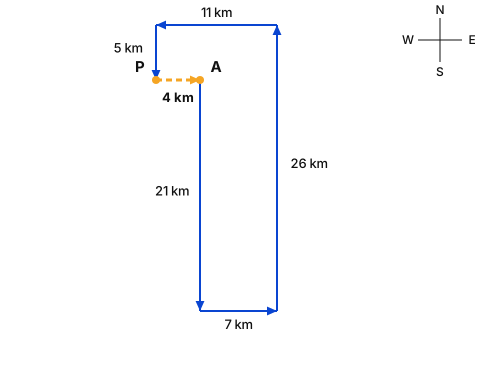
Mr. KLM starts from Point A and drives 21 km towards the south. He then takes a left turn, drives 7 km, turns left and drives 26 km. He then takes a left turn and drives 11 km. He takes a final left turn, drives 5 km and stops at Point P. How far (shortest distance) and in which direction should he drive in order to reach Point A again? (All turns are 90- degree turns only unless specified)
श्री KLM बिंदु A से चलना शुरू करते हैं और दक्षिण की ओर 21 km ड्राइव करते हैं। फिर वह बाएँ मुड़ते हैं, 7 km ड्राइव करते हैं, बाएँ मुड़ते हैं और 26 km ड्राइव करते हैं। फिर वह बाएँ मुड़ते हैं और 11 km ड्राइव करते हैं। वह अंतिम बार बाएँ मुड़ते हैं, 5 km ड्राइव करते हैं और बिंदु P पर रुक जाते हैं। बिंदु A पर फिर से पहुँचने के लिए उन्हें कितनी दूरी (न्यूनतम दूरी) तक और किस दिशा में ड्राइव करना चाहिए? (जब तक निर्दिष्ट न किया जाए, सभी मोड़ केवल 90 डिग्री के मोड़ हैं)
  1. A4 km to the eastपूर्व की ओर 4 km
  2. B3 km to the westपश्चिम की ओर 3 km
  3. C7 km to the eastपूर्व की ओर 7 km
  4. D5 km to the westपश्चिम की ओर 5 km
Show answer

Concept: Track the net east–west and north–south displacement.

  1. From A: 21 km south, left → 7 km east, left → 26 km north, left → 11 km west, left → 5 km south.
  2. North–south: −21+26−5=0, so P is on the same level as A.
  3. East–west: 7−11=−4, so P is 4 km west of A.
  4. To return to A he must drive 4 km towards the east.

Trick: Add all east–west moves and all north–south moves separately; the sign tells the direction.

Answer: (A) 4 km to the east

अवधारणा: कुल पूर्व–पश्चिम और उत्तर–दक्षिण विस्थापन निकालें।

  1. A से: 21 km दक्षिण, बाएँ → 7 km पूर्व, बाएँ → 26 km उत्तर, बाएँ → 11 km पश्चिम, बाएँ → 5 km दक्षिण।
  2. उत्तर–दक्षिण: −21+26−5=0, अतः P, A के समान स्तर पर है।
  3. पूर्व–पश्चिम: 7−11=−4, अतः P, A से 4 km पश्चिम में है।
  4. A तक लौटने के लिए 4 km पूर्व की ओर जाना होगा।

ट्रिक: पूर्व–पश्चिम और उत्तर–दक्षिण की चालें अलग-अलग जोड़ें; चिह्न दिशा बताता है।

उत्तर: (A) 4 km पूर्व की ओर

RRB NTPC Graduate CBT 1General Intelligence and ReasoningDirection and DistanceRRB NTPC Graduate CBT 1 2024 · 20 Jun Shift 2 →
Q1084.
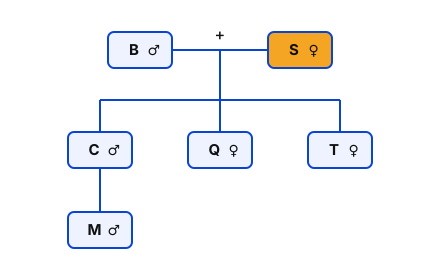
B is the father of C. Q is the sister of C. T is the only sister of Q. T is the child of S. M is the son of S's only son.
How is S related to B?
B, C का पिता है। Q, C की बहन है। T, Q की एकमात्र बहन है। T, S की संतान है। M, S के एकमात्र पुत्र का पुत्र है।
S का B से क्या संबंध है?
  1. AFather's sisterपिता की बहन
  2. BWifeपत्नी
  3. CFather's brotherपिता का भाई
  4. DWife's motherपत्नी की माँ
Show answer

Concept: Build a family tree from the clues and read the relation.

  1. B is the father of C; Q is the sister of C, and T is Q's only sister – so C, Q, T are siblings and B is their father.
  2. T is the child of S, so S is also a parent of C, Q and T.
  3. M is the son of S's only son – S's only son is C, so S is a parent; S is the mother (female) and B is the father.
  4. Hence S is B's wife.

Trick: Two different parents of the same children (one is "father") → the other is the mother, i.e. the wife.

Answer: (B) Wife

अवधारणा: संकेतों से वंश-वृक्ष बनाएँ और संबंध पढ़ें।

  1. B, C का पिता है; Q, C की बहन है और T, Q की एकमात्र बहन – अतः C, Q, T भाई-बहन हैं और B उनका पिता।
  2. T, S की संतान है, अतः S भी C, Q, T का माता/पिता है।
  3. M, S के एकमात्र पुत्र (C) का पुत्र है; B पिता है, अतः S माता है।
  4. इसलिए S, B की पत्नी है।

ट्रिक: एक ही बच्चों के दो अलग माता-पिता (एक "पिता") → दूसरा माता, यानी पत्नी।

उत्तर: (B) पत्नी

RRB NTPC Graduate CBT 1General Intelligence and ReasoningBlood RelationRRB NTPC Graduate CBT 1 2024 · 20 Jun Shift 2 →
Q1085.
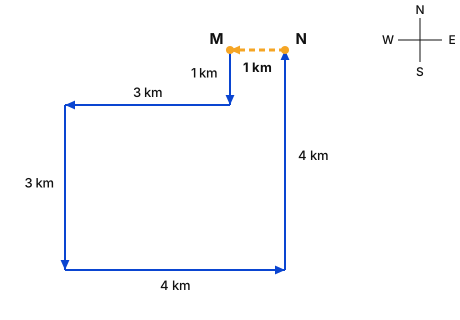
Mr. I starts from Point M and drives 1 km towards the south. He then takes a right turn, drives 3 km, turns left and drives 3 km. He then takes a left turn and drives 4 km. He takes a final left turn, drives 4 km and stops at Point N. How far (shortest distance) and towards which direction should he drive in order to reach Point M again? (All turns are 90-degree turns only unless specified.)
श्री I बिंदु M से चलना शुरू करते हैं और दक्षिण की ओर 1 km ड्राइव करते हैं। फिर वह दाएँ मुड़ते हैं, 3 km ड्राइव करते हैं, बाएँ मुड़ते हैं और 3 km ड्राइव करते हैं। फिर वह बाएँ मुड़ते हैं और 4 km ड्राइव करते हैं। वह अंतिम बार बाएँ मुड़ते हैं, 4 km ड्राइव करते हैं और बिंदु N पर रुक जाते हैं। बिंदु M पर फिर से पहुँचने के लिए उन्हें कितनी दूरी (न्यूनतम दूरी) तक और किस दिशा की ओर ड्राइव करना चाहिए? (जब तक निर्दिष्ट न किया जाए, सभी मोड़ केवल 90 डिग्री के मोड़ हैं।)
  1. A1 km towards the westपश्चिम की ओर 1 km
  2. B2 km towards the southदक्षिण की ओर 2 km
  3. C4 km towards the eastपूर्व की ओर 4 km
  4. D4 km towards the northउत्तर की ओर 4 km
Show answer

Concept: Track the net east–west and north–south displacement.

  1. From M: 1 km south, right → 3 km west, left → 3 km south, left → 4 km east, left → 4 km north.
  2. North–south: −1−3+4=0, so N is level with M.
  3. East–west: −3+4=1, so N is 1 km east of M.
  4. To reach M he must drive 1 km towards the west.

Trick: Facing south, a right turn means west; facing west, a left turn means south.

Answer: (A) 1 km towards the west

अवधारणा: कुल पूर्व–पश्चिम और उत्तर–दक्षिण विस्थापन निकालें।

  1. M से: 1 km दक्षिण, दाएँ → 3 km पश्चिम, बाएँ → 3 km दक्षिण, बाएँ → 4 km पूर्व, बाएँ → 4 km उत्तर।
  2. उत्तर–दक्षिण: −1−3+4=0, अतः N, M के समान स्तर पर।
  3. पूर्व–पश्चिम: −3+4=1, अतः N, M से 1 km पूर्व में।
  4. M तक पहुँचने के लिए 1 km पश्चिम की ओर जाना होगा।

ट्रिक: दक्षिण की ओर मुख हो तो दायाँ = पश्चिम; पश्चिम की ओर मुख हो तो बायाँ = दक्षिण।

उत्तर: (A) 1 km पश्चिम की ओर

RRB NTPC Graduate CBT 1General Intelligence and ReasoningDirection and DistanceRRB NTPC Graduate CBT 1 2024 · 20 Jun Shift 2 →
Q1086.
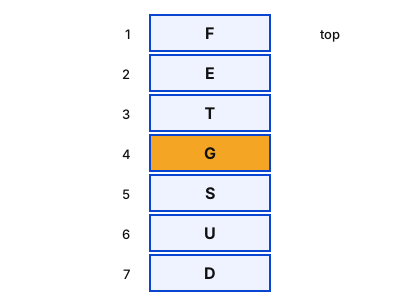
Seven boxes D, E, F, G, S, T and U are kept one over the other but not necessarily in the same order. Only four boxes are kept between E and D. Only F is kept above E. Only two boxes are kept between T and U. G is kept immediately above S. U is not kept
immediately above G. Which box is kept fourth from the top?
सात बक्से D, E, F, G, S, T और U एक के ऊपर एक रखे गए हैं, परंतु आवश्यक नहीं कि इसी क्रम में हों। E और D के बीच केवल चार बक्से रखे गए हैं। E के ऊपर केवल F रखा गया है। T और U के बीच केवल दो बक्से रखे गए हैं। G, S के ठीक ऊपर रखा गया है। U,
G के ठीक ऊपर नहीं रखा गया है। ऊपर से चौथे स्थान पर कौन-सा बक्सा रखा गया है?
  1. AF
  2. BG
  3. CD
  4. DT
Show answer

Concept: Number positions 1 (top) to 7 (bottom) and place the definite boxes first.

  1. Only F is above E → F = 1, E = 2. Four boxes between E and D → D = 7.
  2. Positions 3–6 remain for G, S, T, U. T and U have two boxes between them → T, U take 3 and 6; G, S take 4 and 5 (G immediately above S).
  3. U is not immediately above G, so U ≠ 3 → U = 6, T = 3.
  4. Order: F, E, T, G, S, U, D → fourth from top = G.

Trick: A "gap of 2" pair inside a block of 4 must sit at the two ends of that block.

Answer: (B) G

अवधारणा: स्थान 1 (ऊपर) से 7 (नीचे) तक मानें और पहले निश्चित बॉक्स रखें।

  1. केवल F, E के ऊपर → F = 1, E = 2. E और D के बीच चार बॉक्स → D = 7.
  2. स्थान 3–6 बचे: G, S, T, U. T और U के बीच दो बॉक्स → T, U स्थान 3 और 6; G, S स्थान 4 और 5.
  3. U, G के ठीक ऊपर नहीं → U ≠ 3 → U = 6, T = 3.
  4. क्रम: F, E, T, G, S, U, D → ऊपर से चौथा = G.

ट्रिक: 4 के खंड में "बीच में 2" वाली जोड़ी उस खंड के दोनों सिरों पर ही बैठेगी।

उत्तर: (B) G

RRB NTPC Graduate CBT 1General Intelligence and ReasoningBox ArrangementRRB NTPC Graduate CBT 1 2024 · 20 Jun Shift 2 →
Q1087.
Vinod ranked 36th from the top and 18th from the bottom in his class. How many students are there in his class?
विनोद अपनी कक्षा में ऊपर से 36वें और नीचे से 18वें स्थान पर है। उसकी कक्षा में कितने विद्यार्थी हैं?
  1. A54
  2. B53
  3. C51
  4. D52
Show answer

Concept: Total = rank from top + rank from bottom −1.

  1. Total =36+18−1.
  2. =53 students.

Trick: Subtract 1 because Vinod is counted in both ranks.

Answer: (B) 53

अवधारणा: कुल = ऊपर से रैंक + नीचे से रैंक −1.

  1. कुल =36+18−1.
  2. =53 विद्यार्थी।

ट्रिक: 1 घटाते हैं क्योंकि विनोद दोनों रैंकों में गिना गया है।

उत्तर: (B) 53

RRB NTPC Graduate CBT 1General Intelligence and ReasoningRankingRRB NTPC Graduate CBT 1 2024 · 20 Jun Shift 2 →
Q1088.
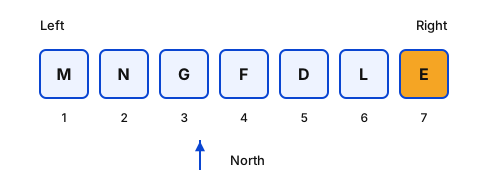
Seven people, D, E, F, G, L, M and N, are sitting in a row, facing north. Only M sits to the left of N. Only four people sit between M and L. Only F sits between G and D, and G is not an immediate neighbour of L. Who sits at the extreme right of the line?
सात व्यक्ति, D, E, F, G, L, M और N, उत्तर की ओर मुख करके एक पंक्ति में बैठे हैं। N के बाईं ओर केवल M बैठा है। M और L के बीच केवल चार व्यक्ति बैठे हैं। G और D के बीच केवल F बैठा है, और G, L का निकटतम पड़ोसी नहीं है। पंक्ति के अंतिम दाएँ छोर पर कौन बैठा है?
  1. AN
  2. BD
  3. CE
  4. DG
Show answer

Concept: Place the people whose positions are fixed first (all face north, so left = left of the line).

  1. Only M sits to the left of N → M = 1, N = 2.
  2. Four people between M and L → L = 6.
  3. D, E, F, G go to 3, 4, 5, 7. F is between G and D (G _F_ D), and G is not next to L, so G ≠ 5, 7 → G = 3, F = 4, D = 5.
  4. E = 7, the extreme right.

Trick: When a block of three (G F D) must fit, check which free slots are consecutive.

Answer: (C) E

अवधारणा: पहले निश्चित स्थान वाले व्यक्तियों को बैठाएँ (सभी उत्तर की ओर मुख, अतः बायाँ = पंक्ति का बायाँ)।

  1. केवल M, N के बाएँ → M = 1, N = 2.
  2. M और L के बीच चार लोग → L = 6.
  3. D, E, F, G के लिए 3, 4, 5, 7. F, G और D के बीच है, G, L का पड़ोसी नहीं → G = 3, F = 4, D = 5.
  4. E = 7, सबसे दाएँ।

ट्रिक: तीन का खंड (G F D) बैठाना हो तो देखें कौन-से खाली स्थान लगातार हैं।

उत्तर: (C) E

RRB NTPC Graduate CBT 1General Intelligence and ReasoningLinear SeatingRRB NTPC Graduate CBT 1 2024 · 20 Jun Shift 2 →
Q1089.
Select the letter-cluster from among the given options that can replace the question mark (?) in the following series.
ENU FLS GJQ ? IFM
दिए गए विकल्पों में से उस अक्षर-समूह का चयन कीजिए जो निम्नलिखित श्रृंखला में प्रश्नचिह्न (?) को प्रतिस्थापित कर सकता है।
ENU FLS GJQ ? IFM
  1. AHHO
  2. BHOP
  3. CHIO
  4. DHIP
Show answer

Concept: Track each letter position of the clusters separately.

  1. First letters: E, F, G, ?, I → +1 each → H.
  2. Second letters: N, L, J, ?, F → −2 each → H.
  3. Third letters: U, S, Q, ?, M → −2 each → O.
  4. Missing cluster = HHO.

Trick: Split the clusters into columns and the pattern is visible at once.

Answer: (A) HHO

अवधारणा: प्रत्येक स्थान के अक्षर को अलग से देखें।

  1. पहले अक्षर: E, F, G, ?, I → +1 → H.
  2. दूसरे अक्षर: N, L, J, ?, F → −2 → H.
  3. तीसरे अक्षर: U, S, Q, ?, M → −2 → O.
  4. लुप्त समूह = HHO.

ट्रिक: समूहों को स्तंभों में बाँटें, पैटर्न तुरंत दिखेगा।

उत्तर: (A) HHO

RRB NTPC Graduate CBT 1General Intelligence and ReasoningLetter SeriesRRB NTPC Graduate CBT 1 2024 · 20 Jun Shift 2 →
Q1090.
Based on the English alphabetical order, three of the following four letter-clusters are alike in a certain way and thus form a group. Which letter-cluster DOES NOT belong to that group?
(Note: The odd one out is not based on the number of consonants/vowels or their position in the letter-cluster.)
अंग्रेज़ी वर्णमाला क्रम के आधार पर, निम्नलिखित चार अक्षर-समूहों में से तीन किसी निश्चित प्रकार से समान हैं और इस प्रकार एक समूह बनाते हैं। कौन-सा अक्षर-समूह उस समूह से संबंधित नहीं है?
(ध्यान दें: असंगत का निर्धारण व्यंजनों/स्वरों की संख्या या अक्षर-समूह में उनकी स्थिति के आधार पर नहीं है।)
  1. AWQNJ
  2. BKEBW
  3. CQKHC
  4. DFZWR
Show answer

Concept: Use alphabet positions (A = 1 … Z = 26) and find the gaps between consecutive letters (wrap Z → A).

  1. KEBW: K(11) −6 → E(5) −3 → B(2) −5 → W (wrap).
  2. QKHC: Q(17) −6 → K(11) −3 → H(8) −5 → C(3). FZWR: F(6) −6 → Z (wrap) −3 → W(23) −5 → R(18).
  3. WQNJ: W(23) −6 → Q(17) −3 → N(14) −4 → J(10) – last gap is −4, not −5.

Trick: Learn EJOTY (5, 10, 15, 20, 25) to get letter positions fast.

Answer: (A) WQNJ

अवधारणा: अक्षरों के स्थान (A = 1 … Z = 26) लें और क्रमागत अक्षरों का अंतर देखें (Z → A घुमाव सहित)।

  1. KEBW: K(11) −6 → E(5) −3 → B(2) −5 → W.
  2. QKHC: Q(17) −6 → K(11) −3 → H(8) −5 → C(3). FZWR: F(6) −6 → Z −3 → W(23) −5 → R(18).
  3. WQNJ: W(23) −6 → Q(17) −3 → N(14) −4 → J(10) – अंतिम अंतर −4, −5 नहीं।

ट्रिक: EJOTY (5, 10, 15, 20, 25) याद रखें, स्थान जल्दी मिलेंगे।

उत्तर: (A) WQNJ

RRB NTPC Graduate CBT 1General Intelligence and ReasoningOdd One Out – LettersRRB NTPC Graduate CBT 1 2024 · 20 Jun Shift 2 →
Q1091.
Seven friends, I, J, K, L, M, N and R, are sitting in a row facing north. No one sits to the right of M. Only three people sit between M and R. Only two people sit between R and L. K sits third to the left of I. J sits to the immediate right of I. How many people sit between N and L?
सात मित्र, I, J, K, L, M, N और R, उत्तर की ओर मुख करके एक पंक्ति में बैठे हैं। M के दाईं ओर कोई नहीं बैठा है। M और R के बीच केवल तीन व्यक्ति बैठे हैं। R और L के बीच केवल दो व्यक्ति बैठे हैं। K, I के बाईं ओर तीसरे स्थान पर बैठा है। J, I के ठीक दाईं ओर बैठा है। N और L के बीच कितने व्यक्ति बैठे हैं?
  1. ATwoदो
  2. BOneएक
  3. CFourचार
  4. DThreeतीन
Show answer

Concept: All face north; fix M first, then R, L and finally the I–J–K block.

  1. No one to the right of M → M = 7. Three between M and R → R = 3. Two between R and L → L = 6.
  2. Free seats: 1, 2, 4, 5. J is immediately right of I, so I–J = 1–2 or 4–5; K is third to the left of I, so I = 4, J = 5, K = 1.
  3. N = 2. Row: K, N, R, I, J, L, M.
  4. Between N (2) and L (6): R, I, J → three people.

Trick: People between seats p and q =|p−q|−1=6−2−1=3.

Answer: (D) Three

अवधारणा: सभी उत्तर की ओर मुख; पहले M, फिर R, L और अंत में I–J–K खंड रखें।

  1. M के दाएँ कोई नहीं → M = 7. M और R के बीच तीन → R = 3. R और L के बीच दो → L = 6.
  2. खाली स्थान: 1, 2, 4, 5. J, I के ठीक दाएँ; K, I के बाएँ तीसरा → I = 4, J = 5, K = 1.
  3. N = 2. पंक्ति: K, N, R, I, J, L, M.
  4. N (2) और L (6) के बीच: R, I, J → तीन लोग।

ट्रिक: स्थान p और q के बीच व्यक्ति =|p−q|−1=6−2−1=3.

उत्तर: (D) तीन

RRB NTPC Graduate CBT 1General Intelligence and ReasoningLinear SeatingRRB NTPC Graduate CBT 1 2024 · 20 Jun Shift 2 →
Q1092.
A group of numbers and symbols is coded using letter codes as per the codes given below and the conditions that follow. Study the given codes and conditions and answer the question that follows.
Note: If none of the conditions apply, then codes for the respective number/symbol are to be followed directly as given in the table.
Number/symbol5$72%*3^#9+
CodeAFLBGMCHNDJ
Conditions:
i) If the first element is a number and the last a symbol, then the codes for these two (the first and the last elements) are to be interchanged.
ii) If the first and the last elements are odd numbers, then the first and last elements are to be coded as @.
iii) If both the second and third elements are perfect square roots, then the third element is to be coded as the code for the second element.
What will be the code for 5#64%?
संख्याओं और प्रतीकों के एक समूह को नीचे दिए गए कूटों और उसके बाद दी गई शर्तों के अनुसार अक्षर कूटों का उपयोग करके कूटबद्ध किया जाता है। दिए गए कूटों और शर्तों का अध्ययन कीजिए और उसके बाद दिए गए प्रश्न का उत्तर दीजिए।
ध्यान दें: यदि कोई भी शर्त लागू नहीं होती है, तो संबंधित संख्या/प्रतीक के लिए तालिका में दिए गए कूटों का सीधे अनुसरण किया जाना है।
संख्या/प्रतीक5$72%*3^#9+
कूटAFLBGMCHNDJ
शर्तें:
i) यदि पहला तत्व एक संख्या है और अंतिम तत्व एक प्रतीक है, तो इन दोनों (पहले और अंतिम तत्वों) के कूट आपस में बदल दिए जाने हैं।
ii) यदि पहला और अंतिम तत्व विषम संख्याएँ हैं, तो पहले और अंतिम तत्वों को @ के रूप में कूटबद्ध किया जाना है।
iii) यदि दूसरा और तीसरा, दोनों तत्व पूर्ण वर्गमूल हैं, तो तीसरे तत्व को दूसरे तत्व के कूट के रूप में कूटबद्ध किया जाना है।
5#64% के लिए कूट क्या होगा?
  1. AANPKG
  2. BAKPNG
  3. CGNPKA
  4. DGKPNA
Show answer

Concept: Write the direct codes, then check each condition in order on the first, second, third and last elements.

  1. 5#64%: direct codes 5 → A, # → N, 6 → P, 4 → K, % → G, i.e. A N P K G.
  2. Condition (i): first element 5 is a number, last element % is a symbol → interchange their codes → G N P K A.
  3. Condition (ii) fails (last is not an odd number); condition (iii) fails (# is not a number).
  4. Code = GNPKA.

Trick: Test the conditions on the given string before writing codes – only the matching one changes the result.

Answer: (C) GNPKA

अवधारणा: पहले सीधे कोड लिखें, फिर क्रम से प्रत्येक शर्त पहले, दूसरे, तीसरे और अंतिम तत्व पर जाँचें।

  1. 5#64%: सीधे कोड 5 → A, # → N, 6 → P, 4 → K, % → G, अर्थात A N P K G.
  2. शर्त (i): पहला तत्व 5 संख्या, अंतिम % प्रतीक → इनके कोड आपस में बदलें → G N P K A.
  3. शर्त (ii) लागू नहीं (अंतिम विषम संख्या नहीं); शर्त (iii) लागू नहीं (# संख्या नहीं)।
  4. कोड = GNPKA.

ट्रिक: कोड लिखने से पहले दिए गए समूह पर शर्तें जाँचें – केवल लागू होने वाली शर्त परिणाम बदलती है।

उत्तर: (C) GNPKA

RRB NTPC Graduate CBT 1General Intelligence and ReasoningCoding with ConditionsRRB NTPC Graduate CBT 1 2024 · 20 Jun Shift 2 →
Q1093.
If 1 is added to each odd digit and 1 is subtracted from each even digit in the number 1865374, which of the following digits will be third from the left in the new number thus formed?
यदि संख्या 1865374 में प्रत्येक विषम अंक में 1 जोड़ा जाए और प्रत्येक सम अंक में से 1 घटाया जाए, तो इस प्रकार बनी नई संख्या में निम्नलिखित में से कौन-सा अंक बाएँ से तीसरा होगा?
  1. A7
  2. B3
  3. C5
  4. D2
Show answer

Concept: Apply the rule to each digit and read the required position.

  1. 1865374: 1 (odd) +1=2, 8 (even) −1=7, 6 →5, 5 →6, 3 →4, 7 →8, 4 →3.
  2. New number: 2756483.
  3. Third digit from the left =5.

Trick: Only the third digit matters: 6 is even → 6−1=5.

Answer: (C) 5

अवधारणा: प्रत्येक अंक पर नियम लगाएँ और माँगा गया स्थान पढ़ें।

  1. 1865374: 1 (विषम) +1=2, 8 (सम) −1=7, 6 →5, 5 →6, 3 →4, 7 →8, 4 →3.
  2. नई संख्या: 2756483.
  3. बाएँ से तीसरा अंक =5.

ट्रिक: केवल तीसरा अंक चाहिए: 6 सम है → 6−1=5.

उत्तर: (C) 5

RRB NTPC Graduate CBT 1General Intelligence and ReasoningDigit OperationsRRB NTPC Graduate CBT 1 2024 · 20 Jun Shift 2 →
Q1094.
Which of the given letter-clusters should replace # and % so that the pattern and relationship followed between the letter-cluster pair on the left side of :: is the same as that on the right side of ::?
# : DZT :: QMG : %
दिए गए अक्षर-समूहों में से कौन-से # और % को प्रतिस्थापित करेंगे, ताकि :: के बाईं ओर के अक्षर-समूह युग्म के बीच का पैटर्न और संबंध, :: के दाईं ओर के अक्षर-समूह युग्म के समान हो?
# : DZT :: QMG : %
  1. A# = OYV, % = PYT
  2. B# = YUO, % = VRL
  3. C# = YPG, % = KUL
  4. D# = ZTY, % = VMH
Show answer

Concept: Find the rule from the complete pair (or the internal pattern) and test options.

  1. Inside DZT: D −4 → Z, Z −6 → T; inside QMG: Q −4 → M, M −6 → G. Both clusters use the gaps −4, −6.
  2. Option B: YUO → Y −4 → U, U −6 → O ✓ and VRL → V −4 → R, R −6 → L ✓.
  3. Also the pairs match: YUO +5 each → DZT, and QMG +5 each → VRL.

Trick: Pair rule "+5 to each letter" works both sides: Y→D, U→Z, O→T and Q→V, M→R, G→L.

Answer: (B) # = YUO, % = VRL

अवधारणा: पूरी जोड़ी (या आंतरिक पैटर्न) से नियम निकालें और विकल्प जाँचें।

  1. DZT में: D −4 → Z, Z −6 → T; QMG में: Q −4 → M, M −6 → G.
  2. विकल्प B: YUO → Y −4 → U, U −6 → O ✓ और VRL → V −4 → R, R −6 → L ✓.
  3. जोड़ी नियम भी मिलता है: YUO में +5 → DZT, और QMG में +5 → VRL.

ट्रिक: प्रत्येक अक्षर में +5: Y→D, U→Z, O→T तथा Q→V, M→R, G→L.

उत्तर: (B) # = YUO, % = VRL

RRB NTPC Graduate CBT 1General Intelligence and ReasoningLetter AnalogyRRB NTPC Graduate CBT 1 2024 · 20 Jun Shift 2 →
Q1095.
If 1 is added to each odd digit and 2 is subtracted from each even digit in the number 1862547, then what will the difference between the highest and lowest digits in the new number thus formed be?
यदि संख्या 1862547 में प्रत्येक विषम अंक में 1 जोड़ा जाए और प्रत्येक सम अंक में से 2 घटाया जाए, तो इस प्रकार बनी नई संख्या में सबसे बड़े और सबसे छोटे अंकों के बीच का अंतर क्या होगा?
  1. A7
  2. B8
  3. C9
  4. D6
Show answer

Concept: Apply the rule to each digit, then find the highest and lowest digits.

  1. 1862547: 1 →2, 8 →6, 6 →4, 2 →0, 5 →6, 4 →2, 7 →8.
  2. New number: 2640628.
  3. Highest =8, lowest =0; difference =8−0=8.

Trick: Watch for 2 → 0: a zero often becomes the lowest digit.

Answer: (B) 8

अवधारणा: प्रत्येक अंक पर नियम लगाएँ, फिर सबसे बड़ा और सबसे छोटा अंक निकालें।

  1. 1862547: 1 →2, 8 →6, 6 →4, 2 →0, 5 →6, 4 →2, 7 →8.
  2. नई संख्या: 2640628.
  3. सबसे बड़ा =8, सबसे छोटा =0; अंतर =8.

ट्रिक: 2 → 0 पर ध्यान दें: शून्य अक्सर सबसे छोटा अंक बनता है।

उत्तर: (B) 8

RRB NTPC Graduate CBT 1General Intelligence and ReasoningDigit OperationsRRB NTPC Graduate CBT 1 2024 · 20 Jun Shift 2 →
Q1096.
What was the theme for the Republic Day 2025 celebrations in India?
भारत में गणतंत्र दिवस 2025 समारोह का विषय (theme) क्या था?
  1. ASwarnim Bharat: Virasat Aur Vikasस्वर्णिम भारत: विरासत और विकास
  2. BCelebrating the Constitutionसंविधान का उत्सव (Celebrating the Constitution)
  3. CUnity in Diversityविविधता में एकता (Unity in Diversity)
  4. DIndia@75: A Nation Marching ForwardIndia@75: प्रगति की ओर अग्रसर राष्ट्र
Show answer

Concept: The theme of the Republic Day parade is announced each year by the Ministry of Defence.

  1. India celebrated its 76th Republic Day on 26 January 2025.
  2. The theme was "Swarnim Bharat: Virasat aur Vikas" (Golden India: Heritage and Development).
  3. Indonesian President Prabowo Subianto was the chief guest.
  4. "India@75" relates to the Azadi Ka Amrit Mahotsav period, not 2025.

Yaad rakhein: 76th Republic Day 2025 = Swarnim Bharat – Virasat aur Vikas.

Answer: (A) Swarnim Bharat: Virasat Aur Vikas

अवधारणा: गणतंत्र दिवस परेड की थीम हर वर्ष रक्षा मंत्रालय घोषित करता है।

  1. 26 जनवरी 2025 को भारत ने 76वाँ गणतंत्र दिवस मनाया।
  2. थीम थी "स्वर्णिम भारत: विरासत और विकास"।
  3. मुख्य अतिथि इंडोनेशिया के राष्ट्रपति प्रबोवो सुबियांतो थे।
  4. "India@75" आज़ादी का अमृत महोत्सव से जुड़ा था, 2025 से नहीं।

याद रखें: 76वाँ गणतंत्र दिवस 2025 = स्वर्णिम भारत – विरासत और विकास।

उत्तर: (A) Swarnim Bharat: Virasat Aur Vikas

RRB NTPC Graduate CBT 1General AwarenessRepublic Day 2025RRB NTPC Graduate CBT 1 2024 · 20 Jun Shift 1 →
Q1097.
According to the World Bank 2021 data, what was the poverty rate at $2.15 a day (2017 PPP) for India?
विश्व बैंक के 2021 के आँकड़ों के अनुसार, भारत के लिए $2.15 प्रतिदिन (2017 PPP) पर गरीबी दर कितनी थी?
  1. A12.92%
  2. B8.9%
  3. C15%
  4. D10.5%
Show answer

Concept: The World Bank measures extreme poverty with the international poverty line of $2.15 per person per day (2017 PPP).

  1. As per World Bank estimates for 2021, about 12.92% of India's population lived below $2.15 a day.
  2. This share had fallen sharply from earlier years (above 20% in 2011).
  3. PPP = Purchasing Power Parity, which adjusts for price differences between countries.

Yaad rakhein: World Bank extreme poverty line: $2.15/day (2017 PPP); India 2021 ≈ 12.9%.

Answer: (A) 12.92%

अवधारणा: विश्व बैंक अत्यधिक गरीबी को अंतरराष्ट्रीय गरीबी रेखा $2.15 प्रति व्यक्ति प्रतिदिन (2017 PPP) से मापता है।

  1. विश्व बैंक के 2021 के अनुमान के अनुसार भारत की लगभग 12.92% आबादी $2.15 प्रतिदिन से नीचे थी।
  2. यह अनुपात 2011 (20% से अधिक) की तुलना में काफी घटा है।
  3. PPP = क्रय शक्ति समता (Purchasing Power Parity), जो देशों के मूल्य अंतर को समायोजित करती है।

याद रखें: विश्व बैंक अत्यधिक गरीबी रेखा: $2.15/दिन (2017 PPP); भारत 2021 ≈ 12.9%।

उत्तर: (A) 12.92%

RRB NTPC Graduate CBT 1General AwarenessPoverty – World Bank dataRRB NTPC Graduate CBT 1 2024 · 20 Jun Shift 1 →
Q1098.
Who is known as the 'Mother of Indian Revolution' for her pioneering role in the early Indian independence movement and for unfurling the first version of the Indian national flag abroad?
प्रारंभिक भारतीय स्वतंत्रता आंदोलन में अपनी अग्रणी भूमिका तथा विदेश में भारतीय राष्ट्रीय ध्वज का पहला संस्करण फहराने के लिए किसे 'भारतीय क्रांति की जननी' के रूप में जाना जाता है?
  1. AVijaya Lakshmi Panditविजया लक्ष्मी पंडित
  2. BAnnie Besantएनी बेसेंट
  3. CMadam Bhikaji Camaमैडम भीकाजी कामा
  4. DSarojini Naiduसरोजिनी नायडू
Show answer

Concept: Madam Bhikaji Rustom Cama was a revolutionary who worked for India's freedom from Europe.

  1. On 22 August 1907 she unfurled an early version of the Indian national flag at the International Socialist Congress in Stuttgart, Germany.
  2. Hence she is called the "Mother of Indian Revolution".
  3. Annie Besant led the Home Rule League; Sarojini Naidu was the "Nightingale of India".

Yaad rakhein: Stuttgart 1907 flag = Bhikaji Cama.

Answer: (C) Madam Bhikaji Cama

अवधारणा: मैडम भीकाजी रुस्तम कामा एक क्रांतिकारी थीं जिन्होंने यूरोप से भारत की आज़ादी के लिए काम किया।

  1. 22 अगस्त 1907 को उन्होंने जर्मनी के स्टटगार्ट में अंतरराष्ट्रीय समाजवादी सम्मेलन में भारतीय ध्वज का प्रारंभिक रूप फहराया।
  2. इसलिए उन्हें "भारतीय क्रांति की जननी" कहा जाता है।
  3. एनी बेसेंट – होम रूल लीग; सरोजिनी नायडू – "भारत कोकिला"।

याद रखें: स्टटगार्ट 1907 ध्वज = भीकाजी कामा।

उत्तर: (C) Madam Bhikaji Cama

RRB NTPC Graduate CBT 1General AwarenessFreedom fightersRRB NTPC Graduate CBT 1 2024 · 20 Jun Shift 1 →
Q1099.
The crescent-shaped sand dunes found in the Thar Desert are called:
थार मरुस्थल में पाए जाने वाले अर्धचंद्राकार रेत के टीलों को क्या कहा जाता है?
  1. AInselbergsइन्सेलबर्ग (Inselbergs)
  2. BErgsअर्ग (Ergs)
  3. CBarchansबरखान (Barchans)
  4. DYardangsयारडांग (Yardangs)
Show answer

Concept: Wind-made (aeolian) landforms are common in hot deserts like the Thar.

  1. Barchans are crescent (moon)-shaped sand dunes whose horns point downwind; they form where wind blows from one direction.
  2. Inselbergs are isolated rocky hills; Ergs are vast sand seas; Yardangs are wind-carved rock ridges.

Trick: Barchan = crescent dune (C for Crescent).

Answer: (C) Barchans

अवधारणा: पवन द्वारा बने स्थलरूप थार जैसे गर्म मरुस्थलों में आम हैं।

  1. बरखान (Barchans) अर्धचंद्राकार रेत के टीले हैं जिनकी भुजाएँ हवा की दिशा में होती हैं।
  2. इंसेलबर्ग – अलग-थलग चट्टानी पहाड़ी; अर्ग – विशाल रेत सागर; यारदांग – हवा से कटी चट्टानी कटक।

ट्रिक: बरखान = अर्धचंद्राकार टीला।

उत्तर: (C) Barchans

RRB NTPC Graduate CBT 1General AwarenessDesert landformsRRB NTPC Graduate CBT 1 2024 · 20 Jun Shift 1 →
Q1100.
Which of the following was the famous ruler of the Satavahana dynasty?
निम्नलिखित में से कौन सातवाहन वंश का प्रसिद्ध शासक था?
  1. AGautamiputra Satakarniगौतमीपुत्र सातकर्णी
  2. BKanishkaकनिष्क
  3. CBhagabhadraभागभद्र
  4. DVasumitra Satakarniवसुमित्र सातकर्णी
Show answer

Concept: The Satavahanas ruled the Deccan after the Mauryas.

  1. Gautamiputra Satakarni was the greatest Satavahana ruler; the Nasik inscription of his mother Gautami Balashri praises his victories over Shakas, Yavanas and Pahlavas.
  2. Kanishka belonged to the Kushana dynasty; Bhagabhadra was a Shunga king.

Yaad rakhein: Satavahana greatest = Gautamiputra Satakarni (Nasik prashasti).

Answer: (A) Gautamiputra Satakarni

अवधारणा: मौर्यों के बाद सातवाहनों ने दक्कन पर शासन किया।

  1. गौतमीपुत्र सातकर्णी सबसे महान सातवाहन शासक थे; उनकी माता गौतमी बालश्री के नासिक अभिलेख में शकों, यवनों और पह्लवों पर उनकी विजय का वर्णन है।
  2. कनिष्क कुषाण वंश के थे; भागभद्र शुंग शासक थे।

याद रखें: सातवाहन का सबसे महान = गौतमीपुत्र सातकर्णी (नासिक प्रशस्ति)।

उत्तर: (A) Gautamiputra Satakarni

RRB NTPC Graduate CBT 1General AwarenessAncient India – SatavahanasRRB NTPC Graduate CBT 1 2024 · 20 Jun Shift 1 →