Question bank

Q&A: practice questions with answers

Search questions on any topic. Filter by exam category, exam, subject and topic, try the question, then open the answer and explanation.

Courses – airGurukul

7,077 questions found.

Q1541.
When the difference between compound interest, compounded annually, and simple interest for three years is ₹228 at 4% interest per annum, the principal is ₹_____.
जब 4% वार्षिक ब्याज दर पर तीन वर्षों के लिए वार्षिक रूप से संयोजित चक्रवृद्धि ब्याज और साधारण ब्याज का अंतर ₹228 है, तो मूलधन ₹_____ है।
  1. A46,300
  2. B48,075
  3. C47,295
  4. D46,875
Show answer

Concept: For 3 years: CI−SI=P(r100)2(3+r100).

  1. 228=P×(4100)2×(3+4100)=P×1610000×304100.
  2. 228=P×48641000000.
  3. P=228×10000004864=46875.

Trick: 4864=64×76 and 228=3×76, so P=3×10664=46875.

Answer: (D) 46,875

अवधारणा: 3 वर्षों के लिए: CI−SI=P(r100)2(3+r100)।

  1. 228=P×(4100)2×(3+4100)=P×1610000×304100।
  2. 228=P×48641000000।
  3. P=228×10000004864=46875।

ट्रिक: 4864=64×76 तथा 228=3×76, अतः P=3×10664=46875।

उत्तर: (D) 46,875

RRB NTPC Graduate CBT 1MathematicsCompound vs simple interestRRB NTPC Graduate CBT 1 2024 · 18 Jun Shift 3 →
Q1542.
A sum, when invested at 20% simple interest per annum, amounts to ₹4,800 after 3 years. What is the simple interest (in ₹) on the same sum at the same rate in 1 year?
एक राशि 20% वार्षिक साधारण ब्याज पर निवेश करने पर 3 वर्ष बाद ₹4,800 हो जाती है। उसी राशि पर उसी दर से 1 वर्ष का साधारण ब्याज (₹ में) कितना है?
  1. A2,400
  2. B1,200
  3. C600
  4. D300
Show answer

Concept: Amount =P(1+RT100) under simple interest.

  1. 4800=P(1+20×3100)=1.6P.
  2. P=48001.6=3000.
  3. SI for 1 year =3000×20×1100=600.

Trick: 3 years at 20% = 60%: 160%→4800, so 20%→600 directly.

Answer: (C) 600

अवधारणा: साधारण ब्याज में मिश्रधन =P(1+RT100)।

  1. 4800=P(1+20×3100)=1.6P।
  2. P=48001.6=3000।
  3. 1 वर्ष का साधारण ब्याज =3000×20×1100=600।

ट्रिक: 3 वर्ष में 20% = 60%: 160%→4800, अतः सीधे 20%→600।

उत्तर: (C) 600

RRB NTPC Graduate CBT 1MathematicsSimple interestRRB NTPC Graduate CBT 1 2024 · 18 Jun Shift 3 →
Q1543.
A salesman marks his good 84% above the cost price and gives a discount of 50% on them. Find the percentage of this gain or loss.
एक विक्रेता अपने माल पर क्रय मूल्य से 84% अधिक मूल्य अंकित करता है और उस पर 50% की छूट देता है। इस लाभ या हानि का प्रतिशत ज्ञात कीजिए।
  1. A5% gain5% लाभ
  2. B9% loss9% हानि
  3. C8% loss8% हानि
  4. D6% gain6% लाभ
Show answer

Concept: If marked price is m% above CP and discount is d%, then SP=CP×(1+m100)(1−d100).

  1. Let CP = 100 → MP = 184.
  2. SP =184×50100=92.
  3. Loss =100−92=8 → 8% loss.

Trick: Net effect =84−50−84×50100=34−42=−8%.

Answer: (C) 8% loss

अवधारणा: यदि अंकित मूल्य CP से m% अधिक तथा छूट d% हो, तो SP=CP×(1+m100)(1−d100)।

  1. माना CP = 100 → MP = 184।
  2. SP =184×50100=92।
  3. हानि =100−92=8 → 8% हानि।

ट्रिक: शुद्ध प्रभाव =84−50−84×50100=34−42=−8%।

उत्तर: (C) 8% हानि

RRB NTPC Graduate CBT 1MathematicsDiscount and profit/lossRRB NTPC Graduate CBT 1 2024 · 18 Jun Shift 3 →
Q1544.
What is the median of the following data?
74, 85, 67, 27, 47, 16, 41, 32, 98, 38, 88
निम्नलिखित आँकड़ों की माध्यिका क्या है?
74, 85, 67, 27, 47, 16, 41, 32, 98, 38, 88
  1. A46.5
  2. B47
  3. C47.5
  4. D48
Show answer

Concept: Arrange the data in ascending order; for an odd count n, median = (n+12)th term.

  1. Sorted: 16, 27, 32, 38, 41, 47, 67, 74, 85, 88, 98.
  2. n=11 → median = (11+12)th=6th term.
  3. 6th term = 47.

Trick: Odd count → exactly one middle value; no averaging needed.

Answer: (B) 47

अवधारणा: आँकड़ों को आरोही क्रम में लगाएँ; विषम n के लिए माध्यिका = (n+12)th पद।

  1. क्रम: 16, 27, 32, 38, 41, 47, 67, 74, 85, 88, 98।
  2. n=11 → माध्यिका = (11+12)th=6th पद।
  3. छठा पद = 47।

ट्रिक: विषम संख्या → केवल एक मध्य मान; औसत निकालने की ज़रूरत नहीं।

उत्तर: (B) 47

RRB NTPC Graduate CBT 1MathematicsMedianRRB NTPC Graduate CBT 1 2024 · 18 Jun Shift 3 →
Q1545.
If 12 , 60 , 13 , and y are in proportion, then the value of y is:
यदि 12 , 60 , 13 , और y समानुपात में हैं, तो y का मान है:
  1. A63
  2. B65
  3. C72
  4. D56
Show answer

Concept: If a,b,c,d are in proportion, then a:b=c:d, i.e. ad=bc.

  1. 12:60=13:y.
  2. 12y=60×13=780.
  3. y=78012=65.

Trick: 60=5×12, so y=5×13=65.

Answer: (B) 65

अवधारणा: यदि a,b,c,d समानुपात में हैं, तो a:b=c:d, अर्थात् ad=bc।

  1. 12:60=13:y।
  2. 12y=60×13=780।
  3. y=78012=65।

ट्रिक: 60=5×12, अतः y=5×13=65।

उत्तर: (B) 65

RRB NTPC Graduate CBT 1MathematicsProportionRRB NTPC Graduate CBT 1 2024 · 18 Jun Shift 3 →
Q1546.
Three numbers are in the ratio 3 : 2 : 13, and their LCM is 4758. Their HCF is ______.
तीन संख्याएँ 3 : 2 : 13 के अनुपात में हैं, और उनका LCM 4758 है। उनका HCF ______ है।
  1. A46
  2. B64
  3. C61
  4. D75
Show answer

Concept: If numbers are 3x,2x,13x (3, 2, 13 pairwise co-prime), HCF =x and LCM =3×2×13×x.

  1. LCM =78x=4758.
  2. x=475878=61.
  3. HCF =61.

Trick: Co-prime ratio terms: HCF =LCMproduct of ratio terms.

Answer: (C) 61

अवधारणा: यदि संख्याएँ 3x,2x,13x हैं (3, 2, 13 परस्पर अभाज्य), तो HCF =x तथा LCM =3×2×13×x।

  1. LCM =78x=4758।
  2. x=475878=61।
  3. HCF =61।

ट्रिक: सह-अभाज्य अनुपात पद: HCF =LCMअनुपात पदों का गुणनफल।

उत्तर: (C) 61

RRB NTPC Graduate CBT 1MathematicsHCF and LCMRRB NTPC Graduate CBT 1 2024 · 18 Jun Shift 3 →
Q1547.
A bike can finish a certain journey in 20 hours at the speed of 66 km/hr. In order to cover the same distance in 15 hours, the speed of the bike (in km/hr) must be increased by ____.
एक बाइक 66 km/hr की चाल से एक निश्चित यात्रा 20 घंटे में पूरी कर सकती है। समान दूरी 15 घंटे में तय करने के लिए बाइक की चाल (km/hr में) ____ बढ़ानी होगी।
  1. A25
  2. B18
  3. C14
  4. D22
Show answer

Concept: Distance is fixed, so speed ∝1time.

  1. Distance =66×20=1320km.
  2. New speed =132015=88km/h.
  3. Increase =88−66=22km/h.

Trick: Time ratio 20:15=4:3 → speed ratio 3:4; 66→88.

Answer: (D) 22

अवधारणा: दूरी स्थिर है, अतः चाल ∝1समय।

  1. दूरी =66×20=1320km।
  2. नई चाल =132015=88km/h।
  3. वृद्धि =88−66=22km/h।

ट्रिक: समय अनुपात 20:15=4:3 → चाल अनुपात 3:4; 66→88।

उत्तर: (D) 22

RRB NTPC Graduate CBT 1MathematicsSpeed, time and distanceRRB NTPC Graduate CBT 1 2024 · 18 Jun Shift 3 →
Q1548.
A cube of side 5 cm and a cuboid of measurements 35 cm,15 cm and 15 cm,
respectively, of the same metal are melted and made into cubes of side 10 cm each. The number of cubes of side 10 cm thus formed is:
एक ही धातु के 5 cm भुजा वाले एक घन और क्रमशः 35 cm, 15 cm और 15 cm माप वाले एक घनाभ को,
पिघलाकर 10 cm भुजा वाले घन बनाए जाते हैं। इस प्रकार बने 10 cm भुजा वाले घनों की संख्या है:
  1. A9
  2. B10
  3. C7
  4. D8
Show answer

Concept: When solids are melted and recast, total volume is conserved.

  1. Volume of cube =53=125cm3.
  2. Volume of cuboid =35×15×15=7875cm3.
  3. Total =8000cm3; one new cube =103=1000cm3.
  4. Number of cubes =80001000=8.

Trick: Number of new solids =total volumevolume of one.

Answer: (D) 8

अवधारणा: ठोसों को पिघलाकर नया ठोस बनाने पर कुल आयतन समान रहता है।

  1. घन का आयतन =53=125cm3।
  2. घनाभ का आयतन =35×15×15=7875cm3।
  3. कुल =8000cm3; एक नया घन =103=1000cm3।
  4. घनों की संख्या =80001000=8।

ट्रिक: नए ठोसों की संख्या =कुल आयतनएक का आयतन।

उत्तर: (D) 8

RRB NTPC Graduate CBT 1MathematicsMensuration – melting and recastingRRB NTPC Graduate CBT 1 2024 · 18 Jun Shift 3 →
Q1549.
A person who spends 32% of his monthly income is able to save ₹7,752 per month. His monthly expenses (in ₹) are:
एक व्यक्ति जो अपनी मासिक आय का 32% खर्च करता है, प्रति माह ₹7,752 की बचत कर पाता है। उसका मासिक व्यय (₹ में) है:
  1. A3,846
  2. B3,864
  3. C3,648
  4. D3,684
Show answer

Concept: Income = Expenditure + Savings; if expenses are 32%, savings are 100%−32%=68%.

  1. 68% of income =7752 → 1%=775268=114.
  2. Expenses =32%=32×114=3648.

Trick: Go directly: expenses =7752×3268=7752×817=3648.

Answer: (C) 3,648

अवधारणा: आय = व्यय + बचत; यदि व्यय 32% है, तो बचत 100%−32%=68%।

  1. आय का 68%=7752 → 1%=775268=114।
  2. व्यय =32%=32×114=3648।

ट्रिक: सीधे: व्यय =7752×3268=7752×817=3648।

उत्तर: (C) 3,648

RRB NTPC Graduate CBT 1MathematicsPercentage – income and expenditureRRB NTPC Graduate CBT 1 2024 · 18 Jun Shift 3 →
Q1550.
Find the simplified value of [525 ÷ {19 + 7 × (3 - 5)}].
[525 ÷ {19 + 7 × (3 - 5)}] का सरलीकृत मान ज्ञात कीजिए।
  1. A102
  2. B105
  3. C108
  4. D104
Show answer

Concept: Solve innermost brackets first, then multiplication, then addition, then division outside.

  1. (3−5)=−2.
  2. 7×(−2)=−14.
  3. {19−14}=5.
  4. 525÷5=105.

Trick: Order: ( ) → { } → [ ].

Answer: (B) 105

अवधारणा: सबसे अंदर का कोष्ठक पहले, फिर गुणा, फिर जोड़, अंत में बाहर का भाग।

  1. (3−5)=−2।
  2. 7×(−2)=−14।
  3. {19−14}=5।
  4. 525÷5=105।

ट्रिक: क्रम: ( ) → { } → [ ]।

उत्तर: (B) 105

RRB NTPC Graduate CBT 1MathematicsSimplification (BODMAS)RRB NTPC Graduate CBT 1 2024 · 18 Jun Shift 3 →
Q1551.
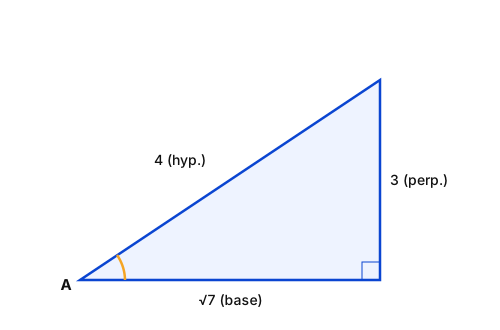
If sinA=34, then calculate cosAcotA.
यदि sinA=34 है, तो cosAcotA की गणना कीजिए।
  1. A127
  2. B712
  3. C67
  4. D76
Show answer

Concept: Use sinA=perpendicularhypotenuse to build a right triangle, then cosAcotA=cos2AsinA.

  1. Perpendicular 3, hypotenuse 4 → base =16−9=7.
  2. cosA=74, cotA=73.
  3. cosAcotA=74×73=712.

Trick: cos2AsinA=1−91634=716×43=712.

Answer: (B) 712

अवधारणा: sinA=लंबकर्ण से समकोण त्रिभुज बनाएँ, फिर cosAcotA=cos2AsinA।

  1. लंब 3, कर्ण 4 → आधार =16−9=7।
  2. cosA=74, cotA=73।
  3. cosAcotA=74×73=712।

ट्रिक: cos2AsinA=1−91634=716×43=712।

उत्तर: (B) 712

RRB NTPC Graduate CBT 1MathematicsTrigonometry – ratiosRRB NTPC Graduate CBT 1 2024 · 18 Jun Shift 3 →
Q1552.
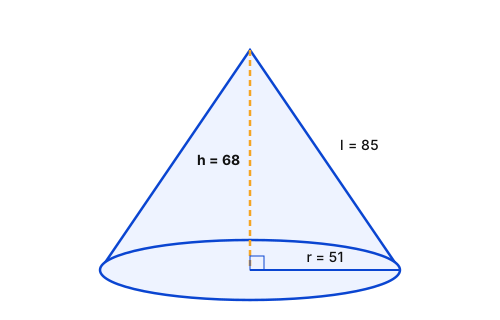
The curved surface area of a right circular cone is 4335π cm2, and the diameter of its base is 102 cm. Find the height (in cm) of the cone.
एक लंब वृत्तीय शंकु का वक्र पृष्ठीय क्षेत्रफल 4335π cm2 है, और इसके आधार का व्यास 102 cm है। शंकु की ऊँचाई (cm में) ज्ञात कीजिए।
  1. A68
  2. B64
  3. C63
  4. D69
Show answer

Concept: Curved surface area of a cone =πrl and h=l2−r2.

  1. r=1022=51cm.
  2. π×51×l=4335π⇒l=433551=85cm.
  3. h=852−512=7225−2601=4624=68cm.

Trick: 51:68:85=17×(3:4:5) — a Pythagorean triplet.

Answer: (A) 68

अवधारणा: शंकु का वक्र पृष्ठीय क्षेत्रफल =πrl तथा h=l2−r2।

  1. r=1022=51cm।
  2. π×51×l=4335π⇒l=433551=85cm।
  3. h=852−512=7225−2601=4624=68cm।

ट्रिक: 51:68:85=17×(3:4:5) — पाइथागोरस त्रिक।

उत्तर: (A) 68

RRB NTPC Graduate CBT 1MathematicsMensuration – coneRRB NTPC Graduate CBT 1 2024 · 18 Jun Shift 3 →
Q1553.
Find the smallest number by which 4232 must be multiplied to make it a perfect square.
वह सबसे छोटी संख्या ज्ञात कीजिए जिससे 4232 को गुणा करने पर वह एक पूर्ण वर्ग बन जाए।
  1. A23
  2. B3
  3. C11
  4. D2
Show answer

Concept: Write the prime factorisation; a perfect square has every prime with an even power.

  1. 4232=2×2116=23×529=23×232.
  2. 23 already has an even power; 2 has power 3 (odd).
  3. Multiply by 2: 24×232=8464=922.

Trick: Pair up primes; the unpaired ones give the smallest multiplier.

Answer: (D) 2

अवधारणा: अभाज्य गुणनखंड लिखें; पूर्ण वर्ग में हर अभाज्य की घात सम होती है।

  1. 4232=2×2116=23×529=23×232।
  2. 23 की घात पहले से सम है; 2 की घात 3 (विषम) है।
  3. 2 से गुणा: 24×232=8464=922।

ट्रिक: अभाज्यों के जोड़े बनाएँ; बिना जोड़े वाले ही सबसे छोटा गुणक देते हैं।

उत्तर: (D) 2

RRB NTPC Graduate CBT 1MathematicsPerfect squaresRRB NTPC Graduate CBT 1 2024 · 18 Jun Shift 3 →
Q1554.
If the quadratic equations 6x2 − 7x − 20 = 0 and 6x2 + bx −10 = 0 have one root in common, find the value of b.
यदि द्विघात समीकरणों 6x2 − 7x − 20 = 0 और 6x2 + bx −10 = 0 का एक मूल उभयनिष्ठ है, तो b का मान ज्ञात कीजिए।
  1. A−11
  2. B11
  3. C10
  4. D−10
Show answer

Concept: Find the roots of the first equation and substitute each into the second.

  1. 6x2−7x−20=(2x−5)(3x+4)=0⇒x=52 or −43.
  2. x=52: 6×254+5b2−10=0⇒27.5+2.5b=0⇒b=−11.
  3. x=−43 gives b=12, which is not among the options.

Trick: Factor first (6×(−20)=−120=−15×8), then test roots.

Answer: (A) −11

अवधारणा: पहले समीकरण के मूल ज्ञात कर दूसरे में रखें।

  1. 6x2−7x−20=(2x−5)(3x+4)=0⇒x=52 या −43।
  2. x=52: 6×254+5b2−10=0⇒27.5+2.5b=0⇒b=−11।
  3. x=−43 से b=12 आता है, जो विकल्पों में नहीं है।

ट्रिक: पहले गुणनखंड करें (6×(−20)=−120=−15×8), फिर मूल जाँचें।

उत्तर: (A) −11

RRB NTPC Graduate CBT 1MathematicsQuadratic equations – common rootRRB NTPC Graduate CBT 1 2024 · 18 Jun Shift 3 →
Q1555.
The population of a town in 1968 was 4,85,000. If its population increased in two successive decades by 20% in each decade, the population of the town in 1988 was:
1968 में एक कस्बे की जनसंख्या 4,85,000 थी। यदि लगातार दो दशकों में प्रत्येक दशक में इसकी जनसंख्या 20% बढ़ी, तो 1988 में कस्बे की जनसंख्या थी:
  1. A6,98,405
  2. B6,98,395
  3. C6,98,400
  4. D6,98,397
Show answer

Concept: Successive growth: Pn=P0(1+r100)n.

  1. P=485000×(1+20100)2=485000×1.44.
  2. 485000×1.44=698400.

Trick: Two successive 20% rises = 20+20+20×20100=44% rise.

Answer: (C) 6,98,400

अवधारणा: क्रमिक वृद्धि: Pn=P0(1+r100)n।

  1. P=485000×(1+20100)2=485000×1.44।
  2. 485000×1.44=698400।

ट्रिक: दो क्रमिक 20% वृद्धि = 20+20+20×20100=44% वृद्धि।

उत्तर: (C) 6,98,400

RRB NTPC Graduate CBT 1MathematicsPopulation growthRRB NTPC Graduate CBT 1 2024 · 18 Jun Shift 3 →
Q1556.
3 men and 14 women can complete a piece of work in 18 days, and 11 men and 8 women can complete the same work in 12 days. The work of how many women is equivalent to that of one man?
3 पुरुष और 14 महिलाएँ एक कार्य को 18 दिनों में पूरा कर सकते हैं, और 11 पुरुष और 8 महिलाएँ उसी कार्य को 12 दिनों में पूरा कर सकते हैं। कितनी महिलाओं का कार्य एक पुरुष के कार्य के बराबर है?
  1. A5
  2. B2
  3. C3
  4. D4
Show answer

Concept: Total work is the same, so (workers × days) are equal in both cases.

  1. 18(3m+14w)=12(11m+8w)
  2. 54m+252w=132m+96w
  3. 156w=78m⇒m=2w

Trick: Divide by 6 first: 3(3m+14w)=2(11m+8w)⇒26w=13m.

Answer: (B) 2

अवधारणा: कुल कार्य समान है, अतः दोनों स्थितियों में (कर्मचारी × दिन) बराबर होंगे।

  1. 18(3m+14w)=12(11m+8w)
  2. 54m+252w=132m+96w
  3. 156w=78m⇒m=2w

ट्रिक: पहले 6 से भाग दें: 3(3m+14w)=2(11m+8w)⇒26w=13m।

उत्तर: (B) 2

RRB NTPC Graduate CBT 1MathematicsTime and WorkRRB NTPC Graduate CBT 1 2024 · 18 Jun Shift 3 →
Q1557.
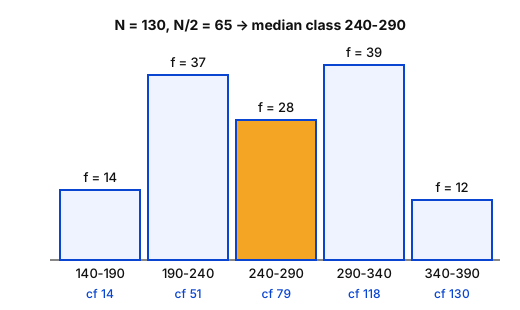
What is the median of the following distribution?
Class140-190190-240240-290290-340340-390
Frequency1437283912
निम्नलिखित बंटन की माध्यिका क्या है?
वर्ग140-190190-240240-290290-340340-390
बारंबारता1437283912
  1. A265
  2. B251
  3. C275
  4. D250
Show answer

Concept: Grouped median =L+N2−cff×h.

  1. N=14+37+28+39+12=130, N2=65.
  2. Cumulative frequencies: 14,51,79,118,130 → 65 lies in 240-290.
  3. L=240, cf=51, f=28, h=50.
  4. Median =240+65−5128×50=240+25=265.

Trick: 65 is exactly midway between 51 and 79, so median ≈ middle of the class = 265.

Answer: (A) 265

अवधारणा: वर्गीकृत माध्यिका =L+N2−cff×h।

  1. N=14+37+28+39+12=130, N2=65।
  2. संचयी बारंबारता: 14,51,79,118,130 → 65 वर्ग 240-290 में है।
  3. L=240, cf=51, f=28, h=50।
  4. माध्यिका =240+65−5128×50=240+25=265।

ट्रिक: 65 ठीक 51 और 79 के बीच में है, इसलिए माध्यिका ≈ वर्ग का मध्य = 265।

उत्तर: (A) 265

RRB NTPC Graduate CBT 1MathematicsStatistics – MedianRRB NTPC Graduate CBT 1 2024 · 18 Jun Shift 3 →
Q1558.
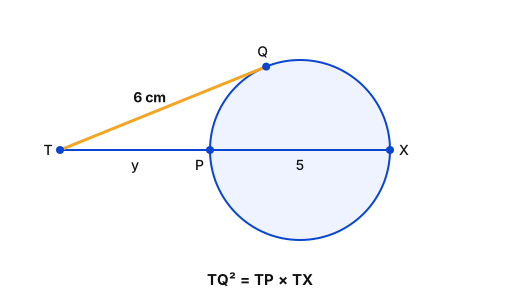
TQ=6 cm is a tangent to the circle and TPX is a secant. If TP=y cm and PX=5 cm, find y.
TQ=6 cm वृत्त की एक स्पर्श रेखा है और TPX एक छेदक रेखा है। यदि TP=y cm और PX=5 cm है, तो y ज्ञात कीजिए।
  1. A4
  2. B6
  3. C5
  4. D3
Show answer

Concept: Tangent-secant theorem: TQ2=TP×TX.

  1. TX=TP+PX=y+5.
  2. 62=y(y+5)⇒y2+5y−36=0.
  3. (y+9)(y−4)=0⇒y=4 (length is positive).

Trick: Check options: 4×9=36=62 ✓.

Answer: (A) 4

अवधारणा: स्पर्श रेखा-छेदक प्रमेय: TQ2=TP×TX।

  1. TX=TP+PX=y+5।
  2. 62=y(y+5)⇒y2+5y−36=0।
  3. (y+9)(y−4)=0⇒y=4 (लंबाई धनात्मक)।

ट्रिक: विकल्प जाँचें: 4×9=36=62 ✓।

उत्तर: (A) 4

RRB NTPC Graduate CBT 1MathematicsCircles – Tangent & SecantRRB NTPC Graduate CBT 1 2024 · 18 Jun Shift 3 →
Q1559.
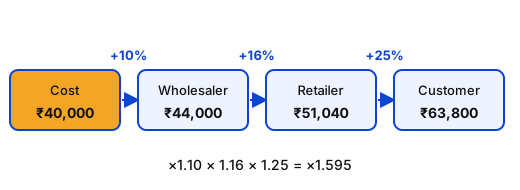
If the manufacturer gains 10%, the wholesale gains 16% and the retailer gains 25%, then find the cost of production of a table (in ₹), whose retail price for the customer is ₹63,800.
(NOTE: Manufacturer sells to wholesaler, wholesaler sells to retailer and retailer sells to customer.)
यदि निर्माता को 10%, थोक विक्रेता को 16% और खुदरा विक्रेता को 25% लाभ होता है, तो उस मेज़ की उत्पादन लागत (₹ में) ज्ञात कीजिए, जिसका ग्राहक के लिए खुदरा मूल्य ₹63,800 है।
(नोट: निर्माता थोक विक्रेता को बेचता है, थोक विक्रेता खुदरा विक्रेता को बेचता है और खुदरा विक्रेता ग्राहक को बेचता है।)
  1. A40,000
  2. B50,000
  3. C44,000
  4. D46,400
Show answer

Concept: Successive gains multiply: Price=C×110100×116100×125100.

  1. C×1.1×1.16×1.25=63800
  2. 1.595C=63800
  3. C=638001.595=40000

Trick: Check: 40000→44000→51040→63800 ✓.

Answer: (A) 40,000

अवधारणा: क्रमिक लाभ गुणा होते हैं: मूल्य=C×110100×116100×125100।

  1. C×1.1×1.16×1.25=63800
  2. 1.595C=63800
  3. C=638001.595=40000

ट्रिक: जाँच: 40000→44000→51040→63800 ✓।

उत्तर: (A) 40,000

RRB NTPC Graduate CBT 1MathematicsProfit and Loss – Successive GainsRRB NTPC Graduate CBT 1 2024 · 18 Jun Shift 3 →
Q1560.
A and B can do a piece of work in 13 days and 52 days, respectively. Both work for 2 days and then A goes away. How long (in days) will B take to complete the remaining work?
A और B एक कार्य को क्रमशः 13 दिनों और 52 दिनों में कर सकते हैं। दोनों 2 दिनों तक कार्य करते हैं और फिर A चला जाता है। शेष कार्य को पूरा करने में B को कितना समय (दिनों में) लगेगा?
  1. A42
  2. B44
  3. C43
  4. D41
Show answer

Concept: Take total work = LCM(13, 52) = 52 units.

  1. A = 5213=4 units/day, B = 1 unit/day.
  2. In 2 days together: 2×(4+1)=10 units.
  3. Remaining =52−10=42 units; B alone takes 421=42 days.

Trick: LCM method avoids fractions completely.

Answer: (A) 42

अवधारणा: कुल कार्य = LCM(13, 52) = 52 इकाई मानें।

  1. A = 5213=4 इकाई/दिन, B = 1 इकाई/दिन।
  2. 2 दिन साथ में: 2×(4+1)=10 इकाई।
  3. शेष =52−10=42 इकाई; B अकेले 421=42 दिन लेगा।

ट्रिक: LCM विधि से भिन्नों से बचें।

उत्तर: (A) 42

RRB NTPC Graduate CBT 1MathematicsTime and WorkRRB NTPC Graduate CBT 1 2024 · 18 Jun Shift 3 →