Question bank

Q&A: practice questions with answers

Search questions on any topic. Filter by exam category, exam, subject and topic, try the question, then open the answer and explanation.

Courses – airGurukul

7,077 questions found.

Q1561.
A man has to cover a distance of 549 km in 8 hours. If he covers 23 of this distance in 34 of the time, then what should be his speed (in km/hr) to cover the remaining distance in the time left?
एक व्यक्ति को 8 घंटे में 549 km की दूरी तय करनी है। यदि वह इस दूरी का 23 भाग, समय के 34 भाग में तय करता है, तो शेष दूरी को शेष समय में तय करने के लिए उसकी चाल (km/hr में) कितनी होनी चाहिए?
  1. A91.5
  2. B96.5
  3. C71.5
  4. D82.5
Show answer

Concept: Required speed =remaining distanceremaining time.

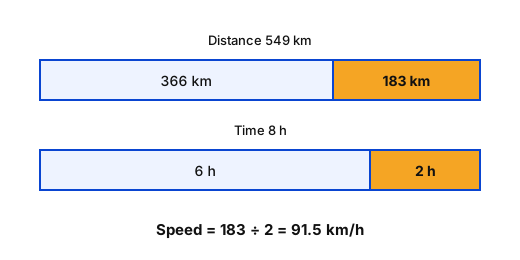
  1. Distance covered =23×549=366 km; remaining =549−366=183 km.
  2. Time used =34×8=6 h; time left =2 h.
  3. Speed =1832=91.5km/h.

Trick: Remaining distance =13×549=183 directly.

Answer: (A) 91.5

अवधारणा: आवश्यक चाल =शेष दूरीशेष समय।

  1. तय दूरी =23×549=366 km; शेष =549−366=183 km।
  2. लगा समय =34×8=6 घंटे; बचा समय =2 घंटे।
  3. चाल =1832=91.5km/h।

ट्रिक: शेष दूरी सीधे =13×549=183।

उत्तर: (A) 91.5

RRB NTPC Graduate CBT 1MathematicsSpeed, Time and DistanceRRB NTPC Graduate CBT 1 2024 · 18 Jun Shift 3 →
Q1562.
An article’s cost price is ₹285, and the marked price is mentioned as ₹1,140. What is the profit percentage of the seller if he sells it by allowing a discount of 70% on the marked price?
एक वस्तु का क्रय मूल्य ₹285 है, और अंकित मूल्य ₹1,140 बताया गया है। यदि विक्रेता अंकित मूल्य पर 70% की छूट देकर इसे बेचता है, तो उसका लाभ प्रतिशत कितना है?
  1. A17%
  2. B19%
  3. C23%
  4. D20%
Show answer

Concept: SP after discount =MP×100−d100; Profit%=SP−CPCP×100.

  1. SP=1140×30100=342
  2. Profit =342−285=57
  3. Profit%=57285×100=20%

Trick: 285×1.2=342 – quick check.

Answer: (D) 20%

अवधारणा: छूट के बाद विक्रय मूल्य =MP×100−d100; लाभ%=SP−CPCP×100।

  1. SP=1140×30100=342
  2. लाभ =342−285=57
  3. लाभ%=57285×100=20%

ट्रिक: 285×1.2=342 – त्वरित जाँच।

उत्तर: (D) 20%

RRB NTPC Graduate CBT 1MathematicsProfit, Loss and DiscountRRB NTPC Graduate CBT 1 2024 · 18 Jun Shift 3 →
Q1563.
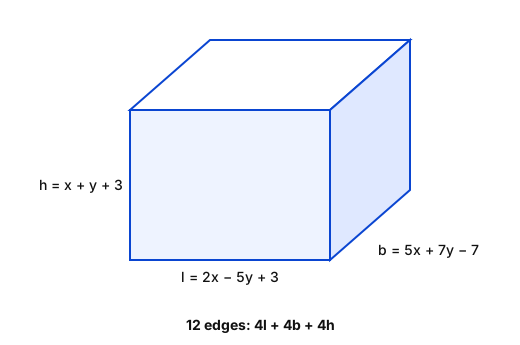
The length, breadth and height of a cuboid are (2x−5y+3) m, (5x+7y−7) m and (x+y+3) m, respectively. Find the perimeter of the cuboid.
एक घनाभ की लंबाई, चौड़ाई और ऊँचाई क्रमशः (2x−5y+3) m, (5x+7y−7) m और (x+y+3) m है। घनाभ का परिमाप ज्ञात कीजिए।
  1. A(32x+12y+4) m
  2. B(32x+12y−4) m
  3. C(16x−12y+8) m
  4. D(16x−12y−8) m
Show answer

Concept: A cuboid has 12 edges (4 of each dimension), so perimeter =4(l+b+h).

  1. l+b+h=(2x−5y+3)+(5x+7y−7)+(x+y+3)
  2. =8x+3y−1
  3. Perimeter =4(8x+3y−1)=32x+12y−4 m.

Trick: Constants: 3−7+3=−1, so the answer must end in −4.

Answer: (B) (32x+12y−4) m

अवधारणा: घनाभ के 12 किनारे (हर विमा के 4) होते हैं, इसलिए परिमाप =4(l+b+h)।

  1. l+b+h=(2x−5y+3)+(5x+7y−7)+(x+y+3)
  2. =8x+3y−1
  3. परिमाप =4(8x+3y−1)=32x+12y−4 m।

ट्रिक: अचर पद: 3−7+3=−1, अतः उत्तर −4 पर समाप्त होगा।

उत्तर: (B) (32x+12y−4) m

RRB NTPC Graduate CBT 1MathematicsMensuration – CuboidRRB NTPC Graduate CBT 1 2024 · 18 Jun Shift 3 →
Q1564.
If a2+b2=163, a×b=27 and a>b, then find the value of a−ba+b.
यदि a2+b2=163, a×b=27 और a>b है, तो a−ba+b का मान ज्ञात कीजिए।
  1. A109217
  2. B109217
  3. C119227
  4. D119227
Show answer

Concept: (a±b)2=a2+b2±2ab.

  1. (a−b)2=163−2×27=109.
  2. (a+b)2=163+2×27=217.
  3. Since a>b, a−ba+b=109217.

Trick: Squares give 109 and 217, so the ratio keeps a square root.

Answer: (A) 109217

अवधारणा: (a±b)2=a2+b2±2ab।

  1. (a−b)2=163−2×27=109।
  2. (a+b)2=163+2×27=217।
  3. चूँकि a>b, a−ba+b=109217।

ट्रिक: वर्ग 109 और 217 देते हैं, इसलिए अनुपात में वर्गमूल रहेगा।

उत्तर: (A) 109217

RRB NTPC Graduate CBT 1MathematicsAlgebraic IdentitiesRRB NTPC Graduate CBT 1 2024 · 18 Jun Shift 3 →
Q1565.
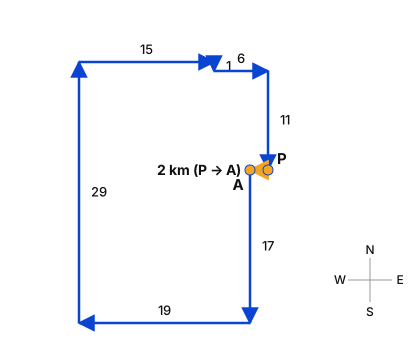
Mr. Yanki starts from Point A and drives 17 km towards the South. He then takes a right turn, drives 19 km, turns right and drives 29 km. He then takes a right turn and drives 15 km, turns right drives 1 km. He then takes a left turn drives 6 km. He takes a final right turn, drives 11 km and stops at Point P. How far (shortest distance) and towards which direction should he drive in order to reach Point A again? (All turns are 90 degrees turns only unless specified.)
श्री यांकी बिंदु A से चलना शुरू करते हैं और दक्षिण की ओर 17 km गाड़ी चलाते हैं। फिर वे दाएँ मुड़ते हैं, 19 km गाड़ी चलाते हैं, दाएँ मुड़ते हैं और 29 km गाड़ी चलाते हैं। फिर वे दाएँ मुड़ते हैं और 15 km गाड़ी चलाते हैं, दाएँ मुड़कर 1 km गाड़ी चलाते हैं। फिर वे बाएँ मुड़कर 6 km गाड़ी चलाते हैं। वे अंतिम बार दाएँ मुड़ते हैं, 11 km गाड़ी चलाते हैं और बिंदु P पर रुक जाते हैं। बिंदु A पर फिर से पहुँचने के लिए उन्हें कितनी दूरी (न्यूनतम दूरी) और किस दिशा में गाड़ी चलानी चाहिए? (जब तक निर्दिष्ट न हो, सभी मोड़ केवल 90 डिग्री के मोड़ हैं।)
  1. A4 km to the Southदक्षिण की ओर 4 km
  2. B2 km to the Westपश्चिम की ओर 2 km
  3. C6 km to the Eastपूर्व की ओर 6 km
  4. D8 km to the Northउत्तर की ओर 8 km
Show answer

Concept: Track the position on a coordinate grid (East +x, North +y); a right turn while facing South points West.

  1. Take A = (0,0). 17 km South → (0,−17); right (West) 19 → (−19,−17).
  2. Right (North) 29 → (−19,12); right (East) 15 → (−4,12); right (South) 1 → (−4,11).
  3. Left (East) 6 → (2,11); right (South) 11 → P =(2,0).
  4. P is 2 km East of A, so he must drive 2 km towards the West.

Trick: Net x: −19+15+6=2, net y: −17+29−1−11=0 → only 2 km East displacement.

Answer: (B) 2 km to the West

अवधारणा: स्थिति को निर्देशांक (East +x, North +y) में लिखें; दक्षिण की ओर मुँह हो तो दायाँ मोड़ = पश्चिम।

  1. A =(0,0)। 17 km दक्षिण → (0,−17); दाएँ (पश्चिम) 19 → (−19,−17)।
  2. दाएँ (उत्तर) 29 → (−19,12); दाएँ (पूर्व) 15 → (−4,12); दाएँ (दक्षिण) 1 → (−4,11)।
  3. बाएँ (पूर्व) 6 → (2,11); दाएँ (दक्षिण) 11 → P =(2,0)।
  4. P, A से 2 km पूर्व में है, अतः उसे 2 km पश्चिम जाना होगा।

ट्रिक: कुल x: −19+15+6=2, कुल y: −17+29−1−11=0 → केवल 2 km पूर्व का विस्थापन।

उत्तर: (B) 2 km पश्चिम की ओर

RRB NTPC Graduate CBT 1General Intelligence and ReasoningDirection and distanceRRB NTPC Graduate CBT 1 2024 · 18 Jun Shift 3 →
Q1566.
Select the letter-cluster from among the given options that can replace the question mark (?) in the following series.
RCX TDS VEN XFI ?
दिए गए विकल्पों में से वह अक्षर-समूह चुनिए जो निम्नलिखित शृंखला में प्रश्न चिह्न (?) के स्थान पर आ सकता है।
RCX TDS VEN XFI ?
  1. AZHE
  2. BZIE
  3. CZIF
  4. DZGD
Show answer

Concept: Check each letter position of the clusters separately.

  1. 1st letters: R, T, V, X → +2 each → Z.
  2. 2nd letters: C, D, E, F → +1 each → G.
  3. 3rd letters: X, S, N, I → −5 each → I −5 = D.
  4. Next cluster = ZGD.

Trick: Write positions: X(24), S(19), N(14), I(9) → 4 = D.

Answer: (D) ZGD

अवधारणा: प्रत्येक समूह के अक्षरों को स्थान के अनुसार अलग-अलग जाँचें।

  1. पहले अक्षर: R, T, V, X → हर बार +2 → Z।
  2. दूसरे अक्षर: C, D, E, F → हर बार +1 → G।
  3. तीसरे अक्षर: X, S, N, I → हर बार −5 → I −5 = D।
  4. अगला समूह = ZGD।

ट्रिक: स्थानांक लिखें: X(24), S(19), N(14), I(9) → 4 = D।

उत्तर: (D) ZGD

RRB NTPC Graduate CBT 1General Intelligence and ReasoningLetter seriesRRB NTPC Graduate CBT 1 2024 · 18 Jun Shift 3 →
Q1567.
Refer to the following number and symbol series and answer the question that follows. Counting to be done from left to right only.
(NOTE: All numbers are single digit numbers only)
(Left) & # 9 % 6 4 % © @ & 6 4 6 7 © 9 8 5 % 9 © 7 (Right)
How many such numbers are there each of which is immediately preceded by a symbol and also immediately followed by a symbol?
निम्नलिखित संख्या और प्रतीक शृंखला को देखिए और उसके बाद दिए गए प्रश्न का उत्तर दीजिए। गिनती केवल बाएँ से दाएँ की जानी है।
(नोट: सभी संख्याएँ केवल एक अंक वाली संख्याएँ हैं)
(बाएँ) & # 9 % 6 4 % © @ & 6 4 6 7 © 9 8 5 % 9 © 7 (दाएँ)
ऐसी कितनी संख्याएँ हैं जिनमें से प्रत्येक के ठीक पहले एक प्रतीक है और ठीक बाद में भी एक प्रतीक है?
  1. A3
  2. B4
  3. C2
  4. D1
Show answer

Concept: Find each number whose left neighbour and right neighbour are both symbols.

  1. Series: & # 9 % 6 4 % © @ & 6 4 6 7 © 9 8 5 % 9 © 7.
  2. # 9 % → qualifies; % 9 © → qualifies.
  3. All other numbers have a number on at least one side (e.g. % 6 4, © 9 8), and the last 7 has nothing after it.
  4. Count = 2.

Trick: Look only for the pattern 'symbol – number – symbol'.

Answer: (C) 2

अवधारणा: ऐसी संख्याएँ खोजें जिनके बाएँ और दाएँ दोनों ओर प्रतीक हों।

  1. श्रृंखला: & # 9 % 6 4 % © @ & 6 4 6 7 © 9 8 5 % 9 © 7।
  2. # 9 % → सही; % 9 © → सही।
  3. अन्य सभी संख्याओं के कम से कम एक ओर संख्या है (जैसे % 6 4, © 9 8), और अंतिम 7 के बाद कुछ नहीं है।
  4. कुल = 2।

ट्रिक: केवल 'प्रतीक – संख्या – प्रतीक' पैटर्न देखें।

उत्तर: (C) 2

RRB NTPC Graduate CBT 1General Intelligence and ReasoningSymbol-number seriesRRB NTPC Graduate CBT 1 2024 · 18 Jun Shift 3 →
Q1568.
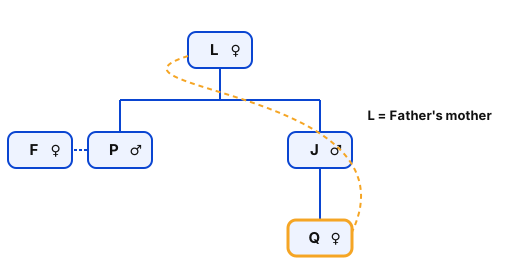
L is the mother of two sons, namely, P and J. F is the wife of P. Q is the daughter of J. How is L related to Q?
L के दो पुत्र हैं, जिनके नाम P और J हैं। F, P की पत्नी है। Q, J की पुत्री है। L का Q से क्या संबंध है?
  1. AHusband's motherपति की माँ
  2. BFather's motherपिता की माँ
  3. CMother's motherमाँ की माँ
  4. DMotherमाँ
Show answer

Concept: Draw the family tree generation by generation and read the relation from Q upward.

  1. L is the mother of sons P and J.
  2. Q is the daughter of J, so J is Q's father.
  3. L is the mother of Q's father → L is Q's father's mother (paternal grandmother).
  4. F (P's wife) is only a distractor.

Trick: Go up the tree: Q → father J → his mother L.

Answer: (B) Father's mother

अवधारणा: पीढ़ी-दर-पीढ़ी वंश-वृक्ष बनाएँ और Q से ऊपर की ओर संबंध पढ़ें।

  1. L, पुत्रों P और J की माँ है।
  2. Q, J की पुत्री है, अतः J, Q का पिता है।
  3. L, Q के पिता की माँ है → L, Q की दादी (Father's mother) है।
  4. F (P की पत्नी) केवल भ्रमित करने के लिए है।

ट्रिक: वृक्ष में ऊपर जाएँ: Q → पिता J → उसकी माँ L।

उत्तर: (B) Father's mother (पिता की माँ)

RRB NTPC Graduate CBT 1General Intelligence and ReasoningBlood relationsRRB NTPC Graduate CBT 1 2024 · 18 Jun Shift 3 →
Q1569.
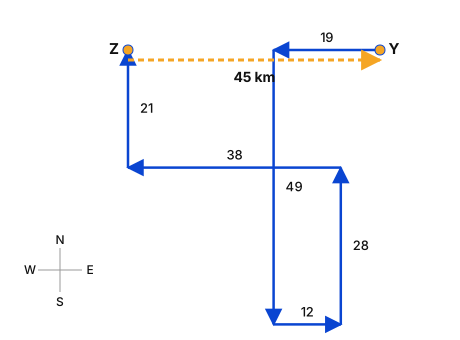
Fenil starts from Point Y and drives 19 km towards the west. He then takes a left turn, drives 49 km, turns left and drives 12 km. He then takes a left turn and drives 28 km. He takes a left turn and drives 38 km. He then turns right and drives 21 km to stop at Point Z. How far (shortest distance) and towards which direction should he drive in order to reach Point Y again? (All turns are 90 degree turns only unless specified.)
फ़ेनिल बिंदु Y से चलना शुरू करता है और पश्चिम की ओर 19 km गाड़ी चलाता है। फिर वह बाएँ मुड़ता है, 49 km गाड़ी चलाता है, बाएँ मुड़ता है और 12 km गाड़ी चलाता है। फिर वह बाएँ मुड़ता है और 28 km गाड़ी चलाता है। वह बाएँ मुड़ता है और 38 km गाड़ी चलाता है। फिर वह दाएँ मुड़ता है और 21 km गाड़ी चलाकर बिंदु Z पर रुक जाता है। बिंदु Y पर फिर से पहुँचने के लिए उसे कितनी दूरी (न्यूनतम दूरी) और किस दिशा में गाड़ी चलानी चाहिए? (जब तक निर्दिष्ट न हो, सभी मोड़ केवल 90 डिग्री के मोड़ हैं।)
  1. A51 km towards the southदक्षिण की ओर 51 km
  2. B39 km towards the westपश्चिम की ओर 39 km
  3. C41 km towards the southदक्षिण की ओर 41 km
  4. D45 km towards the eastपूर्व की ओर 45 km
Show answer

Concept: Track the position on a coordinate grid (East +x, North +y); a left turn while facing West points South.

  1. Y = (0,0). 19 km West → (−19,0); left (South) 49 → (−19,−49).
  2. Left (East) 12 → (−7,−49); left (North) 28 → (−7,−21).
  3. Left (West) 38 → (−45,−21); right (North) 21 → Z =(−45,0).
  4. Z is 45 km West of Y, so he must drive 45 km towards the East.

Trick: Net x: −19+12−38=−45, net y: −49+28+21=0.

Answer: (D) 45 km towards the east

अवधारणा: स्थिति को निर्देशांक (East +x, North +y) में लिखें; पश्चिम की ओर मुँह हो तो बायाँ मोड़ = दक्षिण।

  1. Y =(0,0)। 19 km पश्चिम → (−19,0); बाएँ (दक्षिण) 49 → (−19,−49)।
  2. बाएँ (पूर्व) 12 → (−7,−49); बाएँ (उत्तर) 28 → (−7,−21)।
  3. बाएँ (पश्चिम) 38 → (−45,−21); दाएँ (उत्तर) 21 → Z =(−45,0)।
  4. Z, Y से 45 km पश्चिम में है, अतः उसे 45 km पूर्व जाना होगा।

ट्रिक: कुल x: −19+12−38=−45, कुल y: −49+28+21=0।

उत्तर: (D) 45 km पूर्व की ओर

RRB NTPC Graduate CBT 1General Intelligence and ReasoningDirection and distanceRRB NTPC Graduate CBT 1 2024 · 18 Jun Shift 3 →
Q1570.
In a certain code language, ‘FISH’ is coded as ‘6458’ and ‘HAVE’ is coded as ‘5723’. What is the code for ‘H’ in the given code language?
एक निश्चित कूट भाषा में, ‘FISH’ को ‘6458’ और ‘HAVE’ को ‘5723’ के रूप में कूटबद्ध किया जाता है। दी गई कूट भाषा में ‘H’ का कूट क्या है?
  1. A5
  2. B7
  3. C8
  4. D2
Show answer

Concept: A letter common to both words gets the digit common to both codes.

  1. FISH → {6, 4, 5, 8}; HAVE → {5, 7, 2, 3}.
  2. Common letter: H; common digit: 5.
  3. So H = 5.

Trick: Common letter ↔ common digit (order of digits does not matter).

Answer: (A) 5

अवधारणा: दोनों शब्दों में उभयनिष्ठ अक्षर का कोड दोनों कोडों में उभयनिष्ठ अंक होता है।

  1. FISH → {6, 4, 5, 8}; HAVE → {5, 7, 2, 3}।
  2. उभयनिष्ठ अक्षर: H; उभयनिष्ठ अंक: 5।
  3. अतः H = 5।

ट्रिक: उभयनिष्ठ अक्षर ↔ उभयनिष्ठ अंक (अंकों का क्रम मायने नहीं रखता)।

उत्तर: (A) 5

RRB NTPC Graduate CBT 1General Intelligence and ReasoningCoding-decodingRRB NTPC Graduate CBT 1 2024 · 18 Jun Shift 3 →
Q1571.
Select the pair that follows the same pattern as that followed by the two pairs given below. Both pairs follow the same pattern.
HKO : FJM
DPY : BOW
उस युग्म का चयन कीजिए जो उसी पैटर्न का अनुसरण करता है जिसका अनुसरण नीचे दिए गए दो युग्म करते हैं। दोनों युग्म एक ही पैटर्न का अनुसरण करते हैं।
HKO : FJM
DPY : BOW
  1. AWGO : SCJ
  2. BBPS : AKI
  3. CTRK : RQI
  4. DBZI : WVD
Show answer

Concept: Find the shift applied to each letter position in the given pairs.

  1. HKO → FJM: H−2=F, K−1=J, O−2=M.
  2. DPY → BOW: D−2=B, P−1=O, Y−2=W.
  3. TRK → RQI: T−2=R, R−1=Q, K−2=I ✓.
  4. Others fail, e.g. WGO → SCJ is −4,−4,−5.

Trick: Pattern: −2,−1,−2.

Answer: (C) TRK : RQI

अवधारणा: दिए गए युग्मों में हर अक्षर-स्थान पर लगा अंतर ज्ञात करें।

  1. HKO → FJM: H−2=F, K−1=J, O−2=M।
  2. DPY → BOW: D−2=B, P−1=O, Y−2=W।
  3. TRK → RQI: T−2=R, R−1=Q, K−2=I ✓।
  4. अन्य मेल नहीं खाते, जैसे WGO → SCJ में −4,−4,−5।

ट्रिक: पैटर्न: −2,−1,−2।

उत्तर: (C) TRK : RQI

RRB NTPC Graduate CBT 1General Intelligence and ReasoningLetter analogyRRB NTPC Graduate CBT 1 2024 · 18 Jun Shift 3 →
Q1572.
Read the given statements and conclusions carefully. Assuming that the information given in the statements is true, even if it appears to be at variance with commonly known facts, decide which of the given conclusion(s) logically follow(s) from the statements.
Statements:
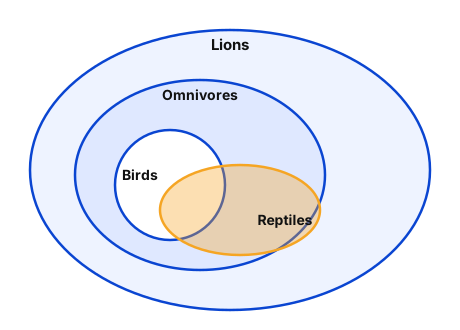
All birds are omnivores.
All omnivores are lions.
Some birds are reptiles.
Conclusions:
(I) Some omnivores are reptiles.
(II) Some reptiles are lions.
दिए गए कथनों और निष्कर्षों को ध्यानपूर्वक पढ़िए। यह मानते हुए कि कथनों में दी गई जानकारी सत्य है, भले ही वह सामान्यतः ज्ञात तथ्यों से भिन्न प्रतीत होती हो, निर्णय कीजिए कि दिए गए निष्कर्षों में से कौन-सा/कौन-से निष्कर्ष तार्किक रूप से कथनों का अनुसरण करता है/करते हैं।
कथन:
सभी पक्षी सर्वाहारी हैं।
सभी सर्वाहारी शेर हैं।
कुछ पक्षी सरीसृप हैं।
निष्कर्ष:
(I) कुछ सर्वाहारी सरीसृप हैं।
(II) कुछ सरीसृप शेर हैं।
  1. ABoth conclusions (I) and (II) follow.निष्कर्ष (I) और (II) दोनों अनुसरण करते हैं।
  2. BOnly conclusion (I) follows.केवल निष्कर्ष (I) अनुसरण करता है।
  3. COnly conclusion (II) follows.केवल निष्कर्ष (II) अनुसरण करता है।
  4. DEither conclusion (I) or (II) follows.या तो निष्कर्ष (I) या (II) अनुसरण करता है।
Show answer

Concept: Draw the least-overlap Venn diagram consistent with all statements.

  1. Birds ⊂ Omnivores ⊂ Lions.
  2. Some birds are reptiles — that common part is inside Omnivores and Lions as well.
  3. (I) Those reptile-birds are omnivores → Some omnivores are reptiles ✓.
  4. (II) Those reptile-birds are also lions → Some reptiles are lions ✓.

Trick: 'All A are B' + 'Some A are C' ⇒ 'Some B are C' always.

Answer: (A) Both conclusions (I) and (II) follow.

अवधारणा: सभी कथनों के अनुरूप न्यूनतम ओवरलैप वाला वेन आरेख बनाएँ।

  1. Birds ⊂ Omnivores ⊂ Lions।
  2. कुछ Birds, Reptiles हैं — यह साझा भाग Omnivores और Lions के अंदर भी है।
  3. (I) वे reptile-birds omnivores हैं → कुछ omnivores, reptiles हैं ✓।
  4. (II) वे reptile-birds lions भी हैं → कुछ reptiles, lions हैं ✓।

ट्रिक: 'सभी A, B हैं' + 'कुछ A, C हैं' ⇒ 'कुछ B, C हैं' सदैव।

उत्तर: (A) दोनों निष्कर्ष (I) और (II) अनुसरण करते हैं।

RRB NTPC Graduate CBT 1General Intelligence and ReasoningSyllogismRRB NTPC Graduate CBT 1 2024 · 18 Jun Shift 3 →
Q1573.
Each of P, Q, R, S, T, U and V has an exam on a different day of a week starting from Monday and ending on Sunday of the same week.
No one has the exam before V. Only four people have exams between P and R. Q has the exam immediately before R. T has the exam before U but after S.
How many people have exams between S and R?
P, Q, R, S, T, U और V में से प्रत्येक की परीक्षा एक ही सप्ताह के सोमवार से शुरू होकर रविवार को समाप्त होने वाले सप्ताह के अलग-अलग दिन है।
V से पहले किसी की परीक्षा नहीं है। P और R के बीच केवल चार व्यक्तियों की परीक्षाएँ हैं। Q की परीक्षा R से ठीक पहले है। T की परीक्षा U से पहले लेकिन S के बाद है।
S और R के बीच कितने व्यक्तियों की परीक्षाएँ हैं?
  1. AThreeतीन
  2. BFourचार
  3. COneएक
  4. DTwoदो
Show answer

Concept: Fix the definite positions first, then place the people with relative conditions.

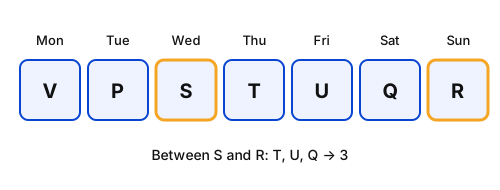
  1. No one before V → V = Monday.
  2. 4 people between P and R → they are on Tue and Sun.
  3. Q immediately before R: R cannot be Tue (Mon is V), so P = Tue, R = Sun, Q = Sat.
  4. S, T, U fill Wed, Thu, Fri with S before T before U → S Wed, T Thu, U Fri.
  5. Between S (Wed) and R (Sun): T, U, Q = 3.

Trick: With V on Monday, the only gap of 4 is Tue–Sun.

Answer: (A) Three

अवधारणा: पहले निश्चित स्थान तय करें, फिर सापेक्ष शर्तों वाले लोगों को रखें।

  1. V से पहले कोई नहीं → V = सोमवार।
  2. P और R के बीच 4 लोग → वे मंगलवार और रविवार को हैं।
  3. Q, R से ठीक पहले: R मंगलवार नहीं हो सकता (सोमवार V है), अतः P = मंगल, R = रवि, Q = शनि।
  4. S, T, U बुध, गुरु, शुक्र में; S < T < U → S बुध, T गुरु, U शुक्र।
  5. S (बुध) और R (रवि) के बीच: T, U, Q = 3।

ट्रिक: V सोमवार पर हो तो 4 का अंतर केवल मंगल–रवि में बनता है।

उत्तर: (A) तीन

RRB NTPC Graduate CBT 1General Intelligence and ReasoningScheduling puzzleRRB NTPC Graduate CBT 1 2024 · 18 Jun Shift 3 →
Q1574.
Each of P, Q, R, S, T, U and V has an exam on a different day of a week starting from Monday and ending on Sunday of the same week. T has an exam on Friday. Exactly 3 people have an exam between P and U, neither of whom has on exam on Sunday. S has an exam immediately after Q. V has an exam immediately before U. How many people have an exam after S?
P, Q, R, S, T, U और V में से प्रत्येक की परीक्षा एक ही सप्ताह के सोमवार से शुरू होकर रविवार को समाप्त होने वाले सप्ताह के अलग-अलग दिन है। T की परीक्षा शुक्रवार को है। P और U के बीच ठीक 3 व्यक्तियों की परीक्षाएँ हैं, इन दोनों में से किसी की भी परीक्षा रविवार को नहीं है। S की परीक्षा Q के ठीक बाद है। V की परीक्षा U से ठीक पहले है। S के बाद कितने व्यक्तियों की परीक्षा है?
  1. A3
  2. B1
  3. C4
  4. D2
Show answer

Concept: Number the days Mon = 1 … Sun = 7 and test the possible P–U positions.

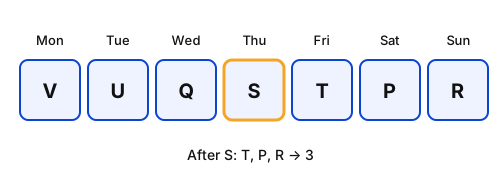
  1. T = Fri (5). Exactly 3 between P and U, none on Sunday → pairs (1, 5) or (2, 6); (1, 5) clashes with T.
  2. So P, U are on 2 and 6. V is immediately before U: U = 6 needs V = 5 (T) ✗, hence U = Tue, V = Mon, P = Sat.
  3. Q–S consecutive in the free days Wed, Thu, Sun → Q Wed, S Thu; R = Sun.
  4. After S (Thu): T, P, R = 3.

Trick: Order: V U Q S T P R.

Answer: (A) 3

अवधारणा: दिनों को सोम = 1 … रवि = 7 मानें और P–U के संभावित स्थान जाँचें।

  1. T = शुक्र (5)। P और U के बीच ठीक 3, कोई रविवार पर नहीं → (1, 5) या (2, 6); (1, 5) में T से टकराव।
  2. अतः P, U दिन 2 और 6 पर। V, U से ठीक पहले: U = 6 हो तो V = 5 (T) ✗, अतः U = मंगल, V = सोम, P = शनि।
  3. Q–S लगातार, खाली दिन बुध, गुरु, रवि → Q बुध, S गुरु; R = रवि।
  4. S (गुरु) के बाद: T, P, R = 3।

ट्रिक: क्रम: V U Q S T P R।

उत्तर: (A) 3

RRB NTPC Graduate CBT 1General Intelligence and ReasoningScheduling puzzleRRB NTPC Graduate CBT 1 2024 · 18 Jun Shift 3 →
Q1575.
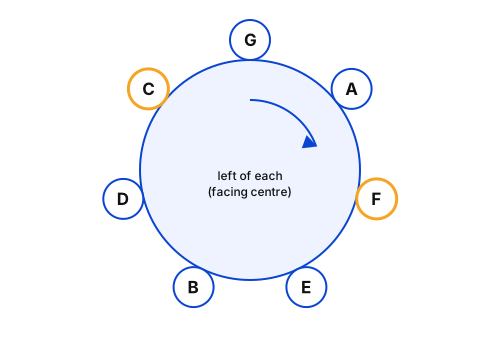
A, B, C, D, E, F, and G are sitting around a circular table facing the centre.
A sits to the immediate left of G. D sits to the immediate left of B. B sits second to the left of F. E sits third to the left of G.
How many people sit between C and F when counted from the left of C?
A, B, C, D, E, F और G एक वृत्ताकार मेज़ के चारों ओर केंद्र की ओर मुख करके बैठे हैं।
A, G के ठीक बाएँ बैठा है। D, B के ठीक बाएँ बैठा है। B, F के बाएँ से दूसरे स्थान पर बैठा है। E, G के बाएँ से तीसरे स्थान पर बैठा है।
C के बाएँ से गिनने पर C और F के बीच कितने व्यक्ति बैठे हैं?
  1. ATwoदो
  2. BOneएक
  3. CThreeतीन
  4. DFourचार
Show answer

Concept: For people facing the centre, 'left' means the clockwise direction.

  1. Fix G. A is immediately left of G; E is third to the left of G.
  2. B is second left of F and D is immediately left of B → F, _, B, D occupy consecutive clockwise seats.
  3. Only free run: F next to A, then E, B, D; C takes the last seat (right of G).
  4. Clockwise order: G, A, F, E, B, D, C.
  5. From C going left: G, A, then F → 2 people between.

Trick: F–B–D form a block of 'skip one, then two together'; fit it into the free seats.

Answer: (A) Two

अवधारणा: केंद्र की ओर मुख वाले व्यक्तियों के लिए 'बायाँ' = घड़ी की सुई की दिशा (clockwise)।

  1. G को स्थिर करें। A, G के ठीक बाएँ; E, G के बाएँ तीसरे स्थान पर।
  2. B, F के बाएँ दूसरे तथा D, B के ठीक बाएँ → F, _, B, D लगातार clockwise सीटें।
  3. एकमात्र स्थान: A के बाद F, फिर E, B, D; C अंतिम सीट (G के दाएँ) पर।
  4. Clockwise क्रम: G, A, F, E, B, D, C।
  5. C से बाईं ओर: G, A, फिर F → बीच में 2 व्यक्ति।

ट्रिक: F–B–D ब्लॉक ('एक छोड़कर फिर दो साथ') को खाली सीटों में बैठाएँ।

उत्तर: (A) दो

RRB NTPC Graduate CBT 1General Intelligence and ReasoningCircular seating arrangementRRB NTPC Graduate CBT 1 2024 · 18 Jun Shift 3 →
Q1576.
What should come in place of the question mark (?) in the given series?
319, 296, 263, ?, 167, 104
दी गई शृंखला में प्रश्न चिह्न (?) के स्थान पर क्या आना चाहिए?
319, 296, 263, ?, 167, 104
  1. A220
  2. B200
  3. C210
  4. D230
Show answer

Concept: Look at the differences between consecutive terms.

  1. 319−296=23, 296−263=33 → differences grow by 10.
  2. Next difference 43: 263−43=220.
  3. Check: 220−53=167, 167−63=104 ✓.

Trick: Differences: −23,−33,−43,−53,−63.

Answer: (A) 220

अवधारणा: क्रमागत पदों के अंतर देखें।

  1. 319−296=23, 296−263=33 → अंतर 10-10 बढ़ता है।
  2. अगला अंतर 43: 263−43=220।
  3. जाँच: 220−53=167, 167−63=104 ✓।

ट्रिक: अंतर: −23,−33,−43,−53,−63।

उत्तर: (A) 220

RRB NTPC Graduate CBT 1General Intelligence and ReasoningNumber seriesRRB NTPC Graduate CBT 1 2024 · 18 Jun Shift 3 →
Q1577.
In a certain code language, ‘NEAR’ is coded as ‘3571’ and ‘WINK’ is coded as ‘2346’. What is the code for ‘N’ in the given code language?
एक निश्चित कूट भाषा में, ‘NEAR’ को ‘3571’ और ‘WINK’ को ‘2346’ के रूप में कूटबद्ध किया जाता है। दी गई कूट भाषा में ‘N’ का कूट क्या है?
  1. A7
  2. B4
  3. C1
  4. D3
Show answer

Concept: A letter common to both words gets the digit common to both codes.

  1. NEAR → {3, 5, 7, 1}; WINK → {2, 3, 4, 6}.
  2. Common letter: N; common digit: 3.
  3. So N = 3.

Trick: Common letter ↔ common digit.

Answer: (D) 3

अवधारणा: दोनों शब्दों में उभयनिष्ठ अक्षर का कोड दोनों कोडों में उभयनिष्ठ अंक होता है।

  1. NEAR → {3, 5, 7, 1}; WINK → {2, 3, 4, 6}।
  2. उभयनिष्ठ अक्षर: N; उभयनिष्ठ अंक: 3।
  3. अतः N = 3।

ट्रिक: उभयनिष्ठ अक्षर ↔ उभयनिष्ठ अंक।

उत्तर: (D) 3

RRB NTPC Graduate CBT 1General Intelligence and ReasoningCoding-decodingRRB NTPC Graduate CBT 1 2024 · 18 Jun Shift 3 →
Q1578.
What will come in the place of the question mark (?) in the following equation, if ‘+’ and ‘−’ are interchanged and ‘×’ and ‘÷’ are interchanged?
117 ÷ 7 + 426 × 6 − 66 = ?
यदि ‘+’ और ‘−’ को आपस में बदल दिया जाए तथा ‘×’ और ‘÷’ को आपस में बदल दिया जाए, तो निम्नलिखित समीकरण में प्रश्न चिह्न (?) के स्थान पर क्या आएगा?
117 ÷ 7 + 426 × 6 − 66 = ?
  1. A811
  2. B804
  3. C809
  4. D814
Show answer

Concept: Interchange the signs first, then solve using BODMAS.

  1. After interchange: 117×7−426÷6+66.
  2. 117×7=819; 426÷6=71.
  3. 819−71+66=814.

Trick: Swap signs on paper before calculating — most errors come from mixing old and new signs.

Answer: (D) 814

अवधारणा: पहले चिह्न बदलें, फिर BODMAS से हल करें।

  1. बदलने के बाद: 117×7−426÷6+66।
  2. 117×7=819; 426÷6=71।
  3. 819−71+66=814।

ट्रिक: गणना से पहले चिह्न बदलकर लिख लें — अधिकतर गलतियाँ पुराने-नए चिह्न मिलाने से होती हैं।

उत्तर: (D) 814

RRB NTPC Graduate CBT 1General Intelligence and ReasoningMathematical operationsRRB NTPC Graduate CBT 1 2024 · 18 Jun Shift 3 →
Q1579.
This question is based on the five, three-digit numbers given below.
(Left) 853 628 981 217 132 (Right)
(Example- 697 – First digit = 6, second digit = 9 and third digit = 7)
(NOTE: All operations to be done from left to right.)
What will be the resultant if the second digit of the highest number is added to the first digit of the lowest number?
यह प्रश्न नीचे दी गई तीन अंकों वाली पाँच संख्याओं पर आधारित है।
(बाएँ) 853 628 981 217 132 (दाएँ)
(उदाहरण- 697 – पहला अंक = 6, दूसरा अंक = 9 और तीसरा अंक = 7)
(नोट: सभी संक्रियाएँ बाएँ से दाएँ की जानी हैं।)
यदि सबसे बड़ी संख्या के दूसरे अंक को सबसे छोटी संख्या के पहले अंक में जोड़ा जाए, तो परिणाम क्या होगा?
  1. A12
  2. B9
  3. C8
  4. D10
Show answer

Concept: Identify the highest and lowest numbers, then pick the required digits.

  1. Highest number = 981 → second digit = 8.
  2. Lowest number = 132 → first digit = 1.
  3. 8+1=9.

Trick: Compare the hundreds digits first: 9 is highest, 1 is lowest.

Answer: (B) 9

अवधारणा: सबसे बड़ी और सबसे छोटी संख्या पहचानें, फिर अपेक्षित अंक लें।

  1. सबसे बड़ी संख्या = 981 → दूसरा अंक = 8।
  2. सबसे छोटी संख्या = 132 → पहला अंक = 1।
  3. 8+1=9।

ट्रिक: पहले सैकड़े के अंक की तुलना करें: 9 सबसे बड़ा, 1 सबसे छोटा।

उत्तर: (B) 9

RRB NTPC Graduate CBT 1General Intelligence and ReasoningNumber operationsRRB NTPC Graduate CBT 1 2024 · 18 Jun Shift 3 →
Q1580.
Which of the following letter-number clusters will replace the question mark (?) in the given series to make it logically complete?
KDG 19 LEH 30 MFI 41 NGJ 52 ?
निम्नलिखित में से कौन-सा अक्षर-संख्या समूह दी गई शृंखला में प्रश्न चिह्न (?) का स्थान लेकर उसे तार्किक रूप से पूर्ण करेगा?
KDG 19 LEH 30 MFI 41 NGJ 52 ?
  1. AOHL 64
  2. BOHK 64
  3. COHK 63
  4. DOHL 63
Show answer

Concept: Each letter moves +1 and the number increases by 11.

  1. First letters: K, L, M, N → O; second: D, E, F, G → H; third: G, H, I, J → K.
  2. Numbers: 19,30,41,52 (each +11) → 52+11=63.
  3. Next term = OHK 63.

Trick: Check the number first: only options with 63 survive, then the third letter K.

Answer: (C) OHK 63

अवधारणा: हर अक्षर +1 आगे बढ़ता है और संख्या 11 बढ़ती है।

  1. पहला अक्षर: K, L, M, N → O; दूसरा: D, E, F, G → H; तीसरा: G, H, I, J → K।
  2. संख्याएँ: 19,30,41,52 (हर बार +11) → 52+11=63।
  3. अगला पद = OHK 63।

ट्रिक: पहले संख्या जाँचें: 63 वाले विकल्प बचे, फिर तीसरा अक्षर K।

उत्तर: (C) OHK 63

RRB NTPC Graduate CBT 1General Intelligence and ReasoningLetter-Number SeriesRRB NTPC Graduate CBT 1 2024 · 18 Jun Shift 3 →