Question bank

Q&A: practice questions with answers

Search questions on any topic. Filter by exam category, exam, subject and topic, try the question, then open the answer and explanation.

Courses – airGurukul

7,077 questions found.

Q1741.
If the median of a data is 71.24 less than its mode, then the median of the data exceeds its mean by _____. (Use the empirical formula)
यदि किसी आँकड़े की माध्यिका उसके बहुलक से 71.24 कम है, तो आँकड़े की माध्यिका उसके माध्य से _____ अधिक है। (आनुभविक सूत्र का प्रयोग कीजिए)
  1. A34.14
  2. B35.62
  3. C41.97
  4. D33.91
Show answer

Concept: Empirical relation: Mode=3Median−2Mean, so Mode−Median=2(Median−Mean).

  1. Mode−Median=71.24
  2. 2(Median−Mean)=71.24
  3. Median−Mean=35.62

Trick: Median sits between mean and mode, twice as far from the mode: just halve the gap.

Answer: (B) 35.62

अवधारणा: आनुभविक संबंध: Mode=3Median−2Mean, अतः Mode−Median=2(Median−Mean)।

  1. Mode−Median=71.24
  2. 2(Median−Mean)=71.24
  3. Median−Mean=35.62

ट्रिक: माध्यिका, बहुलक से दोगुनी दूरी पर – बस अंतर को आधा करें।

उत्तर: (B) 35.62
RRB NTPC Graduate CBT 1MathematicsStatistics – Mean, Median, ModeRRB NTPC Graduate CBT 1 2024 · 18 Jun Shift 1 →
Q1742.
A and B can do a piece of work in 12 days and 18 days, respectively. Both work for 2 days and then A goes away and B completed the remaining work alone. The whole work was completed in ______________ days.
A और B किसी कार्य को क्रमशः 12 दिन और 18 दिन में कर सकते हैं। दोनों 2 दिन तक कार्य करते हैं और फिर A चला जाता है तथा B शेष कार्य को अकेले पूरा करता है। पूरा कार्य ______________ दिनों में पूरा हुआ।
  1. A13
  2. B14
  3. C15
  4. D16
Show answer

Concept: Take total work = LCM of days and work in units per day.

  1. Total work =LCM(12,18)=36 units; A =3, B =2 units/day.
  2. In 2 days together: 2×5=10 units.
  3. Remaining 26 units by B: 262=13 days.
  4. Total =2+13=15 days

Trick: LCM method avoids fractions completely.

Answer: (C) 15

अवधारणा: कुल कार्य = दिनों का LCM लें और प्रतिदिन इकाइयाँ निकालें।

  1. कुल कार्य =LCM(12,18)=36 इकाई; A =3, B =2 इकाई/दिन।
  2. 2 दिन साथ में: 2×5=10 इकाई।
  3. शेष 26 इकाई B अकेला: 262=13 दिन।
  4. कुल =2+13=15 दिन

ट्रिक: LCM विधि से भिन्नों से बचें।

उत्तर: (C) 15

RRB NTPC Graduate CBT 1MathematicsTime and WorkRRB NTPC Graduate CBT 1 2024 · 18 Jun Shift 1 →
Q1743.
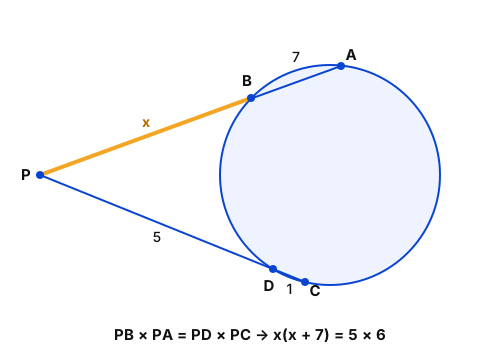
Chords AB and CD of a circle intersect externally at P. If AB = 7 cm, CD = 1 cm and PD = 5 cm, then the length of PB (in cm) is:
एक वृत्त की जीवाएँ AB और CD बाह्य रूप से P पर प्रतिच्छेद करती हैं। यदि AB = 7 cm, CD = 1 cm और PD = 5 cm है, तो PB की लंबाई (cm में) है:
  1. A3
  2. B4
  3. C2
  4. D5
Show answer

Concept: If two chords AB and CD meet externally at P, then PA×PB=PC×PD (secant–secant theorem).

  1. Let PB=x, so PA=x+7; PD=5, PC=5+1=6.
  2. x(x+7)=5×6=30
  3. x2+7x−30=0⇒(x+10)(x−3)=0
  4. x=3 cm

Trick: Outside part × whole = outside part × whole. Try options: 3×10=30 ✓.

Answer: (A) 3

अवधारणा: यदि जीवाएँ AB और CD बाहर बिंदु P पर मिलें, तो PA×PB=PC×PD (छेदक–छेदक प्रमेय)।

  1. माना PB=x, तो PA=x+7; PD=5, PC=5+1=6।
  2. x(x+7)=5×6=30
  3. x2+7x−30=0⇒(x+10)(x−3)=0
  4. x=3 cm

ट्रिक: बाहरी भाग × पूरा = बाहरी भाग × पूरा। विकल्प जाँचें: 3×10=30 ✓।

उत्तर: (A) 3

RRB NTPC Graduate CBT 1MathematicsGeometry – Secants of a CircleRRB NTPC Graduate CBT 1 2024 · 18 Jun Shift 1 →
Q1744.
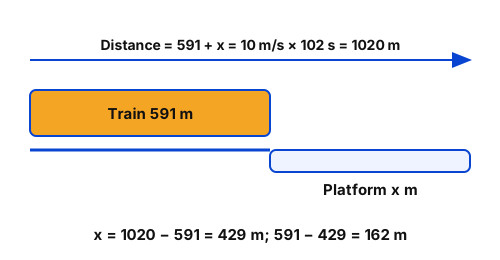
A train is 591 m and it crosses a platform in 1.7 minutes running at the speed of 36 km/hr. Find the difference between the length of the train and the platform.
एक रेलगाड़ी 591 m लंबी है और यह 36 km/hr की चाल से चलते हुए एक प्लेटफ़ॉर्म को 1.7 मिनट में पार करती है। रेलगाड़ी और प्लेटफ़ॉर्म की लंबाई का अंतर ज्ञात कीजिए।
  1. A162 m
  2. B171 m
  3. C170 m
  4. D159 m
Show answer

Concept: To cross a platform, a train covers (train length + platform length).

  1. Speed =36×518=10m/s; time =1.7×60=102s
  2. Distance =10×102=1020m
  3. Platform =1020−591=429m
  4. Difference =591−429=162m

Trick: 36 km/h = 10 m/s, so distance in metres = 10 × seconds.

Answer: (A) 162 m

अवधारणा: प्लेटफ़ॉर्म पार करने में ट्रेन (ट्रेन की लंबाई + प्लेटफ़ॉर्म की लंबाई) तय करती है।

  1. चाल =36×518=10m/s; समय =1.7×60=102s
  2. दूरी =10×102=1020m
  3. प्लेटफ़ॉर्म =1020−591=429m
  4. अंतर =591−429=162m

ट्रिक: 36 km/h = 10 m/s, अतः दूरी (m) = 10 × सेकंड।

उत्तर: (A) 162 m

RRB NTPC Graduate CBT 1MathematicsSpeed – Train and PlatformRRB NTPC Graduate CBT 1 2024 · 18 Jun Shift 1 →
Q1745.
Find the value of cos35∘sin55∘+sin11∘cos79∘−2cos27∘cosec63∘.
cos35∘sin55∘+sin11∘cos79∘−2cos27∘cosec63∘ का मान ज्ञात कीजिए।
  1. A0
  2. B1
  3. C−1
  4. D2
Show answer

Concept: sin(90∘−θ)=cosθ, cos(90∘−θ)=sinθ, csc(90∘−θ)=secθ.

  1. sin55∘=cos35∘⇒cos35∘sin55∘=1
  2. cos79∘=sin11∘⇒sin11∘cos79∘=1
  3. csc63∘=sec27∘⇒2cos27∘csc63∘=2
  4. Value =1+1−2=0

Trick: Angles adding to 90∘ in a ratio always give 1.

Answer: (A) 0

अवधारणा: sin(90∘−θ)=cosθ, cos(90∘−θ)=sinθ, csc(90∘−θ)=secθ।

  1. sin55∘=cos35∘⇒cos35∘sin55∘=1
  2. cos79∘=sin11∘⇒sin11∘cos79∘=1
  3. csc63∘=sec27∘⇒2cos27∘csc63∘=2
  4. मान =1+1−2=0

ट्रिक: योग 90∘ वाले कोणों का अनुपात हमेशा 1 देता है।

उत्तर: (A) 0

RRB NTPC Graduate CBT 1MathematicsTrigonometry – Complementary AnglesRRB NTPC Graduate CBT 1 2024 · 18 Jun Shift 1 →
Q1746.
Which of the following ratios is greatest?
निम्नलिखित में से कौन-सा अनुपात सबसे बड़ा है?
  1. A19 : 37
  2. B10 : 15
  3. C15 : 33
  4. D18 : 37
Show answer

Concept: Compare each ratio with 12 or convert to decimals.

  1. 1937≈0.51,1015≈0.67
  2. 1533≈0.45,1837≈0.49
  3. Greatest is 1015.

Trick: Only 1015=23 is well above 12; others are near 12.

Answer: (B) 10 : 15

अवधारणा: हर अनुपात की तुलना 12 से करें या दशमलव में बदलें।

  1. 1937≈0.51,1015≈0.67
  2. 1533≈0.45,1837≈0.49
  3. सबसे बड़ा 1015 है।

ट्रिक: केवल 1015=23 ही 12 से काफ़ी बड़ा है।

उत्तर: (B) 10 : 15

RRB NTPC Graduate CBT 1MathematicsComparison of RatiosRRB NTPC Graduate CBT 1 2024 · 18 Jun Shift 1 →
Q1747.
Find the smallest number by which 6760 must be multiplied to make it a perfect square.
वह सबसे छोटी संख्या ज्ञात कीजिए जिससे 6760 को गुणा करने पर वह एक पूर्ण वर्ग बन जाए।
  1. A28
  2. B26
  3. C23
  4. D10
Show answer

Concept: Factorise; every prime must have an even power in a perfect square.

  1. 6760=676×10=262×2×5
  2. The unpaired primes are 2 and 5.
  3. Multiply by 2×5=10: 67600=2602

Trick: Spot 676=262 quickly; leftover 10 is the multiplier.

Answer: (D) 10

अवधारणा: गुणनखंड करें; पूर्ण वर्ग में हर अभाज्य की घात सम होनी चाहिए।

  1. 6760=676×10=262×2×5
  2. अयुग्मित अभाज्य 2 और 5 हैं।
  3. 2×5=10 से गुणा: 67600=2602

ट्रिक: 676=262 पहचानें; बचा 10 ही गुणक है।

उत्तर: (D) 10

RRB NTPC Graduate CBT 1MathematicsPerfect SquaresRRB NTPC Graduate CBT 1 2024 · 18 Jun Shift 1 →
Q1748.
Kalpana and Sudha got 696 and 584 marks, respectively, in the same examination. If Kalpana scored 87% marks, then what is the percentage of marks scored by Sudha?
कल्पना और सुधा ने एक ही परीक्षा में क्रमशः 696 और 584 अंक प्राप्त किए। यदि कल्पना ने 87% अंक प्राप्त किए, तो सुधा द्वारा प्राप्त अंकों का प्रतिशत क्या है?
  1. A73%
  2. B72%
  3. C76%
  4. D74%
Show answer

Concept: Find maximum marks from Kalpana’s score, then Sudha’s percentage.

  1. Max marks =69687×100=800
  2. Sudha =584800×100=73%

Trick: Direct ratio: 584696×87=73 (since 696=8×87, 584=8×73).

Answer: (A) 73%

अवधारणा: कल्पना के अंकों से अधिकतम अंक निकालें, फिर सुधा का प्रतिशत।

  1. अधिकतम अंक =69687×100=800
  2. सुधा =584800×100=73%

ट्रिक: सीधा अनुपात: 584696×87=73 (क्योंकि 696=8×87, 584=8×73)।

उत्तर: (A) 73%

RRB NTPC Graduate CBT 1MathematicsPercentageRRB NTPC Graduate CBT 1 2024 · 18 Jun Shift 1 →
Q1749.
The ratio of three numbers is 5 : 16 : 21. If 20 percent of the first number is 26, what would be 40 percent of the difference of the third and second number?
तीन संख्याओं का अनुपात 5 : 16 : 21 है। यदि पहली संख्या का 20 प्रतिशत 26 है, तो तीसरी और दूसरी संख्या के अंतर का 40 प्रतिशत क्या होगा?
  1. A54
  2. B52
  3. C50
  4. D51
Show answer

Concept: Use the ratio unit: numbers are 5k,16k,21k.

  1. 20% of 5k=k=26
  2. Difference of third and second =21k−16k=5k=130
  3. 40% of 130=52

Trick: 40% of 5k=2k=2×26=52 directly.

Answer: (B) 52

अवधारणा: अनुपात इकाई लें: संख्याएँ 5k,16k,21k।

  1. 5k का 20%=k=26
  2. तीसरी और दूसरी का अंतर =21k−16k=5k=130
  3. 130 का 40%=52

ट्रिक: 5k का 40%=2k=2×26=52 सीधे।

उत्तर: (B) 52

RRB NTPC Graduate CBT 1MathematicsRatio and PercentageRRB NTPC Graduate CBT 1 2024 · 18 Jun Shift 1 →
Q1750.
If the selling price of a bed is 2-times of initial, then the profit is 6-times of initial. Find the initial profit percentage (in %).
यदि एक पलंग का विक्रय मूल्य प्रारंभिक का 2 गुना हो, तो लाभ प्रारंभिक का 6 गुना हो जाता है। प्रारंभिक लाभ प्रतिशत (% में) ज्ञात कीजिए।
  1. A33.33
  2. B300
  3. C200
  4. D25
Show answer

Concept: Cost price stays the same; profit = SP − CP.

  1. Let CP =C, SP =S. New SP =2S, new profit =6(S−C).
  2. 2S−C=6S−6C⇒5C=4S⇒S=54C
  3. Initial profit =S−CC×100=14×100=25%

Trick: Test option: CP 100, SP 125, profit 25; SP 250 → profit 150 = 6 × 25 ✓.

Answer: (D) 25

अवधारणा: क्रय मूल्य वही रहता है; लाभ = SP − CP।

  1. माना CP =C, SP =S। नया SP =2S, नया लाभ =6(S−C)।
  2. 2S−C=6S−6C⇒5C=4S⇒S=54C
  3. प्रारंभिक लाभ =S−CC×100=14×100=25%

ट्रिक: विकल्प जाँचें: CP 100, SP 125, लाभ 25; SP 250 → लाभ 150 = 6 × 25 ✓।

उत्तर: (D) 25

RRB NTPC Graduate CBT 1MathematicsProfit PercentageRRB NTPC Graduate CBT 1 2024 · 18 Jun Shift 1 →
Q1751.
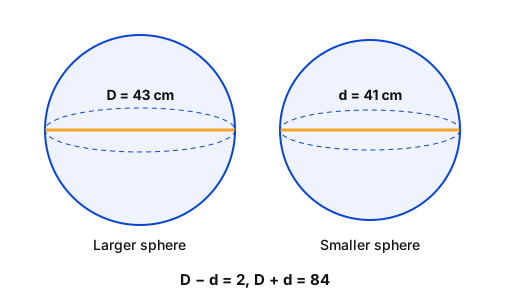
The diameter of a sphere is 2 cm more than the diameter of a smaller sphere. The surface area of the larger sphere is 528 cm2 more than the surface area of the smaller sphere. What is the diameter (in cm) of the larger sphere?
(Use π=227)
एक गोले का व्यास एक छोटे गोले के व्यास से 2 cm अधिक है। बड़े गोले का पृष्ठीय क्षेत्रफल छोटे गोले के पृष्ठीय क्षेत्रफल से 528 cm2 अधिक है। बड़े गोले का व्यास (cm में) क्या है?
(π=227 का प्रयोग कीजिए)
  1. A43
  2. B41
  3. C39
  4. D45
Show answer

Concept: Surface area of a sphere =4πr2=πD2 (since D=2r).

  1. Let diameters be D (larger) and d (smaller); D−d=2.
  2. πD2−πd2=528⇒227(D−d)(D+d)=528.
  3. (D+d)=528×722×2=84.
  4. D=84+22=43cm.

Trick: Use π(D2−d2) directly with diameters – avoids halving radii.

Answer: (A) 43

अवधारणा: गोले का पृष्ठीय क्षेत्रफल =4πr2=πD2 (क्योंकि D=2r)।

  1. बड़े व छोटे गोले के व्यास D और d; D−d=2।
  2. πD2−πd2=528⇒227(D−d)(D+d)=528।
  3. (D+d)=528×722×2=84।
  4. D=84+22=43cm।

ट्रिक: व्यास के साथ सीधे π(D2−d2) लगाएँ – त्रिज्या निकालने की ज़रूरत नहीं।

उत्तर: (A) 43

RRB NTPC Graduate CBT 1MathematicsMensuration – SphereRRB NTPC Graduate CBT 1 2024 · 18 Jun Shift 1 →
Q1752.
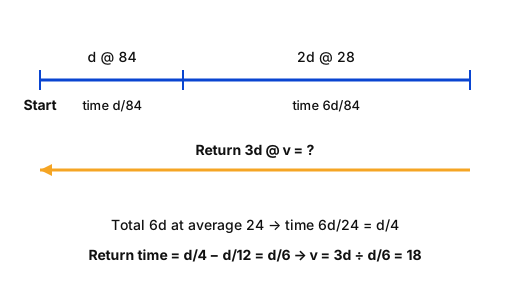
Amita travels a certain distance at a speed of 84 km/hr and double the earlier distance at 28 km/hr. She then returns to the starting point through the same route. If her average speed for the entire journey is 24 km/hr, then what is her speed (in km/hr) for the return journey?
अमिता एक निश्चित दूरी 84 km/hr की चाल से और उससे दोगुनी दूरी 28 km/hr की चाल से तय करती है। फिर वह उसी मार्ग से आरंभिक बिंदु पर लौटती है। यदि पूरी यात्रा के लिए उसकी औसत चाल 24 km/hr है, तो वापसी यात्रा में उसकी चाल (km/hr में) क्या है?
  1. A17.2
  2. B16
  3. C18
  4. D21.5
Show answer

Concept: Average speed =total distancetotal time.

  1. Forward: d at 84 and 2d at 28; time =d84+2d28=7d84=d12.
  2. Return distance =3d, so total distance =6d; total time =6d24=d4.
  3. Return time =d4−d12=d6.
  4. Return speed =3dd/6=18km/h.

Trick: Take d=84: forward time =1+6=7 h, total time =50424=21 h, return =14 h for 252 km → 18.

Answer: (C) 18

अवधारणा: औसत चाल =कुल दूरीकुल समय।

  1. जाते समय: d दूरी 84 पर और 2d दूरी 28 पर; समय =d84+2d28=d12।
  2. वापसी दूरी =3d, कुल दूरी =6d; कुल समय =6d24=d4।
  3. वापसी समय =d4−d12=d6।
  4. वापसी चाल =3dd/6=18km/h।

ट्रिक: d=84 मानें: जाने का समय =1+6=7 घंटे, कुल समय =21 घंटे, वापसी =14 घंटे में 252 km → 18।

उत्तर: (C) 18

RRB NTPC Graduate CBT 1MathematicsSpeed, distance and time – Average speedRRB NTPC Graduate CBT 1 2024 · 18 Jun Shift 1 →
Q1753.
If α and β are the roots of the equation x2 − 6x − 5 = 0, then find the equation having the roots 3α and 3β.
यदि α और β समीकरण x2 − 6x − 5 = 0 के मूल हैं, तो वह समीकरण ज्ञात कीजिए जिसके मूल 3α और 3β हैं।
  1. Ax2−18x−48=0
  2. Bx2−18x−45=0
  3. Cx2−15x+48=0
  4. Dx2−15x+45=0
Show answer

Concept: A quadratic with roots p,q is x2−(p+q)x+pq=0.

  1. For x2−6x−5=0: α+β=6, αβ=−5.
  2. New sum =3α+3β=18.
  3. New product =9αβ=−45.
  4. Equation: x2−18x−45=0.

Trick: Roots multiplied by k: replace x by xk → x2−6(3)x−5(9)=0.

Answer: (B) x2−18x−45=0

अवधारणा: मूल p,q वाला द्विघात समीकरण x2−(p+q)x+pq=0 होता है।

  1. x2−6x−5=0 से: α+β=6, αβ=−5।
  2. नया योग =3α+3β=18।
  3. नया गुणनफल =9αβ=−45।
  4. समीकरण: x2−18x−45=0।

ट्रिक: मूलों को k गुना करने पर x की जगह xk रखें → x2−6(3)x−5(9)=0।

उत्तर: (B) x2−18x−45=0

RRB NTPC Graduate CBT 1MathematicsAlgebra – Quadratic equationsRRB NTPC Graduate CBT 1 2024 · 18 Jun Shift 1 →
Q1754.
The present cost of an apartment is ₹1,70,014. After a year, its cost increased to ₹1,93,900. The percentage increase (rounded off to the nearest integer) in the cost of the apartment is:
एक अपार्टमेंट का वर्तमान मूल्य ₹1,70,014 है। एक वर्ष बाद, इसका मूल्य बढ़कर ₹1,93,900 हो गया। अपार्टमेंट के मूल्य में प्रतिशत वृद्धि (निकटतम पूर्णांक तक पूर्णांकित) है:
  1. A28%
  2. B3%
  3. C14%
  4. D22%
Show answer

Concept: Increase%=increaseoriginal×100.

  1. Increase =193900−170014=23886.
  2. %=23886170014×100≈14.05%.
  3. Rounded: 14%.

Trick: 10% of 170014 ≈ 17000, 15% ≈ 25500; 23886 lies just below 15% → 14%.

Answer: (C) 14%

अवधारणा: वृद्धि%=वृद्धिमूल×100।

  1. वृद्धि =193900−170014=23886।
  2. %=23886170014×100≈14.05%।
  3. पूर्णांकित: 14%।

ट्रिक: 170014 का 10% ≈ 17000, 15% ≈ 25500; 23886 15% से थोड़ा कम → 14%।

उत्तर: (C) 14%

RRB NTPC Graduate CBT 1MathematicsPercentage – IncreaseRRB NTPC Graduate CBT 1 2024 · 18 Jun Shift 1 →
Q1755.
The equivalent fraction of 6.555... is:
6.555... का समतुल्य भिन्न है:
  1. A599
  2. B613
  3. C5613
  4. D5317
Show answer

Concept: A pure recurring decimal 0.a―=a9.

  1. 6.555…=6+0.5―.
  2. 0.5―=59.
  3. 6+59=54+59=599.

Trick: Check: 59÷9=6.555… ✓

Answer: (A) 599

अवधारणा: शुद्ध आवर्ती दशमलव 0.a―=a9।

  1. 6.555…=6+0.5―।
  2. 0.5―=59।
  3. 6+59=54+59=599।

ट्रिक: जाँच: 59÷9=6.555… ✓

उत्तर: (A) 599

RRB NTPC Graduate CBT 1MathematicsNumber system – Recurring decimalsRRB NTPC Graduate CBT 1 2024 · 18 Jun Shift 1 →
Q1756.
The median of the observations 59, 67, 17, 38, 88, 61, 80, 91, 30, 48 and 80 is:
प्रेक्षणों 59, 67, 17, 38, 88, 61, 80, 91, 30, 48 और 80 की माध्यिका है:
  1. A61
  2. B59
  3. C67
  4. D58
Show answer

Concept: For n (odd) observations in order, median =(n+12)th value.

  1. Ascending order: 17, 30, 38, 48, 59, 61, 67, 80, 80, 88, 91.
  2. n=11, so median is the 11+12=6th value.
  3. 6th value =61.

Trick: Always sort first – the unsorted middle value (88) is a trap.

Answer: (A) 61

अवधारणा: n (विषम) प्रेक्षणों को क्रम में रखने पर माध्यिका =(n+12)वाँ मान।

  1. आरोही क्रम: 17, 30, 38, 48, 59, 61, 67, 80, 80, 88, 91।
  2. n=11, अतः माध्यिका 11+12=6ठा मान।
  3. 6ठा मान =61।

ट्रिक: पहले क्रम में लगाएँ – बिना क्रम का बीच वाला मान (88) जाल है।

उत्तर: (A) 61

RRB NTPC Graduate CBT 1MathematicsStatistics – MedianRRB NTPC Graduate CBT 1 2024 · 18 Jun Shift 1 →
Q1757.
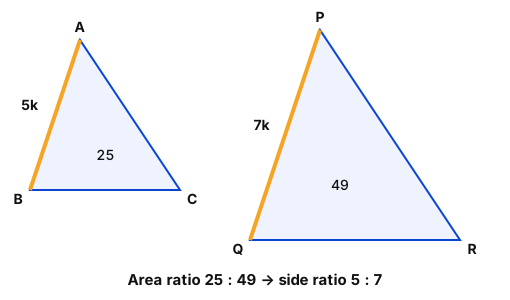
If ΔABC~ΔPQR and area(ΔABC)area(ΔPQR)=2549, then what is the value of AB : PQ?
यदि ΔABC~ΔPQR और area(ΔABC)area(ΔPQR)=2549 है, तो AB : PQ का मान क्या है?
  1. A3 : 7
  2. B2 : 7
  3. C5 : 7
  4. D4 : 7
Show answer

Concept: For similar triangles, ratio of areas = (ratio of corresponding sides)2.

  1. (ABPQ)2=2549.
  2. ABPQ=2549=57.
  3. AB:PQ=5:7.

Trick: Sides = square root of area ratio; area = square of side ratio.

Answer: (C) 5:7

अवधारणा: समरूप त्रिभुजों में क्षेत्रफलों का अनुपात = (संगत भुजाओं का अनुपात)2।

  1. (ABPQ)2=2549।
  2. ABPQ=2549=57।
  3. AB:PQ=5:7।

ट्रिक: भुजा अनुपात = क्षेत्रफल अनुपात का वर्गमूल।

उत्तर: (C) 5:7

RRB NTPC Graduate CBT 1MathematicsGeometry – Similar trianglesRRB NTPC Graduate CBT 1 2024 · 18 Jun Shift 1 →
Q1758.
Simplify: [(22×6)×{8÷4×(15−114)}]
सरल कीजिए: [(22×6)×{8÷4×(15−114)}]
  1. A3277
  2. B3234
  3. C3262
  4. D3275
Show answer

Concept: Solve the innermost bracket first, then ÷ and × from left to right.

  1. 15−114=60−114=494.
  2. 8÷4×494=2×494=492.
  3. 22×6=132.
  4. 132×492=66×49=3234.

Trick: 66×49=66×50−66=3300−66=3234.

Answer: (B) 3234

अवधारणा: पहले सबसे भीतरी कोष्ठक, फिर बाएँ से दाएँ ÷ और ×।

  1. 15−114=60−114=494।
  2. 8÷4×494=2×494=492।
  3. 22×6=132।
  4. 132×492=66×49=3234।

ट्रिक: 66×49=66×50−66=3300−66=3234।

उत्तर: (B) 3234

RRB NTPC Graduate CBT 1MathematicsSimplification – BODMASRRB NTPC Graduate CBT 1 2024 · 18 Jun Shift 1 →
Q1759.
13 men and 3 women can complete a piece of work in 7 days, and 5 men and 6 women can complete the same work in 18 days. The work of how many women is equivalent to that of one man?
13 पुरुष और 3 महिलाएँ एक कार्य को 7 दिनों में पूरा कर सकते हैं, और 5 पुरुष और 6 महिलाएँ उसी कार्य को 18 दिनों में पूरा कर सकते हैं। कितनी महिलाओं का कार्य एक पुरुष के कार्य के बराबर है?
  1. A87
  2. B84
  3. C88
  4. D90
Show answer

Concept: Same work: (workers × days) must be equal.

  1. (13m+3w)×7=(5m+6w)×18.
  2. 91m+21w=90m+108w.
  3. m=87w.
  4. So 1 man = 87 women.

Trick: Cross-multiply efficiencies with days, collect m on one side, w on the other.

Answer: (A) 87

अवधारणा: समान कार्य के लिए (श्रमिक × दिन) बराबर होता है।

  1. (13m+3w)×7=(5m+6w)×18।
  2. 91m+21w=90m+108w।
  3. m=87w।
  4. अतः 1 पुरुष = 87 महिलाएँ।

ट्रिक: दिनों से गुणा करें, m एक ओर और w दूसरी ओर रखें।

उत्तर: (A) 87

RRB NTPC Graduate CBT 1MathematicsTime and work – Men and womenRRB NTPC Graduate CBT 1 2024 · 18 Jun Shift 1 →
Q1760.
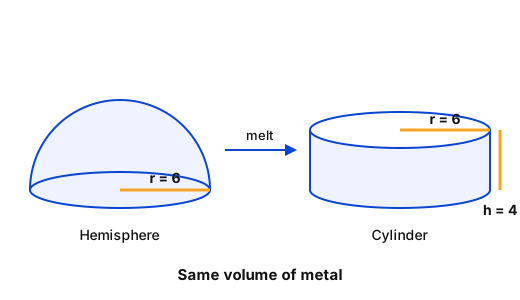
A solid metal hemisphere has a radius of 6 cm. If the metal of the hemisphere is melted and recast into a cylindrical shape with the same radius, find the height of the cylinder.
धातु के एक ठोस अर्धगोले की त्रिज्या 6 cm है। यदि अर्धगोले की धातु को पिघलाकर समान त्रिज्या वाले एक बेलन के आकार में ढाला जाता है, तो बेलन की ऊँचाई ज्ञात कीजिए।
  1. A12 cm
  2. B8 cm
  3. C6 cm
  4. D4 cm
Show answer

Concept: On melting and recasting, volume stays the same. Hemisphere =23πr3, cylinder =πr2h.

  1. πr2h=23πr3.
  2. h=23r=23×6.
  3. h=4cm.

Trick: Same radius: cylinder height =23 of radius (for hemisphere).

Answer: (D) 4cm

अवधारणा: पिघलाकर दोबारा ढालने पर आयतन समान रहता है। अर्धगोला =23πr3, बेलन =πr2h।

  1. πr2h=23πr3।
  2. h=23r=23×6।
  3. h=4cm।

ट्रिक: समान त्रिज्या: बेलन की ऊँचाई = त्रिज्या का 23 (अर्धगोले से)।

उत्तर: (D) 4cm

RRB NTPC Graduate CBT 1MathematicsMensuration – Recasting solidsRRB NTPC Graduate CBT 1 2024 · 18 Jun Shift 1 →