Question bank

Q&A: practice questions with answers

Search questions on any topic. Filter by exam category, exam, subject and topic, try the question, then open the answer and explanation.

Courses – airGurukul

7,077 questions found.

Q1941.
A company produces two products A and B with prices of ₹156 and ₹220, respectively. If 55% of the products sold are A and 45% of the products sold are B. Find the weighted average price?
एक कंपनी दो उत्पाद A और B बनाती है, जिनके मूल्य क्रमशः ₹156 और ₹220 हैं। यदि बेचे गए उत्पादों में से 55% उत्पाद A हैं और 45% उत्पाद B हैं, तो भारित औसत मूल्य ज्ञात कीजिए।
  1. A₹169.50
  2. B₹184.80
  3. C₹174.60
  4. D₹165.30
Show answer

Concept: Weighted average =∑(price×weight) with weights as fractions.

  1. 0.55×156=85.8
  2. 0.45×220=99
  3. Weighted average =85.8+99=184.8

Trick: 156+0.45×(220−156)=156+28.8=184.8.

Answer: (B) ₹184.80

अवधारणा: भारित औसत =∑(मूल्य×भार)।

  1. 0.55×156=85.8
  2. 0.45×220=99
  3. भारित औसत =85.8+99=184.8

ट्रिक: 156+0.45×(220−156)=156+28.8=184.8।

उत्तर: (B) ₹184.80

RRB NTPC Graduate CBT 1MathematicsWeighted AverageRRB NTPC Graduate CBT 1 2024 · 17 Jun Shift 2 →
Q1942.
The population of a town in 1930 was 3,48,000. If its population increased in two successive decades by 95% in each decade, the population of the town in 1950 was:
1930 में एक कस्बे की जनसंख्या 3,48,000 थी। यदि लगातार दो दशकों में इसकी जनसंख्या में प्रत्येक दशक में 95% की वृद्धि हुई, तो 1950 में कस्बे की जनसंख्या कितनी थी?
  1. A13,23,273
  2. B13,23,270
  3. C13,23,267
  4. D13,23,272
Show answer

Concept: Successive % growth works like compound interest: P(1+r100)n.

  1. Factor =1.952=3.8025
  2. Population 1950 =348000×3.8025
  3. =1323270 → 13,23,270

Trick: Last digits: 348000×3.8025 ends in …270 since 3.8025×1000=3802.5 and 348×3802.5=1323270.

Answer: (B) 13,23,270

अवधारणा: क्रमिक प्रतिशत वृद्धि चक्रवृद्धि जैसी: P(1+r100)n।

  1. गुणक =1.952=3.8025
  2. 1950 की जनसंख्या =348000×3.8025
  3. =1323270 → 13,23,270

ट्रिक: 348×3802.5=1323270 – सीधे गुणा करें।

उत्तर: (B) 13,23,270

RRB NTPC Graduate CBT 1MathematicsPopulation GrowthRRB NTPC Graduate CBT 1 2024 · 17 Jun Shift 2 →
Q1943.
Three persons X, Y, and Z started a business with their shares in the ratio 3 : 4 : 10. After 6 months, Y withdrew his 50% share, while Z withdrew his 40% share 9 months prior to completion of the year. If the total profit at the end of the year is ₹23,400, find the share of Z (in ₹) in the profit.
तीन व्यक्तियों X, Y और Z ने 3 : 4 : 10 के अनुपात में अपने अंशों के साथ एक व्यवसाय शुरू किया। 6 महीने बाद, Y ने अपना 50% अंश निकाल लिया, जबकि Z ने वर्ष पूरा होने से 9 महीने पहले अपना 40% अंश निकाल लिया। यदि वर्ष के अंत में कुल लाभ ₹23,400 है, तो लाभ में Z का हिस्सा (₹ में) ज्ञात कीजिए।
  1. A12,600
  2. B12,366
  3. C12,510
  4. D12,559
Show answer

Concept: Profit share ∝ capital × time (sum over each period).

  1. Take capitals 30, 40, 100. X: 30×12=360
  2. Y: 40×6+20×6=360
  3. Z withdraws 40% after 3 months: 100×3+60×9=840
  4. Ratio 360:360:840=3:3:7; Z =713×23400=12600

Trick: '9 months prior to completion' = after 3 months.

Answer: (A) 12,600

अवधारणा: लाभ हिस्सा ∝ पूँजी × समय।

  1. पूँजी 30, 40, 100 लें। X: 30×12=360
  2. Y: 40×6+20×6=360
  3. Z ने 3 माह बाद 40% निकाला: 100×3+60×9=840
  4. अनुपात 3:3:7; Z =713×23400=12600

ट्रिक: 'वर्ष पूरा होने से 9 माह पहले' = 3 माह बाद।

उत्तर: (A) 12,600

RRB NTPC Graduate CBT 1MathematicsPartnershipRRB NTPC Graduate CBT 1 2024 · 17 Jun Shift 2 →
Q1944.
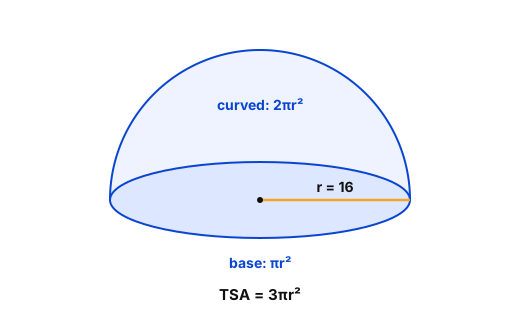
A solid hemisphere has a radius of 16 cm. Find its total surface area.
एक ठोस अर्धगोले की त्रिज्या 16 cm है। इसका संपूर्ण पृष्ठीय क्षेत्रफल ज्ञात कीजिए।
  1. A764π cm2
  2. B760π cm2
  3. C761π cm2
  4. D768π cm2
Show answer

Concept: Solid hemisphere TSA = curved 2πr2 + flat base πr2=3πr2.

  1. r=16cm, r2=256
  2. TSA =3π×256=768πcm2

Trick: Solid hemisphere → 3πr2; hollow (curved only) → 2πr2.

Answer: (D) 768πcm2

अवधारणा: ठोस अर्धगोले का कुल पृष्ठीय क्षेत्रफल = वक्र 2πr2 + समतल आधार πr2=3πr2।

  1. r=16cm, r2=256
  2. TSA =3π×256=768πcm2

ट्रिक: ठोस अर्धगोला → 3πr2; केवल वक्र → 2πr2।

उत्तर: (D) 768πcm2

RRB NTPC Graduate CBT 1MathematicsMensuration – HemisphereRRB NTPC Graduate CBT 1 2024 · 17 Jun Shift 2 →
Q1945.
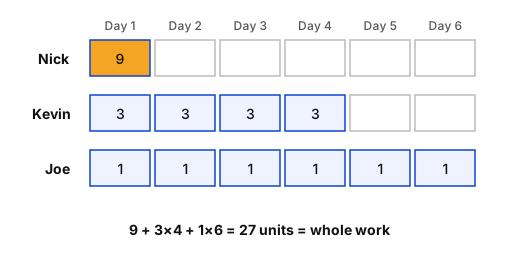
Nick, Kevin, and Joe can finish a certain piece of work in 3, 9, and 27 days respectively. All three of them started the work together. Nick left after working for 1 day, and Kevin left 2 days before the work was completed. Find the total number of days taken to complete the work.
निक, केविन और जो किसी कार्य को क्रमशः 3, 9 और 27 दिनों में पूरा कर सकते हैं। तीनों ने एक साथ कार्य शुरू किया। निक 1 दिन कार्य करने के बाद चला गया, और केविन कार्य पूरा होने से 2 दिन पहले चला गया। कार्य पूरा करने में लगे कुल दिनों की संख्या ज्ञात कीजिए।
  1. A7
  2. B5
  3. C4
  4. D6
Show answer

Concept: Take total work = LCM(3, 9, 27) = 27 units; efficiencies 9, 3, 1 units/day.

  1. Let total days =n. Nick works 1 day → 9 units.
  2. Kevin works n−2 days → 3(n−2); Joe works n days → n.
  3. 9+3(n−2)+n=27⇒4n=24⇒n=6

Trick: All three for n days =13n; subtract absences: 13n−9(n−1)−3×2=27⇒n=6.

Answer: (D) 6

अवधारणा: कुल कार्य = LCM(3, 9, 27) = 27 इकाई; क्षमता 9, 3, 1 इकाई/दिन।

  1. कुल दिन =n। Nick 1 दिन → 9 इकाई।
  2. Kevin n−2 दिन → 3(n−2); Joe n दिन → n।
  3. 9+3(n−2)+n=27⇒4n=24⇒n=6

ट्रिक: कौन कितने दिन काम करता है – उसी से एक-चर समीकरण बनाएँ।

उत्तर: (D) 6

RRB NTPC Graduate CBT 1MathematicsTime and WorkRRB NTPC Graduate CBT 1 2024 · 17 Jun Shift 2 →
Q1946.
The mode of the observations 8, 7, 4, 7, 9, 4, 5, 4, 7, 2, 4, 5, 8, 5, 4 and 5 is:
प्रेक्षणों 8, 7, 4, 7, 9, 4, 5, 4, 7, 2, 4, 5, 8, 5, 4 और 5 का बहुलक है:
  1. A8
  2. B7
  3. C2
  4. D4
Show answer

Concept: Mode = the value that occurs most often.

  1. Counts: 4 → 5 times, 5 → 4 times, 7 → 3 times, 8 → 2 times; 2 and 9 once.
  2. Highest frequency is for 4.

Trick: Tally quickly – mark each value once as you pass.

Answer: (D) 4

अवधारणा: बहुलक = सबसे अधिक बार आने वाला मान।

  1. गिनती: 4 → 5 बार, 5 → 4 बार, 7 → 3 बार, 8 → 2 बार; 2 व 9 एक-एक बार।
  2. सबसे अधिक बारंबारता 4 की।

ट्रिक: मिलान चिह्न (tally) से तेज़ी से गिनें।

उत्तर: (D) 4

RRB NTPC Graduate CBT 1MathematicsStatistics – ModeRRB NTPC Graduate CBT 1 2024 · 17 Jun Shift 2 →
Q1947.
Three numbers are in the ratio 2 : 7 : 13, and their LCM is 3094. Their HCF is ____.
तीन संख्याएँ 2 : 7 : 13 के अनुपात में हैं, और उनका LCM 3094 है। उनका HCF ____ है।
  1. A17
  2. B20
  3. C9
  4. D18
Show answer

Concept: Write the numbers as 2k,7k,13k; since 2, 7, 13 are pairwise co-prime, LCM =2×7×13×k.

  1. LCM =182k=3094
  2. k=3094182=17
  3. HCF =k=17

Trick: Co-prime ratio terms → HCF = the common multiplier k.

Answer: (A) 17

अवधारणा: संख्याएँ 2k,7k,13k; 2, 7, 13 परस्पर अभाज्य, अतः LCM =2×7×13×k।

  1. LCM =182k=3094
  2. k=3094182=17
  3. HCF =k=17

ट्रिक: अनुपात के पद सह-अभाज्य हों तो HCF = k।

उत्तर: (A) 17

RRB NTPC Graduate CBT 1MathematicsHCF and LCMRRB NTPC Graduate CBT 1 2024 · 17 Jun Shift 2 →
Q1948.
Govind bought two items at a total cost of ₹4,800. He sold one item at 34% profit and the other at 10% loss. If Govind sold both the items together for ₹5,442, then what is the difference between the cost price (in ₹) of both the items?
गोविंद ने ₹4,800 की कुल लागत पर दो वस्तुएँ खरीदीं। उसने एक वस्तु 34% लाभ पर और दूसरी 10% हानि पर बेची। यदि गोविंद ने दोनों वस्तुएँ एक साथ ₹5,442 में बेचीं, तो दोनों वस्तुओं के क्रय मूल्य (₹ में) के बीच का अंतर कितना है?
  1. A350
  2. B300
  3. C275
  4. D325
Show answer

Concept: Let one item cost x; the other costs 4800−x. Write the total selling price as an equation.

  1. 1.34x+0.90(4800−x)=5442
  2. 0.44x+4320=5442⇒0.44x=1122⇒x=2550
  3. Other item =4800−2550=2250
  4. Difference =2550−2250=300

Trick: If all were sold at 10% loss, SP would be ₹4320. Extra ₹1122 comes from 34%+10%=44% of item 1, so item 1 =11220.44=2550.

Answer: (B) ₹300

अवधारणा: एक वस्तु का क्रय मूल्य x मानें; दूसरी का 4800−x। कुल विक्रय मूल्य से समीकरण बनाएँ।

  1. 1.34x+0.90(4800−x)=5442
  2. 0.44x+4320=5442⇒0.44x=1122⇒x=2550
  3. दूसरी वस्तु =4800−2550=2250
  4. अंतर =2550−2250=300

ट्रिक: यदि दोनों 10% हानि पर बिकतीं तो विक्रय मूल्य ₹4320 होता। अतिरिक्त ₹1122 पहली वस्तु के 34%+10%=44% से आए, अतः पहली वस्तु =11220.44=2550।

उत्तर: (B) ₹300

RRB NTPC Graduate CBT 1MathematicsProfit and LossRRB NTPC Graduate CBT 1 2024 · 17 Jun Shift 2 →
Q1949.
A bank offers 1.1% compound interest per annum calculated on a half-yearly basis. A customer deposits ₹7,745 each on 1 January and 1 July of a year. At the end of the year, the amount he would have gained by way of interest is ________. (Rounded up to the 2 decimal places.)
एक बैंक अर्धवार्षिक आधार पर परिकलित 1.1% वार्षिक चक्रवृद्धि ब्याज प्रदान करता है। एक ग्राहक किसी वर्ष की 1 जनवरी और 1 जुलाई को प्रत्येक बार ₹7,745 जमा करता है। वर्ष के अंत में, उसे ब्याज के रूप में ________ राशि प्राप्त होगी। (2 दशमलव स्थानों तक पूर्णांकित।)
  1. A₹121.87
  2. B₹128.03
  3. C₹131.93
  4. D₹109.99
Show answer

Concept: Half-yearly compounding: rate per half-year =1.12=0.55%. The January deposit earns for 2 half-years, the July deposit for 1 half-year.

  1. Jan deposit: 7745[(1.0055)2−1]=7745×0.01103025=85.43
  2. July deposit: 7745×0.0055=42.60
  3. Total interest =85.43+42.60=128.03

Trick: CI for 2 periods at r% =2r+r2100=1.1+0.003025=1.103025%; add 0.55% for the second deposit: 1.653025% of 7745 ≈128.03.

Answer: (B) ₹128.03

अवधारणा: अर्धवार्षिक चक्रवृद्धि: प्रति छमाही दर =1.12=0.55%। जनवरी की जमा 2 छमाही, जुलाई की जमा 1 छमाही ब्याज कमाती है।

  1. जनवरी जमा: 7745[(1.0055)2−1]=7745×0.01103025=85.43
  2. जुलाई जमा: 7745×0.0055=42.60
  3. कुल ब्याज =85.43+42.60=128.03

ट्रिक: 2 अवधियों का CI =2r+r2100=1.103025%; दूसरी जमा का 0.55% जोड़ें: 7745 का 1.653025%≈128.03।

उत्तर: (B) ₹128.03

RRB NTPC Graduate CBT 1MathematicsCompound InterestRRB NTPC Graduate CBT 1 2024 · 17 Jun Shift 2 →
Q1950.
Which of the following numbers is divisible by 41?
निम्नलिखित में से कौन-सी संख्या 41 से विभाज्य है?
  1. A9430
  2. B9879
  3. C9249
  4. D10113
Show answer

Concept: Divide each option by 41 and check the remainder.

  1. 9430÷41=230 exactly, since 41×230=9430
  2. 9879=41×240+39; 9249=41×225+24; 10113=41×246+27 – not divisible

Trick: 9430=943×10 and 943=41×23 (since 41×23=943).

Answer: (A) 9430

अवधारणा: प्रत्येक विकल्प को 41 से भाग देकर शेषफल जाँचें।

  1. 9430÷41=230 पूर्णतः, क्योंकि 41×230=9430
  2. 9879=41×240+39; 9249=41×225+24; 10113=41×246+27 – विभाज्य नहीं

ट्रिक: 9430=943×10 और 943=41×23।

उत्तर: (A) 9430

RRB NTPC Graduate CBT 1MathematicsDivisibilityRRB NTPC Graduate CBT 1 2024 · 17 Jun Shift 2 →
Q1951.
The sum of two positive numbers x and y (where x>y) is 15 and their product is 36. Find the difference between the numbers x and y.
दो धनात्मक संख्याओं x और y (जहाँ x>y) का योग 15 है और उनका गुणनफल 36 है। संख्याओं x और y के बीच का अंतर ज्ञात कीजिए।
  1. A10
  2. B9
  3. C12
  4. D8
Show answer

Concept: Use (x−y)2=(x+y)2−4xy.

  1. (x−y)2=152−4×36=225−144=81
  2. x−y=81=9 (positive since x>y)
  3. Check: x=12, y=3 ⇒ 12+3=15, 12×3=36

Trick: Find two numbers with product 36 and sum 15 directly: 12 and 3.

Answer: (B) 9

अवधारणा: सूत्र (x−y)2=(x+y)2−4xy का प्रयोग करें।

  1. (x−y)2=152−4×36=225−144=81
  2. x−y=81=9 (क्योंकि x>y)
  3. जाँच: x=12, y=3 ⇒ 12+3=15, 12×3=36

ट्रिक: गुणनफल 36 और योग 15 वाली संख्याएँ सीधे सोचें: 12 और 3।

उत्तर: (B) 9

RRB NTPC Graduate CBT 1MathematicsAlgebra – Sum and ProductRRB NTPC Graduate CBT 1 2024 · 17 Jun Shift 2 →
Q1952.
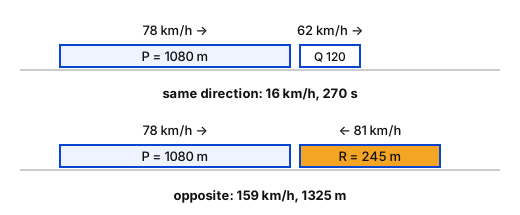
A train P going at the speed of 78 km/hr completely passes train Q of length 120 m, going in the same direction on parallel tracks, at 62 km/hr, in 4.5 minutes. How much time (in seconds) will P take to cross completely train R of length 245 m, going at 81 km/hr in the opposite direction?
78 km/hr की चाल से चल रही एक ट्रेन P, समानांतर पटरियों पर उसी दिशा में 62 km/hr की चाल से चल रही 120 m लंबी ट्रेन Q को 4.5 मिनट में पूरी तरह पार कर लेती है। विपरीत दिशा में 81 km/hr की चाल से चल रही 245 m लंबी ट्रेन R को पूरी तरह पार करने में P को कितना समय (सेकंड में) लगेगा?
  1. A49
  2. B28
  3. C30
  4. D15
Show answer

Concept: Crossing distance = sum of lengths; use relative speed (difference for same direction, sum for opposite).

  1. Same direction: 78−62=16km/h=409m/s; time =4.5×60=270s
  2. LP+120=409×270=1200⇒LP=1080m
  3. Opposite: 78+81=159km/h=159×518=2656m/s
  4. Time =1080+245265/6=1325×6265=30s

Trick: 1325=5×265, so time =5×6=30 s.

Answer: (C) 30

अवधारणा: पार करने की दूरी = दोनों लंबाइयों का योग; सापेक्ष चाल (एक ही दिशा में अंतर, विपरीत दिशा में योग)।

  1. एक ही दिशा: 78−62=16km/h=409m/s; समय =4.5×60=270s
  2. LP+120=409×270=1200⇒LP=1080m
  3. विपरीत दिशा: 78+81=159km/h=2656m/s
  4. समय =1080+245265/6=1325×6265=30s

ट्रिक: 1325=5×265, अतः समय =5×6=30 सेकंड।

उत्तर: (C) 30

RRB NTPC Graduate CBT 1MathematicsTrainsRRB NTPC Graduate CBT 1 2024 · 17 Jun Shift 2 →
Q1953.
A vendor sells 8, 12, 10, 14, and 6 mangoes over five days. What is the average number of mangoes sold per day?
एक विक्रेता पाँच दिनों में 8, 12, 10, 14 और 6 आम बेचता है। प्रति दिन बेचे गए आमों की औसत संख्या क्या है?
  1. A8
  2. B14
  3. C12
  4. D10
Show answer

Concept: Average =sumcount.

  1. Sum =8+12+10+14+6=50
  2. Average =505=10

Trick: Pair the deviations around 10: −2,+2,0,+4,−4 cancel out, so the average is 10.

Answer: (D) 10

अवधारणा: औसत =योगसंख्या।

  1. योग =8+12+10+14+6=50
  2. औसत =505=10

ट्रिक: 10 से विचलन −2,+2,0,+4,−4 आपस में कट जाते हैं, अतः औसत 10।

उत्तर: (D) 10

RRB NTPC Graduate CBT 1MathematicsAverageRRB NTPC Graduate CBT 1 2024 · 17 Jun Shift 2 →
Q1954.
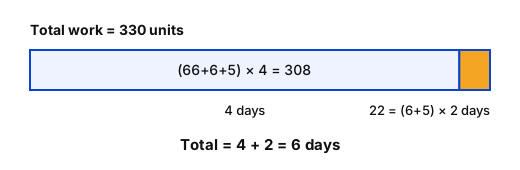
A, B and C alone can do a piece of work in 5, 55 and 66 days, respectively. They all started the work together, but A left after 4 days. In how many days was the whole work completed?
A, B और C अकेले किसी कार्य को क्रमशः 5, 55 और 66 दिनों में कर सकते हैं। सभी ने एक साथ कार्य शुरू किया, लेकिन A 4 दिन बाद चला गया। पूरा कार्य कितने दिनों में पूरा हुआ?
  1. A7
  2. B3
  3. C2
  4. D6
Show answer

Concept: Take total work = LCM(5, 55, 66) = 330 units.

  1. Efficiencies: A =3305=66, B =33055=6, C =33066=5 units/day
  2. 4 days together: (66+6+5)×4=308 units
  3. Left: 330−308=22 units by B + C at 11/day ⇒ 2211=2 days
  4. Total =4+2=6 days

Trick: Units method avoids fractions – always use LCM as total work.

Answer: (D) 6

अवधारणा: कुल कार्य = LCM(5, 55, 66) = 330 इकाई मानें।

  1. क्षमता: A =3305=66, B =33055=6, C =33066=5 इकाई/दिन
  2. 4 दिन साथ में: (66+6+5)×4=308 इकाई
  3. शेष: 330−308=22 इकाई, B + C 11 प्रतिदिन ⇒ 2211=2 दिन
  4. कुल =4+2=6 दिन

ट्रिक: LCM को कुल कार्य मानने से भिन्नें नहीं आतीं।

उत्तर: (D) 6

RRB NTPC Graduate CBT 1MathematicsTime and WorkRRB NTPC Graduate CBT 1 2024 · 17 Jun Shift 2 →
Q1955.
Namita travels a certain distance at a speed of 88 km/hr and double the earlier distance at 16 km/hr. She then returns to the starting point through the same route. If her average speed for the entire journey is 33 km/hr, then what is her speed (in km/hr) for the return journey?
नमिता एक निश्चित दूरी 88 km/hr की चाल से और उससे दोगुनी दूरी 16 km/hr की चाल से तय करती है। फिर वह उसी मार्ग से प्रारंभिक बिंदु पर लौटती है। यदि पूरी यात्रा के लिए उसकी औसत चाल 33 km/hr है, तो वापसी यात्रा के लिए उसकी चाल (km/hr में) क्या है?
  1. A64
  2. B65.4
  3. C66
  4. D71.2
Show answer

Concept: Average speed =total distancetotal time. Let first part =d, second part =2d.

  1. Onward time =d88+2d16=d88+11d88=12d88=3d22
  2. Total distance =6d; total time =6d33=2d11=4d22
  3. Return time =4d22−3d22=d22
  4. Return speed =3dd/22=66km/h

Trick: Take d=88: onward time 12 h, total time 16 h, return time 4 h for 264 km ⇒ 66 km/h.

Answer: (C) 66

अवधारणा: औसत चाल =कुल दूरीकुल समय। पहला भाग =d, दूसरा =2d मानें।

  1. जाने का समय =d88+2d16=12d88=3d22
  2. कुल दूरी =6d; कुल समय =6d33=4d22
  3. वापसी का समय =4d22−3d22=d22
  4. वापसी चाल =3dd/22=66km/h

ट्रिक: d=88 लें: जाने में 12 घंटे, कुल 16 घंटे, वापसी 4 घंटे में 264 km ⇒ 66 km/h।

उत्तर: (C) 66

RRB NTPC Graduate CBT 1MathematicsAverage SpeedRRB NTPC Graduate CBT 1 2024 · 17 Jun Shift 2 →
Q1956.
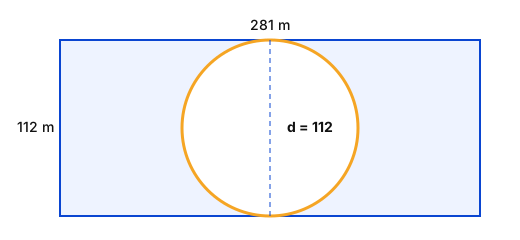
Find the circumference (in m) of the largest circle that can be inscribed in a rectangle whose dimensions are given as 112 m and 281 m.
Take π=227
उस सबसे बड़े वृत्त की परिधि (m में) ज्ञात कीजिए जो 112 m और 281 m विमाओं वाले एक आयत के अंदर बनाया जा सकता है।
π=227 लीजिए
  1. A352
  2. B348
  3. C354
  4. D342
Show answer

Concept: The largest circle inside a rectangle touches the two longer sides, so its diameter = the shorter side.

  1. Diameter =112m
  2. Circumference =πd=227×112=22×16=352m

Trick: Diameter = smaller side of the rectangle; the longer side (281) is irrelevant.

Answer: (A) 352

अवधारणा: आयत के अंदर सबसे बड़ा वृत्त दो लंबी भुजाओं को छूता है, अतः उसका व्यास = छोटी भुजा।

  1. व्यास =112m
  2. परिधि =πd=227×112=22×16=352m

ट्रिक: व्यास = आयत की छोटी भुजा; लंबी भुजा (281) का कोई उपयोग नहीं।

उत्तर: (A) 352

RRB NTPC Graduate CBT 1MathematicsMensuration – CircleRRB NTPC Graduate CBT 1 2024 · 17 Jun Shift 2 →
Q1957.
Find the value of 0.040.0004:
0.040.0004 का मान ज्ञात कीजिए:
  1. A18
  2. B29
  3. C10
  4. D21
Show answer

Concept: Take square roots of numerator and denominator separately.

  1. 0.04=0.2 and 0.0004=0.02
  2. 0.20.02=10

Trick: 0.040.0004=100=10 in one step.

Answer: (C) 10

अवधारणा: अंश और हर का वर्गमूल अलग-अलग निकालें।

  1. 0.04=0.2 और 0.0004=0.02
  2. 0.20.02=10

ट्रिक: एक ही चरण में: 0.040.0004=100=10।

उत्तर: (C) 10

RRB NTPC Graduate CBT 1MathematicsSquare Roots of DecimalsRRB NTPC Graduate CBT 1 2024 · 17 Jun Shift 2 →
Q1958.
The cost of 8 pens and 2 pencils is ₹96 and the cost of 4 pens and 7 pencils ₹72. The cost of 2 pens and 8 pencils is:
8 पेन और 2 पेंसिल का मूल्य ₹96 है तथा 4 पेन और 7 पेंसिल का मूल्य ₹72 है। 2 पेन और 8 पेंसिल का मूल्य है:
  1. A₹53
  2. B₹55
  3. C₹54
  4. D₹56
Show answer

Concept: Let pen =p, pencil =c and solve the two equations.

  1. 8p+2c=96 and 4p+7c=72
  2. Double the second: 8p+14c=144; subtract: 12c=48⇒c=4
  3. 8p=96−8=88⇒p=11
  4. 2p+8c=22+32=54

Trick: Make the pen coefficients equal (8) and subtract to get pencils first.

Answer: (C) ₹54

अवधारणा: पेन =p, पेंसिल =c मानकर दोनों समीकरण हल करें।

  1. 8p+2c=96 और 4p+7c=72
  2. दूसरे को 2 से गुणा: 8p+14c=144; घटाएँ: 12c=48⇒c=4
  3. 8p=96−8=88⇒p=11
  4. 2p+8c=22+32=54

ट्रिक: पेन के गुणांक बराबर (8) करके घटाएँ, पहले पेंसिल का मान मिलेगा।

उत्तर: (C) ₹54

RRB NTPC Graduate CBT 1MathematicsLinear EquationsRRB NTPC Graduate CBT 1 2024 · 17 Jun Shift 2 →
Q1959.
In a regular polygon with n sides, the sum of the interior angles is 1800°. What is the number of sides (n) of the polygon?
n भुजाओं वाले एक सम बहुभुज में अंतः कोणों का योग 1800° है। बहुभुज की भुजाओं की संख्या (n) क्या है?
  1. A14
  2. B10
  3. C12
  4. D16
Show answer

Concept: Sum of interior angles of an n-sided polygon =(n−2)×180∘.

  1. (n−2)×180=1800
  2. n−2=10⇒n=12

Trick: Divide the sum by 180 and add 2: 1800180+2=12.

Answer: (C) 12

अवधारणा: n भुजाओं वाले बहुभुज के अंतःकोणों का योग =(n−2)×180∘।

  1. (n−2)×180=1800
  2. n−2=10⇒n=12

ट्रिक: योग को 180 से भाग देकर 2 जोड़ें: 1800180+2=12।

उत्तर: (C) 12

RRB NTPC Graduate CBT 1MathematicsPolygonsRRB NTPC Graduate CBT 1 2024 · 17 Jun Shift 2 →
Q1960.
Find the simplified value of [160 ÷ {30 + 7 × (2 - 6)}].
[160 ÷ {30 + 7 × (2 - 6)}] का सरलीकृत मान ज्ञात कीजिए।
  1. A80
  2. B79
  3. C85
  4. D78
Show answer

Concept: Solve innermost brackets first, then multiplication, then addition, then division.

  1. 2−6=−4
  2. 7×(−4)=−28
  3. 30+(−28)=2
  4. 160÷2=80

Trick: Watch the sign: 7×(−4) is negative, so the curly bracket becomes just 2.

Answer: (A) 80

अवधारणा: पहले सबसे भीतरी कोष्ठक, फिर गुणा, फिर जोड़, फिर भाग।

  1. 2−6=−4
  2. 7×(−4)=−28
  3. 30+(−28)=2
  4. 160÷2=80

ट्रिक: चिह्न पर ध्यान दें: 7×(−4) ऋणात्मक है, अतः मझला कोष्ठक केवल 2 बनता है।

उत्तर: (A) 80

RRB NTPC Graduate CBT 1MathematicsSimplification (BODMAS)RRB NTPC Graduate CBT 1 2024 · 17 Jun Shift 2 →