Question bank

Q&A: practice questions with answers

Search questions on any topic. Filter by exam category, exam, subject and topic, try the question, then open the answer and explanation.

Courses – airGurukul

8,495 questions found.

Q2061.
₹42,100 were divided among A, B and C such that 8 times the share of A = 3 times the share of B = 6 times the share of C. Find the share of A.
₹42,100 को A, B और C के बीच इस प्रकार विभाजित किया गया कि A के हिस्से का 8 गुना = B के हिस्से का 3 गुना = C के हिस्से का 6 गुना। A का हिस्सा ज्ञात कीजिए।
  1. A₹8,278
  2. B₹8,360
  3. C₹8,420
  4. D₹8,538
Show answer

Concept: If 8A=3B=6C=k, then A:B:C=18:13:16.

  1. Multiply by LCM 24: A:B:C=3:8:4.
  2. Total parts =15.
  3. A =315×42100=421005=8420.

Trick: For aA=bB=cC, take reciprocals 1a:1b:1c and clear by LCM.

Answer: (C) ₹8,420

अवधारणा: यदि 8A=3B=6C=k, तो A:B:C=18:13:16।

  1. LCM 24 से गुणा: A:B:C=3:8:4।
  2. कुल भाग =15।
  3. A =315×42100=421005=8420।

ट्रिक: aA=bB=cC हो तो व्युत्क्रम 1a:1b:1c लें और LCM से गुणा करें।

उत्तर: (C) ₹8,420
RRB NTPC Undergraduate CBT 1MathematicsRatio and ProportionRRB NTPC Undergraduate CBT 1 2024 · 14 Aug Shift 3 →
Q2062.
If the third proportional of 4 and 16 be x, then what is the value of x?
यदि 4 और 16 का तृतीयानुपाती x है, तो x का मान क्या है?
  1. A62
  2. B67
  3. C66
  4. D64
Show answer

Concept: Third proportional of a and b is x where a:b=b:x, so x=b2a.

  1. x=1624=2564.
  2. x=64.

Yaad rakhein: Third proportional =b2a; mean proportional =ab.

Answer: (D) 64

अवधारणा: a और b का तृतीय समानुपाती x हो तो a:b=b:x, अतः x=b2a।

  1. x=1624=2564।
  2. x=64।

याद रखें: तृतीय समानुपाती =b2a; मध्यानुपाती =ab।

उत्तर: (D) 64

RRB NTPC Undergraduate CBT 1MathematicsThird ProportionalRRB NTPC Undergraduate CBT 1 2024 · 14 Aug Shift 3 →
Q2063.
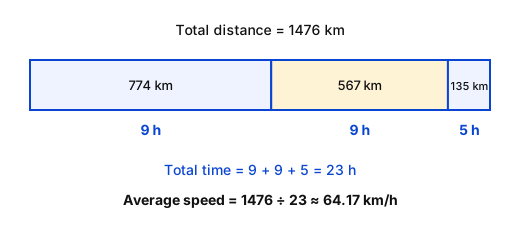
Daksh travels 774 km at 86 km/hr, the next 567 km at 63 km/hr and the next 135 km at 27 km/hr. What is his average speed (in km/hr, rounded off to two decimal places) for the whole journey?
दक्ष 774 km की दूरी 86 km/hr की चाल से, अगली 567 km की दूरी 63 km/hr की चाल से और अगली 135 km की दूरी 27 km/hr की चाल से तय करता है। पूरी यात्रा के लिए उसकी औसत चाल (km/hr में, दो दशमलव स्थानों तक पूर्णांकित) क्या है?
  1. A70.24
  2. B70.02
  3. C64.17
  4. D63.06
Show answer

Concept: Average speed =total distancetotal time (not the average of speeds).

  1. Times: 77486=9 h, 56763=9 h, 13527=5 h.
  2. Total distance =774+567+135=1476km; total time =23 h.
  3. Average speed =147623=64.17km/h.

Trick: Each leg divides exactly (9, 9, 5 hours), so the totals come quickly.

Answer: (C) 64.17

अवधारणा: औसत चाल =कुल दूरीकुल समय (चालों का औसत नहीं)।

  1. समय: 77486=9 h, 56763=9 h, 13527=5 h।
  2. कुल दूरी =774+567+135=1476km; कुल समय =23 h।
  3. औसत चाल =147623=64.17km/h।

ट्रिक: हर भाग पूरा-पूरा बँटता है (9, 9, 5 घंटे), इसलिए योग जल्दी मिल जाता है।

उत्तर: (C) 64.17

RRB NTPC Undergraduate CBT 1MathematicsAverage SpeedRRB NTPC Undergraduate CBT 1 2024 · 14 Aug Shift 3 →
Q2064.
Evaluate 742.
742 का मान ज्ञात कीजिए।
  1. A5456
  2. B5526
  3. C5486
  4. D5476
Show answer

Concept: (a+b)2=a2+2ab+b2.

  1. 742=(70+4)2=4900+560+16.
  2. =5476.

Trick: Last digit of 742 is 6 (since 42=16) and near 752=5625 minus 75+74=149: 5625−149=5476.

Answer: (D) 5476

अवधारणा: (a+b)2=a2+2ab+b2।

  1. 742=(70+4)2=4900+560+16।
  2. =5476।

ट्रिक: 752=5625 से 75+74=149 घटाएँ: 5625−149=5476।

उत्तर: (D) 5476

RRB NTPC Undergraduate CBT 1MathematicsSquaresRRB NTPC Undergraduate CBT 1 2024 · 14 Aug Shift 3 →
Q2065.
If the interest earned during the 2ndyear on a certain sum is ₹5,520, and the rate of interest is 20% per annum compounded annually, then the sum is:
यदि किसी निश्चित राशि पर 2रे वर्ष के दौरान अर्जित ब्याज ₹5,520 है, और ब्याज की दर 20% वार्षिक है जो वार्षिक रूप से संयोजित होती है, तो राशि है:
  1. A₹22,875
  2. B₹23,000
  3. C₹23,405
  4. D₹22,695
Show answer

Concept: CI of the 2nd year = interest on (P + first-year interest) =P×R100×(1+R100).

  1. P×0.2×1.2=5520.
  2. 0.24P=5520 ⇒ P=55200.24=23000.

Trick: At 20%: 1st-year interest =20% of P, 2nd-year =24% of P.

Answer: (B) ₹23,000

अवधारणा: दूसरे वर्ष का CI = (P + पहले वर्ष का ब्याज) पर ब्याज =P×R100×(1+R100)।

  1. P×0.2×1.2=5520।
  2. 0.24P=5520 ⇒ P=55200.24=23000।

ट्रिक: 20% पर: पहले वर्ष का ब्याज P का 20%, दूसरे वर्ष का P का 24%।

उत्तर: (B) ₹23,000

RRB NTPC Undergraduate CBT 1MathematicsCompound InterestRRB NTPC Undergraduate CBT 1 2024 · 14 Aug Shift 3 →
Q2066.
The product of two positive numbers is 9245. If the first number is five times of the second number, then the sum of the two numbers is:
दो धनात्मक संख्याओं का गुणनफल 9245 है। यदि पहली संख्या दूसरी संख्या की पाँच गुनी है, तो दोनों संख्याओं का योग है:
  1. A269
  2. B266
  3. C258
  4. D257
Show answer

Concept: Let the second number =x, first =5x.

  1. 5x×x=9245 ⇒ x2=1849 ⇒ x=43.
  2. First number =215.
  3. Sum =215+43=258 (or 6x=258).

Trick: Sum =6x, so the answer must be a multiple of 6: only 258 is.

Answer: (C) 258

अवधारणा: माना दूसरी संख्या =x, पहली =5x।

  1. 5x×x=9245 ⇒ x2=1849 ⇒ x=43।
  2. पहली संख्या =215।
  3. योग =215+43=258 (या 6x=258)।

ट्रिक: योग =6x, अतः उत्तर 6 का गुणज होगा – केवल 258।

उत्तर: (C) 258

RRB NTPC Undergraduate CBT 1MathematicsNumber SystemRRB NTPC Undergraduate CBT 1 2024 · 14 Aug Shift 3 →
Q2067.
Six times the present age of P exceeds the present age of Q by 46 years. After 10 years, six times Q’s age will be 18 years less than five times P’s age at that time. What is the present age of Q (in years)?
P की वर्तमान आयु का छह गुना, Q की वर्तमान आयु से 46 वर्ष अधिक है। 10 वर्ष बाद, Q की आयु का छह गुना उस समय P की आयु के पाँच गुने से 18 वर्ष कम होगा। Q की वर्तमान आयु (वर्षों में) कितनी है?
  1. A1
  2. B2
  3. C6
  4. D5
Show answer

Concept: Form two equations from the two statements and solve.

  1. 6P=Q+46.
  2. After 10 years: 6(Q+10)=5(P+10)−18 ⇒ 6Q+60=5P+32 ⇒ 5P=6Q+28.
  3. From the first, P=Q+466: 5(Q+46)6=6Q+28 ⇒ 5Q+230=36Q+168.
  4. 31Q=62 ⇒ Q=2 (and P=8).

Trick: Check options: Q=2 ⇒ P=8; after 10 years 6×12=72, 5×18−18=72 ✓.

Answer: (B) 2

अवधारणा: दोनों कथनों से दो समीकरण बनाकर हल करें।

  1. 6P=Q+46।
  2. 10 वर्ष बाद: 6(Q+10)=5(P+10)−18 ⇒ 6Q+60=5P+32 ⇒ 5P=6Q+28।
  3. P=Q+466 रखने पर: 5Q+230=36Q+168।
  4. 31Q=62 ⇒ Q=2 (और P=8)।

ट्रिक: विकल्प जाँचें: Q=2 ⇒ P=8; 10 वर्ष बाद 6×12=72, 5×18−18=72 ✓।

उत्तर: (B) 2

RRB NTPC Undergraduate CBT 1MathematicsProblems on AgesRRB NTPC Undergraduate CBT 1 2024 · 14 Aug Shift 3 →
Q2068.
The number 934725 is divisible by which of the following?
संख्या 934725 निम्नलिखित में से किससे विभाज्य है?
  1. A6
  2. B3
  3. C2
  4. D10
Show answer

Concept: Divisible by 3 if the digit sum is divisible by 3; by 2 if the last digit is even; by 6 if by both 2 and 3; by 10 if it ends in 0.

  1. Digit sum =9+3+4+7+2+5=30, divisible by 3 ✓.
  2. Last digit 5 is odd ⇒ not divisible by 2, hence not by 6; not ending in 0 ⇒ not by 10.

Trick: Number ends in 5 → rule out 2, 6, 10 at once; check only 3.

Answer: (B) 3

अवधारणा: 3 से विभाज्य यदि अंकों का योग 3 से विभाज्य; 2 से यदि अंतिम अंक सम; 6 से यदि 2 और 3 दोनों से; 10 से यदि अंत में 0।

  1. अंकों का योग =9+3+4+7+2+5=30, 3 से विभाज्य ✓।
  2. अंतिम अंक 5 विषम ⇒ 2 से नहीं, अतः 6 से भी नहीं; अंत में 0 नहीं ⇒ 10 से नहीं।

ट्रिक: अंत में 5 → 2, 6, 10 तुरंत बाहर; केवल 3 जाँचें।

उत्तर: (B) 3

RRB NTPC Undergraduate CBT 1MathematicsDivisibility RulesRRB NTPC Undergraduate CBT 1 2024 · 14 Aug Shift 3 →
Q2069.
Based on the English alphabetical order, three of the following four letter-cluster pairs are alike in a certain way and thus form a group. Which letter-cluster pair DOES NOT belong to that group?
(Note: The odd one out is not based on the number of consonants/vowels or their position in the letter-cluster.)
अंग्रेज़ी वर्णमाला क्रम के आधार पर, निम्नलिखित चार अक्षर-समूह युग्मों में से तीन किसी निश्चित प्रकार से एकसमान हैं और इस प्रकार एक समूह बनाते हैं। कौन-सा अक्षर-समूह युग्म उस समूह से संबंधित नहीं है?
(ध्यान दें: असंगत का निर्धारण अक्षर-समूह में व्यंजनों/स्वरों की संख्या या उनके स्थान पर आधारित नहीं है।)
  1. AZR - FN
  2. BHO - MK
  3. CBV - GR
  4. DYD - DZ
Show answer

Concept: Compare position values: 1st letter of pair-2 = 1st letter of pair-1 +5, 2nd letter = 2nd letter −4 (cyclic).

  1. HO - MK: H(8)+5 = M(13), O(15)−4 = K(11) ✓.
  2. BV - GR: B(2)+5 = G(7), V(22)−4 = R(18) ✓.
  3. YD - DZ: Y(25)+5 = 30−26 = D(4), D(4)−4 = 0 → Z(26) ✓.
  4. ZR - FN: Z(26)+5 = E(5), not F ✗ (R−4 = N works).

Trick: Write positions under each letter; the pair that breaks even one step is the odd one.

Answer: (A) ZR - FN

अवधारणा: स्थानीय मान की तुलना: दूसरे भाग का पहला अक्षर = पहले भाग का पहला अक्षर +5, दूसरा अक्षर = दूसरा अक्षर −4 (चक्रीय)।

  1. HO - MK: H(8)+5 = M(13), O(15)−4 = K(11) ✓।
  2. BV - GR: B(2)+5 = G(7), V(22)−4 = R(18) ✓।
  3. YD - DZ: Y(25)+5 = 30−26 = D(4), D(4)−4 = 0 → Z(26) ✓।
  4. ZR - FN: Z(26)+5 = E(5), F नहीं ✗।

ट्रिक: हर अक्षर के नीचे स्थान लिखें; जो युग्म किसी एक चरण में टूटे वही विषम।

उत्तर: (A) ZR - FN

RRB NTPC Undergraduate CBT 1General Intelligence and ReasoningLetter Analogy – Odd PairRRB NTPC Undergraduate CBT 1 2024 · 14 Aug Shift 3 →
Q2070.
What should come in place of the question mark (?) in the given series?
657 660 665 672 681 ?
दी गई श्रृंखला में प्रश्न चिह्न (?) के स्थान पर क्या आना चाहिए?
657 660 665 672 681 ?
  1. A690
  2. B691
  3. C693
  4. D692
Show answer

Concept: Look at the differences between consecutive terms.

  1. Differences: 3,5,7,9 (consecutive odd numbers).
  2. Next difference =11 ⇒ 681+11=692.

Trick: 657+ (sum of odd numbers): differences rise by 2 each time.

Answer: (D) 692

अवधारणा: क्रमागत पदों के अंतर देखें।

  1. अंतर: 3,5,7,9 (क्रमागत विषम संख्याएँ)।
  2. अगला अंतर =11 ⇒ 681+11=692।

ट्रिक: अंतर हर बार 2 बढ़ रहा है।

उत्तर: (D) 692

RRB NTPC Undergraduate CBT 1General Intelligence and ReasoningNumber SeriesRRB NTPC Undergraduate CBT 1 2024 · 14 Aug Shift 3 →
Q2071.
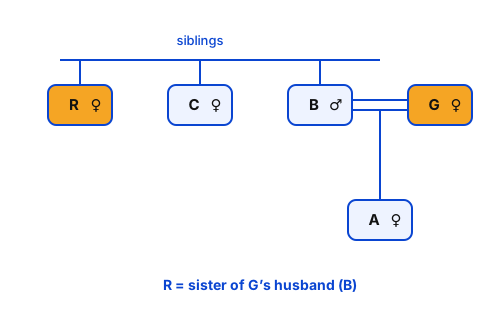
R is the sister of C. C is the sister of B. B is the father of A. A is the daughter of G. How is R related to G?
R, C की बहन है। C, B की बहन है। B, A का पिता है। A, G की पुत्री है। R का G से क्या संबंध है?
  1. AHusband's motherपति की माँ
  2. BSisterबहन
  3. CHusband's sisterपति की बहन
  4. DMotherमाँ
Show answer

Concept: Draw the family tree step by step and read the relation from R to G.

  1. R, C and B are siblings (R and C are sisters of B).
  2. B is the father of A, and A is the daughter of G ⇒ G is the mother of A, i.e. B’s wife.
  3. So R is the sister of G’s husband ⇒ husband’s sister.

Trick: Father B + child’s other parent G ⇒ husband–wife; B’s sister becomes G’s husband’s sister (sister-in-law).

Answer: (C) Husband’s sister

अवधारणा: चरणबद्ध परिवार-वृक्ष बनाएँ और R का G से संबंध पढ़ें।

  1. R, C और B भाई-बहन हैं (R और C, B की बहनें)।
  2. B, A का पिता है और A, G की बेटी है ⇒ G, A की माँ यानी B की पत्नी।
  3. अतः R, G के पति की बहन (ननद) है।

ट्रिक: पिता B + बच्चे का दूसरा अभिभावक G ⇒ पति-पत्नी; B की बहन = G की ननद।

उत्तर: (C) पति की बहन (Husband’s sister)

RRB NTPC Undergraduate CBT 1General Intelligence and ReasoningBlood RelationsRRB NTPC Undergraduate CBT 1 2024 · 14 Aug Shift 3 →
Q2072.
Read the given statements and conclusions carefully. Assuming that the information given in the statements is true, even if it appears to be at variance with commonly known facts, decide which of the given conclusions logically follow(s) from the statements.
Statements:
All bats are stick.
All bamboo is stick.
Conclusions:
(I): Some bats are bamboo.
(II): Some sticks are bamboo.
दिए गए कथनों और निष्कर्षों को ध्यानपूर्वक पढ़िए। यह मानते हुए कि कथनों में दी गई जानकारी सत्य है, भले ही वह सामान्य रूप से ज्ञात तथ्यों से भिन्न प्रतीत होती हो, निर्णय कीजिए कि दिए गए निष्कर्षों में से कौन-सा/से निष्कर्ष कथनों का तार्किक रूप से अनुसरण करता है/करते हैं।
कथन:
सभी बैट, स्टिक हैं।
सभी बैम्बू, स्टिक हैं।
निष्कर्ष:
(I): कुछ बैट, बैम्बू हैं।
(II): कुछ स्टिक, बैम्बू हैं।
  1. ABoth conclusions (I) and (II) follow.निष्कर्ष (I) और (II) दोनों अनुसरण करते हैं।
  2. BOnly conclusion (II) follows.केवल निष्कर्ष (II) अनुसरण करता है।
  3. CNeither conclusion (I) nor (II) follows.न तो निष्कर्ष (I) और न ही (II) अनुसरण करता है।
  4. DOnly conclusion (I) follows.केवल निष्कर्ष (I) अनुसरण करता है।
Show answer

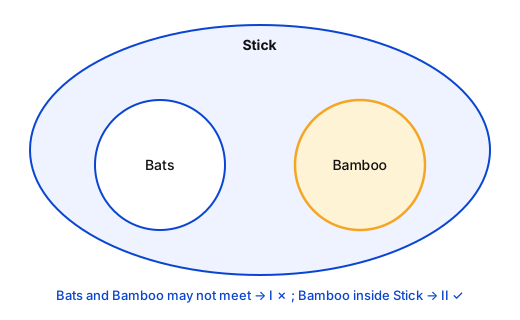
Concept: Two "All" statements with the same predicate (stick) do not connect the subjects with each other.

  1. All bats ⊂ stick and all bamboo ⊂ stick; bats and bamboo may be fully separate inside stick ⇒ I (Some bats are bamboo) does not follow.
  2. All bamboo is stick ⇒ some sticks are bamboo (conversion of "All") ⇒ II follows.

Trick: "All A are B" always gives "Some B are A"; two circles inside a third need not touch.

Answer: (B) Only conclusion (II) follows.

अवधारणा: एक ही विधेय (stick) वाले दो "All" कथन दोनों उद्देश्यों को आपस में नहीं जोड़ते।

  1. सभी bats ⊂ stick और सभी bamboo ⊂ stick; bats और bamboo, stick के भीतर अलग-अलग हो सकते हैं ⇒ I अनुसरण नहीं करता।
  2. सभी bamboo, stick हैं ⇒ कुछ sticks, bamboo हैं ⇒ II अनुसरण करता है।

ट्रिक: "सभी A, B हैं" से सदैव "कुछ B, A हैं" निकलता है; एक बड़े वृत्त के अंदर दो वृत्तों का मिलना ज़रूरी नहीं।

उत्तर: (B) केवल निष्कर्ष (II) अनुसरण करता है।

RRB NTPC Undergraduate CBT 1General Intelligence and ReasoningSyllogismRRB NTPC Undergraduate CBT 1 2024 · 14 Aug Shift 3 →
Q2073.
Seven boxes F, G, H, I, K, L, and O are kept one over the other but not necessarily in the same order. O is kept immediately above F. G is kept immediately above I. Only K is kept above L. Only two boxes are kept above O. G is not kept at the third position from the bottom.
How many boxes are kept between H and K?
सात बॉक्स F, G, H, I, K, L और O एक के ऊपर एक रखे गए हैं, लेकिन आवश्यक नहीं कि इसी क्रम में हों। O को F के ठीक ऊपर रखा गया है। G को I के ठीक ऊपर रखा गया है। L के ऊपर केवल K रखा गया है। O के ऊपर केवल दो बॉक्स रखे गए हैं। G को नीचे से तीसरे स्थान पर नहीं रखा गया है।
H और K के बीच कितने बॉक्स रखे गए हैं?
  1. ATwoदो
  2. BFourचार
  3. COneएक
  4. DThreeतीन
Show answer

Concept: Number the positions 1 (top) to 7 (bottom) and fix the definite clues first.

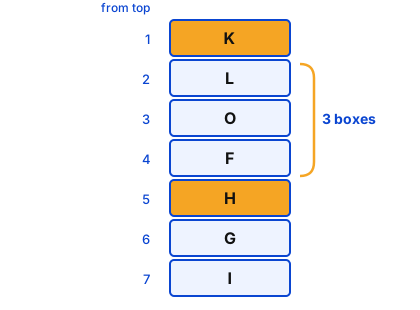
  1. Only K above L ⇒ K = 1, L = 2. Only two above O ⇒ O = 3; O immediately above F ⇒ F = 4.
  2. Left: positions 5, 6, 7 for G, I, H with G immediately above I.
  3. G is not 3rd from bottom (position 5) ⇒ G = 6, I = 7, H = 5.
  4. Between H (5) and K (1): L, O, F ⇒ three boxes.

Trick: Start with clues using "only" – they give exact positions.

Answer: (D) Three

अवधारणा: स्थान 1 (ऊपर) से 7 (नीचे) तक मानें और निश्चित संकेत पहले लगाएँ।

  1. केवल K, L के ऊपर ⇒ K = 1, L = 2। O के ऊपर केवल दो ⇒ O = 3; O, F के ठीक ऊपर ⇒ F = 4।
  2. बचे स्थान 5, 6, 7 पर G, I, H; G ठीक I के ऊपर।
  3. G नीचे से तीसरा (स्थान 5) नहीं ⇒ G = 6, I = 7, H = 5।
  4. H (5) और K (1) के बीच: L, O, F ⇒ तीन बक्से।

ट्रिक: "केवल" वाले संकेत पहले लगाएँ – वे सटीक स्थान देते हैं।

उत्तर: (D) तीन (Three)

RRB NTPC Undergraduate CBT 1General Intelligence and ReasoningPuzzle – Box ArrangementRRB NTPC Undergraduate CBT 1 2024 · 14 Aug Shift 3 →
Q2074.
Refer to the following number and symbol series and answer the question that follows. Counting to be done from left to right only.
(Left) / / 9 3 * > * ? 5 6 2 $ # 3 ^ $ 4 + 6 < + (Right)
How many such numbers are there, each of which is immediately preceded by another number and also immediately followed by a symbol?
निम्नलिखित संख्या और प्रतीक श्रृंखला को देखिए और उसके बाद आने वाले प्रश्न का उत्तर दीजिए। गिनती केवल बाएँ से दाएँ की जानी है।
(बाएँ) / / 9 3 * > * ? 5 6 2 $ # 3 ^ $ 4 + 6 < + (दाएँ)
ऐसी कितनी संख्याएँ हैं, जिनमें से प्रत्येक के ठीक पहले एक अन्य संख्या है और ठीक बाद एक प्रतीक भी है?
  1. AOneएक
  2. BNoneकोई नहीं
  3. CFourचार
  4. DTwoदो
Show answer

Concept: Check every number: the element just before it must be a number and the element just after it must be a symbol.

  1. Series: / / 9 3 * > * ? 5 6 2 $ # 3 ^ $ 4 + 6 < +
  2. 3 (after 9, before *) ✓; 2 (after 6, before $) ✓.
  3. Others fail: 9 (after /), 5 (after ?), 6 (followed by 2), 3 (after #), 4 (after $), 6 (after +).
  4. Total =2.

Trick: Scan for "number–number–symbol" triplets and count the middle number.

Answer: (D) Two

अवधारणा: हर संख्या जाँचें: उसके ठीक पहले संख्या और ठीक बाद प्रतीक होना चाहिए।

  1. श्रृंखला: / / 9 3 * > * ? 5 6 2 $ # 3 ^ $ 4 + 6 < +
  2. 3 (9 के बाद, * से पहले) ✓; 2 (6 के बाद, $ से पहले) ✓।
  3. बाकी असफल: 9 (/ के बाद), 5 (? के बाद), 6 (बाद में 2), 3 (# के बाद), 4 ($ के बाद), 6 (+ के बाद)।
  4. कुल =2।

ट्रिक: "संख्या–संख्या–प्रतीक" त्रिक खोजें और बीच वाली संख्या गिनें।

उत्तर: (D) दो (Two)

RRB NTPC Undergraduate CBT 1General Intelligence and ReasoningNumber–Symbol SeriesRRB NTPC Undergraduate CBT 1 2024 · 14 Aug Shift 3 →
Q2075.
What should come in place of the question mark (?) in the given series?
31 58 94 139 193 ?
दी गई श्रृंखला में प्रश्न चिह्न (?) के स्थान पर क्या आना चाहिए?
31 58 94 139 193 ?
  1. A272
  2. B263
  3. C281
  4. D256
Show answer

Concept: Find the differences between consecutive terms.

  1. Differences: 27,36,45,54 (each increases by 9).
  2. Next difference =63 ⇒ 193+63=256.

Trick: Differences are multiples of 9: 9×3,9×4,9×5,…

Answer: (D) 256

अवधारणा: क्रमागत पदों के अंतर ज्ञात करें।

  1. अंतर: 27,36,45,54 (हर बार 9 बढ़ता है)।
  2. अगला अंतर =63 ⇒ 193+63=256।

ट्रिक: अंतर 9 के गुणज हैं: 9×3,9×4,9×5,…

उत्तर: (D) 256

RRB NTPC Undergraduate CBT 1General Intelligence and ReasoningNumber SeriesRRB NTPC Undergraduate CBT 1 2024 · 14 Aug Shift 3 →
Q2076.
IMJI is related to GKHG in a certain way based on the English alphabetical order. In the same way, FJGF is related to DHED. To which of the given options is XBYX related, following the same logic?
अंग्रेज़ी वर्णमाला क्रम के आधार पर IMJI एक निश्चित प्रकार से GKHG से संबंधित है। उसी प्रकार, FJGF, DHED से संबंधित है। समान तर्क का अनुसरण करते हुए, XBYX दिए गए विकल्पों में से किससे संबंधित है?
  1. AVZVV
  2. BVAVX
  3. CVYVV
  4. DVZWV
Show answer

Concept: Each letter moves back by 2 positions.

  1. IMJI → GKHG: I−2=G, M−2=K, J−2=H, I−2=G.
  2. FJGF → DHED: same −2 rule.
  3. XBYX → X−2=V, B−2=Z (cyclic), Y−2=W, X−2=V ⇒ VZWV.

Trick: Repeated letters stay repeated: 1st and 4th letters of the answer must be the same and 3rd must be W.

Answer: (D) VZWV

अवधारणा: हर अक्षर 2 स्थान पीछे जाता है।

  1. IMJI → GKHG: I−2=G, M−2=K, J−2=H, I−2=G।
  2. FJGF → DHED: वही −2 नियम।
  3. XBYX → X−2=V, B−2=Z (चक्रीय), Y−2=W, X−2=V ⇒ VZWV।

ट्रिक: Y−2 = W, अतः तीसरा अक्षर W वाला विकल्प ही सही।

उत्तर: (D) VZWV

RRB NTPC Undergraduate CBT 1General Intelligence and ReasoningLetter AnalogyRRB NTPC Undergraduate CBT 1 2024 · 14 Aug Shift 3 →
Q2077.
If 1 is added to each even digit and 2 is subtracted from each odd digit in the number 5237894, what will be difference between the highest and lowest digits in the number thus formed?
यदि संख्या 5237894 में प्रत्येक सम अंक में 1 जोड़ा जाए और प्रत्येक विषम अंक में से 2 घटाया जाए, तो इस प्रकार बनी संख्या में सबसे बड़े और सबसे छोटे अंक के बीच कितना अंतर होगा?
  1. A6
  2. B7
  3. C8
  4. D9
Show answer

Concept: Apply the rule digit by digit: even digit +1, odd digit −2.

  1. 5 2 3 7 8 9 4 → 3 3 1 5 9 7 5.
  2. Highest digit =9, lowest =1.
  3. Difference =9−1=8.

Trick: Only the extremes matter: 8 becomes 9 (max) and 3 becomes 1 (min).

Answer: (C) 8

अवधारणा: हर अंक पर नियम लगाएँ: सम अंक +1, विषम अंक −2।

  1. 5 2 3 7 8 9 4 → 3 3 1 5 9 7 5।
  2. सबसे बड़ा अंक =9, सबसे छोटा =1।
  3. अंतर =9−1=8।

ट्रिक: केवल सिरे देखें: 8 → 9 (अधिकतम) और 3 → 1 (न्यूनतम)।

उत्तर: (C) 8

RRB NTPC Undergraduate CBT 1General Intelligence and ReasoningDigit OperationsRRB NTPC Undergraduate CBT 1 2024 · 14 Aug Shift 3 →
Q2078.
Which of the following letter-number clusters will replace the question mark (?) in the given series to make it logically complete?
LTB 83, OWE 74, RZH 65, UCK 56, XFN 47, ?
दी गई श्रृंखला को तार्किक रूप से पूर्ण करने के लिए निम्नलिखित में से कौन-सा अक्षर-संख्या समूह प्रश्न चिह्न (?) के स्थान पर आएगा?
LTB 83, OWE 74, RZH 65, UCK 56, XFN 47, ?
  1. AAMQ 36
  2. BBIQ 42
  3. CAIO 40
  4. DAIQ 38
Show answer

Concept: Each letter moves forward by 3 positions; the number decreases by 9.

  1. LTB → OWE → RZH → UCK → XFN: every letter +3.
  2. XFN + 3: X→A, F→I, N→Q ⇒ AIQ.
  3. Numbers: 83,74,65,56,47 (−9 each) ⇒ 47−9=38.

Trick: Number part alone settles it: only AIQ has 38.

Answer: (D) AIQ 38

अवधारणा: हर अक्षर 3 स्थान आगे और संख्या 9 कम होती है।

  1. LTB → OWE → RZH → UCK → XFN: हर अक्षर +3।
  2. XFN + 3: X→A, F→I, N→Q ⇒ AIQ।
  3. संख्याएँ: 83,74,65,56,47 (हर बार −9) ⇒ 47−9=38।

ट्रिक: केवल संख्या से ही हल: 38 केवल AIQ के साथ है।

उत्तर: (D) AIQ 38

RRB NTPC Undergraduate CBT 1General Intelligence and ReasoningLetter–Number SeriesRRB NTPC Undergraduate CBT 1 2024 · 14 Aug Shift 3 →
Q2079.
Vimal ranked 29th from the top and 24th from the bottom in his class. How many students are there in his class?
विमल की अपनी कक्षा में रैंक ऊपर से 29वीं और नीचे से 24वीं है। उसकी कक्षा में कितने विद्यार्थी हैं?
  1. A54
  2. B52
  3. C53
  4. D51
Show answer

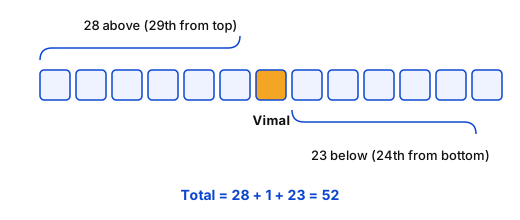
Concept: Total = rank from top + rank from bottom −1.

  1. Above Vimal: 28; below Vimal: 23.
  2. Total =29+24−1=52.

Trick: Subtract 1 because Vimal is counted in both ranks.

Answer: (B) 52

अवधारणा: कुल = ऊपर से रैंक + नीचे से रैंक −1।

  1. विमल के ऊपर: 28; नीचे: 23।
  2. कुल =29+24−1=52।

ट्रिक: 1 घटाते हैं क्योंकि विमल दोनों रैंकों में गिना गया है।

उत्तर: (B) 52

RRB NTPC Undergraduate CBT 1General Intelligence and ReasoningRankingRRB NTPC Undergraduate CBT 1 2024 · 14 Aug Shift 3 →
Q2080.
Select the pair that follows the same pattern as that followed by the two pairs given below. Both pairs follow the same pattern.
GOF : IQE
SNG : UPF
उस युग्म का चयन कीजिए जो उसी पैटर्न का अनुसरण करता है जिसका अनुसरण नीचे दिए गए दो युग्म करते हैं। दोनों युग्म एक ही पैटर्न का अनुसरण करते हैं।
GOF : IQE
SNG : UPF
  1. ANNL : PQK
  2. BQUK : SXJ
  3. CQRQ : STR
  4. DELM : GNL
Show answer

Concept: Find the change in each letter position: +2,+2,−1.

  1. GOF → IQE: G+2=I, O+2=Q, F−1=E. SNG → UPF: same.
  2. ELM → GNL: E+2=G, L+2=N, M−1=L ✓.
  3. NNL : PQK (+2,+3,−1), QUK : SXJ (+2,+3,−1), QRQ : STR (+2,+2,+1) ✗.

Trick: Check the third letter first (−1): it removes QRQ : STR; then the middle (+2) removes the other two.

Answer: (D) ELM : GNL

अवधारणा: हर अक्षर के स्थान में परिवर्तन: +2,+2,−1।

  1. GOF → IQE: G+2=I, O+2=Q, F−1=E। SNG → UPF: वही।
  2. ELM → GNL: E+2=G, L+2=N, M−1=L ✓।
  3. NNL : PQK (+2,+3,−1), QUK : SXJ (+2,+3,−1), QRQ : STR (+2,+2,+1) ✗।

ट्रिक: पहले तीसरा अक्षर (−1) जाँचें, फिर बीच वाला (+2)।

उत्तर: (D) ELM : GNL

RRB NTPC Undergraduate CBT 1General Intelligence and ReasoningLetter AnalogyRRB NTPC Undergraduate CBT 1 2024 · 14 Aug Shift 3 →