Question bank

Q&A: practice questions with answers

Search questions on any topic. Filter by exam category, exam, subject and topic, try the question, then open the answer and explanation.

Courses – airGurukul

8,495 questions found.

Q2541.
Find the value of 48−17÷ 4812× 48−13.
48−17÷ 4812× 48−13 का मान ज्ञात कीजिए।
  1. A48−34
  2. B48−37
  3. C48−35
  4. D48−42
Show answer

Concept: Same base: am÷an=am−n and am×an=am+n; work left to right.

  1. 48−17÷4812=48−17−12=48−29.
  2. 48−29×48−13=48−29−13=48−42.

Trick: Add powers being multiplied, subtract powers being divided: −17−12−13=−42.

Answer: (D) 48−42

अवधारणा: समान आधार: am÷an=am−n और am×an=am+n; बाएँ से दाएँ हल करें।

  1. 48−17÷4812=48−17−12=48−29।
  2. 48−29×48−13=48−29−13=48−42।

ट्रिक: गुणा में घात जोड़ें, भाग में घटाएँ: −17−12−13=−42।

उत्तर: (D) 48−42

RRB NTPC Undergraduate CBT 1MathematicsIndices / ExponentsRRB NTPC Undergraduate CBT 1 2024 · 13 Aug Shift 1 →
Q2542.
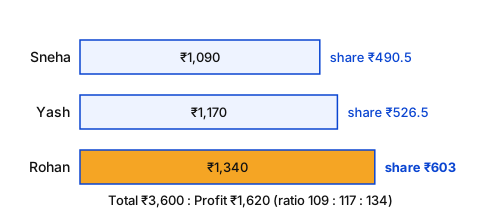
Sneha, Yash and Rohan invested ₹1,090, ₹1,170 and ₹1,340, respectively to start a business. If the profit at the end of the year is ₹1,620, what is Rohan's share of the profit?
स्नेहा, यश और रोहन ने एक व्यवसाय शुरू करने के लिए क्रमशः ₹1,090, ₹1,170 और ₹1,340 का निवेश किया। यदि वर्ष के अंत में लाभ ₹1,620 है, तो लाभ में रोहन का हिस्सा कितना है?
  1. A₹603
  2. B₹605
  3. C₹606
  4. D₹602
Show answer

Concept: When time is equal, profit is shared in the ratio of investments.

  1. Ratio =1090:1170:1340=109:117:134; total =360 parts.
  2. 1 part =1620360=4.5.
  3. Rohan's share =134×4.5=603 rupees.

Trick: Profit is 45% of total capital (₹1,620 of ₹3,600), so Rohan gets 0.45×1340=603.

Answer: (A) ₹603

अवधारणा: समय बराबर हो तो लाभ निवेश के अनुपात में बँटता है।

  1. अनुपात =1090:1170:1340=109:117:134; कुल =360 भाग।
  2. 1 भाग =1620360=4.5।
  3. रोहन का हिस्सा =134×4.5=603 रुपये।

ट्रिक: लाभ कुल पूँजी (₹3,600) का 45% है, अतः रोहन को 0.45×1340=603।

उत्तर: (A) ₹603

RRB NTPC Undergraduate CBT 1MathematicsPartnershipRRB NTPC Undergraduate CBT 1 2024 · 13 Aug Shift 1 →
Q2543.
The number 587407 is divisible by which of the following?
संख्या 587407 निम्नलिखित में से किससे विभाज्य है?
  1. A34
  2. B43
  3. C41
  4. D47
Show answer

Concept: Divide by each option (or use factor rules); only an exact quotient works.

  1. 34 = 2 × 17 needs an even number – 587407 is odd → no.
  2. 587407÷41=14327 exactly (41×14327=587407).
  3. 587407÷43 leaves remainder 17; 587407÷47 leaves remainder 33.

Trick: Eliminate even divisors instantly for an odd number; then test the rest.

Answer: (C) 41

अवधारणा: प्रत्येक विकल्प से भाग दें; केवल पूर्ण भागफल वाला सही।

  1. 34 = 2 × 17 के लिए संख्या सम होनी चाहिए – 587407 विषम है → नहीं।
  2. 587407÷41=14327 पूर्णतः (41×14327=587407)।
  3. 587407÷43 का शेष 17; 587407÷47 का शेष 33।

ट्रिक: विषम संख्या के लिए सम भाजक तुरंत हटाएँ, फिर बाकी जाँचें।

उत्तर: (C) 41

RRB NTPC Undergraduate CBT 1MathematicsNumber System – DivisibilityRRB NTPC Undergraduate CBT 1 2024 · 13 Aug Shift 1 →
Q2544.
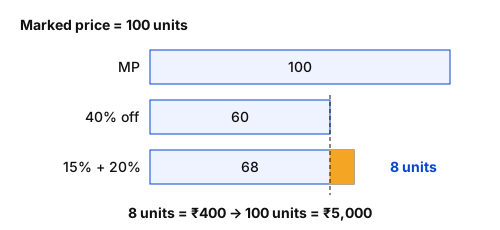
On a marked price, the difference between the selling prices with a single discount of 40% and two successive discounts of 15% and 20% is ₹400, then find the marked price (in ₹).
किसी अंकित मूल्य पर, 40% की एकल छूट और 15% तथा 20% की दो क्रमिक छूटों के साथ विक्रय मूल्यों का अंतर ₹400 है, तो अंकित मूल्य (₹ में) ज्ञात कीजिए।
  1. A₹5,150
  2. B₹4,900
  3. C₹5,000
  4. D₹4,950
Show answer

Concept: Successive discounts a% and b% equal a single discount of (a+b−ab100)%.

  1. 15% and 20% → 15+20−15×20100=32%, so SP =68% of MP.
  2. Single 40% → SP =60% of MP.
  3. Difference =8% of MP =400 → MP =400×1008=5000.

Trick: Take MP = 100: SPs are 60 and 68 → 8 units = ₹400.

Answer: (C) ₹5,000

अवधारणा: क्रमागत बट्टे a% और b% = एकल बट्टा (a+b−ab100)%।

  1. 15% और 20% → 15+20−15×20100=32%, अतः SP = MP का 68%।
  2. एकल 40% → SP = MP का 60%।
  3. अंतर = MP का 8%=400 → MP =400×1008=5000।

ट्रिक: MP = 100 लें: SP 60 और 68 → 8 इकाई = ₹400।

उत्तर: (C) ₹5,000

RRB NTPC Undergraduate CBT 1MathematicsDiscount – Successive DiscountsRRB NTPC Undergraduate CBT 1 2024 · 13 Aug Shift 1 →
Q2545.
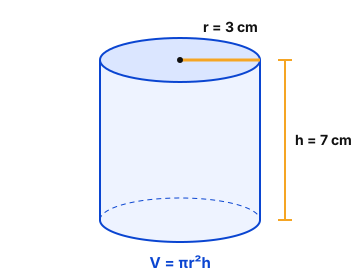
Find the volume of the cylinder whose height and radius are 7 cm and 3 cm, respectively (use π=3.14).
उस बेलन का आयतन ज्ञात कीजिए जिसकी ऊँचाई और त्रिज्या क्रमशः 7 cm और 3 cm हैं (π=3.14 का प्रयोग कीजिए)।
  1. A193.58 cm3
  2. B190.01 cm3
  3. C195.68 cm3
  4. D197.82 cm3
Show answer

Concept: Volume of a cylinder V=πr2h.

  1. r=3cm, h=7cm, π=3.14.
  2. V=3.14×32×7=3.14×63.
  3. V=197.82cm3.

Trick: π×63: 63×3=189, 63×0.14=8.82 → 197.82.

Answer: (D) 197.82cm3

अवधारणा: बेलन का आयतन V=πr2h।

  1. r=3cm, h=7cm, π=3.14।
  2. V=3.14×32×7=3.14×63।
  3. V=197.82cm3।

ट्रिक: 63×3=189, 63×0.14=8.82 → 197.82।

उत्तर: (D) 197.82cm3

RRB NTPC Undergraduate CBT 1MathematicsMensuration – CylinderRRB NTPC Undergraduate CBT 1 2024 · 13 Aug Shift 1 →
Q2546.
By selling 6 articles for a rupee, a man loses 30%. To gain 40% how many must he sell for a rupee?
एक रुपये में 6 वस्तुएँ बेचने पर एक व्यक्ति को 30% की हानि होती है। 40% लाभ प्राप्त करने के लिए उसे एक रुपये में कितनी वस्तुएँ बेचनी चाहिए?
  1. A5
  2. B4
  3. C2
  4. D3
Show answer

Concept: For the same money (₹1), the number of articles sold is inversely proportional to the SP per article: n1(100−L)=n2(100+G).

  1. 6×(100−30)=n×(100+40).
  2. 6×70=140n → n=420140=3.

Trick: Loss 30% → 70; gain 40% → 140 = double, so articles become half: 62=3.

Answer: (D) 3

अवधारणा: निश्चित विक्रय मूल्य (₹1) पर: n1(100−L)=n2(100+G)।

  1. 6×(100−30)=n×(100+40)।
  2. 6×70=140n → n=420140=3।

ट्रिक: हानि 30% → 70; लाभ 40% → 140 = दोगुना, अतः वस्तुएँ आधी: 62=3।

उत्तर: (D) 3

RRB NTPC Undergraduate CBT 1MathematicsProfit and LossRRB NTPC Undergraduate CBT 1 2024 · 13 Aug Shift 1 →
Q2547.
The marks scored by 10 students are given below.
19, 14, 11, 20, 18, 17, 14, 10, 11, 11
The mode of the given data is:
10 विद्यार्थियों द्वारा प्राप्त अंक नीचे दिए गए हैं।
19, 14, 11, 20, 18, 17, 14, 10, 11, 11
दिए गए आँकड़ों का बहुलक (mode) है:
  1. A19
  2. B14
  3. C11
  4. D20
Show answer

Concept: Mode is the value that occurs most often.

  1. Frequencies: 10→1, 11→3, 14→2, 17→1, 18→1, 19→1, 20→1.
  2. 11 occurs 3 times – the highest frequency.

Trick: Sort first: 10, 11, 11, 11, 14, 14, … – the longest run is the mode.

Answer: (C) 11

अवधारणा: बहुलक (mode) वह मान है जो सबसे अधिक बार आता है।

  1. बारंबारता: 10→1, 11→3, 14→2, 17→1, 18→1, 19→1, 20→1।
  2. 11 तीन बार आता है – सर्वाधिक।

ट्रिक: क्रम में लगाएँ: 10, 11, 11, 11, 14, 14, … – सबसे लंबी श्रृंखला = बहुलक।

उत्तर: (C) 11

RRB NTPC Undergraduate CBT 1MathematicsStatistics – ModeRRB NTPC Undergraduate CBT 1 2024 · 13 Aug Shift 1 →
Q2548.
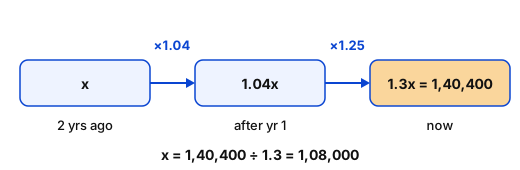
Shivam got an increase of 4% in his sales amount in the first year and 25% in the second year; also with this, his current sales are ₹1,40,400, what was his sales (in ₹) two years ago?
शिवम की बिक्री राशि में पहले वर्ष 4% और दूसरे वर्ष 25% की वृद्धि हुई; इसके साथ, उसकी वर्तमान बिक्री ₹1,40,400 है, तो दो वर्ष पहले उसकी बिक्री (₹ में) कितनी थी?
  1. A₹88,000
  2. B₹1,12,320
  3. C₹1,35,000
  4. D₹1,08,000
Show answer

Concept: Successive increases multiply: final =x×(1+4100)(1+25100).

  1. x×1.04×1.25=1.3x.
  2. 1.3x=140400 → x=1404001.3=108000.
  3. Sales two years ago = ₹1,08,000.

Trick: 4% then 25% → net 4+25+4×25100=30% rise.

Answer: (D) ₹1,08,000

अवधारणा: क्रमागत वृद्धि गुणा होती है: अंतिम =x×(1+4100)(1+25100)।

  1. x×1.04×1.25=1.3x।
  2. 1.3x=140400 → x=1404001.3=108000।
  3. दो वर्ष पहले बिक्री = ₹1,08,000।

ट्रिक: 4% फिर 25% → कुल 4+25+4×25100=30% वृद्धि।

उत्तर: (D) ₹1,08,000

RRB NTPC Undergraduate CBT 1MathematicsPercentage – Successive IncreaseRRB NTPC Undergraduate CBT 1 2024 · 13 Aug Shift 1 →
Q2549.
Which of the following ratio is greatest?
निम्नलिखित में से कौन-सा अनुपात सबसे बड़ा है?
  1. A46 : 75
  2. B34 : 77
  3. C39 : 89
  4. D36 : 69
Show answer

Concept: Write each ratio as a decimal (or fraction) and compare.

  1. 46:75=4675≈0.613
  2. 34:77≈0.442, 39:89≈0.438
  3. 36:69≈0.522
  4. Largest value is 0.613, i.e. 46:75.

Trick: Only 46:75 has the first term more than half of the second (46>37.5); compare others with 12 to eliminate fast.

Answer: (A) 46:75

अवधारणा: हर अनुपात को दशमलव (या भिन्न) में बदलकर तुलना करें।

  1. 46:75=4675≈0.613
  2. 34:77≈0.442, 39:89≈0.438
  3. 36:69≈0.522
  4. सबसे बड़ा मान 0.613 है, यानी 46:75।

ट्रिक: केवल 46:75 में पहला पद दूसरे के आधे से काफ़ी बड़ा है (46>37.5); बाकी को 12 से तुलना कर हटाएँ।

उत्तर: (A) 46:75

RRB NTPC Undergraduate CBT 1MathematicsComparison of ratiosRRB NTPC Undergraduate CBT 1 2024 · 13 Aug Shift 1 →
Q2550.
If 3sin2θ+7cos2θ=4, 0∘<θ<90∘, then the value of θ (in degrees) is:
यदि 3sin2θ+7cos2θ=4, 0∘<θ<90∘, तो θ का मान (डिग्री में) है:
  1. A45∘
  2. B60∘
  3. C30∘
  4. D15∘
Show answer

Concept: Use sin2θ+cos2θ=1.

  1. 3sin2θ+7cos2θ=3(sin2θ+cos2θ)+4cos2θ=3+4cos2θ
  2. 3+4cos2θ=4⇒cos2θ=14
  3. cosθ=12 (acute angle) ⇒θ=60∘

Trick: Split the bigger coefficient: 7=3+4, so the identity removes sin2θ at once.

Answer: (B) 60∘

अवधारणा: sin2θ+cos2θ=1 का प्रयोग करें।

  1. 3sin2θ+7cos2θ=3(sin2θ+cos2θ)+4cos2θ=3+4cos2θ
  2. 3+4cos2θ=4⇒cos2θ=14
  3. cosθ=12 (न्यून कोण) ⇒θ=60∘

ट्रिक: बड़े गुणांक को तोड़ें: 7=3+4, सर्वसमिका से sin2θ तुरंत हट जाता है।

उत्तर: (B) 60∘

RRB NTPC Undergraduate CBT 1MathematicsTrigonometric identitiesRRB NTPC Undergraduate CBT 1 2024 · 13 Aug Shift 1 →
Q2551.
The selling price of 20 books is equal to the cost price of 24 books. Find the loss or gain percentage on these books.
20 पुस्तकों का विक्रय मूल्य 24 पुस्तकों के क्रय मूल्य के बराबर है। इन पुस्तकों पर हानि या लाभ प्रतिशत ज्ञात कीजिए।
  1. A20% loss20% हानि
  2. B20% gain20% लाभ
  3. C1004% loss1004% हानि
  4. D1004% gain1004% लाभ
Show answer

Concept: If SP of x articles = CP of y articles, then Gain%=y−xx×100.

  1. SP of 20 books = CP of 24 books, so SP is more than CP: it is a gain.
  2. Gain%=24−2020×100
  3. =420×100=20%

Trick: Divide the difference by the number of articles sold (20), not by 24 – dividing by 4 or 24 gives the trap options.

Answer: (B) 20% gain

अवधारणा: यदि x वस्तुओं का विक्रय मूल्य = y वस्तुओं का क्रय मूल्य, तो लाभ%=y−xx×100।

  1. 20 पुस्तकों का SP = 24 पुस्तकों का CP, अतः SP अधिक है: लाभ हुआ।
  2. लाभ%=24−2020×100
  3. =420×100=20%

ट्रिक: अंतर को बेची गई वस्तुओं (20) से भाग दें, 24 या 4 से नहीं।

उत्तर: (B) 20% लाभ

RRB NTPC Undergraduate CBT 1MathematicsProfit and lossRRB NTPC Undergraduate CBT 1 2024 · 13 Aug Shift 1 →
Q2552.
A can lay railway track between two given stations in 22 days and B can do the same job in 11 days. With the help of C, they did the job in 4 days only. Then, C alone can do the job in
A दो दिए गए स्टेशनों के बीच रेलवे ट्रैक 22 दिनों में बिछा सकता है और B वही कार्य 11 दिनों में कर सकता है। C की सहायता से, उन्होंने वह कार्य केवल 4 दिनों में पूरा कर लिया। तो, C अकेले उस कार्य को कितने समय में कर सकता है?
  1. A1145 days1145 दिन
  2. B1745 days1745 दिन
  3. C845 days845 दिन
  4. D1345 days1345 दिन
Show answer

Concept: Add one-day works: 1A+1B+1C=1together.

  1. A + B in one day: 122+111=322
  2. A + B + C in one day: 14
  3. C in one day: 14−322=11−644=544
  4. C alone: 445=845 days

Trick: LCM method: total work =44 units; A =2, B =4, all =11 units/day, so C =5 units/day ⇒445 days.

Answer: (C) 845 days

अवधारणा: एक दिन के कार्य जोड़ें: 1A+1B+1C=1मिलकर।

  1. A + B का एक दिन का काम: 122+111=322
  2. A + B + C का एक दिन का काम: 14
  3. C का एक दिन का काम: 14−322=544
  4. C अकेला: 445=845 दिन

ट्रिक: LCM विधि: कुल काम =44 इकाई; A =2, B =4, सब मिलकर =11 इकाई/दिन, अतः C =5 इकाई/दिन।

उत्तर: (C) 845 दिन

RRB NTPC Undergraduate CBT 1MathematicsTime and workRRB NTPC Undergraduate CBT 1 2024 · 13 Aug Shift 1 →
Q2553.
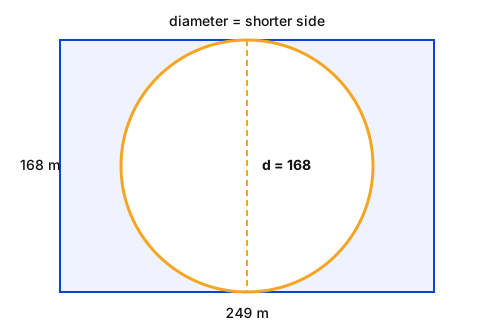
Find the circumference (in m) of the largest circle that can be drawn completely inside a rectangle whose dimensions are given as 249 m and 168 m.
(Take π=227.)
उस सबसे बड़े वृत्त की परिधि (m में) ज्ञात कीजिए जिसे 249 m और 168 m विमाओं वाले एक आयत के अंदर पूर्णतः खींचा जा सकता है।
(π=227 लीजिए।)
  1. A521
  2. B528
  3. C530
  4. D536
Show answer

Concept: The largest circle inside a rectangle has diameter equal to the shorter side.

  1. Diameter d=168m (the shorter side)
  2. Circumference =πd=227×168
  3. =22×24=528m

Trick: The circle can never be wider than the smaller side – the 249 m side is extra data.

Answer: (B) 528

अवधारणा: आयत के अंदर सबसे बड़े वृत्त का व्यास छोटी भुजा के बराबर होता है।

  1. व्यास d=168m (छोटी भुजा)
  2. परिधि =πd=227×168
  3. =22×24=528m

ट्रिक: वृत्त छोटी भुजा से चौड़ा नहीं हो सकता – 249 m अतिरिक्त जानकारी है।

उत्तर: (B) 528

RRB NTPC Undergraduate CBT 1MathematicsCircle inside a rectangleRRB NTPC Undergraduate CBT 1 2024 · 13 Aug Shift 1 →
Q2554.
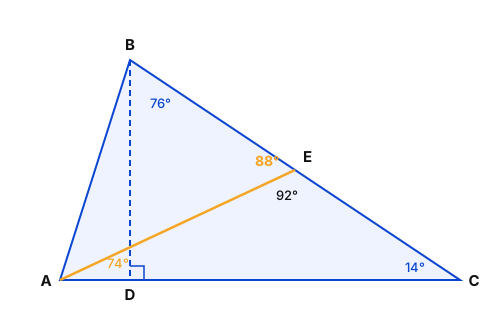
In △ABC, BD ⟂ AC at D and ∠DBC = 76°. E is a point on BC such that ∠CAE = 74°. What is the measure of ∠AEB?
△ABC में, D पर BD ⟂ AC है और ∠DBC = 76° है। BC पर E एक ऐसा बिंदु है कि ∠CAE = 74° है। ∠AEB का माप क्या है?
  1. A88°
  2. B99°
  3. C77°
  4. D100°
Show answer

Concept: Angle sum of a triangle is 180∘; an exterior angle equals the sum of the two opposite interior angles.

  1. In right △BDC: ∠C=180∘−90∘−76∘=14∘
  2. In △AEC: ∠AEC=180∘−74∘−14∘=92∘
  3. B, E, C are collinear: ∠AEB=180∘−92∘=88∘

Trick: Directly: ∠AEB is exterior to △AEC, so ∠AEB=74∘+14∘=88∘.

Answer: (A) 88∘

अवधारणा: त्रिभुज के कोणों का योग 180∘; बहिष्कोण = दो सम्मुख अंतःकोणों का योग।

  1. समकोण △BDC में: ∠C=180∘−90∘−76∘=14∘
  2. △AEC में: ∠AEC=180∘−74∘−14∘=92∘
  3. B, E, C एक रेखा पर: ∠AEB=180∘−92∘=88∘

ट्रिक: सीधे: ∠AEB, △AEC का बहिष्कोण है, अतः 74∘+14∘=88∘।

उत्तर: (A) 88∘

RRB NTPC Undergraduate CBT 1MathematicsAngles in a triangleRRB NTPC Undergraduate CBT 1 2024 · 13 Aug Shift 1 →
Q2555.
Four times P’s present age exceeds Q’s present age by 41 years. After 10 years, three times Q’s age will be 33 years less than seven times P’s age at that time. What is Q’s present age?
P की वर्तमान आयु का चार गुना, Q की वर्तमान आयु से 41 वर्ष अधिक है। 10 वर्ष बाद, Q की आयु का तीन गुना उस समय P की आयु के सात गुने से 33 वर्ष कम होगा। Q की वर्तमान आयु क्या है?
  1. A71
  2. B63
  3. C67
  4. D62
Show answer

Concept: Form two linear equations from the two statements and solve.

  1. 4P−Q=41⇒Q=4P−41
  2. After 10 years: 3(Q+10)=7(P+10)−33⇒3Q=7P+7
  3. 3(4P−41)=7P+7⇒5P=130⇒P=26
  4. Q=4×26−41=63

Trick: Check options: Q=63⇒P=26; then 3×73=219 and 7×36−33=219 ✔.

Answer: (B) 63

अवधारणा: दोनों कथनों से दो रैखिक समीकरण बनाकर हल करें।

  1. 4P−Q=41⇒Q=4P−41
  2. 10 वर्ष बाद: 3(Q+10)=7(P+10)−33⇒3Q=7P+7
  3. 3(4P−41)=7P+7⇒5P=130⇒P=26
  4. Q=4×26−41=63

ट्रिक: विकल्प जाँचें: Q=63⇒P=26; 3×73=219 और 7×36−33=219 ✔।

उत्तर: (B) 63

RRB NTPC Undergraduate CBT 1MathematicsProblems on agesRRB NTPC Undergraduate CBT 1 2024 · 13 Aug Shift 1 →
Q2556.
The marked price of a shirt is ₹1,250; the shopkeeper offers a scheme of 'buy four get two free'. What amount does a customer have to pay for taking home six shirts?
एक कमीज़ का अंकित मूल्य ₹1,250 है; दुकानदार 'चार खरीदें, दो मुफ़्त पाएँ' की योजना प्रदान करता है। छह कमीज़ें घर ले जाने के लिए एक ग्राहक को कितनी राशि का भुगतान करना होगा?
  1. A₹5,200
  2. B₹5,000
  3. C₹4,500
  4. D₹4,200
Show answer

Concept: In 'buy 4 get 2 free', the customer pays only for 4 out of every 6 items.

  1. Six shirts = 4 paid + 2 free
  2. Amount =4×1250=5000, i.e. ₹5,000

Trick: Effective discount =26=3313%; 23 of ₹7,500 = ₹5,000.

Answer: (B) ₹5,000

अवधारणा: '4 खरीदें 2 मुफ़्त' में हर 6 वस्तुओं में से केवल 4 का भुगतान होता है।

  1. छह शर्ट = 4 भुगतान वाली + 2 मुफ़्त
  2. राशि =4×1250=5000, यानी ₹5,000

ट्रिक: प्रभावी छूट =26=3313%; ₹7,500 का 23 = ₹5,000।

उत्तर: (B) ₹5,000

RRB NTPC Undergraduate CBT 1MathematicsDiscount schemesRRB NTPC Undergraduate CBT 1 2024 · 13 Aug Shift 1 →
Q2557.
Pipe P can fill 79 part of a tank in 14 hours and pipe Q can fill 59 part of the same tank in 20 hours. Both P and Q were kept open for 2 hours, then both were closed. Pipe R alone was then opened and it emptied the water in the tank in 6 hours. Pipes P, Q and R together can fill the empty tank in:
पाइप P एक टंकी के 79 भाग को 14 घंटे में भर सकता है और पाइप Q उसी टंकी के 59 भाग को 20 घंटे में भर सकता है। P और Q दोनों को 2 घंटे तक खुला रखा गया, फिर दोनों को बंद कर दिया गया। इसके बाद केवल पाइप R को खोला गया और उसने टंकी का पानी 6 घंटे में खाली कर दिया। पाइप P, Q और R मिलकर खाली टंकी को कितने समय में भर सकते हैं?
  1. A19 hours19 घंटे
  2. B18 hours18 घंटे
  3. C3 hours3 घंटे
  4. D12 hours12 घंटे
Show answer

Concept: Find each pipe's full-tank time, then use filled part = rate × time.

  1. P fills 79 in 14 h ⇒ full tank in 14×97=18 h; Q fills 59 in 20 h ⇒ 36 h
  2. In 2 h, P + Q fill 2(118+136)=16 tank
  3. R empties 16 tank in 6 h ⇒ full tank in 36 h
  4. Together: 118+136−136=118⇒18 h

Trick: Q's filling rate and R's emptying rate are equal (36 h each), so they cancel – only P works: 18 h.

Answer: (B) 18 hours

अवधारणा: हर पाइप का पूरी टंकी का समय निकालें, फिर भरा भाग = दर × समय।

  1. P, 14 घंटे में 79 भरता है ⇒ पूरी टंकी 18 घंटे; Q, 20 घंटे में 59 ⇒ 36 घंटे
  2. 2 घंटे में P + Q भरते हैं 2(118+136)=16 टंकी
  3. R, 16 टंकी 6 घंटे में खाली करता है ⇒ पूरी 36 घंटे में
  4. मिलकर: 118+136−136=118⇒18 घंटे

ट्रिक: Q की भरने की दर और R की खाली करने की दर बराबर (36 घंटे) है, दोनों कट जाते हैं – केवल P: 18 घंटे।

उत्तर: (B) 18 घंटे

RRB NTPC Undergraduate CBT 1MathematicsPipes and cisternsRRB NTPC Undergraduate CBT 1 2024 · 13 Aug Shift 1 →
Q2558.
A number, when increased by 70%, gives 3230. The number is:
एक संख्या में 70% की वृद्धि करने पर 3230 प्राप्त होता है। वह संख्या है:
  1. A1900
  2. B950
  3. C5700
  4. D3800
Show answer

Concept: After a 70% increase, the number becomes 170% of itself.

  1. 1.7x=3230
  2. x=32301.7=1900

Trick: 3230÷17=190, so x=190×10=1900.

Answer: (A) 1900

अवधारणा: 70% बढ़ने पर संख्या अपनी 170% हो जाती है।

  1. 1.7x=3230
  2. x=32301.7=1900

ट्रिक: 3230÷17=190, अतः x=1900।

उत्तर: (A) 1900

RRB NTPC Undergraduate CBT 1MathematicsPercentage increaseRRB NTPC Undergraduate CBT 1 2024 · 13 Aug Shift 1 →
Q2559.
The value of 144+0.0225−6.25=
144+0.0225−6.25= का मान
  1. A6.94
  2. B7.22
  3. C9.65
  4. D3.27
Show answer

Concept: decimal: take the root of the digits and halve the number of decimal places.

  1. 144=12
  2. 0.0225=0.15 (since 152=225)
  3. 6.25=2.5
  4. 12+0.15−2.5=9.65

Trick: 4 decimal places under the root give 2 decimal places in the answer.

Answer: (C) 9.65

अवधारणा: दशमलव का वर्गमूल: अंकों का वर्गमूल लें और दशमलव स्थान आधे करें।

  1. 144=12
  2. 0.0225=0.15 (क्योंकि 152=225)
  3. 6.25=2.5
  4. 12+0.15−2.5=9.65

ट्रिक: मूल के अंदर 4 दशमलव स्थान, तो उत्तर में 2 दशमलव स्थान।

उत्तर: (C) 9.65

RRB NTPC Undergraduate CBT 1MathematicsSquare roots of decimalsRRB NTPC Undergraduate CBT 1 2024 · 13 Aug Shift 1 →
Q2560.
The sum of the squares of two consecutive even natural numbers is 1684. The sum of the numbers is:
दो क्रमागत सम प्राकृत संख्याओं के वर्गों का योग 1684 है। संख्याओं का योग है:
  1. A42
  2. B66
  3. C48
  4. D58
Show answer

Concept: Let the numbers be n and n+2.

  1. n2+(n+2)2=1684⇒2n2+4n−1680=0
  2. n2+2n−840=0⇒(n+30)(n−28)=0⇒n=28
  3. Numbers: 28 and 30; sum =58

Trick: 16842=842≈292, so the numbers sit around 29: 28 and 30 (784+900=1684).

Answer: (D) 58

अवधारणा: संख्याएँ n और n+2 मानें।

  1. n2+(n+2)2=1684⇒2n2+4n−1680=0
  2. n2+2n−840=0⇒(n+30)(n−28)=0⇒n=28
  3. संख्याएँ 28 और 30; योग =58

ट्रिक: 16842=842≈292, अतः संख्याएँ 29 के आसपास: 28 और 30 (784+900=1684)।

उत्तर: (D) 58

RRB NTPC Undergraduate CBT 1MathematicsConsecutive even numbersRRB NTPC Undergraduate CBT 1 2024 · 13 Aug Shift 1 →