Question bank

Q&A: practice questions with answers

Search questions on any topic. Filter by exam category, exam, subject and topic, try the question, then open the answer and explanation.

Courses – airGurukul

8,500 questions found.

Q2941.
If the 6-digit number N29M11 is divisible by 11, then which of the options below can give a possible correct relation between M and N?
यदि 6-अंकीय संख्या N29M11, 11 से विभाज्य है, तो नीचे दिए गए विकल्पों में से कौन-सा विकल्प M और N के बीच संभावित सही संबंध दे सकता है?
  1. AM - N = 7
  2. BM = N
  3. CM - N = 1
  4. DM + N = -7
Show answer

Concept: A number is divisible by 11 if (sum of digits at odd places) − (sum of digits at even places) is 0 or a multiple of 11.

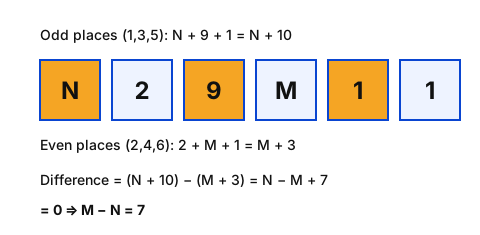
  1. Odd places of N29M11: N+9+1=N+10.
  2. Even places: 2+M+1=M+3.
  3. Difference =(N+10)−(M+3)=N−M+7.
  4. Setting it =0 gives M−N=7 (e.g. N=1,M=8: 129811=11×11801).

Trick: Write N−M+7=0 or 11; only M−N=7 is in the options.

Answer: (A) M−N=7

अवधारणा: कोई संख्या 11 से विभाज्य है यदि (विषम स्थानों के अंकों का योग) − (सम स्थानों के अंकों का योग) 0 या 11 का गुणज हो।

  1. N29M11 के विषम स्थान: N+9+1=N+10।
  2. सम स्थान: 2+M+1=M+3।
  3. अंतर =(N+10)−(M+3)=N−M+7।
  4. इसे 0 रखने पर M−N=7 (जैसे N=1,M=8: 129811=11×11801)।

ट्रिक: N−M+7=0 या 11 लिखें; विकल्पों में केवल M−N=7 है।

उत्तर: (A) M−N=7

RRB NTPC Undergraduate CBT 1MathematicsDivisibility by 11RRB NTPC Undergraduate CBT 1 2024 · 11 Aug Shift 3 →
Q2942.
A cylinder has its radius reduced by 20% while its height is increased by 40%. What is the percentage change in its volume?
एक बेलन की त्रिज्या में 20% की कमी की जाती है, जबकि उसकी ऊँचाई में 40% की वृद्धि की जाती है। उसके आयतन में कितने प्रतिशत का परिवर्तन होगा?
  1. A10.4% decrease10.4% कमी
  2. BNo increase or decreaseन कोई वृद्धि, न कोई कमी
  3. C14.2% increase14.2% वृद्धि
  4. D12% increase12% वृद्धि
Show answer

Concept: V=πr2h, so V∝r2h.

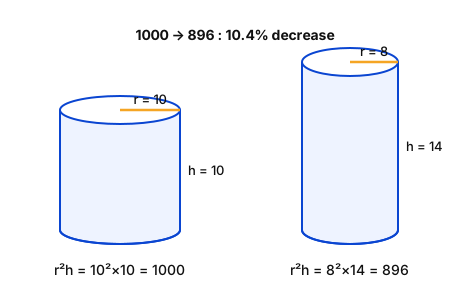
  1. Take r=10, h=10: r2h=1000.
  2. New r=8 (20% less), new h=14 (40% more): r2h=64×14=896.
  3. Change =896−10001000×100=−10.4%, i.e. a decrease.

Trick: Multiply factors: 0.82×1.4=0.896 ⇒ 10.4% decrease.

Answer: (A) 10.4% decrease

अवधारणा: V=πr2h, अतः V∝r2h।

  1. r=10, h=10 लें: r2h=1000।
  2. नया r=8 (20% कम), नया h=14 (40% अधिक): r2h=64×14=896।
  3. परिवर्तन =896−10001000×100=−10.4%, अर्थात कमी।

ट्रिक: गुणक गुणा करें: 0.82×1.4=0.896 ⇒ 10.4% कमी।

उत्तर: (A) 10.4% कमी

RRB NTPC Undergraduate CBT 1MathematicsVolume of cylinderRRB NTPC Undergraduate CBT 1 2024 · 11 Aug Shift 3 →
Q2943.
The average of first 154 even numbers is
प्रथम 154 सम संख्याओं का औसत है
  1. A156
  2. B154.5
  3. C155
  4. D155.5
Show answer

Concept: Sum of the first n even numbers =n(n+1), so their average =n+1.

  1. Here n=154.
  2. Sum =154×155.
  3. Average =154×155154=155.

Trick: Average of first n even numbers =n+1; of first n odd numbers =n.

Answer: (C) 155

अवधारणा: प्रथम n सम संख्याओं का योग =n(n+1), अतः औसत =n+1।

  1. यहाँ n=154।
  2. योग =154×155।
  3. औसत =154×155154=155।

ट्रिक: प्रथम n सम संख्याओं का औसत =n+1; प्रथम n विषम संख्याओं का =n।

उत्तर: (C) 155

RRB NTPC Undergraduate CBT 1MathematicsAverageRRB NTPC Undergraduate CBT 1 2024 · 11 Aug Shift 3 →
Q2944.
By availing two successive discounts of 20% and 10%, a customer got a discount of ₹23,800. Determine the marked price of the item.
20% और 10% की दो क्रमिक छूटों का लाभ उठाकर, एक ग्राहक को ₹23,800 की छूट मिली। वस्तु का अंकित मूल्य ज्ञात कीजिए।
  1. A₹75,000
  2. B₹80,000
  3. C₹90,000
  4. D₹85,000
Show answer

Concept: Two successive discounts a% and b% equal a single discount of a+b−ab100%.

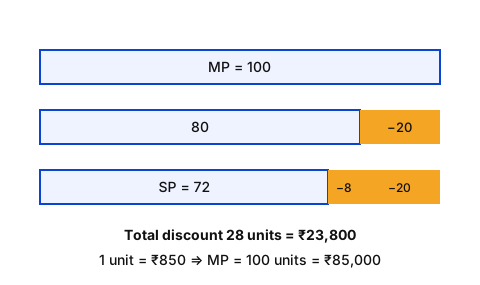
  1. Net discount =20+10−20×10100=28%.
  2. 28% of MP = ₹23,800.
  3. MP =23800×10028=85000, i.e. ₹85,000.

Trick: Take MP =100: 100→80→72, discount 28 units.

Answer: (D) ₹85,000

अवधारणा: दो क्रमागत छूट a% और b% = एकल छूट a+b−ab100%।

  1. कुल छूट =20+10−20×10100=28%।
  2. अंकित मूल्य का 28% = ₹23,800।
  3. अंकित मूल्य =23800×10028=85000, अर्थात ₹85,000।

ट्रिक: अंकित मूल्य =100 लें: 100→80→72, छूट 28 इकाई।

उत्तर: (D) ₹85,000

RRB NTPC Undergraduate CBT 1MathematicsSuccessive discountsRRB NTPC Undergraduate CBT 1 2024 · 11 Aug Shift 3 →
Q2945.
Given that 1030.2=x, 1030.43=y and xz=y6, then the value of z is close to:
दिया गया है कि 1030.2=x, 1030.43=y और xz=y6, तो z का मान लगभग है:
  1. A12.9
  2. B11.74
  3. C12.45
  4. D14.16
Show answer

Concept: If the bases are equal, the exponents can be equated: (am)n=amn.

  1. xz=(1030.2)z=1030.2z.
  2. y6=(1030.43)6=1032.58.
  3. So 0.2z=2.58 ⇒ z=2.580.2=12.9.

Trick: z=6×0.430.2=12.9 directly.

Answer: (A) 12.9

अवधारणा: आधार समान हों तो घातांक बराबर किए जा सकते हैं: (am)n=amn।

  1. xz=(1030.2)z=1030.2z।
  2. y6=(1030.43)6=1032.58।
  3. अतः 0.2z=2.58 ⇒ z=2.580.2=12.9।

ट्रिक: सीधे z=6×0.430.2=12.9।

उत्तर: (A) 12.9

RRB NTPC Undergraduate CBT 1MathematicsIndicesRRB NTPC Undergraduate CBT 1 2024 · 11 Aug Shift 3 →
Q2946.
4 years ago, the age of a father was 37 years more than twice his son's age. After how many years, from now, will he be twice his son's age?
4 वर्ष पहले, एक पिता की आयु उसके पुत्र की आयु के दोगुने से 37 वर्ष अधिक थी। अब से कितने वर्ष बाद, उसकी आयु उसके पुत्र की आयु की दोगुनी होगी?
  1. A31
  2. B33
  3. C30
  4. D35
Show answer

Concept: Write present ages as F (father) and S (son) and convert each statement into an equation.

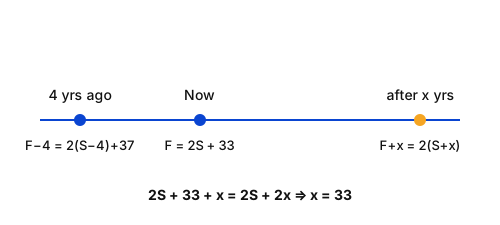
  1. 4 years ago: F−4=2(S−4)+37 ⇒ F=2S+33.
  2. After x years: F+x=2(S+x).
  3. 2S+33+x=2S+2x ⇒ x=33.

Trick: The extra '+33' over twice the son's age vanishes after 33 years.

Answer: (B) 33

अवधारणा: वर्तमान आयु पिता F और पुत्र S मानें और हर कथन को समीकरण में बदलें।

  1. 4 वर्ष पहले: F−4=2(S−4)+37 ⇒ F=2S+33।
  2. x वर्ष बाद: F+x=2(S+x)।
  3. 2S+33+x=2S+2x ⇒ x=33।

ट्रिक: पुत्र की दुगुनी आयु से अतिरिक्त '+33', 33 वर्ष बाद समाप्त हो जाता है।

उत्तर: (B) 33

RRB NTPC Undergraduate CBT 1MathematicsProblems on agesRRB NTPC Undergraduate CBT 1 2024 · 11 Aug Shift 3 →
Q2947.
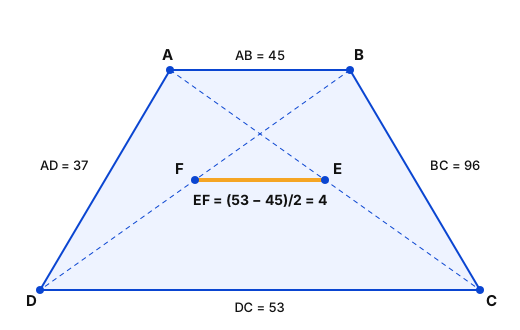
ABCD is a quadrilateral in which AB ∥ DC, and E and F are the mid points of the diagonals AC and BD, respectively. If AB = 45 cm, BC = 96 cm, DC = 53 cm, and AD = 37 cm, then what is the length (in cm) of EF?
ABCD एक चतुर्भुज है जिसमें AB ∥ DC है, और E तथा F क्रमशः विकर्णों AC और BD के मध्य-बिंदु हैं। यदि AB = 45 cm, BC = 96 cm, DC = 53 cm और AD = 37 cm है, तो EF की लंबाई (cm में) क्या है?
  1. A4
  2. B3
  3. C7
  4. D5
Show answer

Concept: In a trapezium, the segment joining the midpoints of the diagonals is parallel to the bases and equals half their difference: EF=DC−AB2.

  1. Let the midline through E and F be drawn parallel to AB and DC.
  2. In △ADC midpoint segment = DC2; in △ADB midpoint segment = AB2; on the same line their difference is EF.
  3. EF=53−452=82=4cm. (BC and AD are not needed.)

Trick: Midpoints of diagonals → half the difference; median → half the sum.

Answer: (A) 4

अवधारणा: समलंब में विकर्णों के मध्य-बिंदुओं को मिलाने वाला रेखाखंड आधारों के समांतर होता है और उनके अंतर का आधा होता है: EF=DC−AB2।

  1. E और F से होकर AB व DC के समांतर मध्य-रेखा लें।
  2. △ADC में मध्य-बिंदु रेखाखंड =DC2; △ADB में =AB2; एक ही रेखा पर इनका अंतर EF है।
  3. EF=53−452=82=4cm। (BC और AD की आवश्यकता नहीं।)

ट्रिक: विकर्णों के मध्य-बिंदु → अंतर का आधा; मध्य-रेखा → योग का आधा।

उत्तर: (A) 4

RRB NTPC Undergraduate CBT 1MathematicsTrapezium – midpoints of diagonalsRRB NTPC Undergraduate CBT 1 2024 · 11 Aug Shift 3 →
Q2948.
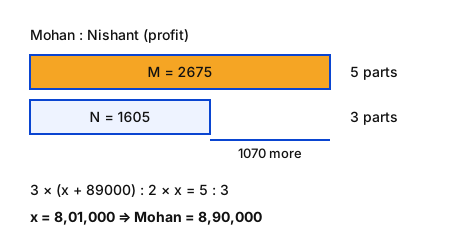
Mohan and Nishant start a business. Mohan invests ₹89,000 more than Nishant for 3 months and Nishant invests for 2 months. Mohan's share is ₹1,070 more than that of Nishant, out of a total profit of ₹4,280. Find the capital contributed by Mohan.
मोहन और निशांत एक व्यवसाय शुरू करते हैं। मोहन, निशांत से ₹89,000 अधिक राशि 3 महीने के लिए निवेश करता है और निशांत 2 महीने के लिए निवेश करता है। ₹4,280 के कुल लाभ में से मोहन का हिस्सा निशांत के हिस्से से ₹1,070 अधिक है। मोहन द्वारा लगाई गई पूँजी ज्ञात कीजिए।
  1. A₹8,60,000
  2. B₹8,10,000
  3. C₹8,90,000
  4. D₹8,20,000
Show answer

Concept: Profit is shared in the ratio of capital×time.

  1. Mohan + Nishant = 4280 and Mohan − Nishant = 1070 ⇒ Mohan = 2675, Nishant = 1605; ratio 2675:1605=5:3.
  2. Let Nishant's capital be x; Mohan's =x+89000.
  3. 3(x+89000)2x=53 ⇒ 9x+801000=10x ⇒ x=801000.
  4. Mohan's capital =801000+89000=890000, i.e. ₹8,90,000.

Trick: First turn the profit sum and difference into a ratio (5:3), then use capital × time.

Answer: (C) ₹8,90,000

अवधारणा: लाभ पूँजी×समय के अनुपात में बँटता है।

  1. मोहन + निशांत = 4280 और मोहन − निशांत = 1070 ⇒ मोहन = 2675, निशांत = 1605; अनुपात 2675:1605=5:3।
  2. निशांत की पूँजी x मानें; मोहन की =x+89000।
  3. 3(x+89000)2x=53 ⇒ 9x+801000=10x ⇒ x=801000।
  4. मोहन की पूँजी =801000+89000=890000, अर्थात ₹8,90,000।

ट्रिक: पहले लाभ के योग व अंतर से अनुपात (5:3) निकालें, फिर पूँजी × समय लगाएँ।

उत्तर: (C) ₹8,90,000

RRB NTPC Undergraduate CBT 1MathematicsPartnershipRRB NTPC Undergraduate CBT 1 2024 · 11 Aug Shift 3 →
Q2949.
A number, when increased by 100%, gives 2800. The number is:
एक संख्या में 100% की वृद्धि करने पर 2800 प्राप्त होता है। वह संख्या है:
  1. A1400
  2. B2800
  3. C700
  4. D4200
Show answer

Concept: Increasing a number by 100% doubles it: new value =x×200100=2x.

  1. 2x=2800.
  2. x=28002=1400.
  3. Check: 1400+100% of 1400=2800.

Trick: +100% = double, so halve the result.

Answer: (A) 1400

अवधारणा: किसी संख्या को 100% बढ़ाने पर वह दुगुनी हो जाती है: नया मान =x×200100=2x।

  1. 2x=2800।
  2. x=28002=1400।
  3. जाँच: 1400+1400 का 100%=2800।

ट्रिक: +100% = दुगुना, अतः परिणाम का आधा लें।

उत्तर: (A) 1400

RRB NTPC Undergraduate CBT 1MathematicsPercentageRRB NTPC Undergraduate CBT 1 2024 · 11 Aug Shift 3 →
Q2950.
Simplify x(7x − 4) + 2(x2 − 2) + 11.
x(7x − 4) + 2(x2 − 2) + 11 को सरल कीजिए।
  1. A9x2 − 4x + 7
  2. B9x2 − 4x − 7
  3. C−9x2 − 4x − 7
  4. D−9x2 − 4x + 7
Show answer

Concept: Expand the brackets and then combine like terms.

  1. x(7x−4)=7x2−4x.
  2. 2(x2−2)=2x2−4.
  3. Sum +11: 7x2+2x2−4x−4+11=9x2−4x+7.

Trick: Put x=1: expression =3+(−2)+11=12, and 9−4+7=12 ✓.

Answer: (A) 9x2−4x+7

अवधारणा: कोष्ठक खोलें और फिर समान पदों को जोड़ें।

  1. x(7x−4)=7x2−4x।
  2. 2(x2−2)=2x2−4।
  3. योग +11: 7x2+2x2−4x−4+11=9x2−4x+7।

ट्रिक: x=1 रखें: व्यंजक =3+(−2)+11=12, और 9−4+7=12 ✓।

उत्तर: (A) 9x2−4x+7

RRB NTPC Undergraduate CBT 1MathematicsAlgebraic simplificationRRB NTPC Undergraduate CBT 1 2024 · 11 Aug Shift 3 →
Q2951.
Simplify: cosα1−sinα−1+sinαcosα
सरल कीजिए: cosα1−sinα−1+sinαcosα
  1. Asin2α
  2. Bcos2α
  3. C1
  4. D0
Show answer

Concept: Use sin2α+cos2α=1, i.e. 1−sin2α=cos2α.

  1. Take LCM (1−sinα)cosα: cos2α−(1+sinα)(1−sinα)(1−sinα)cosα
  2. (1+sinα)(1−sinα)=1−sin2α=cos2α
  3. Numerator =cos2α−cos2α=0, so the value is 0.

Trick: Put α=0∘: 11−11=0. Only option (D) matches.

Answer: (D) 0

अवधारणा: sin2α+cos2α=1 का प्रयोग करें, अर्थात् 1−sin2α=cos2α।

  1. LCM (1−sinα)cosα लें: cos2α−(1+sinα)(1−sinα)(1−sinα)cosα
  2. (1+sinα)(1−sinα)=1−sin2α=cos2α
  3. अंश =cos2α−cos2α=0, अतः मान 0 है।

ट्रिक: α=0∘ रखें: 11−11=0। केवल विकल्प (D) मेल खाता है।

उत्तर: (D) 0

RRB NTPC Undergraduate CBT 1MathematicsTrigonometric identitiesRRB NTPC Undergraduate CBT 1 2024 · 11 Aug Shift 3 →
Q2952.
Find the simple interest (in ₹) on ₹4,000 at 7.5% per annum rate of interest deposited on 12 February 2024 and withdrawn on 13 April 2024.
12 फरवरी 2024 को जमा की गई और 13 अप्रैल 2024 को निकाली गई ₹4,000 की राशि पर 7.5% वार्षिक ब्याज दर से साधारण ब्याज (₹ में) ज्ञात कीजिए।
  1. A51
  2. B49
  3. C48
  4. D50
Show answer

Concept: SI=P×R×T100, with T in years = days/366 (2024 is a leap year). The deposit day is not counted, the withdrawal day is.

  1. Days: Feb (29−12)=17, March 31, April 13 → 17+31+13=61 days
  2. T=61366=16 year
  3. SI=4000×7.5100×16=300×16=50

Trick: Count one of the two end dates only. 61 days of a leap year =16 year exactly.

Answer: (D) ₹50

अवधारणा: SI=P×R×T100, जहाँ T (वर्ष) = दिन/366 (2024 लीप वर्ष है)। जमा वाला दिन नहीं गिनते, निकासी वाला दिन गिनते हैं।

  1. दिन: फ़रवरी (29−12)=17, मार्च 31, अप्रैल 13 → 17+31+13=61 दिन
  2. T=61366=16 वर्ष
  3. SI=4000×7.5100×16=300×16=50

ट्रिक: दोनों सिरों में से केवल एक दिन गिनें। लीप वर्ष के 61 दिन =16 वर्ष।

उत्तर: (D) ₹50

RRB NTPC Undergraduate CBT 1MathematicsSimple interest (days)RRB NTPC Undergraduate CBT 1 2024 · 11 Aug Shift 3 →
Q2953.
Evaluate 1822.
1822 का मान ज्ञात कीजिए।
  1. A33084
  2. B33074
  3. C33094
  4. D33124
Show answer

Concept: (a+b)2=a2+2ab+b2.

  1. 1822=(180+2)2
  2. =32400+2×180×2+4=32400+720+4
  3. =33124

Trick: Use 1802=32400 and add 4×180+4=724 to get 33124 directly.

Answer: (D) 33124

अवधारणा: (a+b)2=a2+2ab+b2।

  1. 1822=(180+2)2
  2. =32400+2×180×2+4=32400+720+4
  3. =33124

ट्रिक: 1802=32400 में 724 जोड़ दें — सीधे 33124।

उत्तर: (D) 33124

RRB NTPC Undergraduate CBT 1MathematicsSquaresRRB NTPC Undergraduate CBT 1 2024 · 11 Aug Shift 3 →
Q2954.
The population of a district is 356000, out of which 178000 are males. 39% of the population is literate. If 59% males are literate, then what percentage of females are literate?
एक ज़िले की जनसंख्या 356000 है, जिसमें से 178000 पुरुष हैं। जनसंख्या का 39% साक्षर है। यदि 59% पुरुष साक्षर हैं, तो कितने प्रतिशत महिलाएँ साक्षर हैं?
  1. A16%
  2. B17%
  3. C21%
  4. D19%
Show answer

Concept: Total literates = male literates + female literates.

  1. Total literates =39%×356000=138840
  2. Male literates =59%×178000=105020
  3. Females =356000−178000=178000; female literates =138840−105020=33820
  4. 33820178000×100=19%

Trick: Males = females (half each), so average: 59+x2=39⇒x=19.

Answer: (D) 19%

अवधारणा: कुल साक्षर = साक्षर पुरुष + साक्षर महिलाएँ।

  1. कुल साक्षर =39%×356000=138840
  2. साक्षर पुरुष =59%×178000=105020
  3. महिलाएँ =178000; साक्षर महिलाएँ =138840−105020=33820
  4. 33820178000×100=19%

ट्रिक: पुरुष = महिलाएँ (आधे-आधे), इसलिए औसत: 59+x2=39⇒x=19।

उत्तर: (D) 19%

RRB NTPC Undergraduate CBT 1MathematicsPercentage (literacy)RRB NTPC Undergraduate CBT 1 2024 · 11 Aug Shift 3 →
Q2955.
An amount of ₹638 is divided among three persons in the ratio of 5 : 17 : 7. The difference between the largest and the smallest shares (in ₹) in the distribution is:
₹638 की राशि को तीन व्यक्तियों में 5 : 17 : 7 के अनुपात में बाँटा जाता है। इस वितरण में सबसे बड़े और सबसे छोटे हिस्से (₹ में) के बीच का अंतर है:
  1. A331
  2. B264
  3. C170
  4. D190
Show answer

Concept: Share =ratio partsum of parts×total.

  1. Sum of parts =5+17+7=29; one part =63829=22
  2. Largest − smallest =17−5=12 parts
  3. 12×22=264

Trick: Find value of 1 part first, then multiply by the difference of ratio terms.

Answer: (B) ₹264

अवधारणा: हिस्सा =अनुपात भागभागों का योग×कुल।

  1. भागों का योग =5+17+7=29; 1 भाग =63829=22
  2. सबसे बड़ा − सबसे छोटा =17−5=12 भाग
  3. 12×22=264

ट्रिक: पहले 1 भाग का मान निकालें, फिर अनुपात-पदों के अंतर से गुणा करें।

उत्तर: (B) ₹264

RRB NTPC Undergraduate CBT 1MathematicsRatio and proportionRRB NTPC Undergraduate CBT 1 2024 · 11 Aug Shift 3 →
Q2956.
The number of prime numbers lying between 393 and 401, both included, is:
393 और 401 (दोनों सम्मिलित) के बीच स्थित अभाज्य संख्याओं की संख्या है:
  1. A1
  2. B3
  3. C7
  4. D2
Show answer

Concept: A number n is prime if no prime ≤n divides it (401≈20, test 2, 3, 5, 7, 11, 13, 17, 19).

  1. Even numbers (394, 396, 398, 400) and 395 (by 5) are out
  2. 393 =3×131, 399 =3×133 → not prime
  3. 397 and 401 are not divisible by 7, 11, 13, 17, 19 → prime

Trick: Between consecutive odd numbers here, strike out multiples of 3 and 5 first; only 397, 401 survive.

Answer: (D) 2

अवधारणा: संख्या n अभाज्य है यदि n तक की कोई अभाज्य संख्या उसे न विभाजित करे (401≈20)।

  1. सम संख्याएँ (394, 396, 398, 400) और 395 (5 से) बाहर
  2. 393 =3×131, 399 =3×133 → अभाज्य नहीं
  3. 397 और 401 किसी भी 7, 11, 13, 17, 19 से विभाज्य नहीं → अभाज्य

ट्रिक: पहले 3 और 5 के गुणज काटें; केवल 397 और 401 बचते हैं।

उत्तर: (D) 2

RRB NTPC Undergraduate CBT 1MathematicsPrime numbersRRB NTPC Undergraduate CBT 1 2024 · 11 Aug Shift 3 →
Q2957.
The number 956169 is divisible by which of the following?
संख्या 956169 निम्नलिखित में से किससे विभाज्य है?
  1. A3
  2. B12
  3. C2
  4. D4
Show answer

Concept: Divisible by 3 if digit sum is divisible by 3; by 2, 4 or 12 the number must be even.

  1. Digit sum =9+5+6+1+6+9=36, divisible by 3 ✓
  2. Last digit 9 is odd → not divisible by 2, 4 or 12

Trick: An odd number can never be divisible by any even number.

Answer: (A) 3

अवधारणा: अंकों का योग 3 से विभाज्य हो तो संख्या 3 से विभाज्य; 2, 4 या 12 के लिए संख्या सम होनी चाहिए।

  1. अंकों का योग =9+5+6+1+6+9=36, 3 से विभाज्य ✓
  2. अंतिम अंक 9 विषम है → 2, 4, 12 से विभाज्य नहीं

ट्रिक: विषम संख्या किसी भी सम संख्या से विभाज्य नहीं होती।

उत्तर: (A) 3

RRB NTPC Undergraduate CBT 1MathematicsDivisibility rulesRRB NTPC Undergraduate CBT 1 2024 · 11 Aug Shift 3 →
Q2958.
The sum of the squares of two consecutive even natural numbers is 1460. The sum of the numbers is:
दो क्रमागत सम प्राकृत संख्याओं के वर्गों का योग 1460 है। संख्याओं का योग है:
  1. A56
  2. B58
  3. C54
  4. D60
Show answer

Concept: Two consecutive even numbers: n and n+2.

  1. n2+(n+2)2=1460⇒2n2+4n−1456=0⇒n2+2n−728=0
  2. (n+28)(n−26)=0⇒n=26
  3. Numbers 26 and 28: 676+784=1460 ✓; sum =54

Trick: 14602=730≈272, so the numbers sit around 27: 26 and 28.

Answer: (C) 54

अवधारणा: दो क्रमागत सम संख्याएँ: n और n+2।

  1. n2+(n+2)2=1460⇒n2+2n−728=0
  2. (n+28)(n−26)=0⇒n=26
  3. संख्याएँ 26 और 28: 676+784=1460 ✓; योग =54

ट्रिक: 14602=730≈272, अतः संख्याएँ 27 के आस-पास: 26 और 28।

उत्तर: (C) 54

RRB NTPC Undergraduate CBT 1MathematicsNumber system (squares)RRB NTPC Undergraduate CBT 1 2024 · 11 Aug Shift 3 →
Q2959.
If 40% of first number is equal to two-sevenths of second number, what is the ratio of first number to the second number?
यदि पहली संख्या का 40%, दूसरी संख्या के दो-सातवें भाग के बराबर है, तो पहली संख्या और दूसरी संख्या का अनुपात क्या है?
  1. A5 : 7
  2. B4 : 8
  3. C1 : 9
  4. D8 : 4
Show answer

Concept: If pA=qB, then A:B=q:p.

  1. 40100A=27B⇒25A=27B
  2. AB=27×52=57

Trick: Cancel the common 2 in 25 and 27: ratio is 5:7 directly.

Answer: (A) 5:7

अवधारणा: यदि pA=qB, तो A:B=q:p।

  1. 40100A=27B⇒25A=27B
  2. AB=27×52=57

ट्रिक: 25 और 27 में 2 कट जाता है — अनुपात सीधे 5:7।

उत्तर: (A) 5:7

RRB NTPC Undergraduate CBT 1MathematicsRatioRRB NTPC Undergraduate CBT 1 2024 · 11 Aug Shift 3 →
Q2960.
An article is marked at ₹4,000. Two successive discounts of 25% and 20% are given. What is the final price?
एक वस्तु का अंकित मूल्य ₹4,000 है। 25% और 20% की दो क्रमिक छूटें दी जाती हैं। अंतिम मूल्य क्या है?
  1. A₹2,500
  2. B₹2,400
  3. C₹2,560
  4. D₹2,600
Show answer

Concept: Final price =MP×(1−d1100)(1−d2100).

  1. After 25%: 4000×34=3000
  2. After 20%: 3000×45=2400

Trick: Net discount =25+20−25×20100=40%; 60% of 4000 =2400.

Answer: (B) ₹2,400

अवधारणा: अंतिम मूल्य =अंकित मूल्य×(1−d1100)(1−d2100)।

  1. 25% के बाद: 4000×34=3000
  2. 20% के बाद: 3000×45=2400

ट्रिक: कुल छूट =25+20−25×20100=40%; 4000 का 60%=2400।

उत्तर: (B) ₹2,400

RRB NTPC Undergraduate CBT 1MathematicsSuccessive discountsRRB NTPC Undergraduate CBT 1 2024 · 11 Aug Shift 3 →