Question bank

Q&A: practice questions with answers

Search questions on any topic. Filter by exam category, exam, subject and topic, try the question, then open the answer and explanation.

Courses – airGurukul

8,500 questions found.

Q2961.
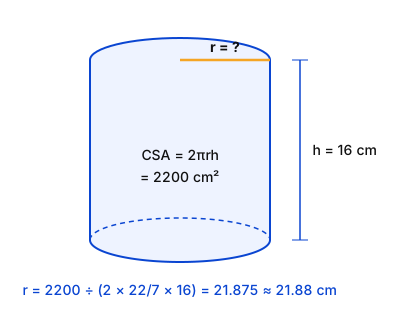
A cylindrical rod has an outer curved surface area of 2200 cm2. If the length of the rod is 16 cm, then the outer radius (in cm) of the rod, correct to two places of decimal, is:
(Take π=227)
एक बेलनाकार छड़ का बाहरी वक्र पृष्ठीय क्षेत्रफल 2200 cm2 है। यदि छड़ की लंबाई 16 cm है, तो दशमलव के दो स्थानों तक सही, छड़ की बाहरी त्रिज्या (cm में) है:
(π=227 लीजिए)
  1. A23.95
  2. B21.88
  3. C23.29
  4. D21.09
Show answer

Concept: Curved surface area of a cylinder =2πrh.

  1. 2×227×r×16=2200
  2. 7047r=2200⇒r=2200×7704=15400704
  3. r=21.875≈21.88cm

Trick: 22002πh: 2π×16≈100.57, and 2200÷100.57≈21.9 → 21.88.

Answer: (B) 21.88

अवधारणा: बेलन का वक्र पृष्ठीय क्षेत्रफल =2πrh।

  1. 2×227×r×16=2200
  2. 7047r=2200⇒r=15400704
  3. r=21.875≈21.88cm

ट्रिक: 2π×16≈100.57, और 2200÷100.57≈21.9 → 21.88।

उत्तर: (B) 21.88

RRB NTPC Undergraduate CBT 1MathematicsMensuration – cylinderRRB NTPC Undergraduate CBT 1 2024 · 11 Aug Shift 3 →
Q2962.
A man walks to a viewpoint and returns to the starting point by his car maintaining constant speed and thus takes a total time of 5 hours 30 minutes. He would have gained 3 hours by driving both ways. How long would it have taken for him to walk both ways with same walking speed?
एक व्यक्ति एक दर्शनीय स्थल तक पैदल जाता है और स्थिर चाल बनाए रखते हुए अपनी कार से प्रारंभिक बिंदु पर वापस लौटता है और इस प्रकार कुल 5 घंटे 30 मिनट का समय लेता है। यदि वह दोनों ओर कार से जाता, तो उसके 3 घंटे बच जाते। समान पैदल चाल से दोनों ओर पैदल चलने में उसे कितना समय लगता?
  1. A7 hours 15 minutes7 घंटे 15 मिनट
  2. B8 hours 30 minutes8 घंटे 30 मिनट
  3. C8 hours 45 minutes8 घंटे 45 मिनट
  4. D9 hours 30 minutes9 घंटे 30 मिनट
Show answer

Concept: Walk one way + drive one way = 5.5 h; drive both ways = 5.5 − 3 = 2.5 h.

  1. One-way drive =2.52=1.25 h
  2. One-way walk =5.5−1.25=4.25 h
  3. Walk both ways =2×4.25=8.5 h =8 h 30 min

Trick: Walk both ways =2×(mixed)−(drive both)=11−2.5=8.5 h.

Answer: (B) 8 hours 30 minutes

अवधारणा: एक ओर पैदल + एक ओर कार = 5.5 घंटे; दोनों ओर कार = 5.5 − 3 = 2.5 घंटे।

  1. एक ओर कार =2.52=1.25 घंटे
  2. एक ओर पैदल =5.5−1.25=4.25 घंटे
  3. दोनों ओर पैदल =2×4.25=8.5 घंटे =8 घंटे 30 मिनट

ट्रिक: दोनों ओर पैदल =2×(मिश्रित)−(दोनों ओर कार)=11−2.5=8.5 घंटे।

उत्तर: (B) 8 घंटे 30 मिनट

RRB NTPC Undergraduate CBT 1MathematicsTime and distanceRRB NTPC Undergraduate CBT 1 2024 · 11 Aug Shift 3 →
Q2963.
The selling price of 50 books is equal to the cost price of 19 books. Find the loss or gain percentage.
50 पुस्तकों का विक्रय मूल्य 19 पुस्तकों के क्रय मूल्य के बराबर है। हानि या लाभ प्रतिशत ज्ञात कीजिए।
  1. A10031% gain10031% लाभ
  2. B62% gain62% लाभ
  3. C62% loss62% हानि
  4. D10031% loss10031% हानि
Show answer

Concept: If SP of a articles = CP of b articles and b<a, it is a loss of a−ba×100%.

  1. Let CP of 1 book = ₹1 → SP of 50 books = ₹19, CP of 50 books = ₹50
  2. Loss =50−19=31
  3. Loss% =3150×100=62%

Trick: SP side has more items (50 > 19) → loss; divide by the SP-side count (50).

Answer: (C) 62% loss

अवधारणा: यदि a वस्तुओं का विक्रय मूल्य =b वस्तुओं का क्रय मूल्य और b<a, तो हानि =a−ba×100%।

  1. 1 पुस्तक का CP = ₹1 → 50 पुस्तकों का SP = ₹19, CP = ₹50
  2. हानि =50−19=31
  3. हानि% =3150×100=62%

ट्रिक: SP वाली ओर अधिक वस्तुएँ (50 > 19) → हानि; 50 से भाग दें।

उत्तर: (C) 62% हानि

RRB NTPC Undergraduate CBT 1MathematicsProfit and lossRRB NTPC Undergraduate CBT 1 2024 · 11 Aug Shift 3 →
Q2964.
The average weight (in kg) of a family of five members whose weights are 40 kg, 49 kg, 56 kg, 74 kg and 36 kg is:
पाँच सदस्यों वाले एक परिवार, जिनका भार 40 kg, 49 kg, 56 kg, 74 kg और 36 kg है, का औसत भार (kg में) है:
  1. A52
  2. B50
  3. C51
  4. D53
Show answer

Concept: Average =sumcount.

  1. Sum =40+49+56+74+36=255
  2. Average =2555=51

Trick: Take 50 as base: deviations −10,−1,+6,+24,−14 sum to +5 → 50+55=51.

Answer: (C) 51

अवधारणा: औसत =योगसंख्या।

  1. योग =40+49+56+74+36=255
  2. औसत =2555=51

ट्रिक: 50 को आधार लें: विचलन −10,−1,+6,+24,−14 का योग +5 → 50+1=51।

उत्तर: (C) 51

RRB NTPC Undergraduate CBT 1MathematicsAverageRRB NTPC Undergraduate CBT 1 2024 · 11 Aug Shift 3 →
Q2965.
The number 861616843 is divisible by which of the following?
संख्या 861616843 निम्नलिखित में से किससे विभाज्य है?
  1. A43
  2. B36
  3. C50
  4. D47
Show answer

Concept: Rule out options by quick tests, then divide.

  1. Odd number → not divisible by 36 or 50 (50 needs last digit 0)
  2. 861616843÷43: 43×20037601=861616843 exactly
  3. (Check 47: remainder is not 0.)

Trick: Break it: 860000000=43×20000000; remainder part 1616843=43×37601.

Answer: (A) 43

अवधारणा: त्वरित परीक्षणों से विकल्प हटाएँ, फिर भाग दें।

  1. विषम संख्या → 36 या 50 से विभाज्य नहीं
  2. 861616843÷43: 43×20037601=861616843 पूर्णतः
  3. (47 से भाग देने पर शेष 0 नहीं आता।)

ट्रिक: तोड़ें: 860000000=43×20000000; बचा भाग 1616843=43×37601।

उत्तर: (A) 43

RRB NTPC Undergraduate CBT 1MathematicsDivisibilityRRB NTPC Undergraduate CBT 1 2024 · 11 Aug Shift 3 →
Q2966.
Find the simple interest (in ₹) if a sum of ₹400 is borrowed for 5.5 years at 16% per annum rate of interest.
यदि ₹400 की राशि 16% वार्षिक ब्याज दर पर 5.5 वर्ष के लिए उधार ली जाती है, तो साधारण ब्याज (₹ में) ज्ञात कीजिए।
  1. A452
  2. B402
  3. C352
  4. D332
Show answer

Concept: SI=P×R×T100.

  1. SI=400×16×5.5100
  2. =4×16×5.5=64×5.5=352

Trick: Interest per year =64; 5.5 years → 64×5+32=352.

Answer: (C) ₹352

अवधारणा: SI=P×R×T100।

  1. SI=400×16×5.5100
  2. =64×5.5=352

ट्रिक: प्रति वर्ष ब्याज =64; 5.5 वर्ष → 64×5+32=352।

उत्तर: (C) ₹352

RRB NTPC Undergraduate CBT 1MathematicsSimple interestRRB NTPC Undergraduate CBT 1 2024 · 11 Aug Shift 3 →
Q2967.
Lokesh and Manoj can complete a certain piece of work in 11 and 15 days, respectively. They started to work together, and after 5 days, Manoj left. In how many days will Lokesh complete the remaining work?
लोकेश और मनोज एक निश्चित कार्य को क्रमशः 11 और 15 दिनों में पूरा कर सकते हैं। उन्होंने एक साथ कार्य करना शुरू किया, और 5 दिनों के बाद मनोज ने कार्य छोड़ दिया। लोकेश शेष कार्य को कितने दिनों में पूरा करेगा?
  1. A213
  2. B223
  3. C723
  4. D713
Show answer

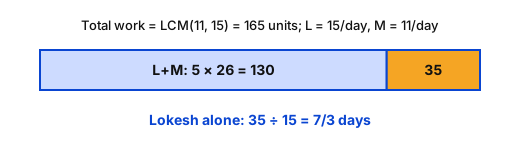
Concept: Take total work = LCM of days; efficiency = work ÷ days.

  1. Work =LCM(11,15)=165; Lokesh =15/day, Manoj =11/day
  2. 5 days together: 5×26=130
  3. Left =165−130=35; Lokesh alone =3515=73=213 days

Trick: Fraction way: 5(111+115)=2633; remaining 733×11=73.

Answer: (A) 213

अवधारणा: कुल कार्य = दिनों का LCM; दक्षता = कार्य ÷ दिन।

  1. कार्य =LCM(11,15)=165; लोकेश =15/दिन, मनोज =11/दिन
  2. 5 दिन साथ: 5×26=130
  3. शेष =35; लोकेश अकेले =3515=73=213 दिन

ट्रिक: भिन्न से: 5(111+115)=2633; शेष 733×11=73।

उत्तर: (A) 213

RRB NTPC Undergraduate CBT 1MathematicsTime and workRRB NTPC Undergraduate CBT 1 2024 · 11 Aug Shift 3 →
Q2968.
Pipe A can fill a tank in 11 hours, pipe B can fill the same tank in 26 hours and pipe C can fill the same tank in 12 hours. The time taken by them to fill the same tank if they operate together is::
पाइप A एक टंकी को 11 घंटे में भर सकता है, पाइप B उसी टंकी को 26 घंटे में भर सकता है और पाइप C उसी टंकी को 12 घंटे में भर सकता है। यदि वे एक साथ कार्य करें, तो उसी टंकी को भरने में उनके द्वारा लिया गया समय है::
  1. A11256365 hours11256365 घंटे
  2. B7256365 hours7256365 घंटे
  3. C10256365 hours10256365 घंटे
  4. D4256365 hours4256365 घंटे
Show answer

Concept: Together time =11a+1b+1c.

  1. LCM(11,26,12)=1716 units
  2. Per hour: A =156, B =66, C =143 → total 365
  3. Time =1716365=4256365 hours

Trick: Time must be less than the fastest pipe (11 h) alone and roughly 1716365≈4.7, so only option (D).

Answer: (D) 4256365 hours

अवधारणा: एक साथ समय =11a+1b+1c।

  1. LCM(11,26,12)=1716 इकाई
  2. प्रति घंटा: A =156, B =66, C =143 → कुल 365
  3. समय =1716365=4256365 घंटे

ट्रिक: समय सबसे तेज़ पाइप (11 घंटे) से कम होगा और लगभग 4.7 — केवल (D)।

उत्तर: (D) 4256365 घंटे

RRB NTPC Undergraduate CBT 1MathematicsPipes and cisternsRRB NTPC Undergraduate CBT 1 2024 · 11 Aug Shift 3 →
Q2969.
Yash travels 252 km at 63 km/hr, the next 891 km at 99 km/hr and the next 183 km at 61 km/hr. What is his average speed (in km/hr) for the whole journey? (Round off your answer to two decimal places)
यश 252 km की दूरी 63 km/hr की चाल से, अगली 891 km की दूरी 99 km/hr की चाल से और अगली 183 km की दूरी 61 km/hr की चाल से तय करता है। पूरी यात्रा के लिए उसकी औसत चाल (km/hr में) क्या है? (अपने उत्तर को दशमलव के दो स्थानों तक पूर्णांकित कीजिए)
  1. A88.59
  2. B84.55
  3. C82.88
  4. D79.83
Show answer

Concept: Average speed =total distancetotal time.

  1. Times: 25263=4, 89199=9, 18361=3 → total 16 h
  2. Distance =252+891+183=1326 km
  3. Average =132616=82.875≈82.88km/h

Trick: Never average the speeds directly; each leg here divides exactly, so add times.

Answer: (C) 82.88

अवधारणा: औसत चाल =कुल दूरीकुल समय।

  1. समय: 25263=4, 89199=9, 18361=3 → कुल 16 घंटे
  2. दूरी =1326 km
  3. औसत =132616=82.875≈82.88km/h

ट्रिक: चालों का सीधा औसत कभी न लें; समय जोड़ें।

उत्तर: (C) 82.88

RRB NTPC Undergraduate CBT 1MathematicsAverage speedRRB NTPC Undergraduate CBT 1 2024 · 11 Aug Shift 3 →
Q2970.
Himanshi bought a toy for ₹199, decorated it at a cost of ₹9, and sold the toy for ₹231. Find the loss or gain percentage.
हिमांशी ने ₹199 में एक खिलौना खरीदा, ₹9 की लागत से उसे सजाया और खिलौने को ₹231 में बेच दिया। हानि या लाभ प्रतिशत ज्ञात कीजिए।
  1. A58552% loss58552% हानि
  2. B57552% loss57552% हानि
  3. C57552% profit57552% लाभ
  4. D575% profit575% लाभ
Show answer

Concept: Extra expenses (overheads) are added to CP; Profit% =ProfitCP×100.

  1. Effective CP =199+9=₹208; SP =₹231
  2. Profit =231−208=₹23
  3. Profit% =23208×100=2300208=57552%

Trick: Always add repair/decoration cost to CP before finding profit%.

Answer: (C) 57552% profit

अवधारणा: अतिरिक्त खर्च CP में जुड़ता है; लाभ% =लाभCP×100।

  1. प्रभावी CP =199+9=₹208; SP =₹231
  2. लाभ =231−208=₹23
  3. लाभ% =2300208=57552%

ट्रिक: सजावट/मरम्मत खर्च हमेशा CP में जोड़ें।

उत्तर: (C) 57552% लाभ

RRB NTPC Undergraduate CBT 1MathematicsProfit and lossRRB NTPC Undergraduate CBT 1 2024 · 11 Aug Shift 3 →
Q2971.
Seven boxes, A, B, C, D, E, F and G, are kept one over the other but not necessarily in the same order.
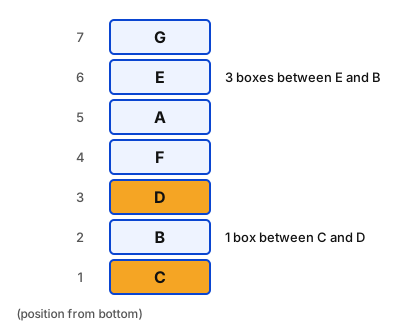
B is kept second from the bottom. Only three boxes are kept between B and E. C is kept at one of the positions below B. Only A is kept between E and F. G is kept at one of the positions above E.
How many boxes are kept between C and D?
सात बक्से, A, B, C, D, E, F और G, एक के ऊपर एक रखे गए हैं, परंतु आवश्यक नहीं कि इसी क्रम में हों।
B को नीचे से दूसरे स्थान पर रखा गया है। B और E के बीच केवल तीन बक्से रखे गए हैं। C को B के नीचे के स्थानों में से किसी एक पर रखा गया है। E और F के बीच केवल A रखा गया है। G को E के ऊपर के स्थानों में से किसी एक पर रखा गया है।
C और D के बीच कितने बक्से रखे गए हैं?
  1. A3
  2. B4
  3. C1
  4. D2
Show answer

Concept: Fix definite positions first (number positions 1 = bottom to 7 = top).

  1. B = 2; three boxes between B and E → E = 6
  2. C below B → C = 1
  3. Only A between E and F → A = 5, F = 4 (above E is impossible)
  4. G above E → G = 7; D takes the last place 3
  5. Between C (1) and D (3): only B → 1 box

Trick: Boxes between positions p and q = |p − q| − 1 = 3 − 1 − 1 = 1.

Answer: (C) 1

अवधारणा: पहले निश्चित स्थान तय करें (1 = नीचे, 7 = ऊपर)।

  1. B = 2; B और E के बीच तीन बॉक्स → E = 6
  2. C, B के नीचे → C = 1
  3. E और F के बीच केवल A → A = 5, F = 4
  4. G, E के ऊपर → G = 7; D = 3
  5. C (1) और D (3) के बीच: केवल B → 1 बॉक्स

ट्रिक: बीच के बॉक्स = |p − q| − 1 = 3 − 1 − 1 = 1।

उत्तर: (C) 1

RRB NTPC Undergraduate CBT 1General Intelligence and ReasoningBox arrangementRRB NTPC Undergraduate CBT 1 2024 · 11 Aug Shift 3 →
Q2972.
If ‘A’ stands for ‘÷’, ‘B’ stands for ‘×’, ‘C’ stands for ‘+’ and ‘D’ stands for ‘−’, what will come in place of the question mark (?) in the following equation?
99 A 9 C 12 B 2 D 16 = ?
यदि ‘A’ का अर्थ ‘÷’, ‘B’ का अर्थ ‘×’, ‘C’ का अर्थ ‘+’ और ‘D’ का अर्थ ‘−’ है, तो निम्नलिखित समीकरण में प्रश्न चिह्न (?) के स्थान पर क्या आएगा?
99 A 9 C 12 B 2 D 16 = ?
  1. A26
  2. B12
  3. C35
  4. D19
Show answer

Concept: Replace letters by signs and follow BODMAS.

  1. 99÷9+12×2−16
  2. =11+24−16=19

Trick: Divide and multiply first: 11 and 24, then 35−16.

Answer: (D) 19

अवधारणा: अक्षरों को चिह्नों से बदलें और BODMAS लगाएँ।

  1. 99÷9+12×2−16
  2. =11+24−16=19

ट्रिक: पहले भाग और गुणा: 11 और 24, फिर 35−16।

उत्तर: (D) 19

RRB NTPC Undergraduate CBT 1General Intelligence and ReasoningMathematical operationsRRB NTPC Undergraduate CBT 1 2024 · 11 Aug Shift 3 →
Q2973.
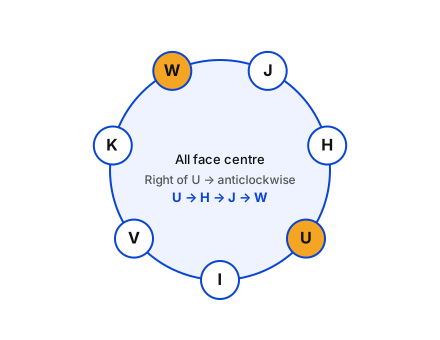
H, I, J, K, U, V and W are sitting around a circular table facing the centre of the table. V sits to the immediate left of I. H sits to the immediate left of J. J sits second to the left of K. W sits third to the left of I. Who sits third to the right of U?
H, I, J, K, U, V और W एक वृत्ताकार मेज़ के चारों ओर मेज़ के केंद्र की ओर मुख करके बैठे हैं। V, I के ठीक बाईं ओर बैठा है। H, J के ठीक बाईं ओर बैठा है। J, K के बाईं ओर दूसरे स्थान पर बैठा है। W, I के बाईं ओर तीसरे स्थान पर बैठा है। U के दाईं ओर तीसरे स्थान पर कौन बैठा है?
  1. AW
  2. BH
  3. CK
  4. DV
Show answer

Concept: Facing the centre: left = clockwise, right = anticlockwise.

  1. Place I; V is immediate left of I; W is third to the left of I
  2. J is second to the left of K and H is immediate left of J → only fit: K, J, H in the remaining seats as shown
  3. U takes the last seat (immediate right of I)
  4. Third to the right of U: U → H → J → W

Trick: In a 7-seat circle, 3rd to the right = 4th to the left — use whichever is shorter to check.

Answer: (A) W

अवधारणा: केंद्र की ओर मुख: बायाँ = दक्षिणावर्त (clockwise), दायाँ = वामावर्त (anticlockwise)।

  1. I को रखें; V, I के ठीक बाएँ; W, I के बाएँ से तीसरा
  2. J, K के बाएँ से दूसरा और H, J के ठीक बाएँ → केवल चित्र वाली व्यवस्था बनती है
  3. U अंतिम सीट पर (I के ठीक दाएँ)
  4. U के दाएँ से तीसरा: U → H → J → W

ट्रिक: 7 सीटों में दाएँ से तीसरा = बाएँ से चौथा — जाँच के लिए उपयोगी।

उत्तर: (A) W

RRB NTPC Undergraduate CBT 1General Intelligence and ReasoningCircular seating arrangementRRB NTPC Undergraduate CBT 1 2024 · 11 Aug Shift 3 →
Q2974.
What should come in place of the question mark (?) in the given series based on the English alphabetical order?
ZWR VSN ROJ NKF ?
अंग्रेज़ी वर्णमाला क्रम के आधार पर दी गई शृंखला में प्रश्न चिह्न (?) के स्थान पर क्या आना चाहिए?
ZWR VSN ROJ NKF ?
  1. AJGB
  2. BJHA
  3. CJGA
  4. DJHB
Show answer

Concept: Track each letter position separately.

  1. 1st letters: Z, V, R, N → −4 each → J
  2. 2nd: W, S, O, K → −4 → G
  3. 3rd: R, N, J, F → −4 → B

Trick: All three positions move −4: shift NKF back by 4 → JGB.

Answer: (A) JGB

अवधारणा: हर स्थान के अक्षर को अलग-अलग देखें।

  1. पहला: Z, V, R, N → −4 → J
  2. दूसरा: W, S, O, K → −4 → G
  3. तीसरा: R, N, J, F → −4 → B

ट्रिक: तीनों स्थान −4 चलते हैं: NKF को 4 पीछे करें → JGB।

उत्तर: (A) JGB

RRB NTPC Undergraduate CBT 1General Intelligence and ReasoningAlphabet seriesRRB NTPC Undergraduate CBT 1 2024 · 11 Aug Shift 3 →
Q2975.
What should come in place of the question mark (?) in the given series based on the English alphabetical order?
GDB OLJ WTR EBZ ?
अंग्रेज़ी वर्णमाला क्रम के आधार पर दी गई शृंखला में प्रश्न चिह्न (?) के स्थान पर क्या आना चाहिए?
GDB OLJ WTR EBZ ?
  1. AMHJ
  2. BHMJ
  3. CHJM
  4. DMJH
Show answer

Concept: Each position moves +8 (wrapping after Z).

  1. 1st: G, O, W, E (W+8 wraps to E) → E+8 = M
  2. 2nd: D, L, T, B → B+8 = J
  3. 3rd: B, J, R, Z → Z+8 = H

Trick: Z+8: count past Z → A(1)… H(8).

Answer: (D) MJH

अवधारणा: हर स्थान +8 चलता है (Z के बाद फिर A से)।

  1. पहला: G, O, W, E → E+8 = M
  2. दूसरा: D, L, T, B → B+8 = J
  3. तीसरा: B, J, R, Z → Z+8 = H

ट्रिक: Z+8: Z के बाद A(1)… H(8)।

उत्तर: (D) MJH

RRB NTPC Undergraduate CBT 1General Intelligence and ReasoningAlphabet seriesRRB NTPC Undergraduate CBT 1 2024 · 11 Aug Shift 3 →
Q2976.
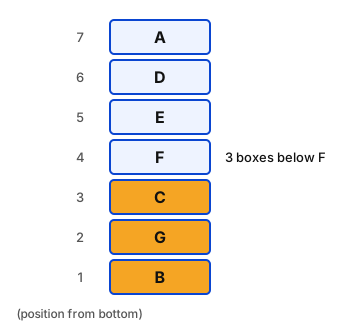
Seven boxes A, B, C, D, E, F and G are kept one over the other but not necessarily in the same order. Only A is kept above D. Only E is kept between D and F. Only B is kept below G. How many boxes are kept below F?
सात बक्से A, B, C, D, E, F और G एक के ऊपर एक रखे गए हैं, परंतु आवश्यक नहीं कि इसी क्रम में हों। केवल A को D के ऊपर रखा गया है। D और F के बीच केवल E रखा गया है। G के नीचे केवल B रखा गया है। F के नीचे कितने बक्से रखे गए हैं?
  1. A3
  2. B1
  3. C4
  4. D2
Show answer

Concept: “Only A above D” fixes the top two; “only B below G” fixes the bottom two.

  1. A = 7 (top), D = 6
  2. Only E between D and F → E = 5, F = 4
  3. B = 1 (bottom), G = 2; C = 3
  4. Below F (4): C, G, B → 3 boxes

Trick: ‘Only X above Y’ means X is on top and Y just below it.

Answer: (A) 3

अवधारणा: “केवल A, D के ऊपर” से ऊपर के दो, “केवल B, G के नीचे” से नीचे के दो तय होते हैं।

  1. A = 7 (सबसे ऊपर), D = 6
  2. D और F के बीच केवल E → E = 5, F = 4
  3. B = 1, G = 2; C = 3
  4. F (4) के नीचे: C, G, B → 3 बॉक्स

ट्रिक: ‘केवल X, Y के ऊपर’ = X सबसे ऊपर, Y उसके ठीक नीचे।

उत्तर: (A) 3

RRB NTPC Undergraduate CBT 1General Intelligence and ReasoningBox arrangementRRB NTPC Undergraduate CBT 1 2024 · 11 Aug Shift 3 →
Q2977.
Based on the English alphabetical order, three of the following four letter-clusters are alike in a certain way and thus form a group. Which letter-cluster DOES NOT belong to that group?
(Note: The odd one out is not based on the number of consonants/vowels or their position in the letter-cluster.)
अंग्रेज़ी वर्णमाला क्रम के आधार पर, निम्नलिखित चार अक्षर-समूहों में से तीन किसी प्रकार से एक समान हैं और इस प्रकार एक समूह बनाते हैं। कौन-सा अक्षर-समूह उस समूह से संबंधित नहीं है?
(ध्यान दें: असंगत अक्षर-समूह, उस अक्षर-समूह में व्यंजनों/स्वरों की संख्या या उनके स्थान पर आधारित नहीं है।)
  1. AUNR
  2. BQJM
  3. CWPS
  4. DSLO
Show answer

Concept: Check gaps between alphabet positions.

  1. QJM: 17, 10, 13 → −7, +3
  2. WPS: 23, 16, 19 → −7, +3; SLO: 19, 12, 15 → −7, +3
  3. UNR: 21, 14, 18 → −7, +4 ✗

Trick: First gap is −7 in all; the second gap decides the odd one.

Answer: (A) UNR

अवधारणा: अक्षरों के स्थानों का अंतर देखें।

  1. QJM: 17, 10, 13 → −7, +3
  2. WPS: −7, +3; SLO: −7, +3
  3. UNR: 21, 14, 18 → −7, +4 ✗

ट्रिक: पहला अंतर सबमें −7 है; दूसरा अंतर विषम पहचानता है।

उत्तर: (A) UNR

RRB NTPC Undergraduate CBT 1General Intelligence and ReasoningOdd one out (letters)RRB NTPC Undergraduate CBT 1 2024 · 11 Aug Shift 3 →
Q2978.
Refer to the following number and symbol series and answer the question that follows. Counting to be done from left to right only.
(Left) # © 8 4 5 % % 3 8 2 8 2 9 4 £ & % © # £ 1 * (Right)
How many such symbols are there, each of which is immediately preceded by a number and also immediately followed by a symbol?
निम्नलिखित संख्या और प्रतीक शृंखला का संदर्भ लेकर नीचे दिए गए प्रश्न का उत्तर दीजिए। गिनती केवल बाएँ से दाएँ की जानी है।
(बाएँ) # © 8 4 5 % % 3 8 2 8 2 9 4 £ & % © # £ 1 * (दाएँ)
ऐसे कितने प्रतीक हैं, जिनमें से प्रत्येक के ठीक पहले एक संख्या है और ठीक बाद भी एक प्रतीक है?
  1. A1
  2. B3
  3. C4
  4. D2
Show answer

Concept: Look for the pattern number – symbol – symbol.

  1. 5 % % → the first % counts
  2. 4 £ & → £ counts
  3. 1 * (end) → nothing follows, does not count; other symbols are not preceded by a number

Trick: Scan only symbols that come right after a number, then check the next item.

Answer: (D) 2

अवधारणा: पैटर्न खोजें: संख्या – प्रतीक – प्रतीक।

  1. 5 % % → पहला % गिना
  2. 4 £ & → £ गिना
  3. 1 * (अंत) → आगे कुछ नहीं, नहीं गिना; बाकी प्रतीकों से पहले संख्या नहीं

ट्रिक: केवल वे प्रतीक देखें जो संख्या के ठीक बाद हैं, फिर अगला पद जाँचें।

उत्तर: (D) 2

RRB NTPC Undergraduate CBT 1General Intelligence and ReasoningSymbol-number seriesRRB NTPC Undergraduate CBT 1 2024 · 11 Aug Shift 3 →
Q2979.
In a certain code language, ‘life is good’ is coded as ‘tu ro na’ and ‘she loves life’ is coded as ‘ko ie na’. How is ‘life’ coded in the given language?
एक निश्चित कूट भाषा में, ‘life is good’ को ‘tu ro na’ के रूप में कूटबद्ध किया जाता है और ‘she loves life’ को ‘ko ie na’ के रूप में कूटबद्ध किया जाता है। दी गई भाषा में ‘life’ को किस प्रकार कूटबद्ध किया जाता है?
  1. Aie
  2. Bko
  3. Ctu
  4. Dna
Show answer

Concept: A word common to two sentences takes the code common to both.

  1. ‘life’ is in both sentences
  2. Common code in ‘tu ro na’ and ‘ko ie na’ is ‘na’

Trick: Common word ↔ common code.

Answer: (D) na

अवधारणा: दोनों वाक्यों में समान शब्द का कोड भी दोनों में समान होगा।

  1. ‘life’ दोनों वाक्यों में है
  2. ‘tu ro na’ और ‘ko ie na’ में समान कोड ‘na’

ट्रिक: समान शब्द ↔ समान कोड।

उत्तर: (D) na

RRB NTPC Undergraduate CBT 1General Intelligence and ReasoningCoding-decodingRRB NTPC Undergraduate CBT 1 2024 · 11 Aug Shift 3 →
Q2980.
Based on the English alphabetical order, three of the following four letter-clusters are alike in a certain way and thus form a group. Which letter-cluster DOES NOT belong to that group?
(Note: The odd one out is not based on the number of consonants/vowels or their position in the letter-cluster.)
अंग्रेज़ी वर्णमाला क्रम के आधार पर, निम्नलिखित चार अक्षर-समूहों में से तीन किसी प्रकार से एक समान हैं और इस प्रकार एक समूह बनाते हैं। कौन-सा अक्षर-समूह उस समूह से संबंधित नहीं है?
(ध्यान दें: असंगत अक्षर-समूह, उस अक्षर-समूह में व्यंजनों/स्वरों की संख्या या उनके स्थान पर आधारित नहीं है।)
  1. AIEK
  2. BLHN
  3. CNJO
  4. DFBH
Show answer

Concept: Compare alphabet-position gaps.

  1. IEK: 9, 5, 11 → −4, +6; LHN: 12, 8, 14 → −4, +6
  2. FBH: 6, 2, 8 → −4, +6
  3. NJO: 14, 10, 15 → −4, +5 ✗

Trick: Middle letter is 4 behind the first and 6 behind the last in the group.

Answer: (C) NJO

अवधारणा: अक्षरों के स्थानों का अंतर देखें।

  1. IEK: −4, +6; LHN: −4, +6
  2. FBH: −4, +6
  3. NJO: 14, 10, 15 → −4, +5 ✗

ट्रिक: समूह में बीच का अक्षर पहले से 4 पीछे और अंतिम से 6 पीछे है।

उत्तर: (C) NJO

RRB NTPC Undergraduate CBT 1General Intelligence and ReasoningOdd one out (letters)RRB NTPC Undergraduate CBT 1 2024 · 11 Aug Shift 3 →