Question bank

Q&A: practice questions with answers

Search questions on any topic. Filter by exam category, exam, subject and topic, try the question, then open the answer and explanation.

Courses – airGurukul

8,500 questions found.

Q3041.
The value of 22+82−24−11 is
22+82−24−11 का मान है
  1. A5
  2. B-7
  3. C2
  4. D-3
Show answer

Concept: Evaluate powers and roots first, then add/subtract left to right; a2=a for a>0.

  1. 22=4, 82=8, 24=2×2=4
  2. Value =4+8−4−11
  3. =12−15=−3

Trick: x2 just removes the square: 82=8.

Answer: (D) −3

अवधारणा: पहले घात और मूल हल करें, फिर बाएँ से दाएँ जोड़-घटाव; a>0 के लिए a2=a।

  1. 22=4, 82=8, 24=2×2=4
  2. मान =4+8−4−11
  3. =12−15=−3

ट्रिक: x2 वर्ग को हटा देता है: 82=8।

उत्तर: (D) −3

RRB NTPC Undergraduate CBT 1MathematicsSimplification – Powers & RootsRRB NTPC Undergraduate CBT 1 2024 · 11 Aug Shift 2 →
Q3042.
The product of two consecutive positive natural numbers is 272. The greater of the two numbers is:
दो क्रमागत धनात्मक प्राकृत संख्याओं का गुणनफल 272 है। दोनों में से बड़ी संख्या है:
  1. A36
  2. B9
  3. C17
  4. D28
Show answer

Concept: If the numbers are n and n+1, then n(n+1)=272; look for two neighbours around 272.

  1. 272≈16.5, so try 16 and 17.
  2. 16×17=272 ✓
  3. Greater number =17.

Trick: Product of consecutive numbers ≈ square: 272 lies between 16 and 17.

Answer: (C) 17

अवधारणा: संख्याएँ n और n+1 हों तो n(n+1)=272; 272 के आस-पास की दो संख्याएँ देखें।

  1. 272≈16.5, अतः 16 और 17 लें।
  2. 16×17=272 ✓
  3. बड़ी संख्या =17।

ट्रिक: क्रमागत संख्याओं का गुणनफल ≈ वर्ग: 272 16 और 17 के बीच है।

उत्तर: (C) 17

RRB NTPC Undergraduate CBT 1MathematicsNumber System – Consecutive NumbersRRB NTPC Undergraduate CBT 1 2024 · 11 Aug Shift 2 →
Q3043.
Find the value of [290 ÷ {27 + 5 × (2 − 7)}].
[290 ÷ {27 + 5 × (2 − 7)}] का मान ज्ञात कीजिए।
  1. A145
  2. B141
  3. C140
  4. D150
Show answer

Concept: BODMAS: innermost bracket first, then multiplication, then addition, then the outer division.

  1. (2−7)=−5
  2. 5×(−5)=−25, so {27−25}=2
  3. 290÷2=145

Trick: Always solve ( ) → { } → [ ].

Answer: (A) 145

अवधारणा: BODMAS: पहले सबसे भीतरी कोष्ठक, फिर गुणा, फिर जोड़, फिर बाहरी भाग।

  1. (2−7)=−5
  2. 5×(−5)=−25, अतः {27−25}=2
  3. 290÷2=145

ट्रिक: क्रम हमेशा ( ) → { } → [ ]।

उत्तर: (A) 145

RRB NTPC Undergraduate CBT 1MathematicsSimplification – BODMASRRB NTPC Undergraduate CBT 1 2024 · 11 Aug Shift 2 →
Q3044.
What smallest number should be added to 81661 so that the sum is completely divisible by 73?
81661 में कौन-सी सबसे छोटी संख्या जोड़ी जानी चाहिए ताकि योगफल 73 से पूर्णतः विभाज्य हो?
  1. A25
  2. B24
  3. C26
  4. D30
Show answer

Concept: Least number to add =divisor−remainder.

  1. 73×1118=81614
  2. Remainder =81661−81614=47
  3. Number to add =73−47=26; check: 81687=73×1119 ✓

Trick: Add (divisor − remainder); subtract the remainder itself.

Answer: (C) 26

अवधारणा: जोड़ी जाने वाली न्यूनतम संख्या =भाजक−शेषफल।

  1. 73×1118=81614
  2. शेषफल =81661−81614=47
  3. जोड़ें =73−47=26; जाँच: 81687=73×1119 ✓

ट्रिक: जोड़ना हो तो (भाजक − शेष); घटाना हो तो शेष ही।

उत्तर: (C) 26

RRB NTPC Undergraduate CBT 1MathematicsNumber System – DivisibilityRRB NTPC Undergraduate CBT 1 2024 · 11 Aug Shift 2 →
Q3045.
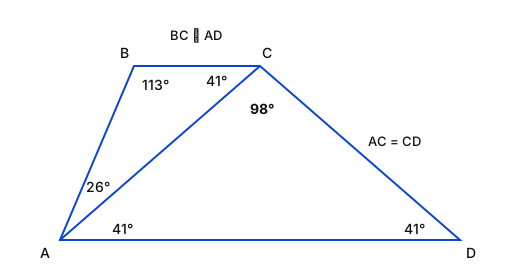
ABCD is a trapezium in which BC ∥ AD and AC = CD. If ∠ABC=113∘ and ∠BAC=26∘, then what is the measure of ∠ACD (in degree)?
ABCD एक समलंब चतुर्भुज है जिसमें BC ∥ AD और AC = CD है। यदि ∠ABC=113∘ और ∠BAC=26∘ है, तो ∠ACD का माप (डिग्री में) क्या है?
  1. A168°
  2. B165°
  3. C41°
  4. D166°
Show answer

Concept: Angle sum of a triangle =180∘; with BC∥AD, alternate angles ∠BCA=∠CAD; in an isosceles triangle the angles opposite equal sides are equal.

  1. In △ABC: ∠BCA=180∘−113∘−26∘=41∘.
  2. BC∥AD and AC is a transversal, so ∠CAD=∠BCA=41∘.
  3. AC=CD, so in △ACD: ∠CDA=∠CAD=41∘.
  4. ∠ACD=180∘−41∘−41∘=98∘.
  5. 98∘ is not among the options (168°, 165°, 41°, 166°); 41° is ∠CAD, not ∠ACD. No option is correct.

Note: Mark each angle on the figure with its vertex letters before matching it to the options. In the exam, every candidate gets full marks (bonus) for such a question.

Answer: Bonus – no option is correct as printed; full marks to all.

अवधारणा: त्रिभुज के कोणों का योग =180∘; BC∥AD होने से एकांतर कोण ∠BCA=∠CAD; समद्विबाहु त्रिभुज में बराबर भुजाओं के सामने के कोण बराबर होते हैं।

  1. △ABC में: ∠BCA=180∘−113∘−26∘=41∘।
  2. BC∥AD और AC तिर्यक रेखा है, अतः ∠CAD=∠BCA=41∘।
  3. AC=CD, अतः △ACD में: ∠CDA=∠CAD=41∘।
  4. ∠ACD=180∘−41∘−41∘=98∘।
  5. 98∘ विकल्पों (168°, 165°, 41°, 166°) में नहीं है; 41° तो ∠CAD है, ∠ACD नहीं। कोई विकल्प सही नहीं।

नोट: विकल्पों से मिलाने से पहले हर कोण को उसके शीर्ष-अक्षरों सहित चित्र पर अंकित करें। परीक्षा में ऐसे प्रश्न पर सभी अभ्यर्थियों को पूरे अंक (बोनस) दिए जाते हैं।

उत्तर: बोनस – छपे प्रश्न के अनुसार कोई विकल्प सही नहीं; सभी को पूरे अंक।

RRB NTPC Undergraduate CBT 1MathematicsGeometry – QuadrilateralsRRB NTPC Undergraduate CBT 1 2024 · 11 Aug Shift 2 →
Q3046.
A store sells a printer priced at ₹32,000, offering a trade discount of 9%. What is the discount amount?
एक दुकान ₹32,000 मूल्य का एक प्रिंटर बेचती है और 9% की व्यापारिक छूट देती है। छूट की राशि कितनी है?
  1. A₹2,780
  2. B₹2,880
  3. C₹2,740
  4. D₹2,840
Show answer

Concept: Discount=Marked price×Discount%100

  1. Discount =32000×9100
  2. =320×9=2880

Trick: 1% of ₹32,000 is ₹320, so 9% =9×320.

Answer: (B) ₹2,880

अवधारणा: छूट=अंकित मूल्य×छूट%100

  1. छूट =32000×9100
  2. =320×9=2880

ट्रिक: ₹32,000 का 1% = ₹320, अतः 9% =9×320।

उत्तर: (B) ₹2,880

RRB NTPC Undergraduate CBT 1MathematicsDiscountRRB NTPC Undergraduate CBT 1 2024 · 11 Aug Shift 2 →
Q3047.
Pipe A can fill a tank in 14 hours, pipe B can fill the same tank in 24 hours and pipe C can fill the same tank in 17 hours. The time taken by them to fill the same tank if they operate together is::
पाइप A एक टंकी को 14 घंटे में भर सकता है, पाइप B उसी टंकी को 24 घंटे में भर सकता है और पाइप C उसी टंकी को 17 घंटे में भर सकता है। यदि तीनों एक साथ चलाए जाएँ, तो उसी टंकी को भरने में लगने वाला समय है:
  1. A5401491 hours5401491 घंटे
  2. B11401491 hours11401491 घंटे
  3. C10401491 hours10401491 घंटे
  4. D2401491 hours2401491 घंटे
Show answer

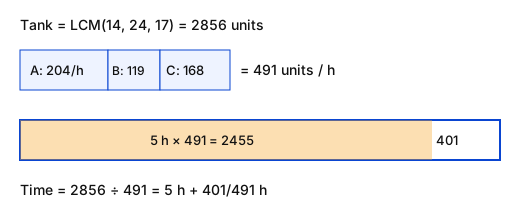
Concept: Take tank capacity = LCM of the times; each pipe’s hourly work = capacity ÷ its time.

  1. LCM(14,24,17)=2856 units
  2. A =285614=204, B =285624=119, C =285617=168 units/h
  3. Together =204+119+168=491 units/h
  4. Time =2856491=5401491 hours

Trick: Rough check: 114+124+117≈0.17, so time ≈ 5.8 h – only the option starting with 5 fits.

Answer: (A) 5401491 hours

अवधारणा: टंकी की क्षमता = समयों का LCM लें; हर पाइप का प्रति घंटा कार्य = क्षमता ÷ उसका समय।

  1. LCM(14,24,17)=2856 इकाई
  2. A =285614=204, B =285624=119, C =285617=168 इकाई/घंटा
  3. तीनों मिलकर =204+119+168=491 इकाई/घंटा
  4. समय =2856491=5401491 घंटे

ट्रिक: मोटा अनुमान: 114+124+117≈0.17, अतः समय ≈ 5.8 घंटे – केवल 5 से शुरू होने वाला विकल्प सही।

उत्तर: (A) 5401491 घंटे

RRB NTPC Undergraduate CBT 1MathematicsPipes and CisternsRRB NTPC Undergraduate CBT 1 2024 · 11 Aug Shift 2 →
Q3048.
I bought two frocks for ₹1,200. I sold the first one at a loss of 10% and the second at a gain of 15%. If, on the whole I made neither a loss nor a gain, find the cost price (in ₹) of the first frock.
मैंने ₹1,200 में दो फ्रॉक खरीदीं। मैंने पहली फ्रॉक 10% की हानि पर और दूसरी 15% के लाभ पर बेची। यदि कुल मिलाकर मुझे न तो हानि हुई और न ही लाभ, तो पहली फ्रॉक का क्रय मूल्य (₹ में) ज्ञात कीजिए।
  1. A740
  2. B744
  3. C704
  4. D720
Show answer

Concept: No overall profit or loss ⇒ loss on the first frock = gain on the second.

  1. Let CP of first =x, second =1200−x.
  2. 10% of x=15% of (1200−x) ⇒ 10x=18000−15x
  3. 25x=18000 ⇒ x=720
  4. Check: loss =72, gain =15% of 480=72 ✓

Trick: Loss% : Gain% =10:15 ⇒ CPs are in ratio 15:10=3:2 ⇒ first =35×1200=720.

Answer: (D) 720

अवधारणा: कुल न लाभ न हानि ⇒ पहली फ्रॉक पर हानि = दूसरी पर लाभ।

  1. पहली का क्रय मूल्य =x, दूसरी का =1200−x।
  2. x का 10% =(1200−x) का 15% ⇒ 10x=18000−15x
  3. 25x=18000 ⇒ x=720
  4. जाँच: हानि =72, लाभ =480 का 15%=72 ✓

ट्रिक: हानि% : लाभ% =10:15 ⇒ क्रय मूल्य 15:10=3:2 ⇒ पहली =35×1200=720।

उत्तर: (D) 720

RRB NTPC Undergraduate CBT 1MathematicsProfit and LossRRB NTPC Undergraduate CBT 1 2024 · 11 Aug Shift 2 →
Q3049.
Train A leaves station M at 8:05 a.m. and reaches station N at 3:05 p.m. on the same day. Train B leaves station N at 10:05 a.m. and reaches station M at 3:05 p.m. on the same day. Find the time when Trains A and B meet.
ट्रेन A स्टेशन M से सुबह 8:05 बजे चलती है और उसी दिन दोपहर 3:05 बजे स्टेशन N पहुँचती है। ट्रेन B स्टेशन N से सुबह 10:05 बजे चलती है और उसी दिन दोपहर 3:05 बजे स्टेशन M पहुँचती है। वह समय ज्ञात कीजिए जब ट्रेन A और B मिलती हैं।
  1. A12:10 p.m.
  2. B12:30 p.m.
  3. C12:00 p.m.
  4. D11:50 a.m.
Show answer

Concept: Take distance MN =D; speeds are Dtime; trains moving towards each other close the gap at the sum of speeds.

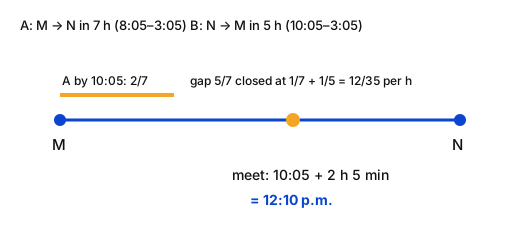
  1. A takes 7 h (8:05 a.m.–3:05 p.m.), speed D7; B takes 5 h (10:05 a.m.–3:05 p.m.), speed D5.
  2. By 10:05 a.m., A covers 2D7; gap =5D7.
  3. Relative speed =D7+D5=12D35
  4. Time =5D7÷12D35=2512h=2h5min ⇒ 10:05 + 2:05 = 12:10 p.m.

Trick: Take D=35 (LCM of 7 and 5): A =5, B =7 per h; gap 35−10=25 at 12 per h =2512 h.

Answer: (A) 12:10 p.m.

अवधारणा: दूरी MN =D लें; चाल =Dसमय; आमने-सामने चलने पर दूरी दोनों चालों के योग से घटती है।

  1. A को 7 घंटे (8:05 a.m.–3:05 p.m.), चाल D7; B को 5 घंटे (10:05 a.m.–3:05 p.m.), चाल D5।
  2. 10:05 a.m. तक A ने 2D7 तय किया; शेष दूरी =5D7।
  3. सापेक्ष चाल =D7+D5=12D35
  4. समय =5D7÷12D35=2512h=2h5min ⇒ 10:05 + 2:05 = 12:10 p.m.

ट्रिक: D=35 लें (7 व 5 का LCM): A =5, B =7 प्रति घंटा; शेष 35−10=25, 12 प्रति घंटा से =2512 घंटे।

उत्तर: (A) 12:10 p.m.

RRB NTPC Undergraduate CBT 1MathematicsTime and Distance – Trains MeetingRRB NTPC Undergraduate CBT 1 2024 · 11 Aug Shift 2 →
Q3050.
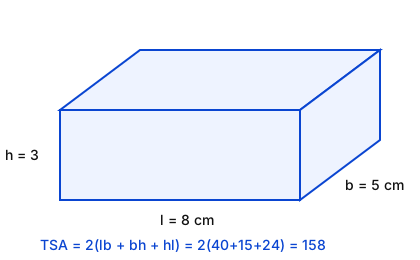
Find the surface area of a cuboid with length 8 cm, breadth 5 cm and height 3 cm.
एक घनाभ का पृष्ठीय क्षेत्रफल ज्ञात कीजिए जिसकी लंबाई 8 cm, चौड़ाई 5 cm और ऊँचाई 3 cm है।
  1. A140 cm²
  2. B94 cm²
  3. C158 cm²
  4. D126 cm²
Show answer

Concept: Total surface area of a cuboid =2(lb+bh+hl).

  1. lb=8×5=40, bh=5×3=15, hl=3×8=24
  2. Sum =40+15+24=79
  3. TSA =2×79=158cm2

Trick: Lateral area =2h(l+b)=78; add top and bottom 2lb=80 ⇒ 158.

Answer: (C) 158cm2

अवधारणा: घनाभ का संपूर्ण पृष्ठीय क्षेत्रफल =2(lb+bh+hl)।

  1. lb=8×5=40, bh=5×3=15, hl=3×8=24
  2. योग =40+15+24=79
  3. संपूर्ण पृष्ठ =2×79=158cm2

ट्रिक: पार्श्व क्षेत्रफल =2h(l+b)=78; ऊपर-नीचे 2lb=80 जोड़ें ⇒ 158।

उत्तर: (C) 158cm2

RRB NTPC Undergraduate CBT 1MathematicsMensuration – CuboidRRB NTPC Undergraduate CBT 1 2024 · 11 Aug Shift 2 →
Q3051.
Priya can do a certain piece of work in 22 days. Priya and Varsha can together do the same work in 11 days, and Priya, Varsha and Nisha can do the same work together in 8 days. In how many days can Priya and Nisha do the same work?
प्रिया किसी कार्य को 22 दिनों में कर सकती है। प्रिया और वर्षा मिलकर उसी कार्य को 11 दिनों में कर सकती हैं, और प्रिया, वर्षा और निशा मिलकर उसी कार्य को 8 दिनों में कर सकती हैं। प्रिया और निशा मिलकर उसी कार्य को कितने दिनों में कर सकती हैं?
  1. A949
  2. B958
  3. C787
  4. D887
Show answer

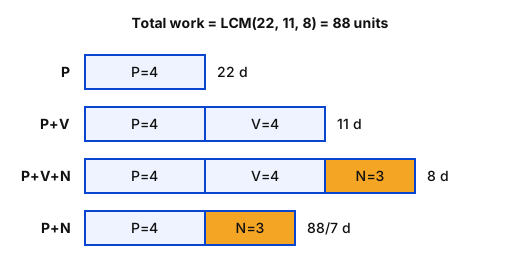
Concept: Take total work = LCM of the given days; then one-day work (efficiency) of each person can be added or subtracted.

  1. Total work =LCM(22,11,8)=88 units.
  2. Priya =8822=4; Priya + Varsha =8811=8, so Varsha =4.
  3. All three =888=11, so Nisha =11−8=3 units/day.
  4. Priya + Nisha =4+3=7 units/day → time =887 days.

Trick: Nisha alone =18−111=388; add Priya 488 → 788, so 887 days.

Answer: (D) 887

अवधारणा: कुल कार्य = दिए गए दिनों का LCM लें; फिर हर व्यक्ति की एक दिन की क्षमता (efficiency) जोड़-घटा सकते हैं।

  1. कुल कार्य =LCM(22,11,8)=88 इकाई।
  2. प्रिया =8822=4; प्रिया + वर्षा =8811=8, अतः वर्षा =4।
  3. तीनों मिलकर =888=11, अतः निशा =11−8=3 इकाई/दिन।
  4. प्रिया + निशा =4+3=7 इकाई/दिन → समय =887 दिन।

ट्रिक: निशा अकेले =18−111=388; प्रिया का 488 जोड़ें → 788, यानी 887 दिन।

उत्तर: (D) 887

RRB NTPC Undergraduate CBT 1MathematicsTime and WorkRRB NTPC Undergraduate CBT 1 2024 · 11 Aug Shift 2 →
Q3052.
Find the value of x satisfying: 5(5x2 − 7) − 5(5x2 + 2x − 4) = 15
x का वह मान ज्ञात कीजिए जो इसे संतुष्ट करता है: 5(5x2 − 7) − 5(5x2 + 2x − 4) = 15
  1. A2
  2. B−1
  3. C−3
  4. D0
Show answer

Concept: Open the brackets; the x2 terms cancel, leaving a linear equation.

  1. 25x2−35−25x2−10x+20=15
  2. −10x−15=15
  3. −10x=30⇒x=−3

Trick: Check options: x=−3 → 5(45−7)−5(45−6−4)=190−175=15 ✓.

Answer: (C) −3

अवधारणा: कोष्ठक खोलें; x2 वाले पद कट जाते हैं और रैखिक समीकरण बचता है।

  1. 25x2−35−25x2−10x+20=15
  2. −10x−15=15
  3. −10x=30⇒x=−3

ट्रिक: विकल्प जाँचें: x=−3 → 5(45−7)−5(45−6−4)=190−175=15 ✓।

उत्तर: (C) −3

RRB NTPC Undergraduate CBT 1MathematicsLinear EquationsRRB NTPC Undergraduate CBT 1 2024 · 11 Aug Shift 2 →
Q3053.
What sum of money (in ₹) will amount to ₹2,280 at 4% per annum simple interest in 5 years?
कितनी धनराशि (₹ में) 4% वार्षिक साधारण ब्याज की दर से 5 वर्षों में ₹2,280 हो जाएगी?
  1. A₹11,400
  2. B₹1,900
  3. C₹1,850
  4. D₹1,950
Show answer

Concept: A=P(1+RT100) for simple interest.

  1. Total interest rate =4×5=20%.
  2. P×1.2=2280
  3. P=22801.2=1900

Trick: Amount =120% of P → 2280120×100=1900.

Answer: (B) ₹1,900

अवधारणा: साधारण ब्याज में मिश्रधन=P(1+RT100)।

  1. कुल ब्याज दर =4×5=20%।
  2. P×1.2=2280
  3. P=22801.2=1900

ट्रिक: मिश्रधन = P का 120% → 2280120×100=1900।

उत्तर: (B) ₹1,900

RRB NTPC Undergraduate CBT 1MathematicsSimple InterestRRB NTPC Undergraduate CBT 1 2024 · 11 Aug Shift 2 →
Q3054.
Which of the following numbers divide 726179?
निम्नलिखित में से कौन-सी संख्या 726179 को विभाजित करती है?
  1. A29
  2. B28
  3. C23
  4. D20
Show answer

Concept: Rule out options by quick tests, then divide.

  1. 726179 is odd → not divisible by 28 or 20.
  2. 726179÷23=31573 exactly (23×31573=726179).
  3. 726179÷29 leaves remainder 9 → not divisible.

Trick: An odd number can never be divisible by an even number – strike 28 and 20 instantly.

Answer: (C) 23

अवधारणा: त्वरित जाँच से विकल्प हटाएँ, फिर भाग दें।

  1. 726179 विषम है → 28 या 20 से विभाज्य नहीं।
  2. 726179÷23=31573 पूर्ण (23×31573=726179)।
  3. 726179÷29 में शेषफल 9 → विभाज्य नहीं।

ट्रिक: विषम संख्या कभी सम संख्या से विभाज्य नहीं होती – 28 और 20 तुरंत हटाएँ।

उत्तर: (C) 23

RRB NTPC Undergraduate CBT 1MathematicsDivisibilityRRB NTPC Undergraduate CBT 1 2024 · 11 Aug Shift 2 →
Q3055.
If the third proportional of 54 and 18 is x, then what is the value of x?
यदि 54 और 18 का तृतीयानुपाती x है, तो x का मान क्या है?
  1. A5
  2. B6
  3. C9
  4. D3
Show answer

Concept: Third proportional of a and b is x=b2a (since a:b=b:x).

  1. 54:18=18:x
  2. x=18254=32454=6

Trick: 54→18 is ÷3; continue: 18÷3=6.

Answer: (B) 6

अवधारणा: a और b का तृतीय अनुपाती x=b2a (क्योंकि a:b=b:x)।

  1. 54:18=18:x
  2. x=18254=32454=6

ट्रिक: 54→18 में ÷3; आगे 18÷3=6।

उत्तर: (B) 6

RRB NTPC Undergraduate CBT 1MathematicsThird ProportionalRRB NTPC Undergraduate CBT 1 2024 · 11 Aug Shift 2 →
Q3056.
The average weight of Vipul, Mohan, and Mohammad is 46 kg. If the average weight of Vipul and Mohan is 36 kg and that of Mohan and Mohammad is 43 kg, then the weight of Mohan (in kg) is:
विपुल, मोहन और मोहम्मद का औसत भार 46 kg है। यदि विपुल और मोहन का औसत भार 36 kg है और मोहन और मोहम्मद का औसत भार 43 kg है, तो मोहन का भार (kg में) है:
  1. A30
  2. B20
  3. C35
  4. D40
Show answer

Concept: Convert averages into totals; the common person is counted twice in the pair sums.

  1. V+Mo+Mm=3×46=138
  2. V+Mo=2×36=72, Mo+Mm=2×43=86
  3. Mo=72+86−138=20 kg

Trick: Common person = (sum of the two pair totals) − (total of all three).

Answer: (B) 20

अवधारणा: औसत को योग में बदलें; जोड़ों के योग में साझा व्यक्ति दो बार गिना जाता है।

  1. V+Mo+Mm=3×46=138
  2. V+Mo=2×36=72, Mo+Mm=2×43=86
  3. मोहन =72+86−138=20 kg

ट्रिक: साझा व्यक्ति = (दोनों जोड़ों का योग) − (तीनों का योग)।

उत्तर: (B) 20

RRB NTPC Undergraduate CBT 1MathematicsAverageRRB NTPC Undergraduate CBT 1 2024 · 11 Aug Shift 2 →
Q3057.
The population of a district is 364000, out of which 178000 are males. 63% of the population is literate. If 63% males are literate, then what percentage of females are literate?
एक जिले की जनसंख्या 364000 है, जिसमें से 178000 पुरुष हैं। 63% जनसंख्या साक्षर है। यदि 63% पुरुष साक्षर हैं, तो कितने प्रतिशत महिलाएँ साक्षर हैं?
  1. A66%
  2. B62%
  3. C63%
  4. D65%
Show answer

Concept: If the overall literacy rate equals the male literacy rate, the female rate must be the same (weighted average).

  1. Literates =63%×364000=229320; literate males =63%×178000=112140.
  2. Females =186000; literate females =229320−112140=117180.
  3. 117180186000×100=63%

Trick: Average of two groups = 63% and one group = 63% → the other group is also 63%.

Answer: (C) 63%

अवधारणा: यदि कुल साक्षरता दर = पुरुष साक्षरता दर, तो महिला दर भी वही होगी (भारित औसत)।

  1. साक्षर =63%×364000=229320; साक्षर पुरुष =63%×178000=112140।
  2. महिलाएँ =186000; साक्षर महिलाएँ =229320−112140=117180।
  3. 117180186000×100=63%

ट्रिक: दो समूहों का औसत 63% और एक समूह 63% → दूसरा भी 63%।

उत्तर: (C) 63%

RRB NTPC Undergraduate CBT 1MathematicsPercentageRRB NTPC Undergraduate CBT 1 2024 · 11 Aug Shift 2 →
Q3058.
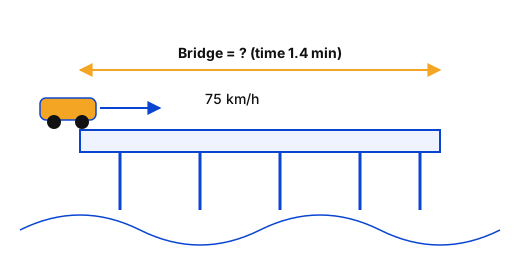
A man driving a car at a speed of 75 km/hr crosses a bridge in 1.4 minutes. Find the length of the bridge.
75 km/hr की चाल से कार चला रहा एक व्यक्ति एक पुल को 1.4 मिनट में पार करता है। पुल की लंबाई ज्ञात कीजिए।
  1. A1.02 km
  2. B1.75 km
  3. C1.18 km
  4. D1.01 km
Show answer

Concept: The car is treated as a point, so distance covered = length of the bridge =speed×time.

  1. Time =1.4 min =1.460 h.
  2. Length =75×1.460=10560=1.75 km

Trick: 75 km/h =1.25 km per minute → 1.25×1.4=1.75 km.

Answer: (B) 1.75 km

अवधारणा: कार को बिंदु मानते हैं, अतः तय दूरी = पुल की लंबाई =चाल×समय।

  1. समय =1.4 मिनट =1.460 घंटा।
  2. लंबाई =75×1.460=10560=1.75 km

ट्रिक: 75 km/h =1.25 km प्रति मिनट → 1.25×1.4=1.75 km।

उत्तर: (B) 1.75 km

RRB NTPC Undergraduate CBT 1MathematicsSpeed, Time and DistanceRRB NTPC Undergraduate CBT 1 2024 · 11 Aug Shift 2 →
Q3059.
If 2 times a mother's present age is 27 years more than 9 times her daughter's present age, and 6 times the daughter's present age is 9 years less than the mother's present age, then what is the difference (in years) between the ages of the mother and the daughter?
यदि एक माँ की वर्तमान आयु का 2 गुना, उसकी बेटी की वर्तमान आयु के 9 गुने से 27 वर्ष अधिक है, और बेटी की वर्तमान आयु का 6 गुना, माँ की वर्तमान आयु से 9 वर्ष कम है, तो माँ और बेटी की आयु में अंतर (वर्षों में) क्या है?
  1. A21
  2. B29
  3. C24
  4. D23
Show answer

Concept: Form two linear equations in mother’s age M and daughter’s age D.

  1. 2M=9D+27 and 6D=M−9⇒M=6D+9.
  2. 2(6D+9)=9D+27⇒12D+18=9D+27⇒D=3
  3. M=6×3+9=27; difference =27−3=24 years.

Trick: Substitute M=6D+9 straight into the first equation – one step to D.

Answer: (C) 24

अवधारणा: माँ की आयु M और बेटी की आयु D में दो रैखिक समीकरण बनाएँ।

  1. 2M=9D+27 तथा 6D=M−9⇒M=6D+9।
  2. 2(6D+9)=9D+27⇒12D+18=9D+27⇒D=3
  3. M=6×3+9=27; अंतर =27−3=24 वर्ष।

ट्रिक: M=6D+9 को सीधे पहले समीकरण में रखें – एक कदम में D मिल जाता है।

उत्तर: (C) 24

RRB NTPC Undergraduate CBT 1MathematicsProblems on AgesRRB NTPC Undergraduate CBT 1 2024 · 11 Aug Shift 2 →
Q3060.
Find the simple interest (in ₹) on ₹4,000 at 6.75% per annum rate of interest deposited on 23 February 2024 and withdrawn on 24 April 2024.
23 फरवरी 2024 को जमा किए गए और 24 अप्रैल 2024 को निकाले गए ₹4,000 पर 6.75% वार्षिक ब्याज दर से साधारण ब्याज (₹ में) ज्ञात कीजिए।
  1. A₹43
  2. B₹44
  3. C₹45
  4. D₹46
Show answer

Concept: Count days excluding the day of deposit and including the day of withdrawal; 2024 is a leap year (366 days).

  1. Days: February 29−23=6, March 31, April 24 → total 61 days.
  2. SI=4000×6.75×61100×366
  3. =270×61366=270×16=45

Trick: 61366=16 exactly – the numbers are chosen for it.

Answer: (C) ₹45

अवधारणा: जमा का दिन छोड़कर और निकासी का दिन जोड़कर दिन गिनें; 2024 लीप वर्ष है (366 दिन)।

  1. दिन: फरवरी 29−23=6, मार्च 31, अप्रैल 24 → कुल 61 दिन।
  2. SI=4000×6.75×61100×366
  3. =270×61366=270×16=45

ट्रिक: 61366=16 ठीक बैठता है।

उत्तर: (C) ₹45

RRB NTPC Undergraduate CBT 1MathematicsSimple InterestRRB NTPC Undergraduate CBT 1 2024 · 11 Aug Shift 2 →