Question bank

Q&A: practice questions with answers

Search questions on any topic. Filter by exam category, exam, subject and topic, try the question, then open the answer and explanation.

Courses – airGurukul

8,500 questions found.

Q3061.
A jacket is marked at ₹8,000. The shopkeeper offers a 30% discount on the marked price. After the discount, a 12% sales tax is added on the discounted price. What is the final price of the jacket?
एक जैकेट का अंकित मूल्य ₹8,000 है। दुकानदार अंकित मूल्य पर 30% की छूट देता है। छूट के बाद, छूट वाले मूल्य पर 12% बिक्री कर जोड़ा जाता है। जैकेट का अंतिम मूल्य क्या है?
  1. A₹6,440
  2. B₹7,248
  3. C₹6,240
  4. D₹6,272
Show answer

Concept: Apply successive percentage changes as multipliers.

  1. After 30% discount: 8000×0.70=5600
  2. Add 12% tax: 5600×1.12=6272

Trick: Net factor 0.7×1.12=0.784 → 8000×0.784=6272.

Answer: (D) ₹6,272

अवधारणा: क्रमागत प्रतिशत परिवर्तनों को गुणक की तरह लगाएँ।

  1. 30% छूट के बाद: 8000×0.70=5600
  2. 12% कर जोड़ें: 5600×1.12=6272

ट्रिक: कुल गुणक 0.7×1.12=0.784 → 8000×0.784=6272।

उत्तर: (D) ₹6,272

RRB NTPC Undergraduate CBT 1MathematicsDiscount and TaxRRB NTPC Undergraduate CBT 1 2024 · 11 Aug Shift 2 →
Q3062.
Find the value of sinA−2sin3A2cos3A−cosA+csc2A−1.
sinA−2sin3A2cos3A−cosA+csc2A−1 का मान ज्ञात कीजिए।
  1. AsecAcscA
  2. Bcsc2A
  3. Csec2A
  4. DsecA
Show answer

Concept: 1−2sin2A=cos2A=2cos2A−1 and csc2A−1=cotA.

  1. sinA(1−2sin2A)cosA(2cos2A−1)=sinAcos2AcosAcos2A=tanA
  2. csc2A−1=cotA
  3. tanA+cotA=sin2A+cos2AsinAcosA=secAcscA

Trick: Put A=45∘: first part undefined, so try A=30∘: 13+3=43 = sec30∘csc30∘=23×2 ✓.

Answer: (A) secAcscA

अवधारणा: 1−2sin2A=cos2A=2cos2A−1 तथा csc2A−1=cotA।

  1. sinA(1−2sin2A)cosA(2cos2A−1)=sinAcos2AcosAcos2A=tanA
  2. csc2A−1=cotA
  3. tanA+cotA=sin2A+cos2AsinAcosA=secAcscA

ट्रिक: A=30∘ रखें: 13+3=43 = sec30∘csc30∘=23×2 ✓।

उत्तर: (A) secAcscA

RRB NTPC Undergraduate CBT 1MathematicsTrigonometric IdentitiesRRB NTPC Undergraduate CBT 1 2024 · 11 Aug Shift 2 →
Q3063.
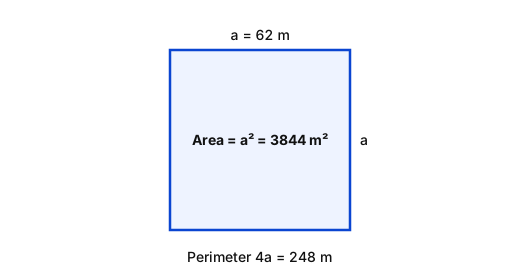
The perimeter of a square is 248 m. Its area (in m2) is:
एक वर्ग का परिमाप 248 m है। इसका क्षेत्रफल (m2 में) है:
  1. A3848
  2. B3816
  3. C3840
  4. D3844
Show answer

Concept: Square: perimeter =4a, area =a2.

  1. a=2484=62 m
  2. Area =622=3844 m2

Trick: 622=602+2×60×2+22=3600+240+4=3844; a square of a number ending in 2 must end in 4.

Answer: (D) 3844

अवधारणा: वर्ग: परिमाप =4a, क्षेत्रफल =a2।

  1. a=2484=62 m
  2. क्षेत्रफल =622=3844 m2

ट्रिक: 622=602+2×60×2+4=3844।

उत्तर: (D) 3844

RRB NTPC Undergraduate CBT 1MathematicsMensuration – SquareRRB NTPC Undergraduate CBT 1 2024 · 11 Aug Shift 2 →
Q3064.
Manoj, Swati and Rahul invested ₹1,020, ₹1,440 and ₹1,230, respectively to start a business. If the profit at the end of the year is ₹1,260, what is Rahul's share of the profit?
मनोज, स्वाति और राहुल ने एक व्यवसाय शुरू करने के लिए क्रमशः ₹1,020, ₹1,440 और ₹1,230 का निवेश किया। यदि वर्ष के अंत में लाभ ₹1,260 है, तो लाभ में राहुल का हिस्सा कितना है?
  1. A₹420
  2. B₹423
  3. C₹421
  4. D₹422
Show answer

Concept: For equal time, profit is shared in the ratio of investments.

  1. 1020:1440:1230=102:144:123, sum =369.
  2. Rahul’s share =1260×123369=1260×13=420

Trick: 1230 is exactly one-third of the total 3690 → share =12603.

Answer: (A) ₹420

अवधारणा: समान समय के लिए लाभ निवेश के अनुपात में बँटता है।

  1. 1020:1440:1230=102:144:123, योग =369।
  2. राहुल का हिस्सा =1260×123369=1260×13=420

ट्रिक: 1230 कुल 3690 का ठीक एक-तिहाई है → हिस्सा =12603।

उत्तर: (A) ₹420

RRB NTPC Undergraduate CBT 1MathematicsPartnershipRRB NTPC Undergraduate CBT 1 2024 · 11 Aug Shift 2 →
Q3065.
The average weight (in kg) of a family of five members whose weights are 40 kg, 49 kg, 56 kg, 73 kg and 39 kg is:
पाँच सदस्यों वाले एक परिवार, जिनके भार 40 kg, 49 kg, 56 kg, 73 kg और 39 kg हैं, का औसत भार (kg में) है:
  1. A51.4
  2. B53.4
  3. C52.4
  4. D50.4
Show answer

Concept: Average =sumcount.

  1. Sum =40+49+56+73+39=257
  2. Average =2575=51.4 kg

Trick: Deviations from 50: −10,−1,+6,+23,−11 → total +7 → 50+75=51.4.

Answer: (A) 51.4

अवधारणा: औसत=योगसंख्या।

  1. योग =40+49+56+73+39=257
  2. औसत =2575=51.4 kg

ट्रिक: 50 से विचलन: −10,−1,+6,+23,−11 → कुल +7 → 50+75=51.4।

उत्तर: (A) 51.4

RRB NTPC Undergraduate CBT 1MathematicsAverageRRB NTPC Undergraduate CBT 1 2024 · 11 Aug Shift 2 →
Q3066.
A number when increased by 100% gives 2700. The number is:
एक संख्या में 100% की वृद्धि करने पर 2700 प्राप्त होता है। वह संख्या है:
  1. A1350
  2. B2700
  3. C4050
  4. D675
Show answer

Concept: Increasing by 100% means the number becomes double.

  1. x×200100=2700
  2. x=27002=1350

Trick: +100% = ×2, so just halve the result.

Answer: (A) 1350

अवधारणा: 100% बढ़ाने का अर्थ है संख्या दोगुनी हो जाना।

  1. x×200100=2700
  2. x=27002=1350

ट्रिक: +100% = ×2, अतः परिणाम का आधा करें।

उत्तर: (A) 1350

RRB NTPC Undergraduate CBT 1MathematicsPercentageRRB NTPC Undergraduate CBT 1 2024 · 11 Aug Shift 2 →
Q3067.
The selling price of 50 books is equal to the cost price of 5 books. Find the loss or gain percentage.
50 पुस्तकों का विक्रय मूल्य 5 पुस्तकों के क्रय मूल्य के बराबर है। हानि या लाभ प्रतिशत ज्ञात कीजिए।
  1. A90% loss90% हानि
  2. B90% gain90% लाभ
  3. C10045% loss10045% हानि
  4. D10045% gain10045% लाभ
Show answer

Concept: If SP of x articles = CP of y articles, then loss%=x−yx×100 (when x>y).

  1. SP of 50 = CP of 5; let CP of 1 book = ₹1 → CP of 50 = ₹50, SP of 50 = ₹5.
  2. Loss =50−5=45 → loss%=4550×100=90%

Trick: 50−550×100=90%; SP is smaller than CP, so it is a loss.

Answer: (A) 90% loss

अवधारणा: यदि x वस्तुओं का SP = y वस्तुओं का CP, तो हानि%=x−yx×100 (जब x>y)।

  1. 50 का SP = 5 का CP; 1 पुस्तक का CP = ₹1 मानें → 50 का CP = ₹50, 50 का SP = ₹5।
  2. हानि =50−5=45 → हानि%=4550×100=90%

ट्रिक: 50−550×100=90%; SP, CP से कम है, अतः हानि।

उत्तर: (A) 90% हानि (loss)

RRB NTPC Undergraduate CBT 1MathematicsProfit and LossRRB NTPC Undergraduate CBT 1 2024 · 11 Aug Shift 2 →
Q3068.
Which of the following numbers divides 15,99,16,901?
निम्नलिखित में से कौन-सी संख्या 15,99,16,901 को विभाजित करती है?
  1. A25
  2. B19
  3. C28
  4. D18
Show answer

Concept: Eliminate using quick rules, then check the remaining divisor.

  1. Ends in 1 → not divisible by 25; odd → not by 28 or 18.
  2. 159916901÷19=8416679 exactly (19×8416679=159916901).

Trick: Odd number → all even divisors out; 25 needs the last two digits 00, 25, 50 or 75. Only 19 remains.

Answer: (B) 19

अवधारणा: त्वरित नियमों से विकल्प हटाएँ, फिर बचे भाजक की जाँच करें।

  1. अंत में 1 → 25 से विभाज्य नहीं; विषम → 28 या 18 से नहीं।
  2. 159916901÷19=8416679 पूर्ण (19×8416679=159916901)।

ट्रिक: विषम संख्या → सभी सम भाजक बाहर; 25 के लिए अंतिम दो अंक 00, 25, 50 या 75 चाहिए। केवल 19 बचता है।

उत्तर: (B) 19

RRB NTPC Undergraduate CBT 1MathematicsDivisibilityRRB NTPC Undergraduate CBT 1 2024 · 11 Aug Shift 2 →
Q3069.
M and N start a business. M invests ₹70,000 more than N for 3 months and N invests for 5 months. M's share is ₹288 more than that of N, out of a total profit of ₹4,896. Find the capital contributed by M.
M और N एक व्यवसाय शुरू करते हैं। M, N से ₹70,000 अधिक 3 महीने के लिए निवेश करता है और N, 5 महीने के लिए निवेश करता है। ₹4,896 के कुल लाभ में से M का हिस्सा N के हिस्से से ₹288 अधिक है। M द्वारा लगाई गई पूँजी ज्ञात कीजिए।
  1. A₹1,50,000
  2. B₹1,40,000
  3. C₹1,80,000
  4. D₹1,60,000
Show answer

Concept: Profit ratio = (capital × time) ratio.

  1. M+N=4896, M−N=288 → M’s share =2592, N’s share =2304; ratio =9:8.
  2. Let N’s capital =x: 3(x+70000)5x=98
  3. 24x+1680000=45x⇒x=80000
  4. M’s capital =80000+70000=150000

Trick: Check option (A): 3×150000:5×80000=450000:400000=9:8 ✓.

Answer: (A) ₹1,50,000

अवधारणा: लाभ का अनुपात = (पूँजी × समय) का अनुपात।

  1. M+N=4896, M−N=288 → M का हिस्सा =2592, N का =2304; अनुपात =9:8।
  2. N की पूँजी =x: 3(x+70000)5x=98
  3. 24x+1680000=45x⇒x=80000
  4. M की पूँजी =80000+70000=150000

ट्रिक: विकल्प (A) जाँचें: 3×150000:5×80000=450000:400000=9:8 ✓।

उत्तर: (A) ₹1,50,000

RRB NTPC Undergraduate CBT 1MathematicsPartnershipRRB NTPC Undergraduate CBT 1 2024 · 11 Aug Shift 2 →
Q3070.
The LCM of 33 × 82 × 14, 32 × 142 × 19 and 83 × 142 × 192 is:
33 × 82 × 14, 32 × 142 × 19 और 83 × 142 × 192 का LCM (लघुत्तम समापवर्त्य) है:
  1. A33 × 82 × 142 × 19
  2. B32 × 82 × 142 × 193
  3. C32 × 83 × 14 × 192
  4. D33 × 83 × 142 × 192
Show answer

Concept: LCM takes the highest power of each factor appearing in the numbers.

  1. Highest power of 3: 33; of 8: 83.
  2. Highest power of 14: 142; of 19: 192.
  3. LCM =33×83×142×192 (in primes 211×33×72×192 – the same value).

Trick: LCM = highest powers, HCF = lowest powers – only option D has every highest power.

Answer: (D) 33×83×142×192

अवधारणा: LCM में प्रत्येक गुणनखंड की सबसे बड़ी घात ली जाती है।

  1. 3 की अधिकतम घात: 33; 8 की: 83।
  2. 14 की अधिकतम घात: 142; 19 की: 192।
  3. LCM =33×83×142×192 (अभाज्य रूप 211×33×72×192 – मान वही)।

याद रखें: LCM = अधिकतम घातें, HCF = न्यूनतम घातें – केवल विकल्प D में सभी अधिकतम घातें हैं।

उत्तर: (D) 33×83×142×192

RRB NTPC Undergraduate CBT 1MathematicsLCMRRB NTPC Undergraduate CBT 1 2024 · 11 Aug Shift 2 →
Q3071.
Based on the English alphabetical order, three of the following four letter-cluster pairs are alike in a certain way and thus form a group. Which letter-cluster pair DOES NOT belong to that group?
(Note: The odd one out is not based on the number of consonants/vowels or their position in the letter-cluster.)
अंग्रेज़ी वर्णमाला क्रम के आधार पर, निम्नलिखित चार अक्षर-समूह युग्मों में से तीन किसी निश्चित प्रकार से एकसमान हैं और इस प्रकार एक समूह बनाते हैं। कौन-सा अक्षर-समूह युग्म उस समूह से संबंधित नहीं है?
(ध्यान दें: असंगत अक्षर-समूह, उस अक्षर-समूह में व्यंजनों/स्वरों की संख्या या उनके स्थान पर आधारित नहीं है।)
  1. AUQ-VR
  2. BQM-RO
  3. CSO-TQ
  4. DWS-XU
Show answer

Concept: Compare each letter of the first cluster with the matching letter of the second cluster.

  1. QM-RO: Q+1=R, M+2=O. SO-TQ: S+1=T, O+2=Q. WS-XU: W+1=X, S+2=U.
  2. UQ-VR: U+1=V but Q+1=R (not +2).

Trick: In the three alike pairs the first letters differ by 4 in cluster 1 and by 3 in cluster 2; in UQ-VR both differ by 4.

Answer: (A) UQ-VR

अवधारणा: पहले समूह के प्रत्येक अक्षर की तुलना दूसरे समूह के संगत अक्षर से करें।

  1. QM-RO: Q+1=R, M+2=O। SO-TQ: S+1=T, O+2=Q। WS-XU: W+1=X, S+2=U।
  2. UQ-VR: U+1=V परंतु Q+1=R (+2 नहीं)।

ट्रिक: समान युग्मों में पहले समूह के अक्षरों में अंतर 4 और दूसरे में 3 है; UQ-VR में दोनों में 4।

उत्तर: (A) UQ-VR

RRB NTPC Undergraduate CBT 1General Intelligence and ReasoningOdd One Out – Letter PairsRRB NTPC Undergraduate CBT 1 2024 · 11 Aug Shift 2 →
Q3072.
Read the given statements and conclusions carefully. Assuming that the information given in the statements is true, even if it appears to be at variance with commonly known facts, decide which of the given conclusions logically follow(s) from the statements.
Statements:
Some marks are tattoo.
No tattoo is a painting.
Conclusions:
(I): Some marks are painting.
(II): Some tattoo are mark.
दिए गए कथनों और निष्कर्षों को ध्यानपूर्वक पढ़िए। यह मानते हुए कि कथनों में दी गई जानकारी सत्य है, भले ही वह सामान्य रूप से ज्ञात तथ्यों से भिन्न प्रतीत होती हो, निर्णय कीजिए कि दिए गए निष्कर्षों में से कौन-सा/कौन-से निष्कर्ष तार्किक रूप से कथनों का अनुसरण करता है/करते हैं।
कथन:
कुछ निशान, टैटू हैं।
कोई टैटू, पेंटिंग नहीं है।
निष्कर्ष:
(I): कुछ निशान, पेंटिंग हैं।
(II): कुछ टैटू, निशान हैं।
  1. ANeither conclusion (I) nor (II) follows.न तो निष्कर्ष (I) और न ही (II) अनुसरण करता है।
  2. BBoth conclusions (I) and (II) follow.निष्कर्ष (I) और (II) दोनों अनुसरण करते हैं।
  3. COnly conclusion (I) follows.केवल निष्कर्ष (I) अनुसरण करता है।
  4. DOnly conclusion (II) follows.केवल निष्कर्ष (II) अनुसरण करता है।
Show answer

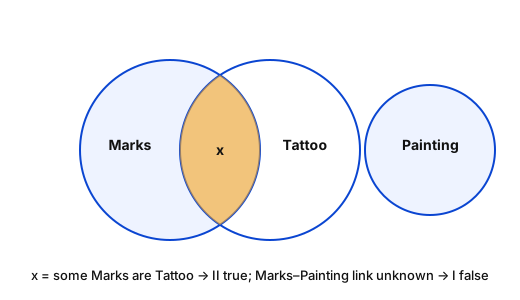
Concept: Draw the least-overlap Venn diagram; a conclusion follows only if it is true in every possible diagram.

  1. I: Marks touch Painting only through possibility – no definite link, so “Some marks are painting” does not follow.
  2. II: “Some marks are tattoo” converts to “Some tattoo are mark” – follows.

Yaad rakhein: “Some A are B” always gives “Some B are A”.

Answer: (D) Only conclusion (II) follows.

अवधारणा: न्यूनतम ओवरलैप वाला वेन आरेख बनाएँ; निष्कर्ष तभी सही है जब हर संभव आरेख में सत्य हो।

  1. I: Marks और Painting के बीच कोई निश्चित संबंध नहीं, अतः “कुछ marks, painting हैं” नहीं निकलता।
  2. II: “कुछ marks, tattoo हैं” का रूपांतरण “कुछ tattoo, mark हैं” – निकलता है।

याद रखें: “कुछ A, B हैं” से हमेशा “कुछ B, A हैं” मिलता है।

उत्तर: (D) केवल निष्कर्ष (II) निकलता है।

RRB NTPC Undergraduate CBT 1General Intelligence and ReasoningSyllogismRRB NTPC Undergraduate CBT 1 2024 · 11 Aug Shift 2 →
Q3073.
In a certain code language, ‘DRUM’ is coded as ‘2194’ and ‘CURD’ is coded as ‘4592’. What is the code for ‘C’ in the given code language?
एक निश्चित कूट भाषा में, ‘DRUM’ को ‘2194’ के रूप में कूटबद्ध किया जाता है और ‘CURD’ को ‘4592’ के रूप में कूटबद्ध किया जाता है। उस कूट भाषा में ‘C’ के लिए कूट क्या है?
  1. A2
  2. B5
  3. C9
  4. D4
Show answer

Concept: Common letters in two words get the common digits.

  1. DRUM = 2194, CURD = 4592.
  2. Common letters D, R, U ↔ common digits 2, 9, 4.
  3. Left: M (DRUM) = 1 and C (CURD) = 5.

Trick: Strike out the shared letters and shared digits – the leftover pair gives the answer.

Answer: (B) 5

अवधारणा: दो शब्दों के उभयनिष्ठ अक्षरों को उभयनिष्ठ अंक मिलते हैं।

  1. DRUM = 2194, CURD = 4592।
  2. उभयनिष्ठ अक्षर D, R, U ↔ उभयनिष्ठ अंक 2, 9, 4।
  3. शेष: M (DRUM) = 1 और C (CURD) = 5।

ट्रिक: साझा अक्षर और साझा अंक काट दें – बचा हुआ जोड़ा उत्तर देता है।

उत्तर: (B) 5

RRB NTPC Undergraduate CBT 1General Intelligence and ReasoningCoding-DecodingRRB NTPC Undergraduate CBT 1 2024 · 11 Aug Shift 2 →
Q3074.
What should come in place of the question mark (?) in the given series?
316 288 262 238 216 ?
दी गई श्रृंखला में प्रश्न चिह्न (?) के स्थान पर क्या आना चाहिए?
316 288 262 238 216 ?
  1. A185
  2. B205
  3. C196
  4. D172
Show answer

Concept: Check the differences between consecutive terms.

  1. 316−28=288, 288−26=262, 262−24=238, 238−22=216
  2. Next difference 20: 216−20=196

Trick: Subtractions decrease by 2 each time: 28, 26, 24, 22, 20.

Answer: (C) 196

अवधारणा: क्रमागत पदों का अंतर देखें।

  1. 316−28=288, 288−26=262, 262−24=238, 238−22=216
  2. अगला अंतर 20: 216−20=196

ट्रिक: घटाई जाने वाली संख्या हर बार 2 कम: 28, 26, 24, 22, 20।

उत्तर: (C) 196

RRB NTPC Undergraduate CBT 1General Intelligence and ReasoningNumber SeriesRRB NTPC Undergraduate CBT 1 2024 · 11 Aug Shift 2 →
Q3075.
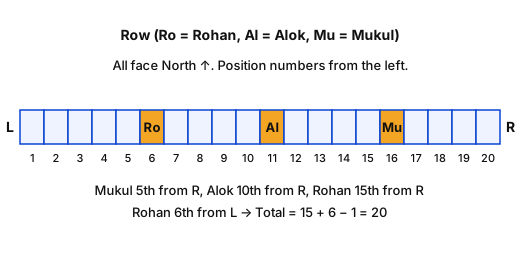
In a row of people all facing north, Mukul is 5th from the right end. Alok is 10th from the right end. Alok is exactly between Mukul and Rohan. If Rohan is 6th from the left end of the line, how many people are there in the row?
उत्तर की ओर मुख करके खड़े लोगों की एक पंक्ति में, मुकुल दाएँ छोर से 5वें स्थान पर है। आलोक दाएँ छोर से 10वें स्थान पर है। आलोक, मुकुल और रोहन के ठीक बीच में है। यदि रोहन पंक्ति के बाएँ छोर से 6ठे स्थान पर है, तो पंक्ति में कितने लोग हैं?
  1. A20
  2. B23
  3. C26
  4. D24
Show answer

Concept: Total = (position from right) + (position from left) −1 for the same person.

  1. Mukul 5th, Alok 10th from right; Alok is exactly in the middle → Rohan is 10+5=15th from right.
  2. Rohan is 6th from left.
  3. Total =15+6−1=20

Trick: The gap Mukul→Alok (5 places) repeats Alok→Rohan.

Answer: (A) 20

अवधारणा: एक ही व्यक्ति के लिए कुल = (दाएँ से स्थान) + (बाएँ से स्थान) −1।

  1. मुकुल दाएँ से 5वाँ, आलोक 10वाँ; आलोक ठीक बीच में → रोहन दाएँ से 10+5=15वाँ।
  2. रोहन बाएँ से 6वाँ।
  3. कुल =15+6−1=20

ट्रिक: मुकुल→आलोक का अंतर (5 स्थान) आलोक→रोहन में दोहराएँ।

उत्तर: (A) 20

RRB NTPC Undergraduate CBT 1General Intelligence and ReasoningRanking and OrderRRB NTPC Undergraduate CBT 1 2024 · 11 Aug Shift 2 →
Q3076.
What should come in place of the question mark (?) in the given series?
7 10 16 28 52 ?
दी गई श्रृंखला में प्रश्न चिह्न (?) के स्थान पर क्या आना चाहिए?
7 10 16 28 52 ?
  1. A99
  2. B104
  3. C100
  4. D102
Show answer

Concept: Differences form a doubling pattern.

  1. Differences: 3, 6, 12, 24 (each ×2).
  2. Next difference =48 → 52+48=100

Trick: Each term =2×previous−4: 2×52−4=100.

Answer: (C) 100

अवधारणा: अंतर दोगुने होते जाते हैं।

  1. अंतर: 3, 6, 12, 24 (हर बार ×2)।
  2. अगला अंतर =48 → 52+48=100

ट्रिक: हर पद =2×पिछला−4: 2×52−4=100।

उत्तर: (C) 100

RRB NTPC Undergraduate CBT 1General Intelligence and ReasoningNumber SeriesRRB NTPC Undergraduate CBT 1 2024 · 11 Aug Shift 2 →
Q3077.
In a certain code language, ‘TALK’ is coded as ‘5327’ and ‘LINE’ is coded as ‘6143’. What is the code for ‘L’ in the given code language?
एक निश्चित कूट भाषा में, ‘TALK’ को ‘5327’ के रूप में कूटबद्ध किया जाता है और ‘LINE’ को ‘6143’ के रूप में कूटबद्ध किया जाता है। उस कूट भाषा में ‘L’ के लिए कूट क्या है?
  1. A2
  2. B6
  3. C4
  4. D3
Show answer

Concept: The only letter common to both words takes the only digit common to both codes.

  1. TALK = 5327, LINE = 6143.
  2. Common letter: L. Common digit: 3.
  3. So L = 3.

Trick: One common letter ↔ one common digit – no need to decode the rest.

Answer: (D) 3

अवधारणा: दोनों शब्दों में एकमात्र उभयनिष्ठ अक्षर को दोनों कोडों का एकमात्र उभयनिष्ठ अंक मिलता है।

  1. TALK = 5327, LINE = 6143।
  2. उभयनिष्ठ अक्षर: L। उभयनिष्ठ अंक: 3।
  3. अतः L = 3।

ट्रिक: एक साझा अक्षर ↔ एक साझा अंक – बाकी डिकोड करने की आवश्यकता नहीं।

उत्तर: (D) 3

RRB NTPC Undergraduate CBT 1General Intelligence and ReasoningCoding-DecodingRRB NTPC Undergraduate CBT 1 2024 · 11 Aug Shift 2 →
Q3078.
If ‘P’ stands for ‘×’, ‘Q’ stands for ‘÷’, ‘R’ stands for ‘−’ and ‘S’ stands for ‘+’, then what will come in place of the question mark (?) in the following equation?
(63 P 2) R (24 P 3) S (98 Q 2) R (48 Q 3) R 3 = ?
यदि ‘P’ का अर्थ ‘×’, ‘Q’ का अर्थ ‘÷’, ‘R’ का अर्थ ‘−’ और ‘S’ का अर्थ ‘+’ है, तो निम्नलिखित समीकरण में प्रश्न चिह्न (?) के स्थान पर क्या आएगा?
(63 P 2) R (24 P 3) S (98 Q 2) R (48 Q 3) R 3 = ?
  1. A98
  2. B84
  3. C122
  4. D104
Show answer

Concept: Replace the letters by signs, then follow BODMAS.

  1. (63×2)−(24×3)+(98÷2)−(48÷3)−3
  2. =126−72+49−16−3
  3. =84

Trick: Brackets first: 126, 72, 49, 16 – then add/subtract left to right.

Answer: (B) 84

अवधारणा: अक्षरों के स्थान पर चिह्न रखें, फिर BODMAS लगाएँ।

  1. (63×2)−(24×3)+(98÷2)−(48÷3)−3
  2. =126−72+49−16−3
  3. =84

ट्रिक: पहले कोष्ठक: 126, 72, 49, 16 – फिर बाएँ से दाएँ जोड़-घटाव।

उत्तर: (B) 84

RRB NTPC Undergraduate CBT 1General Intelligence and ReasoningMathematical OperationsRRB NTPC Undergraduate CBT 1 2024 · 11 Aug Shift 2 →
Q3079.
In the following triads, each group of letters is related to the subsequent one following a certain logic. Select from the given options, the one which follows the same logic. SAIN - ANIS - NIAS
COIN - ONIC - NIOC
निम्नलिखित त्रिकों में, अक्षरों का प्रत्येक समूह एक निश्चित तर्क के आधार पर अगले समूह से संबंधित है। दिए गए विकल्पों में से उस विकल्प का चयन कीजिए जो समान तर्क का अनुसरण करता है। SAIN - ANIS - NIAS
COIN - ONIC - NIOC
  1. AYOUR - YUOR - RUOY
  2. BMACE - AMCE - EACM
  3. CMILE - IELM - ELIM
  4. DFEAT - EFAT - TEAF
Show answer

Concept: Find the position rule from 1st to 2nd cluster and from 1st to 3rd cluster.

  1. SAIN → ANIS: letters in order 2, 4, 3, 1 (A N I S). COIN → ONIC: same.
  2. 3rd cluster = 1st written in reverse: SAIN → NIAS, COIN → NIOC.
  3. MILE → (2,4,3,1) IELM; reverse → ELIM. Matches option C.

Trick: First check the easy rule (3rd = reverse of 1st): only MILE-ELIM and YOUR-RUOY pass; then the middle term decides.

Answer: (C) MILE - IELM - ELIM

अवधारणा: पहले से दूसरे और पहले से तीसरे समूह तक स्थान का नियम खोजें।

  1. SAIN → ANIS: अक्षर क्रम 2, 4, 3, 1 (A N I S)। COIN → ONIC: वही।
  2. तीसरा समूह = पहले का उल्टा: SAIN → NIAS, COIN → NIOC।
  3. MILE → (2,4,3,1) IELM; उल्टा → ELIM। विकल्प C से मेल।

ट्रिक: पहले आसान नियम (तीसरा = पहले का उल्टा) जाँचें: केवल MILE-ELIM और YOUR-RUOY बचते हैं; फिर बीच का पद निर्णय करता है।

उत्तर: (C) MILE - IELM - ELIM

RRB NTPC Undergraduate CBT 1General Intelligence and ReasoningLetter Analogy (Triads)RRB NTPC Undergraduate CBT 1 2024 · 11 Aug Shift 2 →
Q3080.
Refer to the following number, symbol series and answer the question. Counting to be done from left to right only.
(Left) 9 8 6 1 & & 2 ^ ^ $ $ > 5 ^ 6 ^ 4 & # 6 @ (Right)
How many such symbols are there each of which is immediately preceded by a number and also immediately followed by another symbol?
निम्नलिखित संख्या, प्रतीक श्रृंखला को देखिए और प्रश्न का उत्तर दीजिए। गिनती केवल बाएँ से दाएँ की जानी है।
(बाएँ) 9 8 6 1 & & 2 ^ ^ $ $ > 5 ^ 6 ^ 4 & # 6 @ (दाएँ)
ऐसे कितने प्रतीक हैं जिनमें से प्रत्येक के ठीक पहले एक संख्या है और ठीक बाद एक अन्य प्रतीक भी है?
  1. ATwoदो
  2. BOneएक
  3. CFourचार
  4. DThreeतीन
Show answer

Concept: Look for the pattern Number – Symbol – Symbol and count the middle symbols.

  1. 1 & & → ✓
  2. 2 ^ ^ → ✓
  3. 4 & # → ✓
  4. 5 ^ 6, 6 ^ 4 → followed by a number ✗; 6 @ → nothing after ✗.

Trick: Scan only the numbers and look at the next two positions – faster than checking every symbol.

Answer: (D) Three

अवधारणा: संख्या – प्रतीक – प्रतीक का पैटर्न खोजें और बीच के प्रतीक गिनें।

  1. 1 & & → ✓
  2. 2 ^ ^ → ✓
  3. 4 & # → ✓
  4. 5 ^ 6, 6 ^ 4 → बाद में संख्या ✗; 6 @ → बाद में कुछ नहीं ✗।

ट्रिक: केवल संख्याओं को देखें और उनके अगले दो स्थान जाँचें – हर प्रतीक जाँचने से तेज़।

उत्तर: (D) तीन (Three)

RRB NTPC Undergraduate CBT 1General Intelligence and ReasoningNumber-Symbol SeriesRRB NTPC Undergraduate CBT 1 2024 · 11 Aug Shift 2 →