Question bank

Q&A: practice questions with answers

Search questions on any topic. Filter by exam category, exam, subject and topic, try the question, then open the answer and explanation.

Courses – airGurukul

8,500 questions found.

Q3161.
The marked price of a shirt is ₹800 and it is sold at a discount of 25%. Find the selling price of the shirt.
एक कमीज़ का अंकित मूल्य ₹800 है और इसे 25% की छूट पर बेचा जाता है। कमीज़ का विक्रय मूल्य ज्ञात कीजिए।
  1. A₹680
  2. B₹600
  3. C₹640
  4. D₹620
Show answer

Concept: Selling price =MP×100−d100.

  1. Discount =25% of 800=200.
  2. SP =800−200=600.

Trick: 25% off means pay 34: 34×800=600.

Answer: (B) ₹600

अवधारणा: विक्रय मूल्य =अंकित मूल्य×100−d100।

  1. छूट =800 का 25%=200।
  2. विक्रय मूल्य =800−200=600।

ट्रिक: 25% छूट यानी 34 देना: 34×800=600।

उत्तर: (B) ₹600

RRB NTPC Undergraduate CBT 1MathematicsDiscountRRB NTPC Undergraduate CBT 1 2024 · 11 Aug Shift 1 →
Q3162.
A can do a work in 13 days and B can do the same work in 24 days. If they work together for 5 days, what fraction of the work will be left?
A किसी कार्य को 13 दिनों में और B उसी कार्य को 24 दिनों में कर सकता है। यदि वे 5 दिनों तक एक साथ कार्य करते हैं, तो कार्य का कितना भाग शेष रहेगा?
  1. A133312
  2. B129312
  3. C127312
  4. D137312
Show answer

Concept: One day's work =1days; work done together = sum of rates × days.

  1. A+B per day =113+124=24+13312=37312.
  2. In 5 days: 185312.
  3. Remaining =1−185312=127312.

Trick: LCM 13×24=312 units: A does 24, B does 13 per day → 5×37=185, left 127.

Answer: (C) 127312

अवधारणा: एक दिन का कार्य =1दिन; साथ में कार्य = दरों का योग × दिन।

  1. A+B प्रति दिन =113+124=37312।
  2. 5 दिन में: 185312।
  3. शेष =1−185312=127312।

ट्रिक: कुल कार्य 312 इकाई: प्रतिदिन 37, 5 दिन में 185, शेष 127।

उत्तर: (C) 127312

RRB NTPC Undergraduate CBT 1MathematicsTime and workRRB NTPC Undergraduate CBT 1 2024 · 11 Aug Shift 1 →
Q3163.
A wholesaler offers a trade discount of 20% on an item worth ₹10,000. On the discounted price, a scheme discount of 10% is given. However, if the customer pays in cash, an additional discount of 5% is given on the final price after both discounts. How much will the customer have to pay as the final price?
एक थोक विक्रेता ₹10,000 मूल्य की एक वस्तु पर 20% की व्यापारिक छूट देता है। छूट वाले मूल्य पर 10% की योजना छूट दी जाती है। हालाँकि, यदि ग्राहक नकद भुगतान करता है, तो दोनों छूटों के बाद के अंतिम मूल्य पर 5% की अतिरिक्त छूट दी जाती है। ग्राहक को अंतिम मूल्य के रूप में कितना भुगतान करना होगा?
  1. A₹6,800
  2. B₹7,000
  3. C₹6,940
  4. D₹6,840
Show answer

Concept: Successive discounts are multiplied: price ×(1−d1)(1−d2)(1−d3).

  1. After 20%: 10000×0.8=8000.
  2. After 10%: 8000×0.9=7200.
  3. After 5%: 7200×0.95=6840.

Trick: Never add discounts (35% would give ₹6500, a trap).

Answer: (D) ₹6,840

अवधारणा: क्रमिक छूटें गुणा होती हैं: मूल्य ×(1−d1)(1−d2)(1−d3)।

  1. 20% के बाद: 8000।
  2. 10% के बाद: 7200।
  3. 5% के बाद: 7200×0.95=6840।

ट्रिक: छूटों को सीधे न जोड़ें।

उत्तर: (D) ₹6,840

RRB NTPC Undergraduate CBT 1MathematicsSuccessive discountsRRB NTPC Undergraduate CBT 1 2024 · 11 Aug Shift 1 →
Q3164.
A district has 359000 people, of whom 179000 are males. If 22% of the total
population is literate and 22% of the males are literate, what is the literacy rate (in percent) of the females?
एक ज़िले की जनसंख्या 359000 है, जिसमें से 179000 पुरुष हैं। यदि कुल
जनसंख्या का 22% साक्षर है और 22% पुरुष साक्षर हैं, तो महिलाओं की साक्षरता दर (प्रतिशत में) कितनी है?
  1. A19%
  2. B24%
  3. C22%
  4. D20%
Show answer

Concept: Literates among women = total literates − literate men.

  1. Total literates =22% of 359000=78980.
  2. Literate men =22% of 179000=39380.
  3. Women =180000; literate women =39600; rate =39600180000×100=22%.

Trick: If the whole and one part both have 22%, the other part must also be 22%.

Answer: (C) 22%

अवधारणा: साक्षर महिलाएँ = कुल साक्षर − साक्षर पुरुष।

  1. कुल साक्षर =359000 का 22%=78980।
  2. साक्षर पुरुष =179000 का 22%=39380।
  3. महिलाएँ =180000; साक्षर महिलाएँ =39600; दर =22%।

ट्रिक: कुल और एक भाग दोनों 22% हों तो दूसरा भाग भी 22%।

उत्तर: (C) 22%

RRB NTPC Undergraduate CBT 1MathematicsPercentage (literacy)RRB NTPC Undergraduate CBT 1 2024 · 11 Aug Shift 1 →
Q3165.
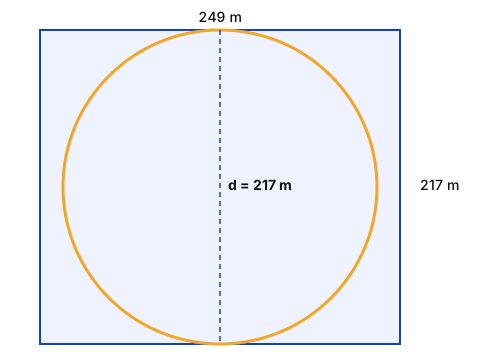
Find the circumference (in m) of the largest circle that can be drawn inside a rectangle of dimensions 249 m and 217 m.
(π=227)
249 m और 217 m विमाओं वाले एक आयत के अंदर खींचे जा सकने वाले सबसे बड़े वृत्त की परिधि (m में) ज्ञात कीजिए।
(π=227)
  1. A679
  2. B676
  3. C682
  4. D690
Show answer

Concept: The largest circle inside a rectangle has diameter = the shorter side.

  1. Diameter =217m.
  2. Circumference =πd=227×217=22×31=682m.

Trick: 217=7×31, so 227 cancels neatly.

Answer: (C) 682

अवधारणा: आयत के अंदर सबसे बड़े वृत्त का व्यास = छोटी भुजा।

  1. व्यास =217m।
  2. परिधि =πd=227×217=682m।

ट्रिक: 217=7×31, 227 आसानी से कट जाता है।

उत्तर: (C) 682

RRB NTPC Undergraduate CBT 1MathematicsCircle in a rectangleRRB NTPC Undergraduate CBT 1 2024 · 11 Aug Shift 1 →
Q3166.
Pipe P can fill 34 part of a tank in 15 hours, and pipe Q can fill 56 part of the same tank in 25 hours. Both P and Q were kept open for 2 hours, then both were closed. Pipe R alone was then opened and it emptied the water in the tank in 5 hours. Pipes P, Q and R together can fill the empty tank in:
पाइप P किसी टंकी का 34 भाग 15 घंटे में भर सकता है, और पाइप Q उसी टंकी का 56 भाग 25 घंटे में भर सकता है। P और Q दोनों को 2 घंटे तक खुला रखा गया, फिर दोनों को बंद कर दिया गया। इसके बाद केवल पाइप R को खोला गया और उसने टंकी का पानी 5 घंटे में खाली कर दिया। पाइप P, Q और R एक साथ खाली टंकी को कितने समय में भर सकते हैं?
  1. A17 hours17 घंटे
  2. B22 hours22 घंटे
  3. C31 hours31 घंटे
  4. D20 hours20 घंटे
Show answer

Concept: Rate of a pipe =part filledtime; an emptying pipe has a negative rate.

  1. P: 34 in 15 h → full in 20 h. Q: 56 in 25 h → full in 30 h.
  2. In 2 h, P+Q fill 2(120+130)=16.
  3. R empties 16 in 5 h → R empties full tank in 30 h.
  4. P+Q−R: 120+130−130=120 → 20 hours.

Trick: Q and R have equal rates and cancel, so only P works: 20 hours.

Answer: (D) 20 hours

अवधारणा: पाइप की दर =भरा भागसमय; खाली करने वाले पाइप की दर ऋणात्मक।

  1. P: 34 भाग 15 घंटे में → पूरी 20 घंटे में। Q: पूरी 30 घंटे में।
  2. 2 घंटे में P+Q =2(120+130)=16।
  3. R ने 16 भाग 5 घंटे में खाली किया → पूरी 30 घंटे में।
  4. P+Q−R: 120+130−130=120 → 20 घंटे।

ट्रिक: Q और R की दर बराबर है, एक-दूसरे को काट देती हैं – केवल P: 20 घंटे।

उत्तर: (D) 20 hours

RRB NTPC Undergraduate CBT 1MathematicsPipes and cisternsRRB NTPC Undergraduate CBT 1 2024 · 11 Aug Shift 1 →
Q3167.
When 5 times the son's age is added to the father's age, the sum is 79 years. When 2.5 times the father's age is added to the son's age, the sum is 94 years. Then, what is the father's age (in years)?
जब पुत्र की आयु के 5 गुने को पिता की आयु में जोड़ा जाता है, तो योग 79 वर्ष होता है। जब पिता की आयु के 2.5 गुने को पुत्र की आयु में जोड़ा जाता है, तो योग 94 वर्ष होता है। तो, पिता की आयु (वर्षों में) कितनी है?
  1. A34
  2. B37
  3. C38
  4. D30
Show answer

Concept: Form two linear equations and solve.

  1. 5s+f=79 and 2.5f+s=94.
  2. From the first, f=79−5s; so 2.5(79−5s)+s=94⇒197.5−11.5s=94.
  3. s=9, f=79−45=34.

Trick: Option check: f=34⇒s=9; 2.5×34+9=94 ✓.

Answer: (A) 34

अवधारणा: दो रैखिक समीकरण बनाकर हल करें।

  1. 5s+f=79 और 2.5f+s=94।
  2. f=79−5s रखें: 197.5−11.5s=94।
  3. s=9, f=34।

ट्रिक: विकल्प से जाँच: f=34⇒s=9; 2.5×34+9=94 ✓।

उत्तर: (A) 34

RRB NTPC Undergraduate CBT 1MathematicsProblems on agesRRB NTPC Undergraduate CBT 1 2024 · 11 Aug Shift 1 →
Q3168.
The average price of three pieces of furniture is ₹15,990 and their prices are in the ratio 3 : 5 : 7. What is the price (in ₹) of the cheapest piece of furniture?
फर्नीचर के तीन सामानों का औसत मूल्य ₹15,990 है और उनके मूल्य 3 : 5 : 7 के अनुपात में हैं। फर्नीचर के सबसे सस्ते सामान का मूल्य (₹ में) कितना है?
  1. A7,462
  2. B9,594
  3. C3,198
  4. D1,066
Show answer

Concept: Total = average × number; split total in the given ratio.

  1. Total =3×15990=47970.
  2. Cheapest =315×47970=9594.

Trick: 315×3×avg=35×15990=9594.

Answer: (B) 9,594

अवधारणा: कुल = औसत × संख्या; कुल को अनुपात में बाँटें।

  1. कुल =3×15990=47970।
  2. सबसे सस्ता =315×47970=9594।

ट्रिक: सीधे 35×15990=9594।

उत्तर: (B) 9,594

RRB NTPC Undergraduate CBT 1MathematicsRatio and averageRRB NTPC Undergraduate CBT 1 2024 · 11 Aug Shift 1 →
Q3169.
At 7.7% per annum, the simple interest on a certain sum for 267 years is ₹1,188.
At 8.5% per annum simple interest, how much amount will have to be paid for that sum in 459 years?
7.7% वार्षिक दर से, किसी निश्चित राशि पर 267 वर्ष का साधारण ब्याज ₹1,188 है।
8.5% वार्षिक साधारण ब्याज की दर से, उस राशि के लिए 459 वर्ष में कितनी मिश्रधन राशि का भुगतान करना होगा?
  1. A₹7,491
  2. B₹7,489
  3. C₹7,484
  4. D₹7,504
Show answer

Concept: SI=Prt100; amount =P+SI.

  1. P×7.7100×207=1188⇒0.22P=1188⇒P=5400.
  2. New SI =5400×8.5100×419=51×41=2091.
  3. Amount =5400+2091=7491.

Trick: 7.7×207=22% total interest – so P=11880.22.

Answer: (A) ₹7,491

अवधारणा: SI=Prt100; मिश्रधन =P+SI।

  1. P×7.7100×207=1188⇒0.22P=1188⇒P=5400।
  2. नया SI =5400×8.5100×419=2091।
  3. मिश्रधन =5400+2091=7491।

ट्रिक: 7.7×207=22% कुल ब्याज।

उत्तर: (A) ₹7,491

RRB NTPC Undergraduate CBT 1MathematicsSimple interest – amountRRB NTPC Undergraduate CBT 1 2024 · 11 Aug Shift 1 →
Q3170.
A person driving at a speed of 42 km/h crosses a bridge in 5.4 minutes. What is the length of the bridge?
42 km/h की चाल से गाड़ी चला रहा एक व्यक्ति 5.4 मिनट में एक पुल पार करता है। पुल की लंबाई कितनी है?
  1. A3.51 km
  2. B3.42 km
  3. C4.38 km
  4. D3.78 km
Show answer

Concept: Distance = speed × time (convert minutes to hours).

  1. 5.4min=5.460=0.09h.
  2. Length =42×0.09=3.78km.

Trick: km/h × minutes ÷ 60: 42×5.460=0.7×5.4.

Answer: (D) 3.78km

अवधारणा: दूरी = चाल × समय (मिनट को घंटे में बदलें)।

  1. 5.4min=0.09h।
  2. लंबाई =42×0.09=3.78km।

ट्रिक: 4260=0.7; 0.7×5.4=3.78।

उत्तर: (D) 3.78km

RRB NTPC Undergraduate CBT 1MathematicsSpeed, distance, timeRRB NTPC Undergraduate CBT 1 2024 · 11 Aug Shift 1 →
Q3171.
If 'A' means '÷', 'B' means '×', 'C' means '+' and 'D' means '−', then what will come in place of the question mark (?) in the given equation?
9 B 5 D 12 A 2 C 11 = ?
यदि 'A' का अर्थ '÷', 'B' का अर्थ '×', 'C' का अर्थ '+' और 'D' का अर्थ '−' है, तो दिए गए समीकरण में प्रश्नचिह्न (?) के स्थान पर क्या आएगा?
9 B 5 D 12 A 2 C 11 = ?
  1. A50
  2. B43
  3. C32
  4. D38
Show answer

Concept: Replace letters by signs, then apply BODMAS.

  1. 9×5−12÷2+11.
  2. =45−6+11=50.

Trick: Write the converted expression fully before calculating.

Answer: (A) 50

अवधारणा: अक्षरों को चिह्नों से बदलें, फिर BODMAS लगाएँ।

  1. 9×5−12÷2+11।
  2. =45−6+11=50।

ट्रिक: पहले पूरा व्यंजक बदलकर लिखें।

उत्तर: (A) 50

RRB NTPC Undergraduate CBT 1General Intelligence and ReasoningMathematical operationsRRB NTPC Undergraduate CBT 1 2024 · 11 Aug Shift 1 →
Q3172.
Which letter-cluster will replace the question mark (?) in the given series as per the English alphabetical order?
XZR UWO RTL OQI ?
अंग्रेज़ी वर्णमाला क्रम के अनुसार, दी गई श्रृंखला में प्रश्नचिह्न (?) के स्थान पर कौन-सा अक्षर-समूह आएगा?
XZR UWO RTL OQI ?
  1. ALNE
  2. BLME
  3. CLNF
  4. DLMF
Show answer

Concept: Track each letter position separately.

  1. 1st letters: X, U, R, O → each −3 → L.
  2. 2nd letters: Z, W, T, Q → −3 → N.
  3. 3rd letters: R, O, L, I → −3 → F.

Trick: All three positions move −3; just shift OQI back by 3.

Answer: (C) LNF

अवधारणा: हर स्थान के अक्षर अलग-अलग देखें।

  1. पहले अक्षर: X, U, R, O → −3 → L।
  2. दूसरे: Z, W, T, Q → −3 → N।
  3. तीसरे: R, O, L, I → −3 → F।

ट्रिक: OQI के हर अक्षर को 3 पीछे करें।

उत्तर: (C) LNF

RRB NTPC Undergraduate CBT 1General Intelligence and ReasoningLetter seriesRRB NTPC Undergraduate CBT 1 2024 · 11 Aug Shift 1 →
Q3173.
Rajesh ranks 25th from the top and 35th from the bottom in his class. How many students are there in his class?
राजेश अपनी कक्षा में ऊपर से 25वें और नीचे से 35वें स्थान पर है। उसकी कक्षा में कितने विद्यार्थी हैं?
  1. A59
  2. B58
  3. C57
  4. D60
Show answer

Concept: Total = rank from top + rank from bottom − 1.

  1. 25+35−1=59.

Trick: Subtract 1 because the person is counted twice.

Answer: (A) 59

अवधारणा: कुल = ऊपर से स्थान + नीचे से स्थान − 1।

  1. 25+35−1=59।

ट्रिक: व्यक्ति दोनों ओर गिना जाता है, इसलिए 1 घटाएँ।

उत्तर: (A) 59

RRB NTPC Undergraduate CBT 1General Intelligence and ReasoningRankingRRB NTPC Undergraduate CBT 1 2024 · 11 Aug Shift 1 →
Q3174.
Which letter-cluster will replace the question mark (?) in the given series as per the English alphabetical order?
EHR LOY SVF ZCM ?
अंग्रेज़ी वर्णमाला क्रम के अनुसार, दी गई श्रृंखला में प्रश्नचिह्न (?) के स्थान पर कौन-सा अक्षर-समूह आएगा?
EHR LOY SVF ZCM ?
  1. AGJT
  2. BGRF
  3. CGTJ
  4. DGFR
Show answer

Concept: Find the gap within each group and between groups.

  1. Within groups: E→H (+3), H→R (+10); L→O, O→Y; S→V, V→F; Z→C, C→M.
  2. First letters: E, L, S, Z → +7 → G.
  3. G +3 = J, J +10 = T → GJT.

Trick: Get the first letter (+7), then apply the fixed +3, +10 inside.

Answer: (A) GJT

अवधारणा: हर समूह के अंदर और समूहों के बीच अंतर देखें।

  1. समूह के अंदर: +3, फिर +10 (E→H→R)।
  2. पहले अक्षर: E, L, S, Z → +7 → G।
  3. G +3 = J, J +10 = T → GJT।

ट्रिक: पहला अक्षर +7, फिर अंदर +3, +10।

उत्तर: (A) GJT

RRB NTPC Undergraduate CBT 1General Intelligence and ReasoningLetter seriesRRB NTPC Undergraduate CBT 1 2024 · 11 Aug Shift 1 →
Q3175.
In the following triads, each letter-cluster is related to the next letter-cluster following a certain logic. Select the triad from the given options that follows the same logic. SKIP - KSPI - PIKS
MEND - EMDN - DNEM
निम्नलिखित त्रिकों में, प्रत्येक अक्षर-समूह एक निश्चित तर्क का अनुसरण करते हुए अगले अक्षर-समूह से संबंधित है। दिए गए विकल्पों में से उस त्रिक का चयन कीजिए जो समान तर्क का अनुसरण करता है। SKIP - KSPI - PIKS
MEND - EMDN - DNEM
  1. AKITE - IKET - ETIK
  2. BPLUM - PULM - MULP
  3. CFOIL - LIFO - FOLI
  4. DHEAL - AHEL - LAEH
Show answer

Concept: Write the positions and see how they move.

  1. SKIP → KSPI: swap letters 1–2 and 3–4.
  2. KSPI → PIKS: swap the two halves (KS)(PI) → (PI)(KS).
  3. MEND → EMDN → DNEM follows the same rule.
  4. KITE → IKET → ETIK ✓.

Trick: Step 1 = pair swap, Step 2 = half swap.

Answer: (A) KITE - IKET - ETIK

अवधारणा: अक्षरों की स्थिति कैसे बदलती है, देखें।

  1. SKIP → KSPI: 1–2 और 3–4 की अदला-बदली।
  2. KSPI → PIKS: दोनों आधे भाग बदल गए।
  3. MEND → EMDN → DNEM भी यही नियम।
  4. KITE → IKET → ETIK ✓।

ट्रिक: पहला चरण = जोड़ी बदलें, दूसरा = आधे भाग बदलें।

उत्तर: (A) KITE - IKET - ETIK

RRB NTPC Undergraduate CBT 1General Intelligence and ReasoningLetter-cluster analogyRRB NTPC Undergraduate CBT 1 2024 · 11 Aug Shift 1 →
Q3176.
Which number will replace the question mark (?) in the given series?
13 31 40 76 94 148 ?
दी गई श्रृंखला में प्रश्नचिह्न (?) के स्थान पर कौन-सी संख्या आएगी?
13 31 40 76 94 148 ?
  1. A157
  2. B202
  3. C175
  4. D220
Show answer

Concept: Look at the differences.

  1. Differences: +18,+9,+36,+18,+54,…
  2. Pattern: +18k then half of it: 18,9; 36,18; 54,27.
  3. 148+27=175.

Trick: Alternate differences are multiples of 18 and their halves.

Answer: (C) 175

अवधारणा: अंतर देखें।

  1. अंतर: +18,+9,+36,+18,+54,…
  2. पैटर्न: 18,9; 36,18; 54,27।
  3. 148+27=175।

ट्रिक: अंतर 18 के गुणज और फिर उनका आधा।

उत्तर: (C) 175

RRB NTPC Undergraduate CBT 1General Intelligence and ReasoningNumber seriesRRB NTPC Undergraduate CBT 1 2024 · 11 Aug Shift 1 →
Q3177.
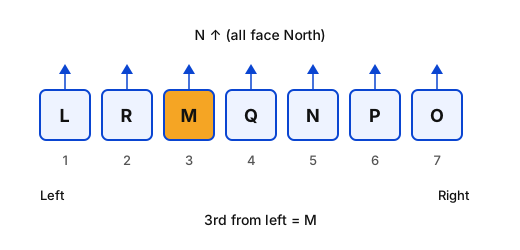
Seven people, L, M, N, O, P, Q and R, are sitting in a row, facing north. Only two people sit to the right of N. Only two people sit between N and R. Only two people sit between L and Q. Q sits immediately to the left of N. O sits immediately to the right of P.
Who is sitting third from the left end of the row?
सात व्यक्ति, L, M, N, O, P, Q और R, उत्तर की ओर मुख करके एक पंक्ति में बैठे हैं। N के दाईं ओर केवल दो व्यक्ति बैठे हैं। N और R के बीच केवल दो व्यक्ति बैठे हैं। L और Q के बीच केवल दो व्यक्ति बैठे हैं। Q, N के ठीक बाईं ओर बैठा है। O, P के ठीक दाईं ओर बैठा है।
पंक्ति के बाएँ छोर से तीसरे स्थान पर कौन बैठा है?
  1. AL
  2. BM
  3. CO
  4. DR
Show answer

Concept: Fix the most definite clue first (positions counted from the left).

  1. Only two to the right of N → N at 5; Q immediately left → Q at 4.
  2. Two between N and R → R at 2. Two between L and Q → L at 1 or 7.
  3. P–O must be adjacent (O right of P): only possible if L = 1 and P, O = 6, 7; M = 3.
  4. Row: L R M Q N P O → 3rd from left is M.

Trick: Start with “only two to the right” – it pins a person to a fixed seat.

Answer: (B) M

अवधारणा: सबसे निश्चित सूचना से शुरू करें (बाएँ से स्थान)।

  1. N के दाएँ केवल दो → N स्थान 5; Q ठीक बाएँ → 4।
  2. N और R के बीच दो → R स्थान 2। L और Q के बीच दो → L स्थान 1 या 7।
  3. P–O साथ-साथ (O, P के दाएँ) तभी संभव जब L = 1, P = 6, O = 7; M = 3।
  4. क्रम: L R M Q N P O → बाएँ से तीसरा M।

ट्रिक: “दाएँ केवल दो” वाली सूचना स्थान पक्का कर देती है।

उत्तर: (B) M

RRB NTPC Undergraduate CBT 1General Intelligence and ReasoningLinear seating arrangementRRB NTPC Undergraduate CBT 1 2024 · 11 Aug Shift 1 →
Q3178.
In a certain code language, 'month owl row' is written as 'eg kv oc' and 'vex row virus' is written as 'jl vf eg'. How is 'row' written in the given code language?
एक निश्चित कूट भाषा में, 'month owl row' को 'eg kv oc' लिखा जाता है और 'vex row virus' को 'jl vf eg' लिखा जाता है। दी गई कूट भाषा में 'row' को कैसे लिखा जाएगा?
  1. Ajl
  2. Boc
  3. Ckv
  4. Deg
Show answer

Concept: A word common to two sentences takes the code common to both.

  1. “row” is in both sentences.
  2. Common code in “eg kv oc” and “jl vf eg” is “eg”.

Trick: Common word ↔ common code.

Answer: (D) eg

अवधारणा: दोनों वाक्यों का साझा शब्द, साझा कोड पाता है।

  1. “row” दोनों वाक्यों में है।
  2. दोनों कोड में साझा “eg” है।

ट्रिक: साझा शब्द ↔ साझा कोड।

उत्तर: (D) eg

RRB NTPC Undergraduate CBT 1General Intelligence and ReasoningCoding-decodingRRB NTPC Undergraduate CBT 1 2024 · 11 Aug Shift 1 →
Q3179.
Which of the given options will replace the question mark (?) in the following series?
44 55 68 83 100 ?
निम्नलिखित श्रृंखला में प्रश्नचिह्न (?) के स्थान पर दिए गए विकल्पों में से कौन-सा आएगा?
44 55 68 83 100 ?
  1. A108
  2. B124
  3. C119
  4. D112
Show answer

Concept: Check the differences.

  1. Differences: 11,13,15,17 (odd numbers increasing by 2).
  2. Next difference =19: 100+19=119.

Trick: Differences rising by 2 → second difference is constant.

Answer: (C) 119

अवधारणा: अंतर देखें।

  1. अंतर: 11,13,15,17।
  2. अगला अंतर 19: 100+19=119।

ट्रिक: अंतर 2-2 बढ़ रहे हैं।

उत्तर: (C) 119

RRB NTPC Undergraduate CBT 1General Intelligence and ReasoningNumber seriesRRB NTPC Undergraduate CBT 1 2024 · 11 Aug Shift 1 →
Q3180.
Read the given statements and conclusions carefully. Assuming that the information given in the statements is true, even if it appears to be at variance with commonly known facts, decide which of the given conclusion(s) logically follow(s) from the statements.
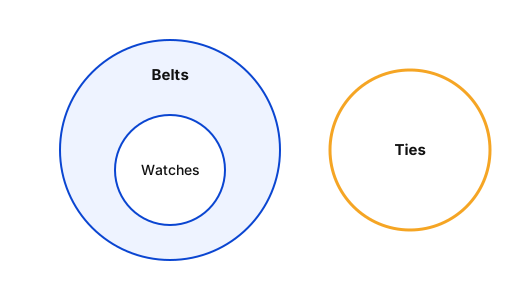
Statements: All watches are belts. No belt is a tie.
Conclusions (I): Some watches are ties.
Conclusions (II): All ties are belts.
दिए गए कथनों और निष्कर्षों को ध्यानपूर्वक पढ़िए। यह मानते हुए कि कथनों में दी गई जानकारी सत्य है, भले ही वह सामान्य रूप से ज्ञात तथ्यों से भिन्न प्रतीत होती हो, निर्णय लीजिए कि दिए गए निष्कर्षों में से कौन-सा/से निष्कर्ष कथनों का तार्किक रूप से अनुसरण करता है/करते हैं।
कथन: सभी घड़ियाँ, बेल्ट हैं। कोई बेल्ट, टाई नहीं है।
निष्कर्ष (I): कुछ घड़ियाँ, टाई हैं।
निष्कर्ष (II): सभी टाई, बेल्ट हैं।
  1. AOnly conclusion (I) follows.केवल निष्कर्ष (I) अनुसरण करता है।
  2. BOnly conclusion (II) follows.केवल निष्कर्ष (II) अनुसरण करता है।
  3. CBoth conclusions (I) and (II) follow.निष्कर्ष (I) और (II) दोनों अनुसरण करते हैं।
  4. DNeither conclusion (I) nor (II) follows.न तो निष्कर्ष (I) और न ही (II) अनुसरण करता है।
Show answer

Concept: Draw the least-overlap Venn diagram allowed by the statements.

  1. Watches lie fully inside Belts; Ties lie completely outside Belts.
  2. So no watch is a tie → I (Some watches are ties) is false.
  3. No tie is a belt → II (All ties are belts) is false.

Trick: “All A are B” + “No B is C” ⇒ “No A is C”.

Answer: (D) Neither conclusion (I) nor (II) follows.

अवधारणा: कथनों के अनुसार वेन आरेख बनाएँ।

  1. Watches पूरी तरह Belts के अंदर; Ties, Belts से बिल्कुल अलग।
  2. अतः कोई watch, tie नहीं → I गलत।
  3. कोई tie, belt नहीं → II गलत।

ट्रिक: “सभी A, B हैं” + “कोई B, C नहीं” ⇒ “कोई A, C नहीं”।

उत्तर: (D) Neither conclusion (I) nor (II) follows.

RRB NTPC Undergraduate CBT 1General Intelligence and ReasoningSyllogismRRB NTPC Undergraduate CBT 1 2024 · 11 Aug Shift 1 →