Question bank

Q&A: practice questions with answers

Search questions on any topic. Filter by exam category, exam, subject and topic, try the question, then open the answer and explanation.

Courses – airGurukul

8,500 questions found.

Q3261.
What is the discount on a product with a list price of ₹3,000 and a discount rate of 25%?
₹3,000 सूची मूल्य और 25% छूट दर वाले एक उत्पाद पर छूट कितनी है?
  1. A₹1,000
  2. B₹700
  3. C₹750
  4. D₹900
Show answer

Concept: Discount = discount rate × list price.

  1. Discount =25% of 3000=25100×3000.
  2. = ₹750.

Trick: 25% = one-fourth: 3000÷4=750.

Answer: (C) ₹750

अवधारणा: छूट = छूट दर × सूची मूल्य।

  1. छूट =3000 का 25%=25100×3000।
  2. = ₹750।

ट्रिक: 25% = एक-चौथाई: 3000÷4=750।

उत्तर: (C) ₹750

RRB NTPC Undergraduate CBT 1MathematicsDiscountRRB NTPC Undergraduate CBT 1 2024 · 9 Sep Shift 3 →
Q3262.
Aman and Pawan together invested ₹62,800 in a business. At the end of the year, out of a total profit of ₹11,600, Pawan's share was ₹2,900. What was the difference between their investments?
अमन और पवन ने मिलकर एक व्यवसाय में ₹62,800 का निवेश किया। वर्ष के अंत में, ₹11,600 के कुल लाभ में से पवन का हिस्सा ₹2,900 था। उनके निवेशों के बीच का अंतर कितना था?
  1. A₹32,000
  2. B₹31,800
  3. C₹31,400
  4. D₹30,400
Show answer

Concept: For the same time period, profit is shared in the ratio of investments.

  1. Aman's profit =11600−2900= ₹8700; ratio Aman : Pawan =8700:2900=3:1.
  2. Investments: Aman =34×62800= ₹47100, Pawan = ₹15700.
  3. Difference =47100−15700= ₹31400.

Trick: Difference =3−14×62800=12×62800= ₹31400.

Answer: (C) ₹31,400

अवधारणा: समान अवधि में लाभ, निवेश के अनुपात में बँटता है।

  1. अमन का लाभ =11600−2900= ₹8700; अनुपात अमन : पवन =8700:2900=3:1।
  2. निवेश: अमन =34×62800= ₹47100, पवन = ₹15700।
  3. अंतर =47100−15700= ₹31400।

ट्रिक: अंतर =3−14×62800=12×62800= ₹31400।

उत्तर: (C) ₹31,400

RRB NTPC Undergraduate CBT 1MathematicsPartnershipRRB NTPC Undergraduate CBT 1 2024 · 9 Sep Shift 3 →
Q3263.
The product of two consecutive natural numbers is 306. The greater of the two numbers is:
दो क्रमागत प्राकृत संख्याओं का गुणनफल 306 है। दोनों संख्याओं में से बड़ी संख्या है:
  1. A19
  2. B18
  3. C31
  4. D36
Show answer

Concept: Product n(n+1) is close to n2; take 306≈17.5.

  1. Try 17×18=306 ✓.
  2. The two numbers are 17 and 18; greater is 18.

Trick: Last digit 6 → numbers end in 2&3 or 7&8; near 306 gives 17, 18.

Answer: (B) 18

अवधारणा: गुणनफल n(n+1) लगभग n2 होता है; 306≈17.5।

  1. जाँच: 17×18=306 ✓।
  2. संख्याएँ 17 और 18; बड़ी संख्या 18।

ट्रिक: इकाई अंक 6 → संख्याएँ 2-3 या 7-8 पर समाप्त; 306 के पास 17, 18।

उत्तर: (B) 18

RRB NTPC Undergraduate CBT 1MathematicsNumber SystemRRB NTPC Undergraduate CBT 1 2024 · 9 Sep Shift 3 →
Q3264.
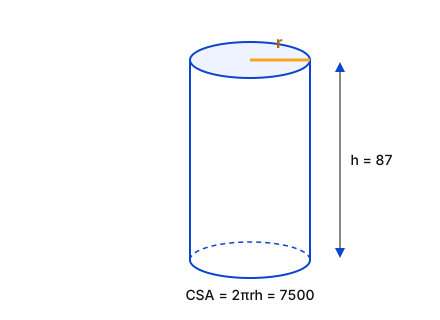
A cylindrical rod has an outer curved surface area of 7500 cm2. If the length of the rod is 87 cm, then the outer radius (in cm) of the rod, correct to two places of decimal, is:
(Take π=227)
एक बेलनाकार छड़ का बाहरी वक्र पृष्ठीय क्षेत्रफल 7500 cm2 है। यदि छड़ की लंबाई 87 cm है, तो दशमलव के दो स्थानों तक सही, छड़ की बाहरी त्रिज्या (cm में) है:
(π=227 लीजिए)
  1. A16.52
  2. B13.71
  3. C16.68
  4. D13.96
Show answer

Concept: Curved surface area of a cylinder =2πrh.

  1. 2×227×r×87=7500.
  2. r=7500×744×87=525003828.
  3. r≈13.71cm.

Trick: Quick estimate: 2πh≈547, and 7500÷547≈13.7.

Answer: (B) 13.71

अवधारणा: बेलन का वक्र पृष्ठीय क्षेत्रफल =2πrh।

  1. 2×227×r×87=7500।
  2. r=7500×744×87=525003828।
  3. r≈13.71cm।

ट्रिक: अनुमान: 2πh≈547, और 7500÷547≈13.7।

उत्तर: (B) 13.71

RRB NTPC Undergraduate CBT 1MathematicsMensuration – CylinderRRB NTPC Undergraduate CBT 1 2024 · 9 Sep Shift 3 →
Q3265.
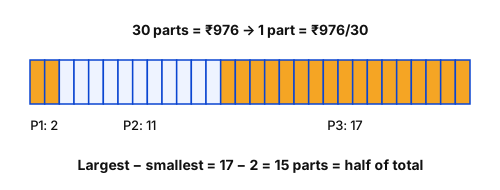
An amount of ₹976 is divided among three persons in the ratio of 2 : 11 : 17. The difference between the largest and the smallest shares (in ₹) in the distribution is:
₹976 की राशि को तीन व्यक्तियों में 2 : 11 : 17 के अनुपात में विभाजित किया जाता है। इस वितरण में सबसे बड़े और सबसे छोटे हिस्सों (₹ में) के बीच का अंतर है:
  1. A488
  2. B531
  3. C495
  4. D517
Show answer

Concept: Share = (its ratio part ÷ total parts) × amount.

  1. Total parts =2+11+17=30; 1 part =97630.
  2. Difference = 17−2=15 parts.
  3. 15×97630=9762= ₹488.

Trick: 15 parts out of 30 is exactly half of ₹976.

Answer: (A) 488

अवधारणा: हिस्सा = (उसके भाग ÷ कुल भाग) × राशि।

  1. कुल भाग =2+11+17=30; 1 भाग =97630।
  2. अंतर = 17−2=15 भाग।
  3. 15×97630=9762= ₹488।

ट्रिक: 30 में से 15 भाग = ₹976 का ठीक आधा।

उत्तर: (A) 488

RRB NTPC Undergraduate CBT 1MathematicsRatio and ProportionRRB NTPC Undergraduate CBT 1 2024 · 9 Sep Shift 3 →
Q3266.
The number 869671195 is divisible by which of the following?
संख्या 869671195 निम्नलिखित में से किससे विभाज्य है?
  1. A5
  2. B13
  3. C12
  4. D15
Show answer

Concept: Divisible by 5 if the last digit is 0 or 5; by 3 if the digit sum is divisible by 3.

  1. Last digit is 5 → divisible by 5 ✓.
  2. Digit sum =8+6+9+6+7+1+1+9+5=52, not divisible by 3 → not by 15 or 12.
  3. It is odd, so not divisible by 12 either.

Trick: Check the easiest rule first – the last digit.

Answer: (A) 5

अवधारणा: 5 से विभाज्य यदि इकाई अंक 0 या 5; 3 से विभाज्य यदि अंकों का योग 3 से विभाज्य।

  1. इकाई अंक 5 → 5 से विभाज्य ✓।
  2. अंकों का योग =8+6+9+6+7+1+1+9+5=52, 3 से विभाज्य नहीं → 15 से भी नहीं।
  3. संख्या विषम है, अतः 12 से भी नहीं।

ट्रिक: सबसे आसान नियम पहले – इकाई अंक देखें।

उत्तर: (A) 5

RRB NTPC Undergraduate CBT 1MathematicsDivisibility RulesRRB NTPC Undergraduate CBT 1 2024 · 9 Sep Shift 3 →
Q3267.
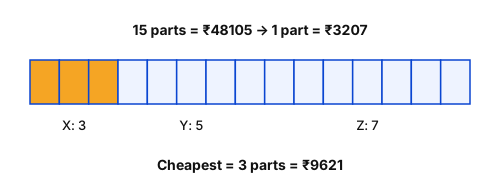
The average price of three items of furniture is ₹16,035. If their prices are in the ratio 3 : 5 : 7, the price of the cheapest item (in ₹) is:
फ़र्नीचर की तीन वस्तुओं का औसत मूल्य ₹16,035 है। यदि उनके मूल्य 3 : 5 : 7 के अनुपात में हैं, तो सबसे सस्ती वस्तु का मूल्य (₹ में) है:
  1. A3,207
  2. B7,483
  3. C5,345
  4. D9,621
Show answer

Concept: Total = average × count; split total in the given ratio.

  1. Total price =3×16035= ₹48105.
  2. Total parts =3+5+7=15; 1 part =4810515= ₹3207.
  3. Cheapest =3×3207= ₹9621.

Trick: Average of the ratio terms is 5 parts = ₹16035, so 1 part = ₹3207 directly.

Answer: (D) 9,621

अवधारणा: कुल = औसत × संख्या; कुल को दिए अनुपात में बाँटें।

  1. कुल मूल्य =3×16035= ₹48105।
  2. कुल भाग =3+5+7=15; 1 भाग =4810515= ₹3207।
  3. सबसे सस्ती =3×3207= ₹9621।

ट्रिक: अनुपात के पदों का औसत 5 भाग = ₹16035, तो सीधे 1 भाग = ₹3207।

उत्तर: (D) 9,621

RRB NTPC Undergraduate CBT 1MathematicsAverage and RatioRRB NTPC Undergraduate CBT 1 2024 · 9 Sep Shift 3 →
Q3268.
Find the value of 14−23×25−23×15−23.
14−23×25−23×15−23 का मान ज्ञात कीजिए।
  1. A1525723
  2. B1521423
  3. C1524323
  4. D1525023
Show answer

Concept: am×bm×cm=(abc)m and a−m=1am.

  1. 14−23×25−23×15−23=(14×25×15)−23.
  2. 14×25×15=5250.
  3. Value =5250−23=1525023.

Trick: 14×15=210, 210×25=5250.

Answer: (D) 1525023

अवधारणा: am×bm×cm=(abc)m तथा a−m=1am।

  1. 14−23×25−23×15−23=(14×25×15)−23।
  2. 14×25×15=5250।
  3. मान =5250−23=1525023।

ट्रिक: 14×15=210, 210×25=5250।

उत्तर: (D) 1525023

RRB NTPC Undergraduate CBT 1MathematicsLaws of ExponentsRRB NTPC Undergraduate CBT 1 2024 · 9 Sep Shift 3 →
Q3269.
By selling an article at 25 of its actual selling price, Aman incurs a loss of 24%.
If he sells it at 81% of its actual selling price, then the profit percentage is:
किसी वस्तु को उसके वास्तविक विक्रय मूल्य के 25 पर बेचने से अमन को 24% की हानि होती है।
यदि वह इसे इसके वास्तविक विक्रय मूल्य के 81% पर बेचता है, तो लाभ प्रतिशत है:
  1. A55.9%
  2. B55.7%
  3. C55.5%
  4. D53.9%
Show answer

Concept: Relate the selling price (SP) to the cost price (CP) using the loss condition.

  1. 25SP=0.76CP (loss 24%).
  2. SP=0.76×52CP=1.9CP.
  3. New price =0.81×1.9CP=1.539CP → profit 53.9%.

Trick: Take CP = 100: 25SP=76 → SP = 190; 81% of 190=153.9.

Answer: (D) 53.9%

अवधारणा: हानि की शर्त से विक्रय मूल्य (SP) को क्रय मूल्य (CP) से जोड़ें।

  1. 25SP=0.76CP (24% हानि)।
  2. SP=0.76×52CP=1.9CP।
  3. नया मूल्य =0.81×1.9CP=1.539CP → लाभ 53.9%।

ट्रिक: CP = 100 लें: 25SP=76 → SP = 190; 190 का 81%=153.9।

उत्तर: (D) 53.9%

RRB NTPC Undergraduate CBT 1MathematicsProfit and LossRRB NTPC Undergraduate CBT 1 2024 · 9 Sep Shift 3 →
Q3270.
If the third proportional of 26 and 52 be x, then what is the value of x?
यदि 26 और 52 का तृतीयानुपाती x है, तो x का मान क्या है?
  1. A107
  2. B104
  3. C102
  4. D106
Show answer

Concept: Third proportional of a and b is x where a:b=b:x, i.e. x=b2a.

  1. x=52226=270426.
  2. x=104.

Trick: 52=2×26, so x=2×52=104 (ratio doubles each time).

Answer: (B) 104

अवधारणा: a और b का तृतीय समानुपाती x: a:b=b:x, अर्थात x=b2a।

  1. x=52226=270426।
  2. x=104।

ट्रिक: 52=2×26, अतः x=2×52=104 (हर बार दोगुना)।

उत्तर: (B) 104

RRB NTPC Undergraduate CBT 1MathematicsThird ProportionalRRB NTPC Undergraduate CBT 1 2024 · 9 Sep Shift 3 →
Q3271.
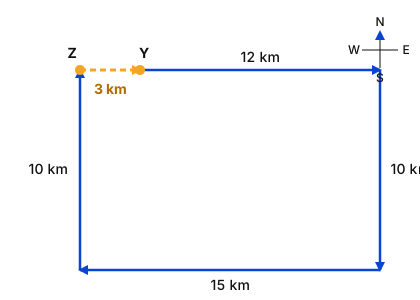
Priya starts from Point Y and drives 12 km towards the east. She then takes a right turn, drives 10 km. She then turns right and drives 15 km. She takes a final right turn, drives 10 km and stops at Point Z. How far (shortest distance) and towards which direction should she drive in order to reach Point Y again? (All turns are 90-degree turns only unless specified)
प्रिया बिंदु Y से चलना शुरू करती है और पूर्व की ओर 12 km गाड़ी चलाती है। फिर वह दाएँ मुड़ती है और 10 km गाड़ी चलाती है। फिर वह दाएँ मुड़ती है और 15 km गाड़ी चलाती है। वह अंतिम बार दाएँ मुड़ती है, 10 km गाड़ी चलाती है और बिंदु Z पर रुक जाती है। बिंदु Y पर फिर से पहुँचने के लिए उसे कितनी दूर (न्यूनतम दूरी) और किस दिशा में गाड़ी चलानी चाहिए? (जब तक निर्दिष्ट न किया जाए, सभी मोड़ केवल 90 डिग्री के हैं)
  1. A9 km towards northउत्तर की ओर 9 km
  2. B3 km towards eastपूर्व की ओर 3 km
  3. C7 km towards southदक्षिण की ओर 7 km
  4. D2 km towards westपश्चिम की ओर 2 km
Show answer

Concept: Trace the path on axes (east = +x, north = +y) and compare the end point with the start.

  1. Y(0, 0) → 12 km east → (12, 0).
  2. Right turn = south 10 km → (12, −10); right = west 15 km → (−3, −10).
  3. Right = north 10 km → Z(−3, 0).
  4. Z is 3 km west of Y, so she must drive 3 km towards east.

Trick: North–south moves cancel (10 and 10); net east–west =12−15=−3 → 3 km west of Y.

Answer: (B) 3 km towards east

अवधारणा: मार्ग को अक्षों पर बनाएँ (पूर्व = +x, उत्तर = +y) और अंतिम बिंदु की तुलना आरंभ से करें।

  1. Y(0, 0) → 12 km पूर्व → (12, 0)।
  2. दाएँ मुड़कर दक्षिण 10 km → (12, −10); दाएँ = पश्चिम 15 km → (−3, −10)।
  3. दाएँ = उत्तर 10 km → Z(−3, 0)।
  4. Z, Y से 3 km पश्चिम में है, अतः उसे 3 km पूर्व की ओर जाना होगा।

ट्रिक: उत्तर-दक्षिण गति कट जाती है (10 और 10); पूर्व-पश्चिम =12−15=−3 → Y से 3 km पश्चिम।

उत्तर: (B) 3 km पूर्व की ओर

RRB NTPC Undergraduate CBT 1General Intelligence and ReasoningDirection and DistanceRRB NTPC Undergraduate CBT 1 2024 · 9 Sep Shift 3 →
Q3272.
What should come in place of the question mark (?) in the given series?
99 100 105 114 127 ?
दी गई श्रृंखला में प्रश्न चिह्न (?) के स्थान पर क्या आना चाहिए?
99 100 105 114 127 ?
  1. A145
  2. B146
  3. C144
  4. D143
Show answer

Concept: Check the differences between consecutive terms.

  1. Differences: 1,5,9,13 – increasing by 4.
  2. Next difference =17.
  3. 127+17=144.

Trick: Second difference constant (4) → add next term of 1, 5, 9, 13, 17.

Answer: (C) 144

अवधारणा: क्रमागत पदों के अंतर देखें।

  1. अंतर: 1,5,9,13 – हर बार 4 बढ़ता है।
  2. अगला अंतर =17।
  3. 127+17=144।

ट्रिक: दूसरा अंतर स्थिर (4) → 1, 5, 9, 13, 17 जोड़ते जाएँ।

उत्तर: (C) 144

RRB NTPC Undergraduate CBT 1General Intelligence and ReasoningNumber SeriesRRB NTPC Undergraduate CBT 1 2024 · 9 Sep Shift 3 →
Q3273.
Select the set in which the numbers are related in the same way as are the numbers of the following sets.
(Note: Operations should be performed on the whole numbers, without breaking down the numbers into their constituent digits. E.g., 13 – Operations on 13 such as
adding/subtracting/multiplying to 13 can be performed. Breaking down 13 into 1 and 3 and then performing mathematical operations on 1 and 3 is not allowed.)
(23, 70, 211)
(12, 37, 112)
उस समुच्चय का चयन कीजिए जिसमें संख्याएँ उसी प्रकार संबंधित हैं जिस प्रकार निम्नलिखित समुच्चयों की संख्याएँ संबंधित हैं।
(ध्यान दें: संख्याओं को उनके घटक अंकों में तोड़े बिना, संक्रियाएँ पूर्ण संख्याओं पर की जानी चाहिए। उदाहरण के लिए, 13 – 13 पर संक्रियाएँ जैसे
13 में जोड़ना/घटाना/गुणा करना आदि किया जा सकता है। 13 को 1 और 3 में तोड़कर फिर 1 और 3 पर गणितीय संक्रियाएँ करने की अनुमति नहीं है।)
(23, 70, 211)
(12, 37, 112)
  1. A(5, 16, 48)
  2. B(22, 45, 105)
  3. C(18, 54, 153)
  4. D(33, 100, 301)
Show answer

Concept: Find the rule linking the three numbers: each term =3×previous+1.

  1. 23×3+1=70, 70×3+1=211 ✓; 12×3+1=37, 37×3+1=112 ✓.
  2. Option (D): 33×3+1=100, 100×3+1=301 ✓.
  3. (A): 5×3+1=16 but 16×3+1=49≠48 ✗.

Trick: Check both steps of every option – (A) passes the first step only.

Answer: (D) (33, 100, 301)

अवधारणा: तीनों संख्याओं का नियम: हर पद =3×पिछला+1।

  1. 23×3+1=70, 70×3+1=211 ✓; 12×3+1=37, 37×3+1=112 ✓।
  2. विकल्प (D): 33×3+1=100, 100×3+1=301 ✓।
  3. (A): 5×3+1=16 पर 16×3+1=49≠48 ✗।

ट्रिक: हर विकल्प के दोनों चरण जाँचें – (A) केवल पहला चरण पास करता है।

उत्तर: (D) (33, 100, 301)

RRB NTPC Undergraduate CBT 1General Intelligence and ReasoningNumber Analogy (Sets)RRB NTPC Undergraduate CBT 1 2024 · 9 Sep Shift 3 →
Q3274.
In the following triads, each group of letters is related to the subsequent one following a certain logic. Select from the given options, the one which follows the same logic. LONG - ONLG - GNOL
EARN - AREN - NRAE
निम्नलिखित त्रिकों में, अक्षरों का प्रत्येक समूह एक निश्चित तर्क का अनुसरण करते हुए अपने बाद वाले समूह से संबंधित है। दिए गए विकल्पों में से उस विकल्प का चयन कीजिए जो समान तर्क का अनुसरण करता है। LONG - ONLG - GNOL
EARN - AREN - NRAE
  1. ACUTE - UCTE - EUTC
  2. BBACK - ACBK - ACKB
  3. CCOIN - OICN - NIOC
  4. DSKIP - SIKP - PIKS
Show answer

Concept: Track letter positions: word 1-2-3-4 → 2-3-1-4, and third = reverse of the first word.

  1. LONG → O N L G (2, 3, 1, 4); GNOL = LONG reversed.
  2. EARN → A R E N (2, 3, 1, 4); NRAE = EARN reversed ✓.
  3. COIN → O I C N (2, 3, 1, 4); NIOC = COIN reversed ✓.
  4. CUTE → UTCE would be needed (not UCTE); BACK, SKIP also fail.

Trick: Check the easy part first – the third term must be the exact reverse of the first.

Answer: (C) COIN - OICN - NIOC

अवधारणा: अक्षरों की स्थिति देखें: शब्द 1-2-3-4 → 2-3-1-4, और तीसरा पद = पहले शब्द का उल्टा।

  1. LONG → O N L G (2, 3, 1, 4); GNOL = LONG उल्टा।
  2. EARN → A R E N (2, 3, 1, 4); NRAE = EARN उल्टा ✓।
  3. COIN → O I C N (2, 3, 1, 4); NIOC = COIN उल्टा ✓।
  4. CUTE से UTCE बनना चाहिए (UCTE नहीं); BACK, SKIP भी गलत।

ट्रिक: पहले आसान भाग देखें – तीसरा पद पहले शब्द का ठीक उल्टा होना चाहिए।

उत्तर: (C) COIN - OICN - NIOC

RRB NTPC Undergraduate CBT 1General Intelligence and ReasoningLetter RearrangementRRB NTPC Undergraduate CBT 1 2024 · 9 Sep Shift 3 →
Q3275.
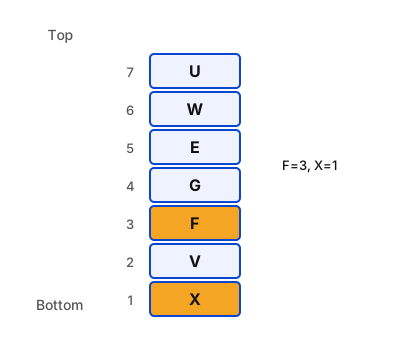
Seven boxes U, V, W, X, E, F and G are kept one over the other but not necessarily in the same order.
V is kept second from the bottom. Only three boxes are kept between V and W. X is kept at one of the positions below V. Only E is kept between W and G. U is kept at one of the positions above W. How many boxes are kept between F and X?
सात बक्से U, V, W, X, E, F और G एक के ऊपर एक रखे गए हैं, लेकिन आवश्यक नहीं कि इसी क्रम में हों।
V को नीचे से दूसरे स्थान पर रखा गया है। V और W के बीच केवल तीन बक्से रखे गए हैं। X को V के नीचे के किसी एक स्थान पर रखा गया है। W और G के बीच केवल E रखा गया है। U को W के ऊपर के किसी एक स्थान पर रखा गया है। F और X के बीच कितने बक्से रखे गए हैं?
  1. AFourचार
  2. BThreeतीन
  3. COneएक
  4. DTwoदो
Show answer

Concept: Number positions 1 (bottom) to 7 (top) and place the fixed boxes first.

  1. V = 2; three boxes between V and W → W = 6.
  2. X below V → X = 1. Only E between W and G → E = 5, G = 4.
  3. U above W → U = 7; remaining F = 3.
  4. Between F (3) and X (1): only V → one box.

Trick: Fix the 'second from bottom' clue first; everything else follows from it.

Answer: (C) One

अवधारणा: स्थान 1 (नीचे) से 7 (ऊपर) तक लें और निश्चित बॉक्स पहले रखें।

  1. V = 2; V और W के बीच तीन बॉक्स → W = 6।
  2. X, V से नीचे → X = 1। W और G के बीच केवल E → E = 5, G = 4।
  3. U, W से ऊपर → U = 7; शेष F = 3।
  4. F (3) और X (1) के बीच: केवल V → एक बॉक्स।

ट्रिक: 'नीचे से दूसरा' वाला संकेत पहले लगाएँ; बाकी उसी से निकलता है।

उत्तर: (C) एक

RRB NTPC Undergraduate CBT 1General Intelligence and ReasoningBox ArrangementRRB NTPC Undergraduate CBT 1 2024 · 9 Sep Shift 3 →
Q3276.
YELP is related to BZOK in a certain way based on the English alphabetical order. In the same way, EURF is related to HPUA. To which of the given options is KKXV related, following the same logic?
अंग्रेज़ी वर्णमाला क्रम के आधार पर YELP एक निश्चित प्रकार से BZOK से संबंधित है। उसी प्रकार, EURF, HPUA से संबंधित है। समान तर्क का अनुसरण करते हुए, KKXV दिए गए विकल्पों में से किससे संबंधित है?
  1. AMDAP
  2. BNFAQ
  3. CMEBR
  4. DOGZP
Show answer

Concept: Find the shift of each letter using place values (A = 1 … Z = 26).

  1. YELP → BZOK: Y+3 = B, E−5 = Z, L+3 = O, P−5 = K.
  2. EURF → HPUA: E+3 = H, U−5 = P, R+3 = U, F−5 = A ✓.
  3. KKXV: K+3 = N, K−5 = F, X+3 = A, V−5 = Q → NFAQ.

Trick: Pattern +3, −5, +3, −5; wrap around after Z (X+3 = A).

Answer: (B) NFAQ

अवधारणा: स्थानीय मान (A = 1 … Z = 26) से हर अक्षर का खिसकाव देखें।

  1. YELP → BZOK: Y+3 = B, E−5 = Z, L+3 = O, P−5 = K।
  2. EURF → HPUA: E+3 = H, U−5 = P, R+3 = U, F−5 = A ✓।
  3. KKXV: K+3 = N, K−5 = F, X+3 = A, V−5 = Q → NFAQ।

ट्रिक: पैटर्न +3, −5, +3, −5; Z के बाद फिर A से गिनें (X+3 = A)।

उत्तर: (B) NFAQ

RRB NTPC Undergraduate CBT 1General Intelligence and ReasoningLetter CodingRRB NTPC Undergraduate CBT 1 2024 · 9 Sep Shift 3 →
Q3277.
Each of the digits in the number 257146983 is arranged in ascending order from left to right. What will be the sum of the digits which are third from the left and second from the right in the new number thus formed?
संख्या 257146983 के प्रत्येक अंक को बाएँ से दाएँ आरोही क्रम में व्यवस्थित किया जाता है। इस प्रकार बनी नई संख्या में बाएँ से तीसरे और दाएँ से दूसरे अंकों का योग क्या होगा?
  1. A13
  2. B12
  3. C11
  4. D10
Show answer

Concept: Arrange the digits in ascending order and pick positions.

  1. 257146983 → 123456789.
  2. Third from left = 3; second from right = 8.
  3. Sum =3+8=11.

Trick: Digits 1–9 each once → position from left equals the digit itself.

Answer: (C) 11

अवधारणा: अंकों को आरोही क्रम में लगाएँ और स्थान चुनें।

  1. 257146983 → 123456789।
  2. बाएँ से तीसरा = 3; दाएँ से दूसरा = 8।
  3. योग =3+8=11।

ट्रिक: 1–9 प्रत्येक एक बार → बाएँ से स्थान = वही अंक।

उत्तर: (C) 11

RRB NTPC Undergraduate CBT 1General Intelligence and ReasoningDigit ArrangementRRB NTPC Undergraduate CBT 1 2024 · 9 Sep Shift 3 →
Q3278.
JGCK is related to HEAI in a certain way based on the English alphabetical order. In the same way, MJFN is related to KHDL. To which of the given options is PMIQ related, following the same logic?
अंग्रेज़ी वर्णमाला क्रम के आधार पर JGCK एक निश्चित प्रकार से HEAI से संबंधित है। उसी प्रकार, MJFN, KHDL से संबंधित है। समान तर्क का अनुसरण करते हुए, PMIQ दिए गए विकल्पों में से किससे संबंधित है?
  1. ANKHO
  2. BNKHP
  3. CNKGO
  4. DNKGP
Show answer

Concept: Compare each letter with its code letter.

  1. JGCK → HEAI: each letter −2.
  2. MJFN → KHDL: each letter −2 ✓.
  3. PMIQ → N K G O.

Trick: Uniform shift: just move every letter two steps back.

Answer: (C) NKGO

अवधारणा: हर अक्षर की उसके कोड से तुलना करें।

  1. JGCK → HEAI: हर अक्षर −2।
  2. MJFN → KHDL: हर अक्षर −2 ✓।
  3. PMIQ → N K G O।

ट्रिक: समान खिसकाव: हर अक्षर दो स्थान पीछे।

उत्तर: (C) NKGO

RRB NTPC Undergraduate CBT 1General Intelligence and ReasoningLetter CodingRRB NTPC Undergraduate CBT 1 2024 · 9 Sep Shift 3 →
Q3279.
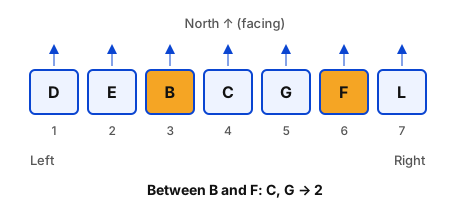
Seven people, B, C, D, E, F, G and L, are sitting in a row facing North. Only three people sit between D and G. C sits to the immediate left of G. No one sits to the right of L. Only two people sit between L and C. B sits to the immediate right of E. How many people sit between F and B?
सात व्यक्ति B, C, D, E, F, G और L एक पंक्ति में उत्तर की ओर मुख करके बैठे हैं। D और G के बीच केवल तीन व्यक्ति बैठे हैं। C, G के ठीक बाएँ बैठा है। L के दाएँ कोई नहीं बैठा है। L और C के बीच केवल दो व्यक्ति बैठे हैं। B, E के ठीक दाएँ बैठा है। F और B के बीच कितने व्यक्ति बैठे हैं?
  1. ATwoदो
  2. BThreeतीन
  3. COneएक
  4. DFourचार
Show answer

Concept: Facing north, left/right are the viewer's left/right. Fix the end person first.

  1. No one right of L → L = 7. Two between L and C → C = 4; G immediately right of C → G = 5.
  2. Three between D and G → D = 1.
  3. E–B pair (B immediately right of E) fits only 2–3 → E = 2, B = 3; F = 6.
  4. Between B (3) and F (6): C, G → two.

Trick: Place the end person and the fixed pair; the rest drops into the gaps.

Answer: (A) Two

अवधारणा: उत्तर की ओर मुख होने पर बायाँ/दायाँ हमारे बायाँ/दायाँ ही है। पहले छोर वाले व्यक्ति को रखें।

  1. L के दाएँ कोई नहीं → L = 7। L और C के बीच दो → C = 4; G, C के ठीक दाएँ → G = 5।
  2. D और G के बीच तीन → D = 1।
  3. E–B जोड़ा (B, E के ठीक दाएँ) केवल 2–3 पर → E = 2, B = 3; F = 6।
  4. B (3) और F (6) के बीच: C, G → दो।

ट्रिक: छोर वाला व्यक्ति और निश्चित जोड़ा पहले रखें; बाकी खाली स्थानों में आ जाते हैं।

उत्तर: (A) दो

RRB NTPC Undergraduate CBT 1General Intelligence and ReasoningLinear SeatingRRB NTPC Undergraduate CBT 1 2024 · 9 Sep Shift 3 →
Q3280.
Seven people A, B, C, D, E, F and G are sitting in a row, facing north.
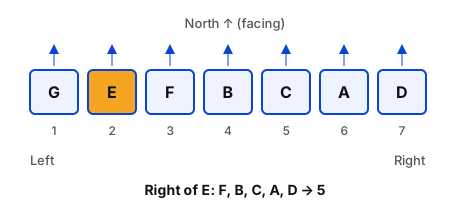
No one sits to the right of D. Only three people sit between D and F. Only two people sit between F and A. G sits third to the left of B. C sits to the immediate right of B. How many people sit to the right of E?
सात व्यक्ति A, B, C, D, E, F और G एक पंक्ति में उत्तर की ओर मुख करके बैठे हैं।
D के दाएँ कोई नहीं बैठा है। D और F के बीच केवल तीन व्यक्ति बैठे हैं। F और A के बीच केवल दो व्यक्ति बैठे हैं। G, B के बाएँ से तीसरे स्थान पर बैठा है। C, B के ठीक दाएँ बैठा है। E के दाएँ कितने व्यक्ति बैठे हैं?
  1. A2
  2. B3
  3. C4
  4. D5
Show answer

Concept: Facing north; number seats 1 (left) to 7 (right).

  1. No one right of D → D = 7. Three between D and F → F = 3. Two between F and A → A = 6.
  2. G third to the left of B and C immediately right of B → G = 1, B = 4, C = 5.
  3. E takes the remaining seat 2.
  4. Right of E: F, B, C, A, D → 5 people.

Trick: Seat 2 means 7−2=5 people to the right.

Answer: (D) 5

अवधारणा: उत्तर की ओर मुख; सीटें 1 (बाएँ) से 7 (दाएँ)।

  1. D के दाएँ कोई नहीं → D = 7। D और F के बीच तीन → F = 3। F और A के बीच दो → A = 6।
  2. G, B के बाएँ से तीसरा और C, B के ठीक दाएँ → G = 1, B = 4, C = 5।
  3. E शेष सीट 2 पर।
  4. E के दाएँ: F, B, C, A, D → 5 लोग।

ट्रिक: सीट 2 पर बैठे व्यक्ति के दाएँ 7−2=5 लोग।

उत्तर: (D) 5

RRB NTPC Undergraduate CBT 1General Intelligence and ReasoningLinear SeatingRRB NTPC Undergraduate CBT 1 2024 · 9 Sep Shift 3 →