Question bank

Q&A: practice questions with answers

Search questions on any topic. Filter by exam category, exam, subject and topic, try the question, then open the answer and explanation.

Courses – airGurukul

8,500 questions found.

Q3361.
Three pieces of timber that are 187 m, 102 m and 255 m long have to be divided into planks of the same length. What is the greatest possible length (in metres) of each plank?
लकड़ी के तीन टुकड़ों, जिनकी लंबाई 187 m, 102 m और 255 m है, को समान लंबाई के तख्तों में विभाजित करना है। प्रत्येक तख्ते की अधिकतम संभव लंबाई (मीटर में) कितनी है?
  1. A17
  2. B19
  3. C11
  4. D13
Show answer

Concept: The greatest equal length that divides all pieces exactly is their HCF.

  1. 187=11×17, 102=6×17, 255=15×17.
  2. Common factor =17 (11, 6, 15 have no common factor).
  3. HCF =17m.

Trick: Check options from largest: 19 does not divide 102; 17 divides all three.

Answer: (A) 17

अवधारणा: सभी टुकड़ों को पूरी तरह विभाजित करने वाली सबसे बड़ी समान लंबाई उनका HCF है।

  1. 187=11×17, 102=6×17, 255=15×17।
  2. उभयनिष्ठ गुणनखंड =17।
  3. HCF =17m।

ट्रिक: बड़े विकल्प से जाँचें: 19 से 102 विभाजित नहीं; 17 से तीनों विभाजित।

उत्तर: (A) 17

RRB NTPC Undergraduate CBT 1MathematicsHCFRRB NTPC Undergraduate CBT 1 2024 · 9 Sep Shift 2 →
Q3362.
Four times the present age of P exceeds the present age of Q by 46 years. After 7 years, three times Q’s age will be 41 years less than seven times P’s age at that time. What is the present age (in years) of Q?
P की वर्तमान आयु का चार गुना, Q की वर्तमान आयु से 46 वर्ष अधिक है। 7 वर्ष बाद, Q की आयु का तीन गुना, उस समय P की आयु के सात गुने से 41 वर्ष कम होगा। Q की वर्तमान आयु (वर्षों में) कितनी है?
  1. A53
  2. B56
  3. C54
  4. D64
Show answer

Concept: Form two linear equations from the statements and solve.

  1. 4P−Q=46 → Q=4P−46.
  2. After 7 years: 3(Q+7)=7(P+7)−41 → 3Q=7P−13.
  3. 3(4P−46)=7P−13 → 5P=125 → P=25.
  4. Q=4×25−46=54.

Trick: Check: after 7 years 3×61=183 and 7×32−41=183 ✓.

Answer: (C) 54

अवधारणा: कथनों से दो रैखिक समीकरण बनाकर हल करें।

  1. 4P−Q=46 → Q=4P−46।
  2. 7 वर्ष बाद: 3(Q+7)=7(P+7)−41 → 3Q=7P−13।
  3. 3(4P−46)=7P−13 → 5P=125 → P=25।
  4. Q=4×25−46=54।

ट्रिक: जाँच: 7 वर्ष बाद 3×61=183 और 7×32−41=183 ✓।

उत्तर: (C) 54

RRB NTPC Undergraduate CBT 1MathematicsProblems on AgesRRB NTPC Undergraduate CBT 1 2024 · 9 Sep Shift 2 →
Q3363.
What sum of money (in ₹) will amount to ₹2,160 at 5% per annum simple interest in 5 years?
कितनी धनराशि (₹ में) 5% वार्षिक साधारण ब्याज की दर से 5 वर्षों में ₹2,160 हो जाएगी?
  1. A₹1,728
  2. B₹8,640
  3. C₹1,678
  4. D₹1,778
Show answer

Concept: Amount =P(1+RT100) under simple interest.

  1. RT100=5×5100=14.
  2. P×54=2160.
  3. P=2160×45=1728.

Trick: Total interest 25% → Amount =125% of P → P =21601.25.

Answer: (A) ₹1,728

अवधारणा: साधारण ब्याज में मिश्रधन =P(1+RT100)।

  1. RT100=5×5100=14।
  2. P×54=2160।
  3. P=2160×45=1728।

ट्रिक: कुल ब्याज 25% → मिश्रधन मूलधन का 125% → P =21601.25।

उत्तर: (A) ₹1,728

RRB NTPC Undergraduate CBT 1MathematicsSimple InterestRRB NTPC Undergraduate CBT 1 2024 · 9 Sep Shift 2 →
Q3364.
The value of 196+0.0256−7.29 is _____.
196+0.0256−7.29 का मान _____ है।
  1. A9.2
  2. B11.46
  3. C12.2
  4. D8.11
Show answer

Concept: decimal: take root of the digits and halve the decimal places.

  1. 196=14.
  2. 0.0256=0.16 (since 162=256).
  3. 7.29=2.7 (since 272=729).
  4. Value =14+0.16−2.7=11.46.

Yaad rakhein: Even number of decimal places → root has half as many: 4 places → 2 places.

Answer: (B) 11.46

अवधारणा: दशमलव का वर्गमूल: अंकों का मूल लें और दशमलव स्थान आधे करें।

  1. 196=14।
  2. 0.0256=0.16 (क्योंकि 162=256)।
  3. 7.29=2.7 (क्योंकि 272=729)।
  4. मान =14+0.16−2.7=11.46।

याद रखें: 4 दशमलव स्थान → मूल में 2 स्थान।

उत्तर: (B) 11.46

RRB NTPC Undergraduate CBT 1MathematicsSquare Roots of DecimalsRRB NTPC Undergraduate CBT 1 2024 · 9 Sep Shift 2 →
Q3365.
The product of two positive numbers is 11045. If the first number is five times the second number, then the sum of the two numbers is:
दो धनात्मक संख्याओं का गुणनफल 11045 है। यदि पहली संख्या, दूसरी संख्या की पाँच गुनी है, तो दोनों संख्याओं का योग है:
  1. A289
  2. B282
  3. C291
  4. D295
Show answer

Concept: Let the second number be x; the first is 5x.

  1. 5x×x=11045 → x2=2209.
  2. x=47 (since 472=2209).
  3. Sum =x+5x=6x=282.

Trick: Sum must be a multiple of 6: only 282 fits.

Answer: (B) 282

अवधारणा: दूसरी संख्या x मानें; पहली 5x होगी।

  1. 5x×x=11045 → x2=2209।
  2. x=47 (क्योंकि 472=2209)।
  3. योग =x+5x=6x=282।

ट्रिक: योग 6 का गुणज होगा: केवल 282 ठीक है।

उत्तर: (B) 282

RRB NTPC Undergraduate CBT 1MathematicsNumbers – Product and SumRRB NTPC Undergraduate CBT 1 2024 · 9 Sep Shift 2 →
Q3366.
A number, when increased by 60%, gives 3630. The number is:
एक संख्या में 60% की वृद्धि करने पर 3630 प्राप्त होता है। वह संख्या है:
  1. A1134.375
  2. B6806.25
  3. C2268.75
  4. D4537.5
Show answer

Concept: Increase by 60% means the number becomes 160% of itself.

  1. 1.6x=3630.
  2. x=36301.6=3630016.
  3. x=2268.75.

Trick: Check: 2268.75×1.6=3630 ✓.

Answer: (C) 2268.75

अवधारणा: 60% बढ़ाने पर संख्या अपने 160% के बराबर हो जाती है।

  1. 1.6x=3630।
  2. x=36301.6=3630016।
  3. x=2268.75।

ट्रिक: जाँच: 2268.75×1.6=3630 ✓।

उत्तर: (C) 2268.75

RRB NTPC Undergraduate CBT 1MathematicsPercentageRRB NTPC Undergraduate CBT 1 2024 · 9 Sep Shift 2 →
Q3367.
A sum of money triples itself at a certain rate of compound interest in 12 years. In how many years will it amount to 27 times of itself?
कोई धनराशि चक्रवृद्धि ब्याज की एक निश्चित दर पर 12 वर्षों में स्वयं की तीन गुनी हो जाती है। कितने वर्षों में यह स्वयं की 27 गुनी हो जाएगी?
  1. A33 years33 वर्ष
  2. B36 years36 वर्ष
  3. C46 years46 वर्ष
  4. D41 years41 वर्ष
Show answer

Concept: Under CI, if a sum becomes k times in T years, it becomes kn times in nT years.

  1. Sum triples (3 times) in 12 years.
  2. 27=33, so n=3.
  3. Time =3×12=36 years.

Yaad rakhein: CI: power of the multiple ↔ multiple of the time.

Answer: (B) 36 years

अवधारणा: चक्रवृद्धि ब्याज में यदि राशि T वर्ष में k गुनी हो, तो nT वर्ष में kn गुनी होगी।

  1. राशि 12 वर्ष में 3 गुनी होती है।
  2. 27=33, अतः n=3।
  3. समय =3×12=36 वर्ष।

याद रखें: CI में: गुणज की घात ↔ समय का गुणज।

उत्तर: (B) 36 वर्ष

RRB NTPC Undergraduate CBT 1MathematicsCompound InterestRRB NTPC Undergraduate CBT 1 2024 · 9 Sep Shift 2 →
Q3368.
By selling an article at 413 of its actual selling price, Hitesh incurs a loss of 22%. If he sells it at 60% of its actual selling price, then the profit percentage is:
किसी वस्तु को उसके वास्तविक विक्रय मूल्य के 413 पर बेचने पर, हितेश को 22% की हानि होती है। यदि वह इसे इसके वास्तविक विक्रय मूल्य के 60% पर बेचता है, तो लाभ प्रतिशत है:
  1. A52.1%
  2. B54.5%
  3. C53.9%
  4. D54.2%
Show answer

Concept: Let the actual SP be S; use the given loss to find CP in terms of S.

  1. At 413S there is 22% loss: 413S=0.78CP → CP=4S10.14.
  2. New SP =0.6S.
  3. SPCP=0.6×10.144=1.521.
  4. Profit =52.1%.

Trick: Take S=13: SP =4 at 78% → CP =40.78; new SP =7.8 → ratio 7.8×0.784=1.521.

Answer: (A) 52.1%

अवधारणा: वास्तविक विक्रय मूल्य S मानें; दी गई हानि से CP को S में निकालें।

  1. 413S पर 22% हानि: 413S=0.78CP → CP=4S10.14।
  2. नया SP =0.6S।
  3. SPCP=0.6×10.144=1.521।
  4. लाभ =52.1%।

ट्रिक: S=13 लें: SP =4 (CP का 78%); नया SP =7.8 → अनुपात 7.8×0.784=1.521।

उत्तर: (A) 52.1%

RRB NTPC Undergraduate CBT 1MathematicsProfit and LossRRB NTPC Undergraduate CBT 1 2024 · 9 Sep Shift 2 →
Q3369.
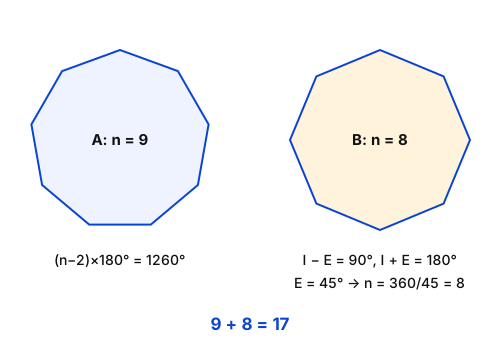
Let A and B be two regular polygons. The sum of the interior angles of A is 1260°. Each interior angle of B exceeds its exterior angle by 90°. Find the sum of the number of sides of A and B.
मान लीजिए A और B दो सम बहुभुज हैं। A के अंतःकोणों का योग 1260° है। B का प्रत्येक अंतःकोण उसके बहिष्कोण से 90° अधिक है। A और B की भुजाओं की संख्या का योग ज्ञात कीजिए।
  1. A15
  2. B17
  3. C18
  4. D19
Show answer

Concept: Sum of interior angles =(n−2)×180∘; each exterior angle of a regular polygon =360∘n.

  1. A: (n−2)×180∘=1260∘ → n−2=7 → n=9.
  2. B: I−E=90∘ and I+E=180∘ → E=45∘.
  3. B: n=36045=8.
  4. Sum =9+8=17.

Yaad rakhein: Interior + exterior =180∘ always.

Answer: (B) 17

अवधारणा: अंतः कोणों का योग =(n−2)×180∘; सम बहुभुज का प्रत्येक बाह्य कोण =360∘n।

  1. A: (n−2)×180∘=1260∘ → n−2=7 → n=9।
  2. B: I−E=90∘ और I+E=180∘ → E=45∘।
  3. B: n=36045=8।
  4. योग =9+8=17।

याद रखें: अंतः कोण + बाह्य कोण =180∘ सदैव।

उत्तर: (B) 17

RRB NTPC Undergraduate CBT 1MathematicsPolygons – AnglesRRB NTPC Undergraduate CBT 1 2024 · 9 Sep Shift 2 →
Q3370.
Pipe P can fill 29 part of a tank in 20 hours, and pipe Q can fill 25 part of the same tank in 18 hours. Both P and Q were kept open for 3 hours, then both were closed. Pipe R alone was then opened and it emptied the water in the tank in 4 hours. Pipes P, Q and R together can fill the empty tank in:
पाइप P किसी टंकी का 29 भाग 20 घंटे में भर सकता है, और पाइप Q उसी टंकी का 25 भाग 18 घंटे में भर सकता है। P और Q दोनों को 3 घंटे तक खुला रखा गया, फिर दोनों को बंद कर दिया गया। इसके बाद केवल पाइप R को खोला गया और इसने 4 घंटे में टंकी का पानी खाली कर दिया। पाइप P, Q और R एक साथ खाली टंकी को कितने समय में भर सकते हैं?
  1. A100 hours100 घंटे
  2. B120 hours120 घंटे
  3. C101 hours101 घंटे
  4. D134 hours134 घंटे
Show answer

Concept: Find each pipe's full-tank time, then add rates (emptying pipe negative).

  1. P: 29 in 20 h → full in 90 h. Q: 25 in 18 h → full in 45 h.
  2. In 3 h: 3(190+145)=110 tank filled.
  3. R empties 110 in 4 h → full tank in 40 h.
  4. Net rate =190+145−140=4+8−9360=1120 → 120 hours.

Trick: Work in units: LCM 360 → P =4, Q =8, R =−9 per hour → net 3 → 3603=120.

Answer: (B) 120 hours

अवधारणा: हर पाइप का पूरी टंकी भरने का समय निकालें, फिर दरें जोड़ें (खाली करने वाला ऋणात्मक)।

  1. P: 20 घंटे में 29 → पूरी 90 घंटे में। Q: 18 घंटे में 25 → पूरी 45 घंटे में।
  2. 3 घंटे में: 3(190+145)=110 भाग भरा।
  3. R, 110 भाग 4 घंटे में खाली करता है → पूरी टंकी 40 घंटे में।
  4. शुद्ध दर =190+145−140=4+8−9360=1120 → 120 घंटे।

ट्रिक: इकाई विधि: LCM 360 → P =4, Q =8, R =−9 प्रति घंटा → शुद्ध 3 → 3603=120।

उत्तर: (B) 120 घंटे

RRB NTPC Undergraduate CBT 1MathematicsPipes and CisternsRRB NTPC Undergraduate CBT 1 2024 · 9 Sep Shift 2 →
Q3371.
AQWE is related to FVBJ in a certain way based on the English alphabetical order. In the same way, UKQY is related to ZPVD. To which of the following is JZFN related, following the same logic?
अंग्रेज़ी वर्णमाला क्रम के आधार पर AQWE एक निश्चित प्रकार से FVBJ से संबंधित है। उसी प्रकार, UKQY, ZPVD से संबंधित है। समान तर्क का अनुसरण करते हुए, JZFN निम्नलिखित में से किससे संबंधित है?
  1. AOEKS
  2. BOKIU
  3. CKIOP
  4. DOKIT
Show answer

Concept: Find the shift of each letter position from the first cluster to the second.

  1. A→F, Q→V, W→B, E→J: every letter +5.
  2. Check: U→Z, K→P, Q→V, Y→D (+5) ✓.
  3. JZFN +5: J→O, Z→E, F→K, N→S = OEKS.

Trick: After Z wrap around: Z +5 = E (26 + 5 = 31 → 5).

Answer: (A) OEKS

अवधारणा: पहले समूह से दूसरे समूह तक हर अक्षर का स्थानांतरण (shift) देखें।

  1. A→F, Q→V, W→B, E→J: हर अक्षर +5।
  2. जाँच: U→Z, K→P, Q→V, Y→D (+5) ✓।
  3. JZFN +5: J→O, Z→E, F→K, N→S = OEKS।

ट्रिक: Z के बाद फिर A से गिनें: Z +5 = E।

उत्तर: (A) OEKS

RRB NTPC Undergraduate CBT 1General Intelligence and ReasoningLetter AnalogyRRB NTPC Undergraduate CBT 1 2024 · 9 Sep Shift 2 →
Q3372.
OWLS is related to TRPO in a certain way based on the English alphabetical order. In the same way, YMTK is related to DHXG. To which of the following is ICBC related, following the same logic?
अंग्रेज़ी वर्णमाला क्रम के आधार पर OWLS एक निश्चित प्रकार से TRPO से संबंधित है। उसी प्रकार, YMTK, DHXG से संबंधित है। समान तर्क का अनुसरण करते हुए, ICBC निम्नलिखित में से किससे संबंधित है?
  1. AOWGX
  2. BNXFY
  3. CNWEX
  4. DMYEZ
Show answer

Concept: Find the position-wise shift between the two clusters.

  1. OWLS→TRPO: +5,−5,+4,−4.
  2. YMTK→DHXG: +5,−5,+4,−4 ✓.
  3. ICBC: I+5=N, C−5=X, B+4=F, C−4=Y → NXFY.

Trick: Backward wrap: C −5 → X, C −4 → Y.

Answer: (B) NXFY

अवधारणा: दोनों समूहों में स्थान-वार स्थानांतरण देखें।

  1. OWLS→TRPO: +5,−5,+4,−4।
  2. YMTK→DHXG: +5,−5,+4,−4 ✓।
  3. ICBC: I+5=N, C−5=X, B+4=F, C−4=Y → NXFY।

ट्रिक: पीछे की ओर: C −5 → X, C −4 → Y।

उत्तर: (B) NXFY

RRB NTPC Undergraduate CBT 1General Intelligence and ReasoningLetter AnalogyRRB NTPC Undergraduate CBT 1 2024 · 9 Sep Shift 2 →
Q3373.
Based on the English alphabetical order, three of the following four letter-cluster pairs are alike in a certain way and thus form a group. Which letter-cluster pair DOES NOT belong to that group?
(Note: The odd one out is not based on the number of consonants/vowels or their position in the letter-cluster.)
अंग्रेज़ी वर्णमाला क्रम के आधार पर, निम्नलिखित चार अक्षर-समूह युग्मों में से तीन किसी निश्चित प्रकार से एकसमान हैं और इस प्रकार एक समूह बनाते हैं। कौन-सा अक्षर-समूह युग्म उस समूह से संबंधित नहीं है?
(ध्यान दें: असंगत अक्षर-समूह, उस अक्षर-समूह में व्यंजनों/स्वरों की संख्या या उनके स्थान पर आधारित नहीं है।)
  1. AWA - SF
  2. BDY - ZD
  3. CZG - VL
  4. DME - HJ
Show answer

Concept: In each pair check: 1st letter → 3rd letter and 2nd letter → 4th letter.

  1. WA-SF: W−4=S, A+5=F.
  2. DY-ZD: D−4=Z, Y+5=D; ZG-VL: Z−4=V, G+5=L.
  3. ME-HJ: M−5=H, E+5=J – first shift is −5, not −4.

Trick: Pattern (−4,+5) in three pairs; the odd one breaks only the first shift.

Answer: (D) ME - HJ

अवधारणा: हर जोड़ी में देखें: पहला → तीसरा अक्षर और दूसरा → चौथा अक्षर।

  1. WA-SF: W−4=S, A+5=F।
  2. DY-ZD: D−4=Z, Y+5=D; ZG-VL: Z−4=V, G+5=L।
  3. ME-HJ: M−5=H, E+5=J – पहला बदलाव −5 है, −4 नहीं।

ट्रिक: तीन जोड़ियों में (−4,+5); विषम जोड़ी में पहला बदलाव अलग है।

उत्तर: (D) ME - HJ

RRB NTPC Undergraduate CBT 1General Intelligence and ReasoningOdd One Out – Letter PairsRRB NTPC Undergraduate CBT 1 2024 · 9 Sep Shift 2 →
Q3374.
If 1 is added for each odd digit and 1 is subtracted from each even digit of the number 86435621, how many digits are repeated more than once in the new number formed?
यदि संख्या 86435621 के प्रत्येक विषम अंक में 1 जोड़ा जाए और प्रत्येक सम अंक में से 1 घटाया जाए, तो इस प्रकार बनी नई संख्या में कितने अंक एक से अधिक बार आते हैं?
  1. ANoneकोई नहीं
  2. BOneएक
  3. CMore than twoदो से अधिक
  4. DTwoदो
Show answer

Concept: Apply the rule digit by digit, then count digits that appear more than once.

  1. 86435621: 8→7, 6→5, 4→3, 3→4, 5→6, 6→5, 2→1, 1→2.
  2. New number: 75346512.
  3. Only 5 appears twice; all other digits appear once.

Trick: Equal original digits give equal new digits: the two 6s both become 5.

Answer: (B) One

अवधारणा: नियम हर अंक पर लगाएँ, फिर एक से अधिक बार आने वाले अंक गिनें।

  1. 86435621: 8→7, 6→5, 4→3, 3→4, 5→6, 6→5, 2→1, 1→2।
  2. नई संख्या: 75346512।
  3. केवल 5 दो बार आता है; बाकी अंक एक-एक बार।

ट्रिक: मूल में समान अंक नए में भी समान रहेंगे: दोनों 6 → 5।

उत्तर: (B) एक

RRB NTPC Undergraduate CBT 1General Intelligence and ReasoningNumber OperationsRRB NTPC Undergraduate CBT 1 2024 · 9 Sep Shift 2 →
Q3375.
Each of the digits in the number 6243514 is arranged in ascending order from left to right. What will be the sum of the digits which are second from the left and third from the right in the new number thus formed?
संख्या 6243514 के प्रत्येक अंक को बाएँ से दाएँ आरोही क्रम में व्यवस्थित किया जाता है। इस प्रकार बनी नई संख्या में बाएँ से दूसरे और दाएँ से तीसरे अंकों का योग क्या होगा?
  1. A7
  2. B5
  3. C8
  4. D6
Show answer

Concept: Arrange the digits in ascending order and read positions.

  1. 6243514 → ascending: 1 2 3 4 4 5 6.
  2. Second from left =2; third from right =4.
  3. Sum =2+4=6.

Trick: Repeated digits (4, 4) are both kept while sorting.

Answer: (D) 6

अवधारणा: अंकों को आरोही क्रम में लगाकर स्थान पढ़ें।

  1. 6243514 → आरोही: 1 2 3 4 4 5 6।
  2. बाएँ से दूसरा =2; दाएँ से तीसरा =4।
  3. योग =2+4=6।

ट्रिक: क्रमबद्ध करते समय दोहराए अंक (4, 4) दोनों रखें।

उत्तर: (D) 6

RRB NTPC Undergraduate CBT 1General Intelligence and ReasoningDigit ArrangementRRB NTPC Undergraduate CBT 1 2024 · 9 Sep Shift 2 →
Q3376.
In the following number-pairs, the second number is obtained by applying certain mathematical operations to the first number. Select the set in which the numbers are related in the same way as are the numbers of the following sets.
(NOTE: Operations should be performed on the whole numbers, without breaking down the numbers into their constituent digits. E.g. 13 – Operations on 13 such as
adding/subtracting/multiplying to 13 can be performed. Breaking down 13 into 1 and 3 and then performing mathematical operations on 1 and 3 is not allowed.)
45, 165
21, 141
निम्नलिखित संख्या-युग्मों में, पहली संख्या पर कुछ गणितीय संक्रियाएँ करके दूसरी संख्या प्राप्त की जाती है। उस समुच्चय का चयन कीजिए जिसमें संख्याएँ उसी प्रकार संबंधित हैं जिस प्रकार निम्नलिखित समुच्चयों की संख्याएँ संबंधित हैं।
(ध्यान दें: संक्रियाएँ संख्याओं को उनके घटक अंकों में विभाजित किए बिना, पूर्ण संख्याओं पर की जानी चाहिए। उदाहरण के लिए 13 – 13 पर संक्रियाएँ जैसे
13 में जोड़ना/घटाना/गुणा करना आदि किया जा सकता है। 13 को 1 और 3 में विभाजित करना और फिर 1 और 3 पर गणितीय संक्रियाएँ करना वर्जित है।)
45, 165
21, 141
  1. A25, 155
  2. B38, 158
  3. C12, 122
  4. D32, 162
Show answer

Concept: Find the common operation linking the first and second number in the given pairs.

  1. 45+120=165 and 21+120=141.
  2. Rule: second = first +120.
  3. Options: 25+120=145≠155; 38+120=158 ✓; 12+120=132; 32+120=152.

Trick: Subtract: 165−45=141−21=120 – the same gap.

Answer: (B) 38, 158

अवधारणा: दिए गए युग्मों में पहली और दूसरी संख्या का संबंध खोजें।

  1. 45+120=165 और 21+120=141।
  2. नियम: दूसरी = पहली +120।
  3. विकल्प: 25+120=145≠155; 38+120=158 ✓; 12+120=132; 32+120=152।

ट्रिक: अंतर देखें: 165−45=141−21=120 – समान।

उत्तर: (B) 38, 158

RRB NTPC Undergraduate CBT 1General Intelligence and ReasoningNumber Pair AnalogyRRB NTPC Undergraduate CBT 1 2024 · 9 Sep Shift 2 →
Q3377.
If 2 is added to each even digit and 3 is subtracted from each odd digit in the number 6325497, what will be the sum of the greatest and smallest digit in the number thus formed?
यदि संख्या 6325497 के प्रत्येक सम अंक में 2 जोड़ा जाए और प्रत्येक विषम अंक में से 3 घटाया जाए, तो इस प्रकार बनी संख्या में सबसे बड़े और सबसे छोटे अंक का योग क्या होगा?
  1. A6
  2. B10
  3. C8
  4. D12
Show answer

Concept: Apply the rule to every digit, then find the largest and smallest digits.

  1. 6325497: 6→8, 3→0, 2→4, 5→2, 4→6, 9→6, 7→4.
  2. New number: 8042664.
  3. Greatest =8, smallest =0; sum =8.

Trick: Even +2, odd −3 – do not swap the rule.

Answer: (C) 8

अवधारणा: हर अंक पर नियम लगाएँ, फिर सबसे बड़ा और सबसे छोटा अंक देखें।

  1. 6325497: 6→8, 3→0, 2→4, 5→2, 4→6, 9→6, 7→4।
  2. नई संख्या: 8042664।
  3. सबसे बड़ा =8, सबसे छोटा =0; योग =8।

ट्रिक: सम +2, विषम −3 – नियम उलटा न करें।

उत्तर: (C) 8

RRB NTPC Undergraduate CBT 1General Intelligence and ReasoningNumber OperationsRRB NTPC Undergraduate CBT 1 2024 · 9 Sep Shift 2 →
Q3378.
Aditya ranked 19th from the top and 29th from the bottom in his class. How many students are there in his class?
आदित्य अपनी कक्षा में ऊपर से 19वें और नीचे से 29वें स्थान पर है। उसकी कक्षा में कितने विद्यार्थी हैं?
  1. A46
  2. B48
  3. C47
  4. D49
Show answer

Concept: Total = rank from top + rank from bottom −1.

  1. Rank from top =19, from bottom =29.
  2. Aditya is counted in both, so subtract 1.
  3. Total =19+29−1=47.

Yaad rakhein: Same person from both ends → always "−1".

Answer: (C) 47

अवधारणा: कुल = ऊपर से रैंक + नीचे से रैंक −1।

  1. ऊपर से रैंक =19, नीचे से =29।
  2. आदित्य दोनों में गिना गया, इसलिए 1 घटाएँ।
  3. कुल =19+29−1=47।

याद रखें: एक ही व्यक्ति दोनों ओर से → हमेशा "−1"।

उत्तर: (C) 47

RRB NTPC Undergraduate CBT 1General Intelligence and ReasoningRankingRRB NTPC Undergraduate CBT 1 2024 · 9 Sep Shift 2 →
Q3379.
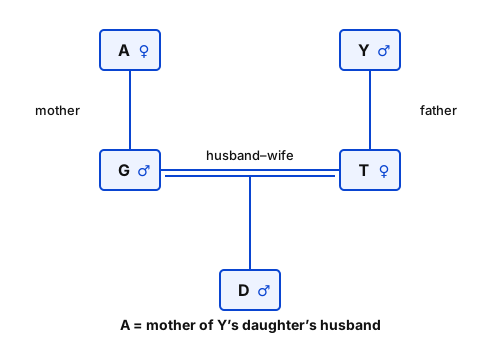
A is the mother of G. G is the father of D. D is the son of T. Y is the father of T. How is A related to Y?
A, G की माता है। G, D का पिता है। D, T का पुत्र है। Y, T का पिता है। A का Y से क्या संबंध है?
  1. ADaughter's husband's sisterपुत्री के पति की बहन
  2. BHusband's motherपति की माता
  3. CHusband's sisterपति की बहन
  4. DDaughter's husband's motherपुत्री के पति की माता
Show answer

Concept: Draw a family tree from the given relations.

  1. A is the mother of G; G is the father of D (G is male).
  2. D is the son of T, so T is G's wife.
  3. Y is T's father, so T is Y's daughter and G is Y's daughter's husband.
  4. A (G's mother) = Y's daughter's husband's mother.

Trick: Relate A to Y through the couple G–T in the middle generation.

Answer: (D) Daughter's husband's mother

अवधारणा: दिए गए संबंधों से वंश-वृक्ष बनाएँ।

  1. A, G की माता है; G, D का पिता है (G पुरुष)।
  2. D, T का पुत्र है, अतः T, G की पत्नी है।
  3. Y, T का पिता है, अतः T, Y की पुत्री और G, Y की पुत्री का पति (दामाद) है।
  4. A (G की माता) = Y की पुत्री के पति की माता।

ट्रिक: बीच की पीढ़ी के दंपति G–T से A को Y से जोड़ें।

उत्तर: (D) पुत्री के पति की माता (Daughter's husband's mother)

RRB NTPC Undergraduate CBT 1General Intelligence and ReasoningBlood RelationRRB NTPC Undergraduate CBT 1 2024 · 9 Sep Shift 2 →
Q3380.
What should come in place of the question mark (?) in the given series?
9 25 50 82 123 ?
दी गई शृंखला में प्रश्न चिह्न (?) के स्थान पर क्या आना चाहिए?
9 25 50 82 123 ?
  1. A117
  2. B127
  3. C171
  4. D172
Show answer

Concept: Look at the differences between consecutive terms.

  1. Differences: 16,25,32,41.
  2. They alternately increase by +9 and +7: 16→25 (+9), 25→32 (+7), 32→41 (+9).
  3. Next difference =41+7=48; term =123+48=171.

Trick: Second-level differences 9,7,9,… alternate.

Answer: (C) 171

अवधारणा: क्रमागत पदों के अंतर देखें।

  1. अंतर: 16,25,32,41।
  2. अंतर बारी-बारी से +9 और +7 बढ़ते हैं: 16→25 (+9), 25→32 (+7), 32→41 (+9)।
  3. अगला अंतर =41+7=48; पद =123+48=171।

ट्रिक: दूसरे स्तर के अंतर 9,7,9,… बारी-बारी से।

उत्तर: (C) 171

RRB NTPC Undergraduate CBT 1General Intelligence and ReasoningNumber SeriesRRB NTPC Undergraduate CBT 1 2024 · 9 Sep Shift 2 →