Question bank

Q&A: practice questions with answers

Search questions on any topic. Filter by exam category, exam, subject and topic, try the question, then open the answer and explanation.

Courses – airGurukul

8,500 questions found.

Q3381.
In a certain code language, ‘BEST’ is coded as ‘5237’ and ‘SINK’ is coded as ‘6142’. What is the code for ‘S’ in the given code language?
एक निश्चित कूट भाषा में, ‘BEST’ को ‘5237’ के रूप में कूटबद्ध किया जाता है और ‘SINK’ को ‘6142’ के रूप में कूटबद्ध किया जाता है। दी गई कूट भाषा में ‘S’ के लिए कूट क्या है?
  1. A6
  2. B2
  3. C3
  4. D4
Show answer

Concept: A letter common to both words takes the digit common to both codes.

  1. BEST and SINK have only S in common.
  2. 5237 and 6142 have only 2 in common.
  3. So S = 2.

Trick: Common letter ↔ common digit; order of digits does not matter.

Answer: (B) 2

अवधारणा: दोनों शब्दों में उभयनिष्ठ अक्षर का कोड दोनों कोडों का उभयनिष्ठ अंक होगा।

  1. BEST और SINK में केवल S उभयनिष्ठ है।
  2. 5237 और 6142 में केवल 2 उभयनिष्ठ है।
  3. अतः S = 2।

ट्रिक: उभयनिष्ठ अक्षर ↔ उभयनिष्ठ अंक; अंकों का क्रम मायने नहीं रखता।

उत्तर: (B) 2
RRB NTPC Undergraduate CBT 1General Intelligence and ReasoningCoding-DecodingRRB NTPC Undergraduate CBT 1 2024 · 9 Sep Shift 2 →
Q3382.
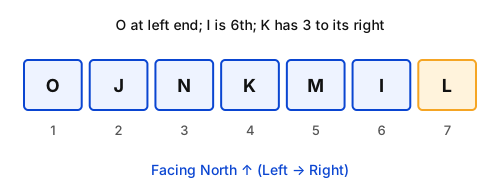
Seven people, I, J, K, L, M, N and O, are sitting in a row, facing north. No one sits to the left of O. Only four people sit between O and I. Only three people sit to the right of K. J sits to the immediate left of N. L is not an immediate neighbour of K. Who sits at the rightmost end of the line?
सात व्यक्ति, I, J, K, L, M, N और O, उत्तर की ओर मुख करके एक पंक्ति में बैठे हैं। O के बाईं ओर कोई नहीं बैठा है। O और I के बीच केवल चार व्यक्ति बैठे हैं। K के दाईं ओर केवल तीन व्यक्ति बैठे हैं। J, N के ठीक बाईं ओर बैठा है। L, K का निकटतम पड़ोसी नहीं है। पंक्ति के सबसे दाएँ छोर पर कौन बैठा है?
  1. AL
  2. BI
  3. CK
  4. DN
Show answer

Concept: Fix definite positions first (left end, counts), then place pairs.

  1. No one is left of O → O is 1st. Four between O and I → I is 6th.
  2. Three to the right of K → K is 4th.
  3. J immediately left of N: only 2–3 is free → J 2nd, N 3rd.
  4. L not next to K → L is 7th, M is 5th: O J N K M I L.

Trick: Facing north: left of the line = your left.

Answer: (A) L

अवधारणा: पहले निश्चित स्थान (बाएँ सिरा, गिनती) तय करें, फिर जोड़ियाँ रखें।

  1. O के बाएँ कोई नहीं → O पहला। O और I के बीच चार → I छठा।
  2. K के दाएँ तीन → K चौथा।
  3. J, N के ठीक बाएँ: केवल 2–3 खाली → J दूसरा, N तीसरा।
  4. L, K का पड़ोसी नहीं → L सातवाँ, M पाँचवाँ: O J N K M I L।

ट्रिक: उत्तर की ओर मुख: पंक्ति का बायाँ = आपका बायाँ।

उत्तर: (A) L

RRB NTPC Undergraduate CBT 1General Intelligence and ReasoningLinear Seating ArrangementRRB NTPC Undergraduate CBT 1 2024 · 9 Sep Shift 2 →
Q3383.
XSLE is related to AWOI in a certain way based on the English alphabetical order. In the same way, JIXU is related to MMAY. To which of the following options is SUGG related, following the same logic?
अंग्रेज़ी वर्णमाला क्रम के आधार पर XSLE एक निश्चित प्रकार से AWOI से संबंधित है। उसी प्रकार, JIXU, MMAY से संबंधित है। समान तर्क का अनुसरण करते हुए, SUGG निम्नलिखित में से किस विकल्प से संबंधित है?
  1. AVYJK
  2. BVIKU
  3. CVJKU
  4. DVYKI
Show answer

Concept: Find the shift of each letter position-wise.

  1. XSLE→AWOI: +3,+4,+3,+4.
  2. JIXU→MMAY: +3,+4,+3,+4 ✓.
  3. SUGG: S+3=V, U+4=Y, G+3=J, G+4=K → VYJK.

Trick: Alternating +3,+4 – the two Gs get different letters.

Answer: (A) VYJK

अवधारणा: हर अक्षर का स्थान-वार स्थानांतरण देखें।

  1. XSLE→AWOI: +3,+4,+3,+4।
  2. JIXU→MMAY: +3,+4,+3,+4 ✓।
  3. SUGG: S+3=V, U+4=Y, G+3=J, G+4=K → VYJK।

ट्रिक: बारी-बारी +3,+4 – दोनों G के अक्षर अलग होंगे।

उत्तर: (A) VYJK

RRB NTPC Undergraduate CBT 1General Intelligence and ReasoningLetter AnalogyRRB NTPC Undergraduate CBT 1 2024 · 9 Sep Shift 2 →
Q3384.
Refer to the following number and symbol series and answer the question that follows. Counting to be done from left to right only.
(Left) 9 & # 3 % £ 4 7 & 2 $ * 5 Ω 6 1 @ 8 (Right)
How many such symbols are there, each of which is immediately preceded by a number and also immediately followed by another number?
निम्नलिखित संख्या और प्रतीक शृंखला का संदर्भ लीजिए और आगे दिए गए प्रश्न का उत्तर दीजिए। गिनती केवल बाएँ से दाएँ की जानी है।
(बाएँ) 9 & # 3 % £ 4 7 & 2 $ * 5 Ω 6 1 @ 8 (दाएँ)
ऐसे कितने प्रतीक हैं, जिनमें से प्रत्येक के ठीक पहले एक संख्या है और ठीक बाद भी एक अन्य संख्या है?
  1. ANoneकोई नहीं
  2. BMore than twoदो से अधिक
  3. CTwoदो
  4. DOneएक
Show answer

Concept: Scan each symbol and check its immediate left and right neighbours.

  1. Number–symbol–number blocks: 7 & 2, 5 Ω 6, 1 @ 8.
  2. Other symbols fail (e.g. 9 & # – next is a symbol).
  3. Count =3, i.e. more than two.

Trick: Look for the pattern digit-symbol-digit directly.

Answer: (B) More than two

अवधारणा: हर प्रतीक के ठीक बाएँ और दाएँ पड़ोसी जाँचें।

  1. संख्या–प्रतीक–संख्या समूह: 7 & 2, 5 Ω 6, 1 @ 8।
  2. अन्य प्रतीक शर्त पूरी नहीं करते (जैसे 9 & # – आगे प्रतीक है)।
  3. संख्या =3, यानी दो से अधिक।

ट्रिक: सीधे अंक-प्रतीक-अंक का पैटर्न खोजें।

उत्तर: (B) दो से अधिक

RRB NTPC Undergraduate CBT 1General Intelligence and ReasoningNumber-Symbol SeriesRRB NTPC Undergraduate CBT 1 2024 · 9 Sep Shift 2 →
Q3385.
In a certain code language, ‘WANT’ is coded as ‘3517’ and ‘TIDE’ is coded as ‘2146’. What is the code for ‘T’ in the given code language?
एक निश्चित कूट भाषा में, ‘WANT’ को ‘3517’ के रूप में कूटबद्ध किया जाता है और ‘TIDE’ को ‘2146’ के रूप में कूटबद्ध किया जाता है। दी गई कूट भाषा में ‘T’ के लिए कूट क्या है?
  1. A1
  2. B5
  3. C2
  4. D6
Show answer

Concept: A letter common to both words takes the digit common to both codes.

  1. WANT and TIDE have only T in common.
  2. 3517 and 2146 have only 1 in common.
  3. So T = 1.

Trick: Common letter ↔ common digit.

Answer: (A) 1

अवधारणा: दोनों शब्दों में उभयनिष्ठ अक्षर का कोड दोनों कोडों का उभयनिष्ठ अंक होगा।

  1. WANT और TIDE में केवल T उभयनिष्ठ है।
  2. 3517 और 2146 में केवल 1 उभयनिष्ठ है।
  3. अतः T = 1।

ट्रिक: उभयनिष्ठ अक्षर ↔ उभयनिष्ठ अंक।

उत्तर: (A) 1

RRB NTPC Undergraduate CBT 1General Intelligence and ReasoningCoding-DecodingRRB NTPC Undergraduate CBT 1 2024 · 9 Sep Shift 2 →
Q3386.
What should come in place of the question mark (?) in the given series?
97, 101, 110, 126, 151, ?
दी गई शृंखला में प्रश्न चिह्न (?) के स्थान पर क्या आना चाहिए?
97, 101, 110, 126, 151, ?
  1. A178
  2. B186
  3. C185
  4. D187
Show answer

Concept: Look at the differences between consecutive terms.

  1. Differences: 4,9,16,25 = 22,32,42,52.
  2. Next difference =62=36.
  3. Next term =151+36=187.

Trick: Differences that are perfect squares are very common in NTPC series.

Answer: (D) 187

अवधारणा: क्रमागत पदों के अंतर देखें।

  1. अंतर: 4,9,16,25 = 22,32,42,52।
  2. अगला अंतर =62=36।
  3. अगला पद =151+36=187।

ट्रिक: पूर्ण वर्ग अंतर NTPC श्रृंखला में बहुत आम हैं।

उत्तर: (D) 187

RRB NTPC Undergraduate CBT 1General Intelligence and ReasoningNumber SeriesRRB NTPC Undergraduate CBT 1 2024 · 9 Sep Shift 2 →
Q3387.
What should come in place of the question mark (?) in the given series based on the English alphabetical order?
WGO GRA QCM ANY ?
अंग्रेज़ी वर्णमाला क्रम के आधार पर दी गई शृंखला में प्रश्न चिह्न (?) के स्थान पर क्या आना चाहिए?
WGO GRA QCM ANY ?
  1. AKUK
  2. BYKK
  3. CKYK
  4. DKKY
Show answer

Concept: Track each letter position separately across the clusters.

  1. 1st letters W, G, Q, A: +10 each → A+10 = K.
  2. 2nd letters G, R, C, N: +11 each → N+11 = Y.
  3. 3rd letters O, A, M, Y: +12 each → Y+12 = K.
  4. Answer cluster: KYK.

Trick: Shifts +10,+11,+12 by position; wrap after Z.

Answer: (C) KYK

अवधारणा: हर स्थान के अक्षर को अलग-अलग देखें।

  1. पहले अक्षर W, G, Q, A: हर बार +10 → A+10 = K।
  2. दूसरे अक्षर G, R, C, N: हर बार +11 → N+11 = Y।
  3. तीसरे अक्षर O, A, M, Y: हर बार +12 → Y+12 = K।
  4. उत्तर: KYK।

ट्रिक: स्थान के अनुसार +10,+11,+12; Z के बाद फिर A से।

उत्तर: (C) KYK

RRB NTPC Undergraduate CBT 1General Intelligence and ReasoningLetter SeriesRRB NTPC Undergraduate CBT 1 2024 · 9 Sep Shift 2 →
Q3388.
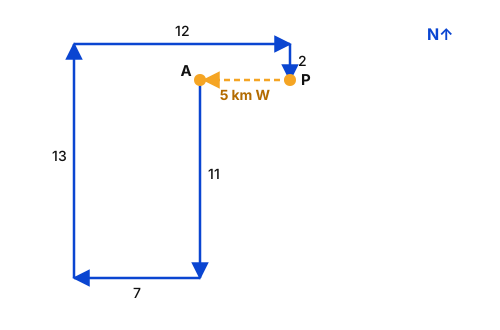
Manoj starts from Point A and drives 11 km towards the south. He then takes a right turn and drives 7 km, then turns right and drives 13 km. He then takes a right turn and drives 12 km. He takes a final right turn, drives 2 km and stops at Point P. How far (shortest distance) and in which direction should he drive in order to reach Point A again? (All turns are 90-degree turns only unless specified.)
मनोज बिंदु A से चलना शुरू करता है और दक्षिण की ओर 11 km ड्राइव करता है। फिर वह दाएँ मुड़ता है और 7 km ड्राइव करता है, फिर दाएँ मुड़ता है और 13 km ड्राइव करता है। फिर वह दाएँ मुड़ता है और 12 km ड्राइव करता है। वह अंतिम बार दाएँ मुड़ता है, 2 km ड्राइव करता है और बिंदु P पर रुक जाता है। बिंदु A पर फिर से पहुँचने के लिए उसे कितनी दूरी (न्यूनतम दूरी) और किस दिशा में ड्राइव करना चाहिए? (जब तक निर्दिष्ट न हो, सभी मोड़ केवल 90-डिग्री के मोड़ हैं।)
  1. A4 km to the westपश्चिम की ओर 4 km
  2. B5 km to the eastपूर्व की ओर 5 km
  3. C5 km to the westपश्चिम की ओर 5 km
  4. D4 km to the eastपूर्व की ओर 4 km
Show answer

Concept: Plot the path with coordinates, taking A at the origin and north upward.

  1. South 11 → (0,−11); right (west) 7 → (−7,−11).
  2. Right (north) 13 → (−7,2); right (east) 12 → (5,2).
  3. Right (south) 2 → P =(5,0).
  4. A (0,0) is 5 km to the west of P.

Trick: Net E–W: −7+12=5 east; net N–S: −11+13−2=0 → go 5 km west.

Answer: (C) 5 km to the west

अवधारणा: A को मूल बिंदु और उत्तर को ऊपर मानकर पथ बनाएँ।

  1. दक्षिण 11 → (0,−11); दाएँ (पश्चिम) 7 → (−7,−11)।
  2. दाएँ (उत्तर) 13 → (−7,2); दाएँ (पूर्व) 12 → (5,2)।
  3. दाएँ (दक्षिण) 2 → P =(5,0)।
  4. A (0,0), P से 5 km पश्चिम में है।

ट्रिक: शुद्ध पूर्व–पश्चिम: −7+12=5 पूर्व; उत्तर–दक्षिण: −11+13−2=0 → 5 km पश्चिम जाएँ।

उत्तर: (C) 5 km पश्चिम की ओर

RRB NTPC Undergraduate CBT 1General Intelligence and ReasoningDirection and DistanceRRB NTPC Undergraduate CBT 1 2024 · 9 Sep Shift 2 →
Q3389.
Based on the English alphabetical order, three of the following four letter-clusters are alike in a certain way and thus form a group. Which letter-cluster DOES NOT belong to that group?
(Note: The odd one out is not based on the number of consonants/vowels or their position in the letter-cluster.)
अंग्रेज़ी वर्णमाला क्रम के आधार पर, निम्नलिखित चार अक्षर-समूहों में से तीन किसी निश्चित प्रकार से एकसमान हैं और इस प्रकार एक समूह बनाते हैं। कौन-सा अक्षर-समूह उस समूह से संबंधित नहीं है?
(ध्यान दें: असंगत अक्षर-समूह, उस अक्षर-समूह में व्यंजनों/स्वरों की संख्या या उनके स्थान पर आधारित नहीं है।)
  1. ATWZ
  2. BLQR
  3. CYBE
  4. DPSV
Show answer

Concept: Three clusters follow a fixed gap pattern between consecutive letters.

  1. TWZ: +3,+3; PSV: +3,+3.
  2. YBE: Y+3=B, B+3=E (+3,+3).
  3. LQR: +5,+1 – different.

Trick: Count gaps with wrap-around: Y→B is also +3.

Answer: (B) LQR

अवधारणा: तीन समूहों में क्रमागत अक्षरों के बीच निश्चित अंतर है।

  1. TWZ: +3,+3; PSV: +3,+3।
  2. YBE: Y+3=B, B+3=E (+3,+3)।
  3. LQR: +5,+1 – अलग।

ट्रिक: चक्रीय गिनती: Y→B भी +3 है।

उत्तर: (B) LQR

RRB NTPC Undergraduate CBT 1General Intelligence and ReasoningOdd One Out – LettersRRB NTPC Undergraduate CBT 1 2024 · 9 Sep Shift 2 →
Q3390.
Read the given statements and conclusions carefully. Assuming that the information given in the statements is true, even if it appears to be at variance with commonly known facts, decide which of the given conclusions logically follow(s) from the statements.
Statements:
All chairs are papers.
No chair is a desk.
Conclusions:
(I): No paper is a desk.
(II): All papers are chairs.
दिए गए कथनों और निष्कर्षों को ध्यानपूर्वक पढ़िए। यह मानते हुए कि कथनों में दी गई जानकारी सत्य है, भले ही वह सामान्य रूप से ज्ञात तथ्यों से भिन्न प्रतीत होती हो, निर्णय लीजिए कि दिए गए निष्कर्षों में से कौन-सा/से निष्कर्ष कथनों का तार्किक रूप से अनुसरण करता है/करते हैं।
कथन:
सभी कुर्सियाँ, कागज़ हैं।
कोई कुर्सी, डेस्क नहीं है।
निष्कर्ष:
(I): कोई कागज़, डेस्क नहीं है।
(II): सभी कागज़, कुर्सियाँ हैं।
  1. AOnly Conclusion II followsकेवल निष्कर्ष II अनुसरण करता है
  2. BNeither Conclusion I nor II followsन तो निष्कर्ष I और न ही II अनुसरण करता है
  3. CBoth Conclusions I and II followनिष्कर्ष I और II दोनों अनुसरण करते हैं
  4. DOnly Conclusion I followsकेवल निष्कर्ष I अनुसरण करता है
Show answer

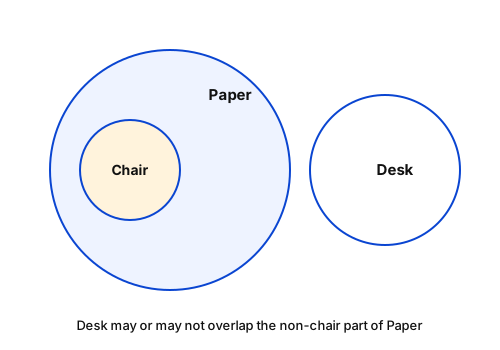
Concept: Draw the least possible Venn diagram and test each conclusion.

  1. Chair lies fully inside Paper; Desk stays outside Chair.
  2. I: Desk may still overlap the non-chair part of Paper – "No paper is a desk" is not certain.
  3. II: Paper may be larger than Chair – "All papers are chairs" is not certain.
  4. So neither follows.

Yaad rakhein: "All A are B" can never be reversed into "All B are A".

Answer: (B) Neither Conclusion I nor II follows

अवधारणा: न्यूनतम संभव वेन आरेख बनाकर हर निष्कर्ष जाँचें।

  1. Chair पूरी तरह Paper के अंदर; Desk, Chair से बाहर।
  2. I: Desk, Paper के बाकी हिस्से से मिल सकता है – "कोई paper desk नहीं" निश्चित नहीं।
  3. II: Paper, Chair से बड़ा हो सकता है – "सभी papers chairs हैं" निश्चित नहीं।
  4. अतः कोई निष्कर्ष नहीं।

याद रखें: "सभी A, B हैं" को उलटकर "सभी B, A हैं" नहीं कह सकते।

उत्तर: (B) न तो निष्कर्ष I और न ही II अनुसरण करता है

RRB NTPC Undergraduate CBT 1General Intelligence and ReasoningSyllogismRRB NTPC Undergraduate CBT 1 2024 · 9 Sep Shift 2 →
Q3391.
If 2 is added to each odd digit and 1 is subtracted from each even digit in the number 6531874, what will be the sum of the digits which are second from the left and second from the right in the new number thus formed?
यदि संख्या 6531874 के प्रत्येक विषम अंक में 2 जोड़ा जाए और प्रत्येक सम अंक में से 1 घटाया जाए, तो इस प्रकार बनी नई संख्या में बाएँ से दूसरे और दाएँ से दूसरे अंकों का योग क्या होगा?
  1. A15
  2. B16
  3. C14
  4. D12
Show answer

Concept: Apply the rule digit by digit and read the required positions.

  1. 6531874: 6→5, 5→7, 3→5, 1→3, 8→7, 7→9, 4→3.
  2. New number: 5753793.
  3. Second from left =7, second from right =9; sum =16.

Trick: Only the two needed digits: 5 (odd) → 7 and 7 (odd) → 9.

Answer: (B) 16

अवधारणा: हर अंक पर नियम लगाएँ और माँगे गए स्थान पढ़ें।

  1. 6531874: 6→5, 5→7, 3→5, 1→3, 8→7, 7→9, 4→3।
  2. नई संख्या: 5753793।
  3. बाएँ से दूसरा =7, दाएँ से दूसरा =9; योग =16।

ट्रिक: केवल ज़रूरी अंक बदलें: 5 → 7 और 7 → 9।

उत्तर: (B) 16

RRB NTPC Undergraduate CBT 1General Intelligence and ReasoningNumber OperationsRRB NTPC Undergraduate CBT 1 2024 · 9 Sep Shift 2 →
Q3392.
Refer to the following number and symbol series and answer the question that follows. Counting to be done from left to right only.
(Note: All numbers are single digit numbers only.)
(Left) @ 8 < 8 @ < 3 ^ # + $ 6 2 ^ 1 ^ > $ (Right)
If all the numbers are dropped from the series, which of the following will be seventh from the left?
निम्नलिखित संख्या और प्रतीक शृंखला का संदर्भ लीजिए और आगे दिए गए प्रश्न का उत्तर दीजिए। गिनती केवल बाएँ से दाएँ की जानी है।
(ध्यान दें: सभी संख्याएँ केवल एक अंक वाली संख्याएँ हैं।)
(बाएँ) @ 8 < 8 @ < 3 ^ # + $ 6 2 ^ 1 ^ > $ (दाएँ)
यदि शृंखला से सभी संख्याओं को हटा दिया जाए, तो निम्नलिखित में से कौन-सा बाएँ से सातवाँ होगा?
  1. A#
  2. B>
  3. C@
  4. D+
Show answer

Concept: Remove all numbers, then count from the left.

  1. Series without numbers: @ < @ < ^ # + $ ^ ^ > $.
  2. Count: 1 @, 2 <, 3 @, 4 <, 5 ^, 6 #, 7 +.
  3. Seventh from left is +.

Trick: Count only symbols up to the 7th place – no need to rewrite the whole series.

Answer: (D) +

अवधारणा: सभी संख्याएँ हटाकर बाएँ से गिनें।

  1. संख्याएँ हटाने पर: @ < @ < ^ # + $ ^ ^ > $।
  2. गिनती: 1 @, 2 <, 3 @, 4 <, 5 ^, 6 #, 7 +।
  3. बाएँ से सातवाँ + है।

ट्रिक: केवल 7वें स्थान तक प्रतीक गिनें – पूरी श्रृंखला दोबारा लिखने की ज़रूरत नहीं।

उत्तर: (D) +

RRB NTPC Undergraduate CBT 1General Intelligence and ReasoningNumber-Symbol SeriesRRB NTPC Undergraduate CBT 1 2024 · 9 Sep Shift 2 →
Q3393.
What should come in place of ? in the given series based on the English alphabetical order?
RTM PRK NPI LNG ?
अंग्रेज़ी वर्णमाला क्रम के आधार पर दी गई शृंखला में ? के स्थान पर क्या आना चाहिए?
RTM PRK NPI LNG ?
  1. AJKF
  2. BJLF
  3. CJLE
  4. DJKE
Show answer

Concept: Track each letter position separately.

  1. 1st letters R, P, N, L: −2 each → J.
  2. 2nd letters T, R, P, N: −2 each → L.
  3. 3rd letters M, K, I, G: −2 each → E. Answer JLE.

Trick: All three positions move back by 2 together.

Answer: (C) JLE

अवधारणा: हर स्थान के अक्षर को अलग से देखें।

  1. पहले अक्षर R, P, N, L: हर बार −2 → J।
  2. दूसरे अक्षर T, R, P, N: हर बार −2 → L।
  3. तीसरे अक्षर M, K, I, G: हर बार −2 → E। उत्तर JLE।

ट्रिक: तीनों स्थान एक साथ 2 पीछे जाते हैं।

उत्तर: (C) JLE

RRB NTPC Undergraduate CBT 1General Intelligence and ReasoningLetter SeriesRRB NTPC Undergraduate CBT 1 2024 · 9 Sep Shift 2 →
Q3394.
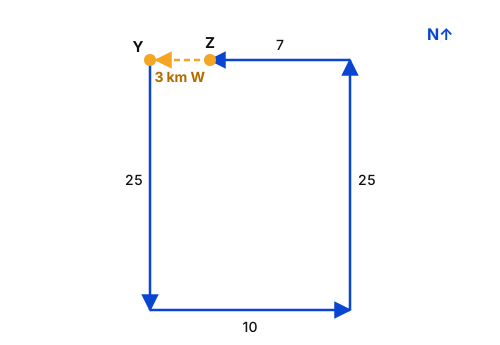
Jwalith starts from Point Y and drives 25 km towards south. He then takes a left turn, drives 10 km. He then turns left and drives 25 km. He takes a final left turn, drives 7 km and stops at Point Z. How far (shortest distance) and towards which direction should he drive in order to reach Point Y again? (All turns are 90-degree turns only unless specified)
ज्वालिथ बिंदु Y से चलना शुरू करता है और दक्षिण की ओर 25 km ड्राइव करता है। फिर वह बाएँ मुड़ता है, 10 km ड्राइव करता है। फिर वह बाएँ मुड़ता है और 25 km ड्राइव करता है। वह अंतिम बार बाएँ मुड़ता है, 7 km ड्राइव करता है और बिंदु Z पर रुक जाता है। बिंदु Y पर फिर से पहुँचने के लिए उसे कितनी दूरी (न्यूनतम दूरी) और किस दिशा में ड्राइव करना चाहिए? (जब तक निर्दिष्ट न हो, सभी मोड़ केवल 90-डिग्री के मोड़ हैं)
  1. A3 km towards westपश्चिम की ओर 3 km
  2. B6 km towards eastपूर्व की ओर 6 km
  3. C25 km towards southदक्षिण की ओर 25 km
  4. D7 km towards northउत्तर की ओर 7 km
Show answer

Concept: Plot the path with Y at the origin and north upward.

  1. South 25 → (0,−25); facing south, left turn = east, 10 → (10,−25).
  2. Left (north) 25 → (10,0); left (west) 7 → Z =(3,0).
  3. Y (0,0) is 3 km west of Z.

Trick: North–south cancels (25−25=0); east–west 10−7=3 east → go 3 km west.

Answer: (A) 3 km towards west

अवधारणा: Y को मूल बिंदु और उत्तर को ऊपर मानकर पथ बनाएँ।

  1. दक्षिण 25 → (0,−25); दक्षिण की ओर मुख से बायाँ = पूर्व, 10 → (10,−25)।
  2. बाएँ (उत्तर) 25 → (10,0); बाएँ (पश्चिम) 7 → Z =(3,0)।
  3. Y (0,0), Z से 3 km पश्चिम में है।

ट्रिक: उत्तर–दक्षिण कट जाते हैं; पूर्व–पश्चिम 10−7=3 पूर्व → 3 km पश्चिम जाएँ।

उत्तर: (A) 3 km पश्चिम की ओर

RRB NTPC Undergraduate CBT 1General Intelligence and ReasoningDirection and DistanceRRB NTPC Undergraduate CBT 1 2024 · 9 Sep Shift 2 →
Q3395.
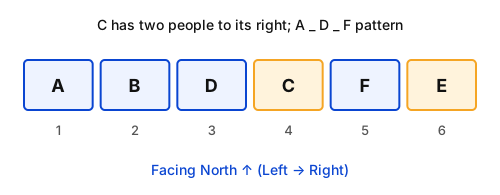
Six people, A, B, C, D, E and F are sitting in a row, facing the north. Only two people are sitting to the right of C. A is sitting second to the left of D. B is sitting to the immediate right of A. F is sitting second to the right of D. Who is sitting second to the left of E?
छह व्यक्ति, A, B, C, D, E और F, उत्तर की ओर मुख करके एक पंक्ति में बैठे हैं। C के दाईं ओर केवल दो व्यक्ति बैठे हैं। A, D के बाईं ओर दूसरे स्थान पर बैठा है। B, A के ठीक दाईं ओर बैठा है। F, D के दाईं ओर दूसरे स्थान पर बैठा है। E के बाईं ओर दूसरे स्थान पर कौन बैठा है?
  1. AA
  2. BD
  3. CF
  4. DC
Show answer

Concept: Place the fixed person first, then fit the A–B–D–F block.

  1. Two people to the right of C → C is 4th of 6.
  2. Block: A, B (immediate right of A), D (2nd right of A), F (2nd right of D) needs positions p,p+1,p+2,p+4.
  3. p=1 works (A1, B2, D3, F5); E takes 6th: A B D C F E.
  4. Second to the left of E (6th) is 4th = C.

Trick: p=2 would put D on C's seat, so p=1 is forced.

Answer: (D) C

अवधारणा: पहले निश्चित व्यक्ति रखें, फिर A–B–D–F समूह बैठाएँ।

  1. C के दाएँ दो लोग → 6 में C चौथा।
  2. समूह: A, B (A के ठीक दाएँ), D (A के दूसरे दाएँ), F (D के दूसरे दाएँ) → स्थान p,p+1,p+2,p+4।
  3. p=1 ठीक (A1, B2, D3, F5); E छठा: A B D C F E।
  4. E (छठा) के बाएँ दूसरा = चौथा = C।

ट्रिक: p=2 पर D, C की जगह आएगा, इसलिए p=1 ही संभव।

उत्तर: (D) C

RRB NTPC Undergraduate CBT 1General Intelligence and ReasoningLinear Seating ArrangementRRB NTPC Undergraduate CBT 1 2024 · 9 Sep Shift 2 →
Q3396.
All 93 students in a class are standing in a row facing north. Veer is 48th from the right end while Kabir is 33rd from the left end. How many people stand between Veer and Kabir?
एक कक्षा के सभी 93 विद्यार्थी उत्तर की ओर मुख करके एक पंक्ति में खड़े हैं। वीर दाएँ छोर से 48वें स्थान पर है जबकि कबीर बाएँ छोर से 33वें स्थान पर है। वीर और कबीर के बीच कितने व्यक्ति खड़े हैं?
  1. A11
  2. B12
  3. C14
  4. D13
Show answer

Concept: Convert both positions to the same end, then subtract.

  1. Veer from left =93−48+1=46.
  2. Kabir from left =33.
  3. People between =46−33−1=12.

Yaad rakhein: Between two positions a<b from the same end: b−a−1.

Answer: (B) 12

अवधारणा: दोनों स्थान एक ही सिरे से बदलें, फिर घटाएँ।

  1. वीर बाएँ से =93−48+1=46।
  2. कबीर बाएँ से =33।
  3. बीच में लोग =46−33−1=12।

याद रखें: एक ही सिरे से a<b स्थानों के बीच: b−a−1।

उत्तर: (B) 12

RRB NTPC Undergraduate CBT 1General Intelligence and ReasoningRankingRRB NTPC Undergraduate CBT 1 2024 · 9 Sep Shift 2 →
Q3397.
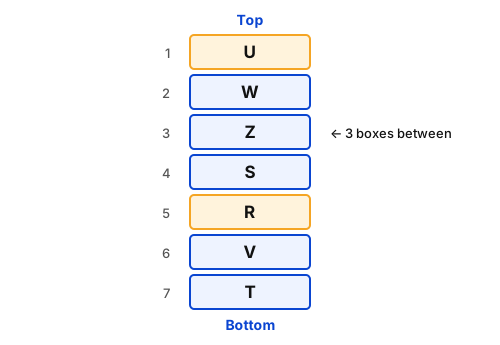
Seven boxes R, S, T, U, V, W and Z are kept one over the other, but not necessarily in the same order. Z is kept immediately above S. V is kept immediately above T. Only U is kept above W. Only two boxes are kept above Z. V is not kept at the third position from the bottom. How many boxes are kept between R and U?
सात बक्से R, S, T, U, V, W और Z एक के ऊपर एक रखे गए हैं, लेकिन ज़रूरी नहीं कि इसी क्रम में हों। Z को S के ठीक ऊपर रखा गया है। V को T के ठीक ऊपर रखा गया है। W के ऊपर केवल U रखा गया है। Z के ऊपर केवल दो बक्से रखे गए हैं। V को नीचे से तीसरे स्थान पर नहीं रखा गया है। R और U के बीच कितने बक्से रखे गए हैं?
  1. AOneएक
  2. BTwoदो
  3. CFourचार
  4. DThreeतीन
Show answer

Concept: Number the positions 1 (top) to 7 (bottom) and fix definite boxes first.

  1. Only U above W → U 1st, W 2nd. Only two above Z → Z 3rd; Z just above S → S 4th.
  2. V just above T: options 5–6 or 6–7; V is not 3rd from bottom (5th) → V 6th, T 7th.
  3. R takes 5th. Order: U W Z S R V T.
  4. Between R (5th) and U (1st): W, Z, S = three boxes.

Trick: 3rd from bottom in 7 boxes = 5th from top.

Answer: (D) Three

अवधारणा: स्थान 1 (ऊपर) से 7 (नीचे) तक मानें और पहले निश्चित डिब्बे रखें।

  1. केवल U, W के ऊपर → U पहला, W दूसरा। Z के ऊपर केवल दो → Z तीसरा; Z के ठीक नीचे S → S चौथा।
  2. V, T के ठीक ऊपर: 5–6 या 6–7; V नीचे से तीसरा (5वाँ) नहीं → V छठा, T सातवाँ।
  3. R पाँचवाँ। क्रम: U W Z S R V T।
  4. R (5) और U (1) के बीच: W, Z, S = तीन डिब्बे।

ट्रिक: 7 डिब्बों में नीचे से तीसरा = ऊपर से पाँचवाँ।

उत्तर: (D) तीन

RRB NTPC Undergraduate CBT 1General Intelligence and ReasoningBox ArrangementRRB NTPC Undergraduate CBT 1 2024 · 9 Sep Shift 2 →
Q3398.
Based on the English alphabetical order, three of the following four letter-cluster pairs are alike in a certain way and thus form a group. Which letter-cluster pair DOES NOT belong to that group?
(Note: The odd one out is not based on the number of consonants/vowels or their position in the letter-cluster.)
अंग्रेज़ी वर्णमाला क्रम के आधार पर, निम्नलिखित चार अक्षर-समूह युग्मों में से तीन किसी निश्चित प्रकार से एकसमान हैं और इस प्रकार एक समूह बनाते हैं। कौन-सा अक्षर-समूह युग्म उस समूह से संबंधित नहीं है?
(ध्यान दें: असंगत अक्षर-समूह, उस अक्षर-समूह में व्यंजनों/स्वरों की संख्या या उनके स्थान पर आधारित नहीं है।)
  1. AHF−DB
  2. BDB−ZX
  3. CVT−RP
  4. DOM−JK
Show answer

Concept: Check the letter gaps inside each pair: 1st→2nd, 1st→3rd, 3rd→4th.

  1. HF−DB: H−2=F, H−4=D, D−2=B.
  2. DB−ZX and VT−RP follow the same −2,−4,−2 pattern.
  3. OM−JK: O−2=M, but O−5=J and J+1=K – different.

Trick: Each valid pair is four letters stepping back by 2: H F D B.

Answer: (D) OM−JK

अवधारणा: हर जोड़ी में अंतर देखें: पहला→दूसरा, पहला→तीसरा, तीसरा→चौथा।

  1. HF−DB: H−2=F, H−4=D, D−2=B।
  2. DB−ZX और VT−RP भी −2,−4,−2 पैटर्न पर।
  3. OM−JK: O−2=M, पर O−5=J और J+1=K – अलग।

ट्रिक: हर सही जोड़ी 2-2 पीछे चलती है: H F D B।

उत्तर: (D) OM−JK

RRB NTPC Undergraduate CBT 1General Intelligence and ReasoningOdd One Out – Letter PairsRRB NTPC Undergraduate CBT 1 2024 · 9 Sep Shift 2 →
Q3399.
Read the given statements and conclusions carefully. Assuming that the information given in the statements is true, even if it appears to be at variance with commonly known facts, decide which of the given conclusions logically follow(s) from the statements.
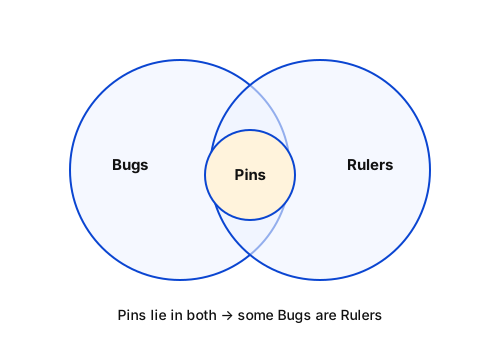
Statements: All pins are bugs. All pins are rulers.
Conclusions (I): Some bugs are rulers.
Conclusions (II): All rulers are pins.
दिए गए कथनों और निष्कर्षों को ध्यानपूर्वक पढ़िए। यह मानते हुए कि कथनों में दी गई जानकारी सत्य है, भले ही वह सामान्य रूप से ज्ञात तथ्यों से भिन्न प्रतीत होती हो, निर्णय लीजिए कि दिए गए निष्कर्षों में से कौन-सा/से निष्कर्ष कथनों का तार्किक रूप से अनुसरण करता है/करते हैं।
कथन: सभी पिन, कीड़े हैं। सभी पिन, रूलर हैं।
निष्कर्ष (I): कुछ कीड़े, रूलर हैं।
निष्कर्ष (II): सभी रूलर, पिन हैं।
  1. AOnly conclusion (II) follows.केवल निष्कर्ष (II) अनुसरण करता है।
  2. BBoth conclusions (I) and (II) follow.निष्कर्ष (I) और (II) दोनों अनुसरण करते हैं।
  3. COnly conclusion (I) follows.केवल निष्कर्ष (I) अनुसरण करता है।
  4. DNeither conclusion (I) nor (II) follows.न तो निष्कर्ष (I) और न ही (II) अनुसरण करता है।
Show answer

Concept: Draw the least possible Venn diagram and test each conclusion.

  1. Pins lie inside Bugs and inside Rulers.
  2. So the Pins region is common to Bugs and Rulers → "Some bugs are rulers" definitely follows.
  3. Rulers may contain items that are not pins → II does not follow.

Yaad rakhein: All A are B + All A are C ⇒ Some B are C (and Some C are B).

Answer: (C) Only conclusion (I) follows.

अवधारणा: न्यूनतम संभव वेन आरेख बनाकर हर निष्कर्ष जाँचें।

  1. Pins, Bugs और Rulers दोनों के अंदर हैं।
  2. अतः Pins वाला भाग Bugs और Rulers में उभयनिष्ठ → "कुछ bugs, rulers हैं" निश्चित।
  3. Rulers में pins के अलावा भी वस्तुएँ हो सकती हैं → II अनुसरण नहीं करता।

याद रखें: सभी A, B + सभी A, C ⇒ कुछ B, C हैं।

उत्तर: (C) केवल निष्कर्ष (I) अनुसरण करता है।

RRB NTPC Undergraduate CBT 1General Intelligence and ReasoningSyllogismRRB NTPC Undergraduate CBT 1 2024 · 9 Sep Shift 2 →
Q3400.
What should come in place of the question mark (?) in the given series?
1091 1092 1096 1105 1121 ?
दी गई शृंखला में प्रश्न चिह्न (?) के स्थान पर क्या आना चाहिए?
1091 1092 1096 1105 1121 ?
  1. A1146
  2. B1136
  3. C1131
  4. D1141
Show answer

Concept: Look at the differences between consecutive terms.

  1. Differences: 1,4,9,16 = 12,22,32,42.
  2. Next difference =52=25.
  3. Next term =1121+25=1146.

Trick: Square differences: add n2 each time.

Answer: (A) 1146

अवधारणा: क्रमागत पदों के अंतर देखें।

  1. अंतर: 1,4,9,16 = 12,22,32,42।
  2. अगला अंतर =52=25।
  3. अगला पद =1121+25=1146।

ट्रिक: वर्ग अंतर: हर बार n2 जोड़ें।

उत्तर: (A) 1146

RRB NTPC Undergraduate CBT 1General Intelligence and ReasoningNumber SeriesRRB NTPC Undergraduate CBT 1 2024 · 9 Sep Shift 2 →