Question bank

Q&A: practice questions with answers

Search questions on any topic. Filter by exam category, exam, subject and topic, try the question, then open the answer and explanation.

Courses – airGurukul

8,495 questions found.

Q341.
M and N start a business. M invests ₹17,000 more than N for 6 months and N invests for 5 months. M's share is ₹498 more than that of N, out of a total profit of ₹1,494. Find the capital contributed by M.
M और N एक व्यवसाय शुरू करते हैं। M, N से ₹17,000 अधिक 6 महीने के लिए निवेश करता है और N 5 महीने के लिए निवेश करता है। ₹1,494 के कुल लाभ में से M का हिस्सा N के हिस्से से ₹498 अधिक है। M द्वारा लगाई गई पूँजी ज्ञात कीजिए।
  1. A₹42,500
  2. B₹42,326
  3. C₹42,661
  4. D₹42,304
Show answer

Concept: In a partnership, profit is shared in the ratio of (capital × time).

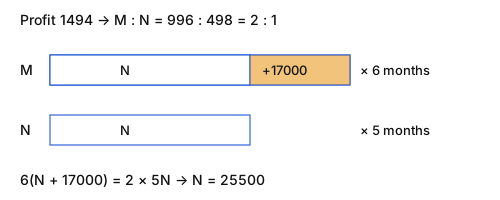
  1. Total profit = ₹1,494 and M gets ₹498 more, so M =1494+4982=996, N =498; ratio M : N =2:1.
  2. Let N's capital =x; M's =x+17000. Then 6(x+17000)5x=21.
  3. 6x+102000=10x⇒x=25500.
  4. M's capital =25500+17000=42500.

Trick: Check options: M = 42,500 → N = 25,500; 42500×625500×5=255000127500=2 ✓.

Answer: (A) ₹42,500

अवधारणा: साझेदारी में लाभ (पूँजी × समय) के अनुपात में बँटता है।

  1. कुल लाभ = ₹1,494 और M को ₹498 अधिक, अतः M =1494+4982=996, N =498; अनुपात 2:1।
  2. माना N की पूँजी =x; M की =x+17000। तब 6(x+17000)5x=21।
  3. 6x+102000=10x⇒x=25500।
  4. M की पूँजी =25500+17000=42500।

ट्रिक: विकल्प जाँचें: M = 42,500 → N = 25,500; 42500×625500×5=2 ✓।

उत्तर: (A) ₹42,500

RRB NTPC Undergraduate CBT 1MathematicsPartnershipRRB NTPC Undergraduate CBT 1 2024 · 28 Aug Shift 3 →
Q342.
Find the simple interest (in ₹) on ₹1,200 at an interest rate of 4% per month for 10 months.
₹1,200 पर 4% प्रति माह की ब्याज दर से 10 महीने का साधारण ब्याज (₹ में) ज्ञात कीजिए।
  1. A₹40
  2. B₹60
  3. C₹480
  4. D₹80
Show answer

Concept: SI=P×R×T100, with R and T in the same time unit.

  1. Here P=1200, R=4% per month, T=10 months.
  2. SI=1200×4×10100=480.
  3. (If the rate were 4% per annum, T=1012 year would give 1200×4×101200=40 – but the question says per month.)

Trick: 4% per month for 10 months = 40% of 1200 = 480.

Answer: (C) ₹480

अवधारणा: SI=P×R×T100, जहाँ R और T एक ही समय-इकाई में हों।

  1. यहाँ P=1200, R=4% प्रति माह, T=10 माह।
  2. SI=1200×4×10100=480।
  3. (यदि दर 4% वार्षिक होती तो T=1012 वर्ष से 1200×4×101200=40 आता – पर प्रश्न में प्रति माह दिया है।)

ट्रिक: 4% प्रति माह × 10 माह = 1200 का 40% = 480।

उत्तर: (C) ₹480

RRB NTPC Undergraduate CBT 1MathematicsSimple interestRRB NTPC Undergraduate CBT 1 2024 · 28 Aug Shift 3 →
Q343.
Simplify the given expression.
x(7x − 5) + 3(x2 − 2) + 14
दिए गए व्यंजक को सरल कीजिए।
x(7x − 5) + 3(x2 − 2) + 14
  1. A−10x2 − 5x + 8
  2. B10x2 − 5x − 8
  3. C10x2 − 5x + 8
  4. D−10x2 − 5x − 8
Show answer

Concept: Expand each bracket, then combine like terms.

  1. x(7x−5)=7x2−5x
  2. 3(x2−2)=3x2−6
  3. Sum: 7x2−5x+3x2−6+14=10x2−5x+8

Trick: Put x=1: 1(2)+3(−1)+14=13; only 10−5+8=13 ✓.

Answer: (C) 10x2−5x+8

अवधारणा: प्रत्येक कोष्ठक खोलें, फिर समान पदों को जोड़ें।

  1. x(7x−5)=7x2−5x
  2. 3(x2−2)=3x2−6
  3. योग: 7x2−5x+3x2−6+14=10x2−5x+8

ट्रिक: x=1 रखें: 1(2)+3(−1)+14=13; केवल 10−5+8=13 ✓।

उत्तर: (C) 10x2−5x+8

RRB NTPC Undergraduate CBT 1MathematicsAlgebra – simplificationRRB NTPC Undergraduate CBT 1 2024 · 28 Aug Shift 3 →
Q344.
Pipe P can fill 45 part of a tank in 12 hours and pipe Q can fill 27 part of the same tank in 30 hours. Both P and Q were kept open for 5 hours, then both were closed. Pipe R alone was then opened and it emptied the water in the tank in 8 hours.
Pipes P, Q and R together can fill the empty tank in:
पाइप P किसी टंकी का 45 भाग 12 घंटे में भर सकता है और पाइप Q उसी टंकी का 27 भाग 30 घंटे में भर सकता है। P और Q दोनों को 5 घंटे तक खुला रखा गया, फिर दोनों को बंद कर दिया गया। इसके बाद केवल पाइप R को खोला गया और उसने टंकी का पानी 8 घंटे में खाली कर दिया।
पाइप P, Q और R मिलकर खाली टंकी को कितने समय में भर सकते हैं?
  1. A17 hours17 घंटे
  2. B35 hours35 घंटे
  3. C43 hours43 घंटे
  4. D18 hours18 घंटे
Show answer

Concept: Find each pipe's full-tank time, take LCM as tank capacity, and add efficiencies (emptying pipe negative).

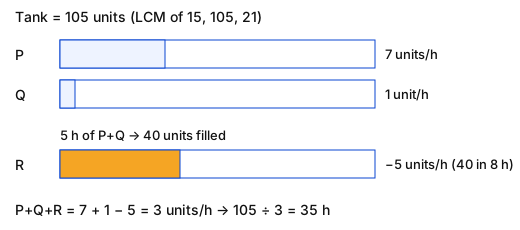
  1. P fills 45 in 12 h → full in 12×54=15 h; Q fills 27 in 30 h → full in 30×72=105 h.
  2. Tank =105 units: P =7, Q =1 unit/h. In 5 h: 5×8=40 units.
  3. R empties 40 units in 8 h → R =−5 unit/h.
  4. P + Q + R =7+1−5=3 unit/h → time =1053=35 h.

Yaad rakhein: Filling pipe +, emptying pipe −; time =capacitynet efficiency.

Answer: (B) 35 hours

अवधारणा: प्रत्येक पाइप का पूरी टंकी भरने का समय निकालें, LCM को क्षमता मानें और दक्षताएँ जोड़ें (खाली करने वाला पाइप ऋणात्मक)।

  1. P, 12 घंटे में 45 भरता है → पूरी 12×54=15 घंटे; Q, 30 घंटे में 27 → पूरी 30×72=105 घंटे।
  2. टंकी =105 इकाई: P =7, Q =1 इकाई/घंटा। 5 घंटे में: 5×8=40 इकाई।
  3. R, 8 घंटे में 40 इकाई खाली करता है → R =−5 इकाई/घंटा।
  4. P + Q + R =7+1−5=3 इकाई/घंटा → समय =1053=35 घंटे।

याद रखें: भरने वाला +, खाली करने वाला −; समय =क्षमताकुल दक्षता।

उत्तर: (B) 35 घंटे

RRB NTPC Undergraduate CBT 1MathematicsPipes and cisternsRRB NTPC Undergraduate CBT 1 2024 · 28 Aug Shift 3 →
Q345.
The average of first 163 even numbers is
प्रथम 163 सम संख्याओं का औसत कितना है?
  1. A165
  2. B163.5
  3. C164.5
  4. D164
Show answer

Concept: First n even numbers: 2,4,…,2n; their sum =n(n+1), so average =n+1.

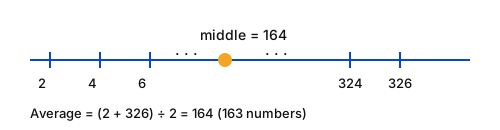
  1. Here n=163; last term =2×163=326.
  2. Average =2+3262=164.
  3. Or directly: n+1=163+1=164.

Trick: Average of first n even numbers =n+1; of first n odd numbers =n.

Answer: (D) 164

अवधारणा: पहली n सम संख्याएँ: 2,4,…,2n; योग =n(n+1), अतः औसत =n+1।

  1. यहाँ n=163; अंतिम पद =2×163=326।
  2. औसत =2+3262=164।
  3. सीधे: n+1=163+1=164।

ट्रिक: पहली n सम संख्याओं का औसत =n+1; पहली n विषम संख्याओं का =n।

उत्तर: (D) 164

RRB NTPC Undergraduate CBT 1MathematicsAverage – even numbersRRB NTPC Undergraduate CBT 1 2024 · 28 Aug Shift 3 →
Q346.
The value of 53+(11+49)−25 is
53+(11+49)−25 का मान है:
  1. A384191
  2. B382195
  3. C379201
  4. D380197
Show answer

Concept: Simplify the inner (continued) fraction first, then add/subtract using the LCM.

  1. 1+49=139, so 11+49=913.
  2. Expression =53+913−25; LCM of 3, 13, 5 =195.
  3. =325+135−78195=382195.

Trick: Denominator must be the LCM 195 – only option B has it.

Answer: (B) 382195

अवधारणा: पहले अंदर की भिन्न सरल करें, फिर LCM से जोड़-घटाव करें।

  1. 1+49=139, अतः 11+49=913।
  2. व्यंजक =53+913−25; 3, 13, 5 का LCM =195।
  3. =325+135−78195=382195।

ट्रिक: हर LCM 195 होना चाहिए – केवल विकल्प B में है।

उत्तर: (B) 382195

RRB NTPC Undergraduate CBT 1MathematicsFractions – simplificationRRB NTPC Undergraduate CBT 1 2024 · 28 Aug Shift 3 →
Q347.
The product of two consecutive natural numbers is 110. The greater of the two numbers is:
दो क्रमागत प्राकृत संख्याओं का गुणनफल 110 है। दोनों संख्याओं में से बड़ी संख्या है:
  1. A3
  2. B5
  3. C11
  4. D7
Show answer

Concept: Consecutive natural numbers are n and n+1.

  1. n(n+1)=110⇒n2+n−110=0.
  2. (n+11)(n−10)=0⇒n=10 (natural).
  3. Numbers: 10 and 11; greater =11.

Trick: 110≈10.5 → the numbers lie on either side: 10×11=110.

Answer: (C) 11

अवधारणा: क्रमागत प्राकृतिक संख्याएँ n और n+1 हैं।

  1. n(n+1)=110⇒n2+n−110=0।
  2. (n+11)(n−10)=0⇒n=10 (प्राकृतिक)।
  3. संख्याएँ: 10 और 11; बड़ी =11।

ट्रिक: 110≈10.5 → संख्याएँ इसके दोनों ओर: 10×11=110।

उत्तर: (C) 11

RRB NTPC Undergraduate CBT 1MathematicsNumber systemRRB NTPC Undergraduate CBT 1 2024 · 28 Aug Shift 3 →
Q348.
The value of 121+0.0225−5.76=
121+0.0225−5.76= का मान है:
  1. A13.05
  2. B12.62
  3. C8.75
  4. D5.35
Show answer

Concept: For a decimal, take the square root of the digits and halve the number of decimal places.

  1. 121=11
  2. 0.0225=0.15 (since 152=225)
  3. 5.76=2.4 (since 242=576)
  4. 11+0.15−2.4=8.75

Trick: Decimal places in the square = 2 × decimal places in the root: 0.0225 (4) → 0.15 (2).

Answer: (C) 8.75

अवधारणा: दशमलव संख्या का वर्गमूल: अंकों का वर्गमूल लें और दशमलव स्थान आधे करें।

  1. 121=11
  2. 0.0225=0.15 (क्योंकि 152=225)
  3. 5.76=2.4 (क्योंकि 242=576)
  4. 11+0.15−2.4=8.75

ट्रिक: वर्ग में दशमलव स्थान = मूल के दशमलव स्थान का दोगुना: 0.0225 (4) → 0.15 (2)।

उत्तर: (C) 8.75

RRB NTPC Undergraduate CBT 1MathematicsSquare roots of decimalsRRB NTPC Undergraduate CBT 1 2024 · 28 Aug Shift 3 →
Q349.
Simplify: tan2βcosec2β1+tan2β
सरल कीजिए: tan2βcosec2β1+tan2β
  1. A−1
  2. Btanβ
  3. C1
  4. Dsecβ
Show answer

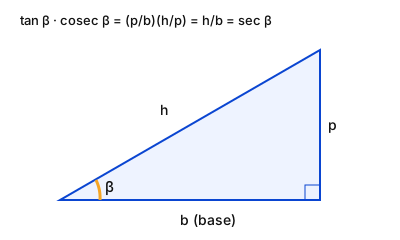
Concept: Use 1+tan2β=sec2β and tanβcosecβ=sinβcosβ·1sinβ=secβ.

  1. Numerator: tan2βcosec2β=sec2β.
  2. Denominator: 1+tan2β=sec2β.
  3. sec2βsec2β=1.

Trick: Put β=45∘: 1×21+1=1.

Answer: (C) 1

अवधारणा: 1+tan2β=sec2β और tanβcosecβ=sinβcosβ·1sinβ=secβ का प्रयोग करें।

  1. अंश: tan2βcosec2β=sec2β।
  2. हर: 1+tan2β=sec2β।
  3. sec2βsec2β=1।

ट्रिक: β=45∘ रखें: 1×21+1=1।

उत्तर: (C) 1

RRB NTPC Undergraduate CBT 1MathematicsTrigonometric identitiesRRB NTPC Undergraduate CBT 1 2024 · 28 Aug Shift 3 →
Q350.
The HCF and LCM of two numbers are 72 and 432, respectively. If one of the numbers is 144, find the other one.
दो संख्याओं का महत्तम समापवर्तक (HCF) और लघुत्तम समापवर्त्य (LCM) क्रमशः 72 और 432 हैं। यदि उनमें से एक संख्या 144 है, तो दूसरी संख्या ज्ञात कीजिए।
  1. A216
  2. B144
  3. C72
  4. D288
Show answer

Concept: For two numbers: HCF×LCM=product of the numbers.

  1. 72×432=144×x
  2. x=72×432144=4322=216.
  3. Check: HCF(144, 216) =72, LCM =432 ✓.

Trick: 14472=2, so x=4322=216.

Answer: (A) 216

अवधारणा: दो संख्याओं के लिए: HCF×LCM=संख्याओं का गुणनफल।

  1. 72×432=144×x
  2. x=72×432144=4322=216।
  3. जाँच: HCF(144, 216) =72, LCM =432 ✓।

ट्रिक: 14472=2, अतः x=4322=216।

उत्तर: (A) 216

RRB NTPC Undergraduate CBT 1MathematicsHCF and LCMRRB NTPC Undergraduate CBT 1 2024 · 28 Aug Shift 3 →
Q351.
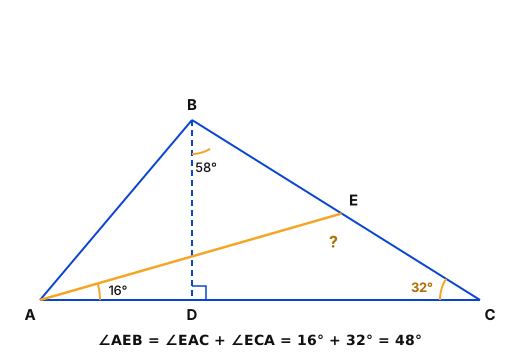
In △ABC, BD ⟂ AC at D and ∠DBC = 58°. E is a point on BC such that ∠CAE = 16°. What is the measure of ∠AEB?
△ABC में, BD ⟂ AC, D पर है और ∠DBC = 58° है। BC पर एक बिंदु E इस प्रकार है कि ∠CAE = 16° है। ∠AEB की माप क्या है?
  1. A42°
  2. B49°
  3. C52°
  4. D48°
Show answer

Concept: An exterior angle of a triangle equals the sum of the two opposite interior angles.

  1. In right △BDC: ∠BDC=90∘, so ∠C=180∘−90∘−58∘=32∘.
  2. In △AEC, ∠AEB is the exterior angle at E (since B, E, C are collinear).
  3. ∠AEB=∠EAC+∠ECA=16∘+32∘=48∘.

Trick: In a right triangle the two acute angles add to 90∘, so ∠C=90∘−58∘ directly.

Answer: (D) 48∘

अवधारणा: त्रिभुज का बाह्य कोण = दोनों सम्मुख अंतः कोणों का योग।

  1. समकोण △BDC में ∠BDC=90∘, अतः ∠C=180∘−90∘−58∘=32∘।
  2. B, E, C एक रेखा पर हैं, इसलिए ∠AEB, △AEC का E पर बाह्य कोण है।
  3. ∠AEB=∠EAC+∠ECA=16∘+32∘=48∘।

ट्रिक: समकोण त्रिभुज में दोनों न्यून कोणों का योग 90∘ होता है, अतः ∠C=90∘−58∘।

उत्तर: (D) 48∘

RRB NTPC Undergraduate CBT 1MathematicsTriangles – exterior angleRRB NTPC Undergraduate CBT 1 2024 · 28 Aug Shift 3 →
Q352.
What is the volume of a cylindrical container that has a base radius of 3.5 metres and a height of 5.2 metres?
एक बेलनाकार पात्र का आयतन क्या है, जिसके आधार की त्रिज्या 3.5 मीटर और ऊँचाई 5.2 मीटर है?
  1. A67.3π cubic metres67.3π घन मीटर
  2. B65.4π cubic metres65.4π घन मीटर
  3. C63.7π cubic metres63.7π घन मीटर
  4. D68.6π cubic metres68.6π घन मीटर
Show answer

Concept: Volume of a cylinder V=πr2h.

  1. r=3.5m, so r2=12.25.
  2. V=π×12.25×5.2=63.7πm3.

Trick: 3.52×5.2=12.25×5.2: 12×5.2=62.4 and 0.25×5.2=1.3, total 63.7.

Answer: (C) 63.7π cubic metres

अवधारणा: बेलन (cylinder) का आयतन V=πr2h।

  1. r=3.5m, अतः r2=12.25।
  2. V=π×12.25×5.2=63.7πm3।

ट्रिक: 12×5.2=62.4 और 0.25×5.2=1.3, कुल 63.7।

उत्तर: (C) 63.7π घन मीटर

RRB NTPC Undergraduate CBT 1MathematicsMensuration – cylinder volumeRRB NTPC Undergraduate CBT 1 2024 · 28 Aug Shift 3 →
Q353.
Find the mean proportional of 96 and 54.
96 और 54 का मध्यानुपाती ज्ञात कीजिए।
  1. A71
  2. B69
  3. C75
  4. D72
Show answer

Concept: Mean proportional of a and b is ab.

  1. 96×54=5184.
  2. 5184=72.

Trick: 96=6×16, 54=6×9, so 96×54=6×4×3=72.

Answer: (D) 72

अवधारणा: a और b का मध्यानुपाती (mean proportional) ab होता है।

  1. 96×54=5184।
  2. 5184=72।

ट्रिक: 96=6×16, 54=6×9, अतः 96×54=6×4×3=72।

उत्तर: (D) 72

RRB NTPC Undergraduate CBT 1MathematicsMean proportionalRRB NTPC Undergraduate CBT 1 2024 · 28 Aug Shift 3 →
Q354.
The value of 72+82−516−14 is:
72+82−516−14 का मान है:
  1. A16
  2. B31
  3. C23
  4. D26
Show answer

Concept: Evaluate powers and roots first, then add/subtract left to right.

  1. 72=49, 82=8, 516=5×4=20.
  2. 49+8−20−14=23.

Trick: a2=a for positive a – no need to square 8.

Answer: (C) 23

अवधारणा: पहले घात और मूल हल करें, फिर बाएँ से दाएँ जोड़/घटाव।

  1. 72=49, 82=8, 516=5×4=20।
  2. 49+8−20−14=23।

ट्रिक: धनात्मक a के लिए a2=a।

उत्तर: (C) 23

RRB NTPC Undergraduate CBT 1MathematicsSimplification – powers and rootsRRB NTPC Undergraduate CBT 1 2024 · 28 Aug Shift 3 →
Q355.
Pipe A can fill a tank in 11 hours, pipe B can fill the same tank in 24 hours and pipe C can fill the same tank in 19 hours. The time taken by them to fill the same tank if they operate together is::
पाइप A किसी टंकी को 11 घंटे में भर सकता है, पाइप B उसी टंकी को 24 घंटे में भर सकता है और पाइप C उसी टंकी को 19 घंटे में भर सकता है। यदि वे एक साथ कार्य करें, तो उसी टंकी को भरने में उनके द्वारा लिया गया समय है:
  1. A4371929 hours4371929 घंटे
  2. B7371929 hours7371929 घंटे
  3. C5371929 hours5371929 घंटे
  4. D9371929 hours9371929 घंटे
Show answer

Concept: Work per hour adds up: combined rate =111+124+119.

  1. LCM =11×24×19=5016.
  2. Rate =456+209+2645016=9295016 tank per hour.
  3. Time =5016929=5371929 hours (since 929×5=4645, remainder 371).

Trick: Estimate: rate ≈0.091+0.042+0.053=0.186, so time ≈5.4 h – only option (C) starts with 5.

Answer: (C) 5371929 hours

अवधारणा: प्रति घंटे का काम जुड़ता है: संयुक्त दर =111+124+119।

  1. LCM =11×24×19=5016।
  2. दर =456+209+2645016=9295016 टंकी प्रति घंटा।
  3. समय =5016929=5371929 घंटे (929×5=4645, शेष 371)।

ट्रिक: अनुमान: दर ≈0.186, अतः समय ≈5.4 घंटे – केवल विकल्प (C) 5 से शुरू होता है।

उत्तर: (C) 5371929 घंटे

RRB NTPC Undergraduate CBT 1MathematicsPipes and cisternsRRB NTPC Undergraduate CBT 1 2024 · 28 Aug Shift 3 →
Q356.
A trader offers one kitchen set free with each kitchen set purchased at the marked price. If he still makes a profit of 20%, at what percentage above the cost price has the trader marked the kitchen set?
एक व्यापारी अंकित मूल्य पर खरीदे गए प्रत्येक किचन सेट के साथ एक किचन सेट मुफ़्त देता है। यदि फिर भी उसे 20% का लाभ होता है, तो व्यापारी ने किचन सेट का मूल्य क्रय मूल्य से कितने प्रतिशत अधिक अंकित किया है?
  1. A50%
  2. B150%
  3. C140%
  4. D40%
Show answer

Concept: In 'one free with one', the customer pays the marked price of 1 article but gets 2.

  1. Let CP of one set =100; he gives 2 sets, so CP =200.
  2. Profit 20% ⇒ SP =200×1.2=240.
  3. This SP is the marked price of one set: 240, i.e. 140% above the CP of 100.

Trick: Mark-up =2×120100−1=140%.

Answer: (C) 140%

अवधारणा: 'एक के साथ एक मुफ्त' में ग्राहक 1 वस्तु का अंकित मूल्य देता है पर 2 वस्तुएँ पाता है।

  1. एक सेट का क्रय मूल्य =100; 2 सेट दिए, अतः क्रय मूल्य =200।
  2. 20% लाभ ⇒ विक्रय मूल्य =200×1.2=240।
  3. यही एक सेट का अंकित मूल्य है: 240, यानी क्रय मूल्य 100 से 140% अधिक।

ट्रिक: मार्क-अप =2×120100−1=140%।

उत्तर: (C) 140%

RRB NTPC Undergraduate CBT 1MathematicsProfit and loss – buy one get one freeRRB NTPC Undergraduate CBT 1 2024 · 28 Aug Shift 3 →
Q357.
The number 716710501 is divisible by which of the following?
संख्या 716710501 निम्नलिखित में से किससे विभाज्य है?
  1. A20
  2. B16
  3. C19
  4. D13
Show answer

Concept: Divisibility by 13 (also 7, 11): split into 3-digit groups from the right and take the alternating sum; if it is divisible by 13, so is the number.

  1. Groups: 716 | 710 | 501.
  2. Alternating sum =501−710+716=507=13×39 ⇒ divisible by 13.
  3. Ends in 1 ⇒ not divisible by 20 or 16; 716710501÷19 leaves remainder 6.

Trick: An odd number can never be divisible by an even number like 16 or 20 – eliminate them at once.

Answer: (D) 13

अवधारणा: 13 (तथा 7, 11) से विभाज्यता: दाएँ से 3-3 अंकों के समूह बनाकर एकांतर योग लें; वह 13 से विभाज्य हो तो संख्या भी।

  1. समूह: 716 | 710 | 501।
  2. एकांतर योग =501−710+716=507=13×39 ⇒ 13 से विभाज्य।
  3. अंतिम अंक 1 ⇒ 20 और 16 से विभाज्य नहीं; 19 से भाग देने पर शेष 6।

ट्रिक: विषम संख्या कभी 16 या 20 जैसी सम संख्या से विभाज्य नहीं होती – इन्हें तुरंत हटाएँ।

उत्तर: (D) 13

RRB NTPC Undergraduate CBT 1MathematicsDivisibility rulesRRB NTPC Undergraduate CBT 1 2024 · 28 Aug Shift 3 →
Q358.
The number of prime numbers between 374 and 381, both included, is:
374 और 381 (दोनों सम्मिलित) के बीच अभाज्य संख्याओं की संख्या है:
  1. A2
  2. B3
  3. C4
  4. D1
Show answer

Concept: A prime has no divisor other than 1 and itself; test primes up to 381≈19.5.

  1. Even numbers 374, 376, 378, 380 and 375 (ends in 5) are out.
  2. 377=13×29, 381=3×127 – not prime.
  3. 379 is not divisible by 2, 3, 5, 7, 11, 13, 17, 19 ⇒ prime. Count =1.

Trick: Digit sum 3+8+1=12 shows 381 is divisible by 3 instantly.

Answer: (D) 1

अवधारणा: अभाज्य संख्या का 1 और स्वयं के अलावा कोई भाजक नहीं; 381≈19.5 तक के अभाज्यों से जाँचें।

  1. सम संख्याएँ 374, 376, 378, 380 तथा 375 (अंत में 5) बाहर।
  2. 377=13×29, 381=3×127 – अभाज्य नहीं।
  3. 379 किसी भी 2, 3, 5, 7, 11, 13, 17, 19 से विभाज्य नहीं ⇒ अभाज्य। गिनती =1।

ट्रिक: अंकों का योग 3+8+1=12 से 381 तुरंत 3 से विभाज्य दिखता है।

उत्तर: (D) 1

RRB NTPC Undergraduate CBT 1MathematicsPrime numbersRRB NTPC Undergraduate CBT 1 2024 · 28 Aug Shift 3 →
Q359.
By how much is 65% of 75 greater than 35 of 45?
75 का 65%, 45 के 35 से कितना अधिक है?
  1. A19.75
  2. B18.75
  3. C15.75
  4. D21.75
Show answer

Concept: Find each quantity and subtract.

  1. 65% of 75=65×75100=48.75.
  2. 35 of 45=27.
  3. Difference =48.75−27=21.75.

Trick: 65% of 75 =75% of 65 =34×65=48.75.

Answer: (D) 21.75

अवधारणा: दोनों मात्राएँ निकालकर घटाएँ।

  1. 75 का 65%=65×75100=48.75।
  2. 45 का 35=27।
  3. अंतर =48.75−27=21.75।

ट्रिक: 75 का 65% = 65 का 75%=34×65=48.75।

उत्तर: (D) 21.75

RRB NTPC Undergraduate CBT 1MathematicsPercentage and fractionsRRB NTPC Undergraduate CBT 1 2024 · 28 Aug Shift 3 →
Q360.
By selling an article at 514 of its actual selling price, Hitesh incurs a loss of 25%. If he sells it at 58% of its actual selling price, then the profit percentage is:
किसी वस्तु को उसके वास्तविक विक्रय मूल्य के 514 पर बेचने पर हितेश को 25% की हानि होती है। यदि वह इसे इसके वास्तविक विक्रय मूल्य के 58% पर बेचता है, तो लाभ प्रतिशत है:
  1. A23.1%
  2. B23.7%
  3. C22.5%
  4. D21.8%
Show answer

Concept: Express CP in terms of the actual SP S.

  1. 514S gives 25% loss ⇒ 514S=0.75CP ⇒ CP=1021S.
  2. New SP =0.58S.
  3. Profit%=(0.58S1021S−1)×100=(1.218−1)×100=21.8%.

Trick: Take S=210: CP =100, new SP =0.58×210=121.8 ⇒ 21.8%.

Answer: (D) 21.8%

अवधारणा: क्रय मूल्य को वास्तविक विक्रय मूल्य S के रूप में लिखें।

  1. 514S पर 25% हानि ⇒ 514S=0.75CP ⇒ CP=1021S।
  2. नया विक्रय मूल्य =0.58S।
  3. लाभ% =(0.58S1021S−1)×100=21.8%।

ट्रिक: S=210 लें: CP =100, नया SP =121.8 ⇒ 21.8%।

उत्तर: (D) 21.8%

RRB NTPC Undergraduate CBT 1MathematicsProfit and lossRRB NTPC Undergraduate CBT 1 2024 · 28 Aug Shift 3 →