Question bank

Q&A: practice questions with answers

Search questions on any topic. Filter by exam category, exam, subject and topic, try the question, then open the answer and explanation.

Courses – airGurukul

8,500 questions found.

Q3641.
Which of the following numbers is divisible by 14?
निम्नलिखित में से कौन-सी संख्या 14 से विभाज्य है?
  1. A67,94,266
  2. B71,32,960
  3. C64,36,639
  4. D70,48,048
Show answer

Concept: A number is divisible by 14=2×7 only if it is divisible by both 2 and 7.

  1. 64,36,639 is odd, so it is not divisible by 2 – rejected.
  2. Test of 7 (alternate sum of 3-digit groups from right): 6794266→266−794+6=−522 ✗; 7132960→960−132+7=835 ✗.
  3. 7048048→048−048+7=7 ✓, and it is even.
  4. Check: 7048048÷14=503432.

Trick: Divisible by a composite number = divisible by each of its co-prime factors (14=2×7).

Answer: (D) 70,48,048

अवधारणा: कोई संख्या 14=2×7 से तभी विभाज्य है जब वह 2 और 7 दोनों से विभाज्य हो।

  1. 64,36,639 विषम है, अतः 2 से विभाज्य नहीं – बाहर।
  2. 7 की जाँच (दाएँ से 3-3 अंकों के समूहों का एकांतर योग): 6794266→266−794+6=−522 ✗; 7132960→960−132+7=835 ✗।
  3. 7048048→048−048+7=7 ✓, और यह सम है।
  4. जाँच: 7048048÷14=503432।

ट्रिक: भाज्य संख्या से विभाज्यता = उसके सह-अभाज्य गुणनखंडों से विभाज्यता (14=2×7)।

उत्तर: (D) 70,48,048

RRB NTPC Undergraduate CBT 1MathematicsDivisibilityRRB NTPC Undergraduate CBT 1 2024 · 8 Sep Shift 2 →
Q3642.
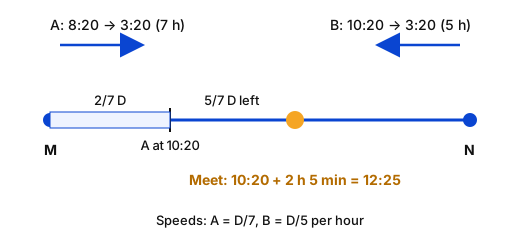
Train A leaves station M at 8:20 AM and reaches station N at 3:20 PM on the same day. Train B leaves station N at 10:20 AM and reaches station M at 3:20 PM on the same day. Find the time when trains A and B meet.
ट्रेन A स्टेशन M से सुबह 8:20 बजे चलती है और उसी दिन दोपहर 3:20 बजे स्टेशन N पहुँचती है। ट्रेन B स्टेशन N से सुबह 10:20 बजे चलती है और उसी दिन दोपहर 3:20 बजे स्टेशन M पहुँचती है। वह समय ज्ञात कीजिए जब ट्रेन A और B मिलती हैं।
  1. A12:35 PM
  2. B12:15 PM
  3. C12:05 PM
  4. D12:25 PM
Show answer

Concept: Take distance MN =D. Speed = distance ÷ time; when two trains move towards each other, relative speed = sum of speeds.

  1. A takes 8:20 AM to 3:20 PM =7 h → speed D7; B takes 10:20 AM to 3:20 PM =5 h → speed D5.
  2. By 10:20 AM, A has run 2 h: covered 2D7, gap left =5D7.
  3. Relative speed =D7+D5=12D35.
  4. Time to meet =5D7÷12D35=2512h=2h5min → 10:20 + 2 h 5 min = 12:25 PM.

Trick: Take D=LCM(7,5)=35 km: speeds 5 and 7; at 10:20 gap =25, time =2512 h.

Answer: (D) 12:25 PM

अवधारणा: दूरी MN =D लें। चाल = दूरी ÷ समय; आमने-सामने चलने पर सापेक्ष चाल = चालों का योग।

  1. A: 8:20 AM से 3:20 PM =7 घंटे → चाल D7; B: 10:20 AM से 3:20 PM =5 घंटे → चाल D5।
  2. 10:20 AM तक A 2 घंटे चल चुकी: तय दूरी 2D7, शेष अंतर =5D7।
  3. सापेक्ष चाल =D7+D5=12D35।
  4. मिलने का समय =5D7÷12D35=2512h=2h5min → 10:20 + 2 घंटे 5 मिनट = 12:25 PM।

ट्रिक: D=LCM(7,5)=35 किमी लें: चालें 5 और 7; 10:20 पर अंतर =25, समय =2512 घंटे।

उत्तर: (D) 12:25 PM

RRB NTPC Undergraduate CBT 1MathematicsTrains – Meeting TimeRRB NTPC Undergraduate CBT 1 2024 · 8 Sep Shift 2 →
Q3643.
If the marked price of a calculator is ₹600 and ₹50 discount is offered on the calculator, then find the discount percentage (correct to two decimal places).
यदि एक कैलकुलेटर का अंकित मूल्य ₹600 है और कैलकुलेटर पर ₹50 की छूट दी जाती है, तो छूट प्रतिशत ज्ञात कीजिए (दशमलव के दो स्थानों तक सही)।
  1. A9.53%
  2. B10.33%
  3. C8.33%
  4. D7.53%
Show answer

Concept: Discount%=DiscountMP×100.

  1. MP = ₹600, discount = ₹50.
  2. Discount%=50600×100=253=8.33%.

Trick: 50600=112, and 112=813%.

Answer: (C) 8.33%

अवधारणा: छूट%=छूटअंकित मूल्य×100।

  1. अंकित मूल्य = ₹600, छूट = ₹50।
  2. छूट%=50600×100=253=8.33%।

ट्रिक: 50600=112 और 112=813%।

उत्तर: (C) 8.33%

RRB NTPC Undergraduate CBT 1MathematicsDiscountRRB NTPC Undergraduate CBT 1 2024 · 8 Sep Shift 2 →
Q3644.
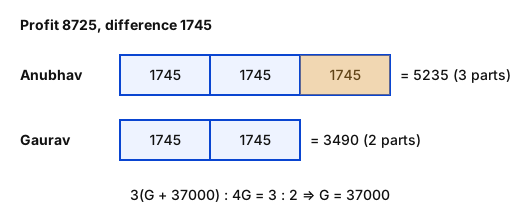
Anubhav and Gaurav start a business. Anubhav invests ₹37,000 more than Gaurav for 3 months and Gaurav invests for 4 months. Anubhav's share is ₹1,745 more than that of Gaurav, out of a total profit of ₹8,725. Find the capital contributed by Anubhav.
अनुभव और गौरव एक व्यवसाय शुरू करते हैं। अनुभव, गौरव से ₹37,000 अधिक 3 महीने के लिए निवेश करता है और गौरव 4 महीने के लिए निवेश करता है। ₹8,725 के कुल लाभ में से अनुभव का हिस्सा गौरव के हिस्से से ₹1,745 अधिक है। अनुभव द्वारा लगाई गई पूँजी ज्ञात कीजिए।
  1. A₹74,002
  2. B₹74,122
  3. C₹74,000
  4. D₹73,800
Show answer

Concept: Profit share ∝ capital × time.

  1. Shares: A+G=8725, A−G=1745 → A=5235, G=3490; ratio =3:2.
  2. Let Gaurav's capital =x; Anubhav's =x+37000.
  3. 3(x+37000)4x=32⇒6x+222000=12x⇒x=37000.
  4. Anubhav's capital =37000+37000= ₹74,000.

Trick: Option check: A = 74000 → G = 37000; 74000×3:37000×4=3:2 ✓.

Answer: (C) ₹74,000

अवधारणा: लाभ का हिस्सा ∝ पूँजी × समय।

  1. हिस्से: A+G=8725, A−G=1745 → A=5235, G=3490; अनुपात =3:2।
  2. गौरव की पूँजी =x; अनुभव की =x+37000।
  3. 3(x+37000)4x=32⇒6x+222000=12x⇒x=37000।
  4. अनुभव की पूँजी =37000+37000= ₹74,000।

ट्रिक: विकल्प जाँच: A = 74000 → G = 37000; 74000×3:37000×4=3:2 ✓।

उत्तर: (C) ₹74,000

RRB NTPC Undergraduate CBT 1MathematicsPartnershipRRB NTPC Undergraduate CBT 1 2024 · 8 Sep Shift 2 →
Q3645.
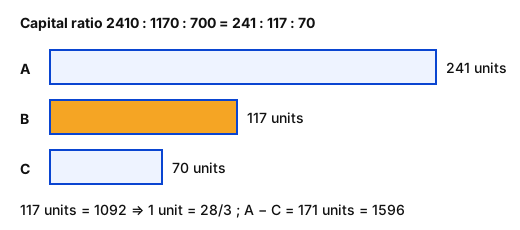
A, B and C started a business investing ₹2,410, ₹1,170 and ₹700, respectively. If B's share in the profit earned by them is ₹1,092. what is the difference in the profit (in ₹) earned by A and C?
A, B और C ने क्रमशः ₹2,410, ₹1,170 और ₹700 निवेश करके एक व्यवसाय शुरू किया। यदि उनके द्वारा अर्जित लाभ में B का हिस्सा ₹1,092 है, तो A और C द्वारा अर्जित लाभ (₹ में) का अंतर कितना है?
  1. A₹1,597
  2. B₹1,593
  3. C₹1,595
  4. D₹1,596
Show answer

Concept: Same time period, so profit is shared in the ratio of capitals.

  1. 2410:1170:700=241:117:70.
  2. B's 117 units = ₹1092 → 1 unit =1092117=283.
  3. A − C =241−70=171 units =171×283=57×28=1596.

Trick: Difference directly: 1092×171117=1092×1913=84×19=1596.

Answer: (D) ₹1,596

अवधारणा: समय समान है, अतः लाभ पूँजी के अनुपात में बँटेगा।

  1. 2410:1170:700=241:117:70।
  2. B के 117 भाग = ₹1092 → 1 भाग =1092117=283।
  3. A − C =241−70=171 भाग =171×283=57×28=1596।

ट्रिक: सीधे अंतर: 1092×171117=1092×1913=84×19=1596।

उत्तर: (D) ₹1,596

RRB NTPC Undergraduate CBT 1MathematicsPartnershipRRB NTPC Undergraduate CBT 1 2024 · 8 Sep Shift 2 →
Q3646.
Find the value of [592 ÷ {12 + 2 × (3 − 7)}].
[592 ÷ {12 + 2 × (3 − 7)}] का मान ज्ञात कीजिए।
  1. A147
  2. B145
  3. C148
  4. D152
Show answer

Concept: BODMAS: innermost bracket first, then multiplication, then addition, then division.

  1. (3−7)=−4.
  2. 2×(−4)=−8, so {12+(−8)}=4.
  3. 592÷4=148.

Trick: Solve brackets from inside out: ( ) → { } → [ ].

Answer: (C) 148

अवधारणा: BODMAS: पहले सबसे भीतरी कोष्ठक, फिर गुणा, फिर जोड़, फिर भाग।

  1. (3−7)=−4।
  2. 2×(−4)=−8, अतः {12+(−8)}=4।
  3. 592÷4=148।

ट्रिक: कोष्ठक भीतर से बाहर हल करें: ( ) → { } → [ ]।

उत्तर: (C) 148

RRB NTPC Undergraduate CBT 1MathematicsSimplification (BODMAS)RRB NTPC Undergraduate CBT 1 2024 · 8 Sep Shift 2 →
Q3647.
The marks scored by 10 students are given below.
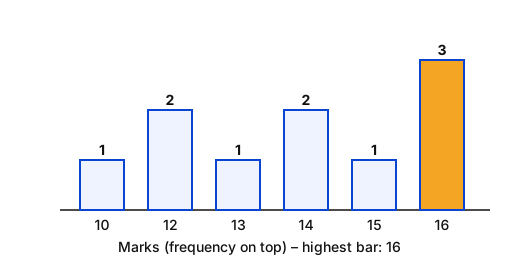
12, 14, 16, 13, 15, 14, 16, 10, 16, 12
The mode of the data is:
10 छात्रों द्वारा प्राप्त अंक नीचे दिए गए हैं।
12, 14, 16, 13, 15, 14, 16, 10, 16, 12
आँकड़ों का बहुलक है:
  1. A13
  2. B12
  3. C16
  4. D14
Show answer

Concept: Mode = the value that occurs most often.

  1. Frequencies: 10 → 1, 12 → 2, 13 → 1, 14 → 2, 15 → 1, 16 → 3.
  2. 16 occurs the maximum number of times (3).

Trick: Arrange data in order: 10, 12, 12, 13, 14, 14, 15, 16, 16, 16 – the longest run is 16.

Answer: (C) 16

अवधारणा: बहुलक (mode) = सबसे अधिक बार आने वाला मान।

  1. बारंबारता: 10 → 1, 12 → 2, 13 → 1, 14 → 2, 15 → 1, 16 → 3।
  2. 16 सबसे अधिक (3) बार आता है।

ट्रिक: आँकड़े क्रम में लिखें: 10, 12, 12, 13, 14, 14, 15, 16, 16, 16 – सबसे लंबा क्रम 16 का है।

उत्तर: (C) 16

RRB NTPC Undergraduate CBT 1MathematicsStatistics – ModeRRB NTPC Undergraduate CBT 1 2024 · 8 Sep Shift 2 →
Q3648.
A bus travelling at 28 km/hr completes a journey in 20 hours. What should its speed be to cover the same distance in 14 hours?
28 km/hr की चाल से चलने वाली एक बस एक यात्रा 20 घंटे में पूरी करती है। समान दूरी 14 घंटे में तय करने के लिए उसकी चाल कितनी होनी चाहिए?
  1. A39 km/hr
  2. B40 km/hr
  3. C50 km/hr
  4. D34 km/hr
Show answer

Concept: For a fixed distance, speed × time is constant: S1T1=S2T2.

  1. Distance =28×20=560km.
  2. Required speed =56014=40km/h.

Trick: S2=28×2014=28×107=40.

Answer: (B) 40km/h

अवधारणा: निश्चित दूरी के लिए चाल × समय स्थिर: S1T1=S2T2।

  1. दूरी =28×20=560km।
  2. आवश्यक चाल =56014=40km/h।

ट्रिक: S2=28×2014=28×107=40।

उत्तर: (B) 40km/h

RRB NTPC Undergraduate CBT 1MathematicsSpeed, Distance and TimeRRB NTPC Undergraduate CBT 1 2024 · 8 Sep Shift 2 →
Q3649.
In an election between two candidates, 95% of the registered voters cast their vote and 20% of the votes polled were found invalid. The winning candidate got 59% of the valid votes and won the election by a margin of 1881 votes. How many voters were
registered?
दो उम्मीदवारों के बीच हुए एक चुनाव में, 95% पंजीकृत मतदाताओं ने अपना मत डाला और डाले गए मतों में से 20% मत अवैध पाए गए। विजयी उम्मीदवार को 59% वैध मत प्राप्त हुए और उसने 1881 मतों के अंतर से चुनाव जीता। कितने मतदाता
पंजीकृत थे?
  1. A13751
  2. B13750
  3. C13749
  4. D13747
Show answer

Concept: Work step by step on registered voters R: polled → valid → margin.

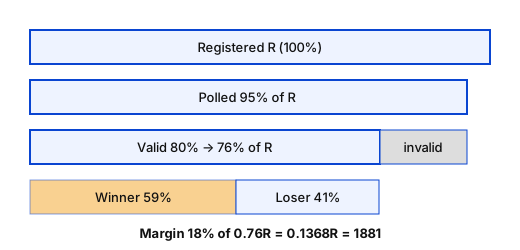
  1. Votes polled =0.95R; valid =80% of polled =0.76R.
  2. Winner 59%, loser 41% of valid → margin =18% of 0.76R=0.1368R.
  3. 0.1368R=1881⇒R=18810.1368=13750.

Trick: Margin as % of R =0.95×0.8×0.18=13.68%; check 13750×0.1368=1881 ✓.

Answer: (B) 13750

अवधारणा: पंजीकृत मतदाता R से क्रमशः चलें: डाले गए मत → वैध मत → अंतर।

  1. डाले गए मत =0.95R; वैध =80% =0.76R।
  2. विजेता 59%, पराजित 41% → अंतर =18% of 0.76R=0.1368R।
  3. 0.1368R=1881⇒R=18810.1368=13750।

ट्रिक: R का अंतर-प्रतिशत =0.95×0.8×0.18=13.68%; जाँच 13750×0.1368=1881 ✓।

उत्तर: (B) 13750

RRB NTPC Undergraduate CBT 1MathematicsPercentage – ElectionsRRB NTPC Undergraduate CBT 1 2024 · 8 Sep Shift 2 →
Q3650.
By selling an article at 511 of its actual selling price, Hitesh incurs a loss of 15%. If he sells it at 90% of its actual selling price, then the profit percentage is:
किसी वस्तु को उसके वास्तविक विक्रय मूल्य के 511 पर बेचने पर हितेश को 15% की हानि होती है। यदि वह इसे उसके वास्तविक विक्रय मूल्य के 90% पर बेचता है, तो लाभ प्रतिशत है:
  1. A67.4%
  2. B68.3%
  3. C69.8%
  4. D66.6%
Show answer

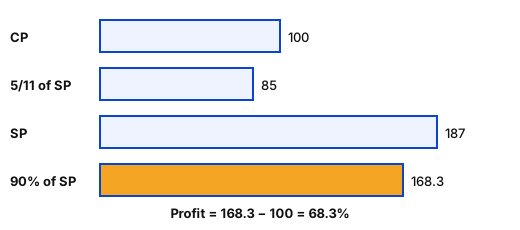
Concept: Loss of 15% means selling price =85% of CP. Take CP =100.

  1. 511 of actual SP =85⇒SP=85×115=187.
  2. 90% of SP =0.9×187=168.3.
  3. Profit %=168.3−100100×100=68.3%.

Trick: New SP/CP =0.85×115×0.9=1.683 → profit 68.3%.

Answer: (B) 68.3%

अवधारणा: 15% हानि का अर्थ विक्रय मूल्य =85% of क्रय मूल्य। क्रय मूल्य =100 लें।

  1. वास्तविक विक्रय मूल्य का 511=85⇒SP=85×115=187।
  2. SP का 90% =0.9×187=168.3।
  3. लाभ%=168.3−100100×100=68.3%।

ट्रिक: नया SP/CP =0.85×115×0.9=1.683 → लाभ 68.3%।

उत्तर: (B) 68.3%

RRB NTPC Undergraduate CBT 1MathematicsProfit and LossRRB NTPC Undergraduate CBT 1 2024 · 8 Sep Shift 2 →
Q3651.
The LCM of the numbers 2.1 and 0.35 is:
संख्याओं 2.1 और 0.35 का LCM है:
  1. A0.021
  2. B21
  3. C0.21
  4. D2.1
Show answer

Concept: Make the decimal places equal, find the LCM of the whole numbers, then put the decimal back.

  1. 2.1=210100 and 0.35=35100
  2. LCM(210,35)=210 (since 210=35×6)
  3. LCM=210100=2.1

Trick: If one number is a multiple of the other (2.1=0.35×6), the bigger number itself is the LCM.

Answer: (D) 2.1

अवधारणा: दशमलव स्थान बराबर करें, पूर्ण संख्याओं का LCM निकालें, फिर दशमलव वापस लगाएँ।

  1. 2.1=210100 और 0.35=35100
  2. LCM(210,35)=210 (क्योंकि 210=35×6)
  3. LCM=210100=2.1

ट्रिक: यदि एक संख्या दूसरी का गुणज हो (2.1=0.35×6), तो बड़ी संख्या ही LCM है।

उत्तर: (D) 2.1

RRB NTPC Undergraduate CBT 1MathematicsLCM of DecimalsRRB NTPC Undergraduate CBT 1 2024 · 8 Sep Shift 2 →
Q3652.
The H.C.F. and the L.C.M. of two numbers are 25 and 250 respectively. If one of the numbers is 50, find the other one.
दो संख्याओं का H.C.F. और L.C.M. क्रमशः 25 और 250 है। यदि उनमें से एक संख्या 50 है, तो दूसरी संख्या ज्ञात कीजिए।
  1. A175
  2. B150
  3. C75
  4. D125
Show answer

Concept: For two numbers, HCF×LCM=first number×second number.

  1. 25×250=50×x
  2. x=625050=125
  3. Check: HCF(50,125)=25, LCM=250 ✓

Trick: Other number =HCF×LCMgiven number.

Answer: (D) 125

अवधारणा: दो संख्याओं के लिए HCF×LCM=पहली संख्या×दूसरी संख्या।

  1. 25×250=50×x
  2. x=625050=125
  3. जाँच: HCF(50,125)=25, LCM=250 ✓

ट्रिक: दूसरी संख्या =HCF×LCMदी गई संख्या।

उत्तर: (D) 125

RRB NTPC Undergraduate CBT 1MathematicsHCF and LCMRRB NTPC Undergraduate CBT 1 2024 · 8 Sep Shift 2 →
Q3653.
ABCD is a quadrilateral with ∠A = 3(x + 2)°, ∠B = 2(2x − 7)°, ∠C = 69° and ∠D = ∠C − 8°. What is the value of ∠B?
ABCD एक चतुर्भुज है, जिसमें ∠A = 3(x + 2)°, ∠B = 2(2x − 7)°, ∠C = 69° और ∠D = ∠C − 8° है। ∠B का मान क्या है?
  1. A128°
  2. B183°
  3. C122°
  4. D153°
Show answer

Concept: The four angles of a quadrilateral add up to 360∘.

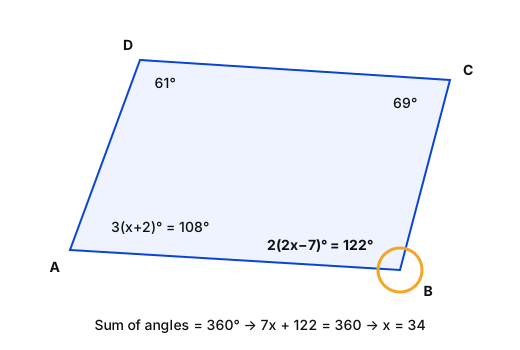
  1. ∠D=69∘−8∘=61∘
  2. 3(x+2)+2(2x−7)+69+61=360⇒7x+122=360
  3. 7x=238⇒x=34
  4. ∠B=2(2×34−7)=2×61=122∘

Trick: Check: 108∘+122∘+69∘+61∘=360∘ ✓

Answer: (C) 122∘

अवधारणा: चतुर्भुज के चारों कोणों का योग 360∘ होता है।

  1. ∠D=69∘−8∘=61∘
  2. 3(x+2)+2(2x−7)+69+61=360⇒7x+122=360
  3. 7x=238⇒x=34
  4. ∠B=2(2×34−7)=2×61=122∘

ट्रिक: जाँच: 108∘+122∘+69∘+61∘=360∘ ✓

उत्तर: (C) 122∘

RRB NTPC Undergraduate CBT 1MathematicsAngles of a QuadrilateralRRB NTPC Undergraduate CBT 1 2024 · 8 Sep Shift 2 →
Q3654.
A shopkeeper marks a product 40% above the cost price. He offers a discount of 20% on the marked price and sells it. What is his gain or loss percentage?
एक दुकानदार किसी उत्पाद पर क्रय मूल्य से 40% अधिक मूल्य अंकित करता है। वह अंकित मूल्य पर 20% की छूट देकर उसे बेचता है। उसका लाभ या हानि प्रतिशत कितना है?
  1. A12% gain12% लाभ
  2. B15% gain15% लाभ
  3. C8% loss8% हानि
  4. D10% loss10% हानि
Show answer

Concept: Selling price = cost price × (1 + markup) × (1 − discount).

  1. Let CP=100; MP=140
  2. SP=140×80100=112
  3. Gain%=112−100100×100=12%

Trick: Net effect =a−b−ab100=40−20−800100=12% gain.

Answer: (A) 12% gain

अवधारणा: विक्रय मूल्य = क्रय मूल्य × (1 + मार्कअप) × (1 − छूट)।

  1. माना CP=100; MP=140
  2. SP=140×80100=112
  3. लाभ%=112−100100×100=12%

ट्रिक: शुद्ध प्रभाव =a−b−ab100=40−20−800100=12% लाभ।

उत्तर: (A) 12% लाभ

RRB NTPC Undergraduate CBT 1MathematicsMarked Price and DiscountRRB NTPC Undergraduate CBT 1 2024 · 8 Sep Shift 2 →
Q3655.
The average of first 153 odd natural numbers, is:
प्रथम 153 विषम प्राकृत संख्याओं का औसत है:
  1. A153
  2. B154
  3. C152.5
  4. D153.5
Show answer

Concept: Sum of the first n odd natural numbers =n2, so their average =n2n=n.

  1. Here n=153
  2. Sum=1532
  3. Average=1532153=153

Yaad rakhein: Average of first n odd numbers =n; of first n even numbers =n+1.

Answer: (A) 153

अवधारणा: प्रथम n विषम प्राकृत संख्याओं का योग =n2, अतः औसत =n2n=n।

  1. यहाँ n=153
  2. योग=1532
  3. औसत=1532153=153

याद रखें: प्रथम n विषम संख्याओं का औसत =n; प्रथम n सम संख्याओं का औसत =n+1।

उत्तर: (A) 153

RRB NTPC Undergraduate CBT 1MathematicsAverage of Odd NumbersRRB NTPC Undergraduate CBT 1 2024 · 8 Sep Shift 2 →
Q3656.
If 2 times the age of Ram is 30 years more than 4 times the age of Ramya, and 5 times the age of Ramya is 6 year less than the age of Ram, then what is the difference (in years) between the ages of Ram and Ramya?
यदि राम की आयु का 2 गुना, रम्या की आयु के 4 गुने से 30 वर्ष अधिक है, और रम्या की आयु का 5 गुना, राम की आयु से 6 वर्ष कम है, तो राम और रम्या की आयु के बीच का अंतर (वर्षों में) कितना है?
  1. A17
  2. B18
  3. C15
  4. D13
Show answer

Concept: Form two linear equations from the statements and solve them.

  1. Let Ram =R, Ramya =r: 2R=4r+30⇒R=2r+15
  2. 5r=R−6⇒R=5r+6
  3. 2r+15=5r+6⇒r=3, R=21
  4. Difference=21−3=18 years

Trick: Equate the two expressions for R directly – one step solves it.

Answer: (B) 18

अवधारणा: कथनों से दो रैखिक समीकरण बनाकर हल करें।

  1. माना राम =R, राम्या =r: 2R=4r+30⇒R=2r+15
  2. 5r=R−6⇒R=5r+6
  3. 2r+15=5r+6⇒r=3, R=21
  4. अंतर=21−3=18 वर्ष

ट्रिक: R के दोनों व्यंजकों को सीधे बराबर करें – एक ही चरण में हल।

उत्तर: (B) 18

RRB NTPC Undergraduate CBT 1MathematicsProblems on AgesRRB NTPC Undergraduate CBT 1 2024 · 8 Sep Shift 2 →
Q3657.
Find the total surface area of a cuboidal box whose length is 84 cm, breadth is 45 cm and height is 25 cm.
एक घनाभाकार डिब्बे का संपूर्ण पृष्ठीय क्षेत्रफल ज्ञात कीजिए, जिसकी लंबाई 84 cm, चौड़ाई 45 cm और ऊँचाई 25 cm है।
  1. A14,250 cm2
  2. B14,010 cm2
  3. C14,120 cm2
  4. D14,380 cm2
Show answer

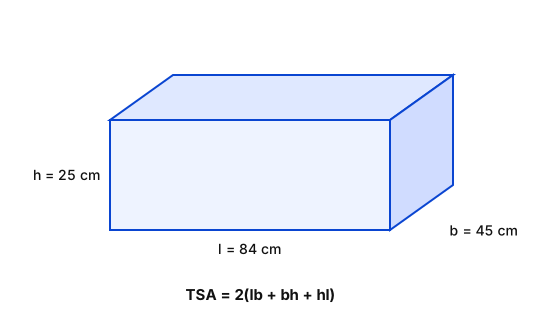
Concept: TSA of cuboid=2(lb+bh+hl).

  1. lb=84×45=3780
  2. bh=45×25=1125, hl=25×84=2100
  3. TSA=2(3780+1125+2100)=2×7005=14010cm2

Trick: Only one option ends in 10 – the unit digit of 2×7005 is 0 and tens digit 1.

Answer: (B) 14,010cm2

अवधारणा: घनाभ का कुल पृष्ठीय क्षेत्रफल=2(lb+bh+hl)।

  1. lb=84×45=3780
  2. bh=45×25=1125, hl=25×84=2100
  3. TSA=2(3780+1125+2100)=2×7005=14010cm2

ट्रिक: 2×7005 का अंत 10 पर होता है – केवल एक विकल्प ऐसा है।

उत्तर: (B) 14,010cm2

RRB NTPC Undergraduate CBT 1MathematicsSurface Area of CuboidRRB NTPC Undergraduate CBT 1 2024 · 8 Sep Shift 2 →
Q3658.
Pipe A can fill a tank in 12 hours, pipe B can fill the same tank in 21 hours and pipe C can fill the same tank in 16 hours. The time taken by them to fill the same tank if they operate together is::
पाइप A एक टंकी को 12 घंटे में भर सकता है, पाइप B उसी टंकी को 21 घंटे में भर सकता है और पाइप C उसी टंकी को 16 घंटे में भर सकता है। यदि वे एक साथ कार्य करें, तो उसी टंकी को भरने में उनके द्वारा लिया गया समय है:
  1. A11165 hours11165 घंटे
  2. B111165 hours111165 घंटे
  3. C51165 hours51165 घंटे
  4. D21165 hours21165 घंटे
Show answer

Concept: Take total work = LCM of the times; add the hourly efficiencies of pipes working together.

  1. LCM(12,21,16)=336 units
  2. Efficiencies: A =28, B =16, C =21 units/hour
  3. Together =28+16+21=65 units/hour
  4. Time=33665=51165 hours

Trick: All options share 1165; only the whole part matters: 65×5=325<336<390, so 5.

Answer: (C) 51165 hours

अवधारणा: कुल कार्य = समयों का LCM लें; साथ काम करने पर प्रति घंटा दक्षताएँ जोड़ें।

  1. LCM(12,21,16)=336 इकाई
  2. दक्षता: A =28, B =16, C =21 इकाई/घंटा
  3. मिलकर =28+16+21=65 इकाई/घंटा
  4. समय=33665=51165 घंटे

ट्रिक: सभी विकल्पों में 1165 है; केवल पूर्णांक देखें: 65×5=325<336<390, अतः 5।

उत्तर: (C) 51165 घंटे

RRB NTPC Undergraduate CBT 1MathematicsPipes and CisternsRRB NTPC Undergraduate CBT 1 2024 · 8 Sep Shift 2 →
Q3659.
The cost of 7 pens and 13 pencils is ₹128. If the cost of a pen decreases by ₹7 and the cost of a pencil increases by ₹2, then the cost of 14 pens and 10 pencils is ₹98. What is the original cost of 9 pens and 7 pencils?
7 पेन और 13 पेंसिलों का मूल्य ₹128 है। यदि एक पेन का मूल्य ₹7 कम हो जाए और एक पेंसिल का मूल्य ₹2 बढ़ जाए, तो 14 पेन और 10 पेंसिलों का मूल्य ₹98 हो जाता है। 9 पेन और 7 पेंसिलों का मूल मूल्य कितना है?
  1. A₹117
  2. B₹112
  3. C₹111
  4. D₹116
Show answer

Concept: Let pen = ₹p, pencil = ₹c; form two equations and eliminate one variable.

  1. 7p+13c=128
  2. 14(p−7)+10(c+2)=98⇒14p+10c=176⇒7p+5c=88
  3. Subtract: 8c=40⇒c=5, 7p=63⇒p=9
  4. 9p+7c=81+35=116

Trick: Halve the second equation first so the 7p terms cancel at once.

Answer: (D) ₹116

अवधारणा: माना पेन = ₹p, पेंसिल = ₹c; दो समीकरण बनाकर एक चर हटाएँ।

  1. 7p+13c=128
  2. 14(p−7)+10(c+2)=98⇒14p+10c=176⇒7p+5c=88
  3. घटाने पर: 8c=40⇒c=5, 7p=63⇒p=9
  4. 9p+7c=81+35=116

ट्रिक: दूसरे समीकरण को पहले आधा करें, जिससे 7p तुरंत कट जाए।

उत्तर: (D) ₹116

RRB NTPC Undergraduate CBT 1MathematicsLinear EquationsRRB NTPC Undergraduate CBT 1 2024 · 8 Sep Shift 2 →
Q3660.
By selling 6 tablets for a rupee, a man loses 35%. To gain 30% how many must he sell for a rupee?
एक रुपये में 6 टैबलेट बेचने पर एक व्यक्ति को 35% की हानि होती है। 30% लाभ प्राप्त करने के लिए उसे एक रुपये में कितनी टैबलेट बेचनी चाहिए?
  1. A3
  2. B2
  3. C4
  4. D5
Show answer

Concept: For a fixed SP of ₹1, the number of articles sold is inversely proportional to the SP-factor (100±%).

  1. At 35% loss, factor =65; at 30% gain, factor =130
  2. New number=6×65130
  3. =6×12=3

Trick: n2=n1×100−loss100+gain.

Answer: (A) 3

अवधारणा: ₹1 के निश्चित SP पर बेची गई वस्तुओं की संख्या, (100±%) के व्युत्क्रमानुपाती होती है।

  1. 35% हानि पर गुणक =65; 30% लाभ पर गुणक =130
  2. नई संख्या=6×65130
  3. =6×12=3

ट्रिक: n2=n1×100−हानि100+लाभ।

उत्तर: (A) 3

RRB NTPC Undergraduate CBT 1MathematicsProfit and Loss (Articles per Rupee)RRB NTPC Undergraduate CBT 1 2024 · 8 Sep Shift 2 →