Question bank

Q&A: practice questions with answers

Search questions on any topic. Filter by exam category, exam, subject and topic, try the question, then open the answer and explanation.

Courses – airGurukul

8,500 questions found.

Q3661.
Find the simple interest (in ₹) on ₹1,200 at an interest rate of 4% per month for 7 months.
₹1,200 पर 4% प्रति माह की ब्याज दर से 7 महीने का साधारण ब्याज (₹ में) ज्ञात कीजिए।
  1. A₹336
  2. B₹28
  3. C₹56
  4. D₹48
Show answer

Concept: SI=P×R×T100, with R and T in the same time unit.

  1. Rate 4% per month, time 7 months
  2. SI=1200×4×7100=336
  3. (If the rate were 4% per annum, SI=1200×4100×712=28.)

Trick: Always check whether the rate is per month or per annum before plugging in.

Answer: (A) ₹336

अवधारणा: SI=P×R×T100, जहाँ R और T एक ही समय इकाई में हों।

  1. दर 4% प्रति माह, समय 7 माह
  2. SI=1200×4×7100=336
  3. (यदि दर 4% वार्षिक होती, तो SI=1200×4100×712=28।)

ट्रिक: दर मासिक है या वार्षिक – सूत्र लगाने से पहले अवश्य जाँचें।

उत्तर: (A) ₹336
RRB NTPC Undergraduate CBT 1MathematicsSimple InterestRRB NTPC Undergraduate CBT 1 2024 · 8 Sep Shift 2 →
Q3662.
The perimeter of a square is 52 m. Its area (in m2) is:
एक वर्ग का परिमाप 52 m है। इसका क्षेत्रफल (m2 में) है:
  1. A172
  2. B168
  3. C169
  4. D180
Show answer

Concept: Side=Perimeter4, Area=side2.

  1. Side=524=13m
  2. Area=132=169m2

Trick: Area =Perimeter216=270416=169.

Answer: (C) 169

अवधारणा: भुजा=परिमाप4, क्षेत्रफल=भुजा2।

  1. भुजा=524=13m
  2. क्षेत्रफल=132=169m2

ट्रिक: क्षेत्रफल =परिमाप216=270416=169।

उत्तर: (C) 169

RRB NTPC Undergraduate CBT 1MathematicsArea of SquareRRB NTPC Undergraduate CBT 1 2024 · 8 Sep Shift 2 →
Q3663.
4 men can complete a piece of work in 18 days, while 9 women can do it in 8 days. In how many days can 3 women and 3 men complete this work?
4 पुरुष किसी कार्य को 18 दिनों में पूरा कर सकते हैं, जबकि 9 महिलाएँ उसे 8 दिनों में कर सकती हैं। 3 महिलाएँ और 3 पुरुष इस कार्य को कितने दिनों में पूरा कर सकते हैं?
  1. A17 days17 दिन
  2. B11 days11 दिन
  3. C12 days12 दिन
  4. D16 days16 दिन
Show answer

Concept: Total work in man-days equals total work in woman-days; compare to find relative efficiency.

  1. 4×18=72 man-days =9×8=72 woman-days
  2. So 1 man = 1 woman
  3. 3 women + 3 men =6 persons
  4. Days=726=12

Trick: M1D1=M2D2 – equal products mean equal efficiency.

Answer: (C) 12 days

अवधारणा: कुल कार्य पुरुष-दिवस और महिला-दिवस में बराबर होता है; इससे दक्षता की तुलना करें।

  1. 4×18=72 पुरुष-दिवस =9×8=72 महिला-दिवस
  2. अतः 1 पुरुष = 1 महिला
  3. 3 महिलाएँ + 3 पुरुष =6 व्यक्ति
  4. दिन=726=12

ट्रिक: M1D1=M2D2 – गुणनफल बराबर, तो दक्षता बराबर।

उत्तर: (C) 12 दिन

RRB NTPC Undergraduate CBT 1MathematicsTime and Work (Men–Women)RRB NTPC Undergraduate CBT 1 2024 · 8 Sep Shift 2 →
Q3664.
Find the value of: 66−5÷ 6611× 66−12
इसका मान ज्ञात कीजिए: 66−5÷ 6611× 66−12
  1. A66−27
  2. B66−34
  3. C66−28
  4. D66−25
Show answer

Concept: am÷an=am−n and am×an=am+n; work left to right.

  1. 66−5÷6611=66−5−11=66−16
  2. 66−16×66−12=66−16−12=66−28

Trick: Exponent =−5−11+(−12)=−28.

Answer: (C) 66−28

अवधारणा: am÷an=am−n तथा am×an=am+n; बाएँ से दाएँ हल करें।

  1. 66−5÷6611=66−5−11=66−16
  2. 66−16×66−12=66−16−12=66−28

ट्रिक: घातांक =−5−11+(−12)=−28।

उत्तर: (C) 66−28

RRB NTPC Undergraduate CBT 1MathematicsLaws of ExponentsRRB NTPC Undergraduate CBT 1 2024 · 8 Sep Shift 2 →
Q3665.
Simplify: 3((73)x2−28x+14)−7(x2+4x−14)
सरल कीजिए: 3((73)x2−28x+14)−7(x2+4x−14)
  1. A112x + 140
  2. B−112x − 140
  3. C112x − 140
  4. D−112x + 140
Show answer

Concept: Expand each bracket and combine like terms.

  1. 3(73x2−28x+14)=7x2−84x+42
  2. −7(x2+4x−14)=−7x2−28x+98
  3. Sum: (7x2−7x2)+(−84x−28x)+(42+98)=−112x+140

Trick: The x2 terms cancel; the x-coefficient is negative and the constant positive – only one option fits.

Answer: (D) −112x+140

अवधारणा: प्रत्येक कोष्ठक खोलें और सजातीय पदों को जोड़ें।

  1. 3(73x2−28x+14)=7x2−84x+42
  2. −7(x2+4x−14)=−7x2−28x+98
  3. योग: (7x2−7x2)+(−84x−28x)+(42+98)=−112x+140

ट्रिक: x2 पद कट जाते हैं; x का गुणांक ऋणात्मक और अचर धनात्मक – केवल एक विकल्प।

उत्तर: (D) −112x+140

RRB NTPC Undergraduate CBT 1MathematicsAlgebraic SimplificationRRB NTPC Undergraduate CBT 1 2024 · 8 Sep Shift 2 →
Q3666.
Simplify: 1+cosA1−cosA
सरल कीजिए: 1+cosA1−cosA
  1. AcosecA+tanA
  2. BcosA+cotA
  3. CsinA+tanA
  4. DcosecA+cotA
Show answer

Concept: Multiply numerator and denominator by (1+cosA) and use 1−cos2A=sin2A.

  1. (1+cosA)21−cos2A=(1+cosA)2sin2A
  2. =1+cosAsinA
  3. =1sinA+cosAsinA=cosecA+cotA

Trick: Put A=90∘: expression =1; cosec90∘+cot90∘=1+0=1 ✓

Answer: (D) cosecA+cotA

अवधारणा: अंश और हर को (1+cosA) से गुणा करें तथा 1−cos2A=sin2A का प्रयोग करें।

  1. (1+cosA)21−cos2A=(1+cosA)2sin2A
  2. =1+cosAsinA
  3. =1sinA+cosAsinA=cosecA+cotA

ट्रिक: A=90∘ रखें: व्यंजक =1; cosec90∘+cot90∘=1+0=1 ✓

उत्तर: (D) cosecA+cotA

RRB NTPC Undergraduate CBT 1MathematicsTrigonometric IdentitiesRRB NTPC Undergraduate CBT 1 2024 · 8 Sep Shift 2 →
Q3667.
Find the mean proportional between 25 and 36.
25 और 36 के बीच मध्यानुपाती ज्ञात कीजिए।
  1. A33
  2. B30
  3. C27
  4. D32
Show answer

Concept: Mean proportional of a and b is ab.

  1. 25×36=900
  2. =30 (or 5×6=30)

Trick: ab=a×b=5×6.

Answer: (B) 30

अवधारणा: a और b का मध्यानुपाती ab होता है।

  1. 25×36=900
  2. =30 (या 5×6=30)

ट्रिक: ab=a×b=5×6।

उत्तर: (B) 30

RRB NTPC Undergraduate CBT 1MathematicsMean ProportionalRRB NTPC Undergraduate CBT 1 2024 · 8 Sep Shift 2 →
Q3668.
Find the simple interest (in ₹) on ₹4,000 at 7.5% per annum rate of interest deposited on 10 February 2024 and withdrawn on 11 April 2024.
10 फ़रवरी 2024 को 7.5% वार्षिक ब्याज दर पर जमा किए गए और 11 अप्रैल 2024 को निकाले गए ₹4,000 पर साधारण ब्याज (₹ में) ज्ञात कीजिए।
  1. A51
  2. B48
  3. C49
  4. D50
Show answer

Concept: Count days excluding the deposit day and including the withdrawal day; 2024 is a leap year (366 days).

  1. Feb: 29−10=19, March: 31, April: 11 → 61 days
  2. SI=4000×7.5×61100×366
  3. =300×61366=3006=50

Trick: 366=6×61 – the 61 cancels neatly, confirming the day count.

Answer: (D) 50

अवधारणा: जमा का दिन छोड़कर और निकासी का दिन जोड़कर दिन गिनें; 2024 लीप वर्ष है (366 दिन)।

  1. फरवरी: 29−10=19, मार्च: 31, अप्रैल: 11 → 61 दिन
  2. SI=4000×7.5×61100×366
  3. =300×61366=3006=50

ट्रिक: 366=6×61 – 61 सीधे कट जाता है, जिससे दिनों की गिनती की पुष्टि होती है।

उत्तर: (D) 50

RRB NTPC Undergraduate CBT 1MathematicsSimple Interest (Days)RRB NTPC Undergraduate CBT 1 2024 · 8 Sep Shift 2 →
Q3669.
A number, when decreased by 7%, gives 2790. The number is:
एक संख्या को 7% कम करने पर 2790 प्राप्त होता है। वह संख्या है:
  1. A3000
  2. B1500
  3. C9000
  4. D6000
Show answer

Concept: After a 7% decrease, 93% of the number remains.

  1. 93% of x=2790
  2. x=2790×10093=30×100=3000

Trick: 2790÷93=30, so the number is 3000.

Answer: (A) 3000

अवधारणा: 7% कमी के बाद संख्या का 93% शेष रहता है।

  1. x का 93%=2790
  2. x=2790×10093=30×100=3000

ट्रिक: 2790÷93=30, अतः संख्या 3000।

उत्तर: (A) 3000

RRB NTPC Undergraduate CBT 1MathematicsPercentage DecreaseRRB NTPC Undergraduate CBT 1 2024 · 8 Sep Shift 2 →
Q3670.
The number of prime numbers lying between 472 and 486, both included, is:
472 और 486 के बीच स्थित अभाज्य संख्याओं की संख्या (दोनों को सम्मिलित करते हुए) है:
  1. A1
  2. B6
  3. C5
  4. D2
Show answer

Concept: Test odd numbers in the range for divisibility by primes up to 486≈22.

  1. Odd numbers: 473=11×43, 475=5×95, 477=9×53
  2. 481=13×37, 483=3×161, 485=5×97
  3. 479 is not divisible by 2,3,5,7,11,13,17,19 → prime

Trick: Remember tricky composites like 481=13×37 and 473=11×43.

Answer: (A) 1

अवधारणा: सीमा की विषम संख्याओं को 486≈22 तक के अभाज्यों से जाँचें।

  1. विषम संख्याएँ: 473=11×43, 475=5×95, 477=9×53
  2. 481=13×37, 483=3×161, 485=5×97
  3. 479, 2,3,5,7,11,13,17,19 से विभाज्य नहीं → अभाज्य

ट्रिक: छिपे भाज्य याद रखें: 481=13×37, 473=11×43।

उत्तर: (A) 1

RRB NTPC Undergraduate CBT 1MathematicsPrime NumbersRRB NTPC Undergraduate CBT 1 2024 · 8 Sep Shift 2 →
Q3671.
Read the given statements and conclusions carefully. Assuming that the information given in the statements is true, even if it appears to be at variance with commonly known facts, decide which of the given conclusions logically follow(s) from the statements.
Statements:
All horses are cats.
No horse is a lion.
Conclusions:
(I): Some lions are cats.
(II): All cats are lions.
दिए गए कथनों और निष्कर्षों को ध्यानपूर्वक पढ़िए। कथनों में दी गई जानकारी को सत्य मानते हुए, भले ही वह सामान्यतः ज्ञात तथ्यों से भिन्न प्रतीत होती हो, निर्णय लीजिए कि दिए गए निष्कर्षों में से कौन-सा/कौन-से निष्कर्ष तार्किक रूप से कथनों का अनुसरण करता है/करते हैं।
कथन:
सभी घोड़े, बिल्लियाँ हैं।
कोई घोड़ा, शेर नहीं है।
निष्कर्ष:
(I): कुछ शेर, बिल्लियाँ हैं।
(II): सभी बिल्लियाँ, शेर हैं।
  1. AOnly conclusion (I) follows.केवल निष्कर्ष (I) अनुसरण करता है।
  2. BOnly conclusion (II) follows.केवल निष्कर्ष (II) अनुसरण करता है।
  3. CBoth conclusions (I) and (II) follow.निष्कर्ष (I) और (II) दोनों अनुसरण करते हैं।
  4. DNeither conclusion (I) nor (II) follows.न तो निष्कर्ष (I) और न ही (II) अनुसरण करता है।
Show answer

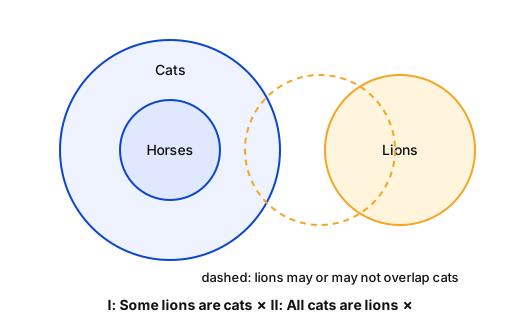
Concept: Draw the least-overlap Venn diagram; a conclusion follows only if it is true in every possible diagram.

  1. All horses lie inside cats; lions are outside horses.
  2. Lions may lie completely outside cats, so 'Some lions are cats' is not certain – I does not follow.
  3. Nothing forces cats to be inside lions – II does not follow.

Trick: 'No A is B' tells nothing about B and the bigger set containing A.

Answer: (D) Neither conclusion (I) nor (II) follows.

अवधारणा: न्यूनतम ओवरलैप वाला वेन आरेख बनाएँ; निष्कर्ष तभी मान्य जब हर संभव आरेख में सत्य हो।

  1. सभी घोड़े बिल्लियों के अंदर; शेर घोड़ों से बाहर।
  2. शेर बिल्लियों से पूरी तरह बाहर भी हो सकते हैं, अतः 'कुछ शेर बिल्लियाँ हैं' निश्चित नहीं – I अनुसरण नहीं करता।
  3. बिल्लियों का शेरों के अंदर होना आवश्यक नहीं – II भी नहीं।

ट्रिक: 'कोई A, B नहीं' से B और A वाले बड़े समूह के बारे में कुछ तय नहीं होता।

उत्तर: (D) न तो निष्कर्ष (I) और न ही (II) अनुसरण करता है।

RRB NTPC Undergraduate CBT 1General Intelligence and ReasoningSyllogismRRB NTPC Undergraduate CBT 1 2024 · 8 Sep Shift 2 →
Q3672.
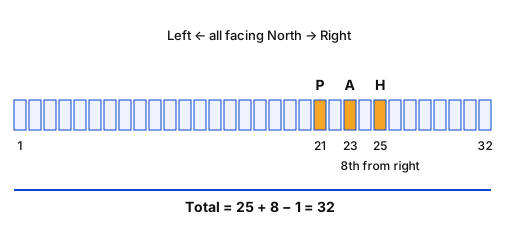
In a row of people all facing north, Pranali is 21st from the left end and Anuj is 23rd from the left end. Anuj is exactly between Pranali and Harish. If Harish is 8th from the right end of the row, how many people are there in the row?
उत्तर की ओर मुख करके खड़े लोगों की एक पंक्ति में, प्रणाली बाएँ छोर से 21वें स्थान पर है और अनुज बाएँ छोर से 23वें स्थान पर है। अनुज, प्रणाली और हरीश के ठीक बीच में है। यदि हरीश पंक्ति के दाएँ छोर से 8वें स्थान पर है, तो पंक्ति में कितने लोग हैं?
  1. A31
  2. B32
  3. C33
  4. D30
Show answer

Concept: Place persons by position from the left; total = position from left + position from right − 1.

  1. Pranali 21st, Anuj 23rd from left – gap of 2.
  2. Anuj is exactly midway, so Harish is 2 places beyond Anuj: 25th from left.
  3. Harish is 8th from right: total = 25 + 8 − 1 = 32.

Trick: Same person counted from both ends: L + R − 1.

Answer: (B) 32

अवधारणा: बाएँ से स्थान के अनुसार व्यक्तियों को रखें; कुल = बाएँ से स्थान + दाएँ से स्थान − 1।

  1. प्रणाली बाएँ से 21वीं, अनुज 23वाँ – अंतर 2।
  2. अनुज ठीक बीच में है, अतः हरीश अनुज से 2 स्थान आगे: बाएँ से 25वाँ।
  3. हरीश दाएँ से 8वाँ: कुल = 25 + 8 − 1 = 32।

ट्रिक: एक ही व्यक्ति दोनों सिरों से: L + R − 1।

उत्तर: (B) 32

RRB NTPC Undergraduate CBT 1General Intelligence and ReasoningRow ArrangementRRB NTPC Undergraduate CBT 1 2024 · 8 Sep Shift 2 →
Q3673.
Based on the English alphabetical order, three of the following four letter-clusters are alike in a certain way and thus form a group. Which letter-cluster DOES NOT belong to that group? (Note: The odd one out is not based on the number of consonants/vowels or their position in the letter-cluster.)
अंग्रेज़ी वर्णमाला क्रम के आधार पर, निम्नलिखित चार अक्षर-समूहों में से तीन किसी निश्चित प्रकार से एकसमान हैं और इस प्रकार एक समूह बनाते हैं। कौन-सा अक्षर-समूह उस समूह से संबंधित नहीं है? (ध्यान दें: असंगत अक्षर-समूह, उस अक्षर-समूह में व्यंजनों/स्वरों की संख्या या उनके स्थान पर आधारित नहीं है।)
  1. AOVP
  2. BLSM
  3. CIPJ
  4. DRYT
Show answer

Concept: Find the alphabetical gaps between consecutive letters of each cluster.

  1. OVP: O +7 → V, V −6 → P
  2. LSM: L +7 → S, S −6 → M; IPJ: I +7 → P, P −6 → J
  3. RYT: R +7 → Y, but Y −5 → T (not −6)

Trick: Pattern +7, −6 means the third letter is just next to the first (O–P, L–M, I–J); R–T breaks it.

Answer: (D) RYT

अवधारणा: प्रत्येक समूह के क्रमागत अक्षरों के बीच वर्णमाला अंतर देखें।

  1. OVP: O +7 → V, V −6 → P
  2. LSM: L +7 → S, S −6 → M; IPJ: I +7 → P, P −6 → J
  3. RYT: R +7 → Y, पर Y −5 → T (−6 नहीं)

ट्रिक: +7, −6 का अर्थ है तीसरा अक्षर पहले का अगला अक्षर (O–P, L–M, I–J); R–T नियम तोड़ता है।

उत्तर: (D) RYT

RRB NTPC Undergraduate CBT 1General Intelligence and ReasoningOdd One Out (Letters)RRB NTPC Undergraduate CBT 1 2024 · 8 Sep Shift 2 →
Q3674.
Which of the following letter-number clusters will replace the question mark (?) in the given series to make it logically complete?'
CKS 11, ZHP 23, WEM 47, TBJ 95, QYG 191, ?
निम्नलिखित में से कौन-सा अक्षर-संख्या समूह दी गई शृंखला में प्रश्न चिह्न (?) के स्थान पर आकर उसे तार्किक रूप से पूर्ण करेगा?
CKS 11, ZHP 23, WEM 47, TBJ 95, QYG 191, ?
  1. ANVD 383
  2. BNOD 383
  3. CDND 383
  4. DNVD 381
Show answer

Concept: Track each letter position and the number separately.

  1. 1st letters: C, Z, W, T, Q → each −3 → N
  2. 2nd letters: K, H, E, B, Y → −3 → V; 3rd letters: S, P, M, J, G → −3 → D
  3. Numbers: 11, 23, 47, 95, 191 → ×2 + 1 → 383

Trick: Every letter moves back by 3 (wrapping A → X); numbers follow ×2 + 1.

Answer: (A) NVD 383

अवधारणा: प्रत्येक अक्षर-स्थान और संख्या को अलग-अलग देखें।

  1. पहले अक्षर: C, Z, W, T, Q → हर बार −3 → N
  2. दूसरे अक्षर: K, H, E, B, Y → −3 → V; तीसरे: S, P, M, J, G → −3 → D
  3. संख्याएँ: 11, 23, 47, 95, 191 → ×2 + 1 → 383

ट्रिक: हर अक्षर 3 पीछे (A के बाद X पर लौटता है); संख्याएँ ×2 + 1।

उत्तर: (A) NVD 383

RRB NTPC Undergraduate CBT 1General Intelligence and ReasoningLetter-Number SeriesRRB NTPC Undergraduate CBT 1 2024 · 8 Sep Shift 2 →
Q3675.
What should come in place of the question mark (?) in the given series?
58 , 64 , 73 , 85 , 100 , ?
दी गई शृंखला में प्रश्न चिह्न (?) के स्थान पर क्या आना चाहिए?
58 , 64 , 73 , 85 , 100 , ?
  1. A121
  2. B118
  3. C119
  4. D120
Show answer

Concept: Look at the differences between consecutive terms.

  1. Differences: 6,9,12,15 (increasing by 3)
  2. Next difference =18
  3. 100+18=118

Trick: Differences in an AP of +3.

Answer: (B) 118

अवधारणा: क्रमागत पदों का अंतर देखें।

  1. अंतर: 6,9,12,15 (हर बार 3 अधिक)
  2. अगला अंतर =18
  3. 100+18=118

ट्रिक: अंतर +3 की समांतर श्रेणी में।

उत्तर: (B) 118

RRB NTPC Undergraduate CBT 1General Intelligence and ReasoningNumber SeriesRRB NTPC Undergraduate CBT 1 2024 · 8 Sep Shift 2 →
Q3676.
Each of the digits in the number 31246978 is arranged in descending order from left to right. The position of how many digits will remain unchanged as compared to that in the original number?
संख्या 31246978 के प्रत्येक अंक को बाएँ से दाएँ अवरोही क्रम में व्यवस्थित किया जाता है। मूल संख्या की तुलना में कितने अंकों का स्थान अपरिवर्तित रहेगा?
  1. ATwoदो
  2. BNoneकोई नहीं
  3. CThreeतीन
  4. DOneएक
Show answer

Concept: Write the digits in descending order and compare position by position.

  1. Original: 3 1 2 4 6 9 7 8
  2. Descending: 9 8 7 6 4 3 2 1
  3. Compare each place: 3–9, 1–8, 2–7, 4–6, 6–4, 9–3, 7–2, 8–1 – no match

Trick: Line the two numbers one under the other and scan column-wise.

Answer: (B) None

अवधारणा: अंकों को अवरोही क्रम में लिखें और स्थान-दर-स्थान तुलना करें।

  1. मूल: 3 1 2 4 6 9 7 8
  2. अवरोही: 9 8 7 6 4 3 2 1
  3. हर स्थान: 3–9, 1–8, 2–7, 4–6, 6–4, 9–3, 7–2, 8–1 – कोई मेल नहीं

ट्रिक: दोनों संख्याएँ एक-दूसरे के नीचे लिखकर कॉलम में देखें।

उत्तर: (B) कोई नहीं

RRB NTPC Undergraduate CBT 1General Intelligence and ReasoningDigit ArrangementRRB NTPC Undergraduate CBT 1 2024 · 8 Sep Shift 2 →
Q3677.
In a certain code language,
A $ B means ‘A is the son of B’
A + B means ‘A is the brother of B’
A @ B means ‘A is the wife of B’
A ÷ B means ‘A is the father of B’
Based on the above, if ‘E + F $ G @ M ÷ N’, then how is E related to N?
एक निश्चित कूट भाषा में,
A $ B का अर्थ है ‘A, B का पुत्र है’
A + B का अर्थ है ‘A, B का भाई है’
A @ B का अर्थ है ‘A, B की पत्नी है’
A ÷ B का अर्थ है ‘A, B का पिता है’
उपरोक्त के आधार पर, यदि ‘E + F $ G @ M ÷ N’ है, तो E का N से क्या संबंध है?
  1. ASonपुत्र
  2. BHusbandपति
  3. CFatherपिता
  4. DBrotherभाई
Show answer

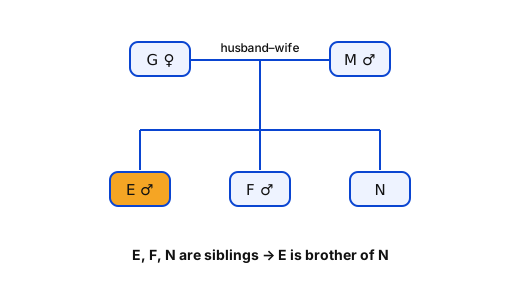
Concept: Decode each symbol step by step and build a family tree.

  1. E + F: E is the brother of F (E is male).
  2. F $ G: F is the son of G; G @ M: G is the wife of M.
  3. M ÷ N: M is the father of N, so N is a child of G and M – a sibling of F and E.
  4. Hence E is the brother of N.

Trick: Children of the same couple are siblings; a male sibling = brother.

Answer: (D) Brother

अवधारणा: प्रत्येक चिह्न को क्रम से डिकोड कर वंश-वृक्ष बनाएँ।

  1. E + F: E, F का भाई है (E पुरुष)।
  2. F $ G: F, G का पुत्र है; G @ M: G, M की पत्नी है।
  3. M ÷ N: M, N का पिता है, अतः N भी G और M की संतान – F और E का सहोदर।
  4. अतः E, N का भाई है।

ट्रिक: एक ही दंपति की संतानें भाई-बहन होती हैं; पुरुष सहोदर = भाई।

उत्तर: (D) भाई

RRB NTPC Undergraduate CBT 1General Intelligence and ReasoningCoded Blood RelationsRRB NTPC Undergraduate CBT 1 2024 · 8 Sep Shift 2 →
Q3678.
Which of the following letter-number clusters will replace the question mark (?) in the given series to make it logically complete?
IQA 15 GMB 8 EIC -1 CED -12 ?
निम्नलिखित में से कौन-सा अक्षर-संख्या समूह दी गई शृंखला में प्रश्न चिह्न (?) के स्थान पर आकर उसे तार्किक रूप से पूर्ण करेगा?
IQA 15 GMB 8 EIC -1 CED -12 ?
  1. ABCE -54
  2. BDNE -45
  3. CAAE -25
  4. DBAE -33
Show answer

Concept: Track each letter position and the number separately.

  1. 1st letters: I, G, E, C → −2 → A
  2. 2nd letters: Q, M, I, E → −4 → A; 3rd letters: A, B, C, D → +1 → E
  3. Numbers: 15,8,−1,−12 – differences −7,−9,−11 → next −13: −12−13=−25

Trick: Differences of the numbers decrease by 2 each time.

Answer: (C) AAE −25

अवधारणा: प्रत्येक अक्षर-स्थान और संख्या को अलग-अलग देखें।

  1. पहले अक्षर: I, G, E, C → −2 → A
  2. दूसरे अक्षर: Q, M, I, E → −4 → A; तीसरे: A, B, C, D → +1 → E
  3. संख्याएँ: 15,8,−1,−12 – अंतर −7,−9,−11 → अगला −13: −12−13=−25

ट्रिक: संख्याओं का अंतर हर बार 2 बढ़कर घटता है।

उत्तर: (C) AAE −25

RRB NTPC Undergraduate CBT 1General Intelligence and ReasoningLetter-Number SeriesRRB NTPC Undergraduate CBT 1 2024 · 8 Sep Shift 2 →
Q3679.
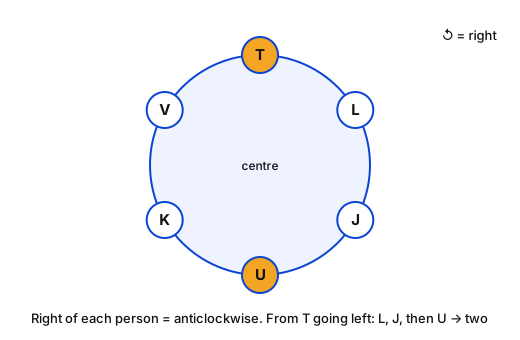
Six friends J, K, L, T, U and V are sitting around a circular table facing the centre. V sits second to the right of L, who sits second to the right of U. J sits to the immediate right of U. T sits second to the left of K. How many persons are sitting between T and U when counted from the left of T?
छह मित्र J, K, L, T, U और V एक वृत्ताकार मेज़ के चारों ओर केंद्र की ओर मुख करके बैठे हैं। V, L के दाएँ से दूसरे स्थान पर बैठा है, जो U के दाएँ से दूसरे स्थान पर बैठा है। J, U के ठीक दाएँ बैठा है। T, K के बाएँ से दूसरे स्थान पर बैठा है। T के बाएँ से गिनने पर T और U के बीच कितने व्यक्ति बैठे हैं?
  1. ATwoदो
  2. BNoneकोई नहीं
  3. COneएक
  4. DThreeतीन
Show answer

Concept: Facing the centre, a person's right is anticlockwise and left is clockwise. Fix U first.

  1. Place U; J sits immediately to the right of U.
  2. L is second to the right of U, and V is second to the right of L.
  3. The two empty seats go to K and T; T is second to the left of K only when T sits opposite U.
  4. Going left from T: L, J, then U → two persons between.

Trick: Six seats: 'second to the right of second to the right' means the person is opposite-adjacent – sketch first.

Answer: (A) Two

अवधारणा: केंद्र की ओर मुख होने पर व्यक्ति का दायाँ = वामावर्त, बायाँ = दक्षिणावर्त। पहले U को रखें।

  1. U को रखें; J, U के ठीक दाएँ।
  2. L, U के दाएँ दूसरे स्थान पर और V, L के दाएँ दूसरे स्थान पर।
  3. शेष दो स्थान K और T के; T, K के बाएँ दूसरा तभी होता है जब T, U के ठीक सामने हो।
  4. T से बाएँ गिनने पर: L, J, फिर U → बीच में दो व्यक्ति।

ट्रिक: पहले चित्र बनाएँ – वृत्ताकार प्रश्न चित्र से जल्दी हल होते हैं।

उत्तर: (A) दो

RRB NTPC Undergraduate CBT 1General Intelligence and ReasoningCircular Seating ArrangementRRB NTPC Undergraduate CBT 1 2024 · 8 Sep Shift 2 →
Q3680.
MERIT is related to RJWNY in a certain way based on the English alphabetical order. In the same way, DRAWN is related to IWFBS. To which of the given options is SHAPE related, following the same logic?
अंग्रेज़ी वर्णमाला क्रम के आधार पर MERIT एक निश्चित प्रकार से RJWNY से संबंधित है। उसी प्रकार, DRAWN, IWFBS से संबंधित है। समान तर्क का अनुसरण करते हुए, SHAPE दिए गए विकल्पों में से किससे संबंधित है?
  1. AWLETI
  2. BXMFUJ
  3. CYNGVK
  4. DYMETK
Show answer

Concept: Compare each letter of the word with the matching letter of its code.

  1. MERIT → RJWNY: M+5=R, E+5=J, R+5=W, I+5=N, T+5=Y
  2. Check DRAWN → IWFBS: every letter +5 ✓
  3. SHAPE +5: S→X, H→M, A→F, P→U, E→J → XMFUJ

Trick: A uniform shift: verify with just the first letter (S+5 = X) to pick the option.

Answer: (B) XMFUJ

अवधारणा: शब्द के प्रत्येक अक्षर की उसके कोड के अक्षर से तुलना करें।

  1. MERIT → RJWNY: M+5=R, E+5=J, R+5=W, I+5=N, T+5=Y
  2. जाँच DRAWN → IWFBS: हर अक्षर +5 ✓
  3. SHAPE +5: S→X, H→M, A→F, P→U, E→J → XMFUJ

ट्रिक: समान खिसकाव: केवल पहला अक्षर (S+5 = X) देखकर विकल्प चुनें।

उत्तर: (B) XMFUJ

RRB NTPC Undergraduate CBT 1General Intelligence and ReasoningCoding-DecodingRRB NTPC Undergraduate CBT 1 2024 · 8 Sep Shift 2 →