Question bank

Q&A: practice questions with answers

Search questions on any topic. Filter by exam category, exam, subject and topic, try the question, then open the answer and explanation.

Courses – airGurukul

8,500 questions found.

Q3841.
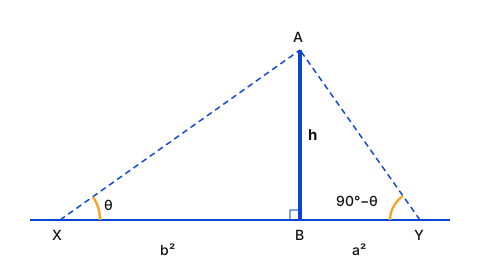
The angles of elevation of the top of a tower from two points X and Y (on opposite sides of the tower) at distances b2 m and a2 m, respectively, from the base and in the same straight line with it are complementary. The height (in m) of the tower is ______.
किसी मीनार के आधार से क्रमशः b2 m और a2 m की दूरी पर स्थित दो बिंदुओं X और Y (मीनार के विपरीत ओर तथा उसके साथ एक ही सीधी रेखा में) से मीनार के शीर्ष के उन्नयन कोण पूरक हैं। मीनार की ऊँचाई (m में) ______ है।
  1. Aab12
  2. B(ab)12
  3. Cba12
  4. Dab
Show answer

Concept: If the angles of elevation from two points at distances d1 and d2 from the base are complementary, then h2=d1d2.

  1. Let the angle at X be θ; then at Y it is 90∘−θ.
  2. tanθ=hb2 and tan(90∘−θ)=cotθ=ha2.
  3. Multiply: tanθ·cotθ=1=h2a2b2.
  4. h2=a2b2⇒h=ab m.

Trick: Complementary angles → h=d1d2=a2b2=ab. (Sides of the tower don't matter.)

Answer: (D) ab

अवधारणा: यदि आधार से d1 और d2 दूरी पर स्थित बिंदुओं से उन्नयन कोण पूरक हों, तो h2=d1d2।

  1. X पर कोण θ मानें; तब Y पर 90∘−θ।
  2. tanθ=hb2 तथा tan(90∘−θ)=cotθ=ha2।
  3. गुणा करें: tanθ·cotθ=1=h2a2b2।
  4. h2=a2b2⇒h=ab m।

ट्रिक: पूरक कोण → h=d1d2=a2b2=ab (बिंदु मीनार के किसी भी ओर हों)।

उत्तर: (D) ab
RRB NTPC Undergraduate CBT 1MathematicsHeights and DistancesRRB NTPC Undergraduate CBT 1 2024 · 8 Aug Shift 3 →
Q3842.
Find the value of [954 ÷ {30 + 9 × (3 − 6)}].
[954 ÷ {30 + 9 × (3 − 6)}] का मान ज्ञात कीजिए।
  1. A319
  2. B318
  3. C313
  4. D321
Show answer

Concept: BODMAS: innermost bracket first, then multiplication, then addition, then the outer division.

  1. (3−6)=−3
  2. 9×(−3)=−27
  3. {30+(−27)}=3
  4. 954÷3=318

Trick: Watch the sign: 9×(−3) is negative, so the curly bracket becomes just 3.

Answer: (B) 318

अवधारणा: BODMAS: पहले सबसे भीतरी कोष्ठक, फिर गुणा, फिर जोड़, अंत में बाहरी भाग।

  1. (3−6)=−3
  2. 9×(−3)=−27
  3. {30+(−27)}=3
  4. 954÷3=318

ट्रिक: चिह्न पर ध्यान दें: 9×(−3) ऋणात्मक है, अतः कोष्ठक केवल 3 बचता है।

उत्तर: (B) 318

RRB NTPC Undergraduate CBT 1MathematicsSimplification (BODMAS)RRB NTPC Undergraduate CBT 1 2024 · 8 Aug Shift 3 →
Q3843.
Prashant and Nisha have to travel from Delhi to Kanpur in their respective cars. Prashant is driving at 117 km/hr while Nisha is driving at 48 km/hr. Find the time taken by Nisha to reach Kanpur if Prashant takes 16 hours.
प्रशांत और निशा को अपनी-अपनी कारों से दिल्ली से कानपुर की यात्रा करनी है। प्रशांत 117 km/hr की चाल से गाड़ी चला रहा है, जबकि निशा 48 km/hr की चाल से गाड़ी चला रही है। यदि प्रशांत को 16 घंटे लगते हैं, तो निशा द्वारा कानपुर पहुँचने में लिया गया समय ज्ञात कीजिए।
  1. A39 hours39 घंटे
  2. B44 hours44 घंटे
  3. C45 hours45 घंटे
  4. D36 hours36 घंटे
Show answer

Concept: For the same distance, time is inversely proportional to speed: S1T1=S2T2.

  1. Distance =117×16=1872km.
  2. Nisha's time =187248=39 hours.

Trick: T2=16×11748=16×3916=39 – 16 cancels instantly.

Answer: (A) 39 hours

अवधारणा: समान दूरी के लिए समय चाल के व्युत्क्रमानुपाती होता है: S1T1=S2T2।

  1. दूरी =117×16=1872km।
  2. निशा का समय =187248=39 घंटे।

ट्रिक: T2=16×11748=16×3916=39 – 16 तुरंत कट जाता है।

उत्तर: (A) 39 घंटे

RRB NTPC Undergraduate CBT 1MathematicsSpeed, Time and DistanceRRB NTPC Undergraduate CBT 1 2024 · 8 Aug Shift 3 →
Q3844.
If the interest earned during the 2nd year on a certain sum is ₹2,352, and the rate of interest is 5% per annum compounded annually, then the sum is:
यदि किसी निश्चित राशि पर 2रे वर्ष के दौरान अर्जित ब्याज ₹2,352 है, और ब्याज की दर 5% वार्षिक है जो वार्षिक रूप से संयोजित होती है, तो वह राशि कितनी है?
  1. A₹44,035
  2. B₹44,855
  3. C₹44,800
  4. D₹45,115
Show answer

Concept: CI for the 2nd year = interest of one year on the amount after the 1st year =P(1+r100)×r100.

  1. P×105100×5100=2352
  2. P×21400=2352
  3. P=2352×40021=112×400=44800

Trick: 2nd-year CI = 0.0525P at 5% → P=23520.0525=44800.

Answer: (C) ₹44,800

अवधारणा: दूसरे वर्ष का CI = पहले वर्ष के बाद की राशि पर एक वर्ष का ब्याज =P(1+r100)×r100।

  1. P×105100×5100=2352
  2. P×21400=2352
  3. P=2352×40021=112×400=44800

ट्रिक: 5% पर दूसरे वर्ष का CI = 0.0525P → P=23520.0525=44800।

उत्तर: (C) ₹44,800

RRB NTPC Undergraduate CBT 1MathematicsCompound InterestRRB NTPC Undergraduate CBT 1 2024 · 8 Aug Shift 3 →
Q3845.
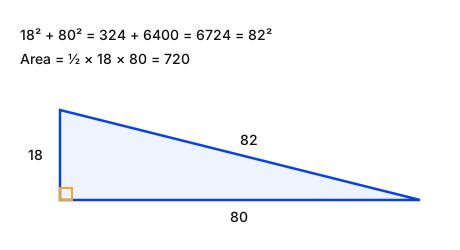
The sides of a triangle are 82 cm, 18 cm, and 80 cm. What is its area? (in cm2 )
एक त्रिभुज की भुजाएँ 82 cm, 18 cm और 80 cm हैं। इसका क्षेत्रफल कितना है? (cm2 में)
  1. A670
  2. B712
  3. C731
  4. D720
Show answer

Concept: If a2+b2=c2, the triangle is right-angled and Area =12×base×height.

  1. 182+802=324+6400=6724=822 → right angle between sides 18 and 80.
  2. Area =12×18×80=720cm2.

Trick: (9, 40, 41) is a Pythagorean triplet; ×2 gives (18, 80, 82).

Answer: (D) 720

अवधारणा: यदि a2+b2=c2 हो तो त्रिभुज समकोण है और क्षेत्रफल =12×आधार×ऊँचाई।

  1. 182+802=324+6400=6724=822 → 18 और 80 वाली भुजाओं के बीच समकोण।
  2. क्षेत्रफल =12×18×80=720cm2।

ट्रिक: (9, 40, 41) पाइथागोरियन त्रिक है; ×2 करने पर (18, 80, 82)।

उत्तर: (D) 720

RRB NTPC Undergraduate CBT 1MathematicsMensuration – TriangleRRB NTPC Undergraduate CBT 1 2024 · 8 Aug Shift 3 →
Q3846.
By how much is 65% of 65 greater than 15 of 15?
65 का 65%, 15 के 15 से कितना अधिक है?
  1. A36.25
  2. B37.25
  3. C33.25
  4. D39.25
Show answer

Concept: x% of N=x100×N; a fraction 'of' means multiply.

  1. 65% of 65=65×65100=4225100=42.25
  2. 15 of 15=3
  3. Difference =42.25−3=39.25

Trick: 652=4225 (numbers ending in 5: 6×7=42, then append 25).

Answer: (D) 39.25

अवधारणा: N का x%=x100×N; भिन्न का 'का' अर्थात गुणा।

  1. 65 का 65%=65×65100=4225100=42.25
  2. 15 का 15=3
  3. अंतर =42.25−3=39.25

ट्रिक: 652=4225 (5 पर ख़त्म होने वाली संख्या: 6×7=42, फिर 25 लगाएँ)।

उत्तर: (D) 39.25

RRB NTPC Undergraduate CBT 1MathematicsPercentage & FractionsRRB NTPC Undergraduate CBT 1 2024 · 8 Aug Shift 3 →
Q3847.
Jaya can do a certain piece of work in 30 days. Jaya and Sushma can together do the same work in 21 days, and Jaya, Sushma and Hina can do the same work together in 14 days. In how many days can Jaya and Hina do the same work together?
जया किसी निश्चित कार्य को 30 दिनों में कर सकती है। जया और सुषमा मिलकर उसी कार्य को 21 दिनों में कर सकती हैं, तथा जया, सुषमा और हिना मिलकर उसी कार्य को 14 दिनों में कर सकती हैं। जया और हिना मिलकर उसी कार्य को कितने दिनों में कर सकती हैं?
  1. A352
  2. B372
  3. C392
  4. D412
Show answer

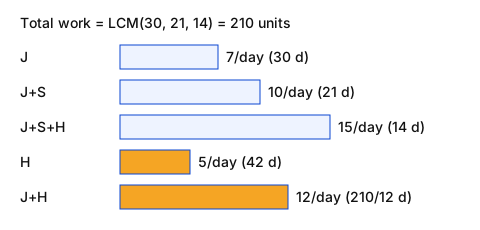
Concept: Take total work = LCM of the given days; then each person's work per day is in units.

  1. Total work =LCM(30,21,14)=210 units.
  2. Jaya =21030=7, J+S =21021=10, J+S+H =21014=15 units/day.
  3. Hina =15−10=5 units/day.
  4. Jaya + Hina =7+5=12 units/day → time =21012=352 days.

Trick: Hina's rate =114−121=142, then 130+142=235.

Answer: (A) 352 days

अवधारणा: कुल कार्य = दिए गए दिनों का LCM मानें; तब प्रत्येक का प्रतिदिन कार्य इकाइयों में मिलता है।

  1. कुल कार्य =LCM(30,21,14)=210 इकाई।
  2. जया =21030=7, J+S =21021=10, J+S+H =21014=15 इकाई/दिन।
  3. हिना =15−10=5 इकाई/दिन।
  4. जया + हिना =7+5=12 इकाई/दिन → समय =21012=352 दिन।

ट्रिक: हिना की दर =114−121=142, फिर 130+142=235।

उत्तर: (A) 352 दिन

RRB NTPC Undergraduate CBT 1MathematicsTime and WorkRRB NTPC Undergraduate CBT 1 2024 · 8 Aug Shift 3 →
Q3848.
An item marked at ₹5,000 is given at successive discounts of 10% and 5%. Find the final selling price.
₹5,000 अंकित मूल्य वाली एक वस्तु 10% और 5% की क्रमिक छूट पर दी जाती है। अंतिम विक्रय मूल्य ज्ञात कीजिए।
  1. A₹4,320
  2. B₹4,250
  3. C₹4,275
  4. D₹4,350
Show answer

Concept: Successive discounts are applied one after another: SP =MP×100−d1100×100−d2100.

  1. After 10%: 5000×90100=4500.
  2. After 5%: 4500×95100=4275.

Trick: Net discount =10+5−10×5100=14.5% → 5000×0.855=4275.

Answer: (C) ₹4,275

अवधारणा: क्रमिक छूट एक के बाद एक लगती है: SP =MP×100−d1100×100−d2100।

  1. 10% के बाद: 5000×90100=4500।
  2. 5% के बाद: 4500×95100=4275।

ट्रिक: शुद्ध छूट =10+5−10×5100=14.5% → 5000×0.855=4275।

उत्तर: (C) ₹4,275

RRB NTPC Undergraduate CBT 1MathematicsSuccessive DiscountRRB NTPC Undergraduate CBT 1 2024 · 8 Aug Shift 3 →
Q3849.
M and N start a business. M invests ₹46,000 more than N for 3 months and N invests for 4 months. M's share is ₹453 more than that of N, out of a total profit of ₹1,359. Find the capital contributed by M.
M और N एक व्यवसाय शुरू करते हैं। M, N से ₹46,000 अधिक राशि 3 महीने के लिए निवेश करता है और N 4 महीने के लिए निवेश करता है। ₹1,359 के कुल लाभ में से M का हिस्सा N के हिस्से से ₹453 अधिक है। M द्वारा लगाई गई पूँजी ज्ञात कीजिए।
  1. A₹73,608
  2. B₹73,516
  3. C₹73,715
  4. D₹73,600
Show answer

Concept: Profit is shared in the ratio of (capital × time).

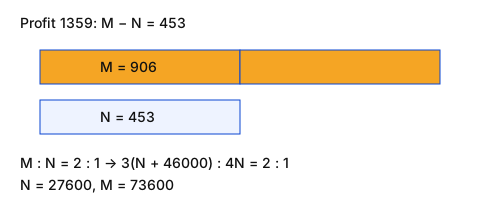
  1. M + N = 1359 and M − N = 453 → M = 906, N = 453, so ratio =2:1.
  2. Let N's capital =x; M's =x+46000.
  3. 3(x+46000)4x=21⇒3x+138000=8x⇒x=27600.
  4. M's capital =27600+46000=73600.

Trick: Check options: 3×73600=220800 and 4×27600=110400 → exactly 2:1.

Answer: (D) ₹73,600

अवधारणा: लाभ (पूँजी × समय) के अनुपात में बँटता है।

  1. M + N = 1359 और M − N = 453 → M = 906, N = 453, अतः अनुपात =2:1।
  2. N की पूँजी =x; M की =x+46000।
  3. 3(x+46000)4x=21⇒3x+138000=8x⇒x=27600।
  4. M की पूँजी =27600+46000=73600।

ट्रिक: जाँच: 3×73600=220800 और 4×27600=110400 → ठीक 2:1।

उत्तर: (D) ₹73,600

RRB NTPC Undergraduate CBT 1MathematicsPartnershipRRB NTPC Undergraduate CBT 1 2024 · 8 Aug Shift 3 →
Q3850.
Find the mean proportional between 24 and 150.
24 और 150 का मध्यानुपाती ज्ञात कीजिए।
  1. A60
  2. B70
  3. C40
  4. D50
Show answer

Concept: Mean proportional between a and b =ab.

  1. 24×150=3600=60

Trick: Check: 24:60=60:150 since 2460=60150=25.

Answer: (A) 60

अवधारणा: a और b का मध्यानुपाती =ab।

  1. 24×150=3600=60

ट्रिक: जाँच: 24:60=60:150 क्योंकि 2460=60150=25।

उत्तर: (A) 60

RRB NTPC Undergraduate CBT 1MathematicsRatio – Mean ProportionalRRB NTPC Undergraduate CBT 1 2024 · 8 Aug Shift 3 →
Q3851.
Train A leaves station M at 8:25 AM and reaches station N at 3:25 PM on the same day. Train B leaves station N at 10:25 AM and reaches station M at 3:25 PM on the same day. Find the time when trains A and B meet.
ट्रेन A स्टेशन M से 8:25 AM पर चलती है और उसी दिन 3:25 PM पर स्टेशन N पहुँचती है। ट्रेन B स्टेशन N से 10:25 AM पर चलती है और उसी दिन 3:25 PM पर स्टेशन M पहुँचती है। वह समय ज्ञात कीजिए जब ट्रेन A और B एक-दूसरे से मिलती हैं।
  1. A12:50 PM
  2. B12:30 PM
  3. C11:30 AM
  4. D11:10 AM
Show answer

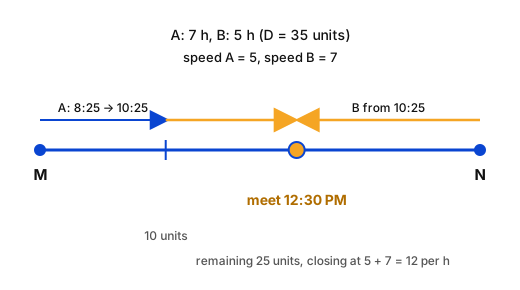
Concept: Take distance MN = LCM of the journey times; then meeting time = remaining distance ÷ sum of speeds.

  1. A takes 8:25 AM → 3:25 PM =7 h; B takes 10:25 AM → 3:25 PM =5 h.
  2. Let MN=35 units: speed of A =5, speed of B =7 units/h.
  3. By 10:25 AM, A has covered 2×5=10 units; 25 units remain.
  4. Time to meet =255+7=2512h=2h5min after 10:25 AM → 12:30 PM.

Trick: Choose distance = LCM of times so that speeds become whole numbers.

Answer: (B) 12:30 PM

अवधारणा: दूरी MN = यात्रा-समयों का LCM मानें; मिलने का समय = शेष दूरी ÷ चालों का योग।

  1. A का समय 8:25 AM → 3:25 PM =7 घंटे; B का 10:25 AM → 3:25 PM =5 घंटे।
  2. MN=35 इकाई: A की चाल =5, B की चाल =7 इकाई/घंटा।
  3. 10:25 AM तक A ने 2×5=10 इकाई तय की; शेष 25 इकाई।
  4. मिलने में समय =255+7=2512h=2 घंटे 5 मिनट → 12:30 PM।

ट्रिक: दूरी = समयों का LCM लें, चालें पूर्णांक बन जाती हैं।

उत्तर: (B) 12:30 PM

RRB NTPC Undergraduate CBT 1MathematicsTrains – meeting timeRRB NTPC Undergraduate CBT 1 2024 · 8 Aug Shift 3 →
Q3852.
The number 327087 is divisible by which of the following?
संख्या 327087 निम्नलिखित में से किससे विभाज्य है?
  1. A5
  2. B8
  3. C3
  4. D12
Show answer

Concept: A number is divisible by 3 if the sum of its digits is divisible by 3.

  1. Digit sum of 327087 =3+2+7+0+8+7=27, a multiple of 3 → divisible by 3.
  2. Last digit 7 → not divisible by 5; last three digits 087 are not a multiple of 8 → not by 8.
  3. Not divisible by 4 (87 is odd), so not by 12.

Trick: Odd number → straight away rule out 8 and 12.

Answer: (C) 3

अवधारणा: अंकों का योग 3 से विभाज्य हो तो संख्या 3 से विभाज्य होती है।

  1. 327087 के अंकों का योग =3+2+7+0+8+7=27, जो 3 का गुणज है → 3 से विभाज्य।
  2. अंतिम अंक 7 → 5 से नहीं; अंतिम तीन अंक 087, 8 के गुणज नहीं → 8 से नहीं।
  3. 87 विषम है, अतः 4 से नहीं, इसलिए 12 से भी नहीं।

ट्रिक: विषम संख्या → 8 और 12 तुरंत हटा दें।

उत्तर: (C) 3

RRB NTPC Undergraduate CBT 1MathematicsDivisibility rulesRRB NTPC Undergraduate CBT 1 2024 · 8 Aug Shift 3 →
Q3853.
Find the greatest number that will divide 49, 97 and 189 so as to leave the same remainder in each case.
वह बड़ी से बड़ी संख्या ज्ञात कीजिए जिससे 49, 97 और 189 को विभाजित करने पर प्रत्येक स्थिति में समान शेषफल प्राप्त हो।
  1. A5
  2. B4
  3. C7
  4. D3
Show answer

Concept: Greatest number leaving the same remainder = HCF of the differences of the numbers.

  1. Differences: 97−49=48, 189−97=92, 189−49=140.
  2. 48=24×3, 92=22×23, 140=22×5×7.
  3. HCF =22=4. Check: remainders 49,97,189 ÷ 4 are all 1.

Trick: Same remainder → HCF of differences (not of the numbers).

Answer: (B) 4

अवधारणा: समान शेषफल छोड़ने वाली सबसे बड़ी संख्या = संख्याओं के अंतरों का HCF।

  1. अंतर: 97−49=48, 189−97=92, 189−49=140।
  2. 48=24×3, 92=22×23, 140=22×5×7।
  3. HCF =22=4। जाँच: 49, 97, 189 को 4 से भाग देने पर हर बार शेष 1।

ट्रिक: समान शेषफल → अंतरों का HCF।

उत्तर: (B) 4

RRB NTPC Undergraduate CBT 1MathematicsHCF – same remainderRRB NTPC Undergraduate CBT 1 2024 · 8 Aug Shift 3 →
Q3854.
Simplify: 3((73)x2−25x+12)−7(x2+9x−13).
सरल कीजिए: 3((73)x2−25x+12)−7(x2+9x−13)।
  1. A138x − 127
  2. B−138x + 127
  3. C138x + 127
  4. D−138x − 127
Show answer

Concept: Expand each bracket, then combine like terms.

  1. 3(73x2−25x+12)=7x2−75x+36
  2. −7(x2+9x−13)=−7x2−63x+91
  3. Add: (7−7)x2+(−75−63)x+(36+91)=−138x+127

Trick: The x2 terms cancel; watch the sign of −7×(−13)=+91.

Answer: (B) −138x+127

अवधारणा: हर कोष्ठक खोलें, फिर समान पदों को जोड़ें।

  1. 3(73x2−25x+12)=7x2−75x+36
  2. −7(x2+9x−13)=−7x2−63x+91
  3. जोड़ें: (7−7)x2+(−75−63)x+(36+91)=−138x+127

ट्रिक: x2 वाले पद कट जाते हैं; −7×(−13)=+91 का चिह्न ध्यान रखें।

उत्तर: (B) −138x+127

RRB NTPC Undergraduate CBT 1MathematicsAlgebraic simplificationRRB NTPC Undergraduate CBT 1 2024 · 8 Aug Shift 3 →
Q3855.
The selling price of 20 books is equal to the cost price of 5 books. Find the loss or gain percentage.
20 पुस्तकों का विक्रय मूल्य 5 पुस्तकों के क्रय मूल्य के बराबर है। हानि या लाभ प्रतिशत ज्ञात कीजिए।
  1. A10015% gain10015% लाभ
  2. B10015% loss10015% हानि
  3. C75% gain75% लाभ
  4. D75% loss75% हानि
Show answer

Concept: Loss%=CP−SPCP×100 for the same number of articles.

  1. Let CP of 1 book = ₹1. SP of 20 books = CP of 5 books = ₹5.
  2. CP of 20 books = ₹20, SP = ₹5 → loss = ₹15.
  3. Loss%=1520×100=75%

Trick: SP of x = CP of y → %=y−xx×100=5−2020×100=−75% (minus = loss).

Answer: (D) 75% loss

अवधारणा: समान संख्या की वस्तुओं के लिए हानि%=CP−SPCP×100।

  1. 1 किताब का CP = ₹1 मानें। 20 किताबों का SP = 5 किताबों का CP = ₹5।
  2. 20 किताबों का CP = ₹20, SP = ₹5 → हानि = ₹15।
  3. हानि%=1520×100=75%

ट्रिक: x का SP = y का CP → %=y−xx×100=5−2020×100=−75% (ऋण = हानि)।

उत्तर: (D) 75% हानि

RRB NTPC Undergraduate CBT 1MathematicsProfit and lossRRB NTPC Undergraduate CBT 1 2024 · 8 Aug Shift 3 →
Q3856.
A can do a work in 12 days and B can do the same work in 18 days. If they work on it together for 4 days, then what fraction of the work is left?
A किसी कार्य को 12 दिनों में कर सकता है और B उसी कार्य को 18 दिनों में कर सकता है। यदि वे दोनों मिलकर 4 दिनों तक उस पर कार्य करते हैं, तो कार्य का कितना भाग शेष रह जाता है?
  1. A49
  2. B119
  3. C149
  4. D139
Show answer

Concept: One-day work = 1days; work left = 1− work done.

  1. (A+B)'s 1-day work =112+118=3+236=536.
  2. Work in 4 days =4×536=2036=59.
  3. Work left =1−59=49.

Trick: Total work = LCM(12,18)=36 units; A =3, B =2 per day → 4 days =20 units, left 16 of 36=49.

Answer: (A) 49

अवधारणा: 1 दिन का कार्य =1दिन; शेष कार्य =1− किया गया कार्य।

  1. (A+B) का 1 दिन का कार्य =112+118=536।
  2. 4 दिन का कार्य =4×536=59।
  3. शेष कार्य =1−59=49।

ट्रिक: कुल कार्य = LCM(12,18)=36 इकाई; A =3, B =2 प्रतिदिन → 4 दिन में 20, शेष 16 यानी 49।

उत्तर: (A) 49

RRB NTPC Undergraduate CBT 1MathematicsTime and workRRB NTPC Undergraduate CBT 1 2024 · 8 Aug Shift 3 →
Q3857.
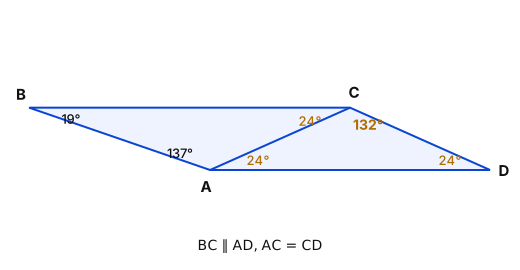
ABCD is a trapezium in which BC∥AD and AC=CD. If ∠ABC=19∘ and ∠BAC=137∘, then what is the measure of ∠ACD (in degree)?
ABCD एक समलंब चतुर्भुज है जिसमें BC∥AD और AC=CD है। यदि ∠ABC=19∘ और ∠BAC=137∘ है, तो ∠ACD का माप (डिग्री में) क्या है?
  1. A120°
  2. B128°
  3. C132°
  4. D131°
Show answer

Concept: Angle sum of a triangle, alternate angles between parallel lines, and equal angles opposite equal sides.

  1. In △ABC: ∠BCA=180∘−19∘−137∘=24∘.
  2. BC∥AD, so ∠CAD=∠BCA=24∘ (alternate angles).
  3. AC=CD → ∠CDA=∠CAD=24∘.
  4. ∠ACD=180∘−24∘−24∘=132∘.

Trick: ∠ACD=180∘−2×∠BCA.

Answer: (C) 132∘

अवधारणा: त्रिभुज के कोणों का योग, समांतर रेखाओं के एकांतर कोण (alternate angles) और समान भुजाओं के सामने समान कोण।

  1. △ABC में: ∠BCA=180∘−19∘−137∘=24∘।
  2. BC∥AD, अतः ∠CAD=∠BCA=24∘ (एकांतर कोण)।
  3. AC=CD → ∠CDA=∠CAD=24∘।
  4. ∠ACD=180∘−24∘−24∘=132∘।

ट्रिक: ∠ACD=180∘−2×∠BCA।

उत्तर: (C) 132∘

RRB NTPC Undergraduate CBT 1MathematicsTrapezium – anglesRRB NTPC Undergraduate CBT 1 2024 · 8 Aug Shift 3 →
Q3858.
If the 6-digit number N83M92 is divisible by 11, then which of the options below can give a possible correct relation between M and N?
यदि 6-अंकीय संख्या N83M92, 11 से विभाज्य है, तो नीचे दिए गए विकल्पों में से कौन-सा विकल्प M और N के बीच एक संभावित सही संबंध दे सकता है?
  1. AM + N = -2
  2. BM - N = 2
  3. CM - N = 1
  4. DM = N
Show answer

Concept: Divisible by 11 if (sum of odd-place digits) − (sum of even-place digits) is 0 or a multiple of 11.

  1. N83M92: odd places N+3+9=N+12; even places 8+M+2=M+10.
  2. Difference =(N+12)−(M+10)=N−M+2.
  3. For single digits, N−M+2=0 → M−N=2 (the other case N−M=9 is not among options).

Trick: Check: M=3,N=1 → 183392 =11×16672.

Answer: (B) M−N=2

अवधारणा: विषम स्थानों के अंकों का योग − सम स्थानों के अंकों का योग = 0 या 11 का गुणज हो तो संख्या 11 से विभाज्य।

  1. N83M92: विषम स्थान N+3+9=N+12; सम स्थान 8+M+2=M+10।
  2. अंतर =N−M+2।
  3. एक अंक वाले M, N के लिए N−M+2=0 → M−N=2 (दूसरा मामला N−M=9 विकल्पों में नहीं)।

ट्रिक: जाँच: M=3,N=1 → 183392 =11×16672।

उत्तर: (B) M−N=2

RRB NTPC Undergraduate CBT 1MathematicsDivisibility by 11RRB NTPC Undergraduate CBT 1 2024 · 8 Aug Shift 3 →
Q3859.
A shopkeeper buys a bicycle for ₹3,500 and sells it at a discount of 20%, making neither profit nor loss. What is the marked price of the bicycle?
एक दुकानदार ₹3,500 में एक साइकिल खरीदता है और उसे 20% की छूट पर बेचता है, जिससे उसे न तो लाभ होता है और न ही हानि। साइकिल का अंकित मूल्य क्या है?
  1. A₹3,475
  2. B₹5,374
  3. C₹7,343
  4. D₹4,375
Show answer

Concept: No profit no loss → SP = CP; SP=MP×100−discount%100.

  1. SP = CP = ₹3,500.
  2. MP×80100=3500
  3. MP=3500×10080=4375 → ₹4,375.

Trick: 20% off means SP is 45 of MP → MP =3500×54.

Answer: (D) ₹4,375

अवधारणा: न लाभ न हानि → SP = CP; SP=MP×100−छूट%100।

  1. SP = CP = ₹3,500।
  2. MP×80100=3500
  3. MP=3500×10080=4375 → ₹4,375।

ट्रिक: 20% छूट → SP, MP का 45 → MP =3500×54।

उत्तर: (D) ₹4,375

RRB NTPC Undergraduate CBT 1MathematicsDiscount – marked priceRRB NTPC Undergraduate CBT 1 2024 · 8 Aug Shift 3 →
Q3860.
The value of 102+22−425−3 is
102+22−425−3 का मान है
  1. A69
  2. B81
  3. C79
  4. D78
Show answer

Concept: Evaluate powers and roots first, then add/subtract (BODMAS).

  1. 102=100, 22=2, 425=4×5=20.
  2. 100+2−20−3=79.

Yaad rakhein: a2=a for positive a.

Answer: (C) 79

अवधारणा: पहले घात और मूल, फिर जोड़-घटाव (BODMAS)।

  1. 102=100, 22=2, 425=4×5=20।
  2. 100+2−20−3=79।

याद रखें: धनात्मक a के लिए a2=a।

उत्तर: (C) 79

RRB NTPC Undergraduate CBT 1MathematicsSimplification – squares and rootsRRB NTPC Undergraduate CBT 1 2024 · 8 Aug Shift 3 →