Question bank

Q&A: practice questions with answers

Search questions on any topic. Filter by exam category, exam, subject and topic, try the question, then open the answer and explanation.

Courses – airGurukul

8,500 questions found.

Q4081.
What should come in place of the question mark (?) in the given series?
450 455 461 466 472 477 483 ?
दी गई श्रृंखला में प्रश्न चिह्न (?) के स्थान पर क्या आना चाहिए?
450 455 461 466 472 477 483 ?
  1. A488
  2. B490
  3. C487
  4. D489
Show answer

Concept: Differences alternate +5, +6.

  1. 450+5=455, +6=461, +5=466, +6=472
  2. +5=477, +6=483
  3. 483+5=488

Trick: Write the differences below the series.

Answer: (A) 488

अवधारणा: अंतर बारी-बारी से +5, +6।

  1. 450+5=455, +6=461, +5=466, +6=472
  2. +5=477, +6=483
  3. 483+5=488

ट्रिक: श्रृंखला के नीचे अंतर लिखें।

उत्तर: (A) 488
RRB NTPC Undergraduate CBT 1General Intelligence and ReasoningNumber SeriesRRB NTPC Undergraduate CBT 1 2024 · 8 Aug Shift 1 →
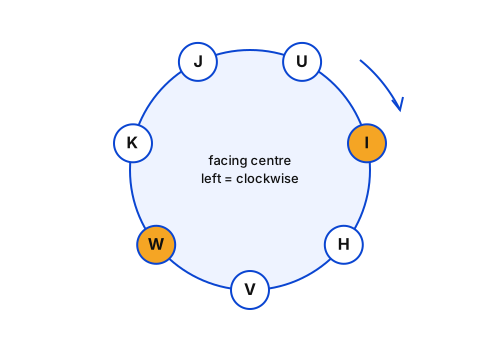
Q4082.
H, I, J, K, U, V and W are sitting around a circular table facing the centre of the table. U sits fourth to the left of V. H sits fourth to the right of J. Only two people sit between V and J when counted from the left of V. K is not an immediate neighbour of H or V. I is not an immediate neighbour of K.
Who sits third to the right of W?
H, I, J, K, U, V और W एक वृत्ताकार मेज़ के चारों ओर मेज़ के केंद्र की ओर मुख करके बैठे हैं। U, V के बाएँ से चौथे स्थान पर बैठा है। H, J के दाएँ से चौथे स्थान पर बैठा है। V के बाएँ से गिनने पर V और J के बीच केवल दो व्यक्ति बैठे हैं। K, H या V का निकटतम पड़ोसी नहीं है। I, K का निकटतम पड़ोसी नहीं है।
W के दाएँ से तीसरे स्थान पर कौन बैठा है?
  1. AK
  2. BI
  3. CU
  4. DH
Show answer

Concept: Facing the centre, left = clockwise, right = anticlockwise.

  1. Fix V. J is 3rd to left of V (two between); U is 4th to left of V.
  2. H is 4th to right of J → H is V's right neighbour.
  3. K is not next to H or V → K sits between W-seat and J; I is not next to K → I sits beside H; W is V's left neighbour.
  4. 3rd to the right of W: W → V → H → I

Trick: With 7 seats, 4th to the left = 3rd to the right.

Answer: (B) I

अवधारणा: केंद्र की ओर मुख होने पर बायाँ = दक्षिणावर्त (clockwise), दायाँ = वामावर्त।

  1. V को स्थिर करें। J, V के बाएँ तीसरा; U, V के बाएँ चौथा।
  2. H, J के दाएँ चौथा → H, V का दायाँ पड़ोसी।
  3. K, H या V के पास नहीं → K, J के पास; I, K के पास नहीं → I, H के पास; W, V का बायाँ पड़ोसी।
  4. W के दाएँ तीसरा: W → V → H → I

ट्रिक: 7 सीटों में बाएँ चौथा = दाएँ तीसरा।

उत्तर: (B) I

RRB NTPC Undergraduate CBT 1General Intelligence and ReasoningCircular SeatingRRB NTPC Undergraduate CBT 1 2024 · 8 Aug Shift 1 →
Q4083.
Nikhil ranked 18th from the top and 36th from the bottom in his class. How many students are there in his class?
निखिल की कक्षा में उसका स्थान ऊपर से 18वाँ और नीचे से 36वाँ है। उसकी कक्षा में कितने विद्यार्थी हैं?
  1. A55
  2. B54
  3. C53
  4. D52
Show answer

Concept: Total = rank from top + rank from bottom −1.

  1. 18+36−1=53

Yaad rakhein: The person is counted twice, so subtract 1.

Answer: (C) 53

अवधारणा: कुल = ऊपर से रैंक + नीचे से रैंक −1।

  1. 18+36−1=53

याद रखें: व्यक्ति दो बार गिना जाता है, इसलिए 1 घटाएँ।

उत्तर: (C) 53

RRB NTPC Undergraduate CBT 1General Intelligence and ReasoningRankingRRB NTPC Undergraduate CBT 1 2024 · 8 Aug Shift 1 →
Q4084.
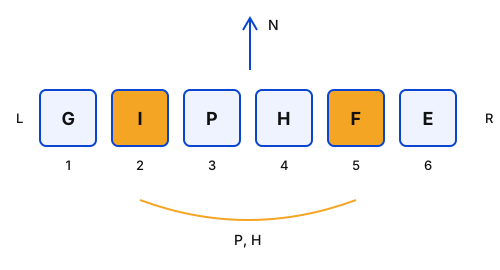
Six people, E, F, G, H, I and P, are sitting in a row, facing north. Only two people sit to the left of P. Only two people sit between P and E. Only one person sits between E and H. Only I sits between P and G. How many people sit between F and I?
छह व्यक्ति, E, F, G, H, I और P, उत्तर की ओर मुख करके एक पंक्ति में बैठे हैं। P के बाईं ओर केवल दो व्यक्ति बैठे हैं। P और E के बीच केवल दो व्यक्ति बैठे हैं। E और H के बीच केवल एक व्यक्ति बैठा है। P और G के बीच केवल I बैठा है। F और I के बीच कितने व्यक्ति बैठे हैं?
  1. AZeroशून्य
  2. BThreeतीन
  3. CTwoदो
  4. DOneएक
Show answer

Concept: Facing north, left to right = positions 1 to 6.

  1. Two people left of P → P at 3.
  2. Two between P and E → E at 6.
  3. One between E and H → H at 4.
  4. Only I between P and G → I at 2, G at 1; F at 5.
  5. Between F (5) and I (2): P and H → two

Trick: Start with the clue that fixes an exact position.

Answer: (C) Two

अवधारणा: उत्तर की ओर मुख, बाएँ से दाएँ = स्थान 1 से 6।

  1. P के बाएँ दो लोग → P स्थान 3 पर।
  2. P और E के बीच दो → E स्थान 6 पर।
  3. E और H के बीच एक → H स्थान 4 पर।
  4. P और G के बीच केवल I → I = 2, G = 1; F = 5।
  5. F (5) और I (2) के बीच: P, H → दो

ट्रिक: उस संकेत से शुरू करें जो निश्चित स्थान देता है।

उत्तर: (C) Two

RRB NTPC Undergraduate CBT 1General Intelligence and ReasoningLinear SeatingRRB NTPC Undergraduate CBT 1 2024 · 8 Aug Shift 1 →
Q4085.
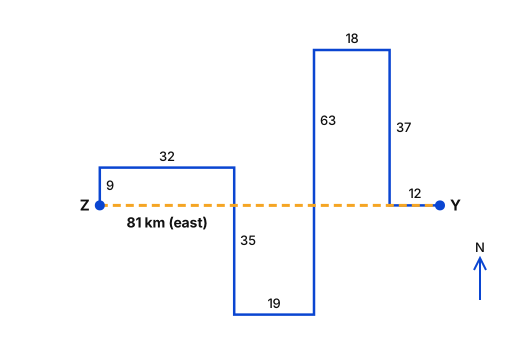
Govind starts from Point Y and drives 12 km towards west. He then turns right and drives 37 km, takes a left turn, drives 18 km, turns left and drives 63 km. He then takes a right turn and drives 19 km. He takes a right turn, drives 35 km, turns left, drives 32 km, then turns left and drives 9 km to stop at Point Z. How far (shortest distance) and towards which direction should he drive in order to reach Point Y again? (All turns are 90° turns only unless specified.)
गोविंद बिंदु Y से चलना शुरू करता है और पश्चिम की ओर 12 km गाड़ी चलाता है। फिर वह दाएँ मुड़ता है और 37 km गाड़ी चलाता है, बाएँ मुड़ता है, 18 km गाड़ी चलाता है, बाएँ मुड़ता है और 63 km गाड़ी चलाता है। फिर वह दाएँ मुड़ता है और 19 km गाड़ी चलाता है। वह दाएँ मुड़ता है, 35 km गाड़ी चलाता है, बाएँ मुड़ता है, 32 km गाड़ी चलाता है, फिर बाएँ मुड़ता है और 9 km गाड़ी चलाकर बिंदु Z पर रुकता है। बिंदु Y पर फिर से पहुँचने के लिए उसे कितनी दूरी (न्यूनतम दूरी) और किस दिशा में गाड़ी चलानी चाहिए? (जब तक निर्दिष्ट न हो, सभी मोड़ केवल 90° के मोड़ हैं।)
  1. A71 km towards westपश्चिम की ओर 71 km
  2. B84 km towards westपश्चिम की ओर 84 km
  3. C81 km towards eastपूर्व की ओर 81 km
  4. D77 km towards eastपूर्व की ओर 77 km
Show answer

Concept: Add all east–west moves and north–south moves separately.

  1. West: 12+18+19+32=81km; no east move
  2. North: 37+35=72; South: 63+9=72 → net 0
  3. Z is 81km due west of Y
  4. To return: 81km towards east

Trick: Net N–S is zero, so the answer is just the total west distance.

Answer: (C) 81 km towards east

अवधारणा: पूर्व–पश्चिम और उत्तर–दक्षिण गतियाँ अलग-अलग जोड़ें।

  1. पश्चिम: 12+18+19+32=81km
  2. उत्तर: 37+35=72; दक्षिण: 63+9=72 → शुद्ध 0
  3. Z, Y से ठीक 81km पश्चिम में
  4. वापसी: 81km पूर्व की ओर

ट्रिक: उत्तर–दक्षिण शुद्ध शून्य है, अतः उत्तर कुल पश्चिम दूरी है।

उत्तर: (C) 81 km towards east

RRB NTPC Undergraduate CBT 1General Intelligence and ReasoningDirection and DistanceRRB NTPC Undergraduate CBT 1 2024 · 8 Aug Shift 1 →
Q4086.
Based on the English alphabetical order, three of the following four letter-cluster pairs are alike in a certain way and thus form a group. Which letter-cluster pair DOES NOT belong to that group?
(Note: The odd one out is not based on the number of consonants/vowels or their position in the letter-cluster.)
अंग्रेज़ी वर्णमाला क्रम के आधार पर, निम्नलिखित चार अक्षर-समूह युग्मों में से तीन किसी निश्चित प्रकार से एकसमान हैं और इस प्रकार एक समूह बनाते हैं। कौन-सा अक्षर-समूह युग्म उस समूह से संबंधित नहीं है?
(ध्यान दें: असंगत अक्षर-समूह, उस अक्षर-समूह में व्यंजनों/स्वरों की संख्या या उनके स्थान पर आधारित नहीं है।)
  1. AIL - FQ
  2. BWR - TW
  3. CHY - DD
  4. DQE - NJ
Show answer

Concept: Pattern: 1st letter −3, 2nd letter +5.

  1. IL → FQ: 9−3=6, 12+5=17 ✓
  2. WR → TW: 23−3=20, 18+5=23 ✓
  3. QE → NJ: 17−3=14, 5+5=10 ✓
  4. HY → DD: 8−4=4 ✗ (needs E)

Trick: Check the first letter of each pair; one shift breaks quickly.

Answer: (C) HY - DD

अवधारणा: नियम: पहला अक्षर −3, दूसरा अक्षर +5।

  1. IL → FQ: 9−3=6, 12+5=17 ✓
  2. WR → TW: 23−3=20, 18+5=23 ✓
  3. QE → NJ: 17−3=14, 5+5=10 ✓
  4. HY → DD: 8−4=4 ✗ (E होना चाहिए)

ट्रिक: हर युग्म का पहला अक्षर जाँचें; नियम जल्दी टूटता दिखता है।

उत्तर: (C) HY - DD

RRB NTPC Undergraduate CBT 1General Intelligence and ReasoningOdd One Out – Letter PairsRRB NTPC Undergraduate CBT 1 2024 · 8 Aug Shift 1 →
Q4087.
EGLU is related to IKOX in a certain way based on the English alphabetical order. In the same way, UWXG is related to YAAJ. To which of the given options is GIGP related, following the same logic?
अंग्रेज़ी वर्णमाला क्रम के आधार पर EGLU एक निश्चित प्रकार से IKOX से संबंधित है। उसी प्रकार, UWXG, YAAJ से संबंधित है। समान तर्क का अनुसरण करते हुए, GIGP दिए गए विकल्पों में से किससे संबंधित है?
  1. AKMJS
  2. BKMSJ
  3. CKSDF
  4. DKJSM
Show answer

Concept: Shifts: +4,+4,+3,+3.

  1. EGLU → IKOX: E+4, G+4, L+3, U+3
  2. UWXG → YAAJ: same (W+4 = A, X+3 = A wrap around)
  3. GIGP → G+4 = K, I+4 = M, G+3 = J, P+3 = S
  4. KMJS

Trick: After Z continue from A.

Answer: (A) KMJS

अवधारणा: बदलाव: +4,+4,+3,+3।

  1. EGLU → IKOX: E+4, G+4, L+3, U+3
  2. UWXG → YAAJ: वही (W+4 = A, X+3 = A)
  3. GIGP → K, M, J, S
  4. KMJS

ट्रिक: Z के बाद फिर A से गिनें।

उत्तर: (A) KMJS

RRB NTPC Undergraduate CBT 1General Intelligence and ReasoningLetter AnalogyRRB NTPC Undergraduate CBT 1 2024 · 8 Aug Shift 1 →
Q4088.
Based on the English alphabetical order, three of the following four letter-cluster pairs are alike in a certain way and thus form a group. Which letter-cluster pair DOES NOT belong to that group?
(Note: The odd one out is not based on the number of consonants/vowels or their position in the letter-cluster.)
अंग्रेज़ी वर्णमाला क्रम के आधार पर, निम्नलिखित चार अक्षर-समूह युग्मों में से तीन किसी निश्चित प्रकार से एकसमान हैं और इस प्रकार एक समूह बनाते हैं। कौन-सा अक्षर-समूह युग्म उस समूह से संबंधित नहीं है?
(ध्यान दें: असंगत अक्षर-समूह, उस अक्षर-समूह में व्यंजनों/स्वरों की संख्या या उनके स्थान पर आधारित नहीं है।)
  1. ART-MO
  2. BOQ-JM
  3. CWY-RU
  4. DUW-PS
Show answer

Concept: In each pair, first cluster has a gap of +2, second cluster has a gap of +3, and clusters shift by −5.

  1. OQ-JM: O+2 = Q; J+3 = M ✓
  2. WY-RU: W+2 = Y; R+3 = U ✓
  3. UW-PS: U+2 = W; P+3 = S ✓
  4. RT-MO: M+2 = O ✗ (gap 2, not 3)

Trick: Compare the internal gaps of both clusters.

Answer: (A) RT-MO

अवधारणा: हर युग्म में पहले समूह का अंतर +2, दूसरे का +3, और पहला अक्षर −5।

  1. OQ-JM: O+2 = Q; J+3 = M ✓
  2. WY-RU: W+2 = Y; R+3 = U ✓
  3. UW-PS: U+2 = W; P+3 = S ✓
  4. RT-MO: M+2 = O ✗ (अंतर 3 होना चाहिए)

ट्रिक: दोनों समूहों के अंदर का अंतर तुलना करें।

उत्तर: (A) RT-MO

RRB NTPC Undergraduate CBT 1General Intelligence and ReasoningOdd One Out – Letter PairsRRB NTPC Undergraduate CBT 1 2024 · 8 Aug Shift 1 →
Q4089.
Niku ranked 24th from the top and 13th from the bottom in his class. How many students are there in his class?
निकू की कक्षा में उसका स्थान ऊपर से 24वाँ और नीचे से 13वाँ है। उसकी कक्षा में कितने विद्यार्थी हैं?
  1. A35
  2. B34
  3. C36
  4. D37
Show answer

Concept: Total = rank from top + rank from bottom −1.

  1. 24+13−1=36

Yaad rakhein: Niku is counted in both ranks, so subtract 1 once.

Answer: (C) 36

अवधारणा: कुल = ऊपर से रैंक + नीचे से रैंक −1।

  1. 24+13−1=36

याद रखें: निकु दोनों रैंक में गिना गया है, अतः 1 घटाएँ।

उत्तर: (C) 36

RRB NTPC Undergraduate CBT 1General Intelligence and ReasoningRankingRRB NTPC Undergraduate CBT 1 2024 · 8 Aug Shift 1 →
Q4090.
Which of the following letter-number clusters will replace the question mark (?) in the given series to make it logically complete?
HMI 3, JOK 6, LQM 9, NSO 12, ?
निम्नलिखित में से कौन-सा अक्षर-संख्या समूह दी गई श्रृंखला में प्रश्न चिह्न (?) का स्थान लेकर उसे तार्किक रूप से पूर्ण करेगा?
HMI 3, JOK 6, LQM 9, NSO 12, ?
  1. AMTP 20
  2. BOUQ 15
  3. CPUQ 15
  4. DPTP 20
Show answer

Concept: Each letter moves +2; the number increases by 3.

  1. 1st letters: H, J, L, N, P
  2. 2nd letters: M, O, Q, S, U
  3. 3rd letters: I, K, M, O, Q
  4. Numbers: 3, 6, 9, 12, 15 → PUQ 15

Trick: Fix the number first (15) to cut options to two, then check letters.

Answer: (C) PUQ 15

अवधारणा: प्रत्येक अक्षर +2 आगे; संख्या 3 बढ़ती है।

  1. पहले अक्षर: H, J, L, N, P
  2. दूसरे अक्षर: M, O, Q, S, U
  3. तीसरे अक्षर: I, K, M, O, Q
  4. संख्याएँ: 3, 6, 9, 12, 15 → PUQ 15

ट्रिक: पहले संख्या (15) तय करें, फिर अक्षर जाँचें।

उत्तर: (C) PUQ 15

RRB NTPC Undergraduate CBT 1General Intelligence and ReasoningLetter-Number SeriesRRB NTPC Undergraduate CBT 1 2024 · 8 Aug Shift 1 →
Q4091.
GBNS is related to EYPV in a certain way based on the English alphabetical order. In the same way, CVRY is related to ASTB. To which of the following is YPVE related, following the same logic?
अंग्रेज़ी वर्णमाला क्रम के आधार पर GBNS एक निश्चित प्रकार से EYPV से संबंधित है। उसी प्रकार, CVRY, ASTB से संबंधित है। समान तर्क का अनुसरण करते हुए, YPVE निम्नलिखित में से किससे संबंधित है?
  1. AVNXG
  2. BXLYF
  3. CWMXH
  4. DVLWF
Show answer

Concept: Shifts: −2,−3,+2,+3.

  1. GBNS → EYPV: G−2, B−3 = Y, N+2, S+3
  2. CVRY → ASTB: same (Y+3 = B)
  3. YPVE → Y−2 = W, P−3 = M, V+2 = X, E+3 = H
  4. WMXH

Trick: Wrap around: before A comes Z, after Z comes A.

Answer: (C) WMXH

अवधारणा: बदलाव: −2,−3,+2,+3।

  1. GBNS → EYPV: G−2, B−3 = Y, N+2, S+3
  2. CVRY → ASTB: वही (Y+3 = B)
  3. YPVE → W, M, X, H
  4. WMXH

ट्रिक: A से पहले Z और Z के बाद A आता है।

उत्तर: (C) WMXH

RRB NTPC Undergraduate CBT 1General Intelligence and ReasoningLetter AnalogyRRB NTPC Undergraduate CBT 1 2024 · 8 Aug Shift 1 →
Q4092.
Each of the digits in the number 6243514 is arranged in ascending order from left to right. The position of how many digits will remain unchanged as compared to that in the original number?
संख्या 6243514 के प्रत्येक अंक को बाएँ से दाएँ आरोही क्रम में व्यवस्थित किया जाता है। मूल संख्या की तुलना में कितने अंकों का स्थान अपरिवर्तित रहेगा?
  1. ATwoदो
  2. BThreeतीन
  3. COneएक
  4. DNoneकोई नहीं
Show answer

Concept: Compare each position before and after sorting.

  1. Original: 6 2 4 3 5 1 4
  2. Sorted: 1 2 3 4 4 5 6
  3. Only the 2nd digit (2) stays the same
  4. Count =1

Trick: Write both numbers one below the other and tick matches.

Answer: (C) One

अवधारणा: क्रम लगाने से पहले और बाद हर स्थान की तुलना करें।

  1. मूल: 6 2 4 3 5 1 4
  2. आरोही: 1 2 3 4 4 5 6
  3. केवल दूसरा अंक (2) अपरिवर्तित
  4. संख्या =1

ट्रिक: दोनों संख्याएँ एक के नीचे एक लिखकर मिलान करें।

उत्तर: (C) One

RRB NTPC Undergraduate CBT 1General Intelligence and ReasoningDigit ArrangementRRB NTPC Undergraduate CBT 1 2024 · 8 Aug Shift 1 →
Q4093.
What should come in place of the question mark (?) in the given series?
679 680 684 693 709 ?
दी गई श्रृंखला में प्रश्न चिह्न (?) के स्थान पर क्या आना चाहिए?
679 680 684 693 709 ?
  1. A741
  2. B739
  3. C734
  4. D731
Show answer

Concept: Differences are perfect squares 12,22,32,…

  1. 679+1=680, +4=684, +9=693, +16=709
  2. Next: 709+25=734

Trick: Differences 1, 4, 9, 16 → squares.

Answer: (C) 734

अवधारणा: अंतर पूर्ण वर्ग हैं 12,22,32,…

  1. 679+1=680, +4=684, +9=693, +16=709
  2. अगला: 709+25=734

ट्रिक: अंतर 1, 4, 9, 16 → वर्ग संख्याएँ।

उत्तर: (C) 734

RRB NTPC Undergraduate CBT 1General Intelligence and ReasoningNumber SeriesRRB NTPC Undergraduate CBT 1 2024 · 8 Aug Shift 1 →
Q4094.
In a certain code language,
'A = B' means ‘A is the wife of B’,
'A ¥ B' means ‘A is the father of B’,
'A # B' means ‘ A is the brother of B’ and
'A % B' means ‘A is the son of B’.
How is S related to P if 'S ¥ Y # R = U % P'?
एक निश्चित कूट भाषा में,
'A = B' का अर्थ है ‘A, B की पत्नी है’,
'A ¥ B' का अर्थ है ‘A, B का पिता है’,
'A # B' का अर्थ है ‘A, B का भाई है’ और
'A % B' का अर्थ है ‘A, B का पुत्र है’।
यदि 'S ¥ Y # R = U % P' है, तो S, P से किस प्रकार संबंधित है?
  1. ASon's wife's sisterपुत्र की पत्नी की बहन
  2. BSon's wife's fatherपुत्र की पत्नी के पिता
  3. CSon's wife's motherपुत्र की पत्नी की माता
  4. DSon's wife's brotherपुत्र की पत्नी के भाई
Show answer

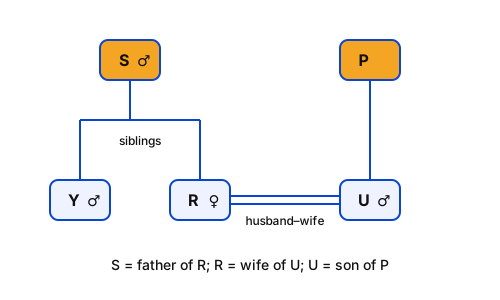
Concept: Decode each symbol step by step and draw the family tree.

  1. S ¥ Y: S is father of Y (S male)
  2. Y # R: Y is brother of R → S is also R's father
  3. R = U: R is wife of U
  4. U % P: U is son of P → R is P's son's wife
  5. S is P's son's wife's father

Trick: Start from P and walk the chain: son → wife → father.

Answer: (B) Son's wife's father

अवधारणा: हर प्रतीक को क्रम से डिकोड करें और वंश-वृक्ष बनाएँ।

  1. S ¥ Y: S, Y का पिता (S पुरुष)
  2. Y # R: Y, R का भाई → S, R का भी पिता
  3. R = U: R, U की पत्नी
  4. U % P: U, P का पुत्र → R, P की पुत्रवधू
  5. S = P के पुत्र की पत्नी का पिता

ट्रिक: P से शुरू करें: पुत्र → पत्नी → पिता।

उत्तर: (B) Son's wife's father

RRB NTPC Undergraduate CBT 1General Intelligence and ReasoningCoded Blood RelationsRRB NTPC Undergraduate CBT 1 2024 · 8 Aug Shift 1 →
Q4095.
Read the given statements and conclusions carefully. Assuming that the information given in the statements is true, even if it appears to be at variance with commonly known facts, decide which of the given conclusion(s) logically follow(s) from the statements.
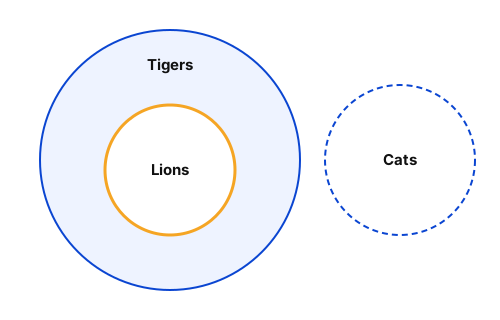
Statements: All lions are tigers. No lion is a cat.
Conclusions (I): Some cats are lions.
Conclusions (II): Some tigers are lions.
दिए गए कथनों और निष्कर्षों को ध्यानपूर्वक पढ़िए। यह मानते हुए कि कथनों में दी गई जानकारी सत्य है, भले ही वह सामान्यतः ज्ञात तथ्यों से भिन्न प्रतीत होती हो, निर्णय कीजिए कि दिए गए निष्कर्षों में से कौन-सा/कौन-से निष्कर्ष तार्किक रूप से कथनों का अनुसरण करता है/करते हैं।
कथन: सभी शेर, बाघ हैं। कोई शेर, बिल्ली नहीं है।
निष्कर्ष (I): कुछ बिल्लियाँ, शेर हैं।
निष्कर्ष (II): कुछ बाघ, शेर हैं।
  1. ANeither conclusion (I) nor (II) follows.न तो निष्कर्ष (I) और न ही (II) अनुसरण करता है।
  2. BOnly conclusion (II) follows.केवल निष्कर्ष (II) अनुसरण करता है।
  3. COnly conclusion (I) follows.केवल निष्कर्ष (I) अनुसरण करता है।
  4. DBoth conclusions (I) and (II) follow.निष्कर्ष (I) और (II) दोनों अनुसरण करते हैं।
Show answer

Concept: All A are B ⇒ Some B are A; No A is C ⇒ No C is A.

  1. No lion is a cat ⇒ No cat is a lion, so I (Some cats are lions) is false.
  2. All lions are tigers ⇒ Some tigers are lions → II follows.

Yaad rakhein: 'All' statements always give a 'Some' conclusion in reverse.

Answer: (B) Only conclusion (II) follows.

अवधारणा: सभी A, B हैं ⇒ कुछ B, A हैं; कोई A, C नहीं ⇒ कोई C, A नहीं।

  1. कोई lion, cat नहीं ⇒ कोई cat, lion नहीं, अतः I गलत।
  2. सभी lions, tigers हैं ⇒ कुछ tigers, lions हैं → II अनुसरण करता है।

याद रखें: 'सभी' वाला कथन उलटने पर हमेशा 'कुछ' का निष्कर्ष देता है।

उत्तर: (B) Only conclusion (II) follows.

RRB NTPC Undergraduate CBT 1General Intelligence and ReasoningSyllogismRRB NTPC Undergraduate CBT 1 2024 · 8 Aug Shift 1 →
Q4096.
In a certain code language, ‘SAID’ is coded as ‘6175’ and ‘DIMS’ is coded as ‘7691’. What is the code for ‘M’ in the given code language?
एक निश्चित कूट भाषा में, ‘SAID’ को ‘6175’ लिखा जाता है और ‘DIMS’ को ‘7691’ लिखा जाता है। उस कूट भाषा में ‘M’ के लिए कूट क्या है?
  1. A9
  2. B7
  3. C6
  4. D1
Show answer

Concept: Common letters share common digits; the leftover letter gets the leftover digit.

  1. SAID → 6175, DIMS → 7691
  2. Common letters: S, I, D ↔ common digits: 6, 7, 1
  3. Leftover in DIMS: M ↔ 9

Trick: Remove common letters and digits; what remains matches.

Answer: (A) 9

अवधारणा: उभयनिष्ठ अक्षरों के उभयनिष्ठ अंक; बचे अक्षर का बचा अंक।

  1. SAID → 6175, DIMS → 7691
  2. उभयनिष्ठ अक्षर: S, I, D ↔ उभयनिष्ठ अंक: 6, 7, 1
  3. DIMS में बचा M ↔ 9

ट्रिक: उभयनिष्ठ हटाएँ; जो बचे वही मेल है।

उत्तर: (A) 9

RRB NTPC Undergraduate CBT 1General Intelligence and ReasoningCoding – DecodingRRB NTPC Undergraduate CBT 1 2024 · 8 Aug Shift 1 →
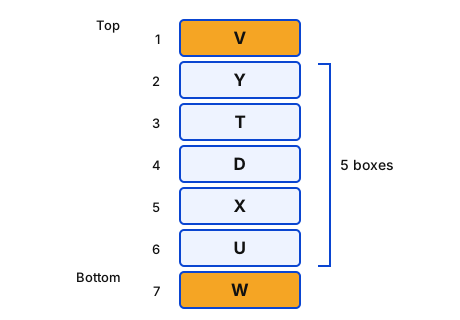
Q4097.
Seven boxes T, U, V, W, X, Y and D are kept one over the other but not necessarily in the same order. T is kept immediately above D. U is kept immediately above W. Only V is kept above Y. Only one box are kept between V and T. Only two boxes are kept between Y and X. How many boxes are kept between W and V?
सात बक्से T, U, V, W, X, Y और D एक के ऊपर एक रखे गए हैं, परंतु आवश्यक नहीं कि इसी क्रम में हों। T को D के ठीक ऊपर रखा गया है। U को W के ठीक ऊपर रखा गया है। Y के ऊपर केवल V रखा गया है। V और T के बीच केवल एक बक्सा रखा गया है। Y और X के बीच केवल दो बक्से रखे गए हैं। W और V के बीच कितने बक्से रखे गए हैं?
  1. AOneएक
  2. BFiveपाँच
  3. CFourचार
  4. DTwoदो
Show answer

Concept: Number the boxes 1 (top) to 7 (bottom) and fix the certain ones first.

  1. Only V above Y → V = 1, Y = 2
  2. One box between V and T → T = 3; T just above D → D = 4
  3. Two between Y and X → X = 5
  4. U just above W → U = 6, W = 7
  5. Between W (7) and V (1): 5 boxes

Trick: 'Only V above Y' fixes the top two at once.

Answer: (B) Five

अवधारणा: बॉक्स को ऊपर से 1 से 7 तक क्रमांकित करें, पहले निश्चित स्थान भरें।

  1. Y के ऊपर केवल V → V = 1, Y = 2
  2. V और T के बीच एक → T = 3; T ठीक D के ऊपर → D = 4
  3. Y और X के बीच दो → X = 5
  4. U ठीक W के ऊपर → U = 6, W = 7
  5. W (7) और V (1) के बीच: 5 बॉक्स

ट्रिक: 'Y के ऊपर केवल V' से ऊपर के दो स्थान तुरंत तय।

उत्तर: (B) Five

RRB NTPC Undergraduate CBT 1General Intelligence and ReasoningBox ArrangementRRB NTPC Undergraduate CBT 1 2024 · 8 Aug Shift 1 →
Q4098.
What will come in the place of the question mark (?) in the following equation, if ‘+’ and ‘×’ are interchanged, and ‘−’ and ‘÷’ are interchanged?
42 − 7 × 12 + 3 ÷ 13 = ?
यदि ‘+’ और ‘×’ को आपस में बदल दिया जाए, तथा ‘−’ और ‘÷’ को आपस में बदल दिया जाए, तो निम्नलिखित समीकरण में प्रश्न चिह्न (?) के स्थान पर क्या आएगा?
42 − 7 × 12 + 3 ÷ 13 = ?
  1. A11
  2. B15
  3. C29
  4. D22
Show answer

Concept: Interchange the signs, then use BODMAS.

  1. After swapping: 42÷7+12×3−13
  2. =6+36−13
  3. =29

Trick: Do ÷ and × first, then + and −.

Answer: (C) 29

अवधारणा: चिह्न बदलें, फिर BODMAS लगाएँ।

  1. बदलने के बाद: 42÷7+12×3−13
  2. =6+36−13
  3. =29

ट्रिक: पहले ÷ और ×, फिर + और −।

उत्तर: (C) 29

RRB NTPC Undergraduate CBT 1General Intelligence and ReasoningMathematical OperationsRRB NTPC Undergraduate CBT 1 2024 · 8 Aug Shift 1 →
Q4099.
This question is based on the five, three-digit numbers given below.
(Left) 384 673 543 236 741 (Right)
(Example- 697 – First digit = 6, second digit = 9 and third digit = 7)
(NOTE: All operations to be done from left to right.)
If 2 is added to the first digit of every number, in how many numbers will the first digit be exactly divisible by the second digit?
यह प्रश्न नीचे दी गई तीन अंकों वाली पाँच संख्याओं पर आधारित है।
(बाएँ) 384 673 543 236 741 (दाएँ)
(उदाहरण- 697 – पहला अंक = 6, दूसरा अंक = 9 और तीसरा अंक = 7)
(ध्यान दें: सभी संक्रियाएँ बाएँ से दाएँ की जानी हैं।)
यदि प्रत्येक संख्या के पहले अंक में 2 जोड़ दिया जाए, तो कितनी संख्याओं में पहला अंक, दूसरे अंक से पूर्णतः विभाज्य होगा?
  1. A2
  2. B0
  3. C3
  4. D1
Show answer

Concept: Add 2 to the first digit and test divisibility by the second digit.

  1. 384 → 5 ÷ 8 ✗; 673 → 8 ÷ 7 ✗
  2. 543 → 7 ÷ 4 ✗; 236 → 4 ÷ 3 ✗
  3. 741 → 9 ÷ 4 ✗
  4. No number qualifies → 0

Trick: A smaller number can never be exactly divisible by a larger one (except 0).

Answer: (B) 0

अवधारणा: पहले अंक में 2 जोड़कर दूसरे अंक से विभाज्यता जाँचें।

  1. 384 → 5 ÷ 8 ✗; 673 → 8 ÷ 7 ✗
  2. 543 → 7 ÷ 4 ✗; 236 → 4 ÷ 3 ✗
  3. 741 → 9 ÷ 4 ✗
  4. कोई संख्या नहीं → 0

ट्रिक: छोटी संख्या बड़ी संख्या से पूर्णतः विभाज्य नहीं होती (0 को छोड़कर)।

उत्तर: (B) 0

RRB NTPC Undergraduate CBT 1General Intelligence and ReasoningDigit-based NumbersRRB NTPC Undergraduate CBT 1 2024 · 8 Aug Shift 1 →
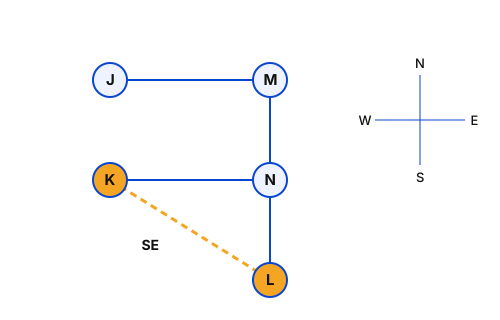
Q4100.
Town J is to the west of town M. Town N is to the south of Town M. Town K is to the west of Town N. Town L is to the south of town N. What is the position of town L with respect to town K?
नगर J, नगर M के पश्चिम में है। नगर N, नगर M के दक्षिण में है। नगर K, नगर N के पश्चिम में है। नगर L, नगर N के दक्षिण में है। नगर K के सापेक्ष नगर L की स्थिति क्या है?
  1. ANortheastउत्तर-पूर्व
  2. BSouthwestदक्षिण-पश्चिम
  3. CNorthwestउत्तर-पश्चिम
  4. DSoutheastदक्षिण-पूर्व
Show answer

Concept: Place towns on a grid with M as reference.

  1. N is south of M; K is west of N; L is south of N.
  2. From K: L is towards east (same column as N) and towards south.
  3. So L is to the southeast of K.

Trick: East + South combined = Southeast.

Answer: (D) Southeast

अवधारणा: M को संदर्भ मानकर नगरों को ग्रिड पर रखें।

  1. N, M के दक्षिण में; K, N के पश्चिम में; L, N के दक्षिण में।
  2. K से देखें: L पूर्व की ओर (N के स्तंभ में) और दक्षिण की ओर है।
  3. अतः L, K के दक्षिण-पूर्व में है।

ट्रिक: पूर्व + दक्षिण = दक्षिण-पूर्व।

उत्तर: (D) Southeast

RRB NTPC Undergraduate CBT 1General Intelligence and ReasoningDirection SenseRRB NTPC Undergraduate CBT 1 2024 · 8 Aug Shift 1 →