Question bank

Q&A: practice questions with answers

Search questions on any topic. Filter by exam category, exam, subject and topic, try the question, then open the answer and explanation.

Courses – airGurukul

8,500 questions found.

Q4181.
In a certain code language,
'A = B' means ‘A is the wife of B’,
'A ¥ B' means ‘A is the father of B’,
'A # B' means ‘ A is the brother of B’ and
'A % B' means ‘A is the mother of B’.
How is D related to A if 'D % E = L ¥ T # A'?
एक निश्चित कूट भाषा में,
'A = B' का अर्थ है ‘A, B की पत्नी है’,
'A ¥ B' का अर्थ है ‘A, B का पिता है’,
'A # B' का अर्थ है ‘A, B का भाई है’ और
'A % B' का अर्थ है ‘A, B की माता है’।
यदि 'D % E = L ¥ T # A' है, तो D का A से क्या संबंध है?
  1. AMother's motherमाता की माता
  2. BMother's brotherमाता का भाई
  3. CMother's fatherमाता का पिता
  4. DMother's sisterमाता की बहन
Show answer

Concept: Decode each symbol one link at a time and build a family tree.
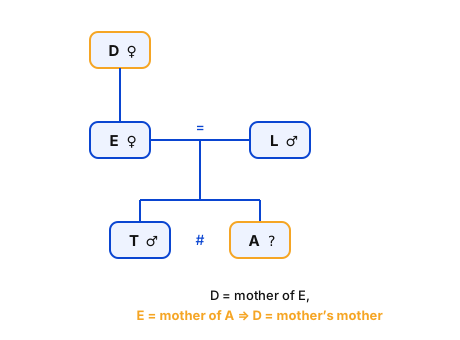
  1. D % E: D is mother of E. E = L: E is wife of L.
  2. L ¥ T: L is father of T, so E is mother of T.
  3. T # A: T is brother of A, so E is mother of A.
  4. D is mother of E → D is A’s mother’s mother.

Trick: Follow the chain D → E → (L) → T → A; mothers on the female line give “mother’s mother”.

Answer: (A) Mother’s mother

अवधारणा: हर चिह्न को एक-एक कड़ी में डिकोड करें और वंश-वृक्ष बनाएँ।

  1. D % E: D, E की माँ है। E = L: E, L की पत्नी है।
  2. L ¥ T: L, T का पिता है, अतः E, T की माँ है।
  3. T # A: T, A का भाई है, अतः E, A की माँ है।
  4. D, E की माँ → D, A की नानी (माँ की माँ) है।

ट्रिक: कड़ी D → E → (L) → T → A का अनुसरण करें; स्त्री-पक्ष से “माँ की माँ”।

उत्तर: (A) माँ की माँ (नानी)
RRB NTPC Undergraduate CBT 1General Intelligence and ReasoningCoded blood relationsRRB NTPC Undergraduate CBT 1 2024 · 7 Aug Shift 3 →
Q4182.
Read the given statement(s) and conclusions carefully. Assuming that the information given in the statements is true, even if it appears to be at variance with commonly known facts, decide which of the given conclusions logically follow(s) from the statement(s).
Statements:
All meters are compasses.
All compasses are scales.
Conclusions:
(I) Some scales are compasses.
(II) All meters are scales.
दिए गए कथन/कथनों और निष्कर्षों को ध्यानपूर्वक पढ़िए। यह मानते हुए कि कथनों में दी गई जानकारी सत्य है, भले ही वह सामान्यतः ज्ञात तथ्यों से भिन्न प्रतीत होती हो, निर्णय लीजिए कि दिए गए निष्कर्षों में से कौन-सा/कौन-से निष्कर्ष तार्किक रूप से कथन/कथनों का अनुसरण करता है/करते हैं।
कथन:
सभी मीटर, कम्पास हैं।
सभी कम्पास, स्केल हैं।
निष्कर्ष:
(I) कुछ स्केल, कम्पास हैं।
(II) सभी मीटर, स्केल हैं।
  1. AOnly conclusion (I) follows.केवल निष्कर्ष (I) अनुसरण करता है।
  2. BOnly conclusion (II) follows.केवल निष्कर्ष (II) अनुसरण करता है।
  3. CBoth conclusions (I) and (II) follow.निष्कर्ष (I) और (II) दोनों अनुसरण करते हैं।
  4. DNeither conclusion (I) nor (II) follows.न तो निष्कर्ष (I) और न ही (II) अनुसरण करता है।
Show answer

Concept: “All X are Y” + “All Y are Z” ⇒ “All X are Z”; also “All Y are Z” ⇒ “Some Z are Y”.

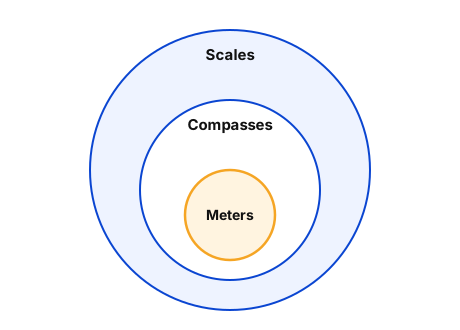
  1. Meters ⊂ Compasses ⊂ Scales (Venn diagram).
  2. (I) All compasses are scales ⇒ some scales are compasses ✓.
  3. (II) Meters inside compasses inside scales ⇒ all meters are scales ✓.

Yaad rakhein: All + All = All (conclusion); “All A are B” always allows “Some B are A”.

Answer: (C) Both conclusions (I) and (II) follow.

अवधारणा: “सभी X, Y हैं” + “सभी Y, Z हैं” ⇒ “सभी X, Z हैं”; तथा “सभी Y, Z हैं” ⇒ “कुछ Z, Y हैं”।

  1. मीटर ⊂ कंपास ⊂ स्केल (वेन आरेख)।
  2. (I) सभी कंपास स्केल हैं ⇒ कुछ स्केल कंपास हैं ✓।
  3. (II) मीटर कंपास में, कंपास स्केल में ⇒ सभी मीटर स्केल हैं ✓।

याद रखें: सभी + सभी = सभी; “सभी A, B हैं” से “कुछ B, A हैं” हमेशा निकलता है।

उत्तर: (C) निष्कर्ष (I) और (II) दोनों अनुसरण करते हैं।

RRB NTPC Undergraduate CBT 1General Intelligence and ReasoningSyllogismRRB NTPC Undergraduate CBT 1 2024 · 7 Aug Shift 3 →
Q4183.
Select the set in which the numbers are related in the same way as are the numbers of the following sets.
(Note: Operations should be performed on the whole numbers, without breaking down the numbers into their constituent digits. E.g., 13 – Operations on 13 such as
adding/subtracting/multiplying to 13 can be performed. Breaking down 13 into 1 and 3 and then performing mathematical operations on 1 and 3 is not allowed.)
(75, 62, 49)
(61, 48, 35)
उस समुच्चय का चयन कीजिए जिसमें संख्याएँ उसी प्रकार संबंधित हैं जिस प्रकार निम्नलिखित समुच्चयों की संख्याएँ संबंधित हैं।
(ध्यान दें: संख्याओं को उनके घटक अंकों में तोड़े बिना, संक्रियाएँ पूर्ण संख्याओं पर की जानी चाहिए। उदाहरण के लिए, 13 – 13 पर संक्रियाएँ जैसे 13 में
जोड़ना/घटाना/गुणा करना आदि किया जा सकता है। 13 को 1 और 3 में तोड़ना और फिर 1 और 3 पर गणितीय संक्रियाएँ करना वर्जित है।)
(75, 62, 49)
(61, 48, 35)
  1. A(73, 60, 53)
  2. B(48, 24, 12)
  3. C(92, 79, 66)
  4. D(66, 52, 41)
Show answer

Concept: Find the rule linking the numbers in each given set and test each option.

  1. (75,62,49): 75−13=62, 62−13=49.
  2. (61,48,35): 61−13=48, 48−13=35.
  3. (92,79,66): 92−13=79, 79−13=66 ✓; others fail (e.g. 73−13=60 but 60−13=47≠53).

Trick: Each set is an AP with common difference −13.

Answer: (C) (92, 79, 66)

अवधारणा: दिए गए समूहों में संख्याओं का नियम खोजें और विकल्प जाँचें।

  1. (75,62,49): 75−13=62, 62−13=49।
  2. (61,48,35): 61−13=48, 48−13=35।
  3. (92,79,66): 92−13=79, 79−13=66 ✓; अन्य नहीं (जैसे 60−13=47≠53)।

ट्रिक: हर समूह सार्व अंतर −13 वाली समांतर श्रेणी है।

उत्तर: (C) (92, 79, 66)

RRB NTPC Undergraduate CBT 1General Intelligence and ReasoningNumber analogy (sets)RRB NTPC Undergraduate CBT 1 2024 · 7 Aug Shift 3 →
Q4184.
ETHC is related to XOMJ in a certain way based on the English alphabetical order. In the same way, CZBE is related to VUGL. To which of the given options is HKQZ related, following the same logic?
अंग्रेज़ी वर्णमाला क्रम के आधार पर ETHC एक निश्चित प्रकार से XOMJ से संबंधित है। उसी प्रकार, CZBE, VUGL से संबंधित है। समान तर्क का अनुसरण करते हुए, HKQZ दिए गए विकल्पों में से किससे संबंधित है?
  1. AAVGF
  2. BAFGV
  3. CAFVG
  4. DAVGH
Show answer

Concept: Find the position shift for each letter (A = 1 … Z = 26, wrap around).

  1. ETHC → XOMJ: E(5)−7=X, T(20)−5=O, H(8)+5=M, C(3)+7=J.
  2. Check CZBE → VUGL: −7,−5,+5,+7 ✓.
  3. HKQZ: H−7=A, K−5=F, Q+5=V, Z+7=G → AFVG.

Trick: Pattern −7,−5,+5,+7 is symmetric — remember wrap-around (Z+7=G).

Answer: (C) AFVG

अवधारणा: प्रत्येक अक्षर का स्थान-परिवर्तन ज्ञात करें (A = 1 … Z = 26, चक्रीय)।

  1. ETHC → XOMJ: E(5)−7=X, T(20)−5=O, H(8)+5=M, C(3)+7=J।
  2. जाँच CZBE → VUGL: −7,−5,+5,+7 ✓।
  3. HKQZ: H−7=A, K−5=F, Q+5=V, Z+7=G → AFVG।

ट्रिक: पैटर्न −7,−5,+5,+7 सममित है — चक्रीय गिनती याद रखें (Z+7=G)।

उत्तर: (C) AFVG

RRB NTPC Undergraduate CBT 1General Intelligence and ReasoningLetter analogyRRB NTPC Undergraduate CBT 1 2024 · 7 Aug Shift 3 →
Q4185.
Based on the English alphabetical order, three of the following four letter cluster pairs are alike in a certain way and thus form a group. Which one DOES NOT belong to that group? (NOTE: The odd one out is not based on the number of consonants/vowels or their position in the letter cluster.)
अंग्रेज़ी वर्णमाला क्रम के आधार पर, निम्नलिखित चार अक्षर-समूह युग्मों में से तीन किसी निश्चित प्रकार से एकसमान हैं और इस प्रकार एक समूह बनाते हैं। कौन-सा युग्म उस समूह से संबंधित नहीं है? (ध्यान दें: असंगत अक्षर-समूह, उस अक्षर-समूह में व्यंजनों/स्वरों की संख्या या उनके स्थान पर आधारित नहीं है।)
  1. AMG-PK
  2. BEY-HC
  3. CKE-MI
  4. DZT-CX
Show answer

Concept: Compare the shift of the 1st letters and of the 2nd letters within each pair.

  1. MG-PK: M+3=P, G+4=K.
  2. EY-HC: E+3=H, Y+4=C (wrap); ZT-CX: Z+3=C, T+4=X.
  3. KE-MI: K+2=M, E+4=I — first shift is 2, not 3.

Trick: All second letters move +4; the odd one is in the first-letter shift.

Answer: (C) KE-MI

अवधारणा: प्रत्येक जोड़ी में पहले अक्षरों और दूसरे अक्षरों का अंतर देखें।

  1. MG-PK: M+3=P, G+4=K।
  2. EY-HC: E+3=H, Y+4=C (चक्रीय); ZT-CX: Z+3=C, T+4=X।
  3. KE-MI: K+2=M, E+4=I — पहला अंतर 2 है, 3 नहीं।

ट्रिक: सभी दूसरे अक्षर +4; विषम पहले अक्षर के अंतर में है।

उत्तर: (C) KE-MI

RRB NTPC Undergraduate CBT 1General Intelligence and ReasoningLetter-cluster odd one outRRB NTPC Undergraduate CBT 1 2024 · 7 Aug Shift 3 →
Q4186.
CFJP is related to GJMS in a certain way based on the English alphabetical order. In the same way, SVVB is related to WZYE. To which of the given options is EHEK related, following the same logic?
अंग्रेज़ी वर्णमाला क्रम के आधार पर CFJP एक निश्चित प्रकार से GJMS से संबंधित है। उसी प्रकार, SVVB, WZYE से संबंधित है। समान तर्क का अनुसरण करते हुए, EHEK दिए गए विकल्पों में से किससे संबंधित है?
  1. ALNHG
  2. BLIHN
  3. CILHN
  4. DLINJ
Show answer

Concept: Find the shift of each letter from the first pair and confirm with the second.

  1. CFJP → GJMS: +4,+4,+3,+3.
  2. SVVB → WZYE: +4,+4,+3,+3 ✓.
  3. EHEK: E+4=I, H+4=L, E+3=H, K+3=N → ILHN.

Trick: Options with first letter L are out at once since E+4=I.

Answer: (C) ILHN

अवधारणा: पहली जोड़ी से प्रत्येक अक्षर का अंतर निकालें और दूसरी से पुष्टि करें।

  1. CFJP → GJMS: +4,+4,+3,+3।
  2. SVVB → WZYE: +4,+4,+3,+3 ✓।
  3. EHEK: E+4=I, H+4=L, E+3=H, K+3=N → ILHN।

ट्रिक: E+4=I, इसलिए L से शुरू होने वाले विकल्प तुरंत हटें।

उत्तर: (C) ILHN

RRB NTPC Undergraduate CBT 1General Intelligence and ReasoningLetter analogyRRB NTPC Undergraduate CBT 1 2024 · 7 Aug Shift 3 →
Q4187.
Refer to the following number and symbol series and answer the question that follows. All number are single-digit numbers. Counting to be done from left to right only. (Left) 5 # % 2 ^ @ 3 & 1 $ 7 Ω 5 2 # 6 * 1 9 (Right)
How many symbols in the series are immediately preceded by a number and
immediately followed by a symbol?
निम्नलिखित संख्या और प्रतीक श्रृंखला का संदर्भ लें और उसके बाद आने वाले प्रश्न का उत्तर दें। सभी संख्याएँ एक-अंकीय संख्याएँ हैं। गिनती केवल बाएँ से दाएँ की जानी है। (बाएँ) 5 # % 2 ^ @ 3 & 1 $ 7 Ω 5 2 # 6 * 1 9 (दाएँ)
श्रृंखला में ऐसे कितने प्रतीक हैं जिनके ठीक पहले एक संख्या है और
ठीक बाद एक प्रतीक है?
  1. AMore than twoदो से अधिक
  2. BOneएक
  3. CTwoदो
  4. DNoneकोई नहीं
Show answer

Concept: Look for the pattern number – SYMBOL – symbol.

  1. 5 # % ✓ (# preceded by 5, followed by %).
  2. 2 ^ @ ✓.
  3. 3 & 1, 1 $ 7, 7 Ω 5, 2 # 6, 6 * 1 — each followed by a number ✗.
  4. Count =2.

Trick: Scan only the symbols that come right after a number, then see what follows.

Answer: (C) Two

अवधारणा: पैटर्न संख्या – प्रतीक – प्रतीक खोजें।

  1. 5 # % ✓ (# के पहले 5, बाद में %)।
  2. 2 ^ @ ✓।
  3. 3 & 1, 1 $ 7, 7 Ω 5, 2 # 6, 6 * 1 — सभी के बाद संख्या ✗।
  4. गिनती =2।

ट्रिक: केवल संख्या के ठीक बाद आने वाले प्रतीक देखें, फिर उनके बाद क्या है।

उत्तर: (C) दो

RRB NTPC Undergraduate CBT 1General Intelligence and ReasoningNumber-symbol seriesRRB NTPC Undergraduate CBT 1 2024 · 7 Aug Shift 3 →
Q4188.
Read the given statements and conclusions carefully. Assuming that the information given in the statements is true, even if it appears to be at variance with commonly known facts, decide which of the given conclusion(s) logically follow(s) from the statements.
Statements:
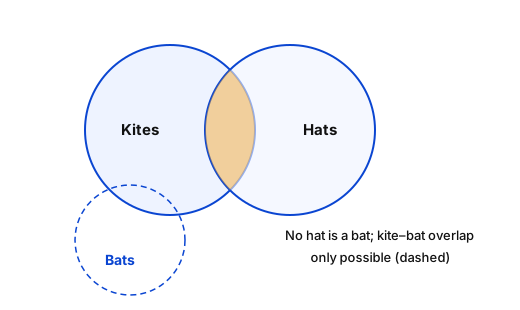
Some kites are hats.
No hat is a bat.
Conclusions:
(I): Some kites are bats.
(II): Some hats are kites.
दिए गए कथनों और निष्कर्षों को ध्यानपूर्वक पढ़िए। यह मानते हुए कि कथनों में दी गई जानकारी सत्य है, भले ही वह सामान्यतः ज्ञात तथ्यों से भिन्न प्रतीत होती हो, निर्णय लीजिए कि दिए गए निष्कर्षों में से कौन-सा/कौन-से निष्कर्ष तार्किक रूप से कथनों का अनुसरण करता है/करते हैं।
कथन:
कुछ पतंगें, टोपियाँ हैं।
कोई टोपी, चमगादड़ नहीं है।
निष्कर्ष:
(I): कुछ पतंगें, चमगादड़ हैं।
(II): कुछ टोपियाँ, पतंगें हैं।
  1. AOnly conclusion (I) follows.केवल निष्कर्ष (I) अनुसरण करता है।
  2. BBoth conclusions (I) and (II) follow.निष्कर्ष (I) और (II) दोनों अनुसरण करते हैं।
  3. COnly conclusion (II) follows.केवल निष्कर्ष (II) अनुसरण करता है।
  4. DNeither conclusion (I) nor (II) follows.न तो निष्कर्ष (I) और न ही (II) अनुसरण करता है।
Show answer

Concept: “Some A are B” converts to “Some B are A”; a “No” statement does not create a definite link between the other two sets.

  1. Some kites are hats ⇒ some hats are kites → (II) follows.
  2. No hat is a bat; kites and bats may or may not overlap → (I) is only a possibility.
  3. Hence only (II) follows.

Yaad rakhein: Some + No ⇒ “Some A are not C” only; never a positive “some” between A and C.

Answer: (C) Only conclusion (II) follows.

अवधारणा: “कुछ A, B हैं” का रूपांतरण “कुछ B, A हैं”; “कोई नहीं” कथन अन्य दो समूहों में निश्चित संबंध नहीं बनाता।

  1. कुछ पतंग टोपी हैं ⇒ कुछ टोपी पतंग हैं → (II) अनुसरण करता है।
  2. कोई टोपी बल्ला नहीं; पतंग और बल्ले का संबंध केवल संभावना → (I) निश्चित नहीं।
  3. अतः केवल (II)।

याद रखें: कुछ + कोई नहीं ⇒ केवल “कुछ A, C नहीं हैं”; A और C में धनात्मक “कुछ” कभी नहीं।

उत्तर: (C) केवल निष्कर्ष (II) अनुसरण करता है।

RRB NTPC Undergraduate CBT 1General Intelligence and ReasoningSyllogismRRB NTPC Undergraduate CBT 1 2024 · 7 Aug Shift 3 →
Q4189.
Which of the following letter-number clusters will replace the question mark (?) in the given series to make it logically complete?
KDU 94, HIQ 107, ENM 120, BSI 133, YXE 146, ?
निम्नलिखित में से कौन-सा अक्षर-संख्या समूह दी गई श्रृंखला को तार्किक रूप से पूर्ण करने के लिए प्रश्न चिह्न (?) का स्थान लेगा?
KDU 94, HIQ 107, ENM 120, BSI 133, YXE 146, ?
  1. AUDB 159
  2. BWBZ 161
  3. CWDC 161
  4. DVCA 159
Show answer

Concept: Each letter position and the number follow their own step (wrap around the alphabet).

  1. 1st letters: K, H, E, B, Y → −3 → V.
  2. 2nd: D, I, N, S, X → +5 → C; 3rd: U, Q, M, I, E → −4 → A.
  3. Numbers: 94, 107, 120, 133, 146 → +13 → 159.

Trick: Number +13 gives 159 — leaves UDB and VCA; first letter Y−3=V.

Answer: (D) VCA 159

अवधारणा: हर अक्षर-स्थान और संख्या का अपना अंतर है (वर्णमाला चक्रीय)।

  1. पहला अक्षर: K, H, E, B, Y → −3 → V।
  2. दूसरा: D, I, N, S, X → +5 → C; तीसरा: U, Q, M, I, E → −4 → A।
  3. संख्याएँ: 94, 107, 120, 133, 146 → +13 → 159।

ट्रिक: संख्या +13 = 159 → UDB और VCA बचे; Y−3=V।

उत्तर: (D) VCA 159

RRB NTPC Undergraduate CBT 1General Intelligence and ReasoningLetter-number seriesRRB NTPC Undergraduate CBT 1 2024 · 7 Aug Shift 3 →
Q4190.
Nushrat ranked 12th from the bottom and 21st from the top in his class. How many students are there in his class?
नुसरत अपनी कक्षा में नीचे से 12th और ऊपर से 21st स्थान पर है। उसकी कक्षा में कितने विद्यार्थी हैं?
  1. A32
  2. B30
  3. C31
  4. D33
Show answer

Concept: Total =rank from top+rank from bottom−1.

  1. 21+12−1=32.

Yaad rakhein: Subtract 1 because the person is counted in both ranks.

Answer: (A) 32

अवधारणा: कुल =ऊपर से रैंक+नीचे से रैंक−1।

  1. 21+12−1=32।

याद रखें: 1 घटाते हैं क्योंकि वही व्यक्ति दोनों रैंकों में गिना गया है।

उत्तर: (A) 32

RRB NTPC Undergraduate CBT 1General Intelligence and ReasoningRankingRRB NTPC Undergraduate CBT 1 2024 · 7 Aug Shift 3 →
Q4191.
Each of the digits in the number 81374569 is arranged in ascending order from left to right. The position of how many digits will remain unchanged as compared to that in the original number?
संख्या 81374569 के प्रत्येक अंक को बाएँ से दाएँ आरोही क्रम में व्यवस्थित किया जाता है। मूल संख्या की तुलना में कितने अंकों का स्थान अपरिवर्तित रहेगा?
  1. AThreeतीन
  2. BOneएक
  3. CTwoदो
  4. DNoneकोई नहीं
Show answer

Concept: Write the digits in ascending order and compare place by place.

  1. Original: 8 1 3 7 4 5 6 9.
  2. Ascending: 1 3 4 5 6 7 8 9.
  3. Only the 8th place (9) is unchanged → one digit.

Trick: Largest digit 9 is already last, so it stays; check the rest quickly.

Answer: (B) One

अवधारणा: अंकों को आरोही क्रम में लिखकर स्थान-दर-स्थान मिलाएँ।

  1. मूल: 8 1 3 7 4 5 6 9।
  2. आरोही: 1 3 4 5 6 7 8 9।
  3. केवल 8वाँ स्थान (9) अपरिवर्तित → एक अंक।

ट्रिक: सबसे बड़ा अंक 9 पहले से अंत में है, अतः वह नहीं हिलता।

उत्तर: (B) एक

RRB NTPC Undergraduate CBT 1General Intelligence and ReasoningDigit arrangementRRB NTPC Undergraduate CBT 1 2024 · 7 Aug Shift 3 →
Q4192.
VR 27 is related to YU 32 in a certain way. In the same way, MI 9 is related to PL 14. To which of the following is GC 13 related, following the same logic?
VR 27 एक निश्चित प्रकार से YU 32 से संबंधित है। उसी प्रकार, MI 9, PL 14 से संबंधित है। समान तर्क का अनुसरण करते हुए, GC 13 निम्नलिखित में से किससे संबंधित है?
  1. AMP 18
  2. BJF 18
  3. CJK 16
  4. DJF 22
Show answer

Concept: Find the change in each letter and in the number.

  1. VR 27 → YU 32: V+3=Y, R+3=U, 27+5=32.
  2. MI 9 → PL 14: +3,+3,+5 ✓.
  3. GC 13 → G+3=J, C+3=F, 13+5=18 → JF 18.

Trick: Number +5 gives 18 — leaves MP 18 and JF 18; G+3=J.

Answer: (B) JF 18

अवधारणा: हर अक्षर और संख्या का परिवर्तन ज्ञात करें।

  1. VR 27 → YU 32: V+3=Y, R+3=U, 27+5=32।
  2. MI 9 → PL 14: +3,+3,+5 ✓।
  3. GC 13 → G+3=J, C+3=F, 13+5=18 → JF 18।

ट्रिक: संख्या +5 = 18 → MP 18 और JF 18 बचे; G+3=J।

उत्तर: (B) JF 18

RRB NTPC Undergraduate CBT 1General Intelligence and ReasoningLetter-number analogyRRB NTPC Undergraduate CBT 1 2024 · 7 Aug Shift 3 →
Q4193.
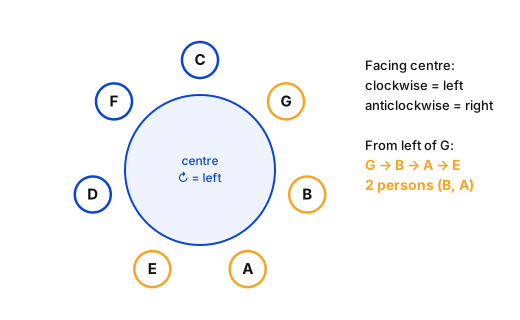
A, B, C, D, E, F and G are sitting around a circular table facing the centre.
Only one person sits between C and D when counted from the right of C. Only one person sits between D and A. Only one person sits between C and B. Only two people sit between F and A. Only one person sits between E and B. How many people sit between E and G when counted from the left of G?
A, B, C, D, E, F और G एक वृत्ताकार मेज़ के चारों ओर केंद्र की ओर मुख करके बैठे हैं।
C के दाएँ से गिनने पर C और D के बीच केवल एक व्यक्ति बैठा है। D और A के बीच केवल एक व्यक्ति बैठा है। C और B के बीच केवल एक व्यक्ति बैठा है। F और A के बीच केवल दो व्यक्ति बैठे हैं। E और B के बीच केवल एक व्यक्ति बैठा है। G के बाएँ से गिनने पर E और G के बीच कितने व्यक्ति बैठे हैं?
  1. A2
  2. B1
  3. C4
  4. D3
Show answer

Concept: Facing the centre: left = clockwise, right = anticlockwise.

  1. Fix C; going right (anticlockwise) from C, one person, then D.
  2. One between D and A and one between C and B fix A and B on the other side: C, _, B, A, _, D, _ (clockwise).
  3. Two between F and A → F sits between D and C; one between E and B → E sits between A and D; G takes the seat between C and B.
  4. Order clockwise: C, G, B, A, E, D, F. From the left of G (clockwise): B, A, then E → 2 people.

Trick: Each “only one between” on a 7-seat table leaves just one free option once the other seat is taken.

Answer: (A) 2

अवधारणा: केंद्र की ओर मुख: बायाँ = दक्षिणावर्त, दायाँ = वामावर्त।

  1. C स्थिर करें; C के दाएँ (वामावर्त) एक व्यक्ति के बाद D।
  2. D–A और C–B के बीच एक-एक से A और B दूसरी ओर: C, _, B, A, _, D, _ (दक्षिणावर्त)।
  3. F–A के बीच दो → F, D और C के बीच; E–B के बीच एक → E, A और D के बीच; G, C और B के बीच।
  4. दक्षिणावर्त क्रम: C, G, B, A, E, D, F। G के बाएँ से (दक्षिणावर्त): B, A, फिर E → 2 व्यक्ति।

ट्रिक: 7 सीटों वाली मेज़ पर “केवल एक बीच में” के दो विकल्पों में से एक प्रायः पहले से भरा होता है।

उत्तर: (A) 2

RRB NTPC Undergraduate CBT 1General Intelligence and ReasoningCircular seating arrangementRRB NTPC Undergraduate CBT 1 2024 · 7 Aug Shift 3 →
Q4194.
Amit ranked 34th from the top and 45th from the bottom in his class. How many students are there in his class?
अमित अपनी कक्षा में ऊपर से 34th और नीचे से 45th स्थान पर है। उसकी कक्षा में कितने विद्यार्थी हैं?
  1. A79
  2. B77
  3. C78
  4. D76
Show answer

Concept: Total =rank from top+rank from bottom−1.

  1. 34+45−1=78.

Yaad rakhein: Subtract 1 because Amit is counted twice.

Answer: (C) 78

अवधारणा: कुल =ऊपर से रैंक+नीचे से रैंक−1।

  1. 34+45−1=78।

याद रखें: 1 घटाते हैं क्योंकि अमित दो बार गिना गया है।

उत्तर: (C) 78

RRB NTPC Undergraduate CBT 1General Intelligence and ReasoningRankingRRB NTPC Undergraduate CBT 1 2024 · 7 Aug Shift 3 →
Q4195.
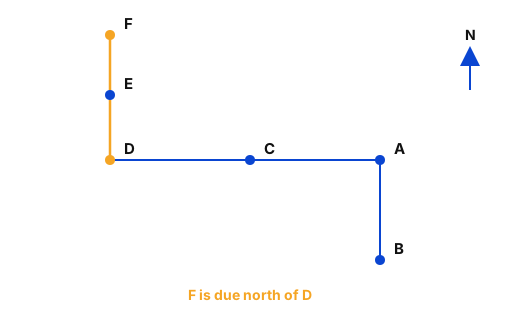
Town B is to the south of Town A. Town C is to the west of Town A. Town D is to the west of Town C. Town E is to the north of Town D and also to the south of Town F. What is the position of Town F with respect to Town D?
नगर B, नगर A के दक्षिण में है। नगर C, नगर A के पश्चिम में है। नगर D, नगर C के पश्चिम में है। नगर E, नगर D के उत्तर में है और नगर F के दक्षिण में भी है। नगर D के सापेक्ष नगर F की स्थिति क्या है?
  1. ANorthउत्तर
  2. BEastपूर्व
  3. CSouthदक्षिण
  4. DWestपश्चिम
Show answer

Concept: Place each town relative to the previous one on a compass sketch.

  1. C is west of A; D is west of C; B is south of A (not needed).
  2. E is north of D, and F is north of E.
  3. So F lies on the same vertical line, north of D.

Trick: D → E → F all go north, so F is simply north of D.

Answer: (A) North

अवधारणा: हर शहर को पिछले के सापेक्ष दिशा-चित्र पर रखें।

  1. C, A के पश्चिम में; D, C के पश्चिम में; B, A के दक्षिण में (आवश्यक नहीं)।
  2. E, D के उत्तर में और F, E के उत्तर में।
  3. अतः F, D के ठीक उत्तर में है।

ट्रिक: D → E → F सब उत्तर की ओर, अतः F, D के उत्तर में।

उत्तर: (A) उत्तर

RRB NTPC Undergraduate CBT 1General Intelligence and ReasoningDirection senseRRB NTPC Undergraduate CBT 1 2024 · 7 Aug Shift 3 →
Q4196.
What should come in place of the question mark (?) in the given series?
86 88 92 100 116 ?
दी गई श्रृंखला में प्रश्न चिह्न (?) के स्थान पर क्या आना चाहिए?
86 88 92 100 116 ?
  1. A148
  2. B180
  3. C132
  4. D144
Show answer

Concept: Differences double each time.

  1. 88−86=2, 92−88=4, 100−92=8, 116−100=16.
  2. Next difference =32: 116+32=148.

Trick: Differences 2,4,8,16,32 = powers of 2.

Answer: (A) 148

अवधारणा: हर बार अंतर दोगुना होता है।

  1. 88−86=2, 92−88=4, 100−92=8, 116−100=16।
  2. अगला अंतर =32: 116+32=148।

ट्रिक: अंतर 2,4,8,16,32 = 2 की घातें।

उत्तर: (A) 148

RRB NTPC Undergraduate CBT 1General Intelligence and ReasoningNumber seriesRRB NTPC Undergraduate CBT 1 2024 · 7 Aug Shift 3 →
Q4197.
Based on the English alphabetical order, three of the following four letter-cluster pairs are alike in a certain way and thus form a group. Which letter-cluster pair DOES NOT belong to that group?
(Note: The odd one out is not based on the number of consonants/vowels or their position in the letter-cluster.)
अंग्रेज़ी वर्णमाला क्रम के आधार पर, निम्नलिखित चार अक्षर-समूह युग्मों में से तीन किसी निश्चित प्रकार से एकसमान हैं और इस प्रकार एक समूह बनाते हैं। कौन-सा अक्षर-समूह युग्म उस समूह से संबंधित नहीं है?
(ध्यान दें: असंगत अक्षर-समूह, उस अक्षर-समूह में व्यंजनों/स्वरों की संख्या या उनके स्थान पर आधारित नहीं है।)
  1. ANE - RK
  2. BPA - TH
  3. CXK - BQ
  4. DQI - UO
Show answer

Concept: Compare the shifts of the first and second letters in each pair.

  1. NE - RK: N+4=R, E+6=K.
  2. XK - BQ: X+4=B (wrap), K+6=Q; QI - UO: Q+4=U, I+6=O.
  3. PA - TH: P+4=T but A+7=H — shift 7, not 6.

Trick: All first letters move +4; the odd one is in the second letter.

Answer: (B) PA - TH

अवधारणा: प्रत्येक जोड़ी के पहले और दूसरे अक्षरों का अंतर देखें।

  1. NE - RK: N+4=R, E+6=K।
  2. XK - BQ: X+4=B (चक्रीय), K+6=Q; QI - UO: Q+4=U, I+6=O।
  3. PA - TH: P+4=T पर A+7=H — अंतर 7, 6 नहीं।

ट्रिक: सभी पहले अक्षर +4; विषम दूसरे अक्षर में है।

उत्तर: (B) PA - TH

RRB NTPC Undergraduate CBT 1General Intelligence and ReasoningLetter-cluster odd one outRRB NTPC Undergraduate CBT 1 2024 · 7 Aug Shift 3 →
Q4198.
What should come in place of the question mark (?) in the given series?
7 7 10 18 33 ?
दी गई श्रृंखला में प्रश्न चिह्न (?) के स्थान पर क्या आना चाहिए?
7 7 10 18 33 ?
  1. A69
  2. B64
  3. C57
  4. D61
Show answer

Concept: Differences are n2−1: 0,3,8,15,24,…

  1. 7→7: +0=12−1; 7→10: +3=22−1.
  2. 10→18: +8=32−1; 18→33: +15=42−1.
  3. Next: +24=52−1, so 33+24=57.

Trick: Second differences 3,5,7,9 (odd numbers) → next difference 15+9=24.

Answer: (C) 57

अवधारणा: अंतर n2−1 हैं: 0,3,8,15,24,…

  1. 7→7: +0=12−1; 7→10: +3=22−1।
  2. 10→18: +8=32−1; 18→33: +15=42−1।
  3. अगला: +24=52−1, अतः 33+24=57।

ट्रिक: दूसरे अंतर 3,5,7,9 (विषम संख्याएँ) → अगला अंतर 15+9=24।

उत्तर: (C) 57

RRB NTPC Undergraduate CBT 1General Intelligence and ReasoningNumber seriesRRB NTPC Undergraduate CBT 1 2024 · 7 Aug Shift 3 →
Q4199.
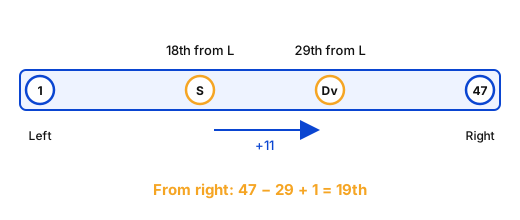
In a row of 47 students facing North, Sonika is 18th from the left end. If Dhruv is 11th to the right of Sonika, what is Dhruv's position from the right-end of the line?
उत्तर की ओर मुख करके खड़े 47 विद्यार्थियों की एक पंक्ति में, सोनिका बाएँ छोर से 18th स्थान पर है। यदि ध्रुव, सोनिका के दाएँ 11th स्थान पर है, तो पंक्ति के दाएँ छोर से ध्रुव का स्थान क्या है?
  1. A20th
  2. B18th
  3. C21st
  4. D19th
Show answer

Concept: Position from right =Total−position from left+1.

  1. Dhruv from left =18+11=29th.
  2. From right =47−29+1=19th.

Yaad rakhein: “kth to the right” of someone at p from left means p+k from left (facing north, right = towards right end).

Answer: (D) 19th

अवधारणा: दाएँ से स्थान =कुल−बाएँ से स्थान+1।

  1. ध्रुव बाएँ से =18+11=29वाँ।
  2. दाएँ से =47−29+1=19वाँ।

याद रखें: बाएँ से p पर खड़े व्यक्ति के दाएँ kवाँ = बाएँ से p+k (उत्तर की ओर मुख)।

उत्तर: (D) 19वाँ

RRB NTPC Undergraduate CBT 1General Intelligence and ReasoningPosition in a rowRRB NTPC Undergraduate CBT 1 2024 · 7 Aug Shift 3 →
Q4200.
In a certain code language, ‘YOUR’ is coded as ‘4628’ and ‘UNIT’ is coded as ‘1385’. What is the code for ‘U’ in the given code language?
एक निश्चित कूट भाषा में, ‘YOUR’ को ‘4628’ के रूप में कूटबद्ध किया जाता है और ‘UNIT’ को ‘1385’ के रूप में कूटबद्ध किया जाता है। दी गई कूट भाषा में ‘U’ के लिए कूट क्या है?
  1. A1
  2. B8
  3. C3
  4. D2
Show answer

Concept: The letter common to both words takes the digit common to both codes.

  1. YOUR → 4628, UNIT → 1385.
  2. Common letter: U; common digit: 8.
  3. So U = 8.

Trick: One common letter and one common digit → direct match.

Answer: (B) 8

अवधारणा: दोनों शब्दों के उभयनिष्ठ अक्षर का कोड दोनों कोडों का उभयनिष्ठ अंक होता है।

  1. YOUR → 4628, UNIT → 1385।
  2. उभयनिष्ठ अक्षर: U; उभयनिष्ठ अंक: 8।
  3. अतः U = 8।

ट्रिक: एक उभयनिष्ठ अक्षर और एक उभयनिष्ठ अंक → सीधा मिलान।

उत्तर: (B) 8

RRB NTPC Undergraduate CBT 1General Intelligence and ReasoningCoding-decodingRRB NTPC Undergraduate CBT 1 2024 · 7 Aug Shift 3 →