Question bank

Q&A: practice questions with answers

Search questions on any topic. Filter by exam category, exam, subject and topic, try the question, then open the answer and explanation.

Courses – airGurukul

8,495 questions found.

Q4441.
Shifa can do a certain piece of work in 20 days. Shifa and Afiya can together do the same work in 12 days, and Shifa, Afiya and Mariyam can do the same work together in 9 days. In how many days can Shifa and Mariyam do the same work together?
शिफ़ा किसी कार्य को 20 दिनों में कर सकती है। शिफ़ा और आफ़िया मिलकर उसी कार्य को 12 दिनों में कर सकती हैं, और शिफ़ा, आफ़िया और मरियम मिलकर उसी कार्य को 9 दिनों में कर सकती हैं। शिफ़ा और मरियम मिलकर उसी कार्य को कितने दिनों में कर सकती हैं?
  1. A838
  2. B859
  3. C907
  4. D807
Show answer

Concept: Take total work = LCM of the given days; then work per day of each person = total ÷ days.
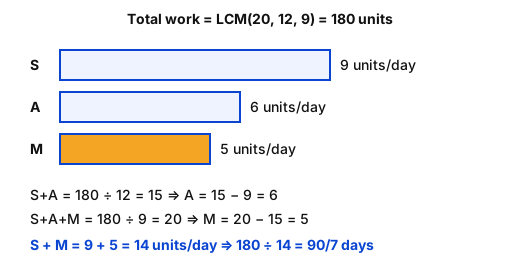
  1. LCM(20,12,9)=180 units. Shifa =18020=9 units/day.
  2. Shifa + Afiya =18012=15⇒ Afiya =6.
  3. All three =1809=20⇒ Mariyam =20−15=5.
  4. Shifa + Mariyam =9+5=14 units/day ⇒ time =18014=907 days.

Trick: Directly: 19−112=136 (Mariyam), then 120+136=790.

Answer: (C) 907

अवधारणा: कुल कार्य = दिए गए दिनों का LCM लें; फिर प्रत्येक का प्रतिदिन कार्य = कुल ÷ दिन।

  1. LCM(20,12,9)=180 इकाई। शिफ़ा =18020=9 इकाई/दिन।
  2. शिफ़ा + आफ़िया =18012=15⇒ आफ़िया =6।
  3. तीनों =1809=20⇒ मरियम =20−15=5।
  4. शिफ़ा + मरियम =9+5=14 इकाई/दिन ⇒ समय =18014=907 दिन।

ट्रिक: सीधे: 19−112=136 (मरियम), फिर 120+136=790।

उत्तर: (C) 907

RRB NTPC Undergraduate CBT 1MathematicsTime and workRRB NTPC Undergraduate CBT 1 2024 · 4 Sep Shift 3 →
Q4442.
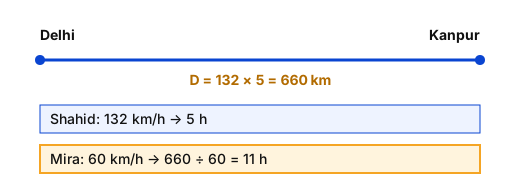
Shahid and Mira have to travel from Delhi to Kanpur in their respective cars. Shahid is driving at 132 km/hr while Mira is driving at 60 km/hr. Find the time taken by Mira to reach Kanpur if Shahid takes 5 hours.
शाहिद और मीरा को अपनी-अपनी कारों से दिल्ली से कानपुर तक यात्रा करनी है। शाहिद 132 km/hr की चाल से गाड़ी चला रहा है जबकि मीरा 60 km/hr की चाल से। यदि शाहिद को 5 घंटे लगते हैं, तो मीरा द्वारा कानपुर पहुँचने में लिया गया समय ज्ञात कीजिए।
  1. A4 hours4 घंटे
  2. B8 hours8 घंटे
  3. C11 hours11 घंटे
  4. D1 hours1 घंटे
Show answer

Concept: For the same distance, time is inversely proportional to speed: Distance=Speed×Time.

  1. Distance Delhi–Kanpur =132×5=660km.
  2. Mira's time =66060=11 hours.

Trick: T2=T1×S1S2=5×13260=11.

Answer: (C) 11 hours

अवधारणा: समान दूरी के लिए समय, चाल के व्युत्क्रमानुपाती होता है: दूरी=चाल×समय।

  1. दिल्ली–कानपुर दूरी =132×5=660km।
  2. मीरा का समय =66060=11 घंटे।

ट्रिक: T2=T1×S1S2=5×13260=11।

उत्तर: (C) 11 घंटे

RRB NTPC Undergraduate CBT 1MathematicsSpeed, time and distanceRRB NTPC Undergraduate CBT 1 2024 · 4 Sep Shift 3 →
Q4443.
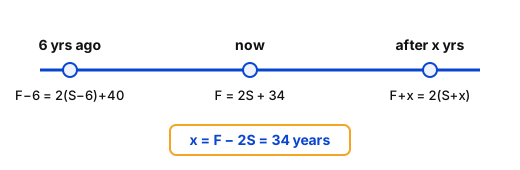
6 years ago, the age of a father was 40 years more than twice his son's age. After how many years, from now, will he be twice his son's age?
6 वर्ष पहले, एक पिता की आयु उसके पुत्र की आयु के दोगुने से 40 वर्ष अधिक थी। अब से कितने वर्ष बाद उसकी आयु उसके पुत्र की आयु की दोगुनी होगी?
  1. A30
  2. B37
  3. C33
  4. D34
Show answer

Concept: Write the condition with present ages F (father) and S (son).

  1. Six years ago: F−6=2(S−6)+40⇒F=2S+34.
  2. After x years: F+x=2(S+x)⇒x=F−2S.
  3. x=(2S+34)−2S=34 years.

Trick: When father = twice son, x=F−2S – here it is just the constant 34.

Answer: (D) 34

अवधारणा: वर्तमान आयु पिता F और पुत्र S मानकर शर्त लिखें।

  1. छह वर्ष पहले: F−6=2(S−6)+40⇒F=2S+34।
  2. x वर्ष बाद: F+x=2(S+x)⇒x=F−2S।
  3. x=(2S+34)−2S=34 वर्ष।

ट्रिक: पिता = पुत्र का दोगुना होने पर x=F−2S – यहाँ सीधे 34।

उत्तर: (D) 34

RRB NTPC Undergraduate CBT 1MathematicsProblems on agesRRB NTPC Undergraduate CBT 1 2024 · 4 Sep Shift 3 →
Q4444.
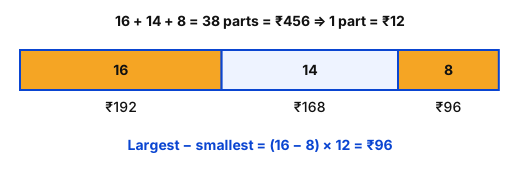
An amount of ₹456 is divided among three persons in the ratio of 16 : 14 : 8. The difference between the largest and the smallest shares (in ₹) in the distribution is:
₹456 की राशि को तीन व्यक्तियों में 16 : 14 : 8 के अनुपात में बाँटा जाता है। इस वितरण में सबसे बड़े और सबसे छोटे हिस्से (₹ में) का अंतर है:
  1. A48
  2. B120
  3. C96
  4. D133
Show answer

Concept: Share =its ratio termsum of terms×total.

  1. Sum of ratio terms =16+14+8=38.
  2. One part =45638=12.
  3. Difference =(16−8)×12=96.

Trick: Find one part first, then multiply the difference of ratio terms.

Answer: (C) 96

अवधारणा: हिस्सा =उसका अनुपात पदपदों का योग×कुल।

  1. अनुपात पदों का योग =16+14+8=38।
  2. एक भाग =45638=12।
  3. अंतर =(16−8)×12=96।

ट्रिक: पहले एक भाग निकालें, फिर अनुपात पदों के अंतर से गुणा करें।

उत्तर: (C) 96

RRB NTPC Undergraduate CBT 1MathematicsRatio and proportionRRB NTPC Undergraduate CBT 1 2024 · 4 Sep Shift 3 →
Q4445.
A number when increased by 100% gives 2690. The number is:
एक संख्या में 100% की वृद्धि करने पर 2690 प्राप्त होता है। वह संख्या है:
  1. A2690
  2. B672.5
  3. C1345
  4. D4035
Show answer

Concept: Increasing a number by 100% doubles it: x×(1+100100)=2x.

  1. 2x=2690
  2. x=26902=1345

Trick: +100% = ×2, so just halve 2690.

Answer: (C) 1345

अवधारणा: किसी संख्या में 100% वृद्धि उसे दोगुना कर देती है: x×(1+100100)=2x।

  1. 2x=2690
  2. x=26902=1345

ट्रिक: +100% = ×2, अतः 2690 को आधा करें।

उत्तर: (C) 1345

RRB NTPC Undergraduate CBT 1MathematicsPercentageRRB NTPC Undergraduate CBT 1 2024 · 4 Sep Shift 3 →
Q4446.
A can lay railway track between two given stations in 19 days and B can do the same job in 15 days. With the help of C, they did the job in 3 days only. Then, C alone can do the job in
A दो दिए गए स्टेशनों के बीच रेलवे ट्रैक 19 दिनों में बिछा सकता है और B वही कार्य 15 दिनों में कर सकता है। C की सहायता से उन्होंने यह कार्य केवल 3 दिनों में पूरा किया। तो, C अकेले यह कार्य कितने दिनों में कर सकता है?
  1. A134161 days134161 दिन
  2. B74161 days74161 दिन
  3. C44161 days44161 दिन
  4. D114161 days114161 दिन
Show answer

Concept: One day's work of C = combined one day's work − (A's + B's) one day's work.

  1. A's 1-day work =119, B's =115, (A+B+C) =13.
  2. C's 1-day work =13−119−115=95−15−19285=61285.
  3. C alone takes 28561=44161 days.

Trick: LCM method: total work =285 units; A = 15, B = 19, all three = 95 units/day, so C =95−34=61 units/day.

Answer: (C) 44161 days

अवधारणा: C का 1 दिन का काम = तीनों का 1 दिन का काम − (A + B) का 1 दिन का काम।

  1. A का 1 दिन का काम =119, B का =115, (A+B+C) का =13।
  2. C का 1 दिन का काम =13−119−115=95−15−19285=61285।
  3. C अकेले 28561=44161 दिन लेगा।

ट्रिक: LCM विधि: कुल काम =285 इकाई; A = 15, B = 19, सभी = 95 इकाई/दिन, तो C =95−34=61 इकाई/दिन।

उत्तर: (C) 44161 दिन

RRB NTPC Undergraduate CBT 1MathematicsTime and WorkRRB NTPC Undergraduate CBT 1 2024 · 4 Sep Shift 3 →
Q4447.
A sum of money triples itself at a certain rate of compound interest in 3 years. In how many years will it amount to 27 times of itself?
कोई धनराशि चक्रवृद्धि ब्याज की एक निश्चित दर पर 3 वर्षों में स्वयं की तीन गुनी हो जाती है। कितने वर्षों में यह स्वयं की 27 गुनी हो जाएगी?
  1. A9 years9 वर्ष
  2. B3 years3 वर्ष
  3. C17 years17 वर्ष
  4. D11 years11 वर्ष
Show answer

Concept: Under compound interest, the multiplying factor for equal time periods multiplies: if money becomes k times in t years, it becomes kn times in nt years.

  1. In 3 years: amount =3P.
  2. 27P=33P, i.e. three such periods.
  3. Time =3×3=9 years.

Trick: Power of the factor × time: 27=33⇒3×3=9 years.

Answer: (A) 9 years

अवधारणा: चक्रवृद्धि ब्याज में यदि धन t वर्ष में k गुना होता है, तो nt वर्ष में kn गुना हो जाता है।

  1. 3 वर्ष में राशि =3P।
  2. 27P=33P, यानी ऐसे 3 अवधि।
  3. समय =3×3=9 वर्ष।

ट्रिक: घात × समय: 27=33⇒3×3=9 वर्ष।

उत्तर: (A) 9 वर्ष

RRB NTPC Undergraduate CBT 1MathematicsCompound InterestRRB NTPC Undergraduate CBT 1 2024 · 4 Sep Shift 3 →
Q4448.
Ishan bought some pens at the rate of ₹150/dozen. He sold them for ₹17 each. His profit percentage is ______%.
ईशान ने कुछ पेन ₹150/दर्जन की दर से खरीदे। उसने उन्हें ₹17 प्रति पेन की दर से बेचा। उसका लाभ प्रतिशत ______% है।
  1. A38
  2. B36
  3. C40
  4. D34
Show answer

Concept: Profit%=SP−CPCP×100 (per pen).

  1. CP of 1 pen =15012= ₹12.5.
  2. SP of 1 pen = ₹17, profit = ₹4.5.
  3. Profit%=4.512.5×100=36%.

Trick: Per dozen: SP =17×12=204, profit =54 on 150 ⇒54150×100=36%.

Answer: (B) 36

अवधारणा: लाभ%=विक्रय मूल्य−क्रय मूल्यक्रय मूल्य×100 (प्रति पेन)।

  1. 1 पेन का क्रय मूल्य =15012= ₹12.5।
  2. 1 पेन का विक्रय मूल्य = ₹17, लाभ = ₹4.5।
  3. लाभ%=4.512.5×100=36%।

ट्रिक: दर्जन के हिसाब से: विक्रय मूल्य =17×12=204, लाभ =54, 54150×100=36%।

उत्तर: (B) 36

RRB NTPC Undergraduate CBT 1MathematicsProfit and LossRRB NTPC Undergraduate CBT 1 2024 · 4 Sep Shift 3 →
Q4449.
If the third proportional of 8 and 56 be x, then what is the value of x?
यदि 8 और 56 का तृतीयानुपाती x हो, तो x का मान क्या है?
  1. A392
  2. B394
  3. C390
  4. D393
Show answer

Concept: Third proportional of a and b is x where a:b=b:x, so x=b2a.

  1. 8:56=56:x.
  2. x=5628=31368=392.

Trick: 568=7, so x=56×7=392.

Answer: (A) 392

अवधारणा: a और b का तृतीयानुपाती (third proportional) x हो तो a:b=b:x, अतः x=b2a।

  1. 8:56=56:x।
  2. x=5628=31368=392।

ट्रिक: 568=7, तो x=56×7=392।

उत्तर: (A) 392

RRB NTPC Undergraduate CBT 1MathematicsRatio and ProportionRRB NTPC Undergraduate CBT 1 2024 · 4 Sep Shift 3 →
Q4450.
The sum of five numbers is 655. The average of the first two numbers is 80, and the third number is 103. Find the average of the remaining two numbers.
पाँच संख्याओं का योग 655 है। पहली दो संख्याओं का औसत 80 है, और तीसरी संख्या 103 है। शेष दो संख्याओं का औसत ज्ञात कीजिए।
  1. A184
  2. B196
  3. C197
  4. D183
Show answer

Concept: Sum of the remaining numbers = total sum − known parts; then divide by their count.

  1. Sum of first two =2×80=160.
  2. Remaining two =655−160−103=392.
  3. Average =3922=196.

Trick: Always convert averages to sums first, then subtract.

Answer: (B) 196

अवधारणा: बचे हुए संख्याओं का योग = कुल योग − ज्ञात भाग; फिर उनकी संख्या से भाग दें।

  1. पहली दो का योग =2×80=160।
  2. शेष दो का योग =655−160−103=392।
  3. औसत =3922=196।

ट्रिक: औसत को पहले योग में बदलें, फिर घटाएँ।

उत्तर: (B) 196

RRB NTPC Undergraduate CBT 1MathematicsAverageRRB NTPC Undergraduate CBT 1 2024 · 4 Sep Shift 3 →
Q4451.
The value of 196+0.0324−5.76=
196+0.0324−5.76= का मान
  1. A16.52
  2. B11.78
  3. C3.21
  4. D8.04
Show answer

Concept: Square root of a decimal: take the root of the digits and halve the number of decimal places.

  1. 196=14.
  2. 0.0324=0.18 (since 182=324, 4 decimal places → 2).
  3. 5.76=2.4 (since 242=576).
  4. 14+0.18−2.4=11.78.

Yaad rakhein: Decimal places in the root = half of those under the root sign.

Answer: (B) 11.78

अवधारणा: दशमलव संख्या का वर्गमूल: अंकों का वर्गमूल लें और दशमलव स्थान आधे कर दें।

  1. 196=14।
  2. 0.0324=0.18 (182=324, 4 दशमलव स्थान → 2)।
  3. 5.76=2.4 (242=576)।
  4. 14+0.18−2.4=11.78।

याद रखें: वर्गमूल में दशमलव स्थान = मूल चिह्न के अंदर वाले स्थानों का आधा।

उत्तर: (B) 11.78

RRB NTPC Undergraduate CBT 1MathematicsSquare RootsRRB NTPC Undergraduate CBT 1 2024 · 4 Sep Shift 3 →
Q4452.
The sum of two numbers is 81 and their L.C.M. is 420. What are the two numbers?
दो संख्याओं का योग 81 है और उनका ल.स.प. (L.C.M.) 420 है। वे दो संख्याएँ कौन-सी हैं?
  1. A14, 67
  2. B26, 55
  3. C19, 62
  4. D21, 60
Show answer

Concept: Check options: the pair must add to 81 and have LCM 420.

  1. 420=22×3×5×7; both numbers must divide 420.
  2. 14 + 67, 26 + 55, 19 + 62: 67, 55, 26, 19, 62 do not divide 420.
  3. 21=3×7, 60=22×3×5; LCM =22×3×5×7=420 and 21+60=81.

Trick: Each number must be a factor of the LCM — eliminate options instantly.

Answer: (D) 21, 60

अवधारणा: विकल्प जाँचें: जोड़ी का योग 81 और LCM 420 होना चाहिए।

  1. 420=22×3×5×7; दोनों संख्याएँ 420 की गुणनखंड होनी चाहिए।
  2. 67, 55, 26, 19, 62 — ये 420 को विभाजित नहीं करतीं।
  3. 21=3×7, 60=22×3×5; LCM =420 और 21+60=81।

ट्रिक: प्रत्येक संख्या LCM का गुणनखंड होनी चाहिए — विकल्प तुरंत हटते हैं।

उत्तर: (D) 21, 60

RRB NTPC Undergraduate CBT 1MathematicsLCM and HCFRRB NTPC Undergraduate CBT 1 2024 · 4 Sep Shift 3 →
Q4453.
M and N started a business. M invested ₹66,000 more than N for 5 months, while N invested for 7 months. M's share is ₹205 more than that of N, out of a total profit of ₹3,895. Find the capital contributed by M.
M और N ने एक व्यवसाय आरंभ किया। M ने N से ₹66,000 अधिक राशि 5 माह के लिए निवेश की, जबकि N ने 7 माह के लिए निवेश किया। ₹3,895 के कुल लाभ में से M का हिस्सा N के हिस्से से ₹205 अधिक है। M द्वारा लगाई गई पूँजी ज्ञात कीजिए।
  1. A₹1,84,910
  2. B₹1,84,849
  3. C₹1,84,800
  4. D₹1,84,602
Show answer

Concept: Profit share ∝ capital × time.

  1. M's share =3895+2052=2050, N's =1845; ratio 2050:1845=10:9.
  2. Let N's capital =x: 5(x+66000)7x=109.
  3. 45x+2970000=70x⇒x=118800.
  4. M's capital =118800+66000= ₹1,84,800.

Trick: Divide both shares by their difference (205) to get the ratio fast: 10:9.

Answer: (C) ₹1,84,800

अवधारणा: लाभ का हिस्सा ∝ पूँजी × समय।

  1. M का हिस्सा =3895+2052=2050, N का =1845; अनुपात 2050:1845=10:9।
  2. N की पूँजी =x: 5(x+66000)7x=109।
  3. 45x+2970000=70x⇒x=118800।
  4. M की पूँजी =118800+66000= ₹1,84,800।

ट्रिक: दोनों हिस्सों को अंतर (205) से भाग दें, अनुपात तुरंत 10:9।

उत्तर: (C) ₹1,84,800

RRB NTPC Undergraduate CBT 1MathematicsPartnershipRRB NTPC Undergraduate CBT 1 2024 · 4 Sep Shift 3 →
Q4454.
The sum of two numbers is 115 and their L.C.M. is 600. What are the two numbers?
दो संख्याओं का योग 115 है और उनका ल.स.प. (L.C.M.) 600 है। वे दो संख्याएँ कौन-सी हैं?
  1. A38, 77
  2. B45, 70
  3. C33, 82
  4. D40, 75
Show answer

Concept: Both numbers must be factors of the LCM and add up to 115.

  1. 600=23×3×52.
  2. 77, 38, 33, 82, 70, 45 are not factors of 600 → options A, B, C fail.
  3. 40=23×5, 75=3×52; LCM =23×3×52=600 and 40+75=115.

Trick: Use the factor test on the LCM to eliminate options.

Answer: (D) 40, 75

अवधारणा: दोनों संख्याएँ LCM की गुणनखंड हों और योग 115 हो।

  1. 600=23×3×52।
  2. 77, 38, 33, 82, 70, 45 — 600 के गुणनखंड नहीं → A, B, C गलत।
  3. 40=23×5, 75=3×52; LCM =600 और 40+75=115।

ट्रिक: LCM के गुणनखंड वाली जाँच से विकल्प हटाएँ।

उत्तर: (D) 40, 75

RRB NTPC Undergraduate CBT 1MathematicsLCM and HCFRRB NTPC Undergraduate CBT 1 2024 · 4 Sep Shift 3 →
Q4455.
The value of 72+102−264−6 is
72+102−264−6 का मान है
  1. A38
  2. B29
  3. C37
  4. D46
Show answer

Concept: Evaluate powers and roots first (BODMAS), then add/subtract.

  1. 72=49, 102=10, 264=2×8=16.
  2. 49+10−16−6=37.

Yaad rakhein: a2=a for positive a.

Answer: (C) 37

अवधारणा: पहले घात और मूल (BODMAS), फिर जोड़-घटाव।

  1. 72=49, 102=10, 264=2×8=16।
  2. 49+10−16−6=37।

याद रखें: धनात्मक a के लिए a2=a।

उत्तर: (C) 37

RRB NTPC Undergraduate CBT 1MathematicsSimplificationRRB NTPC Undergraduate CBT 1 2024 · 4 Sep Shift 3 →
Q4456.
The product of two consecutive natural numbers is 30. The greater of the two numbers is:
दो क्रमागत प्राकृत संख्याओं का गुणनफल 30 है। दोनों संख्याओं में से बड़ी संख्या है:
  1. A12
  2. B3
  3. C6
  4. D24
Show answer

Concept: Consecutive natural numbers: n(n+1)=30.

  1. 5×6=30.
  2. Greater number = 6.

Trick: Take 30≈5.5 — the two numbers lie on either side: 5 and 6.

Answer: (C) 6

अवधारणा: क्रमागत प्राकृत संख्याएँ: n(n+1)=30।

  1. 5×6=30।
  2. बड़ी संख्या = 6।

ट्रिक: 30≈5.5 — दोनों संख्याएँ इसके दोनों ओर: 5 और 6।

उत्तर: (C) 6

RRB NTPC Undergraduate CBT 1MathematicsNumber SystemRRB NTPC Undergraduate CBT 1 2024 · 4 Sep Shift 3 →
Q4457.
Aryan has to reach Ahmedabad which is 977 km away in 11 hours. His starting speed for 4 hours was 39 km/hr. For the next 140 km his speed was 35 km/hr. By what speed he must travel now so as to reach Ahmedabad in the decided time of 11 hours?
आर्यन को 977 km दूर स्थित अहमदाबाद 11 घंटे में पहुँचना है। प्रारंभिक 4 घंटों में उसकी चाल 39 km/hr थी। अगले 140 km के लिए उसकी चाल 35 km/hr थी। निर्धारित 11 घंटे के समय में अहमदाबाद पहुँचने के लिए अब उसे किस चाल से यात्रा करनी होगी?
  1. A227 km/hr
  2. B231 km/hr
  3. C221 km/hr
  4. D229 km/hr
Show answer

Concept: Required speed = remaining distance ÷ remaining time.

  1. First part: 39×4=156 km in 4 h.
  2. Next 140 km at 35 km/h → 14035=4 h.
  3. Used: 8 h, 296 km. Left: 977−296=681 km in 3 h.
  4. Speed =6813=227km/h.

Trick: Track both distance and time used so far in one line: (296 km, 8 h).

Answer: (A) 227 km/hr

अवधारणा: आवश्यक चाल = शेष दूरी ÷ शेष समय।

  1. पहला भाग: 39×4=156 km, 4 घंटे में।
  2. अगले 140 km, 35 km/h से → 14035=4 घंटे।
  3. उपयोग: 8 घंटे, 296 km। शेष: 977−296=681 km, 3 घंटे में।
  4. चाल =6813=227km/h।

ट्रिक: अब तक की दूरी और समय एक साथ लिखें: (296 km, 8 घंटे)।

उत्तर: (A) 227 km/hr

RRB NTPC Undergraduate CBT 1MathematicsSpeed, Time and DistanceRRB NTPC Undergraduate CBT 1 2024 · 4 Sep Shift 3 →
Q4458.
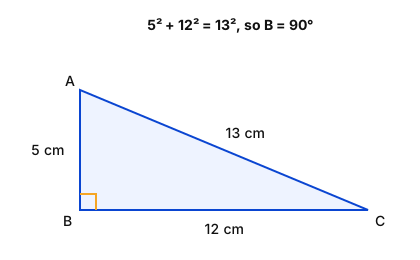
Find the area of a triangle whose sides are of lengths 5 cm, 12 cm and 13 cm.
उस त्रिभुज का क्षेत्रफल ज्ञात कीजिए जिसकी भुजाओं की लंबाई 5 cm, 12 cm और 13 cm है।
  1. A32.5 cm2
  2. B78 cm2
  3. C30 cm2
  4. D60 cm2
Show answer

Concept: 5, 12, 13 is a Pythagorean triplet, so the triangle is right-angled; area =12×base×height.

  1. 52+122=25+144=169=132 → right angle between sides 5 and 12.
  2. Area =12×5×12=30cm2.

Trick: Remember triplets (3,4,5), (5,12,13), (8,15,17), (7,24,25) — no Heron's formula needed.

Answer: (C) 30cm2

अवधारणा: 5, 12, 13 पाइथागोरस त्रिक (Pythagorean triplet) है, अतः त्रिभुज समकोण है; क्षेत्रफल =12×आधार×ऊँचाई।

  1. 52+122=25+144=169=132 → 5 और 12 के बीच समकोण।
  2. क्षेत्रफल =12×5×12=30cm2।

ट्रिक: त्रिक याद रखें: (3,4,5), (5,12,13), (8,15,17), (7,24,25) — हीरोन सूत्र की ज़रूरत नहीं।

उत्तर: (C) 30cm2

RRB NTPC Undergraduate CBT 1MathematicsMensuration – TriangleRRB NTPC Undergraduate CBT 1 2024 · 4 Sep Shift 3 →
Q4459.
Simplify: 3((43)x2−25x+12)−4(x2+7x−18).
सरल कीजिए: 3((43)x2−25x+12)−4(x2+7x−18)।
  1. A103x+108
  2. B103x−108
  3. C−103x−108
  4. D−103x+108
Show answer

Concept: Expand each bracket and combine like terms.

  1. 3(43x2−25x+12)=4x2−75x+36.
  2. −4(x2+7x−18)=−4x2−28x+72.
  3. Add: (4x2−4x2)+(−75x−28x)+(36+72)=−103x+108.

Trick: The x2 terms cancel; just check the constant: 36+72=108 (positive) → only option D.

Answer: (D) −103x+108

अवधारणा: प्रत्येक कोष्ठक खोलें और समान पद जोड़ें।

  1. 3(43x2−25x+12)=4x2−75x+36।
  2. −4(x2+7x−18)=−4x2−28x+72।
  3. जोड़ें: (4x2−4x2)+(−75x−28x)+(36+72)=−103x+108।

ट्रिक: x2 पद कट जाते हैं; x का गुणांक −103 और अचर +108 → विकल्प D।

उत्तर: (D) −103x+108

RRB NTPC Undergraduate CBT 1MathematicsAlgebra – SimplificationRRB NTPC Undergraduate CBT 1 2024 · 4 Sep Shift 3 →
Q4460.
The LCM of the numbers 14.2 and 0.05 is:
संख्याओं 14.2 और 0.05 का ल.स.प. (LCM) है:
  1. A142
  2. B1.42
  3. C0.142
  4. D14.2
Show answer

Concept: Make decimal places equal, find the LCM of the whole numbers, then put back the decimal places.

  1. 14.20 and 0.05 → 1420 and 5 (2 decimal places).
  2. LCM(1420,5)=1420 (as 1420 is a multiple of 5).
  3. LCM =14.20=14.2.

Trick: If the larger number is a multiple of the smaller, it is itself the LCM: 14.2÷0.05=284.

Answer: (D) 14.2

अवधारणा: दशमलव स्थान बराबर करें, पूर्णांकों का LCM निकालें, फिर दशमलव वापस लगाएँ।

  1. 14.20 और 0.05 → 1420 और 5 (2 दशमलव स्थान)।
  2. LCM(1420,5)=1420।
  3. LCM =14.20=14.2।

ट्रिक: यदि बड़ी संख्या छोटी की गुणज है तो वही LCM है: 14.2÷0.05=284।

उत्तर: (D) 14.2

RRB NTPC Undergraduate CBT 1MathematicsLCM of DecimalsRRB NTPC Undergraduate CBT 1 2024 · 4 Sep Shift 3 →