Question bank

Q&A: practice questions with answers

Search questions on any topic. Filter by exam category, exam, subject and topic, try the question, then open the answer and explanation.

Courses – airGurukul

8,495 questions found.

Q4541.
In △ABC, BD ⟂ AC at D and ∠DBC = 63°. E is a point on BC such that ∠CAE = 76°. What is the measure of ∠AEB?
△ABC में, BD ⟂ AC, D पर है और ∠DBC = 63° है। BC पर E एक ऐसा बिंदु है कि ∠CAE = 76° है। ∠AEB का माप क्या है?
  1. A91°
  2. B103°
  3. C105°
  4. D96°
Show answer

Concept: Use the angle-sum property of a triangle and the linear pair at E.
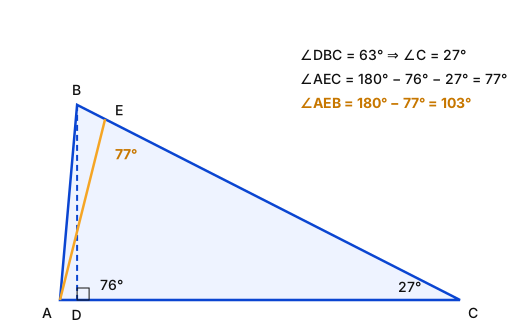
  1. In right △BDC: ∠C=180∘−90∘−63∘=27∘.
  2. In △AEC: ∠AEC=180∘−76∘−27∘=77∘.
  3. ∠AEB and ∠AEC form a linear pair: ∠AEB=180∘−77∘=103∘.

Trick: Exterior angle: ∠AEB=∠CAE+∠C=76∘+27∘=103∘.

Answer: (B) 103∘

अवधारणा: त्रिभुज के कोण-योग गुण और E पर रैखिक युग्म का प्रयोग करें।

  1. समकोण △BDC में: ∠C=180∘−90∘−63∘=27∘।
  2. △AEC में: ∠AEC=180∘−76∘−27∘=77∘।
  3. ∠AEB व ∠AEC रैखिक युग्म: ∠AEB=180∘−77∘=103∘।

ट्रिक: बहिष्कोण: ∠AEB=∠CAE+∠C=76∘+27∘=103∘।

उत्तर: (B) 103∘

RRB NTPC Undergraduate CBT 1MathematicsTriangles – anglesRRB NTPC Undergraduate CBT 1 2024 · 4 Sep Shift 2 →
Q4542.
Ayushi bought a toy for ₹461, decorated it at a cost of ₹15, and sold the toy for ₹918. Find the loss or gain percentage.
आयुषी ने एक खिलौना ₹461 में खरीदा, ₹15 की लागत से उसे सजाया और खिलौने को ₹918 में बेच दिया। हानि या लाभ प्रतिशत ज्ञात कीजिए।
  1. A6607% loss6607% हानि
  2. B6507% loss6507% हानि
  3. C6507% profit6507% लाभ
  4. D650% profit650% लाभ
Show answer

Concept: Extra expenses (decoration, repair, transport) are added to the cost price.

  1. Effective CP = ₹461+15=476; SP = ₹918.
  2. Profit = ₹918−476=442.
  3. Profit%=442476×100=1314×100=6507%.

Trick: 442=34×13 and 476=34×14 – cancel 34 first.

Answer: (C) 6507% profit

अवधारणा: अतिरिक्त ख़र्च (सजावट, मरम्मत, ढुलाई) क्रय मूल्य में जोड़ा जाता है।

  1. प्रभावी क्रय मूल्य = ₹461+15=476; विक्रय मूल्य = ₹918।
  2. लाभ = ₹918−476=442।
  3. लाभ%=442476×100=1314×100=6507%।

ट्रिक: 442=34×13 और 476=34×14 – पहले 34 काटें।

उत्तर: (C) 6507% लाभ

RRB NTPC Undergraduate CBT 1MathematicsProfit and lossRRB NTPC Undergraduate CBT 1 2024 · 4 Sep Shift 2 →
Q4543.
The simple interest on a certain sum for 459 years at the rate of 3.6% per annum is ₹5,453.
What will be the amount payable on the same sum at the rate of 2.7% per annum simple interest in 629 years?
एक निश्चित राशि पर 459 वर्षों के लिए 3.6% वार्षिक दर से साधारण ब्याज ₹5,453 है।
उसी राशि पर 2.7% वार्षिक साधारण ब्याज की दर से 629 वर्षों में देय मिश्रधन कितना होगा?
  1. A₹38,841
  2. B₹38,819
  3. C₹38,828
  4. D₹38,836
Show answer

Concept: SI=P×R×T100; first find the principal, then the new amount.

  1. R×T=3.6×419=16.4%, so 0.164P=5453⇒P=33250.
  2. New R×T=2.7×569=16.8%; SI =0.168×33250=5586.
  3. Amount =33250+5586=38836.

Trick: Total SI % = rate × time; Amount =P×100+16.8100.

Answer: (D) ₹38,836

अवधारणा: SI=P×R×T100; पहले मूलधन, फिर नई राशि निकालें।

  1. R×T=3.6×419=16.4%, अतः 0.164P=5453⇒P=33250।
  2. नया R×T=2.7×569=16.8%; ब्याज =0.168×33250=5586।
  3. मिश्रधन =33250+5586=38836।

ट्रिक: कुल ब्याज % = दर × समय; मिश्रधन =P×100+16.8100।

उत्तर: (D) ₹38,836

RRB NTPC Undergraduate CBT 1MathematicsSimple interestRRB NTPC Undergraduate CBT 1 2024 · 4 Sep Shift 2 →
Q4544.
Find the simple interest (in ₹) if a sum of ₹400 is borrowed for 5.5 years at 8% per annum rate of interest.
यदि ₹400 की राशि 8% वार्षिक ब्याज दर पर 5.5 वर्षों के लिए उधार ली जाती है, तो साधारण ब्याज (₹ में) ज्ञात कीजिए।
  1. A176
  2. B276
  3. C156
  4. D226
Show answer

Concept: SI=P×R×T100.

  1. P=400, R=8%, T=5.5 years.
  2. SI=400×8×5.5100=4×44=176.

Trick: 1 year SI =32; 32×5.5=176.

Answer: (A) ₹176

अवधारणा: SI=P×R×T100।

  1. P=400, R=8%, T=5.5 वर्ष।
  2. SI=400×8×5.5100=4×44=176।

ट्रिक: 1 वर्ष का ब्याज =32; 32×5.5=176।

उत्तर: (A) ₹176

RRB NTPC Undergraduate CBT 1MathematicsSimple interestRRB NTPC Undergraduate CBT 1 2024 · 4 Sep Shift 2 →
Q4545.
The H.C.F. and the L.C.M. of two numbers are 2 and 410, respectively. If one of the numbers is 82, find the other one.
दो संख्याओं का म.स. (H.C.F.) और ल.स. (L.C.M.) क्रमशः 2 और 410 हैं। यदि उनमें से एक संख्या 82 है, तो दूसरी संख्या ज्ञात कीजिए।
  1. A54
  2. B93
  3. C10
  4. D11
Show answer

Concept: For two numbers: HCF×LCM=product of the numbers.

  1. 2×410=82×x
  2. x=82082=10.
  3. Check: HCF(82,10)=2, LCM=410 ✓.

Trick: Other number =HCF×LCMgiven number.

Answer: (C) 10

अवधारणा: दो संख्याओं के लिए: HCF×LCM=संख्याओं का गुणनफल (product)।

  1. 2×410=82×x
  2. x=82082=10।
  3. जाँच: HCF(82,10)=2, LCM=410 ✓।

ट्रिक: दूसरी संख्या =HCF×LCMदी गई संख्या।

उत्तर: (C) 10

RRB NTPC Undergraduate CBT 1MathematicsHCF and LCMRRB NTPC Undergraduate CBT 1 2024 · 4 Sep Shift 2 →
Q4546.
The income of Raman is ₹34,000. He saves 28% of his income. If his income increases by 11% and expenditure increases by 30%, then his savings will:
रमन की आय ₹34,000 है। वह अपनी आय का 28% बचाता है। यदि उसकी आय में 11% की वृद्धि होती है और व्यय में 30% की वृद्धि होती है, तो उसकी बचत:
  1. Adecrease by ₹3,604₹3,604 कम हो जाएगी
  2. Bdecrease by ₹5,649₹5,649 कम हो जाएगी
  3. Cincrease by ₹3,644₹3,644 बढ़ जाएगी
  4. Dincrease by ₹5,639₹5,639 बढ़ जाएगी
Show answer

Concept: Savings = Income − Expenditure; apply each % change to its own base.

  1. Savings =28% of ₹34,000 =9520; expenditure =34000−9520=24480.
  2. New income =34000×1.11=37740.
  3. New expenditure =24480×1.30=31824.
  4. New savings =37740−31824=5916; change =5916−9520=−3604.

Trick: Never apply % changes to savings directly – first split income into savings and expenditure.

Answer: (A) decrease by ₹3,604

अवधारणा: बचत = आय − व्यय; हर प्रतिशत परिवर्तन उसके अपने आधार पर लगाएँ।

  1. बचत =34000 का 28%=9520; व्यय =24480।
  2. नई आय =34000×1.11=37740।
  3. नया व्यय =24480×1.30=31824।
  4. नई बचत =37740−31824=5916; अंतर =5916−9520=−3604, यानी कमी।

ट्रिक: बचत पर सीधे % न लगाएँ – पहले आय को बचत और व्यय में बाँटें।

उत्तर: (A) ₹3,604 की कमी

RRB NTPC Undergraduate CBT 1MathematicsIncome, expenditure & savingsRRB NTPC Undergraduate CBT 1 2024 · 4 Sep Shift 2 →
Q4547.
The value of 169+0.04−6.76 is ______.
169+0.04−6.76 का मान ______ है।
  1. A9.88
  2. B10.57
  3. C10.6
  4. D14.94
Show answer

Concept: Take each square root separately, then add/subtract.

  1. 169=13
  2. 0.04=0.2 and 6.76=2.6
  3. 13+0.2−2.6=10.6

Trick: For decimals, root of digits then halve the decimal places: 676=26⇒6.76=2.6.

Answer: (C) 10.6

अवधारणा: हर वर्गमूल अलग-अलग निकालें, फिर जोड़/घटाएँ।

  1. 169=13
  2. 0.04=0.2 और 6.76=2.6
  3. 13+0.2−2.6=10.6

ट्रिक: दशमलव में: अंकों का वर्गमूल लें, दशमलव स्थान आधे करें: 676=26⇒6.76=2.6।

उत्तर: (C) 10.6

RRB NTPC Undergraduate CBT 1MathematicsSquare rootsRRB NTPC Undergraduate CBT 1 2024 · 4 Sep Shift 2 →
Q4548.
By selling an article at 38 of its actual selling price, Nirbhay incurs a loss of 13%.
If he sells it at 70% of its actual selling price, then the profit percentage is:
किसी वस्तु को उसके वास्तविक विक्रय मूल्य के 38 पर बेचने पर, निर्भय को 13% की हानि होती है।
यदि वह इसे इसके वास्तविक विक्रय मूल्य के 70% पर बेचता है, तो लाभ प्रतिशत है:
  1. A60.5%
  2. B63.3%
  3. C63.5%
  4. D62.4%
Show answer

Concept: Express the actual SP in terms of CP using the loss condition.

  1. 38SP=0.87CP (loss 13%).
  2. SP=8×0.873CP=2.32CP.
  3. 70% of SP =0.7×2.32CP=1.624CP.
  4. Profit =62.4%.

Trick: Take CP =100: SP =87×83=232, 0.7×232=162.4 → profit 62.4%.

Answer: (D) 62.4%

अवधारणा: हानि वाली शर्त से वास्तविक SP को CP के रूप में लिखें।

  1. 38SP=0.87CP (13% हानि)।
  2. SP=8×0.873CP=2.32CP।
  3. SP का 70%=0.7×2.32CP=1.624CP।
  4. लाभ =62.4%।

ट्रिक: CP =100 मानें: SP =87×83=232, 0.7×232=162.4 → लाभ 62.4%।

उत्तर: (D) 62.4%

RRB NTPC Undergraduate CBT 1MathematicsProfit and lossRRB NTPC Undergraduate CBT 1 2024 · 4 Sep Shift 2 →
Q4549.
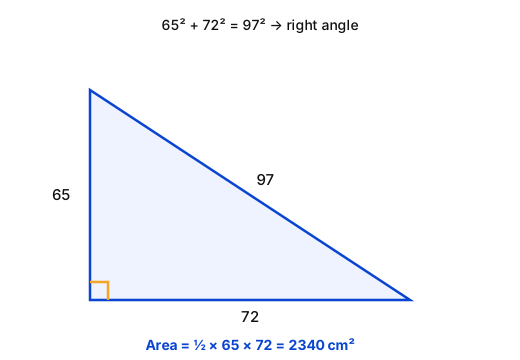
The sides of a triangle are 72 cm, 97 cm, and 65 cm. What is its area? (in cm2 )
एक त्रिभुज की भुजाएँ 72 cm, 97 cm और 65 cm हैं। इसका क्षेत्रफल क्या है? (cm2 में)
  1. A2323
  2. B2355
  3. C2340
  4. D2378
Show answer

Concept: Check for a Pythagorean triple before using Heron's formula.

  1. 652+722=4225+5184=9409=972 → right triangle.
  2. Legs are 65 and 72.
  3. Area =12×65×72=2340cm2.
  4. (Heron check: s=117, 117×45×20×52=2340.)

Trick: 65-72-97 is a Pythagorean triple – remember it.

Answer: (C) 2340

अवधारणा: Heron सूत्र से पहले देखें कि भुजाएँ पाइथागोरस त्रिक हैं या नहीं।

  1. 652+722=4225+5184=9409=972 → समकोण त्रिभुज।
  2. लंब भुजाएँ 65 और 72 हैं।
  3. क्षेत्रफल =12×65×72=2340cm2।
  4. (Heron जाँच: s=117, 117×45×20×52=2340।)

ट्रिक: 65-72-97 एक पाइथागोरस त्रिक है – याद रखें।

उत्तर: (C) 2340

RRB NTPC Undergraduate CBT 1MathematicsArea of triangleRRB NTPC Undergraduate CBT 1 2024 · 4 Sep Shift 2 →
Q4550.
A wholesaler increases the cost price of an item by 90% while marking it. He then offers a 60% discount on this marked price but finds that he incurs a loss. If the wholesaler wants to achieve no profit and no loss, by what percentage should he change the selling price of the item? (Rounded to one decimal place.)
एक थोक विक्रेता किसी वस्तु पर अंकित करते समय उसके क्रय मूल्य में 90% की वृद्धि करता है। फिर वह इस अंकित मूल्य पर 60% की छूट देता है, लेकिन पाता है कि उसे हानि होती है। यदि थोक विक्रेता न लाभ न हानि की स्थिति प्राप्त करना चाहता है, तो उसे वस्तु के विक्रय मूल्य में कितने प्रतिशत का परिवर्तन करना चाहिए? (एक दशमलव स्थान तक पूर्णांकित)
  1. A32.1% decrease32.1% कमी
  2. B35.7% decrease35.7% कमी
  3. C31.6% increase31.6% वृद्धि
  4. D34.5% increase34.5% वृद्धि
Show answer

Concept: Take CP =100 and find SP; then the % change needed to reach CP.

  1. MP =100×1.9=190.
  2. SP =190×0.4=76 → loss.
  3. For no profit no loss SP must be 100: increase =24.
  4. % change =2476×100≈31.6% increase.

Trick: % change is always on the current SP (76), not on CP.

Answer: (C) 31.6% increase

अवधारणा: CP =100 मानकर SP निकालें; फिर CP तक पहुँचने हेतु % परिवर्तन।

  1. MP =100×1.9=190।
  2. SP =190×0.4=76 → हानि।
  3. न लाभ न हानि के लिए SP =100 चाहिए: वृद्धि =24।
  4. % परिवर्तन =2476×100≈31.6% वृद्धि।

ट्रिक: % परिवर्तन वर्तमान SP (76) पर लगता है, CP पर नहीं।

उत्तर: (C) 31.6% वृद्धि

RRB NTPC Undergraduate CBT 1MathematicsMarked price and discountRRB NTPC Undergraduate CBT 1 2024 · 4 Sep Shift 2 →
Q4551.
The average of first 157 even numbers is
प्रथम 157 सम संख्याओं का औसत है
  1. A158.5
  2. B157.5
  3. C159
  4. D158
Show answer

Concept: Sum of first n even numbers =n(n+1), so their average =n+1.

  1. Here n=157.
  2. Sum =157×158.
  3. Average =157×158157=158.

Yaad rakhein: Average of first n even numbers =n+1; of first n odd numbers =n.

Answer: (D) 158

अवधारणा: पहली n सम संख्याओं का योग =n(n+1), अतः औसत =n+1।

  1. यहाँ n=157।
  2. योग =157×158।
  3. औसत =157×158157=158।

याद रखें: पहली n सम संख्याओं का औसत =n+1; पहली n विषम संख्याओं का औसत =n।

उत्तर: (D) 158

RRB NTPC Undergraduate CBT 1MathematicsAverageRRB NTPC Undergraduate CBT 1 2024 · 4 Sep Shift 2 →
Q4552.
The H.C.F. and the L.C.M. of two numbers are 28 and 840, respectively. If one of the numbers is 168, find the other one.
दो संख्याओं का म.स. (H.C.F.) और ल.स. (L.C.M.) क्रमशः 28 और 840 हैं। यदि उनमें से एक संख्या 168 है, तो दूसरी संख्या ज्ञात कीजिए।
  1. A140
  2. B196
  3. C84
  4. D112
Show answer

Concept: Product of two numbers =HCF×LCM.

  1. 168×x=28×840
  2. x=23520168=140
  3. Check: HCF(168,140)=28 ✓

Trick: 840168=5, so other number =28×5=140.

Answer: (A) 140

अवधारणा: दो संख्याओं का गुणनफल =HCF×LCM।

  1. 168×x=28×840
  2. x=23520168=140
  3. जाँच: HCF(168,140)=28 ✓

ट्रिक: 840168=5, अतः दूसरी संख्या =28×5=140।

उत्तर: (A) 140

RRB NTPC Undergraduate CBT 1MathematicsHCF and LCMRRB NTPC Undergraduate CBT 1 2024 · 4 Sep Shift 2 →
Q4553.
An amount of ₹432 is divided among three persons in the ratio of 5 : 14 : 17. The difference between the largest and the smallest shares (in ₹) in the distribution is:
₹432 की राशि को तीन व्यक्तियों में 5 : 14 : 17 के अनुपात में बाँटा जाता है। इस वितरण में सबसे बड़े और सबसे छोटे भाग के बीच का अंतर (₹ में) है:
  1. A144
  2. B62
  3. C178
  4. D132
Show answer

Concept: Each ratio unit =Totalsum of ratio terms.

  1. Sum of terms =5+14+17=36.
  2. 1 unit =43236=12.
  3. Difference =(17−5)×12=144.

Trick: Work directly with the difference of ratio terms (12 units).

Answer: (A) 144

अवधारणा: एक इकाई =कुलअनुपात पदों का योग।

  1. पदों का योग =5+14+17=36।
  2. 1 इकाई =43236=12।
  3. अंतर =(17−5)×12=144।

ट्रिक: सीधे अनुपात पदों के अंतर (12 इकाई) से गुणा करें।

उत्तर: (A) 144

RRB NTPC Undergraduate CBT 1MathematicsRatio and proportionRRB NTPC Undergraduate CBT 1 2024 · 4 Sep Shift 2 →
Q4554.
A kurta is marked for ₹750 and sold for ₹660. The rate of discount is:
एक कुर्ते पर ₹750 अंकित है और उसे ₹660 में बेचा जाता है। छूट की दर है:
  1. A14%
  2. B15%
  3. C12%
  4. D20%
Show answer

Concept: Discount%=MP−SPMP×100.

  1. Discount =750−660=90.
  2. Rate =90750×100=12%.

Trick: Discount % is always on marked price.

Answer: (C) 12%

अवधारणा: छूट%=MP−SPMP×100।

  1. छूट =750−660=90।
  2. दर =90750×100=12%।

ट्रिक: छूट % हमेशा अंकित मूल्य पर होता है।

उत्तर: (C) 12%

RRB NTPC Undergraduate CBT 1MathematicsDiscountRRB NTPC Undergraduate CBT 1 2024 · 4 Sep Shift 2 →
Q4555.
Find the mean proportional between 15 and 240.
15 और 240 का मध्यानुपाती ज्ञात कीजिए।
  1. A60
  2. B58
  3. C63
  4. D57
Show answer

Concept: Mean proportional of a and b =ab.

  1. 15×240=3600
  2. 3600=60
  3. Check: 15:60=60:240 ✓

Yaad rakhein: Mean proportional =ab; third proportional =b2a.

Answer: (A) 60

अवधारणा: a और b का मध्यानुपाती =ab।

  1. 15×240=3600
  2. 3600=60
  3. जाँच: 15:60=60:240 ✓

याद रखें: मध्यानुपाती =ab; तृतीयानुपाती =b2a।

उत्तर: (A) 60

RRB NTPC Undergraduate CBT 1MathematicsMean proportionalRRB NTPC Undergraduate CBT 1 2024 · 4 Sep Shift 2 →
Q4556.
If P=secθ+tanθ, then the value of P2+12P is:
यदि P=secθ+tanθ है, तो P2+12P का मान है:
  1. A1
  2. Btanθ
  3. C0
  4. Dsecθ
Show answer

Concept: sec2θ−tan2θ=1⇒(secθ+tanθ)(secθ−tanθ)=1.

  1. P=secθ+tanθ⇒1P=secθ−tanθ.
  2. P2+12P=12(P+1P).
  3. =12(2secθ)=secθ.

Trick: Put θ=0∘: P=1, value =22=1=sec0∘ – but tan0∘=0, so try θ=60∘ to separate: matches secθ.

Answer: (D) secθ

अवधारणा: sec2θ−tan2θ=1⇒(secθ+tanθ)(secθ−tanθ)=1।

  1. P=secθ+tanθ⇒1P=secθ−tanθ।
  2. P2+12P=12(P+1P)।
  3. =12(2secθ)=secθ।

ट्रिक: θ=0∘ रखने पर मान 1 आता है जो 1 और secθ दोनों से मेल खाता है; θ=60∘ रखकर जाँचें: उत्तर secθ।

उत्तर: (D) secθ

RRB NTPC Undergraduate CBT 1MathematicsTrigonometric identitiesRRB NTPC Undergraduate CBT 1 2024 · 4 Sep Shift 2 →
Q4557.
The product of two consecutive natural numbers is 272. The greater of the two numbers is:
दो क्रमागत प्राकृत संख्याओं का गुणनफल 272 है। दोनों में से बड़ी संख्या है:
  1. A9
  2. B36
  3. C28
  4. D17
Show answer

Concept: Consecutive numbers n(n+1) – their product lies just above n2.

  1. 272≈16.5, so try 16 and 17.
  2. 16×17=272 ✓
  3. Greater number =17.

Trick: Unit digit 2 (6×7) confirms 16×17.

Answer: (D) 17

अवधारणा: क्रमागत संख्याएँ n(n+1) – गुणनफल n2 से थोड़ा अधिक होता है।

  1. 272≈16.5, अतः 16 और 17 जाँचें।
  2. 16×17=272 ✓
  3. बड़ी संख्या =17।

ट्रिक: इकाई अंक 2 (6×7) से 16×17 पुष्टि होती है।

उत्तर: (D) 17

RRB NTPC Undergraduate CBT 1MathematicsNumber systemRRB NTPC Undergraduate CBT 1 2024 · 4 Sep Shift 2 →
Q4558.
Pipe A can fill a tank in 17 hours, pipe B can fill the same tank in 27 hours and pipe C can fill the same tank in 12 hours. The time taken by them to fill the same tank if they operate together is::
पाइप A एक टंकी को 17 घंटे में, पाइप B उसी टंकी को 27 घंटे में और पाइप C उसी टंकी को 12 घंटे में भर सकता है। यदि वे एक साथ कार्य करें, तो उसी टंकी को भरने में उनके द्वारा लिया गया समय है:
  1. A14191329 hours14191329 घंटे
  2. B13191329 hours13191329 घंटे
  3. C5191329 hours5191329 घंटे
  4. D10191329 hours10191329 घंटे
Show answer

Concept: Add the hourly filling rates: 117+127+112.

  1. LCM (17,27,12)=1836 (tank capacity units).
  2. Rates: 108+68+153=329 units/hour.
  3. Time =1836329=5191329 hours.

Trick: Time must be less than the fastest pipe alone (12 h) – only 5191329 fits.

Answer: (C) 5191329 hours

अवधारणा: प्रति घंटा भरने की दरें जोड़ें: 117+127+112।

  1. LCM (17,27,12)=1836 (टंकी की क्षमता इकाई)।
  2. दरें: 108+68+153=329 इकाई/घंटा।
  3. समय =1836329=5191329 घंटे।

ट्रिक: समय सबसे तेज पाइप (12 घंटे) से कम ही होगा – केवल 5191329 सही बैठता है।

उत्तर: (C) 5191329 घंटे

RRB NTPC Undergraduate CBT 1MathematicsPipes and cisternsRRB NTPC Undergraduate CBT 1 2024 · 4 Sep Shift 2 →
Q4559.
Simplify: x(3x - 6) + 4(x2 -5) + 15
सरल कीजिए: x(3x - 6) + 4(x2 -5) + 15
  1. A-7x2 -6x + 5
  2. B-7x2 -6x -5
  3. C7x2 - 6x + 5
  4. D7x2 - 6x - 5
Show answer

Concept: Expand brackets, then combine like terms.

  1. x(3x−6)=3x2−6x
  2. 4(x2−5)=4x2−20
  3. Total =7x2−6x−20+15=7x2−6x−5

Trick: Constant term: −20+15=−5 rules out options with +5.

Answer: (D) 7x2−6x−5

अवधारणा: कोष्ठक खोलें, फिर समान पद जोड़ें।

  1. x(3x−6)=3x2−6x
  2. 4(x2−5)=4x2−20
  3. कुल =7x2−6x−20+15=7x2−6x−5

ट्रिक: अचर पद: −20+15=−5, इससे +5 वाले विकल्प हट जाते हैं।

उत्तर: (D) 7x2−6x−5

RRB NTPC Undergraduate CBT 1MathematicsAlgebraic simplificationRRB NTPC Undergraduate CBT 1 2024 · 4 Sep Shift 2 →
Q4560.
Pipe P can fill 59 part of a tank in 25 hours, and pipe Q can fill 37 part of the same tank in 27 hours. Both P and Q were kept open for 3 hours, then both were closed. Pipe R alone was then opened and it emptied the water in the tank in 4 hours. Pipes P, Q and R together can fill the empty tank in:
पाइप P किसी टंकी का 59 भाग 25 घंटे में भर सकता है, और पाइप Q उसी टंकी का 37 भाग 27 घंटे में भर सकता है। P और Q दोनों को 3 घंटे के लिए खुला रखा गया, फिर दोनों को बंद कर दिया गया। इसके बाद केवल पाइप R को खोला गया और उसने टंकी का पानी 4 घंटे में खाली कर दिया। पाइप P, Q और R एक साथ खाली टंकी को कितने समय में भर सकते हैं?
  1. A108 hours108 घंटे
  2. B93 hours93 घंटे
  3. C105 hours105 घंटे
  4. D112 hours112 घंटे
Show answer

Concept: Find each pipe's full time, then the net rate.

  1. P: 59 in 25 h → full in 45 h; Q: 37 in 27 h → full in 63 h.
  2. In 3 h: 345+363=115+121=435 of tank.
  3. R empties 435 in 4 h → empties full tank in 35 h.
  4. Net: 145+163−135=7+5−9315=1105 → 105 h.

Trick: Full time =time÷fraction: 25÷59=45.

Answer: (C) 105 hours

अवधारणा: हर पाइप का पूरा समय निकालें, फिर शुद्ध दर।

  1. P: 25 घंटे में 59 → पूरी 45 घंटे में; Q: 27 घंटे में 37 → पूरी 63 घंटे में।
  2. 3 घंटे में: 345+363=115+121=435 टंकी।
  3. R 4 घंटे में 435 खाली करता है → पूरी टंकी 35 घंटे में।
  4. शुद्ध दर: 145+163−135=7+5−9315=1105 → 105 घंटे।

ट्रिक: पूरा समय =समय÷भाग: 25÷59=45।

उत्तर: (C) 105 घंटे

RRB NTPC Undergraduate CBT 1MathematicsPipes and cisternsRRB NTPC Undergraduate CBT 1 2024 · 4 Sep Shift 2 →