Question bank

Q&A: practice questions with answers

Search questions on any topic. Filter by exam category, exam, subject and topic, try the question, then open the answer and explanation.

Courses – airGurukul

8,495 questions found.

Q4561.
₹13,700 were divided among A, B and C such that 4 times the share of A = 7 times the share of B = 2 times the share of C. Find the share of A.
₹13,700 को A, B और C में इस प्रकार बाँटा गया कि A के भाग का 4 गुना = B के भाग का 7 गुना = C के भाग का 2 गुना। A का भाग ज्ञात कीजिए।
  1. A₹3,921
  2. B₹3,836
  3. C₹3,988
  4. D₹3,664
Show answer

Concept: If 4A=7B=2C=k, then A:B:C=14:17:12.

  1. Multiply by LCM 28: A:B:C=7:4:14.
  2. Total units =25; 1 unit =1370025=548.
  3. A =7×548=3836.

Trick: Shares are inversely proportional to the multipliers 4,7,2.

Answer: (B) ₹3,836

अवधारणा: यदि 4A=7B=2C=k, तो A:B:C=14:17:12।

  1. LCM 28 से गुणा: A:B:C=7:4:14।
  2. कुल इकाई =25; 1 इकाई =1370025=548।
  3. A =7×548=3836।

ट्रिक: हिस्से गुणकों 4,7,2 के व्युत्क्रमानुपाती होते हैं।

उत्तर: (B) ₹3,836
RRB NTPC Undergraduate CBT 1MathematicsRatio and proportionRRB NTPC Undergraduate CBT 1 2024 · 4 Sep Shift 2 →
Q4562.
A man walks to a viewpoint and returns to the starting point by his car maintaining constant speed and thus takes a total time of 7 hours 45 minutes. He would have gained 6 hours by driving both ways. How long would it have taken for him to walk both ways with same walking speed?
एक व्यक्ति एक दर्शनीय स्थल तक पैदल जाता है और अपनी कार से स्थिर चाल बनाए रखते हुए प्रारंभिक बिंदु पर लौटता है और इस प्रकार कुल 7 घंटे 45 मिनट का समय लेता है। यदि वह दोनों ओर कार से जाता, तो उसके 6 घंटे बच जाते। समान पैदल चाल से दोनों ओर पैदल चलने में उसे कितना समय लगता?
  1. A13 hours 45 minutes13 घंटे 45 मिनट
  2. B14 hours 15 minutes14 घंटे 15 मिनट
  3. C13 hours 30 minutes13 घंटे 30 मिनट
  4. D12 hours 45 minutes12 घंटे 45 मिनट
Show answer

Concept: Walk one way + drive one way = given time; driving both ways saves 6 h.

  1. W+D=734 h.
  2. 2D=734−6=134 h → D=78 h.
  3. W=734−78=678 h.
  4. Walking both ways =2W=1334 h =13 h 45 min.

Trick: Walk both ways = total + time gained =7 h 45 min+6 h=13 h 45 min.

Answer: (A) 13 hours 45 minutes

अवधारणा: एक तरफ पैदल + एक तरफ कार = दिया समय; दोनों तरफ कार से 6 घंटे बचते हैं।

  1. W+D=734 घंटे।
  2. 2D=734−6=134 → D=78 घंटे।
  3. W=734−78=678 घंटे।
  4. दोनों तरफ पैदल =2W=1334 घंटे =13 घंटे 45 मिनट।

ट्रिक: दोनों तरफ पैदल = कुल समय + बचा समय =7 h 45 min+6 h=13 h 45 min।

उत्तर: (A) 13 घंटे 45 मिनट

RRB NTPC Undergraduate CBT 1MathematicsTime and distanceRRB NTPC Undergraduate CBT 1 2024 · 4 Sep Shift 2 →
Q4563.
The LCM of the numbers 2.8 and 0.217 is:
संख्याओं 2.8 और 0.217 का ल.स. (LCM) है:
  1. A86.8
  2. B8.68
  3. C0.868
  4. D868
Show answer

Concept: Make the decimal places equal, find LCM of the integers, then restore the decimal.

  1. 2.8=2.800 and 0.217 → work with 2800 and 217 (thousandths).
  2. 2800=24×52×7; 217=7×31.
  3. LCM =2800×31=86800 → 86.800=86.8.

Trick: LCM of decimals is a multiple of the larger number: 86.8÷2.8=31 ✓, 86.8÷0.217=400 ✓.

Answer: (A) 86.8

अवधारणा: दशमलव स्थान बराबर करें, पूर्णांकों का LCM निकालें, फिर दशमलव वापस लगाएँ।

  1. 2.8=2.800 और 0.217 → 2800 और 217 (हज़ारवें भाग में)।
  2. 2800=24×52×7; 217=7×31।
  3. LCM =2800×31=86800 → 86.800=86.8।

ट्रिक: जाँच: 86.8÷2.8=31 ✓, 86.8÷0.217=400 ✓।

उत्तर: (A) 86.8

RRB NTPC Undergraduate CBT 1MathematicsLCM of decimalsRRB NTPC Undergraduate CBT 1 2024 · 4 Sep Shift 2 →
Q4564.
Evaluate 342.
342 का मान ज्ञात कीजिए।
  1. A1166
  2. B1186
  3. C1156
  4. D1176
Show answer

Concept: (a+b)2=a2+2ab+b2.

  1. 342=(30+4)2
  2. =900+240+16=1156

Trick: Square ending in 4 ends in 6; near 352=1225: 1225−35−34=1156.

Answer: (C) 1156

अवधारणा: (a+b)2=a2+2ab+b2।

  1. 342=(30+4)2
  2. =900+240+16=1156

ट्रिक: 352=1225 से: 1225−35−34=1156।

उत्तर: (C) 1156

RRB NTPC Undergraduate CBT 1MathematicsSquaresRRB NTPC Undergraduate CBT 1 2024 · 4 Sep Shift 2 →
Q4565.
By how much is 65% of 65 greater than 35 of 45?
65 का 65%, 45 के 35 से कितना अधिक है?
  1. A9.25
  2. B15.25
  3. C13.25
  4. D12.25
Show answer

Concept: Compute both quantities and subtract.

  1. 65% of 65=0.65×65=42.25
  2. 35 of 45=27
  3. Difference =42.25−27=15.25

Trick: 65% of 65=652100=4225100.

Answer: (B) 15.25

अवधारणा: दोनों राशियाँ निकालकर घटाएँ।

  1. 65 का 65%=0.65×65=42.25
  2. 45 का 35=27
  3. अंतर =42.25−27=15.25

ट्रिक: 65 का 65%=652100=4225100।

उत्तर: (B) 15.25

RRB NTPC Undergraduate CBT 1MathematicsPercentage and fractionsRRB NTPC Undergraduate CBT 1 2024 · 4 Sep Shift 2 →
Q4566.
FJEC is related to LPKI in a certain way based on the English alphabetical order. In the same way, IMHF is related to OSNL. To which of the following is LPKI related, following the same logic?
अंग्रेज़ी वर्णमाला क्रम के आधार पर FJEC एक निश्चित प्रकार से LPKI से संबंधित है। उसी प्रकार IMHF, OSNL से संबंधित है। समान तर्क का अनुसरण करते हुए, LPKI निम्नलिखित में से किससे संबंधित है?
  1. AVROQ
  2. BRVOQ
  3. CRVQO
  4. DVRQO
Show answer

Concept: Find the shift from FJEC to LPKI and apply it to LPKI.

  1. F→L, J→P, E→K, C→I: each +6.
  2. Check: IMHF +6 → OSNL ✓.
  3. LPKI +6: L→R, P→V, K→Q, I→O = RVQO.

Trick: Same +6 to every letter; keep the order of letters.

Answer: (C) RVQO

अवधारणा: FJEC से LPKI का अंतर देखें और LPKI पर लगाएँ।

  1. F→L, J→P, E→K, C→I: हर अक्षर +6।
  2. जाँच: IMHF +6 → OSNL ✓।
  3. LPKI +6: L→R, P→V, K→Q, I→O = RVQO।

ट्रिक: हर अक्षर पर +6; अक्षरों का क्रम न बदलें।

उत्तर: (C) RVQO

RRB NTPC Undergraduate CBT 1General Intelligence and ReasoningLetter analogyRRB NTPC Undergraduate CBT 1 2024 · 4 Sep Shift 2 →
Q4567.
In a certain code language, ‘TEAR’ is coded as ‘7165’ and ‘SEAT’ is coded as ‘5678’. What is the code for ‘S’ in the given code language?
एक निश्चित कूट भाषा में, ‘TEAR’ को ‘7165’ के रूप में और ‘SEAT’ को ‘5678’ के रूप में कूटबद्ध किया जाता है। दी गई कूट भाषा में ‘S’ का कूट क्या है?
  1. A8
  2. B5
  3. C7
  4. D6
Show answer

Concept: Common letters share common digits.

  1. TEAR = 7165, SEAT = 5678.
  2. Common letters T, E, A ↔ common digits 5, 6, 7.
  3. TEAR's extra letter R ↔ extra digit 1; SEAT's extra letter S ↔ extra digit 8.

Trick: Cancel the common part; the leftover letter takes the leftover digit.

Answer: (A) 8

अवधारणा: सामान्य अक्षरों के सामान्य अंक होते हैं।

  1. TEAR = 7165, SEAT = 5678।
  2. सामान्य अक्षर T, E, A ↔ सामान्य अंक 5, 6, 7।
  3. TEAR का बचा R ↔ 1; SEAT का बचा S ↔ 8।

ट्रिक: सामान्य भाग हटाएँ; बचे अक्षर का कोड बचा अंक है।

उत्तर: (A) 8

RRB NTPC Undergraduate CBT 1General Intelligence and ReasoningCoding-decodingRRB NTPC Undergraduate CBT 1 2024 · 4 Sep Shift 2 →
Q4568.
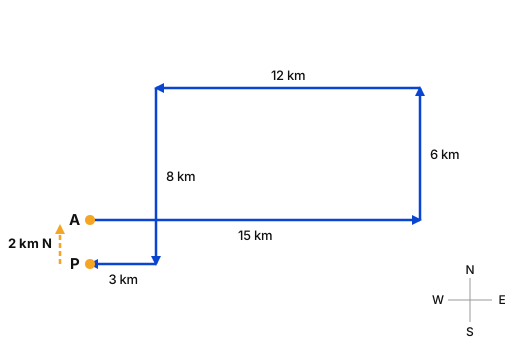
Samad starts from Point A and drives 15 km towards East. He then takes a left turn, drives 6 km, turns left and drives 12 km. He then takes a left turn and drives 8 km. He takes a final right turn, drives 3 km and stops at Point P. How far (shortest distance) and towards which direction should he drive in order to reach Point A again? (All turns are 90° turns only unless specified.)
समद बिंदु A से प्रारंभ करता है और पूर्व की ओर 15 km गाड़ी चलाता है। फिर वह बाएँ मुड़ता है, 6 km गाड़ी चलाता है, बाएँ मुड़ता है और 12 km गाड़ी चलाता है। फिर वह बाएँ मुड़ता है और 8 km गाड़ी चलाता है। वह अंतिम बार दाएँ मुड़ता है, 3 km गाड़ी चलाता है और बिंदु P पर रुक जाता है। बिंदु A पर फिर से पहुँचने के लिए उसे कितनी दूरी (न्यूनतम दूरी) तक और किस दिशा में गाड़ी चलानी चाहिए? (जब तक निर्दिष्ट न हो, सभी मोड़ केवल 90° के मोड़ हैं।)
  1. A2 km towards Northउत्तर की ओर 2 km
  2. B4 km towards Southदक्षिण की ओर 4 km
  3. C2 km towards Westपश्चिम की ओर 2 km
  4. D4 km towards Northउत्तर की ओर 4 km
Show answer

Concept: Track the position with coordinates (East +x, North +y).

  1. A(0,0) → 15 km E → (15,0) → left 6 km N → (15,6).
  2. Left 12 km W → (3,6) → left 8 km S → (3,−2).
  3. Right turn while facing S = West: 3 km → P(0,−2).
  4. P is 2 km South of A, so drive 2 km towards North.

Trick: Net E–W: 15−12−3=0; net N–S: 6−8=−2 → P is 2 km south of A.

Answer: (A) 2 km towards North

अवधारणा: निर्देशांक से स्थिति ट्रैक करें (पूर्व +x, उत्तर +y)।

  1. A(0,0) → 15 km पूर्व → (15,0) → बाएँ 6 km उत्तर → (15,6)।
  2. बाएँ 12 km पश्चिम → (3,6) → बाएँ 8 km दक्षिण → (3,−2)।
  3. दक्षिण की ओर मुख करके दाएँ = पश्चिम: 3 km → P(0,−2)।
  4. P, A से 2 km दक्षिण है, अतः 2 km उत्तर जाना होगा।

ट्रिक: शुद्ध पूर्व–पश्चिम: 15−12−3=0; उत्तर–दक्षिण: 6−8=−2 → P, A से 2 km दक्षिण।

उत्तर: (A) 2 km उत्तर की ओर

RRB NTPC Undergraduate CBT 1General Intelligence and ReasoningDirection and distanceRRB NTPC Undergraduate CBT 1 2024 · 4 Sep Shift 2 →
Q4569.
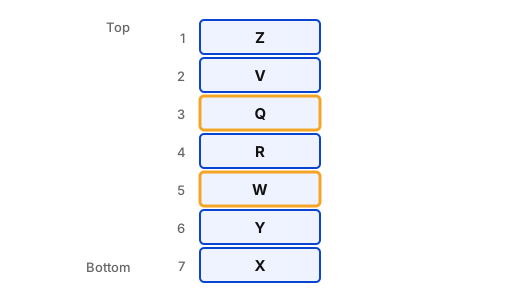
Seven boxes V, W, X, Y, Z, Q and R are kept one over the other but not necessarily in the same order. No box is kept above Z. Only three boxes are kept between Z and W. Only one box is kept between V and R. R is kept immediately above W. Only four boxes are kept between V and X. Q is kept at some place above Y. Which box is kept second below Q?
सात बक्से V, W, X, Y, Z, Q और R एक के ऊपर एक रखे गए हैं, लेकिन आवश्यक नहीं कि इसी क्रम में हों। Z के ऊपर कोई बक्सा नहीं रखा गया है। Z और W के बीच केवल तीन बक्से रखे गए हैं। V और R के बीच केवल एक बक्सा रखा गया है। R, W के ठीक ऊपर रखा गया है। V और X के बीच केवल चार बक्से रखे गए हैं। Q, Y के ऊपर किसी स्थान पर रखा गया है। Q के नीचे दूसरे स्थान पर कौन-सा बक्सा रखा गया है?
  1. AY
  2. BR
  3. CX
  4. DW
Show answer

Concept: Fix definite positions first (positions 1 = top to 7 = bottom).

  1. Z at 1 (nothing above); three between Z and W → W at 5; R immediately above W → R at 4.
  2. One between V and R → V at 2 or 6; four between V and X → V = 2, X = 7.
  3. Remaining 3, 6: Q above Y → Q = 3, Y = 6.
  4. Second below Q (3) is position 5 = W.

Trick: Start with 'no box above Z' – it anchors everything.

Answer: (D) W

अवधारणा: पहले निश्चित स्थान तय करें (1 = ऊपर, 7 = नीचे)।

  1. Z ऊपर (1); Z और W के बीच तीन → W = 5; R, W के ठीक ऊपर → R = 4।
  2. V और R के बीच एक → V = 2 या 6; V और X के बीच चार → V = 2, X = 7।
  3. बचे 3, 6: Q, Y के ऊपर → Q = 3, Y = 6।
  4. Q (3) से दूसरा नीचे स्थान 5 = W।

ट्रिक: 'Z के ऊपर कोई बॉक्स नहीं' से शुरुआत करें।

उत्तर: (D) W

RRB NTPC Undergraduate CBT 1General Intelligence and ReasoningBox arrangementRRB NTPC Undergraduate CBT 1 2024 · 4 Sep Shift 2 →
Q4570.
Refer to the following number and symbol series and answer the question that follows. Counting to be done from left to right only. (Note: All numbers are single digit numbers only).
(Left) 4 7 + $ £ 3 & 8 5 @ 1 Ω # * % 6 2 9 (Right)
How many such numbers are there each of which is immediately preceded by another number and also immediately followed by another number?
निम्नलिखित संख्या और प्रतीक श्रृंखला को देखें और उसके बाद दिए गए प्रश्न का उत्तर दें। गिनती केवल बाएँ से दाएँ की जानी है। (नोट: सभी संख्याएँ केवल एक-अंकीय संख्याएँ हैं।)
(बाएँ) 4 7 + $ £ 3 & 8 5 @ 1 Ω # * % 6 2 9 (दाएँ)
ऐसी कितनी संख्याएँ हैं जिनमें से प्रत्येक के ठीक पहले एक अन्य संख्या है और ठीक बाद भी एक अन्य संख्या है?
  1. A0
  2. B2
  3. C1
  4. D3
Show answer

Concept: Check each number: the element before and after it must both be numbers.

  1. Series: 4 7 + $ £ 3 & 8 5 @ 1 Ω # * % 6 2 9.
  2. Pairs of adjacent numbers: (4,7), (8,5), (6,2,9).
  3. Only 2 has a number on both sides (6 before, 9 after). 7 and 5 are followed by symbols.

Trick: Look for three numbers in a row – the middle one counts.

Answer: (C) 1

अवधारणा: हर संख्या के ठीक पहले और ठीक बाद संख्या होनी चाहिए।

  1. श्रृंखला: 4 7 + $ £ 3 & 8 5 @ 1 Ω # * % 6 2 9।
  2. लगातार संख्याएँ: (4,7), (8,5), (6,2,9)।
  3. केवल 2 के दोनों ओर संख्या है (पहले 6, बाद 9)। 7 और 5 के बाद प्रतीक है।

ट्रिक: लगातार तीन संख्याएँ खोजें – बीच वाली गिनी जाती है।

उत्तर: (C) 1

RRB NTPC Undergraduate CBT 1General Intelligence and ReasoningNumber-symbol seriesRRB NTPC Undergraduate CBT 1 2024 · 4 Sep Shift 2 →
Q4571.
Mayank ranked 39th from the top and 11th from the bottom in his class. How many students are there in his class?
मयंक अपनी कक्षा में ऊपर से 39वें और नीचे से 11वें स्थान पर है। उसकी कक्षा में कितने विद्यार्थी हैं?
  1. A49
  2. B48
  3. C47
  4. D50
Show answer

Concept: Total = rank from top + rank from bottom −1.

  1. Total =39+11−1
  2. =49

Yaad rakhein: Subtract 1 because Mayank is counted twice.

Answer: (A) 49

अवधारणा: कुल = ऊपर से रैंक + नीचे से रैंक −1।

  1. कुल =39+11−1
  2. =49

याद रखें: 1 घटाएँ क्योंकि मयंक दो बार गिना गया है।

उत्तर: (A) 49

RRB NTPC Undergraduate CBT 1General Intelligence and ReasoningRankingRRB NTPC Undergraduate CBT 1 2024 · 4 Sep Shift 2 →
Q4572.
What should come in place of the question mark (?) in the given series?
550 555 565 570 580 585 ? 600
दी गई श्रृंखला में प्रश्न चिह्न (?) के स्थान पर क्या आना चाहिए?
550 555 565 570 580 585 ? 600
  1. A610
  2. B595
  3. C590
  4. D605
Show answer

Concept: Look at the differences.

  1. Differences: +5,+10,+5,+10,+5,…
  2. 585+10=595
  3. Check: 595+5=600 ✓

Trick: Alternating +5, +10 pattern.

Answer: (B) 595

अवधारणा: अंतर देखें।

  1. अंतर: +5,+10,+5,+10,+5,…
  2. 585+10=595
  3. जाँच: 595+5=600 ✓

ट्रिक: +5, +10 बारी-बारी से।

उत्तर: (B) 595

RRB NTPC Undergraduate CBT 1General Intelligence and ReasoningNumber seriesRRB NTPC Undergraduate CBT 1 2024 · 4 Sep Shift 2 →
Q4573.
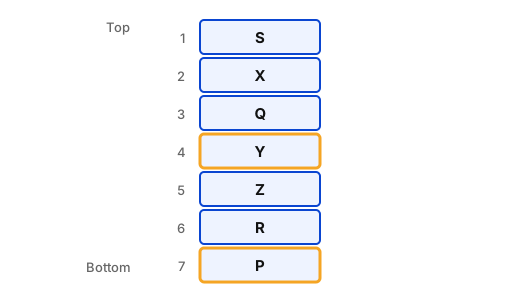
Seven boxes P, Q, R, S, X, Y and Z are kept one over the other, but not necessarily in the same order. Only S is kept above X. Only two boxes are kept between X and Z. Only P is kept below R. Q is not kept immediately above Z. How many boxes are kept between Y and P?
सात बक्से P, Q, R, S, X, Y और Z एक के ऊपर एक रखे गए हैं, लेकिन आवश्यक नहीं कि इसी क्रम में हों। X के ऊपर केवल S रखा गया है। X और Z के बीच केवल दो बक्से रखे गए हैं। R के नीचे केवल P रखा गया है। Q, Z के ठीक ऊपर नहीं रखा गया है। Y और P के बीच कितने बक्से रखे गए हैं?
  1. ATwoदो
  2. BThreeतीन
  3. CFourचार
  4. DOneएक
Show answer

Concept: Use the 'only' clues to fix top and bottom (1 = top).

  1. Only S above X → S = 1, X = 2.
  2. Two boxes between X and Z → Z = 5.
  3. Only P below R → P = 7, R = 6.
  4. Q not immediately above Z → Q ≠ 4, so Q = 3, Y = 4. Between Y (4) and P (7): Z, R = two.

Trick: 'Only S above X' means X is second from top.

Answer: (A) Two

अवधारणा: 'केवल' वाले संकेतों से ऊपर और नीचे तय करें (1 = ऊपर)।

  1. केवल S, X के ऊपर → S = 1, X = 2।
  2. X और Z के बीच दो → Z = 5।
  3. केवल P, R के नीचे → P = 7, R = 6।
  4. Q, Z के ठीक ऊपर नहीं → Q = 3, Y = 4। Y (4) और P (7) के बीच: Z, R = दो।

ट्रिक: 'केवल S, X के ऊपर' = X ऊपर से दूसरा।

उत्तर: (A) दो

RRB NTPC Undergraduate CBT 1General Intelligence and ReasoningBox arrangementRRB NTPC Undergraduate CBT 1 2024 · 4 Sep Shift 2 →
Q4574.
Based on the English alphabetical order, three of the following four letter-clusters are alike in a certain way and thus form a group. Which letter-cluster DOES NOT belong to that group?
(Note: The odd one out is not based on the number of consonants/vowels or their position in the letter-cluster.)
अंग्रेज़ी वर्णमाला क्रम के आधार पर, निम्नलिखित चार अक्षर-समूहों में से तीन किसी निश्चित प्रकार से एकसमान हैं और इस प्रकार एक समूह बनाते हैं। कौन-सा अक्षर-समूह उस समूह से संबंधित नहीं है?
(नोट: असंगत अक्षर-समूह, अक्षर-समूह में व्यंजनों/स्वरों की संख्या या उनके स्थान पर आधारित नहीं है।)
  1. AEHC
  2. BNQK
  3. CYBW
  4. DSVQ
Show answer

Concept: Find the positional gaps between consecutive letters.

  1. EHC: E +3 H, H −5 C.
  2. YBW: Y +3 B, B −5 W; SVQ: S +3 V, V −5 Q.
  3. NQK: N +3 Q, but Q −6 K → odd.

Trick: Write letter positions: N(14) Q(17) K(11) – the second gap is 6, not 5.

Answer: (B) NQK

अवधारणा: लगातार अक्षरों के बीच स्थानीय अंतर देखें।

  1. EHC: E +3 H, H −5 C।
  2. YBW: Y +3 B, B −5 W; SVQ: S +3 V, V −5 Q।
  3. NQK: N +3 Q, पर Q −6 K → विषम।

ट्रिक: स्थान लिखें: N(14) Q(17) K(11) – दूसरा अंतर 6 है, 5 नहीं।

उत्तर: (B) NQK

RRB NTPC Undergraduate CBT 1General Intelligence and ReasoningOdd one out (letters)RRB NTPC Undergraduate CBT 1 2024 · 4 Sep Shift 2 →
Q4575.
Based on the English alphabetical order, three of the following four letter-cluster pairs are alike in a certain way and thus form a group. Which letter-cluster pair DOES NOT belong to that group?
(Note: The odd one out is not based on the number of consonants/vowels or their position in the letter-cluster.)
अंग्रेज़ी वर्णमाला क्रम के आधार पर, निम्नलिखित चार अक्षर-समूह युग्मों में से तीन किसी निश्चित प्रकार से एकसमान हैं और इस प्रकार एक समूह बनाते हैं। कौन-सा अक्षर-समूह युग्म उस समूह से संबंधित नहीं है?
(नोट: असंगत अक्षर-समूह, अक्षर-समूह में व्यंजनों/स्वरों की संख्या या उनके स्थान पर आधारित नहीं है।)
  1. ALQ-NJ
  2. BNS-PK
  3. CJO-LH
  4. DHM-JF
Show answer

Concept: Compare first letters of the two clusters and second letters separately.

  1. LQ-NJ: L +2 N, Q −7 J.
  2. JO-LH: J +2 L, O −7 H; HM-JF: H +2 J, M −7 F.
  3. NS-PK: N +2 P, but S −8 K → odd.

Trick: In the first cluster the gap is 5 in all (L–Q, N–S, J–O, H–M), so the second cluster decides.

Answer: (B) NS-PK

अवधारणा: दोनों समूहों के पहले अक्षर और दूसरे अक्षर अलग-अलग तुलना करें।

  1. LQ-NJ: L +2 N, Q −7 J।
  2. JO-LH: J +2 L, O −7 H; HM-JF: H +2 J, M −7 F।
  3. NS-PK: N +2 P, पर S −8 K → विषम।

ट्रिक: पहले समूह में सबमें अंतर 5 है, अतः फैसला दूसरा समूह करता है।

उत्तर: (B) NS-PK

RRB NTPC Undergraduate CBT 1General Intelligence and ReasoningOdd one out (letter pairs)RRB NTPC Undergraduate CBT 1 2024 · 4 Sep Shift 2 →
Q4576.
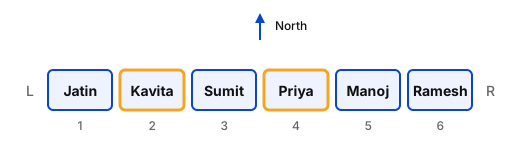
Sumit, Jatin, Ramesh, Priya, Kavita and Manoj are sitting in a straight line, facing north. Sumit sits third from the left end. Manoj sits second to the right of Sumit. Jatin sits to the immediate left of Kavita. Priya does not sit at the end. Who sits second to the left of Priya?
सुमित, जतिन, रमेश, प्रिया, कविता और मनोज एक सीधी पंक्ति में उत्तर की ओर मुख करके बैठे हैं। सुमित बाएँ छोर से तीसरे स्थान पर बैठा है। मनोज, सुमित के दाएँ से दूसरे स्थान पर बैठा है। जतिन, कविता के ठीक बाएँ बैठा है। प्रिया किसी छोर पर नहीं बैठी है। प्रिया के बाएँ से दूसरे स्थान पर कौन बैठा है?
  1. ARameshरमेश
  2. BManojमनोज
  3. CKavitaकविता
  4. DSumitसुमित
Show answer

Concept: Six seats 1–6 from left; all face north so right = towards seat 6.

  1. Sumit = 3; Manoj second to right of Sumit = 5.
  2. Free: 1, 2, 4, 6. Jatin immediately left of Kavita → only adjacent pair is 1, 2: Jatin 1, Kavita 2.
  3. Priya not at end → Priya 4, Ramesh 6.
  4. Second to left of Priya (4) = seat 2 = Kavita.

Trick: Find the only pair of adjacent empty seats for Jatin–Kavita.

Answer: (C) Kavita

अवधारणा: बाएँ से 1–6 सीटें; सभी उत्तरमुखी, इसलिए दायाँ = सीट 6 की ओर।

  1. सुमित = 3; मनोज सुमित के दूसरे दाएँ = 5।
  2. खाली: 1, 2, 4, 6। जतिन, कविता के ठीक बाएँ → केवल 1, 2 सटे हैं: जतिन 1, कविता 2।
  3. प्रिया अंत में नहीं → प्रिया 4, रमेश 6।
  4. प्रिया (4) के दूसरे बाएँ = सीट 2 = कविता।

ट्रिक: जतिन–कविता के लिए सटी हुई खाली सीटें खोजें।

उत्तर: (C) कविता (Kavita)

RRB NTPC Undergraduate CBT 1General Intelligence and ReasoningLinear seatingRRB NTPC Undergraduate CBT 1 2024 · 4 Sep Shift 2 →
Q4577.
What should come in place of the question mark (?) in the given series?
16 28 50 82 124 ?
दी गई श्रृंखला में प्रश्न चिह्न (?) के स्थान पर क्या आना चाहिए?
16 28 50 82 124 ?
  1. A162
  2. B176
  3. C194
  4. D185
Show answer

Concept: Differences increase by a fixed amount.

  1. Differences: 12,22,32,42 (each +10).
  2. Next difference =52.
  3. 124+52=176

Trick: Second difference constant (10) → quadratic pattern.

Answer: (B) 176

अवधारणा: अंतर एक निश्चित मात्रा से बढ़ते हैं।

  1. अंतर: 12,22,32,42 (हर बार +10)।
  2. अगला अंतर =52।
  3. 124+52=176

ट्रिक: दूसरा अंतर स्थिर (10) है।

उत्तर: (B) 176

RRB NTPC Undergraduate CBT 1General Intelligence and ReasoningNumber seriesRRB NTPC Undergraduate CBT 1 2024 · 4 Sep Shift 2 →
Q4578.
Based on the English alphabetical order, three of the following four letter-clusters are alike in a certain way and thus form a group. Which letter-cluster DOES NOT belong to that group?
(Note: The odd one out is not based on the number of consonants/vowels or their position in the letter-cluster.)
अंग्रेज़ी वर्णमाला क्रम के आधार पर, निम्नलिखित चार अक्षर-समूहों में से तीन किसी निश्चित प्रकार से एकसमान हैं और इस प्रकार एक समूह बनाते हैं। कौन-सा अक्षर-समूह उस समूह से संबंधित नहीं है?
(नोट: असंगत अक्षर-समूह, अक्षर-समूह में व्यंजनों/स्वरों की संख्या या उनके स्थान पर आधारित नहीं है।)
  1. ARXT
  2. BMSO
  3. CFLG
  4. DIOK
Show answer

Concept: Check gaps between letter positions.

  1. RXT: R +6 X, X −4 T; MSO: M +6 S, S −4 O.
  2. IOK: I +6 O, O −4 K.
  3. FLG: F +6 L, but L −5 G → odd.

Trick: Pattern +6,−4; FLG breaks the second step.

Answer: (C) FLG

अवधारणा: अक्षरों के स्थानों का अंतर देखें।

  1. RXT: R +6 X, X −4 T; MSO: M +6 S, S −4 O।
  2. IOK: I +6 O, O −4 K।
  3. FLG: F +6 L, पर L −5 G → विषम।

ट्रिक: पैटर्न +6,−4; FLG दूसरे चरण में अलग है।

उत्तर: (C) FLG

RRB NTPC Undergraduate CBT 1General Intelligence and ReasoningOdd one out (letters)RRB NTPC Undergraduate CBT 1 2024 · 4 Sep Shift 2 →
Q4579.
Read the given statements and conclusions carefully. Assuming that the information given in the statements is true, even if it appears to be at variance with commonly known facts, decide which of the given conclusions logically follow(s) from the statements.
Statements:
All mugs are cups.
Some mugs are forks.
Conclusions:
(I): Some cups are forks.
(II): Some forks are mugs.
दिए गए कथनों और निष्कर्षों को ध्यानपूर्वक पढ़िए। यह मानते हुए कि कथनों में दी गई जानकारी सत्य है, भले ही वह सामान्यतः ज्ञात तथ्यों से भिन्न प्रतीत होती हो, निर्णय लीजिए कि दिए गए निष्कर्षों में से कौन-सा/कौन-से निष्कर्ष कथनों का तार्किक रूप से अनुसरण करता है/करते हैं।
कथन:
सभी मग, कप हैं।
कुछ मग, कांटे हैं।
निष्कर्ष:
(I): कुछ कप, कांटे हैं।
(II): कुछ कांटे, मग हैं।
  1. AOnly conclusion I follows.केवल निष्कर्ष I अनुसरण करता है।
  2. BBoth conclusions I and II follow.निष्कर्ष I और II दोनों अनुसरण करते हैं।
  3. CNeither conclusion I nor II follow.न तो निष्कर्ष I और न ही II अनुसरण करता है।
  4. DOnly conclusion II follows.केवल निष्कर्ष II अनुसरण करता है।
Show answer

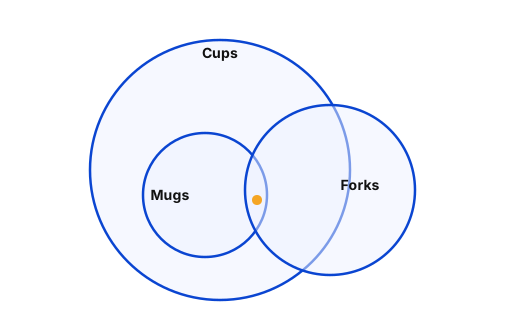
Concept: Draw the minimum Venn diagram for the statements.

  1. All mugs are cups → Mugs inside Cups.
  2. Some mugs are forks → Forks overlap Mugs; that common part is also inside Cups.
  3. So some cups are forks → I follows.
  4. 'Some mugs are forks' converts to 'Some forks are mugs' → II follows.

Trick: 'Some A are B' always gives 'Some B are A'.

Answer: (B) Both conclusions I and II follow.

अवधारणा: कथनों का न्यूनतम वेन आरेख बनाएँ।

  1. सभी mugs cups हैं → Mugs, Cups के अंदर।
  2. कुछ mugs forks हैं → Forks, Mugs को काटता है; यह भाग Cups में भी है।
  3. अतः कुछ cups forks हैं → I अनुसरण करता है।
  4. 'कुछ mugs forks हैं' का रूपांतरण 'कुछ forks mugs हैं' → II भी।

ट्रिक: 'कुछ A, B हैं' से हमेशा 'कुछ B, A हैं' निकलता है।

उत्तर: (B) निष्कर्ष I और II दोनों अनुसरण करते हैं।

RRB NTPC Undergraduate CBT 1General Intelligence and ReasoningSyllogismRRB NTPC Undergraduate CBT 1 2024 · 4 Sep Shift 2 →
Q4580.
In the following triads, each group of letters is related to the subsequent one following a certain logic. Select from the given options, the one which follows the same logic. BOAD - OBAD - BADO
DUCK - UDCK - DCKU
निम्नलिखित त्रिकों में, अक्षरों का प्रत्येक समूह एक निश्चित तर्क का अनुसरण करते हुए अगले समूह से संबंधित है। दिए गए विकल्पों में से उसका चयन कीजिए जो समान तर्क का अनुसरण करता है। BOAD - OBAD - BADO
DUCK - UDCK - DCKU
  1. ACAME - ACME - AMEC
  2. BHEAP - EHAP - PEAH
  3. CFEAN - EFAN - FANE
  4. DRUSK - RSUK - KSUR
Show answer

Concept: Find how the 2nd and 3rd terms come from the 1st.

  1. BOAD → OBAD: first two letters swapped.
  2. BOAD → BADO: the second letter (O) moved to the end. Same for DUCK → UDCK, DCKU.
  3. FEAN → EFAN (swap) and FANE (E moved to end) ✓.
  4. CAME would give CMEA, not AMEC; HEAP gives HAPE, RUSK gives URSK – wrong.

Trick: Third term = first term with its 2nd letter shifted to the end.

Answer: (C) FEAN - EFAN - FANE

अवधारणा: दूसरा और तीसरा पद पहले पद से कैसे बना, देखें।

  1. BOAD → OBAD: पहले दो अक्षर अदला-बदली।
  2. BOAD → BADO: दूसरा अक्षर (O) अंत में। DUCK → UDCK, DCKU भी ऐसे ही।
  3. FEAN → EFAN (अदला-बदली) और FANE (E अंत में) ✓।
  4. CAME से CMEA बनता, AMEC नहीं; HEAP से HAPE, RUSK से URSK – गलत।

ट्रिक: तीसरा पद = पहले पद का दूसरा अक्षर अंत में।

उत्तर: (C) FEAN - EFAN - FANE

RRB NTPC Undergraduate CBT 1General Intelligence and ReasoningLetter triadsRRB NTPC Undergraduate CBT 1 2024 · 4 Sep Shift 2 →