Question bank

Q&A: practice questions with answers

Search questions on any topic. Filter by exam category, exam, subject and topic, try the question, then open the answer and explanation.

Courses – airGurukul

8,495 questions found.

Q441.
The average weight of Gopal, Akshay and Atul is 45 kg. If the average weight of Gopal and Akshay is 44 kg and that of Akshay and Atul is 46 kg, then the weight of Akshay (in kg) is:
गोपाल, अक्षय और अतुल का औसत भार 45 kg है। यदि गोपाल और अक्षय का औसत भार 44 kg है और अक्षय और अतुल का औसत भार 46 kg है, तो अक्षय का भार (kg में) कितना है?
  1. A65
  2. B55
  3. C60
  4. D45
Show answer

Concept: Sum = average × number of items; overlapping sums count the common person twice.
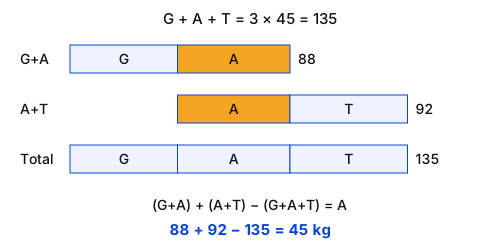
  1. G+A+T=3×45=135
  2. G+A=2×44=88 and A+T=2×46=92
  3. Adding: G+2A+T=88+92=180
  4. A=180−135=45 kg

Trick: Common member = (sum of the two pair-totals) − total of all three.

Answer: (D) 45

अवधारणा: योग = औसत × संख्या; दो जोड़ों के योग में साझा व्यक्ति दो बार गिना जाता है।

  1. G+A+T=3×45=135
  2. G+A=2×44=88 तथा A+T=2×46=92
  3. जोड़ने पर: G+2A+T=88+92=180
  4. A=180−135=45 किग्रा

ट्रिक: साझा सदस्य = दोनों जोड़ों के योग का जोड़ − तीनों का योग।

उत्तर: (D) 45

RRB NTPC Undergraduate CBT 1MathematicsAverageRRB NTPC Undergraduate CBT 1 2024 · 28 Aug Shift 2 →
Q442.
What smallest number should be added to 74978 so that the sum is completely divisible by 24?
74978 में कौन-सी सबसे छोटी संख्या जोड़ी जानी चाहिए ताकि योगफल 24 से पूर्णतः विभाज्य हो?
  1. A22
  2. B17
  3. C20
  4. D26
Show answer

Concept: Smallest number to be added = divisor − remainder.

  1. 24×3124=74976
  2. 74978−74976=2, so the remainder is 2.
  3. Number to add =24−2=22; check: 74978+22=75000=24×3125.

Trick: Divisible by 24 ⇔ divisible by 8 and 3: last three digits of 75000 give 000 (÷8) and digit sum 7+5=12 (÷3).

Answer: (A) 22

अवधारणा: जोड़ी जाने वाली न्यूनतम संख्या = भाजक − शेषफल।

  1. 24×3124=74976
  2. 74978−74976=2, अतः शेषफल 2 है।
  3. जोड़ें =24−2=22; जाँच: 74978+22=75000=24×3125।

ट्रिक: 24 से विभाज्य ⇔ 8 और 3 दोनों से विभाज्य: 75000 के अंतिम तीन अंक 000 (8 से) और अंकों का योग 7+5=12 (3 से)।

उत्तर: (A) 22

RRB NTPC Undergraduate CBT 1MathematicsDivisibilityRRB NTPC Undergraduate CBT 1 2024 · 28 Aug Shift 2 →
Q443.
The value of 82+92−425−14 is
82+92−425−14 का मान ज्ञात कीजिए।
  1. A39
  2. B45
  3. C49
  4. D48
Show answer

Concept: Apply BODMAS: powers and roots first, then multiplication, then addition/subtraction.

  1. 82=64
  2. 92=9
  3. 425=4×5=20
  4. 64+9−20−14=39

Trick: a2=a for positive a – no need to compute 92.

Answer: (A) 39

अवधारणा: BODMAS लगाएँ: पहले घात और मूल, फिर गुणा, फिर जोड़/घटाव।

  1. 82=64
  2. 92=9
  3. 425=4×5=20
  4. 64+9−20−14=39

ट्रिक: धनात्मक a के लिए a2=a – 92 निकालने की ज़रूरत नहीं।

उत्तर: (A) 39

RRB NTPC Undergraduate CBT 1MathematicsSimplificationRRB NTPC Undergraduate CBT 1 2024 · 28 Aug Shift 2 →
Q444.
A number, when increased by 80%, gives 2520. The number is:
एक संख्या में 80% की वृद्धि करने पर 2520 प्राप्त होता है। वह संख्या ज्ञात कीजिए।
  1. A4200
  2. B1400
  3. C2800
  4. D700
Show answer

Concept: Increasing by 80% means multiplying by 180100.

  1. x×180100=2520
  2. x=2520×100180=14×100=1400
  3. Check: 1400+80% of 1400=1400+1120=2520

Trick: 180%→2520 ⇒ 1%→14 ⇒ 100%→1400.

Answer: (B) 1400

अवधारणा: 80% बढ़ाने का अर्थ है 180100 से गुणा करना।

  1. x×180100=2520
  2. x=2520×100180=14×100=1400
  3. जाँच: 1400+1400 का 80%=1400+1120=2520

ट्रिक: 180%→2520 ⇒ 1%→14 ⇒ 100%→1400।

उत्तर: (B) 1400

RRB NTPC Undergraduate CBT 1MathematicsPercentageRRB NTPC Undergraduate CBT 1 2024 · 28 Aug Shift 2 →
Q445.
The LCM of 43 × 62 × 15, 42 × 152 × 19 and 63 × 152 × 192 is:
43 × 62 × 15, 42 × 152 × 19 और 63 × 152 × 192 का LCM (लघुत्तम समापवर्त्य) ज्ञात कीजिए।
  1. A28 x 34x 52 x 192
  2. B28 x 35x 53 x 192
  3. C28 x 35x 52 x 192
  4. D29 x 35x 52 x 192
Show answer

Concept: Write each number in prime factors; LCM = product of every prime with its highest power.

  1. 43×62×15=26·2232·3·5=28×33×5
  2. 42×152×19=24×32×52×19
  3. 63×152×192=23×35×52×192
  4. Highest powers: 28,35,52,192

Trick: Only compare the highest power of each prime – no full multiplication needed.

Answer: (C) 28×35×52×192

अवधारणा: प्रत्येक संख्या को अभाज्य गुणनखंडों में लिखें; LCM = हर अभाज्य की सबसे बड़ी घात का गुणनफल।

  1. 43×62×15=26·2232·3·5=28×33×5
  2. 42×152×19=24×32×52×19
  3. 63×152×192=23×35×52×192
  4. सबसे बड़ी घातें: 28,35,52,192

ट्रिक: हर अभाज्य की केवल सबसे बड़ी घात देखें – पूरा गुणा करने की ज़रूरत नहीं।

उत्तर: (C) 28×35×52×192

RRB NTPC Undergraduate CBT 1MathematicsLCMRRB NTPC Undergraduate CBT 1 2024 · 28 Aug Shift 2 →
Q446.
If one interior angle of a regular polygon is greater than its exterior angle by 144°, how many sides does the polygon have?
यदि किसी सम बहुभुज का एक अंतःकोण उसके बाह्यकोण से 144° अधिक है, तो उस बहुभुज की कितनी भुजाएँ हैं?
  1. A21
  2. B19
  3. C18
  4. D20
Show answer

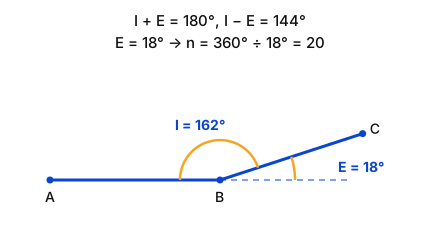
Concept: At each vertex of a polygon, interior angle + exterior angle =180∘; exterior angle of a regular n-gon =360∘n.

  1. I+E=180∘ and I−E=144∘
  2. Subtracting: 2E=36∘, so E=18∘ (and I=162∘)
  3. n=360∘18∘=20

Trick: E=180∘−difference2, then n=360∘E.

Answer: (D) 20

अवधारणा: बहुभुज के हर शीर्ष पर अंतःकोण + बाह्यकोण =180∘; सम n-भुज का बाह्यकोण =360∘n।

  1. I+E=180∘ और I−E=144∘
  2. घटाने पर: 2E=36∘, अतः E=18∘ (और I=162∘)
  3. n=360∘18∘=20

ट्रिक: E=180∘−अंतर2, फिर n=360∘E।

उत्तर: (D) 20

RRB NTPC Undergraduate CBT 1MathematicsGeometry – PolygonsRRB NTPC Undergraduate CBT 1 2024 · 28 Aug Shift 2 →
Q447.
Pipe P can fill 57 part of a tank in 30 hours, and pipe Q can fill 47 part of the same tank in 12 hours. Both P and Q were kept open for 7 hours, then both were closed. Pipe R alone was then opened and it emptied the water in the tank in 9 hours. Pipes P, Q and R together can fill the empty tank in:
पाइप P किसी टंकी के 57 भाग को 30 घंटे में भर सकता है, और पाइप Q उसी टंकी के 47 भाग को 12 घंटे में भर सकता है। P और Q दोनों को 7 घंटे तक खुला रखा गया, फिर दोनों को बंद कर दिया गया। इसके बाद केवल पाइप R को खोला गया और उसने टंकी का पानी 9 घंटे में खाली कर दिया। पाइप P, Q और R मिलकर खाली टंकी को कितने समय में भर सकते हैं?
  1. A56 hours56 घंटे
  2. B82 hours82 घंटे
  3. C78 hours78 घंटे
  4. D63 hours63 घंटे
Show answer

Concept: Find each pipe's full-tank time, then use rates (filling +, emptying −).

  1. P: 57 tank in 30 h ⇒ full in 30×75=42 h. Q: 47 in 12 h ⇒ full in 12×74=21 h.
  2. In 7 h, P and Q fill 7(142+121)=7×342=12 tank.
  3. R empties 12 tank in 9 h ⇒ full tank in 18 h.
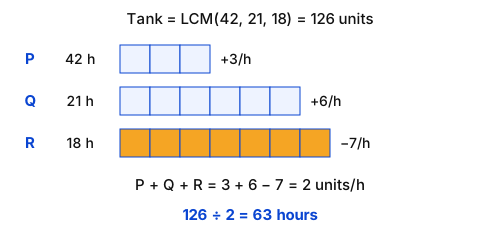
  4. Net rate =142+121−118=3+6−7126=2126=163 ⇒ 63 h.

Trick: Take tank =LCM(42,21,18)=126 units: P =3, Q =6, R =−7 per hour ⇒ 126÷2=63.

Answer: (D) 63 hours

अवधारणा: हर पाइप का पूरी टंकी का समय निकालें, फिर दर लें (भरना +, खाली करना −)।

  1. P: 30 घंटे में 57 ⇒ पूरी 30×75=42 घंटे में। Q: 12 घंटे में 47 ⇒ पूरी 12×74=21 घंटे में।
  2. 7 घंटे में P और Q भरते हैं 7(142+121)=12 टंकी।
  3. R 12 टंकी 9 घंटे में खाली करता है ⇒ पूरी 18 घंटे में।
  4. कुल दर =142+121−118=2126=163 ⇒ 63 घंटे।

ट्रिक: टंकी =LCM(42,21,18)=126 इकाई: P =3, Q =6, R =−7 प्रति घंटा ⇒ 126÷2=63।

उत्तर: (D) 63 घंटे

RRB NTPC Undergraduate CBT 1MathematicsPipes and CisternsRRB NTPC Undergraduate CBT 1 2024 · 28 Aug Shift 2 →
Q448.
Anshuman and Kunal together invested ₹48,300 in a business. At the end of the year, out of a total profit of ₹14,000, Kunal's share was ₹6,000. What was the difference between their investments?
अंशुमान और कुणाल ने मिलकर एक व्यवसाय में ₹48,300 का निवेश किया। वर्ष के अंत में, ₹14,000 के कुल लाभ में से कुणाल का हिस्सा ₹6,000 था। उनके निवेशों के बीच अंतर कितना था?
  1. A₹5,940
  2. B₹6,500
  3. C₹7,640
  4. D₹6,900
Show answer

Concept: For the same time period, profit is shared in the ratio of investments.

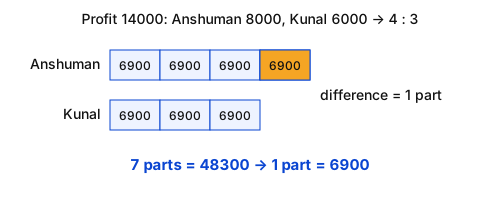
  1. Anshuman's profit =14000−6000=8000
  2. Profit ratio 8000:6000=4:3 = investment ratio
  3. 7 parts =48300 ⇒ 1 part =6900
  4. Investments: 27600 and 20700; difference =1 part =6900

Trick: Difference =4−34+3×48300=6900.

Answer: (D) ₹6900

अवधारणा: समान अवधि के लिए लाभ निवेश के अनुपात में बँटता है।

  1. अंशुमन का लाभ =14000−6000=8000
  2. लाभ अनुपात 8000:6000=4:3 = निवेश अनुपात
  3. 7 भाग =48300 ⇒ 1 भाग =6900
  4. निवेश: 27600 और 20700; अंतर =1 भाग =6900

ट्रिक: अंतर =4−34+3×48300=6900।

उत्तर: (D) ₹6900

RRB NTPC Undergraduate CBT 1MathematicsPartnershipRRB NTPC Undergraduate CBT 1 2024 · 28 Aug Shift 2 →
Q449.
Simplify: x(8x − 7) + 7(x2 − 5) + 14
सरल कीजिए: x(8x − 7) + 7(x2 − 5) + 14
  1. A−15x2 − 7x + 21
  2. B15x2 − 7x − 21
  3. C−15x2 − 7x − 21
  4. D15x2 − 7x + 21
Show answer

Concept: Expand the brackets, then combine like terms.

  1. x(8x−7)=8x2−7x
  2. 7(x2−5)=7x2−35
  3. Sum: 8x2−7x+7x2−35+14=15x2−7x−21

Trick: Check with x=1: 1+(−28)+14=−13 and 15−7−21=−13. ✓

Answer: (B) 15x2−7x−21

अवधारणा: कोष्ठक खोलें, फिर समान पदों को मिलाएँ।

  1. x(8x−7)=8x2−7x
  2. 7(x2−5)=7x2−35
  3. योग: 8x2−7x+7x2−35+14=15x2−7x−21

ट्रिक: x=1 रखकर जाँचें: 1+(−28)+14=−13 और 15−7−21=−13 ✓

उत्तर: (B) 15x2−7x−21

RRB NTPC Undergraduate CBT 1MathematicsAlgebra – SimplificationRRB NTPC Undergraduate CBT 1 2024 · 28 Aug Shift 2 →
Q450.
Yash travels 152 km at 38 km/hr, the next 189 km at 63 km/hr and the next 375 km at 75 km/hr. What is his average speed (in km/hr) for the whole journey? (Round off your answer to two decimal places)
यश 152 km की दूरी 38 km/hr की चाल से, अगले 189 km की दूरी 63 km/hr की चाल से और अगले 375 km की दूरी 75 km/hr की चाल से तय करता है। पूरी यात्रा के लिए उसकी औसत चाल (km/hr में) कितनी है? (अपना उत्तर दशमलव के दो स्थानों तक पूर्णांकित कीजिए)
  1. A59.67
  2. B51.83
  3. C58.22
  4. D70.03
Show answer

Concept: Average speed =total distancetotal time (not the average of the speeds).

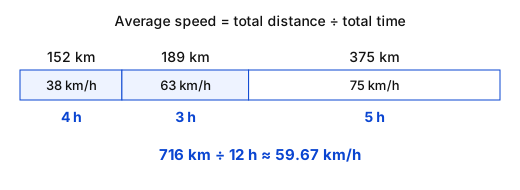
  1. Times: 15238=4 h, 18963=3 h, 37575=5 h
  2. Total time =12 h; total distance =152+189+375=716 km
  3. Average speed =71612=59.666…≈59.67km/h

Trick: Each distance divides exactly by its speed – find the times first.

Answer: (A) 59.67

अवधारणा: औसत चाल =कुल दूरीकुल समय (चालों का औसत नहीं)।

  1. समय: 15238=4 घंटे, 18963=3 घंटे, 37575=5 घंटे
  2. कुल समय =12 घंटे; कुल दूरी =152+189+375=716 किमी
  3. औसत चाल =71612≈59.67km/h

ट्रिक: हर दूरी अपनी चाल से पूरी विभाजित होती है – पहले समय निकालें।

उत्तर: (A) 59.67

RRB NTPC Undergraduate CBT 1MathematicsSpeed – Average speedRRB NTPC Undergraduate CBT 1 2024 · 28 Aug Shift 2 →
Q451.
The cost of 9 pens and 9 pencils is ₹252. If the cost of a pen decreases by ₹1 and the cost of a pencil increases by ₹3, then the cost of 13 pens and 3 pencils is ₹100. What is the original cost of 10 pens and 19 pencils?
9 पेन और 9 पेंसिल का मूल्य ₹252 है। यदि एक पेन का मूल्य ₹1 कम हो जाए और एक पेंसिल का मूल्य ₹3 बढ़ जाए, तो 13 पेन और 3 पेंसिल का मूल्य ₹100 होता है। 10 पेन और 19 पेंसिल का मूल मूल्य कितना है?
  1. A₹513
  2. B₹517
  3. C₹514
  4. D₹516
Show answer

Concept: Form two equations in pen price p and pencil price c, then solve.

  1. 9p+9c=252⇒p+c=28
  2. New prices: 13(p−1)+3(c+3)=100⇒13p+3c=104
  3. Subtract 3(p+c)=84: 10p=20⇒p=2, c=26
  4. 10p+19c=20+494=514

Trick: Multiply the simple equation by the coefficient of c and subtract – one variable disappears at once.

Answer: (C) ₹514

अवधारणा: पेन का मूल्य p और पेंसिल का c मानकर दो समीकरण बनाइए।

  1. 9p+9c=252⇒p+c=28
  2. नए मूल्य: 13(p−1)+3(c+3)=100⇒13p+3c=104
  3. 3(p+c)=84 घटाएँ: 10p=20⇒p=2, c=26
  4. 10p+19c=20+494=514

ट्रिक: सरल समीकरण को c के गुणांक से गुणा करके घटाइए – एक चर तुरंत हट जाता है।

उत्तर: (C) ₹514

RRB NTPC Undergraduate CBT 1MathematicsLinear EquationsRRB NTPC Undergraduate CBT 1 2024 · 28 Aug Shift 2 →
Q452.
Find the value of: [428 ÷ {17 + 8 × ( 5 − 7 )}].
मान ज्ञात कीजिए: [428 ÷ {17 + 8 × ( 5 − 7 )}]।
  1. A428
  2. B429
  3. C427
  4. D426
Show answer

Concept: BODMAS: innermost bracket first, then multiplication, then addition, then outer division.

  1. (5−7)=−2
  2. 8×(−2)=−16
  3. 17+(−16)=1
  4. 428÷1=428

Trick: When a bracket simplifies to 1, the answer is the dividend itself.

Answer: (A) 428

अवधारणा: BODMAS: पहले सबसे भीतरी कोष्ठक, फिर गुणा, फिर जोड़, फिर बाहरी भाग।

  1. (5−7)=−2
  2. 8×(−2)=−16
  3. 17+(−16)=1
  4. 428÷1=428

ट्रिक: कोष्ठक का मान 1 आए तो उत्तर भाज्य ही होता है।

उत्तर: (A) 428

RRB NTPC Undergraduate CBT 1MathematicsSimplification (BODMAS)RRB NTPC Undergraduate CBT 1 2024 · 28 Aug Shift 2 →
Q453.
The sum of two numbers is 121 and their L.C.M. is 264. What are the two numbers?
दो संख्याओं का योग 121 है और उनका L.C.M. 264 है। वे दो संख्याएँ कौन-सी हैं?
  1. A81, 40
  2. B86, 35
  3. C88, 33
  4. D93, 28
Show answer

Concept: Both numbers must divide the LCM 264; check the options for sum 121 and LCM 264.

  1. All options give sum 121, so test the LCM.
  2. 88=8×11, 33=3×11
  3. LCM=8×3×11=264 ✔
  4. Other pairs (e.g. 81, 40) do not divide 264.

Trick: Pick the pair whose both numbers are factors of the LCM: 264 ÷ 88 = 3 and 264 ÷ 33 = 8.

Answer: (C) 88, 33

अवधारणा: दोनों संख्याएँ LCM 264 को विभाजित करनी चाहिए; योग 121 और LCM 264 वाले विकल्प की जाँच करें।

  1. सभी विकल्पों का योग 121 है, अतः LCM जाँचें।
  2. 88=8×11, 33=3×11
  3. LCM=8×3×11=264 ✔
  4. बाकी जोड़े (जैसे 81, 40) 264 को विभाजित नहीं करते।

ट्रिक: वह जोड़ा चुनें जिसकी दोनों संख्याएँ LCM की गुणनखंड हों।

उत्तर: (C) 88, 33

RRB NTPC Undergraduate CBT 1MathematicsHCF and LCMRRB NTPC Undergraduate CBT 1 2024 · 28 Aug Shift 2 →
Q454.
If the interest earned during the 2nd year on a certain sum is ₹1,760, and the rate of interest is 10% per annum compounded annually, then the sum is:
यदि किसी निश्चित धनराशि पर 2रे वर्ष के दौरान अर्जित ब्याज ₹1,760 है, और ब्याज की दर 10% वार्षिक है जो वार्षिक रूप से संयोजित होती है, तो वह धनराशि कितनी है?
  1. A₹16,405
  2. B₹15,495
  3. C₹16,000
  4. D₹15,990
Show answer

Concept: Under annual compounding, interest of the 2nd year =P×R100×(1+R100).

  1. P×0.10×1.10=1760
  2. 0.11P=1760
  3. P=17600.11=16000

Trick: At 10%, 2nd-year interest = 11% of the sum, so sum = 1760×10011.

Answer: (C) ₹16,000

अवधारणा: वार्षिक चक्रवृद्धि में दूसरे वर्ष का ब्याज =P×R100×(1+R100)।

  1. P×0.10×1.10=1760
  2. 0.11P=1760
  3. P=17600.11=16000

ट्रिक: 10% पर दूसरे वर्ष का ब्याज = मूलधन का 11%, अतः मूलधन =1760×10011।

उत्तर: (C) ₹16,000

RRB NTPC Undergraduate CBT 1MathematicsCompound InterestRRB NTPC Undergraduate CBT 1 2024 · 28 Aug Shift 2 →
Q455.
A dealer wants to make a 20% profit on a smart watch that costs him ₹1,575. To attract customers, he plans to offer a 10% discount on the listed price. At what price should he list the smart watch to achieve his desired profit?
एक डीलर एक स्मार्ट वॉच पर 20% लाभ कमाना चाहता है, जिसकी लागत उसे ₹1,575 पड़ती है। ग्राहकों को आकर्षित करने के लिए, वह अंकित मूल्य पर 10% की छूट देने की योजना बनाता है। अपना वांछित लाभ प्राप्त करने के लिए उसे स्मार्ट वॉच का अंकित मूल्य कितना रखना चाहिए?
  1. A₹2,100
  2. B₹1,918
  3. C₹1,654
  4. D₹1,890
Show answer

Concept: SP=CP×100+P%100 and SP=MP×100−D%100.

  1. SP=1575×1.2=1890
  2. MP×0.9=1890
  3. MP=18900.9=2100

Trick: MP=CP×12090=1575×43=2100 in one line.

Answer: (A) ₹2,100

अवधारणा: SP=CP×100+P%100 तथा SP=MP×100−D%100।

  1. SP=1575×1.2=1890
  2. MP×0.9=1890
  3. MP=18900.9=2100

ट्रिक: एक पंक्ति में: MP=1575×12090=2100।

उत्तर: (A) ₹2,100

RRB NTPC Undergraduate CBT 1MathematicsProfit and DiscountRRB NTPC Undergraduate CBT 1 2024 · 28 Aug Shift 2 →
Q456.
Find the simple interest (in ₹) if a sum of ₹400 is borrowed for 4.5 years at 20% per annum rate of interest.
यदि ₹400 की धनराशि 20% वार्षिक ब्याज दर पर 4.5 वर्ष के लिए उधार ली जाती है, तो साधारण ब्याज (₹ में) ज्ञात कीजिए।
  1. A460
  2. B360
  3. C410
  4. D340
Show answer

Concept: SI=P×R×T100.

  1. P=400, R=20, T=4.5
  2. SI=400×20×4.5100
  3. =4×90=360

Trick: 20% per year for 4.5 years = 90% of the principal: 0.9×400=360.

Answer: (B) 360

अवधारणा: SI=P×R×T100।

  1. P=400, R=20, T=4.5
  2. SI=400×20×4.5100
  3. =4×90=360

ट्रिक: 4.5 वर्ष में 20% वार्षिक = मूलधन का 90%: 0.9×400=360।

उत्तर: (B) 360

RRB NTPC Undergraduate CBT 1MathematicsSimple InterestRRB NTPC Undergraduate CBT 1 2024 · 28 Aug Shift 2 →
Q457.
6 years ago, the age of a father was 34 years more than twice his son's age. After how many years, from now, will he be twice his son's age?
6 वर्ष पहले, एक पिता की आयु उसके पुत्र की आयु के दोगुने से 34 वर्ष अधिक थी। अब से कितने वर्ष बाद उसकी आयु उसके पुत्र की आयु की दोगुनी होगी?
  1. A23
  2. B28
  3. C26
  4. D24
Show answer

Concept: Let present ages be father F, son S; write both conditions.

  1. F−6=2(S−6)+34⇒F=2S+28
  2. After x years: F+x=2(S+x)⇒x=F−2S
  3. x=28

Trick: When the father becomes exactly twice the son, years needed =F−2S – here directly 28.

Answer: (B) 28

अवधारणा: वर्तमान आयु पिता F, पुत्र S मानकर दोनों शर्तें लिखें।

  1. F−6=2(S−6)+34⇒F=2S+28
  2. x वर्ष बाद: F+x=2(S+x)⇒x=F−2S
  3. x=28

ट्रिक: पिता पुत्र का दोगुना होने में लगे वर्ष =F−2S – यहाँ सीधे 28।

उत्तर: (B) 28

RRB NTPC Undergraduate CBT 1MathematicsProblems on AgesRRB NTPC Undergraduate CBT 1 2024 · 28 Aug Shift 2 →
Q458.
What is the value of the given expression?
sin4A−cos4A+11+1tan2A
दिए गए व्यंजक का मान क्या है?
sin4A−cos4A+11+1tan2A
  1. A2sin4A
  2. BsinA·cosAtan2A
  3. C2sin2A+tan2A
  4. D2sinA·cosA
Show answer

Concept: sin4A−cos4A=(sin2A−cos2A)(sin2A+cos2A) and 1+cot2A=csc2A.

  1. Numerator: sin2A−cos2A+1=sin2A+sin2A=2sin2A
  2. Denominator: 1+1tan2A=1+cot2A=csc2A=1sin2A
  3. Value =2sin2A×sin2A=2sin4A

Trick: Put A=90∘: expression =1−0+11+0=2; only 2sin4A gives 2.

Answer: (A) 2sin4A

अवधारणा: sin4A−cos4A=(sin2A−cos2A)(sin2A+cos2A) तथा 1+cot2A=csc2A।

  1. अंश: sin2A−cos2A+1=sin2A+sin2A=2sin2A
  2. हर: 1+1tan2A=1+cot2A=csc2A=1sin2A
  3. मान =2sin2A×sin2A=2sin4A

ट्रिक: A=90∘ रखें: मान =1−0+11+0=2; केवल 2sin4A से 2 आता है।

उत्तर: (A) 2sin4A

RRB NTPC Undergraduate CBT 1MathematicsTrigonometric IdentitiesRRB NTPC Undergraduate CBT 1 2024 · 28 Aug Shift 2 →
Q459.
Pipe A can fill a tank in 16 hours, pipe B can fill the same tank in 21 hours and pipe C can fill the same tank in 15 hours. The time taken by them to fill the same tank if they operate together is::
पाइप A किसी टंकी को 16 घंटे में भर सकता है, पाइप B उसी टंकी को 21 घंटे में भर सकता है और पाइप C उसी टंकी को 15 घंटे में भर सकता है। यदि वे एक साथ कार्य करें, तो उसी टंकी को भरने में उनके द्वारा लिया गया समय कितना है?
  1. A76599 hours76599 घंटे
  2. B56599 hours56599 घंटे
  3. C86599 hours86599 घंटे
  4. D66599 hours66599 घंटे
Show answer

Concept: Together, work per hour = sum of individual rates; take LCM of 16, 21, 15 as tank capacity.

  1. Capacity =LCM(16,21,15)=1680 units
  2. Rates: A=105, B=80, C=112 units/h; total =297
  3. Time =1680297=56099=56599 hours

Trick: Three pipes of about 15–21 h together take roughly a third of 17 h ≈5.6 h; only 56599 fits.

Answer: (B) 56599 hours

अवधारणा: साथ में प्रति घंटे कार्य = सभी दरों का योग; 16, 21, 15 का LCM टंकी की क्षमता लें।

  1. क्षमता =LCM(16,21,15)=1680 इकाई
  2. दरें: A=105, B=80, C=112 इकाई/घंटा; कुल =297
  3. समय =1680297=56099=56599 घंटे

ट्रिक: लगभग 15–21 घंटे वाले तीन पाइप साथ में लगभग 17 घंटे का तिहाई ≈5.6 घंटे लेंगे; केवल 56599 सही बैठता है।

उत्तर: (B) 56599 घंटे

RRB NTPC Undergraduate CBT 1MathematicsPipes and CisternsRRB NTPC Undergraduate CBT 1 2024 · 28 Aug Shift 2 →
Q460.
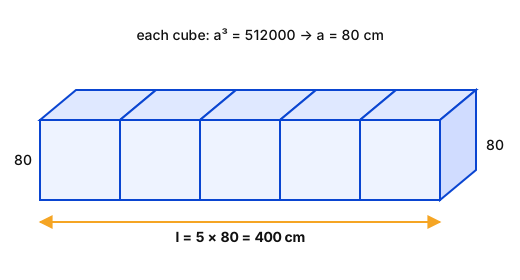
Five solid cubes, each of volume 512000 cm3, are joined end to end to form a cuboid. What is the lateral surface area (in cm2) of the cuboid?
पाँच ठोस घन, जिनमें से प्रत्येक का आयतन 512000 cm3 है, को सिरे से सिरा मिलाकर एक घनाभ बनाया जाता है। घनाभ का पार्श्व पृष्ठीय क्षेत्रफल (cm2 में) कितना है?
  1. A76949
  2. B76903
  3. C76800
  4. D76820
Show answer

Concept: Lateral surface area of a cuboid =2h(l+b).

  1. Side of each cube =5120003=80cm
  2. Cuboid: l=5×80=400, b=h=80
  3. LSA=2×80×(400+80)=160×480=76800cm2

Trick: LSA of n cubes in a row =4×n×a2=4×5×6400=76800.

Answer: (C) 76800

अवधारणा: घनाभ का पार्श्व पृष्ठीय क्षेत्रफल =2h(l+b)।

  1. प्रत्येक घन की भुजा =5120003=80cm
  2. घनाभ: l=5×80=400, b=h=80
  3. LSA=2×80×(400+80)=160×480=76800cm2

ट्रिक: एक पंक्ति में n घनों का LSA =4×n×a2=4×5×6400=76800।

उत्तर: (C) 76800

RRB NTPC Undergraduate CBT 1MathematicsMensuration – Cube and CuboidRRB NTPC Undergraduate CBT 1 2024 · 28 Aug Shift 2 →