Question bank

Q&A: practice questions with answers

Search questions on any topic. Filter by exam category, exam, subject and topic, try the question, then open the answer and explanation.

Courses – airGurukul

8,495 questions found.

Q4661.
If cosecθ+sinθ=2, then find the value of cosec6θ+sin6θ.
यदि cosecθ+sinθ=2 है, तो cosec6θ+sin6θ का मान ज्ञात कीजिए।
  1. A2
  2. B3
  3. C12
  4. D1
Show answer

Concept: If x+1x=2 (with x>0), then x=1.

  1. cosecθ=1sinθ, so sinθ+1sinθ=2⇒sinθ=1.
  2. Then cosecθ=1.
  3. cosec6θ+sin6θ=1+1=2.

Trick: x+1x=2⇒xn+1xn=2 for every n.

Answer: (A) 2

अवधारणा: यदि x+1x=2 (x>0) तो x=1।

  1. cosecθ=1sinθ, अतः sinθ+1sinθ=2⇒sinθ=1।
  2. तब cosecθ=1।
  3. cosec6θ+sin6θ=1+1=2।

ट्रिक: x+1x=2 हो तो हर घात n के लिए xn+1xn=2।

उत्तर: (A) 2

RRB NTPC Undergraduate CBT 1MathematicsTrigonometryRRB NTPC Undergraduate CBT 1 2024 · 4 Sep Shift 1 →
Q4662.
The value of 23−32+(22)2−2+4×7= ______.
23−32+(22)2−2+4×7= का मान ______ है।
  1. A28
  2. B35
  3. C31
  4. D26
Show answer

Concept: Follow BODMAS: powers and brackets first, then multiplication, then addition/subtraction.

  1. 23=8, 32=9, (22)2=1, 4×7=28.
  2. 8−9+1−2+28=26.

Trick: Any number divided by itself is 1, and 12=1.

Answer: (D) 26

अवधारणा: BODMAS लगाएँ: पहले घात और कोष्ठक, फिर गुणा, फिर जोड़/घटाव।

  1. 23=8, 32=9, (22)2=1, 4×7=28।
  2. 8−9+1−2+28=26।

ट्रिक: कोई संख्या स्वयं से भाग देने पर 1, और 12=1।

उत्तर: (D) 26

RRB NTPC Undergraduate CBT 1MathematicsSimplificationRRB NTPC Undergraduate CBT 1 2024 · 4 Sep Shift 1 →
Q4663.
An article listed at ₹500 is sold at successive discounts of 10% and 14%. The buyer wants to sell it at a profit of 15% after offering a 10% discount. What should be his list price (in ₹)?
₹500 अंकित मूल्य वाली एक वस्तु 10% और 14% की क्रमिक छूट पर बेची जाती है। क्रेता इसे 10% की छूट देने के बाद 15% के लाभ पर बेचना चाहता है। उसका अंकित मूल्य (₹ में) क्या होना चाहिए?
  1. A484.50
  2. B485
  3. C494.50
  4. D474
Show answer

Concept: Buyer's cost = list price after successive discounts; required SP = cost × 1.15 = 90% of new list price.

  1. Cost =500×0.90×0.86=387.
  2. Required SP =387×1.15=445.05.
  3. New list price =445.050.90=494.50.

Trick: List price =CP×100+P%100−D%=387×11590.

Answer: (C) 494.50

अवधारणा: खरीदार का क्रय मूल्य = क्रमिक छूट के बाद मूल्य; आवश्यक विक्रय मूल्य = क्रय मूल्य × 1.15 = नए अंकित मूल्य का 90%।

  1. क्रय मूल्य =500×0.90×0.86=387।
  2. आवश्यक विक्रय मूल्य =387×1.15=445.05।
  3. नया अंकित मूल्य =445.050.90=494.50।

ट्रिक: अंकित मूल्य =CP×100+लाभ%100−छूट%=387×11590।

उत्तर: (C) 494.50

RRB NTPC Undergraduate CBT 1MathematicsSuccessive Discount, ProfitRRB NTPC Undergraduate CBT 1 2024 · 4 Sep Shift 1 →
Q4664.
A trader claims to sell pulses at a profit of 48%, but also dishonestly uses a weight which is 12% less than what is mentioned on it. Find the total percentage of profit earned by the trader. (Round off the answer to the nearest whole number.)
एक व्यापारी 48% के लाभ पर दालें बेचने का दावा करता है, परंतु साथ ही बेईमानी से ऐसे बाट का उपयोग करता है जो उस पर अंकित भार से 12% कम है। व्यापारी द्वारा अर्जित कुल लाभ प्रतिशत ज्ञात कीजिए। (उत्तर को निकटतम पूर्ण संख्या तक पूर्णांकित कीजिए।)
  1. A63%
  2. B71%
  3. C68%
  4. D72%
Show answer

Concept: Profit from a false weight: compare the price received with the cost of the quantity actually given.

  1. For 1 kg marked, he gives 0.88 kg (cost 88) and charges 1.48×100=148.
  2. Profit% =148−8888×100=600088≈68.18%.
  3. Rounded: 68%.

Trick: Total gain =(100+claimed)(100−short)−1=14888−1.

Answer: (C) 68%

अवधारणा: कम तौल से लाभ: मिली हुई कीमत की तुलना वास्तव में दी गई मात्रा की लागत से करें।

  1. 1 kg के बदले वह 0.88 kg देता है (लागत 88) और 1.48×100=148 लेता है।
  2. लाभ% =148−8888×100=600088≈68.18%।
  3. निकटतम पूर्णांक: 68%।

ट्रिक: कुल लाभ =100+दावा लाभ100−कम तौल−1=14888−1।

उत्तर: (C) 68%

RRB NTPC Undergraduate CBT 1MathematicsDishonest DealerRRB NTPC Undergraduate CBT 1 2024 · 4 Sep Shift 1 →
Q4665.
The sum of five numbers is 655. The average of the first two numbers is 80 and the third number is 108. Find the average of the remaining two numbers.
पाँच संख्याओं का योग 655 है। पहली दो संख्याओं का औसत 80 है और तीसरी संख्या 108 है। शेष दो संख्याओं का औसत ज्ञात कीजिए।
  1. A189
  2. B193.5
  3. C194.5
  4. D188
Show answer

Concept: Sum = average × count; subtract the known parts.

  1. First two numbers sum =2×80=160.
  2. Remaining two =655−160−108=387.
  3. Average =3872=193.5.

Trick: Total − known parts, then divide by how many are left.

Answer: (B) 193.5

अवधारणा: योग = औसत × संख्या; ज्ञात भाग घटाएँ।

  1. पहली दो संख्याओं का योग =2×80=160।
  2. शेष दो का योग =655−160−108=387।
  3. औसत =3872=193.5।

ट्रिक: कुल − ज्ञात भाग, फिर बची संख्याओं से भाग दें।

उत्तर: (B) 193.5

RRB NTPC Undergraduate CBT 1MathematicsAverageRRB NTPC Undergraduate CBT 1 2024 · 4 Sep Shift 1 →
Q4666.
​If 1 is added to each even digit and 2 is subtracted from each odd digit in the number 4562734, what will be difference between the highest and lowest digits in the number thus formed?
यदि संख्या 4562734 में प्रत्येक सम अंक में 1 जोड़ दिया जाए और प्रत्येक विषम अंक में से 2 घटा दिया जाए, तो इस प्रकार बनी संख्या में सबसे बड़े और सबसे छोटे अंक के बीच कितना अंतर होगा?
  1. A5
  2. B4
  3. C6
  4. D7
Show answer

Concept: Change every digit by the rule: even → +1, odd → −2.

  1. 4 5 6 2 7 3 4 → 5 3 7 3 5 1 5.
  2. New number: 5373515.
  3. Highest digit 7, lowest 1; difference =7−1=6.

Trick: Write the new digits directly under the old ones to avoid mistakes.

Answer: (C) 6

अवधारणा: नियम से हर अंक बदलें: सम → +1, विषम → −2।

  1. 4 5 6 2 7 3 4 → 5 3 7 3 5 1 5।
  2. नई संख्या: 5373515।
  3. सबसे बड़ा अंक 7, सबसे छोटा 1; अंतर =7−1=6।

ट्रिक: नए अंक पुराने अंकों के ठीक नीचे लिखें, गलती नहीं होगी।

उत्तर: (C) 6

RRB NTPC Undergraduate CBT 1General Intelligence and ReasoningNumber OperationsRRB NTPC Undergraduate CBT 1 2024 · 4 Sep Shift 1 →
Q4667.
In the following triads, each group of letters is related to the subsequent one following a certain logic. Select from the given options, the one which follows the same logic. CURD - RCUD - DRUC
KIDS - DKIS - SDIK
निम्नलिखित त्रिकों में, अक्षरों का प्रत्येक समूह एक निश्चित तर्क के आधार पर अपने बाद वाले समूह से संबंधित है। दिए गए विकल्पों में से उसका चयन कीजिए जो समान तर्क का अनुसरण करता है। CURD - RCUD - DRUC
KIDS - DKIS - SDIK
  1. ASLAY - ASLY - LAYS
  2. BPEAT - EPAT - TEAP
  3. CTEAM - TAEM - MAET
  4. DWASH - SWAH - HSAW
Show answer

Concept: Track letter positions: step 1 = 3,1,2,4; step 2 = 4,1,3,2 of the previous word.

  1. CURD → RCUD (3,1,2,4) → DRUC (4,1,3,2).
  2. KIDS → DKIS → SDIK follows the same.
  3. WASH → SWAH (S,W,A,H) → HSAW (H,S,A,W) ✓.
  4. Others fail, e.g. PEAT → EPAT is not (3,1,2,4).

Trick: Test only the first step on all options; usually one survives.

Answer: (D) WASH - SWAH - HSAW

अवधारणा: अक्षरों के स्थान देखें: पहला चरण = 3,1,2,4; दूसरा चरण = पिछले शब्द का 4,1,3,2।

  1. CURD → RCUD (3,1,2,4) → DRUC (4,1,3,2)।
  2. KIDS → DKIS → SDIK भी यही नियम।
  3. WASH → SWAH → HSAW ✓।
  4. अन्य विकल्प नियम तोड़ते हैं, जैसे PEAT → EPAT (3,1,2,4) नहीं है।

ट्रिक: पहले केवल पहला चरण सब विकल्पों पर जाँचें; प्रायः एक ही बचता है।

उत्तर: (D) WASH - SWAH - HSAW

RRB NTPC Undergraduate CBT 1General Intelligence and ReasoningLetter Rearrangement (Triads)RRB NTPC Undergraduate CBT 1 2024 · 4 Sep Shift 1 →
Q4668.
Seven people, I, J, K, L, M, N and O, are sitting in a row, facing north. Only two people sit to the left of K. Only three people sit between K and L. Only one person sits between L and J. N sits to the immediate left of I. M is not an immediate neighbour of L. How many people sit to the right of O?
सात व्यक्ति, I, J, K, L, M, N और O, उत्तर की ओर मुख करके एक पंक्ति में बैठे हैं। K के बाईं ओर केवल दो व्यक्ति बैठे हैं। K और L के बीच केवल तीन व्यक्ति बैठे हैं। L और J के बीच केवल एक व्यक्ति बैठा है। N, I के ठीक बाईं ओर बैठा है। M, L का निकटतम पड़ोसी नहीं है। O के दाईं ओर कितने व्यक्ति बैठे हैं?
  1. AFourचार
  2. BTwoदो
  3. CThreeतीन
  4. DOneएक
Show answer

Concept: Fix definite positions first (all face north, so left = left of the row).
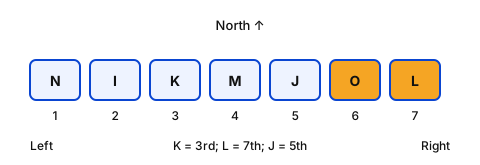
  1. Two to the left of K → K is 3rd. Three between K and L → L is 7th.
  2. One between L and J → J is 5th.
  3. N–I adjacent pair fits only at 1–2; M not next to L → M 4th, O 6th.
  4. Order: N I K M J O L → only L is to the right of O.

Trick: Rules with exact gaps fix seats first; neighbour conditions fill the rest.

Answer: (D) One

अवधारणा: पहले निश्चित स्थान तय करें (सभी उत्तर की ओर मुख, अतः बायाँ = पंक्ति का बायाँ)।

  1. K के बाएँ दो → K तीसरे स्थान पर। K और L के बीच तीन → L 7वें।
  2. L और J के बीच एक → J 5वें।
  3. N–I जोड़ी केवल 1–2 पर; M, L का पड़ोसी नहीं → M 4थे, O 6ठे।
  4. क्रम: N I K M J O L → O के दाएँ केवल L।

ट्रिक: निश्चित दूरी वाले कथनों से पहले सीट तय करें, पड़ोसी वाले कथन बाद में।

उत्तर: (D) एक

RRB NTPC Undergraduate CBT 1General Intelligence and ReasoningLinear Seating ArrangementRRB NTPC Undergraduate CBT 1 2024 · 4 Sep Shift 1 →
Q4669.
HLOY is related to KNRA in a certain way based on the English alphabetical order. In the same way, TTAG is related to WVDI. To which of the given options is CZJM related, following the same logic?
अंग्रेज़ी वर्णमाला क्रम के आधार पर HLOY एक निश्चित प्रकार से KNRA से संबंधित है। उसी प्रकार, TTAG, WVDI से संबंधित है। समान तर्क का अनुसरण करते हुए, CZJM दिए गए विकल्पों में से किससे संबंधित है?
  1. AFBOM
  2. BFOMB
  3. CFBMO
  4. DFMOB
Show answer

Concept: Find the letter shifts: +3, +2, +3, +2.

  1. H→K (+3), L→N (+2), O→R (+3), Y→A (+2).
  2. Check: T→W, T→V, A→D, G→I ✓.
  3. C+3 = F, Z+2 = B, J+3 = M, M+2 = O → FBMO.

Trick: After Z wrap around: Z+2 = B.

Answer: (C) FBMO

अवधारणा: अक्षरों का अंतर: +3, +2, +3, +2।

  1. H→K (+3), L→N (+2), O→R (+3), Y→A (+2)।
  2. जाँच: T→W, T→V, A→D, G→I ✓।
  3. C+3 = F, Z+2 = B, J+3 = M, M+2 = O → FBMO।

ट्रिक: Z के बाद फिर A से गिनें: Z+2 = B।

उत्तर: (C) FBMO

RRB NTPC Undergraduate CBT 1General Intelligence and ReasoningLetter AnalogyRRB NTPC Undergraduate CBT 1 2024 · 4 Sep Shift 1 →
Q4670.
Riya starts from Point P and drives 8 km towards the south. Then she takes a right turn, drives 11 km, she turns right again and drives 14 km. She then takes a right turn and drives 15 km. Then she takes left turn and drives 2 km, she takes a left turn again and drives 4 km and stops at Point Q. How far (shortest distance) and towards which direction should she drive in order to reach Point P again? (All turns are 90-degree turns only unless specified.)
रिया बिंदु P से चलना शुरू करती है और दक्षिण की ओर 8 km गाड़ी चलाती है। फिर वह दाएँ मुड़ती है, 11 km गाड़ी चलाती है, वह फिर से दाएँ मुड़ती है और 14 km गाड़ी चलाती है। फिर वह दाएँ मुड़ती है और 15 km गाड़ी चलाती है। फिर वह बाएँ मुड़ती है और 2 km गाड़ी चलाती है, वह फिर से बाएँ मुड़ती है और 4 km गाड़ी चलाकर बिंदु Q पर रुक जाती है। बिंदु P पर पुनः पहुँचने के लिए उसे कितनी दूरी (न्यूनतम दूरी) और किस दिशा में गाड़ी चलानी चाहिए? (जब तक निर्दिष्ट न हो, सभी मोड़ केवल 90 डिग्री के मोड़ हैं।)
  1. A4 km towards the southदक्षिण की ओर 4 km
  2. B4 km towards the northउत्तर की ओर 4 km
  3. C8 km towards the southदक्षिण की ओर 8 km
  4. D6 km towards the northउत्तर की ओर 6 km
Show answer

Concept: Plot each leg on axes (east = +x, north = +y), taking P as origin.
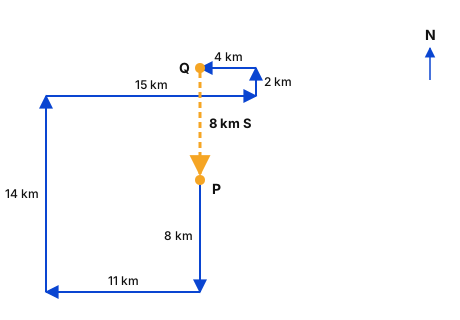
  1. 8 S → (0, −8); right = west 11 → (−11, −8).
  2. Right = north 14 → (−11, 6); right = east 15 → (4, 6).
  3. Left = north 2 → (4, 8); left = west 4 → Q = (0, 8).
  4. Q is 8 km north of P, so she must drive 8 km south.

Trick: Net E–W: −11 + 15 − 4 = 0; net N–S: −8 + 14 + 2 = 8 north.

Answer: (C) 8 km towards the south

अवधारणा: P को मूल बिंदु मानकर हर चरण अक्ष पर लिखें (पूर्व = +x, उत्तर = +y)।

  1. 8 दक्षिण → (0, −8); दाएँ = पश्चिम 11 → (−11, −8)।
  2. दाएँ = उत्तर 14 → (−11, 6); दाएँ = पूर्व 15 → (4, 6)।
  3. बाएँ = उत्तर 2 → (4, 8); बाएँ = पश्चिम 4 → Q = (0, 8)।
  4. Q, P से 8 km उत्तर में है, अतः 8 km दक्षिण जाना होगा।

ट्रिक: पूर्व–पश्चिम कुल: −11 + 15 − 4 = 0; उत्तर–दक्षिण: −8 + 14 + 2 = 8 उत्तर।

उत्तर: (C) 8 km दक्षिण की ओर

RRB NTPC Undergraduate CBT 1General Intelligence and ReasoningDirection and DistanceRRB NTPC Undergraduate CBT 1 2024 · 4 Sep Shift 1 →
Q4671.
In a certain code language, ‘DONT’ is coded as ‘1097’ and ‘NATO’ is coded as ‘0187’. What is the code for ‘A’ in the given code language?
एक निश्चित कूट भाषा में, ‘DONT’ को ‘1097’ लिखा जाता है और ‘NATO’ को ‘0187’ लिखा जाता है। दी गई कूट भाषा में ‘A’ का कूट क्या है?
  1. A7
  2. B0
  3. C8
  4. D1
Show answer

Concept: Letters common to both words share the common digits.

  1. DONT = 1097, NATO = 0187.
  2. Common letters N, O, T ↔ common digits 0, 1, 7.
  3. Remaining: D ↔ 9 and A ↔ 8.

Trick: Cancel the common letters and digits; the leftover pair gives the code.

Answer: (C) 8

अवधारणा: दोनों शब्दों के समान अक्षरों के कोड भी समान अंक होते हैं।

  1. DONT = 1097, NATO = 0187।
  2. समान अक्षर N, O, T ↔ समान अंक 0, 1, 7।
  3. बचे हुए: D ↔ 9 और A ↔ 8।

ट्रिक: समान अक्षर और अंक काट दें; बचा हुआ जोड़ा ही कोड है।

उत्तर: (C) 8

RRB NTPC Undergraduate CBT 1General Intelligence and ReasoningCoding-DecodingRRB NTPC Undergraduate CBT 1 2024 · 4 Sep Shift 1 →
Q4672.
This question is based on five, four-digit numbers given below.
(Left) 4138 2345 6367 5353 1276 (Right)
(Example: 6975 – First digit = 6, second digit = 9, third digit = 7 and fourth digit = 5) (NOTE: All operations to be done from left to right.)
What will be the resultant if the second digit of the second largest number is multiplied to the second digit of the largest number?
यह प्रश्न नीचे दी गई पाँच, चार-अंकीय संख्याओं पर आधारित है।
(बाएँ) 4138 2345 6367 5353 1276 (दाएँ)
(उदाहरण: 6975 – पहला अंक = 6, दूसरा अंक = 9, तीसरा अंक = 7 और चौथा अंक = 5) (नोट: सभी संक्रियाएँ बाएँ से दाएँ की जानी हैं।)
यदि दूसरी सबसे बड़ी संख्या के दूसरे अंक को सबसे बड़ी संख्या के दूसरे अंक से गुणा किया जाए, तो परिणाम क्या होगा?
  1. A5
  2. B6
  3. C7
  4. D9
Show answer

Concept: Arrange the numbers by size, then pick the required digits.

  1. Largest = 6367, second largest = 5353.
  2. Second digit of 6367 = 3; of 5353 = 3.
  3. 3×3=9.

Trick: Just compare first digits: 6 > 5 > 4 > 2 > 1.

Answer: (D) 9

अवधारणा: संख्याओं को आकार के क्रम में रखें, फिर आवश्यक अंक चुनें।

  1. सबसे बड़ी = 6367, दूसरी सबसे बड़ी = 5353।
  2. 6367 का दूसरा अंक = 3; 5353 का = 3।
  3. 3×3=9।

ट्रिक: केवल पहले अंक देखें: 6 > 5 > 4 > 2 > 1।

उत्तर: (D) 9

RRB NTPC Undergraduate CBT 1General Intelligence and ReasoningNumber Series OperationsRRB NTPC Undergraduate CBT 1 2024 · 4 Sep Shift 1 →
Q4673.
Based on the English alphabetical order, three of the following four letter-cluster pairs are alike in a certain way and thus form a group. Which letter-cluster pair DOES NOT belong to that group?
(Note: The odd one out is not based on the number of consonants/vowels or their position in the letter-cluster.)
अंग्रेज़ी वर्णमाला क्रम के आधार पर, निम्नलिखित चार अक्षर-समूह युग्मों में से तीन किसी निश्चित प्रकार से एकसमान हैं और इस प्रकार एक समूह बनाते हैं। कौन-सा अक्षर-समूह युग्म उस समूह से संबंधित नहीं है?
(नोट: असंगत, व्यंजनों/स्वरों की संख्या या अक्षर-समूह में उनके स्थान पर आधारित नहीं है।)
  1. AKO-RN
  2. BNR-UP
  3. CAE-HC
  4. DQU-XS
Show answer

Concept: In each pair XY-ZW: Y = X+4, Z = X+7, W = Y−2.

  1. NR-UP: N+4 = R, N+7 = U, R−2 = P ✓.
  2. AE-HC: A+4 = E, A+7 = H, E−2 = C ✓; QU-XS ✓.
  3. KO-RN: K+4 = O, K+7 = R but O−1 = N ✗ → odd one.

Trick: When two shifts match for all, the third shift decides the odd one.

Answer: (A) KO-RN

अवधारणा: हर युग्म XY-ZW में: Y = X+4, Z = X+7, W = Y−2।

  1. NR-UP: N+4 = R, N+7 = U, R−2 = P ✓।
  2. AE-HC: A+4 = E, A+7 = H, E−2 = C ✓; QU-XS ✓।
  3. KO-RN: K+4 = O, K+7 = R पर O−1 = N ✗ → विषम।

ट्रिक: जब दो अंतर सब में समान हों तो तीसरा अंतर विषम पद बताता है।

उत्तर: (A) KO-RN

RRB NTPC Undergraduate CBT 1General Intelligence and ReasoningLetter Pair Odd One OutRRB NTPC Undergraduate CBT 1 2024 · 4 Sep Shift 1 →
Q4674.
Town T is to the west of Town S. Town U is to the south of Town T. Town V is to the west of Town U. Town W is to the south of Town V. Town X is to the west of Town W. What is the position of Town X with respect to Town S?
नगर T, नगर S के पश्चिम में है। नगर U, नगर T के दक्षिण में है। नगर V, नगर U के पश्चिम में है। नगर W, नगर V के दक्षिण में है। नगर X, नगर W के पश्चिम में है। नगर S के सापेक्ष नगर X की स्थिति क्या है?
  1. ASouthwestदक्षिण-पश्चिम
  2. BSoutheastदक्षिण-पूर्व
  3. CNorthwestउत्तर-पश्चिम
  4. DNortheastउत्तर-पूर्व
Show answer

Concept: Place towns step by step on a grid.
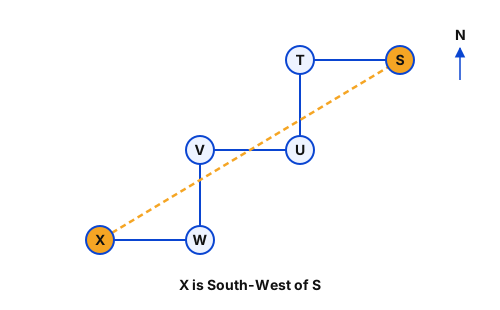
  1. T west of S; U south of T.
  2. V west of U; W south of V; X west of W.
  3. X is both west and south of S → South-West.

Trick: Count moves: 3 times west, 2 times south → SW.

Answer: (A) Southwest

अवधारणा: ग्रिड पर कस्बों को क्रम से रखें।

  1. T, S के पश्चिम; U, T के दक्षिण।
  2. V, U के पश्चिम; W, V के दक्षिण; X, W के पश्चिम।
  3. X, S से पश्चिम भी और दक्षिण भी → दक्षिण-पश्चिम।

ट्रिक: चालें गिनें: 3 बार पश्चिम, 2 बार दक्षिण → दक्षिण-पश्चिम।

उत्तर: (A) दक्षिण-पश्चिम

RRB NTPC Undergraduate CBT 1General Intelligence and ReasoningDirection SenseRRB NTPC Undergraduate CBT 1 2024 · 4 Sep Shift 1 →
Q4675.
What should come in place of the question mark (?) in the given series based on the English alphabetical order?
USR ROT OKV LGX ?
अंग्रेज़ी वर्णमाला क्रम के आधार पर दी गई श्रृंखला में प्रश्न चिह्न (?) के स्थान पर क्या आना चाहिए?
USR ROT OKV LGX ?
  1. AIDS
  2. BICZ
  3. CJWZ
  4. DLKX
Show answer

Concept: Treat the 1st, 2nd and 3rd letters as three separate series.

  1. 1st: U, R, O, L → −3 → I.
  2. 2nd: S, O, K, G → −4 → C.
  3. 3rd: R, T, V, X → +2 → Z.
  4. Answer: ICZ.

Trick: Use position numbers: U21, R18, O15, L12 → 9 = I.

Answer: (B) ICZ

अवधारणा: पहले, दूसरे और तीसरे अक्षर की तीन अलग श्रृंखलाएँ बनाएँ।

  1. पहला: U, R, O, L → −3 → I।
  2. दूसरा: S, O, K, G → −4 → C।
  3. तीसरा: R, T, V, X → +2 → Z।
  4. उत्तर: ICZ।

ट्रिक: स्थान संख्या याद रखें: U21, R18, O15, L12 → 9 = I।

उत्तर: (B) ICZ

RRB NTPC Undergraduate CBT 1General Intelligence and ReasoningLetter SeriesRRB NTPC Undergraduate CBT 1 2024 · 4 Sep Shift 1 →
Q4676.
What should come in place of the question mark (?) in the given series?
561 560 562 561 563 562 564 ?
दी गई श्रृंखला में प्रश्न चिह्न (?) के स्थान पर क्या आना चाहिए?
561 560 562 561 563 562 564 ?
  1. A562
  2. B564
  3. C563
  4. D565
Show answer

Concept: Alternating pattern −1, +2.

  1. 561 −1 = 560, +2 = 562, −1 = 561, +2 = 563, −1 = 562, +2 = 564.
  2. Next: 564 − 1 = 563.

Trick: Alternate terms 561, 562, 563, 564 … and 560, 561, 562, 563.

Answer: (C) 563

अवधारणा: एकांतर पैटर्न −1, +2।

  1. 561 −1 = 560, +2 = 562, −1 = 561, +2 = 563, −1 = 562, +2 = 564।
  2. अगला: 564 − 1 = 563।

ट्रिक: एकांतर पद 560, 561, 562, 563 … बढ़ते हैं।

उत्तर: (C) 563

RRB NTPC Undergraduate CBT 1General Intelligence and ReasoningNumber SeriesRRB NTPC Undergraduate CBT 1 2024 · 4 Sep Shift 1 →
Q4677.
Seven boxes F, G, H, M, N, O and P are kept one over the other but not necessarily in the same order. O is kept immediately above F. G is kept immediately above M. Only P is kept above N. Only two boxes are kept above O. G is not kept at third position from the bottom. How many boxes are kept between H and P?
सात बक्से F, G, H, M, N, O और P एक के ऊपर एक रखे गए हैं, परंतु आवश्यक नहीं कि इसी क्रम में हों। O को F के ठीक ऊपर रखा गया है। G को M के ठीक ऊपर रखा गया है। N के ऊपर केवल P रखा गया है। O के ऊपर केवल दो बक्से रखे गए हैं। G को नीचे से तीसरे स्थान पर नहीं रखा गया है। H और P के बीच कितने बक्से रखे गए हैं?
  1. AFourचार
  2. BThreeतीन
  3. CTwoदो
  4. DOneएक
Show answer

Concept: Number positions from the top and fix definite clues first.
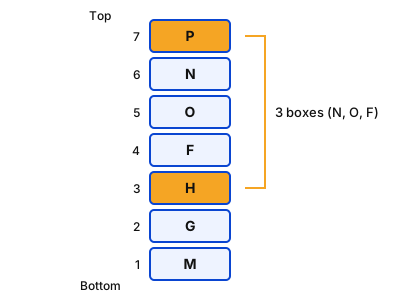
  1. Only P above N → P 1st, N 2nd. Two above O → O 3rd, F 4th.
  2. G just above M: 5–6 or 6–7; G cannot be 3rd from bottom (5th from top) → G 6th, M 7th.
  3. H takes 5th.
  4. Between H (5th) and P (1st): N, O, F = 3 boxes.

Trick: Boxes between positions a and b =|a−b|−1=5−1−1=3.

Answer: (B) Three

अवधारणा: ऊपर से स्थान गिनें और निश्चित संकेत पहले लगाएँ।

  1. केवल P, N के ऊपर → P 1, N 2। O के ऊपर दो → O 3, F 4।
  2. G ठीक M के ऊपर: 5–6 या 6–7; G नीचे से तीसरा (ऊपर से 5वाँ) नहीं → G 6, M 7।
  3. H को 5वाँ स्थान।
  4. H (5) और P (1) के बीच: N, O, F = 3 बॉक्स।

ट्रिक: स्थान a और b के बीच बॉक्स =|a−b|−1=3।

उत्तर: (B) तीन

RRB NTPC Undergraduate CBT 1General Intelligence and ReasoningBox ArrangementRRB NTPC Undergraduate CBT 1 2024 · 4 Sep Shift 1 →
Q4678.
If ‘A’ stands for ‘÷’, ‘B’ stands for ‘×’, ‘C’ stands for ‘+’ and ‘D’ stands for ‘−’, then what will come in place of the question mark (?) in the following equation?
32 B 5 C 63 B 5 D 89 C 9 A 9 D 7 = ?
यदि ‘A’ का अर्थ ‘÷’, ‘B’ का अर्थ ‘×’, ‘C’ का अर्थ ‘+’ और ‘D’ का अर्थ ‘−’ है, तो निम्नलिखित समीकरण में प्रश्न चिह्न (?) के स्थान पर क्या आएगा?
32 B 5 C 63 B 5 D 89 C 9 A 9 D 7 = ?
  1. A293
  2. B380
  3. C349
  4. D308
Show answer

Concept: Replace letters by signs, then apply BODMAS.

  1. 32×5+63×5−89+9÷9−7.
  2. =160+315−89+1−7.
  3. =380.

Trick: Do ÷ and × first: 160, 315, 1 – then add/subtract.

Answer: (B) 380

अवधारणा: अक्षरों के स्थान पर चिह्न रखें, फिर BODMAS लगाएँ।

  1. 32×5+63×5−89+9÷9−7।
  2. =160+315−89+1−7।
  3. =380।

ट्रिक: पहले ÷ और ×: 160, 315, 1 – फिर जोड़/घटाव।

उत्तर: (B) 380

RRB NTPC Undergraduate CBT 1General Intelligence and ReasoningMathematical OperationsRRB NTPC Undergraduate CBT 1 2024 · 4 Sep Shift 1 →
Q4679.
In a certain code language, ‘LOAD’ is coded as ‘5364’ and ‘GOLD’ is coded as ‘4136’. What is the code for ‘G’ in the given code language?
एक निश्चित कूट भाषा में, ‘LOAD’ को ‘5364’ लिखा जाता है और ‘GOLD’ को ‘4136’ लिखा जाता है। दी गई कूट भाषा में ‘G’ का कूट क्या है?
  1. A6
  2. B4
  3. C1
  4. D3
Show answer

Concept: Letters common to both words share the common digits.

  1. LOAD = 5364, GOLD = 4136.
  2. Common letters L, O, D ↔ common digits 3, 4, 6.
  3. Remaining: A ↔ 5 and G ↔ 1.

Trick: Cancel the common part; what is left pairs up.

Answer: (C) 1

अवधारणा: दोनों शब्दों के समान अक्षरों के कोड भी समान अंक होते हैं।

  1. LOAD = 5364, GOLD = 4136।
  2. समान अक्षर L, O, D ↔ समान अंक 3, 4, 6।
  3. बचे हुए: A ↔ 5 और G ↔ 1।

ट्रिक: समान भाग काट दें; बचा हुआ जोड़ा कोड देता है।

उत्तर: (C) 1

RRB NTPC Undergraduate CBT 1General Intelligence and ReasoningCoding-DecodingRRB NTPC Undergraduate CBT 1 2024 · 4 Sep Shift 1 →
Q4680.
In a certain code language,
'A ¥ B' means ‘A is the father of B’,
'A # B' means ‘ A is the brother of B’,
'A % B' means ‘A is the son of B’ and
'A = B' means ‘A is the wife of B’.
How is A related to D if 'A = S # G % E ¥ D'?
एक निश्चित कूट भाषा में,
'A ¥ B' का अर्थ है ‘A, B का पिता है’,
'A # B' का अर्थ है ‘A, B का भाई है’,
'A % B' का अर्थ है ‘A, B का पुत्र है’ और
'A = B' का अर्थ है ‘A, B की पत्नी है’।
यदि 'A = S # G % E ¥ D' है, तो A, D से किस प्रकार संबंधित है?
  1. ABrother's wifeभाई की पत्नी
  2. BSister's brotherबहन का भाई
  3. CSister's sonबहन का पुत्र
  4. DBrother's sonभाई का पुत्र
Show answer

Concept: Decode each symbol and build the family tree.
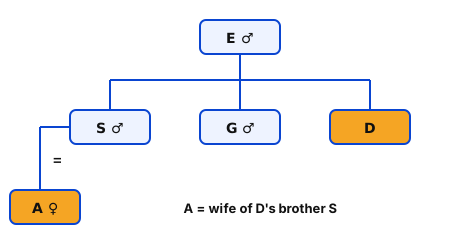
  1. A = S: A is the wife of S. S # G: S is the brother of G.
  2. G % E: G is the son of E. E ¥ D: E is the father of D.
  3. S, G and D are children of E; S is D's brother.
  4. A is the wife of D's brother.

Trick: Read the chain left to right and mark gender as you go (S male, A female).

Answer: (A) Brother's wife

अवधारणा: हर चिह्न का अर्थ लगाकर वंश-वृक्ष बनाएँ।

  1. A = S: A, S की पत्नी है। S # G: S, G का भाई है।
  2. G % E: G, E का पुत्र है। E ¥ D: E, D का पिता है।
  3. S, G और D, E की संतान हैं; S, D का भाई है।
  4. A, D के भाई की पत्नी (भाभी) है।

ट्रिक: शृंखला बाएँ से दाएँ पढ़ें और साथ-साथ लिंग अंकित करें (S पुरुष, A महिला)।

उत्तर: (A) भाई की पत्नी

RRB NTPC Undergraduate CBT 1General Intelligence and ReasoningBlood Relation (Coded)RRB NTPC Undergraduate CBT 1 2024 · 4 Sep Shift 1 →