Question bank

Q&A: practice questions with answers

Search questions on any topic. Filter by exam category, exam, subject and topic, try the question, then open the answer and explanation.

Courses – airGurukul

8,495 questions found.

Q4681.
Karan, Shiv, Ritu, Himani, Gunjan and Pari are sitting in a straight line, facing north. Karan sits third to the left of Himani. Himani sits second from the right end. Pari sits to the immediate left of Gunjan. Shiv does not sit next to Karan. Who sits second to the right of Gunjan?
करण, शिव, रितु, हिमानी, गुंजन और परी उत्तर की ओर मुख करके एक सीधी पंक्ति में बैठे हैं। करण, हिमानी के बाईं ओर तीसरे स्थान पर बैठा है। हिमानी दाएँ छोर से दूसरे स्थान पर बैठी है। परी, गुंजन के ठीक बाईं ओर बैठी है। शिव, करण के बगल में नहीं बैठा है। गुंजन के दाईं ओर दूसरे स्थान पर कौन बैठा है?
  1. AKaranकरण
  2. BShivशिव
  3. CRituरितु
  4. DHimaniहिमानी
Show answer

Concept: Six seats, all facing north; fix the end-based clue first.
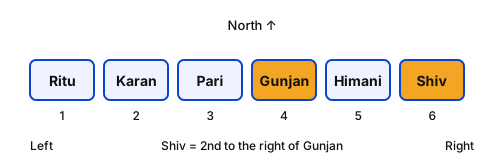
  1. Himani 2nd from right → 5th; Karan 3rd to her left → 2nd.
  2. Pari–Gunjan adjacent pair fits only 3–4.
  3. Shiv not next to Karan → 6th; Ritu 1st.
  4. Ritu Karan Pari Gunjan Himani Shiv → 2nd right of Gunjan = Shiv.

Trick: Facing north: right of a person = higher seat number.

Answer: (B) Shiv

अवधारणा: छह सीटें, सभी उत्तर की ओर; पहले छोर वाला संकेत लगाएँ।

  1. हिमानी दाएँ छोर से दूसरी → 5वीं; करण उसके तीसरे बाएँ → 2रा।
  2. पारी–गुंजन की जोड़ी केवल 3–4 पर।
  3. शिव करण के पास नहीं → 6ठा; रितु 1ली।
  4. रितु करण पारी गुंजन हिमानी शिव → गुंजन के दूसरे दाएँ = शिव।

ट्रिक: उत्तर की ओर मुख: दायाँ = बड़ी सीट संख्या।

उत्तर: (B) शिव
RRB NTPC Undergraduate CBT 1General Intelligence and ReasoningLinear Seating ArrangementRRB NTPC Undergraduate CBT 1 2024 · 4 Sep Shift 1 →
Q4682.
Read the given statements and conclusions carefully. Assuming that the information given in the statements is true, even if it appears to be at variance with commonly known facts, decide which of the given conclusion(s) logically follow(s) from the statements.
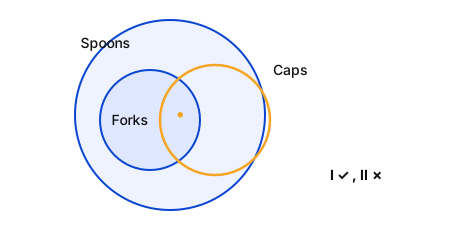
Statements: All forks are spoons. Some forks are caps.
Conclusions (I): Some spoons are caps.
Conclusions (II): All caps are forks.
दिए गए कथनों और निष्कर्षों को ध्यानपूर्वक पढ़िए। कथनों में दी गई जानकारी को सत्य मानते हुए, भले ही वह सामान्यतः ज्ञात तथ्यों से भिन्न प्रतीत होती हो, निर्णय कीजिए कि दिए गए निष्कर्षों में से कौन-सा/से निष्कर्ष कथनों का तार्किक रूप से अनुसरण करता है/करते हैं।
कथन: सभी कांटे, चम्मच हैं। कुछ कांटे, टोपियाँ हैं।
निष्कर्ष (I): कुछ चम्मच, टोपियाँ हैं।
निष्कर्ष (II): सभी टोपियाँ, कांटे हैं।
  1. ABoth conclusions (I) and (II) follow.निष्कर्ष (I) और (II) दोनों अनुसरण करते हैं।
  2. BNeither conclusion (I) nor (II) follows.न तो निष्कर्ष (I) और न ही (II) अनुसरण करता है।
  3. COnly conclusion (I) follows.केवल निष्कर्ष (I) अनुसरण करता है।
  4. DOnly conclusion (II) follows.केवल निष्कर्ष (II) अनुसरण करता है।
Show answer

Concept: Draw the least-overlap Venn diagram for the statements.

  1. All forks are spoons; some forks are caps.
  2. Those caps that are forks are also spoons → some spoons are caps: I follows.
  3. Caps may lie outside forks, so 'all caps are forks' is not certain: II fails.

Trick: 'Some' never proves 'All'.

Answer: (C) Only conclusion (I) follows.

अवधारणा: कथनों का न्यूनतम-अतिव्याप्ति वेन आरेख बनाएँ।

  1. सभी fork, spoon हैं; कुछ fork, cap हैं।
  2. जो cap, fork हैं वे spoon भी हैं → कुछ spoon, cap हैं: I अनुसरण करता है।
  3. cap, fork के बाहर भी हो सकते हैं, अतः 'सभी cap, fork हैं' निश्चित नहीं: II नहीं।

ट्रिक: 'कुछ' से कभी 'सभी' सिद्ध नहीं होता।

उत्तर: (C) केवल निष्कर्ष (I) अनुसरण करता है।

RRB NTPC Undergraduate CBT 1General Intelligence and ReasoningSyllogismRRB NTPC Undergraduate CBT 1 2024 · 4 Sep Shift 1 →
Q4683.
RBNH is related to LVHB in a certain way based on the English alphabetical order. In the same way, TDPJ is related to NXJD. To which of the given options is BLXR related, following the same logic?
अंग्रेज़ी वर्णमाला क्रम के आधार पर RBNH एक निश्चित प्रकार से LVHB से संबंधित है। उसी प्रकार, TDPJ, NXJD से संबंधित है। समान तर्क का अनुसरण करते हुए, BLXR दिए गए विकल्पों में से किससे संबंधित है?
  1. AVFLR
  2. BVRFL
  3. CVFRL
  4. DVLRF
Show answer

Concept: Each letter moves 6 places back.

  1. R→L, B→V, N→H, H→B (each −6).
  2. Check: T→N, D→X, P→J, J→D ✓.
  3. B−6 = V, L−6 = F, X−6 = R, R−6 = L → VFRL.

Trick: Going back from A wraps to Z: B−6 = V.

Answer: (C) VFRL

अवधारणा: हर अक्षर 6 स्थान पीछे जाता है।

  1. R→L, B→V, N→H, H→B (प्रत्येक −6)।
  2. जाँच: T→N, D→X, P→J, J→D ✓।
  3. B−6 = V, L−6 = F, X−6 = R, R−6 = L → VFRL।

ट्रिक: A से पीछे जाने पर Z से गिनें: B−6 = V।

उत्तर: (C) VFRL

RRB NTPC Undergraduate CBT 1General Intelligence and ReasoningLetter AnalogyRRB NTPC Undergraduate CBT 1 2024 · 4 Sep Shift 1 →
Q4684.
Select the set in which the numbers are related in the same way as are the numbers of the following sets.
(Note: Operations should be performed on the whole numbers, without breaking down the numbers into their constituent digits. E.g., 13 – Operations on 13 such as
adding/subtracting/multiplying to 13 can be performed. Breaking down 13 into 1 and 3 and then performing mathematical operations on 1 and 3 is not allowed.)
(48, 26, 15)
(88, 46, 25)
उस समुच्चय का चयन कीजिए जिसमें संख्याएँ उसी प्रकार संबंधित हैं जिस प्रकार निम्नलिखित समुच्चयों की संख्याएँ संबंधित हैं।
(नोट: संक्रियाएँ संख्याओं को उनके घटक अंकों में विभाजित किए बिना, पूर्ण संख्याओं पर की जानी चाहिए। उदाहरण के लिए, 13 – 13 पर संक्रियाएँ जैसे
13 में जोड़ना/घटाना/गुणा करना आदि किया जा सकता है। 13 को 1 और 3 में विभाजित करना और फिर 1 और 3 पर गणितीय संक्रियाएँ करना वर्जित है।)
(48, 26, 15)
(88, 46, 25)
  1. A(12, 6, 7)
  2. B(58, 34, 19)
  3. C(36, 20, 8)
  4. D(24, 14, 9)
Show answer

Concept: Rule: next number =previous2+2.

  1. 482+2=26, 262+2=15 ✓; 882+2=46, 462+2=25 ✓.
  2. (24, 14, 9): 242+2=14, 142+2=9 ✓.
  3. (58, 34, 19): 582+2=31≠34 ✗; others also fail.

Trick: Test the rule on the first two numbers of each option only.

Answer: (D) (24, 14, 9)

अवधारणा: नियम: अगली संख्या =पिछली2+2।

  1. 482+2=26, 262+2=15 ✓; 882+2=46, 462+2=25 ✓।
  2. (24, 14, 9): 242+2=14, 142+2=9 ✓।
  3. (58, 34, 19): 582+2=31≠34 ✗; अन्य भी असफल।

ट्रिक: हर विकल्प की पहली दो संख्याओं पर नियम जाँचें।

उत्तर: (D) (24, 14, 9)

RRB NTPC Undergraduate CBT 1General Intelligence and ReasoningNumber Set AnalogyRRB NTPC Undergraduate CBT 1 2024 · 4 Sep Shift 1 →
Q4685.
Each of the digits in the number 67849315 is arranged in ascending order from left to right. What will be the sum of the digits which are second from the left and third from the right in the new number thus formed?
संख्या 67849315 के प्रत्येक अंक को बाएँ से दाएँ आरोही क्रम में व्यवस्थित किया जाता है। इस प्रकार बनी नई संख्या में बाएँ से दूसरे और दाएँ से तीसरे अंकों का योग क्या होगा?
  1. A9
  2. B10
  3. C7
  4. D11
Show answer

Concept: Arrange the digits in ascending order and count positions.

  1. 67849315 → 13456789.
  2. 2nd from left = 3; 3rd from right = 7.
  3. Sum =3+7=10.

Trick: Distinct digits 1–9 without 2 – the order is easy to write.

Answer: (B) 10

अवधारणा: अंकों को आरोही क्रम में रखें और स्थान गिनें।

  1. 67849315 → 13456789।
  2. बाएँ से दूसरा = 3; दाएँ से तीसरा = 7।
  3. योग =3+7=10।

ट्रिक: 1 से 9 तक के अंक (2 को छोड़कर) – क्रम लिखना आसान है।

उत्तर: (B) 10

RRB NTPC Undergraduate CBT 1General Intelligence and ReasoningDigit ArrangementRRB NTPC Undergraduate CBT 1 2024 · 4 Sep Shift 1 →
Q4686.
Refer to the following number, symbol series and answer the question that follow. Counting to be done from left to right only.
(Left) 6 \ & > 3 @ 8 * & @ 7 1 ^ @ 4 ? \ ? 4 5 < (Right)
How many such numbers are there each of which is immediately preceded by a symbol and also immediately followed by a symbol?
निम्नलिखित संख्या, प्रतीक श्रृंखला को देखिए और उसके बाद दिए गए प्रश्न का उत्तर दीजिए। गिनती केवल बाएँ से दाएँ की जानी है।
(बाएँ) 6 \ & > 3 @ 8 * & @ 7 1 ^ @ 4 ? \ ? 4 5 < (दाएँ)
ऐसी कितनी संख्याएँ हैं जिनमें से प्रत्येक के ठीक पहले एक प्रतीक है और ठीक बाद भी एक प्रतीक है?
  1. ATwoदो
  2. BFourचार
  3. CThreeतीन
  4. DOneएक
Show answer

Concept: Check each number's left and right neighbours: both must be symbols.

  1. > 3 @ ✓; @ 8 * ✓.
  2. @ 7 1 ✗ and 7 1 (symbol) ✗ (number beside).
  3. @ 4 ? ✓; ? 4 5 ✗; 4 5 < ✗; first 6 has nothing before it.
  4. Total = 3 (the numbers 3, 8, 4).

Trick: Skip numbers that sit next to another number – they can never qualify.

Answer: (C) Three

अवधारणा: हर संख्या के बाएँ और दाएँ पड़ोसी देखें: दोनों प्रतीक होने चाहिए।

  1. > 3 @ ✓; @ 8 * ✓।
  2. @ 7 1 ✗ और 1 के बाएँ 7 (संख्या) ✗।
  3. @ 4 ? ✓; ? 4 5 ✗; 4 5 < ✗; पहले 6 के पहले कुछ नहीं।
  4. कुल = 3 (संख्याएँ 3, 8, 4)।

ट्रिक: जो संख्या दूसरी संख्या के पास है वह कभी गिनी नहीं जाएगी।

उत्तर: (C) तीन

RRB NTPC Undergraduate CBT 1General Intelligence and ReasoningNumber-Symbol SeriesRRB NTPC Undergraduate CBT 1 2024 · 4 Sep Shift 1 →
Q4687.
Read the given statements and conclusions carefully. Assuming that the information given in the statements is true, even if it appears to be at variance with commonly known facts, decide which of the given conclusions logically follow(s) from the statements.
Statements:
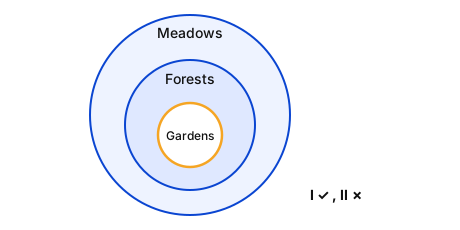
All gardens are forests.
All forests are meadows.
Conclusions:
(I) All gardens are meadows.
(II) All meadows are forests.
दिए गए कथनों और निष्कर्षों को ध्यानपूर्वक पढ़िए। कथनों में दी गई जानकारी को सत्य मानते हुए, भले ही वह सामान्यतः ज्ञात तथ्यों से भिन्न प्रतीत होती हो, निर्णय कीजिए कि दिए गए निष्कर्षों में से कौन-सा/से निष्कर्ष कथनों का तार्किक रूप से अनुसरण करता है/करते हैं।
कथन:
सभी बगीचे, वन हैं।
सभी वन, घास के मैदान हैं।
निष्कर्ष:
(I) सभी बगीचे, घास के मैदान हैं।
(II) सभी घास के मैदान, वन हैं।
  1. AOnly conclusion (I) follows.केवल निष्कर्ष (I) अनुसरण करता है।
  2. BBoth conclusions (I) and (II) follow.निष्कर्ष (I) और (II) दोनों अनुसरण करते हैं।
  3. COnly conclusion (II) follows.केवल निष्कर्ष (II) अनुसरण करता है।
  4. DNeither conclusion (I) nor (II) follows.न तो निष्कर्ष (I) और न ही (II) अनुसरण करता है।
Show answer

Concept: Chain of 'All' statements gives a nested Venn diagram.

  1. Gardens ⊂ Forests ⊂ Meadows.
  2. So all gardens are meadows: I follows.
  3. Meadows can exist outside forests: II ('All meadows are forests') fails.

Trick: All A are B + All B are C ⇒ All A are C; the reverse 'All C are B' never follows.

Answer: (A) Only conclusion (I) follows.

अवधारणा: 'सभी' वाले कथनों की शृंखला से नेस्टेड वेन आरेख बनता है।

  1. Gardens ⊂ Forests ⊂ Meadows।
  2. अतः सभी gardens, meadows हैं: I अनुसरण करता है।
  3. meadows, forests के बाहर भी हो सकते हैं: II नहीं।

ट्रिक: सभी A, B + सभी B, C ⇒ सभी A, C; उल्टा 'सभी C, B' कभी नहीं।

उत्तर: (A) केवल निष्कर्ष (I) अनुसरण करता है।

RRB NTPC Undergraduate CBT 1General Intelligence and ReasoningSyllogismRRB NTPC Undergraduate CBT 1 2024 · 4 Sep Shift 1 →
Q4688.
Mr. Toni ranked 94th from the bottom and 65th from the top in his class. How many students are there in his class?
श्री टोनी का अपनी कक्षा में नीचे से 94वाँ और ऊपर से 65वाँ स्थान था। उसकी कक्षा में कितने विद्यार्थी हैं?
  1. A159
  2. B156
  3. C157
  4. D158
Show answer

Concept: Total = rank from top + rank from bottom − 1.

  1. 65+94−1=158.

Trick: Subtract 1 because the person is counted twice.

Answer: (D) 158

अवधारणा: कुल = ऊपर से रैंक + नीचे से रैंक − 1।

  1. 65+94−1=158।

ट्रिक: व्यक्ति दो बार गिना जाता है, इसलिए 1 घटाएँ।

उत्तर: (D) 158

RRB NTPC Undergraduate CBT 1General Intelligence and ReasoningRankingRRB NTPC Undergraduate CBT 1 2024 · 4 Sep Shift 1 →
Q4689.
What should come in place of the question mark (?) in the given series?
19 42 78 122 179 ?
दी गई श्रृंखला में प्रश्न चिह्न (?) के स्थान पर क्या आना चाहिए?
19 42 78 122 179 ?
  1. A234
  2. B244
  3. C243
  4. D204
Show answer

Concept: Look at the differences, then at the differences of those.

  1. Differences: 23, 36, 44, 57.
  2. Second differences: 13, 8, 13 → next 8.
  3. Next difference =57+8=65; next term =179+65=244.

Trick: If first differences look random, check their differences – here an alternating +13, +8.

Answer: (B) 244

अवधारणा: अंतर निकालें, फिर उन अंतरों का अंतर देखें।

  1. अंतर: 23, 36, 44, 57।
  2. द्वितीय अंतर: 13, 8, 13 → अगला 8।
  3. अगला अंतर =57+8=65; अगला पद =179+65=244।

ट्रिक: प्रथम अंतर अनियमित लगें तो उनके अंतर देखें – यहाँ बारी-बारी +13, +8।

उत्तर: (B) 244

RRB NTPC Undergraduate CBT 1General Intelligence and ReasoningNumber SeriesRRB NTPC Undergraduate CBT 1 2024 · 4 Sep Shift 1 →
Q4690.
Based on the English alphabetical order, three of the following four letter-clusters are alike in a certain way and thus form a group. Which letter-cluster DOES NOT belong to that group? (Note: The odd one out is not based on the number of consonants/vowels or their position in the letter-cluster.)
अंग्रेज़ी वर्णमाला क्रम के आधार पर, निम्नलिखित चार अक्षर-समूहों में से तीन किसी निश्चित प्रकार से एकसमान हैं और इस प्रकार एक समूह बनाते हैं। कौन-सा अक्षर-समूह उस समूह से संबंधित नहीं है? (नोट: असंगत, व्यंजनों/स्वरों की संख्या या अक्षर-समूह में उनके स्थान पर आधारित नहीं है।)
  1. ANIO
  2. BKFM
  3. CTOV
  4. DQLS
Show answer

Concept: Find the gaps between letter positions.

  1. KFM: K(11)−5 = F(6), F+7 = M(13).
  2. TOV: −5, +7; QLS: −5, +7.
  3. NIO: N(14)−5 = I(9), but I+6 = O(15) → odd one.

Trick: Remember positions with EJOTY = 5, 10, 15, 20, 25.

Answer: (A) NIO

अवधारणा: अक्षरों के स्थानों का अंतर निकालें।

  1. KFM: K(11)−5 = F(6), F+7 = M(13)।
  2. TOV: −5, +7; QLS: −5, +7।
  3. NIO: N(14)−5 = I(9), पर I+6 = O(15) → विषम।

ट्रिक: EJOTY = 5, 10, 15, 20, 25 से स्थान जल्दी याद आते हैं।

उत्तर: (A) NIO

RRB NTPC Undergraduate CBT 1General Intelligence and ReasoningLetter Cluster Odd One OutRRB NTPC Undergraduate CBT 1 2024 · 4 Sep Shift 1 →
Q4691.
What should come in place of the question mark (?) in the given series?
154 181 208 ? 262 289
दी गई श्रृंखला में प्रश्न चिह्न (?) के स्थान पर क्या आना चाहिए?
154 181 208 ? 262 289
  1. A242
  2. B235
  3. C228
  4. D260
Show answer

Concept: Constant difference of 27.

  1. 181 − 154 = 27, 208 − 181 = 27.
  2. 208+27=235; check 235+27=262 ✓.

Trick: Verify with the term after the blank.

Answer: (B) 235

अवधारणा: स्थिर अंतर 27।

  1. 181 − 154 = 27, 208 − 181 = 27।
  2. 208+27=235; जाँच 235+27=262 ✓।

ट्रिक: खाली स्थान के बाद वाले पद से जाँच करें।

उत्तर: (B) 235

RRB NTPC Undergraduate CBT 1General Intelligence and ReasoningNumber SeriesRRB NTPC Undergraduate CBT 1 2024 · 4 Sep Shift 1 →
Q4692.
Which of the following letter-number clusters will replace the question mark (?) in the given series to make it logically complete?
LSP 15 OOO 12 RKN 9 UGM 6 ?
निम्नलिखित में से कौन-सा अक्षर-संख्या समूह दी गई श्रृंखला को तार्किक रूप से पूर्ण करने के लिए प्रश्न चिह्न (?) का स्थान लेगा?
LSP 15 OOO 12 RKN 9 UGM 6 ?
  1. ADLV 4
  2. BXCL 3
  3. CDSR 9
  4. DXLC 7
Show answer

Concept: Split into four series: 1st letter, 2nd letter, 3rd letter, number.

  1. 1st: L, O, R, U → +3 → X.
  2. 2nd: S, O, K, G → −4 → C.
  3. 3rd: P, O, N, M → −1 → L.
  4. Number: 15, 12, 9, 6 → −3 → 3. Answer XCL 3.

Trick: The number part alone (−3 each time) already leaves only XCL 3.

Answer: (B) XCL 3

अवधारणा: चार अलग श्रृंखलाएँ बनाएँ: पहला, दूसरा, तीसरा अक्षर और संख्या।

  1. पहला: L, O, R, U → +3 → X।
  2. दूसरा: S, O, K, G → −4 → C।
  3. तीसरा: P, O, N, M → −1 → L।
  4. संख्या: 15, 12, 9, 6 → −3 → 3। उत्तर XCL 3।

ट्रिक: केवल संख्या वाला भाग (हर बार −3) देखकर ही XCL 3 बचता है।

उत्तर: (B) XCL 3

RRB NTPC Undergraduate CBT 1General Intelligence and ReasoningLetter-Number SeriesRRB NTPC Undergraduate CBT 1 2024 · 4 Sep Shift 1 →
Q4693.
Based on the English alphabetical order, three of the following four letter-cluster pairs are alike in a certain way and thus form a group. Which letter-cluster pair DOES NOT belong to that group?
(Note: The odd one out is not based on the number of consonants/vowels or their position in the letter-cluster pair.)
अंग्रेज़ी वर्णमाला क्रम के आधार पर, निम्नलिखित चार अक्षर-समूह युग्मों में से तीन किसी निश्चित प्रकार से एकसमान हैं और इस प्रकार एक समूह बनाते हैं। कौन-सा अक्षर-समूह युग्म उस समूह से संबंधित नहीं है?
(नोट: असंगत, व्यंजनों/स्वरों की संख्या या अक्षर-समूह युग्म में उनके स्थान पर आधारित नहीं है।)
  1. AKO-RW
  2. BIM-PT
  3. CMQ-TX
  4. DFJ-MQ
Show answer

Concept: In each pair XY-ZW: Y = X+4, Z = X+7, W = Y+7.

  1. IM-PT: I+4 = M, I+7 = P, M+7 = T ✓.
  2. MQ-TX ✓ and FJ-MQ ✓ similarly.
  3. KO-RW: K+4 = O, K+7 = R, but O+8 = W ✗ → odd one.

Trick: Equivalently Z−X and W−Y must both be 7.

Answer: (A) KO-RW

अवधारणा: हर युग्म XY-ZW में: Y = X+4, Z = X+7, W = Y+7।

  1. IM-PT: I+4 = M, I+7 = P, M+7 = T ✓।
  2. MQ-TX ✓ और FJ-MQ ✓ इसी तरह।
  3. KO-RW: K+4 = O, K+7 = R, पर O+8 = W ✗ → विषम।

ट्रिक: अर्थात Z−X और W−Y दोनों 7 होने चाहिए।

उत्तर: (A) KO-RW

RRB NTPC Undergraduate CBT 1General Intelligence and ReasoningLetter Pair Odd One OutRRB NTPC Undergraduate CBT 1 2024 · 4 Sep Shift 1 →
Q4694.
What will come in place of the question mark (?) in the following equation, if ‘+’ and ‘−’ are interchanged and ‘×’ and ‘÷’ are interchanged?
14 ÷ 4 + 78 × 13 − 13 = ?
यदि ‘+’ और ‘−’ को आपस में बदल दिया जाए तथा ‘×’ और ‘÷’ को आपस में बदल दिया जाए, तो निम्नलिखित समीकरण में प्रश्न चिह्न (?) के स्थान पर क्या आएगा?
14 ÷ 4 + 78 × 13 − 13 = ?
  1. A65
  2. B55
  3. C63
  4. D58
Show answer

Concept: Interchange the signs first, then apply BODMAS.

  1. 14÷4+78×13−13 becomes 14×4−78÷13+13.
  2. =56−6+13.
  3. =63.

Trick: Rewrite the whole expression with new signs before calculating.

Answer: (C) 63

अवधारणा: पहले चिह्न आपस में बदलें, फिर BODMAS लगाएँ।

  1. 14÷4+78×13−13 बनता है 14×4−78÷13+13।
  2. =56−6+13।
  3. =63।

ट्रिक: गणना से पहले पूरा व्यंजक नए चिह्नों के साथ लिख लें।

उत्तर: (C) 63

RRB NTPC Undergraduate CBT 1General Intelligence and ReasoningMathematical OperationsRRB NTPC Undergraduate CBT 1 2024 · 4 Sep Shift 1 →
Q4695.
Raj ranked 35th from the top and 27th from the bottom in his class. How many students are there in his class?
राज का अपनी कक्षा में ऊपर से 35वाँ और नीचे से 27वाँ स्थान था। उसकी कक्षा में कितने विद्यार्थी हैं?
  1. A60
  2. B62
  3. C63
  4. D61
Show answer

Concept: Total = rank from top + rank from bottom − 1.

  1. 35+27−1=61.

Trick: Subtract 1 because the person is counted twice.

Answer: (D) 61

अवधारणा: कुल = ऊपर से रैंक + नीचे से रैंक − 1।

  1. 35+27−1=61।

ट्रिक: व्यक्ति दो बार गिना जाता है, इसलिए 1 घटाएँ।

उत्तर: (D) 61

RRB NTPC Undergraduate CBT 1General Intelligence and ReasoningRankingRRB NTPC Undergraduate CBT 1 2024 · 4 Sep Shift 1 →
Q4696.
Which State government launched a cryogenic facility to preserve endangered plant species in February 2025?
फरवरी 2025 में किस राज्य सरकार ने संकटग्रस्त पादप प्रजातियों के संरक्षण के लिए एक क्रायोजेनिक (cryogenic) सुविधा शुरू की?
  1. AKeralaकेरल
  2. BKarnatakaकर्नाटक
  3. CTelanganaतेलंगाना
  4. DTamil Naduतमिलनाडु
Show answer

Concept: Cryogenic (very low temperature, about −196∘C in liquid nitrogen) storage keeps seeds and plant tissue alive for decades, helping save endangered plant species.

  1. In February 2025 the Tamil Nadu government launched a cryogenic preservation facility for endangered and rare plant species of the State.
  2. It stores germplasm (seeds, tissues) so that threatened native plants can be regenerated later.
  3. Kerala, Karnataka and Telangana were not the States in this news.

Yaad rakhein: Cryo + plants + Feb 2025 → Tamil Nadu.

Answer: (D) Tamil Nadu

अवधारणा: क्रायोजेनिक (बहुत कम तापमान, लगभग −196∘C, liquid nitrogen) भंडारण में बीज और पौधों के ऊतक दशकों तक जीवित रहते हैं, जिससे लुप्तप्राय (endangered) पौधे बचाए जा सकते हैं।

  1. फरवरी 2025 में तमिलनाडु सरकार ने राज्य की दुर्लभ और लुप्तप्राय पादप प्रजातियों के संरक्षण के लिए क्रायोजेनिक सुविधा शुरू की।
  2. इसमें germplasm (बीज, ऊतक) सुरक्षित रखे जाते हैं ताकि बाद में पौधे फिर उगाए जा सकें।
  3. केरल, कर्नाटक और तेलंगाना इस समाचार से संबंधित नहीं हैं।

याद रखें: Cryo + पौधे + फरवरी 2025 → तमिलनाडु।

उत्तर: (D) तमिलनाडु

RRB NTPC Undergraduate CBT 1General AwarenessCurrent Affairs – EnvironmentRRB NTPC Undergraduate CBT 1 2024 · 3 Sep Shift 3 →
Q4697.
Under Article 254(2) of the Indian Constitution, a State law repugnant to a Central law can prevail in the State only if:
भारतीय संविधान के अनुच्छेद 254(2) के अंतर्गत, केंद्रीय विधि के प्रतिकूल (विरोधी) राज्य विधि राज्य में केवल तभी प्रभावी हो सकती है, जब:
  1. Ait is passed by a special majority in the State Legislatureवह राज्य विधानमंडल में विशेष बहुमत से पारित की गई हो
  2. Bit is published in the State Gazette after legislative approvalवह विधायी अनुमोदन के बाद राज्य राजपत्र में प्रकाशित की गई हो
  3. Cit is reserved for the President’s consideration and gets his assentवह राष्ट्रपति के विचार के लिए आरक्षित की गई हो और उसे उनकी अनुमति प्राप्त हो
  4. Dit is certified by the Governor as necessary for public welfareराज्यपाल द्वारा उसे लोक कल्याण के लिए आवश्यक प्रमाणित किया गया हो
Show answer

Concept: Article 254 deals with inconsistency between Central and State laws on Concurrent List subjects.

  1. Article 254(1): if a State law conflicts with a Central law on a Concurrent List subject, the Central law prevails.
  2. Article 254(2): the State law will prevail in that State if it was reserved for the President's consideration and received his assent.
  3. Special majority, Gazette publication or Governor's certificate do not give such protection; Parliament can still later amend or repeal it.

Yaad rakhein: 254(2) = "Reserve + President's assent".

Answer: (C) it is reserved for the President’s consideration and gets his assent

अवधारणा: अनुच्छेद 254 समवर्ती सूची (Concurrent List) के विषयों पर केंद्र और राज्य के कानूनों में असंगति (repugnancy) से संबंधित है।

  1. अनुच्छेद 254(1): टकराव होने पर केंद्रीय कानून मान्य होता है।
  2. अनुच्छेद 254(2): यदि राज्य का कानून राष्ट्रपति के विचार हेतु आरक्षित किया गया हो और उसे राष्ट्रपति की स्वीकृति मिल जाए, तो वह उस राज्य में मान्य होगा।
  3. विशेष बहुमत, राजपत्र में प्रकाशन या राज्यपाल का प्रमाणपत्र ऐसा संरक्षण नहीं देते; संसद बाद में उसे बदल भी सकती है।

याद रखें: 254(2) = "आरक्षित + राष्ट्रपति की स्वीकृति"।

उत्तर: (C) यह राष्ट्रपति के विचार हेतु आरक्षित हो और उसकी स्वीकृति मिले

RRB NTPC Undergraduate CBT 1General AwarenessPolity – Centre-State RelationsRRB NTPC Undergraduate CBT 1 2024 · 3 Sep Shift 3 →
Q4698.
Which of the following Articles of the Constitution of India empowers the President to declare Scheduled Areas?
भारत के संविधान का निम्नलिखित में से कौन-सा अनुच्छेद राष्ट्रपति को अनुसूचित क्षेत्र घोषित करने का अधिकार देता है?
  1. AArticle 370अनुच्छेद 370
  2. BArticle 338अनुच्छेद 338
  3. CArticle 244अनुच्छेद 244
  4. DArticle 146अनुच्छेद 146
Show answer

Concept: Article 244 provides for the administration of Scheduled Areas and Tribal Areas (Fifth and Sixth Schedules).

  1. Article 244(1) applies the Fifth Schedule; under it the President may by order declare an area to be a Scheduled Area.
  2. Article 338 is about the National Commission for Scheduled Castes; Article 370 dealt with J&K; Article 146 is about Supreme Court officers.

Yaad rakhein: Article 244 → Scheduled & Tribal Areas (5th and 6th Schedules).

Answer: (C) Article 244

अवधारणा: अनुच्छेद 244 अनुसूचित क्षेत्रों और जनजातीय क्षेत्रों (पाँचवीं व छठी अनुसूची) के प्रशासन का प्रावधान करता है।

  1. अनुच्छेद 244(1) पाँचवीं अनुसूची लागू करता है; इसके तहत राष्ट्रपति आदेश द्वारा किसी क्षेत्र को अनुसूचित क्षेत्र घोषित कर सकते हैं।
  2. अनुच्छेद 338 राष्ट्रीय अनुसूचित जाति आयोग, 370 जम्मू-कश्मीर और 146 सर्वोच्च न्यायालय के अधिकारियों से संबंधित है।

याद रखें: अनुच्छेद 244 → अनुसूचित व जनजातीय क्षेत्र (5वीं व 6ठी अनुसूची)।

उत्तर: (C) अनुच्छेद 244

RRB NTPC Undergraduate CBT 1General AwarenessPolity – Scheduled AreasRRB NTPC Undergraduate CBT 1 2024 · 3 Sep Shift 3 →
Q4699.
Who among the following scientists is credited with the development of the modern Periodic Law?
निम्नलिखित में से किस वैज्ञानिक को आधुनिक आवर्त नियम (Periodic Law) के विकास का श्रेय दिया जाता है?
  1. AErnest Rutherfordअर्नेस्ट रदरफोर्ड
  2. BDmitri Mendeleevदिमित्री मेंडेलीव
  3. CJohn Daltonजॉन डाल्टन
  4. DJ.J. Thomsonजे.जे. थॉमसन
Show answer

Concept: Periodic Law states that properties of elements are a periodic function of their atomic weights (Mendeleev, 1869); the modern form uses atomic number (Moseley).

  1. Dmitri Mendeleev formulated the Periodic Law and arranged 63 known elements in a table, leaving gaps for undiscovered elements.
  2. Rutherford gave the nuclear model, Dalton the atomic theory and J.J. Thomson discovered the electron.

Yaad rakhein: Mendeleev → Periodic Law; Moseley → Modern Periodic Law (atomic number).

Answer: (B) Dmitri Mendeleev

अवधारणा: आवर्त नियम (Periodic Law) के अनुसार तत्वों के गुण उनके परमाणु भार के आवर्ती फलन होते हैं (मेंडेलीव, 1869); आधुनिक रूप में परमाणु क्रमांक (Moseley) का उपयोग होता है।

  1. दिमित्री मेंडेलीव ने आवर्त नियम दिया और ज्ञात 63 तत्वों की सारणी बनाई, जिसमें अज्ञात तत्वों के लिए खाली स्थान छोड़े।
  2. रदरफोर्ड ने नाभिकीय मॉडल, डाल्टन ने परमाणु सिद्धांत और जे.जे. थॉमसन ने इलेक्ट्रॉन की खोज की।

याद रखें: मेंडेलीव → आवर्त नियम; मोज़ले → आधुनिक आवर्त नियम (परमाणु क्रमांक)।

उत्तर: (B) दिमित्री मेंडेलीव

RRB NTPC Undergraduate CBT 1General AwarenessChemistry – Periodic TableRRB NTPC Undergraduate CBT 1 2024 · 3 Sep Shift 3 →
Q4700.
Which of the following places is most likely to experience an equable climate with minimal seasonal variation due to its proximity to the sea?
समुद्र से निकटता के कारण निम्नलिखित में से किस स्थान पर न्यूनतम मौसमी भिन्नता वाली सम (समकारी) जलवायु होने की सर्वाधिक संभावना है?
  1. AMumbaiमुंबई
  2. BAmritsarअमृतसर
  3. CBhopalभोपाल
  4. DDelhiदिल्ली
Show answer

Concept: The sea heats and cools slowly, so coastal places have an equable (maritime) climate with a small range of temperature.

  1. Mumbai lies on the west coast; its summer and winter temperatures differ very little.
  2. Amritsar, Delhi and Bhopal are inland and have a continental (extreme) climate – very hot summers and cold winters.

Yaad rakhein: Coast → equable climate; interior → extreme climate.

Answer: (A) Mumbai

अवधारणा: समुद्र धीरे-धीरे गर्म और ठंडा होता है, इसलिए तटीय स्थानों पर सम (equable/maritime) जलवायु होती है जिसमें तापान्तर कम होता है।

  1. मुंबई पश्चिमी तट पर है; यहाँ गर्मी और सर्दी के तापमान में बहुत कम अंतर होता है।
  2. अमृतसर, दिल्ली और भोपाल अंतर्देशीय हैं, जहाँ महाद्वीपीय (विषम) जलवायु है – तेज़ गर्मी और ठंडी सर्दी।

याद रखें: तट → सम जलवायु; भीतरी भाग → विषम जलवायु।

उत्तर: (A) मुंबई

RRB NTPC Undergraduate CBT 1General AwarenessGeography – ClimateRRB NTPC Undergraduate CBT 1 2024 · 3 Sep Shift 3 →