Question bank

Q&A: practice questions with answers

Search questions on any topic. Filter by exam category, exam, subject and topic, try the question, then open the answer and explanation.

Courses – airGurukul

8,495 questions found.

Q4761.
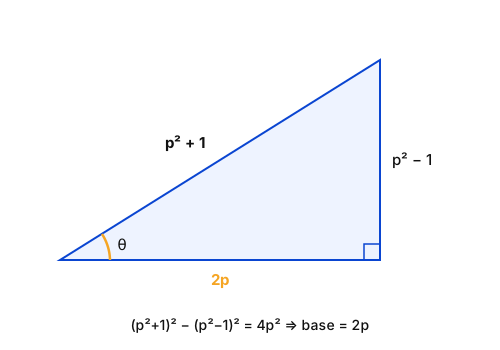
If sinθ=p2−1p2+1, and θ is an acute angle, then find the value of cosθ.
यदि sinθ=p2−1p2+1 है, और θ एक न्यून कोण है, तो cosθ का मान ज्ञात कीजिए।
  1. A2pp2−1
  2. Bp2+12p
  3. C2pp2+1
  4. D1+2pp2−1
Show answer

Concept: sinθ=perpendicularhypotenuse; find the base by Pythagoras, then cosθ=basehypotenuse.

  1. Perpendicular =p2−1, hypotenuse =p2+1
  2. Base2=(p2+1)2−(p2−1)2=4p2, so base =2p
  3. cosθ=2pp2+1

Trick: (p2−1,2p,p2+1) is a standard Pythagorean triplet — learn it.

Answer: (C) 2pp2+1

अवधारणा: sinθ=लंबकर्ण; पाइथागोरस से आधार निकालें, फिर cosθ=आधारकर्ण।

  1. लंब =p2−1, कर्ण =p2+1
  2. आधार2=(p2+1)2−(p2−1)2=4p2, अतः आधार =2p
  3. cosθ=2pp2+1

ट्रिक: (p2−1,2p,p2+1) एक मानक पाइथागोरस त्रिक है।

उत्तर: (C) 2pp2+1
RRB NTPC Undergraduate CBT 1MathematicsTrigonometryRRB NTPC Undergraduate CBT 1 2024 · 3 Sep Shift 3 →
Q4762.
In covering a distance of 52 km, Anmol takes 6 hours more than Nikhil. If Anmol doubles his speed, then he would take 7 hours less than Nikhil. Anmol's speed is:
52 km की दूरी तय करने में, अनमोल, निखिल से 6 घंटे अधिक लेता है। यदि अनमोल अपनी चाल दोगुनी कर दे, तो वह निखिल से 7 घंटे कम समय लेगा। अनमोल की चाल है:
  1. A4 km/hr
  2. B6 km/hr
  3. C2 km/hr
  4. D7 km/hr
Show answer

Concept: Doubling speed halves the time. Compare Anmol’s two times with Nikhil’s time t.

  1. At speed a: 52a=t+6
  2. At speed 2a: 522a=26a=t−7
  3. Subtract: 26a=13
  4. a=2km/h

Trick: Halved time saves 6+7=13 h, so the full time is 26 h; speed =5226=2.

Answer: (C) 2 km/hr

अवधारणा: चाल दोगुनी करने पर समय आधा हो जाता है। अनमोल के दोनों समय की तुलना निखिल के समय t से करें।

  1. चाल a पर: 52a=t+6
  2. चाल 2a पर: 26a=t−7
  3. घटाने पर: 26a=13
  4. a=2km/h

ट्रिक: आधा समय करने पर 6+7=13 घंटे बचे, अतः पूरा समय 26 घंटे; चाल =5226=2।

उत्तर: (C) 2 km/hr

RRB NTPC Undergraduate CBT 1MathematicsSpeed, Time and DistanceRRB NTPC Undergraduate CBT 1 2024 · 3 Sep Shift 3 →
Q4763.
The average weight of Salil, Mukund and Sachin is 45 kg. If the average weight of Salil and Mukund is 44 kg and that of Mukund and Sachin is 48 kg, then the weight of Mukund (in kg) is:
सलिल, मुकुंद और सचिन का औसत भार 45 kg है। यदि सलिल और मुकुंद का औसत भार 44 kg है और मुकुंद और सचिन का औसत भार 48 kg है, तो मुकुंद का भार (kg में) है:
  1. A49
  2. B59
  3. C69
  4. D64
Show answer

Concept: Convert each average into a total, then combine the totals.

  1. Salil + Mukund + Sachin =3×45=135
  2. Salil + Mukund =88 ⇒ Sachin =135−88=47
  3. Mukund + Sachin =96 ⇒ Mukund =96−47=49

Trick: Middle person =(88+96)−135=49 directly.

Answer: (A) 49

अवधारणा: हर औसत को योग में बदलें, फिर योगों को मिलाएँ।

  1. सलिल + मुकुंद + सचिन =3×45=135
  2. सलिल + मुकुंद =88 ⇒ सचिन =135−88=47
  3. मुकुंद + सचिन =96 ⇒ मुकुंद =96−47=49

ट्रिक: बीच वाला (common) व्यक्ति =(88+96)−135=49।

उत्तर: (A) 49

RRB NTPC Undergraduate CBT 1MathematicsAverageRRB NTPC Undergraduate CBT 1 2024 · 3 Sep Shift 3 →
Q4764.
Simplify: x(6x − 9) + 6(x2 − 3) + 19
सरल कीजिए: x(6x − 9) + 6(x2 − 3) + 19
  1. A12x2 − 9x −1
  2. B12x2 − 9x + 1
  3. C−12x2 − 9x + 1
  4. D−12x2 − 9x − 1
Show answer

Concept: Expand each bracket, then collect like terms.

  1. x(6x−9)=6x2−9x
  2. 6(x2−3)=6x2−18
  3. Sum +19: 12x2−9x−18+19=12x2−9x+1

Trick: Put x=1: −3+(−12)+19=4; only 12−9+1=4 matches.

Answer: (B) 12x2−9x+1

अवधारणा: हर कोष्ठक खोलें, फिर समान पद जोड़ें।

  1. x(6x−9)=6x2−9x
  2. 6(x2−3)=6x2−18
  3. +19 जोड़कर: 12x2−9x+1

ट्रिक: x=1 रखें: −3−12+19=4; केवल 12−9+1=4 मेल खाता है।

उत्तर: (B) 12x2−9x+1

RRB NTPC Undergraduate CBT 1MathematicsAlgebraic SimplificationRRB NTPC Undergraduate CBT 1 2024 · 3 Sep Shift 3 →
Q4765.
Pooja, Harsh, and Madhur invest ₹1,120, ₹1,320, and ₹1,160, respectively to start a business. If the profit at the end of the year is ₹1,080, then what is the share of Madhur in the profit?
पूजा, हर्ष और मधुर एक व्यवसाय शुरू करने के लिए क्रमशः ₹1,120, ₹1,320 और ₹1,160 का निवेश करते हैं। यदि वर्ष के अंत में लाभ ₹1,080 है, तो लाभ में मधुर का हिस्सा कितना है?
  1. A₹348
  2. B₹349
  3. C₹351
  4. D₹347
Show answer

Concept: For equal time periods, profit is shared in the ratio of investments.

  1. 1120:1320:1160=28:33:29 (divide by 40)
  2. Total =90 parts
  3. Madhur =2990×1080=29×12=348

Trick: 1080÷90=12 per part makes the multiplication easy.

Answer: (A) ₹348

अवधारणा: समान अवधि हो तो लाभ निवेश के अनुपात में बँटता है।

  1. 1120:1320:1160=28:33:29 (40 से भाग)
  2. कुल =90 भाग
  3. मधुर =2990×1080=29×12=348

ट्रिक: 1080÷90=12 प्रति भाग।

उत्तर: (A) ₹348

RRB NTPC Undergraduate CBT 1MathematicsPartnershipRRB NTPC Undergraduate CBT 1 2024 · 3 Sep Shift 3 →
Q4766.
Based on the English alphabetical order, three of the following four letter-clusters are alike in a certain way and thus form a group. Which letter-cluster DOES NOT belong to that group?
(Note: The odd one out is not based on the number of consonants/vowels or their position in the letter-cluster.)
अंग्रेज़ी वर्णमाला क्रम के आधार पर, निम्नलिखित चार अक्षर-समूहों में से तीन किसी निश्चित प्रकार से एक समान हैं और इस प्रकार एक समूह बनाते हैं। कौन-सा अक्षर-समूह उस समूह से संबंधित नहीं है?
(ध्यान दें: असंगत अक्षर-समूह, उस अक्षर-समूह में व्यंजनों/स्वरों की संख्या या उनके स्थान पर आधारित नहीं है।)
  1. AHPJ
  2. BQYR
  3. CKSM
  4. DNVP
Show answer

Concept: Write the alphabet positions and check the gaps between the letters.

  1. HPJ: H(8) → P(16) is +8, P → J(10) is −6
  2. KSM: 11 → 19 (+8) → 13 (−6); NVP: 14 → 22 (+8) → 16 (−6)
  3. QYR: 17 → 25 (+8) → 18 (−7) — breaks the pattern

Trick: Pattern +8, −6 also means 3rd letter = 1st + 2; Q + 2 = S, not R.

Answer: (B) QYR

अवधारणा: अक्षरों के वर्णमाला क्रमांक लिखकर उनके अंतर जाँचें।

  1. HPJ: H(8) → P(16) +8, P → J(10) −6
  2. KSM: 11 → 19 (+8) → 13 (−6); NVP: 14 → 22 (+8) → 16 (−6)
  3. QYR: 17 → 25 (+8) → 18 (−7) — पैटर्न टूटा

ट्रिक: तीसरा अक्षर = पहला + 2; Q + 2 = S, R नहीं।

उत्तर: (B) QYR

RRB NTPC Undergraduate CBT 1General Intelligence and ReasoningOdd One Out – LettersRRB NTPC Undergraduate CBT 1 2024 · 3 Sep Shift 3 →
Q4767.
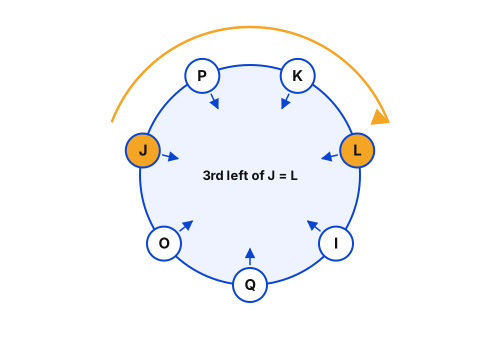
I, J, K, L, O, P and Q are sitting around a circular table facing the centre of the table. Only two people sit between Q and K when counted from the right of Q. Only two people sit between K and O. Only three people sit between Q and P. I sits to the immediate left of L. Who sits third to the left of J?
I, J, K, L, O, P और Q एक वृत्ताकार मेज़ के चारों ओर मेज़ के केंद्र की ओर मुख करके बैठे हैं। Q के दाईं ओर से गिनने पर Q और K के बीच केवल दो व्यक्ति बैठे हैं। K और O के बीच केवल दो व्यक्ति बैठे हैं। Q और P के बीच केवल तीन व्यक्ति बैठे हैं। I, L के ठीक बाईं ओर बैठा है। J के बाईं ओर तीसरे स्थान पर कौन बैठा है?
  1. AK
  2. BL
  3. CQ
  4. DI
Show answer

Concept: Facing the centre, a person’s right is anticlockwise. Fix Q and count seats to Q’s right as positions 1–6.

  1. Two between Q and K from Q’s right ⇒ K at 3. Three between Q and P ⇒ P at 4 (3 is taken).
  2. Two between K and O ⇒ O at 6.
  3. Left seats 1, 2, 5; I immediately left of L ⇒ I = 1, L = 2, J = 5.
  4. Third to the left of J: P, K, L ⇒ L.

Trick: In a 7-seat circle, “n between” on one side = “5 − n between” on the other side.

Answer: (B) L

अवधारणा: केंद्र की ओर मुख होने पर व्यक्ति का दायाँ = वामावर्त (anticlockwise)। Q को स्थिर कर उसके दाएँ स्थान 1–6 गिनें।

  1. Q के दाएँ से Q और K के बीच दो ⇒ K स्थान 3 पर। Q और P के बीच तीन ⇒ P स्थान 4 पर।
  2. K और O के बीच दो ⇒ O स्थान 6 पर।
  3. बचे स्थान 1, 2, 5; I, L के ठीक बाएँ ⇒ I = 1, L = 2, J = 5।
  4. J के बाएँ तीसरा: P, K, L ⇒ L।

ट्रिक: 7 सीटों के वृत्त में एक ओर “n बीच में” = दूसरी ओर “5 − n बीच में”।

उत्तर: (B) L

RRB NTPC Undergraduate CBT 1General Intelligence and ReasoningCircular Seating ArrangementRRB NTPC Undergraduate CBT 1 2024 · 3 Sep Shift 3 →
Q4768.
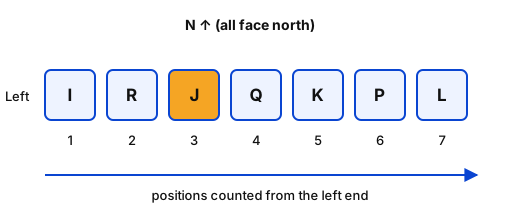
Seven people, I, J, K, L, P, Q and R, are sitting in a row, facing north. Only two people sit to the right of K. Only two people sit between K and R. Only two people sit between I and Q. Q sits to the immediate left of K. L sits to the immediate right of P. Who sits at the third position from the left end of the row?
सात व्यक्ति, I, J, K, L, P, Q और R, एक पंक्ति में उत्तर की ओर मुख करके बैठे हैं। K के दाईं ओर केवल दो व्यक्ति बैठे हैं। K और R के बीच केवल दो व्यक्ति बैठे हैं। I और Q के बीच केवल दो व्यक्ति बैठे हैं। Q, K के ठीक बाईं ओर बैठा है। L, P के ठीक दाईं ओर बैठा है। पंक्ति के बाएँ छोर से तीसरे स्थान पर कौन बैठा है?
  1. AJ
  2. BL
  3. CI
  4. DR
Show answer

Concept: Facing north, the right end is the east end. Number positions 1–7 from the left.

  1. Two people to the right of K ⇒ K = 5; Q immediately left ⇒ Q = 4.
  2. Two between K and R ⇒ R = 2.
  3. Two between I and Q ⇒ I = 1 or 7. P–L must be adjacent: only I = 1 leaves 6, 7 free ⇒ P = 6, L = 7.
  4. Remaining J = 3.

Trick: Test both cases for I quickly — the adjacent-pair condition (P, L) usually rejects one.

Answer: (A) J

अवधारणा: उत्तर की ओर मुख हो तो दायाँ सिरा पूर्व वाला है। बाएँ से स्थान 1–7 लिखें।

  1. K के दाएँ केवल दो ⇒ K = 5; Q ठीक बाएँ ⇒ Q = 4।
  2. K और R के बीच दो ⇒ R = 2।
  3. I और Q के बीच दो ⇒ I = 1 या 7। P–L साथ-साथ: केवल I = 1 से 6, 7 खाली ⇒ P = 6, L = 7।
  4. बचा J = 3।

ट्रिक: I के दोनों विकल्प जाँचें — P, L की सटी जोड़ी एक विकल्प को हटा देती है।

उत्तर: (A) J

RRB NTPC Undergraduate CBT 1General Intelligence and ReasoningLinear Seating ArrangementRRB NTPC Undergraduate CBT 1 2024 · 3 Sep Shift 3 →
Q4769.
What will come in place of the question mark (?) in the following equation, if ‘+’ and ‘−’ are interchanged and ‘×’ and ‘÷’ are interchanged?
100 × 4 + 11 ÷ 2 − 18 = ?
यदि ‘+’ और ‘−’ को आपस में बदल दिया जाए तथा ‘×’ और ‘÷’ को आपस में बदल दिया जाए, तो निम्नलिखित समीकरण में प्रश्न चिह्न (?) के स्थान पर क्या आएगा?
100 × 4 + 11 ÷ 2 − 18 = ?
  1. A27
  2. B15
  3. C21
  4. D36
Show answer

Concept: Swap the signs first, then apply BODMAS.

  1. 100×4+11÷2−18 becomes 100÷4−11×2+18
  2. =25−22+18=21

Trick: Rewrite the whole expression with new signs before calculating — never swap mentally.

Answer: (C) 21

अवधारणा: पहले चिह्न बदलें, फिर BODMAS लगाएँ।

  1. 100×4+11÷2−18 बनता है 100÷4−11×2+18
  2. =25−22+18=21

ट्रिक: गणना से पहले पूरा व्यंजक नए चिह्नों के साथ लिख लें।

उत्तर: (C) 21

RRB NTPC Undergraduate CBT 1General Intelligence and ReasoningMathematical OperationsRRB NTPC Undergraduate CBT 1 2024 · 3 Sep Shift 3 →
Q4770.
What should come in place of the question mark (?) in the given series?
22 25 36 39 50 ?
दी गई श्रृंखला में प्रश्न चिह्न (?) के स्थान पर क्या आना चाहिए?
22 25 36 39 50 ?
  1. A54
  2. B53
  3. C52
  4. D55
Show answer

Concept: Check the differences between consecutive terms.

  1. 22 → 25 (+3) → 36 (+11) → 39 (+3) → 50 (+11)
  2. Next: 50 + 3 = 53

Trick: Alternating differences (+3, +11) repeat — continue the cycle.

Answer: (B) 53

अवधारणा: क्रमागत पदों के अंतर देखें।

  1. 22 → 25 (+3) → 36 (+11) → 39 (+3) → 50 (+11)
  2. अगला: 50 + 3 = 53

ट्रिक: एकांतर अंतर (+3, +11) दोहराए जाते हैं।

उत्तर: (B) 53

RRB NTPC Undergraduate CBT 1General Intelligence and ReasoningNumber SeriesRRB NTPC Undergraduate CBT 1 2024 · 3 Sep Shift 3 →
Q4771.
What should come in place of the question mark (?) in the given series based on the English alphabetical order?
ELJ HOM KRP NUS ?
अंग्रेज़ी वर्णमाला क्रम के आधार पर दी गई श्रृंखला में प्रश्न चिह्न (?) के स्थान पर क्या आना चाहिए?
ELJ HOM KRP NUS ?
  1. AOVT
  2. BQXT
  3. CQXV
  4. DQVT
Show answer

Concept: Track each letter position of the cluster separately.

  1. 1st: E, H, K, N → +3 → Q
  2. 2nd: L, O, R, U → +3 → X
  3. 3rd: J, M, P, S → +3 → V
  4. Answer: QXV

Trick: If one letter shows a constant jump, check the others first with the same jump.

Answer: (C) QXV

अवधारणा: समूह के हर अक्षर-स्थान को अलग से देखें।

  1. पहला: E, H, K, N → +3 → Q
  2. दूसरा: L, O, R, U → +3 → X
  3. तीसरा: J, M, P, S → +3 → V
  4. उत्तर: QXV

ट्रिक: एक अक्षर में स्थिर उछाल दिखे तो बाकी में वही उछाल पहले जाँचें।

उत्तर: (C) QXV

RRB NTPC Undergraduate CBT 1General Intelligence and ReasoningLetter SeriesRRB NTPC Undergraduate CBT 1 2024 · 3 Sep Shift 3 →
Q4772.
Based on the English alphabetical order, three of the following four letter-clusters are alike in a certain way and thus form a group. Which letter-cluster DOES NOT belong to that group?
(Note: The odd one out is not based on the number of consonants/vowels or their position in the letter-cluster.)
अंग्रेज़ी वर्णमाला क्रम के आधार पर, निम्नलिखित चार अक्षर-समूहों में से तीन किसी निश्चित प्रकार से एक समान हैं और इस प्रकार एक समूह बनाते हैं। कौन-सा अक्षर-समूह उस समूह से संबंधित नहीं है?
(ध्यान दें: असंगत अक्षर-समूह, उस अक्षर-समूह में व्यंजनों/स्वरों की संख्या या उनके स्थान पर आधारित नहीं है।)
  1. AFIM
  2. BORV
  3. CZBF
  4. DPSW
Show answer

Concept: Find the gaps between consecutive letters.

  1. FIM: F → I (+3) → M (+4)
  2. ORV: +3, +4; PSW: +3, +4
  3. ZBF: Z → B (+2) → F (+4) — different

Trick: For wrap-around letters (Z → A …) count carefully: Z + 3 = C, not B.

Answer: (C) ZBF

अवधारणा: क्रमागत अक्षरों के बीच अंतर निकालें।

  1. FIM: F → I (+3) → M (+4)
  2. ORV: +3, +4; PSW: +3, +4
  3. ZBF: Z → B (+2) → F (+4) — अलग

ट्रिक: Z के बाद वापस A से गिनें: Z + 3 = C, B नहीं।

उत्तर: (C) ZBF

RRB NTPC Undergraduate CBT 1General Intelligence and ReasoningOdd One Out – LettersRRB NTPC Undergraduate CBT 1 2024 · 3 Sep Shift 3 →
Q4773.
Which of the following letter-number clusters will replace the question mark (?) in the given series to make it logically complete?
NUB 1, JQX 4, FMT 10, BIP 22, XEL 46, ?
निम्नलिखित में से कौन-सा अक्षर-संख्या समूह दी गई श्रृंखला में प्रश्न चिह्न (?) को प्रतिस्थापित करके उसे तार्किक रूप से पूर्ण करेगा?
NUB 1, JQX 4, FMT 10, BIP 22, XEL 46, ?
  1. ATAI 94
  2. BTAH 94
  3. CNAH 94
  4. DTUH 94
Show answer

Concept: Letters and numbers follow separate rules.

  1. Each letter moves −4: N→J→F→B→X→T, U→Q→M→I→E→A, B→X→T→P→L→H
  2. Numbers: 1, 4, 10, 22, 46 — each = previous × 2 + 2
  3. Next number =46imes2+2=94; cluster = TAH 94

Trick: Options share 94, so only the letters decide: −4 from X, E, L gives T, A, H.

Answer: (B) TAH 94

अवधारणा: अक्षर और संख्याएँ अलग-अलग नियम से चलते हैं।

  1. हर अक्षर −4: N→J→F→B→X→T, U→Q→M→I→E→A, B→X→T→P→L→H
  2. संख्याएँ: 1, 4, 10, 22, 46 — हर पद = पिछला × 2 + 2
  3. अगली संख्या =46imes2+2=94; समूह = TAH 94

ट्रिक: सभी विकल्पों में 94 है, केवल अक्षर तय करते हैं: X, E, L में −4 = T, A, H।

उत्तर: (B) TAH 94

RRB NTPC Undergraduate CBT 1General Intelligence and ReasoningAlpha-Numeric SeriesRRB NTPC Undergraduate CBT 1 2024 · 3 Sep Shift 3 →
Q4774.
Read the given statement(s) and conclusions carefully. Assuming that the information given in the statements is true, even if it appears to be at variance with commonly known facts, decide which of the given conclusion(s) logically follow(s) from the statement(s).
Statements:
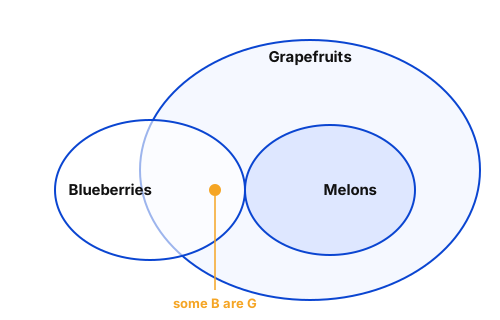
Some Blueberries are Melons.
All Melons are Grapefruits.
Conclusions:
I. No Blueberries are Grapefruits.
II. Some Grapefruits are Blueberries.
दिए गए कथन/कथनों और निष्कर्षों को ध्यानपूर्वक पढ़िए। यह मानते हुए कि कथनों में दी गई जानकारी सत्य है, भले ही वह सामान्य रूप से ज्ञात तथ्यों से भिन्न प्रतीत होती हो, निर्णय कीजिए कि दिए गए निष्कर्षों में से कौन-सा/से निष्कर्ष कथन/कथनों का तार्किक रूप से अनुसरण करता है/करते हैं।
कथन:
कुछ ब्लूबेरी, खरबूजे हैं।
सभी खरबूजे, चकोतरे हैं।
निष्कर्ष:
I. कोई ब्लूबेरी, चकोतरा नहीं है।
II. कुछ चकोतरे, ब्लूबेरी हैं।
  1. ABoth conclusions (I) and (II) follow.निष्कर्ष (I) और (II) दोनों अनुसरण करते हैं।
  2. BNeither conclusion (I) nor (II) follows.न तो निष्कर्ष (I) और न ही (II) अनुसरण करता है।
  3. COnly conclusion (I) follows.केवल निष्कर्ष (I) अनुसरण करता है।
  4. DOnly conclusion (II) follows.केवल निष्कर्ष (II) अनुसरण करता है।
Show answer

Concept: Draw the least-overlap Venn diagram and test each conclusion.

  1. All Melons lie inside Grapefruits; some Blueberries are Melons.
  2. So those Blueberries are also Grapefruits ⇒ “Some Grapefruits are Blueberries” is definite — II follows.
  3. I (“No Blueberries are Grapefruits”) contradicts this — does not follow.

Trick: Some A are B + All B are C ⇒ Some A are C (and its converse Some C are A).

Answer: (D) Only conclusion (II) follows.

अवधारणा: न्यूनतम ओवरलैप वाला वेन आरेख बनाएँ और हर निष्कर्ष जाँचें।

  1. सभी Melons, Grapefruits के अंदर; कुछ Blueberries, Melons हैं।
  2. अतः वे Blueberries, Grapefruits भी हैं ⇒ “कुछ Grapefruits, Blueberries हैं” निश्चित — II सही।
  3. I इसका उलटा है — अनुसरण नहीं करता।

ट्रिक: कुछ A, B हैं + सभी B, C हैं ⇒ कुछ A, C हैं (और कुछ C, A हैं)।

उत्तर: (D) केवल निष्कर्ष (II) अनुसरण करता है।

RRB NTPC Undergraduate CBT 1General Intelligence and ReasoningSyllogismRRB NTPC Undergraduate CBT 1 2024 · 3 Sep Shift 3 →
Q4775.
Refer to the five three-digit numbers given below and answer the question that follows. (Left) 869 509 779 491 863 (Right)
(Example: 697 – first digit = 6, second digit = 9, and third digit = 7)
(NOTE: All operations to be done from left to right.)
If all the numbers are arranged in ascending order, the position of how many numbers will remain unchanged?
नीचे दी गई पाँच तीन-अंकीय संख्याओं को देखिए और उसके बाद दिए गए प्रश्न का उत्तर दीजिए। (बाएँ) 869 509 779 491 863 (दाएँ)
(उदाहरण: 697 – पहला अंक = 6, दूसरा अंक = 9, और तीसरा अंक = 7)
(ध्यान दें: सभी संक्रियाएँ बाएँ से दाएँ की जानी हैं।)
यदि सभी संख्याओं को आरोही क्रम में व्यवस्थित किया जाए, तो कितनी संख्याओं का स्थान अपरिवर्तित रहेगा?
  1. A4
  2. B2
  3. C3
  4. D1
Show answer

Concept: Sort the numbers and compare each position with the original.

  1. Original: 869, 509, 779, 491, 863
  2. Ascending: 491, 509, 779, 863, 869
  3. Same position: 509 (2nd) and 779 (3rd) ⇒ 2 numbers

Trick: Write both rows one under the other and tick matching columns.

Answer: (B) 2

अवधारणा: संख्याओं को आरोही क्रम में लगाकर हर स्थान मूल से मिलाएँ।

  1. मूल: 869, 509, 779, 491, 863
  2. आरोही: 491, 509, 779, 863, 869
  3. अपरिवर्तित: 509 (दूसरा) और 779 (तीसरा) ⇒ 2 संख्याएँ

ट्रिक: दोनों पंक्तियाँ एक के नीचे एक लिखकर मिलान करें।

उत्तर: (B) 2

RRB NTPC Undergraduate CBT 1General Intelligence and ReasoningNumber ArrangementRRB NTPC Undergraduate CBT 1 2024 · 3 Sep Shift 3 →
Q4776.
What should come in place of the question mark (?) in the given series?
83 91 107 139 203 ?
दी गई श्रृंखला में प्रश्न चिह्न (?) के स्थान पर क्या आना चाहिए?
83 91 107 139 203 ?
  1. A335
  2. B321
  3. C332
  4. D331
Show answer

Concept: Differences double every time.

  1. Differences: 8, 16, 32, 64
  2. Next difference = 128
  3. 203 + 128 = 331

Trick: When differences are 8, 16, 32 … they form a ×2 chain.

Answer: (D) 331

अवधारणा: अंतर हर बार दोगुना होता है।

  1. अंतर: 8, 16, 32, 64
  2. अगला अंतर = 128
  3. 203 + 128 = 331

ट्रिक: अंतर 8, 16, 32 … हों तो ×2 की श्रृंखला है।

उत्तर: (D) 331

RRB NTPC Undergraduate CBT 1General Intelligence and ReasoningNumber SeriesRRB NTPC Undergraduate CBT 1 2024 · 3 Sep Shift 3 →
Q4777.
What will come in the place of the question mark (?) in the following equation, if ‘+’ and ‘−’ are interchanged and ‘×’ and ‘÷’ are interchanged?
25 × 5 − 18 ÷ 3 + 15 = ?
यदि ‘+’ और ‘−’ को आपस में बदल दिया जाए तथा ‘×’ और ‘÷’ को आपस में बदल दिया जाए, तो निम्नलिखित समीकरण में प्रश्न चिह्न (?) के स्थान पर क्या आएगा?
25 × 5 − 18 ÷ 3 + 15 = ?
  1. A42
  2. B41
  3. C44
  4. D43
Show answer

Concept: Interchange the signs, then solve with BODMAS.

  1. 25×5−18÷3+15 becomes 25÷5+18×3−15
  2. =5+54−15=44

Trick: Do ÷ and × first after swapping: 5 and 54.

Answer: (C) 44

अवधारणा: चिह्न बदलें, फिर BODMAS से हल करें।

  1. 25×5−18÷3+15 बनता है 25÷5+18×3−15
  2. =5+54−15=44

ट्रिक: चिह्न बदलने के बाद पहले ÷ और ×: 5 और 54।

उत्तर: (C) 44

RRB NTPC Undergraduate CBT 1General Intelligence and ReasoningMathematical OperationsRRB NTPC Undergraduate CBT 1 2024 · 3 Sep Shift 3 →
Q4778.
Select the pair that follows the same pattern as that followed by the two pairs given below. Both pairs follow the same pattern.
QMJ−GCZ
CYV−SOL
उस युग्म का चयन कीजिए जो उसी पैटर्न का अनुसरण करता है जिसका अनुसरण नीचे दिए गए दो युग्म करते हैं। दोनों युग्म एक ही पैटर्न का अनुसरण करते हैं।
QMJ−GCZ
CYV−SOL
  1. AUQN−JGC
  2. BUPL−JFC
  3. CVRO−LHE
  4. DUPL−KGD
Show answer

Concept: Compare letter positions of each pair.

  1. QMJ → GCZ: Q(17)→G(7), M(13)→C(3), J(10)→Z(26): each −10 (wrapping after A)
  2. CYV → SOL: C−10 = S, Y−10 = O, V−10 = L
  3. VRO: V(22)−10 = L, R(18)−10 = H, O(15)−10 = E ⇒ LHE

Trick: −10 is the same as +16; using +16 makes wrap-arounds easy.

Answer: (C) VRO−LHE

अवधारणा: हर जोड़ी के अक्षरों के क्रमांक मिलाएँ।

  1. QMJ → GCZ: Q(17)→G(7), M(13)→C(3), J(10)→Z(26): हर अक्षर −10
  2. CYV → SOL: C−10 = S, Y−10 = O, V−10 = L
  3. VRO: V−10 = L, R−10 = H, O−10 = E ⇒ LHE

ट्रिक: −10 = +16; चक्र (wrap) में +16 जोड़ना आसान है।

उत्तर: (C) VRO−LHE

RRB NTPC Undergraduate CBT 1General Intelligence and ReasoningLetter AnalogyRRB NTPC Undergraduate CBT 1 2024 · 3 Sep Shift 3 →
Q4779.
In a certain code language, ‘RAID’ is coded as ‘3527’ and ‘DOGS’ is coded as ‘1346’. What is the code for ‘D’ in the given code language?
एक निश्चित कूट भाषा में, ‘RAID’ को ‘3527’ के रूप में कूटबद्ध किया जाता है और ‘DOGS’ को ‘1346’ के रूप में कूटबद्ध किया जाता है। दी गई कूट भाषा में ‘D’ के लिए कूट क्या है?
  1. A7
  2. B3
  3. C4
  4. D1
Show answer

Concept: The letter common to both words takes the digit common to both codes.

  1. RAID → 3527, DOGS → 1346
  2. Common letter: D; common digit: 3
  3. So D = 3

Trick: Common letter ↔ common digit (order of digits may be jumbled).

Answer: (B) 3

अवधारणा: दोनों शब्दों में उभयनिष्ठ अक्षर को दोनों कोड का उभयनिष्ठ अंक मिलता है।

  1. RAID → 3527, DOGS → 1346
  2. उभयनिष्ठ अक्षर: D; उभयनिष्ठ अंक: 3
  3. अतः D = 3

ट्रिक: उभयनिष्ठ अक्षर ↔ उभयनिष्ठ अंक (अंकों का क्रम बदला हो सकता है)।

उत्तर: (B) 3

RRB NTPC Undergraduate CBT 1General Intelligence and ReasoningCoding–DecodingRRB NTPC Undergraduate CBT 1 2024 · 3 Sep Shift 3 →
Q4780.
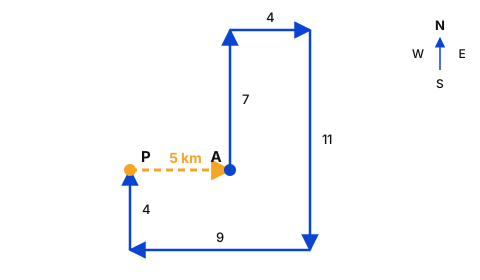
Umar starts from Point A and drives 7 km towards North. He then takes a right turn, drives 4 km, turns right and drives 11 km. He then takes a right turn and drives 9 km. He takes a final right turn, drives 4 km and stops at Point P. How far (shortest distance) and towards which direction should he drive in order to reach Point A again? (All turns are 90° turns only unless specified.)
उमर बिंदु A से चलना शुरू करता है और उत्तर की ओर 7 km गाड़ी चलाता है। फिर वह दाएँ मुड़ता है, 4 km गाड़ी चलाता है, दाएँ मुड़ता है और 11 km गाड़ी चलाता है। फिर वह दाएँ मुड़ता है और 9 km गाड़ी चलाता है। वह अंतिम बार दाएँ मुड़ता है, 4 km गाड़ी चलाता है और बिंदु P पर रुक जाता है। बिंदु A पर पुनः पहुँचने के लिए उसे कितनी दूर (न्यूनतम दूरी) और किस दिशा में गाड़ी चलानी चाहिए? (जब तक निर्दिष्ट न हो, सभी मोड़ केवल 90° के मोड़ हैं।)
  1. A4 km to the Northउत्तर की ओर 4 km
  2. B5 km to the Northउत्तर की ओर 5 km
  3. C4 km to the Southदक्षिण की ओर 4 km
  4. D5 km to the Eastपूर्व की ओर 5 km
Show answer

Concept: Plot each move on a grid with A at (0, 0).

  1. 7 km N → (0, 7); right ⇒ 4 km E → (4, 7)
  2. Right ⇒ 11 km S → (4, −4); right ⇒ 9 km W → (−5, −4)
  3. Right ⇒ 4 km N → P(−5, 0)
  4. P is 5 km west of A ⇒ drive 5 km east

Trick: Net N–S: 7 − 11 + 4 = 0; net E–W: 4 − 9 = −5 (west). Go back 5 km east.

Answer: (D) 5 km to the East

अवधारणा: A को (0, 0) मानकर हर चाल ग्रिड पर बनाएँ।

  1. 7 km उत्तर → (0, 7); दाएँ ⇒ 4 km पूर्व → (4, 7)
  2. दाएँ ⇒ 11 km दक्षिण → (4, −4); दाएँ ⇒ 9 km पश्चिम → (−5, −4)
  3. दाएँ ⇒ 4 km उत्तर → P(−5, 0)
  4. P, A से 5 km पश्चिम ⇒ 5 km पूर्व जाना होगा

ट्रिक: उत्तर–दक्षिण: 7 − 11 + 4 = 0; पूर्व–पश्चिम: 4 − 9 = −5 (पश्चिम)। 5 km पूर्व लौटें।

उत्तर: (D) पूर्व की ओर 5 km

RRB NTPC Undergraduate CBT 1General Intelligence and ReasoningDirection and DistanceRRB NTPC Undergraduate CBT 1 2024 · 3 Sep Shift 3 →