Question bank

Q&A: practice questions with answers

Search questions on any topic. Filter by exam category, exam, subject and topic, try the question, then open the answer and explanation.

Courses – airGurukul

8,495 questions found.

Q461.
The marks scored by 10 students are given below.
19, 15, 10, 14, 13, 18, 19, 19, 11, 11
The mode of the data is:
10 विद्यार्थियों द्वारा प्राप्त अंक नीचे दिए गए हैं।
19, 15, 10, 14, 13, 18, 19, 19, 11, 11
आँकड़ों का बहुलक (mode) है:
  1. A19
  2. B20
  3. C15
  4. D10
Show answer

Concept: Mode is the value that occurs most often.

  1. Frequencies: 19 → 3 times, 11 → 2 times, others once.
  2. Highest frequency is for 19.

Trick: Just count repeats – no calculation needed.

Answer: (A) 19

अवधारणा: बहुलक (mode) वह मान है जो सबसे अधिक बार आता है।

  1. बारंबारता: 19 → 3 बार, 11 → 2 बार, बाकी 1-1 बार।
  2. सबसे अधिक बारंबारता 19 की है।

ट्रिक: केवल दोहराव गिनें – गणना की ज़रूरत नहीं।

उत्तर: (A) 19
RRB NTPC Undergraduate CBT 1MathematicsStatistics – ModeRRB NTPC Undergraduate CBT 1 2024 · 28 Aug Shift 2 →
Q462.
A shopkeeper lists the price of a fan at 50% above its cost price and offers a 30% discount on its list price. If he earns a profit of ₹91, then what is the list price (in ₹) of the fan?
एक दुकानदार एक पंखे का मूल्य उसके क्रय मूल्य से 50% अधिक अंकित करता है और उसके अंकित मूल्य पर 30% की छूट देता है। यदि वह ₹91 का लाभ अर्जित करता है, तो पंखे का अंकित मूल्य (₹ में) कितना है?
  1. A2,774
  2. B2,697
  3. C2,730
  4. D3,025
Show answer

Concept: Take CP =x; apply the markup and the discount one after the other.

  1. LP=1.5x
  2. SP=1.5x×0.7=1.05x, so profit =0.05x
  3. 0.05x=91⇒x=1820
  4. LP=1.5×1820=2730

Trick: Net effect of +50% and −30%: 50−30−50×30100=5% profit.

Answer: (C) 2,730

अवधारणा: क्रय मूल्य =x लेकर अंकन और छूट क्रम से लगाइए।

  1. LP=1.5x
  2. SP=1.5x×0.7=1.05x, अतः लाभ =0.05x
  3. 0.05x=91⇒x=1820
  4. LP=1.5×1820=2730

ट्रिक: +50% और −30% का शुद्ध प्रभाव: 50−30−50×30100=5% लाभ।

उत्तर: (C) 2,730

RRB NTPC Undergraduate CBT 1MathematicsProfit, Loss and DiscountRRB NTPC Undergraduate CBT 1 2024 · 28 Aug Shift 2 →
Q463.
Which of the following numbers divides 2,45,015?
निम्नलिखित में से कौन-सी संख्या 2,45,015 को विभाजित करती है?
  1. A2
  2. B11
  3. C15
  4. D5
Show answer

Concept: Check each divisor with its divisibility rule.

  1. Last digit is 5 (odd) → not divisible by 2; divisible by 5 ✔
  2. Digit sum =2+4+5+0+1+5=17 → not divisible by 3, hence not by 15
  3. For 11: (5+0+4)−(1+5+2)=1 → not divisible by 11

Yaad rakhein: A number ending in 0 or 5 is always divisible by 5.

Answer: (D) 5

अवधारणा: प्रत्येक भाजक को उसके विभाज्यता नियम से जाँचें।

  1. अंतिम अंक 5 (विषम) → 2 से नहीं; 5 से विभाज्य ✔
  2. अंकों का योग =17 → 3 से नहीं, अतः 15 से भी नहीं
  3. 11 के लिए: (5+0+4)−(1+5+2)=1 → 11 से नहीं

याद रखें: 0 या 5 पर समाप्त होने वाली संख्या सदैव 5 से विभाज्य होती है।

उत्तर: (D) 5

RRB NTPC Undergraduate CBT 1MathematicsDivisibility RulesRRB NTPC Undergraduate CBT 1 2024 · 28 Aug Shift 2 →
Q464.
If the third proportional of 9 and 51 be x, then what is the value of x?
यदि 9 और 51 का तृतीयानुपाती x हो, तो x का मान क्या है?
  1. A287
  2. B288
  3. C291
  4. D289
Show answer

Concept: Third proportional of a and b is x where a:b=b:x, i.e. x=b2a.

  1. x=5129
  2. =26019=289

Trick: 519=173, so x=51×173=17×17=289.

Answer: (D) 289

अवधारणा: a और b का तृतीयानुपाती x: a:b=b:x, अर्थात x=b2a।

  1. x=5129
  2. =26019=289

ट्रिक: 519=173, अतः x=51×173=172=289।

उत्तर: (D) 289

RRB NTPC Undergraduate CBT 1MathematicsRatio and ProportionRRB NTPC Undergraduate CBT 1 2024 · 28 Aug Shift 2 →
Q465.
The marked price of an article is ₹4,500. It is sold at successive discounts of 25% and 20%. Find the selling price of the article (in ₹).
एक वस्तु का अंकित मूल्य ₹4,500 है। इसे 25% और 20% की क्रमिक छूटों पर बेचा जाता है। वस्तु का विक्रय मूल्य (₹ में) ज्ञात कीजिए।
  1. A2,700
  2. B2,800
  3. C2,750
  4. D2,900
Show answer

Concept: Successive discounts multiply: SP=MP×100−d1100×100−d2100.

  1. 4500×0.75=3375
  2. 3375×0.8=2700

Trick: 25% and 20% together =25+20−25×20100=40% off: 0.6×4500=2700.

Answer: (A) 2,700

अवधारणा: क्रमिक छूट गुणा होती है: SP=MP×100−d1100×100−d2100।

  1. 4500×0.75=3375
  2. 3375×0.8=2700

ट्रिक: 25% और 20% मिलकर =25+20−25×20100=40% छूट: 0.6×4500=2700।

उत्तर: (A) 2,700

RRB NTPC Undergraduate CBT 1MathematicsSuccessive DiscountsRRB NTPC Undergraduate CBT 1 2024 · 28 Aug Shift 2 →
Q466.
Mahesh bought some pens at the rate of ₹150 a dozen. He sold them for ₹44 each. His profit percentage is ______%.
महेश ने ₹150 प्रति दर्जन की दर से कुछ पेन खरीदे। उसने उन्हें ₹44 प्रति पेन की दर से बेच दिया। उसका लाभ प्रतिशत ______% है।
  1. A256
  2. B250
  3. C254
  4. D252
Show answer

Concept: Compare cost and selling price of one pen: Profit%=SP−CPCP×100.

  1. CP of one pen =15012=12.5
  2. SP =44, profit =31.5
  3. Profit%=31.512.5×100=252%

Trick: Compare per dozen: SP =44×12=528 vs CP 150 → profit 378, 378150×100=252.

Answer: (D) 252

अवधारणा: एक पेन का क्रय और विक्रय मूल्य तुलना करें: लाभ%=SP−CPCP×100।

  1. एक पेन का CP =15012=12.5
  2. SP =44, लाभ =31.5
  3. लाभ%=31.512.5×100=252%

ट्रिक: दर्जन के हिसाब से: SP =528, CP =150 → लाभ 378, 378150×100=252।

उत्तर: (D) 252

RRB NTPC Undergraduate CBT 1MathematicsProfit and LossRRB NTPC Undergraduate CBT 1 2024 · 28 Aug Shift 2 →
Q467.
A toy designer is making a spherical ball with a radius of 6 cm. What is the surface area of the ball? (Use π = 3.14)
एक खिलौना डिज़ाइनर 6 cm त्रिज्या वाली एक गोलाकार गेंद बना रहा है। गेंद का पृष्ठीय क्षेत्रफल कितना है? (π = 3.14 का प्रयोग कीजिए)
  1. A678.24 cm2
  2. B301.44 cm2
  3. C452.16 cm2
  4. D282.74 cm2
Show answer

Concept: Surface area of a sphere =4πr2.

  1. 4×3.14×62
  2. =12.56×36=452.16cm2

Trick: 4πr2=4×113.04: area of one great circle (πr2=113.04) taken four times.

Answer: (C) 452.16 cm2

अवधारणा: गोले का पृष्ठीय क्षेत्रफल =4πr2।

  1. 4×3.14×62
  2. =12.56×36=452.16cm2

ट्रिक: 4πr2=4×113.04: वृहत वृत्त का क्षेत्रफल (πr2=113.04) चार गुना।

उत्तर: (C) 452.16 cm2

RRB NTPC Undergraduate CBT 1MathematicsMensuration – SphereRRB NTPC Undergraduate CBT 1 2024 · 28 Aug Shift 2 →
Q468.
The population of a district is 374000, out of which 170000 are males. 78% of the population is literate. If 72% males are literate, then what percentage of females are literate?
एक ज़िले की जनसंख्या 374000 है, जिसमें से 170000 पुरुष हैं। जनसंख्या का 78% साक्षर है। यदि 72% पुरुष साक्षर हैं, तो कितने प्रतिशत महिलाएँ साक्षर हैं?
  1. A85%
  2. B83%
  3. C81%
  4. D80%
Show answer

Concept: Literate females = total literates − literate males.

  1. Total literates =0.78×374000=291720
  2. Literate males =0.72×170000=122400
  3. Females =204000; literate females =169320
  4. 169320204000×100=83%

Trick: Alligation: males 170 and females 204 (ratio 5 : 6) mix to 78%; 78−72f−78=65⇒f=83.

Answer: (B) 83%

अवधारणा: साक्षर महिलाएँ = कुल साक्षर − साक्षर पुरुष।

  1. कुल साक्षर =0.78×374000=291720
  2. साक्षर पुरुष =0.72×170000=122400
  3. महिलाएँ =204000; साक्षर महिलाएँ =169320
  4. 169320204000×100=83%

ट्रिक: एलिगेशन: पुरुष : महिला =5:6, मिश्रण 78%; 78−72f−78=65⇒f=83।

उत्तर: (B) 83%

RRB NTPC Undergraduate CBT 1MathematicsPercentage – PopulationRRB NTPC Undergraduate CBT 1 2024 · 28 Aug Shift 2 →
Q469.
Arjun and Malaika have to travel from Delhi to Kanpur in their respective cars. Arjun is driving at 140 km/hr while Malaika is driving at 65 km/hr. Find the time taken by Malaika to reach Kanpur if Arjun takes 13 hours.
अर्जुन और मलाइका को अपनी-अपनी कारों से दिल्ली से कानपुर की यात्रा करनी है। अर्जुन 140 km/hr की चाल से गाड़ी चला रहा है, जबकि मलाइका 65 km/hr की चाल से गाड़ी चला रही है। यदि अर्जुन को 13 घंटे लगते हैं, तो मलाइका द्वारा कानपुर पहुँचने में लिया गया समय ज्ञात कीजिए।
  1. A25 hours25 घंटे
  2. B34 hours34 घंटे
  3. C26 hours26 घंटे
  4. D28 hours28 घंटे
Show answer

Concept: Same distance, so Distance=Speed×Time is common to both.

  1. Distance =140×13=1820km
  2. Malaika's time =182065=28 hours

Trick: For equal distance, time ∝ 1speed: 13×14065=13×2813=28.

Answer: (D) 28 hours

अवधारणा: दूरी समान है, अतः दूरी=चाल×समय दोनों के लिए एक।

  1. दूरी =140×13=1820km
  2. मलाइका का समय =182065=28 घंटे

ट्रिक: समान दूरी पर समय ∝ 1चाल: 13×14065=28।

उत्तर: (D) 28 घंटे

RRB NTPC Undergraduate CBT 1MathematicsSpeed, Time and DistanceRRB NTPC Undergraduate CBT 1 2024 · 28 Aug Shift 2 →
Q470.
Anand, Preeti and Dev invested ₹1,310, ₹1,350 and ₹1,140, respectively to start a business. If the profit at the end of the year is ₹1,630, what is Dev's share of the profit?
आनंद, प्रीति और देव ने एक व्यवसाय शुरू करने के लिए क्रमशः ₹1,310, ₹1,350 और ₹1,140 का निवेश किया। यदि वर्ष के अंत में लाभ ₹1,630 है, तो लाभ में देव का हिस्सा कितना है?
  1. A₹488
  2. B₹487
  3. C₹489
  4. D₹490
Show answer

Concept: For equal time, profit is shared in the ratio of investments.

  1. Ratio =1310:1350:1140=131:135:114, total =380
  2. Dev's share =114380×1630
  3. =0.3×1630=489

Trick: 114380=310 exactly – Dev gets 30% of the profit.

Answer: (C) ₹489

अवधारणा: समान समय के लिए लाभ निवेश के अनुपात में बँटता है।

  1. अनुपात =1310:1350:1140=131:135:114, योग =380
  2. देव का हिस्सा =114380×1630
  3. =0.3×1630=489

ट्रिक: 114380=310 – देव को लाभ का ठीक 30% मिलता है।

उत्तर: (C) ₹489

RRB NTPC Undergraduate CBT 1MathematicsPartnershipRRB NTPC Undergraduate CBT 1 2024 · 28 Aug Shift 2 →
Q471.
What should come in place of the question mark (?) in the given series?
27 31 40 56 81 ?
दी गई शृंखला में प्रश्न चिह्न (?) के स्थान पर क्या आना चाहिए?
27 31 40 56 81 ?
  1. A121
  2. B120
  3. C118
  4. D117
Show answer

Concept: Look at the differences between consecutive terms.

  1. Differences: 4, 9, 16, 25 = 22,32,42,52
  2. Next difference =62=36
  3. 81+36=117

Trick: Slowly growing gaps that are perfect squares → add the next square.

Answer: (D) 117

अवधारणा: क्रमागत पदों का अंतर देखें।

  1. अंतर: 4, 9, 16, 25 = 22,32,42,52
  2. अगला अंतर =62=36
  3. 81+36=117

ट्रिक: अंतर पूर्ण वर्ग हों तो अगला वर्ग जोड़ें।

उत्तर: (D) 117

RRB NTPC Undergraduate CBT 1General Intelligence and ReasoningNumber SeriesRRB NTPC Undergraduate CBT 1 2024 · 28 Aug Shift 2 →
Q472.
In a certain code language,
A $ B means ‘A is the son of B’
A + B means ‘A is the brother of B’
A @ B means ‘A is the wife of B’
A ÷ B means ‘A is the father of B’
Based on the above, how is E related to N if ‘E @ F $ G ÷ M + N’?
एक निश्चित कूट भाषा में,
A $ B का अर्थ है ‘A, B का पुत्र है’
A + B का अर्थ है ‘A, B का भाई है’
A @ B का अर्थ है ‘A, B की पत्नी है’
A ÷ B का अर्थ है ‘A, B का पिता है’
उपर्युक्त के आधार पर, यदि ‘E @ F $ G ÷ M + N’ है, तो E का N से क्या संबंध है?
  1. ABrother's daughterभाई की पुत्री
  2. BBrother's wifeभाई की पत्नी
  3. CWifeपत्नी
  4. DDaughterपुत्री
Show answer

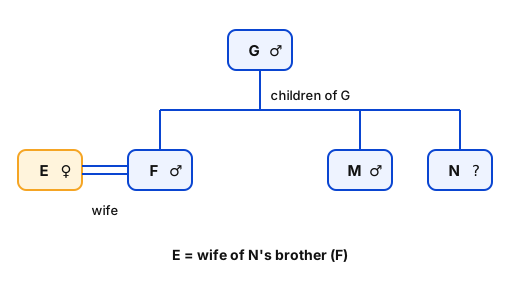
Concept: Decode each symbol and draw the family tree.

  1. E @ F: E is the wife of F
  2. F $ G: F is the son of G (F is male)
  3. G ÷ M: G is the father of M; M + N: M is the brother of N
  4. So F and N are both children of G – F is N's brother; E is F's wife

Trick: Wife of a sibling's brother = brother's wife (bhabhi).

Answer: (B) Brother's wife

अवधारणा: प्रत्येक चिह्न को डिकोड करके वंश-वृक्ष बनाइए।

  1. E @ F: E, F की पत्नी है
  2. F $ G: F, G का पुत्र है (F पुरुष)
  3. G ÷ M: G, M का पिता; M + N: M, N का भाई
  4. अतः F और N दोनों G की संतान – F, N का भाई; E, F की पत्नी

ट्रिक: भाई की पत्नी = भाभी (Brother's wife)।

उत्तर: (B) Brother's wife

RRB NTPC Undergraduate CBT 1General Intelligence and ReasoningCoded Blood RelationsRRB NTPC Undergraduate CBT 1 2024 · 28 Aug Shift 2 →
Q473.
What should come in place of the question mark (?) in the given series based on the English alphabetical order?
WVH BAM GFR LKW ?
अंग्रेज़ी वर्णमाला क्रम के आधार पर दी गई शृंखला में प्रश्न चिह्न (?) के स्थान पर क्या आना चाहिए?
WVH BAM GFR LKW ?
  1. AQPB
  2. BQBP
  3. CQWE
  4. DQEW
Show answer

Concept: Compare letters at the same position in successive clusters.

  1. W→B, B→G, G→L: +5 each time
  2. V→A→F→K: +5; H→M→R→W: +5
  3. Next: L+5=Q, K+5=P, W+5=B → QPB

Trick: First two letters are always consecutive in reverse (WV, BA, GF, LK → QP).

Answer: (A) QPB

अवधारणा: क्रमागत समूहों में समान स्थान के अक्षरों की तुलना करें।

  1. W→B, B→G, G→L: हर बार +5
  2. V→A→F→K: +5; H→M→R→W: +5
  3. अगला: L+5=Q, K+5=P, W+5=B → QPB

ट्रिक: पहले दो अक्षर हमेशा उल्टे क्रम में लगातार हैं (WV, BA, GF, LK → QP)।

उत्तर: (A) QPB

RRB NTPC Undergraduate CBT 1General Intelligence and ReasoningLetter SeriesRRB NTPC Undergraduate CBT 1 2024 · 28 Aug Shift 2 →
Q474.
Based on the English alphabetical order, three of the following four letter-cluster pairs are alike in a certain way and thus form a group. Which letter-cluster pair DOES NOT belong to that group?
(Note: The odd one out is not based on the number of consonants/vowels or their position in the letter-cluster.)
अंग्रेज़ी वर्णमाला क्रम के आधार पर, निम्नलिखित चार अक्षर-समूह युग्मों में से तीन किसी निश्चित प्रकार से एक समान हैं और इस प्रकार एक समूह बनाते हैं। कौन-सा अक्षर-समूह युग्म उस समूह से संबंधित नहीं है?
(ध्यान दें: असंगत अक्षर-समूह, उस अक्षर-समूह में व्यंजनों/स्वरों की संख्या या उनके स्थान पर आधारित नहीं है।)
  1. APT-KQ
  2. BJN-EK
  3. CMQ-HN
  4. DSW-NU
Show answer

Concept: Compare the first letter of each cluster with the first letter of the pair, and second with second.

  1. PT-KQ: P−5=K, T−3=Q
  2. JN-EK: J−5=E, N−3=K; MQ-HN: M−5=H, Q−3=N
  3. SW-NU: S−5=N but W−2=U ✘

Trick: Write positions (P16, T20, K11, Q17) – the pattern −5,−3 shows up quickly.

Answer: (D) SW-NU

अवधारणा: प्रत्येक जोड़ी के पहले अक्षर की तुलना दूसरे क्लस्टर के पहले अक्षर से, और दूसरे की दूसरे से करें।

  1. PT-KQ: P−5=K, T−3=Q
  2. JN-EK: J−5=E, N−3=K; MQ-HN: M−5=H, Q−3=N
  3. SW-NU: S−5=N पर W−2=U ✘

ट्रिक: अक्षरों की स्थिति लिखें (P16, T20, K11, Q17) – −5,−3 का पैटर्न तुरंत दिखेगा।

उत्तर: (D) SW-NU

RRB NTPC Undergraduate CBT 1General Intelligence and ReasoningLetter Analogy – Odd One OutRRB NTPC Undergraduate CBT 1 2024 · 28 Aug Shift 2 →
Q475.
Read the given statements and conclusions carefully. Assuming that the information given in the statements is true, even if it appears to be at variance with commonly known facts, decide which of the given conclusion(s) logically follow(s) from the statements.
Statements:
All letters are mails.
All schedules are mails.
Conclusions:
(I) Some letters are schedules.
(II) Some mails are schedules.
दिए गए कथनों और निष्कर्षों को ध्यानपूर्वक पढ़िए। कथनों में दी गई जानकारी को सत्य मानते हुए, भले ही वह सामान्यतः ज्ञात तथ्यों से भिन्न प्रतीत होती हो, निर्णय कीजिए कि दिए गए निष्कर्षों में से कौन-सा/कौन-से निष्कर्ष तार्किक रूप से कथनों का अनुसरण करता है/करते हैं।
कथन:
सभी पत्र, डाक हैं।
सभी अनुसूचियाँ, डाक हैं।
निष्कर्ष:
(I) कुछ पत्र, अनुसूचियाँ हैं।
(II) कुछ डाक, अनुसूचियाँ हैं।
  1. ANeither conclusion (I) nor (II) follows.न तो निष्कर्ष (I) और न ही (II) अनुसरण करता है।
  2. BOnly conclusion (II) follows.केवल निष्कर्ष (II) अनुसरण करता है।
  3. COnly conclusion (I) follows.केवल निष्कर्ष (I) अनुसरण करता है।
  4. DBoth conclusions (I) and (II) follow.निष्कर्ष (I) और (II) दोनों अनुसरण करते हैं।
Show answer

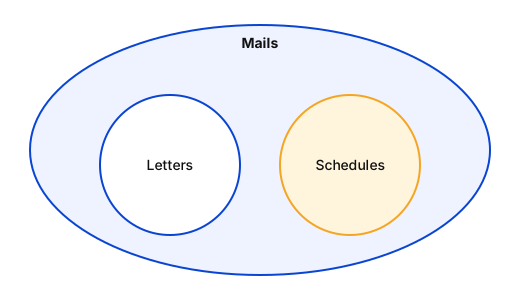
Concept: Two 'All' statements with a common predicate give no definite link between the subjects.

  1. Letters and Schedules are both inside Mails but need not overlap → (I) does not follow.
  2. All schedules are mails, so some mails are schedules → (II) follows.

Yaad rakhein: 'All A are B' always implies 'Some B are A'.

Answer: (B) Only conclusion (II) follows.

अवधारणा: समान विधेय वाले दो 'सभी' कथन से कर्ताओं में निश्चित संबंध नहीं बनता।

  1. Letters और Schedules दोनों Mails के अंदर हैं पर आवश्यक नहीं कि आपस में मिलें → (I) अनुसरण नहीं करता।
  2. सभी schedules, mails हैं, अतः कुछ mails, schedules हैं → (II) अनुसरण करता है।

याद रखें: 'सभी A, B हैं' से सदैव 'कुछ B, A हैं' निकलता है।

उत्तर: (B) Only conclusion (II) follows.

RRB NTPC Undergraduate CBT 1General Intelligence and ReasoningSyllogismRRB NTPC Undergraduate CBT 1 2024 · 28 Aug Shift 2 →
Q476.
Select the set in which the numbers are related in the same way as are the numbers of the following sets.
(NOTE: Operations should be performed on the whole numbers, without breaking down the numbers into their constituent digits. E.g. 13 – Operations on 13 such as adding to/subtracting from/multiplying with 13 can be performed. Breaking down 13 into 1 and 3 and then performing mathematical operations on 1 and 3 is not allowed.)
(16, 63, 16)
(36, 111, 4)
उस समुच्चय का चयन कीजिए जिसमें संख्याएँ उसी प्रकार संबंधित हैं जिस प्रकार निम्नलिखित समुच्चयों की संख्याएँ संबंधित हैं।
(ध्यान दें: संख्याओं को उनके घटक अंकों में तोड़े बिना, पूर्ण संख्याओं पर संक्रियाएँ की जानी चाहिए। उदाहरण के लिए 13 – 13 पर संक्रियाएँ जैसे 13 में जोड़ना/घटाना/गुणा करना आदि की जा सकती हैं। 13 को 1 और 3 में तोड़ना और फिर 1 और 3 पर गणितीय संक्रियाएँ करना वर्जित है।)
(16, 63, 16)
(36, 111, 4)
  1. A(47, 144, 4)
  2. B(48, 162, 15)
  3. C(44, 155, 20)
  4. D(1, 12, 6)
Show answer

Concept: Find the rule linking the middle number to the outer numbers: here middle =3×first+third−1.

  1. (16, 63, 16): 3×16+16−1=63 ✔; (36, 111, 4): 108+4−1=111 ✔
  2. (47, 144, 4): 141+4−1=144 ✔
  3. Others: 144+15−1=158≠162, 132+20−1=151≠155, 3+6−1=8≠12

Trick: Test the rule on both given sets before checking options.

Answer: (A) (47, 144, 4)

अवधारणा: मध्य संख्या का बाहरी संख्याओं से नियम: मध्य =3×पहली+तीसरी−1।

  1. (16, 63, 16): 3×16+16−1=63 ✔; (36, 111, 4): 108+4−1=111 ✔
  2. (47, 144, 4): 141+4−1=144 ✔
  3. अन्य: 158≠162, 151≠155, 8≠12

ट्रिक: विकल्प जाँचने से पहले नियम दोनों दिए गए समूहों पर परखें।

उत्तर: (A) (47, 144, 4)

RRB NTPC Undergraduate CBT 1General Intelligence and ReasoningNumber TriadsRRB NTPC Undergraduate CBT 1 2024 · 28 Aug Shift 2 →
Q477.
If ‘A’ stands for ‘÷’, ‘B’ stands for ‘x’, ‘C’ stands for ‘+’ and ‘D’ stands for ‘−’, what will come in place of the question mark (?) in the following equation?
48 D 14 B 3 C 27 A 3 = ?
यदि ‘A’ का अर्थ ‘÷’, ‘B’ का अर्थ ‘x’, ‘C’ का अर्थ ‘+’ और ‘D’ का अर्थ ‘−’ है, तो निम्नलिखित समीकरण में प्रश्न चिह्न (?) के स्थान पर क्या आएगा?
48 D 14 B 3 C 27 A 3 = ?
  1. A24
  2. B31
  3. C15
  4. D37
Show answer

Concept: Replace letters by signs, then use BODMAS.

  1. 48−14×3+27÷3
  2. =48−42+9
  3. =15

Trick: Do × and ÷ first: 42 and 9; then 48−42+9.

Answer: (C) 15

अवधारणा: अक्षरों को चिह्नों से बदलें, फिर BODMAS लगाएँ।

  1. 48−14×3+27÷3
  2. =48−42+9
  3. =15

ट्रिक: पहले × और ÷: 42 और 9; फिर 48−42+9।

उत्तर: (C) 15

RRB NTPC Undergraduate CBT 1General Intelligence and ReasoningMathematical OperationsRRB NTPC Undergraduate CBT 1 2024 · 28 Aug Shift 2 →
Q478.
Based on the English alphabetical order, three of the following four letter-clusters are alike in a certain way and thus form a group. Which letter-cluster DOES NOT belong to that group? (Note: The odd one out is not based on the number of consonants/vowels or their position in the letter-cluster.)
अंग्रेज़ी वर्णमाला क्रम के आधार पर, निम्नलिखित चार अक्षर-समूहों में से तीन किसी निश्चित प्रकार से एक समान हैं और इस प्रकार एक समूह बनाते हैं। कौन-सा अक्षर-समूह उस समूह से संबंधित नहीं है? (ध्यान दें: असंगत अक्षर-समूह, उस अक्षर-समूह में व्यंजनों/स्वरों की संख्या या उनके स्थान पर आधारित नहीं है।)
  1. ARXCJ
  2. BOUZG
  3. CKQVC
  4. DNTYE
Show answer

Concept: Check the gaps between consecutive letters (wrap Z→A).

  1. RXCJ: R+6=X, X+5=C, C+7=J
  2. OUZG: +6, +5, +7; KQVC: +6, +5, +7
  3. NTYE: N+6=T, T+5=Y, Y+6=E ✘ (should be F)

Trick: Use positions R18, X24, C3(=29), J10(=36) to see the gaps.

Answer: (D) NTYE

अवधारणा: क्रमागत अक्षरों का अंतर देखें (Z के बाद A)।

  1. RXCJ: R+6=X, X+5=C, C+7=J
  2. OUZG: +6, +5, +7; KQVC: +6, +5, +7
  3. NTYE: N+6=T, T+5=Y, Y+6=E ✘ (F होना चाहिए)

ट्रिक: स्थिति लिखें R18, X24, C3(=29), J10(=36) – अंतर साफ़ दिखेगा।

उत्तर: (D) NTYE

RRB NTPC Undergraduate CBT 1General Intelligence and ReasoningLetter Cluster – Odd One OutRRB NTPC Undergraduate CBT 1 2024 · 28 Aug Shift 2 →
Q479.
BGLY is related to DJNB in a certain way based on the English alphabetical order. In the same way, JSTK is related to LVVN. To which of the given options is PBZT related, following the same logic?
अंग्रेज़ी वर्णमाला क्रम के आधार पर BGLY एक निश्चित प्रकार से DJNB से संबंधित है। उसी प्रकार, JSTK, LVVN से संबंधित है। समान तर्क का अनुसरण करते हुए, PBZT दिए गए विकल्पों में से किससे संबंधित है?
  1. ARWBY
  2. BREWB
  3. CREBW
  4. DRWYI
Show answer

Concept: Find the shift for each position from the given pair.

  1. BGLY→DJNB: +2, +3, +2, +3
  2. Check JSTK→LVVN: +2, +3, +2, +3 ✔
  3. PBZT: P+2=R, B+3=E, Z+2=B, T+3=W → REBW

Trick: Alternate +2, +3 pattern; remember Z+2 wraps to B.

Answer: (C) REBW

अवधारणा: दिए गए युग्म से प्रत्येक स्थान का खिसकाव निकालें।

  1. BGLY→DJNB: +2, +3, +2, +3
  2. जाँच JSTK→LVVN: +2, +3, +2, +3 ✔
  3. PBZT: P+2=R, B+3=E, Z+2=B, T+3=W → REBW

ट्रिक: +2, +3 बारी-बारी; Z+2 घूमकर B बनता है।

उत्तर: (C) REBW

RRB NTPC Undergraduate CBT 1General Intelligence and ReasoningLetter AnalogyRRB NTPC Undergraduate CBT 1 2024 · 28 Aug Shift 2 →
Q480.
Seven people, I, J, K, L, M, N and O, are sitting in a row, facing north. Only J sits to the left of O. Only four people sit between J and I. Only K sits between M and N, and M is not an immediate neighbor of I. Who sits at the extreme right of the line?
सात व्यक्ति I, J, K, L, M, N और O एक पंक्ति में उत्तर की ओर मुख करके बैठे हैं। केवल J, O के बाईं ओर बैठा है। J और I के बीच केवल चार व्यक्ति बैठे हैं। M और N के बीच केवल K बैठा है, और M, I का निकटतम पड़ोसी नहीं है। पंक्ति के अंतिम दाएँ छोर पर कौन बैठा है?
  1. AM
  2. BL
  3. CO
  4. DI
Show answer

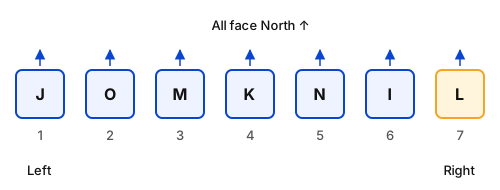
Concept: Facing north, left = west end. Fix the certain positions first.

  1. Only J is left of O → J at 1, O at 2
  2. Four people between J and I → I at 6
  3. M-K-N block in 3–5; M not next to I → M 3, K 4, N 5
  4. L takes the last seat 7

Trick: 'Only X sits to the left of Y' instantly fixes X at the extreme left and Y second.

Answer: (B) L

अवधारणा: उत्तर की ओर मुख, बायाँ = पश्चिमी छोर। पहले निश्चित स्थान तय करें।

  1. केवल J, O के बाएँ → J 1 पर, O 2 पर
  2. J और I के बीच चार → I 6 पर
  3. M-K-N 3–5 में; M, I का पड़ोसी नहीं → M 3, K 4, N 5
  4. L अंतिम स्थान 7 पर

ट्रिक: 'केवल X, Y के बाएँ' से X सबसे बाएँ और Y दूसरे स्थान पर तुरंत तय।

उत्तर: (B) L

RRB NTPC Undergraduate CBT 1General Intelligence and ReasoningSeating Arrangement – LinearRRB NTPC Undergraduate CBT 1 2024 · 28 Aug Shift 2 →