Question bank

Q&A: practice questions with answers

Search questions on any topic. Filter by exam category, exam, subject and topic, try the question, then open the answer and explanation.

Courses – airGurukul

8,495 questions found.

Q4841.
If the interest earned during the 2nd year on a certain sum is ₹2,508, and the rate of interest is 20% per annum compounded annually, then the sum is:
यदि किसी निश्चित राशि पर 2रे वर्ष के दौरान अर्जित ब्याज ₹2,508 है, और ब्याज की दर वार्षिक रूप से संयोजित 20% प्रति वर्ष है, तो राशि है:
  1. A₹9,695
  2. B₹10,315
  3. C₹10,450
  4. D₹10,005
Show answer

Concept: Under annual compounding, interest of the 2nd year =P×R100×(1+R100).

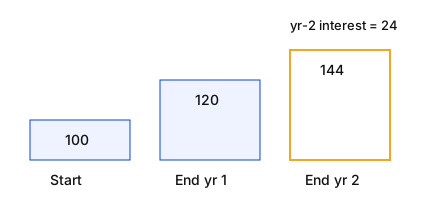
  1. Take P=100: after year 1 amount =120; year-2 interest =20% of 120=24.
  2. So year-2 interest =24% of P: 0.24P=2508.
  3. P=25080.24=10450.

Trick: 2nd-year CI at 20% is 24% of the sum ⇒ 2508×10024.

Answer: (C) ₹10,450

अवधारणा: वार्षिक चक्रवृद्धि में दूसरे वर्ष का ब्याज =P×R100×(1+R100)।

  1. P=100 लें: पहले वर्ष बाद मिश्रधन =120; दूसरे वर्ष का ब्याज =120 का 20%=24।
  2. अतः दूसरे वर्ष का ब्याज =P का 24%: 0.24P=2508।
  3. P=25080.24=10450।

ट्रिक: 20% पर दूसरे वर्ष का CI मूलधन का 24% ⇒ 2508×10024।

उत्तर: (C) ₹10,450

RRB NTPC Undergraduate CBT 1MathematicsCompound InterestRRB NTPC Undergraduate CBT 1 2024 · 3 Sep Shift 2 →
Q4842.
Simplify: x(3x − 9) + 3(x2 − 2) + 14
सरल कीजिए: x(3x − 9) + 3(x2 − 2) + 14
  1. A6x2 − 9x + 8
  2. B−6x2 − 9x − 8
  3. C−6x2 − 9x + 8
  4. D6x2 − 9x − 8
Show answer

Concept: Expand each bracket, then add like terms.

  1. x(3x−9)=3x2−9x.
  2. 3(x2−2)=3x2−6.
  3. Sum: 3x2−9x+3x2−6+14=6x2−9x+8.

Trick: Sign check: constant =−6+14=+8 and x2 coefficient is positive ⇒ only option (A) fits.

Answer: (A) 6x2−9x+8

अवधारणा: हर कोष्ठक खोलें, फिर समान पद जोड़ें।

  1. x(3x−9)=3x2−9x।
  2. 3(x2−2)=3x2−6।
  3. योग: 3x2−9x+3x2−6+14=6x2−9x+8।

ट्रिक: चिह्न जाँच: अचर =−6+14=+8 और x2 का गुणांक धनात्मक ⇒ केवल (A)।

उत्तर: (A) 6x2−9x+8

RRB NTPC Undergraduate CBT 1MathematicsAlgebra – SimplificationRRB NTPC Undergraduate CBT 1 2024 · 3 Sep Shift 2 →
Q4843.
I bought two bicycles for ₹1,200. I sold the first one at a loss of 8% and the second at a gain of 17%. If, on the whole I made neither a loss nor a gain, find the cost price (in ₹) of the first bicycle.
मैंने दो साइकिलें ₹1,200 में खरीदीं। मैंने पहली साइकिल 8% की हानि पर और दूसरी 17% के लाभ पर बेची। यदि कुल मिलाकर मुझे न तो हानि हुई और न ही लाभ, तो पहली साइकिल का क्रय मूल्य (₹ में) ज्ञात कीजिए।
  1. A840
  2. B836
  3. C816
  4. D800
Show answer

Concept: No overall profit/loss ⇒ loss on the first equals gain on the second.

  1. Let CP of first =x; then 8% of x=17% of (1200−x).
  2. 8x=20400−17x ⇒ 25x=20400 ⇒ x=816.
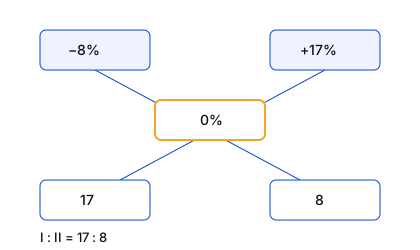
  3. Alligation: −8 and +17 around 0 ⇒ ratio 17:8; first =1725×1200=816.

Trick: Mean 0%: CP ratio = opposite differences 17:8.

Answer: (C) 816

अवधारणा: कुल लाभ/हानि शून्य ⇒ पहली पर हानि = दूसरी पर लाभ।

  1. माना पहली का क्रय मूल्य =x; तब x का 8%=(1200−x) का 17%।
  2. 8x=20400−17x ⇒ 25x=20400 ⇒ x=816।
  3. एलिगेशन: −8 और +17, माध्य 0 ⇒ अनुपात 17:8; पहली =1725×1200=816।

ट्रिक: माध्य 0%: क्रय मूल्य का अनुपात = विपरीत अंतर 17:8।

उत्तर: (C) 816

RRB NTPC Undergraduate CBT 1MathematicsProfit and Loss – AlligationRRB NTPC Undergraduate CBT 1 2024 · 3 Sep Shift 2 →
Q4844.
The cost of 7 pens and 17 pencils is ₹92. If the cost of a pen decreases by ₹0.50 and the cost of a pencil increases by ₹8, then the cost of 8 pens and 14 pencils is ₹186. What is the original cost of 9 pens and 6 pencils?
7 पेन और 17 पेंसिलों का मूल्य ₹92 है। यदि एक पेन का मूल्य ₹0.50 घट जाए और एक पेंसिल का मूल्य ₹8 बढ़ जाए, तो 8 पेन और 14 पेंसिलों का मूल्य ₹186 हो जाता है। 9 पेन और 6 पेंसिलों का मूल मूल्य क्या है?
  1. A₹35
  2. B₹43
  3. C₹41
  4. D₹39
Show answer

Concept: Form two equations in pen price a and pencil price b and solve by elimination.

  1. 7a+17b=92 … (1)
  2. 8(a−0.5)+14(b+8)=186 ⇒ 8a+14b=78 … (2)
  3. (1)×8−(2)×7: 136b−98b=736−546 ⇒ 38b=190 ⇒ b=5; then 7a=92−85 ⇒ a=1.
  4. 9a+6b=9+30=39.

Trick: Check (1): 7×1+17×5=92 ✓.

Answer: (D) ₹39

अवधारणा: पेन का मूल्य a और पेंसिल का b मानकर दो समीकरण बनाएँ और विलोपन से हल करें।

  1. 7a+17b=92 … (1)
  2. 8(a−0.5)+14(b+8)=186 ⇒ 8a+14b=78 … (2)
  3. (1)×8−(2)×7: 38b=190 ⇒ b=5; फिर 7a=92−85 ⇒ a=1।
  4. 9a+6b=9+30=39।

ट्रिक: जाँच (1): 7×1+17×5=92 ✓।

उत्तर: (D) ₹39

RRB NTPC Undergraduate CBT 1MathematicsLinear EquationsRRB NTPC Undergraduate CBT 1 2024 · 3 Sep Shift 2 →
Q4845.
In covering a distance of 110 km, Pranay takes 6 hours more than Aman. If Pranay doubles his speed, then he would take 5 hours less than Aman. Pranay's speed is:
110 km की दूरी तय करने में, प्रणय, अमन से 6 घंटे अधिक लेता है। यदि प्रणय अपनी चाल दोगुनी कर दे, तो वह अमन से 5 घंटे कम समय लेगा। प्रणय की चाल है:
  1. A6 km/hr
  2. B5 km/hr
  3. C11 km/hr
  4. D14 km/hr
Show answer

Concept: Time=DistanceSpeed; doubling speed halves time.

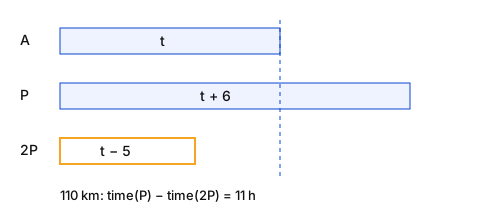
  1. Let Pranay’s speed =p, Aman’s time =t: 110p=t+6 and 1102p=t−5.
  2. Subtract: 110p−55p=11 ⇒ 55p=11.
  3. p=5km/h (Pranay takes 22 h, Aman 16 h, doubled speed 11 h).

Trick: Doubling speed saves half the time: 12T=6+5=11 ⇒ T=22 h ⇒ p=11022=5.

Answer: (B) 5km/hr

अवधारणा: समय=दूरीचाल; चाल दोगुनी करने पर समय आधा।

  1. माना प्रणय की चाल =p, अमन का समय =t: 110p=t+6 और 1102p=t−5।
  2. घटाने पर: 110p−55p=11 ⇒ 55p=11।
  3. p=5km/h (प्रणय 22 घंटे, अमन 16 घंटे, दोगुनी चाल पर 11 घंटे)।

ट्रिक: दोगुनी चाल से आधा समय बचता है: 12T=11 ⇒ T=22 ⇒ p=5।

उत्तर: (B) 5km/hr

RRB NTPC Undergraduate CBT 1MathematicsTime and DistanceRRB NTPC Undergraduate CBT 1 2024 · 3 Sep Shift 2 →
Q4846.
An amount of ₹785 is divided among three persons in the ratio of 2 : 6 : 17. The difference between the largest and the smallest shares (in ₹) in the distribution is:
₹785 की राशि को तीन व्यक्तियों में 2 : 6 : 17 के अनुपात में विभाजित किया जाता है। इस वितरण में सबसे बड़े और सबसे छोटे हिस्सों के बीच का अंतर (₹ में) है:
  1. A471
  2. B496
  3. C566
  4. D434
Show answer

Concept: Total parts = sum of ratio terms; each part = total ÷ parts.

  1. Total parts =2+6+17=25.
  2. One part =78525=31.4.
  3. Largest − smallest =(17−2) parts =15×31.4=471.

Trick: Difference of shares =difference of ratio termssum of terms×total=1525×785.

Answer: (A) ₹471

अवधारणा: कुल भाग = अनुपात के पदों का योग; एक भाग = कुल राशि ÷ भाग।

  1. कुल भाग =2+6+17=25।
  2. एक भाग =78525=31.4।
  3. सबसे बड़ा − सबसे छोटा =15×31.4=471।

ट्रिक: अंतर =1525×785=471 सीधे लिखें।

उत्तर: (A) ₹471

RRB NTPC Undergraduate CBT 1MathematicsRatio and ProportionRRB NTPC Undergraduate CBT 1 2024 · 3 Sep Shift 2 →
Q4847.
The sum of all interior angles of a regular polygon is 1620°. What is the measure (in degrees) of its each exterior angle?
एक सम बहुभुज के सभी अंतः कोणों का योग 1620° है। इसके प्रत्येक बाह्य कोण का माप (डिग्री में) क्या है?
  1. A32811
  2. B31811
  3. C33811
  4. D34811
Show answer

Concept: Sum of interior angles of an n-sided polygon =(n−2)×180∘; each exterior angle of a regular polygon =360∘n.

  1. (n−2)×180=1620⇒n−2=9⇒n=11.
  2. Exterior angle =36011=32811∘.

Yaad rakhein: Exterior angles of any polygon always add up to 360∘.

Answer: (A) 32811

अवधारणा: n भुजाओं वाले बहुभुज के अंतः कोणों का योग =(n−2)×180∘; सम बहुभुज का प्रत्येक बाह्य कोण =360∘n।

  1. (n−2)×180=1620⇒n−2=9⇒n=11।
  2. बाह्य कोण =36011=32811∘।

याद रखें: किसी भी बहुभुज के बाह्य कोणों का योग सदा 360∘ होता है।

उत्तर: (A) 32811

RRB NTPC Undergraduate CBT 1MathematicsPolygons – AnglesRRB NTPC Undergraduate CBT 1 2024 · 3 Sep Shift 2 →
Q4848.
The number 578289151 is divisible by which of the following?
संख्या 578289151 निम्नलिखित में से किससे विभाज्य है?
  1. A11
  2. B6
  3. C4
  4. D10
Show answer

Concept: Divisibility by 11: (sum of digits at odd places) − (sum at even places) must be 0 or a multiple of 11.

  1. Digits of 578289151 from the right: odd places 1+1+8+8+5=23, even places 5+9+2+7=23.
  2. Difference =23−23=0 → divisible by 11.
  3. Not by 6 or 10 (odd, ends in 1) and not by 4 (51 is not a multiple of 4).

Trick: Last digit odd → straight away rule out 4, 6 and 10.

Answer: (A) 11

अवधारणा: 11 से विभाज्यता: विषम स्थानों के अंकों का योग − सम स्थानों के अंकों का योग = 0 या 11 का गुणज।

  1. दाएँ से: विषम स्थान 1+1+8+8+5=23, सम स्थान 5+9+2+7=23।
  2. अंतर =0 → 11 से विभाज्य।
  3. संख्या विषम है (अंत में 1), अतः 4, 6, 10 से नहीं।

ट्रिक: अंतिम अंक विषम → 4, 6, 10 तुरंत हटाएँ।

उत्तर: (A) 11

RRB NTPC Undergraduate CBT 1MathematicsDivisibility RulesRRB NTPC Undergraduate CBT 1 2024 · 3 Sep Shift 2 →
Q4849.
If 2 times Mary’s present age is 16 years more than 3 times Diya's present age, and 2 times Diya's present age is 2 years less than Mary's present age, then what is the difference (in years) between the ages of Mary and Diya?
यदि मैरी की वर्तमान आयु का 2 गुना, दीया की वर्तमान आयु के 3 गुने से 16 वर्ष अधिक है, और दीया की वर्तमान आयु का 2 गुना, मैरी की वर्तमान आयु से 2 वर्ष कम है, तो मैरी और दीया की आयु के बीच का अंतर (वर्षों में) क्या है?
  1. A14
  2. B10
  3. C17
  4. D15
Show answer

Concept: Form two linear equations from the statements and solve.

  1. 2M=3D+16 and 2D=M−2⇒M=2D+2.
  2. Substitute: 2(2D+2)=3D+16⇒4D+4=3D+16⇒D=12.
  3. M=2(12)+2=26; difference =26−12=14.

Trick: Check: 2×26=52=3×12+16 ✔.

Answer: (A) 14

अवधारणा: कथनों से दो रैखिक समीकरण बनाकर हल करें।

  1. 2M=3D+16 तथा 2D=M−2⇒M=2D+2।
  2. 2(2D+2)=3D+16⇒D=12।
  3. M=26; अंतर =26−12=14 वर्ष।

ट्रिक: जाँच: 2×26=52=36+16 ✔।

उत्तर: (A) 14

RRB NTPC Undergraduate CBT 1MathematicsProblems on AgesRRB NTPC Undergraduate CBT 1 2024 · 3 Sep Shift 2 →
Q4850.
A book with a printed price of ₹4,500 is available on successive discounts of 10%, 20% and 25%. Find the selling price of the book.
₹4,500 के अंकित मूल्य वाली एक पुस्तक पर 10%, 20% और 25% की क्रमिक छूट उपलब्ध है। पुस्तक का विक्रय मूल्य ज्ञात कीजिए।
  1. A₹2,420
  2. B₹2,430
  3. C₹2,440
  4. D₹2,410
Show answer

Concept: After successive discounts, SP = MP × product of (1 − each rate).

  1. SP=4500×0.90×0.80×0.75.
  2. 4500×0.9=4050; 4050×0.8=3240; 3240×0.75=2430.

Trick: Apply the 25% first: 4500×34=3375, then ×0.9×0.8 – order does not matter.

Answer: (B) ₹2,430

अवधारणा: क्रमिक छूट के बाद विक्रय मूल्य = अंकित मूल्य × प्रत्येक (1 − दर) का गुणनफल।

  1. SP=4500×0.90×0.80×0.75।
  2. 4050→3240→2430।

ट्रिक: छूटों का क्रम बदलने से उत्तर नहीं बदलता।

उत्तर: (B) ₹2,430

RRB NTPC Undergraduate CBT 1MathematicsSuccessive DiscountsRRB NTPC Undergraduate CBT 1 2024 · 3 Sep Shift 2 →
Q4851.
Evaluate: (−9) − (−60) ÷ (−6) + (−3) × 6
मान ज्ञात कीजिए: (−9) − (−60) ÷ (−6) + (−3) × 6
  1. A−36
  2. B−39
  3. C−37
  4. D−40
Show answer

Concept: BODMAS: division and multiplication before addition and subtraction.

  1. (−60)÷(−6)=10 and (−3)×6=−18.
  2. Expression =−9−10+(−18).
  3. =−19−18=−37.

Trick: Minus × minus = plus; keep signs with each term.

Answer: (C) −37

अवधारणा: BODMAS: पहले भाग और गुणा, फिर जोड़ और घटाव।

  1. (−60)÷(−6)=10, (−3)×6=−18।
  2. −9−10−18=−37।

ट्रिक: ऋण × ऋण = धन; हर पद के साथ चिह्न रखें।

उत्तर: (C) −37

RRB NTPC Undergraduate CBT 1MathematicsSimplification (BODMAS)RRB NTPC Undergraduate CBT 1 2024 · 3 Sep Shift 2 →
Q4852.
The LCM of the numbers 4.8 and 0.024 is:
संख्याओं 4.8 और 0.024 का LCM है:
  1. A0.048
  2. B4.8
  3. C0.48
  4. D48
Show answer

Concept: Make decimal places equal, find the LCM of the whole numbers, then put back the decimal places.

  1. 4.8=4.800, 0.024=0.024 → 48001000 and 241000.
  2. LCM(4800,24)=4800 (4800 is a multiple of 24).
  3. LCM =48001000=4.8.

Trick: If the larger number is a multiple of the smaller, the larger itself is the LCM: 4.8÷0.024=200.

Answer: (B) 4.8

अवधारणा: दशमलव स्थान बराबर करें, पूर्ण संख्याओं का LCM निकालें, फिर दशमलव वापस लगाएँ।

  1. 48001000 और 241000।
  2. LCM(4800,24)=4800।
  3. LCM =4.8।

ट्रिक: बड़ी संख्या छोटी की गुणज हो तो बड़ी संख्या ही LCM: 4.8÷0.024=200।

उत्तर: (B) 4.8

RRB NTPC Undergraduate CBT 1MathematicsLCM of DecimalsRRB NTPC Undergraduate CBT 1 2024 · 3 Sep Shift 2 →
Q4853.
The marks scored by 10 students are given below.
10, 19, 18, 18, 13, 14, 16, 18, 16, 12
The mode of the data is:
10 विद्यार्थियों द्वारा प्राप्त अंक नीचे दिए गए हैं।
10, 19, 18, 18, 13, 14, 16, 18, 16, 12
आँकड़ों का बहुलक है:
  1. A13
  2. B18
  3. C19
  4. D10
Show answer

Concept: Mode is the value that occurs most often.

  1. Frequencies: 18 → 3 times, 16 → 2 times, others once.
  2. Highest frequency is for 18.

Yaad rakhein: Mode = most frequent; median = middle; mean = average.

Answer: (B) 18

अवधारणा: बहुलक (Mode) वह मान है जो सबसे अधिक बार आता है।

  1. 18 → 3 बार, 16 → 2 बार, शेष 1-1 बार।
  2. सर्वाधिक बारंबारता 18 की है।

याद रखें: Mode = सबसे अधिक बार; Median = बीच का; Mean = औसत।

उत्तर: (B) 18

RRB NTPC Undergraduate CBT 1MathematicsStatistics – ModeRRB NTPC Undergraduate CBT 1 2024 · 3 Sep Shift 2 →
Q4854.
The H.C.F. and the L.C.M. of two numbers are 28 and 336, respectively. If one of the numbers is 112, find the other one.
दो संख्याओं का H.C.F. और L.C.M. क्रमशः 28 और 336 है। यदि उनमें से एक संख्या 112 है, तो दूसरी संख्या ज्ञात कीजिए।
  1. A140
  2. B84
  3. C112
  4. D56
Show answer

Concept: Product of two numbers = HCF × LCM.

  1. Other number =28×336112.
  2. =9408112=84.

Trick: Check: HCF(112,84)=28 ✔.

Answer: (B) 84

अवधारणा: दो संख्याओं का गुणनफल = HCF × LCM।

  1. दूसरी संख्या =28×336112=84।

ट्रिक: जाँच: HCF(112,84)=28 ✔।

उत्तर: (B) 84

RRB NTPC Undergraduate CBT 1MathematicsHCF and LCMRRB NTPC Undergraduate CBT 1 2024 · 3 Sep Shift 2 →
Q4855.
The selling price of 25 books is equal to the cost price of 5 books. Find the loss or gain percentage.
25 पुस्तकों का विक्रय मूल्य 5 पुस्तकों के क्रय मूल्य के बराबर है। हानि या लाभ प्रतिशत ज्ञात कीजिए।
  1. A10020% gain10020% लाभ
  2. B80% gain80% लाभ
  3. C10020% loss10020% हानि
  4. D80% loss80% हानि
Show answer

Concept: Compare SP and CP of the same number of articles.

  1. Let CP of 1 book =₹1; then SP of 25 books = CP of 5 books =₹5.
  2. SP of 1 book =525=₹0.2 → loss =0.8.
  3. Loss %=0.81×100=80%.

Trick: Loss%=25−525×100=80% (SP-count − CP-count over SP-count).

Answer: (D) 80% loss

अवधारणा: समान संख्या की वस्तुओं के CP और SP की तुलना करें।

  1. 1 पुस्तक का CP =₹1; 25 पुस्तकों का SP =₹5।
  2. 1 पुस्तक का SP =0.2 → हानि 0.8।
  3. हानि%=80%।

ट्रिक: हानि%=25−525×100=80%।

उत्तर: (D) 80% हानि

RRB NTPC Undergraduate CBT 1MathematicsProfit and LossRRB NTPC Undergraduate CBT 1 2024 · 3 Sep Shift 2 →
Q4856.
Pipe A can fill a tank in 16 hours, pipe B can fill the same tank in 23 hours and pipe C can fill the same tank in 10 hours. The time taken by them to fill the same tank if they operate together is::
पाइप A एक टंकी को 16 घंटे में भर सकता है, पाइप B उसी टंकी को 23 घंटे में भर सकता है और पाइप C उसी टंकी को 10 घंटे में भर सकता है। यदि तीनों एक साथ चलाए जाएँ, तो उसी टंकी को भरने में उनके द्वारा लिया गया समय है:
  1. A10324379 hours10324379 घंटे
  2. B1324379 hours1324379 घंटे
  3. C13324379 hours13324379 घंटे
  4. D4324379 hours4324379 घंटे
Show answer

Concept: Work per hour adds when pipes run together.

  1. LCM of 16, 23, 10 =1840 units (tank).
  2. Per hour: A =115, B =80, C =184 → total 379.
  3. Time =1840379=4324379 hours.

Trick: Quick check: C alone takes 10 h, so all three together must take well under 10 h – only option D fits.

Answer: (D) 4324379 hours

अवधारणा: साथ चलने पर प्रति घंटे का कार्य जुड़ता है।

  1. 16, 23, 10 का LCM =1840 इकाई।
  2. प्रति घंटा: A =115, B =80, C =184 → कुल 379।
  3. समय =1840379=4324379 घंटे।

ट्रिक: अकेला C 10 घंटे लेता है, तो तीनों साथ में 10 से काफी कम लेंगे – केवल D सही बैठता है।

उत्तर: (D) 4324379 घंटे

RRB NTPC Undergraduate CBT 1MathematicsPipes and CisternsRRB NTPC Undergraduate CBT 1 2024 · 3 Sep Shift 2 →
Q4857.
Given that 1340.78 = x, 1340.52= y and xz = y8, then the value of z is close to:
दिया गया है कि 1340.78 = x, 1340.52= y और xz = y8 है, तो z का मान लगभग है:
  1. A6.77
  2. B5.33
  3. C7.89
  4. D5.72
Show answer

Concept: (am)n=amn; equal bases ⇒ equal exponents.

  1. xz=1340.78z and y8=1340.52×8=1344.16.
  2. 0.78z=4.16⇒z=4.160.78=163≈5.33.

Trick: 0.520.78=23, so z=8×23=5.33.

Answer: (B) 5.33

अवधारणा: (am)n=amn; आधार समान हों तो घातांक समान।

  1. xz=1340.78z, y8=1344.16।
  2. 0.78z=4.16⇒z=163≈5.33।

ट्रिक: 0.520.78=23, अतः z=8×23।

उत्तर: (B) 5.33

RRB NTPC Undergraduate CBT 1MathematicsIndicesRRB NTPC Undergraduate CBT 1 2024 · 3 Sep Shift 2 →
Q4858.
If the 6-digit number N51M91 is divisible by 11, then which of the options below can give a possible correct relation between M and N?
यदि 6-अंकीय संख्या N51M91, 11 से विभाज्य है, तो नीचे दिए गए विकल्पों में से कौन-सा विकल्प M और N के बीच एक संभावित सही संबंध दे सकता है?
  1. AM + N = -4
  2. BM = N
  3. CM - N = 1
  4. DM - N = 4
Show answer

Concept: Divisibility by 11: difference of alternate-digit sums is 0 or a multiple of 11.

  1. N51M91: odd places (from left) N+1+9=N+10; even places 5+M+1=M+6.
  2. Difference =(N+10)−(M+6)=N−M+4.
  3. N−M+4=0⇒M−N=4 (e.g. 451891 =11×41081).

Trick: Option values like M−N=1 or M=N give differences 3 and 4 – not multiples of 11.

Answer: (D) M−N=4

अवधारणा: 11 से विभाज्यता: एकांतर अंकों के योगों का अंतर 0 या 11 का गुणज।

  1. N51M91: विषम स्थान N+10, सम स्थान M+6।
  2. अंतर =N−M+4।
  3. N−M+4=0⇒M−N=4 (जैसे 451891=11×41081)।

ट्रिक: M=N या M−N=1 से अंतर 4 या 3 आता है – 11 का गुणज नहीं।

उत्तर: (D) M−N=4

RRB NTPC Undergraduate CBT 1MathematicsDivisibility by 11RRB NTPC Undergraduate CBT 1 2024 · 3 Sep Shift 2 →
Q4859.
Arjun and Malaika have to travel from Delhi to Kanpur in their respective cars. Arjun is driving at 60 km/hr while Malaika is driving at 96 km/hr. Find the time taken by Malaika to reach Kanpur if Arjun takes 8 hours.
अर्जुन और मलाइका को अपनी-अपनी कारों से दिल्ली से कानपुर की यात्रा करनी है। अर्जुन 60 km/hr की चाल से कार चला रहा है जबकि मलाइका 96 km/hr की चाल से कार चला रही है। यदि अर्जुन 8 घंटे लेता है, तो मलाइका द्वारा कानपुर पहुँचने में लिया गया समय ज्ञात कीजिए।
  1. A5 hours5 घंटे
  2. B6 hours6 घंटे
  3. C9 hours9 घंटे
  4. D1 hours1 घंटे
Show answer

Concept: Same distance ⇒ time is inversely proportional to speed.

  1. Distance =60×8=480km.
  2. Malaika's time =48096=5 hours.

Trick: t2=t1×s1s2=8×6096=5.

Answer: (A) 5 hours

अवधारणा: दूरी समान हो तो समय चाल के व्युत्क्रमानुपाती होता है।

  1. दूरी =60×8=480km।
  2. मलाइका का समय =48096=5 घंटे।

ट्रिक: t2=8×6096=5।

उत्तर: (A) 5 घंटे

RRB NTPC Undergraduate CBT 1MathematicsSpeed, Time and DistanceRRB NTPC Undergraduate CBT 1 2024 · 3 Sep Shift 2 →
Q4860.
The average runs scored by a batsman in 23 matches is 40. In the next 10 matches, the batsman scored an average of 13 runs. Find his average runs scored (rounded off to two decimals) in all the 33 matches.
एक बल्लेबाज द्वारा 23 मैचों में बनाए गए रनों का औसत 40 है। अगले 10 मैचों में, बल्लेबाज ने 13 रनों का औसत बनाया। सभी 33 मैचों में उसके द्वारा बनाए गए रनों का औसत (दो दशमलव स्थानों तक पूर्णांकित) ज्ञात कीजिए।
  1. A31.82
  2. B33.82
  3. C32.82
  4. D30.82
Show answer

Concept: Overall average = total runs ÷ total matches.

  1. Runs =23×40+10×13=920+130=1050.
  2. Average =105033=31.818…≈31.82.

Trick: Weighted average must lie between 13 and 40, nearer 40 (more matches).

Answer: (A) 31.82

अवधारणा: कुल औसत = कुल रन ÷ कुल मैच।

  1. रन =920+130=1050।
  2. औसत =105033≈31.82।

ट्रिक: भारित औसत 13 और 40 के बीच, 40 के अधिक निकट होगा।

उत्तर: (A) 31.82

RRB NTPC Undergraduate CBT 1MathematicsAverageRRB NTPC Undergraduate CBT 1 2024 · 3 Sep Shift 2 →