Question bank

Q&A: practice questions with answers

Search questions on any topic. Filter by exam category, exam, subject and topic, try the question, then open the answer and explanation.

Courses – airGurukul

8,495 questions found.

Q4861.
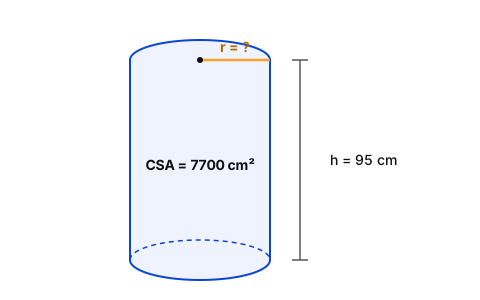
A cylindrical rod has an outer curved surface area of 7700 cm2. If the length of the rod is 95 cm, then the outer radius (in cm) of the rod, correct to two places of decimal, is:
(Take π=227)
एक बेलनाकार छड़ का बाहरी वक्र पृष्ठीय क्षेत्रफल 7700 cm2 है। यदि छड़ की लंबाई 95 cm है, तो छड़ की बाहरी त्रिज्या (cm में), दो दशमलव स्थानों तक सही, है:
(π=227 लीजिए)
  1. A11.54
  2. B11.99
  3. C12.89
  4. D11.14
Show answer

Concept: Curved surface area of a cylinder =2πrh.

  1. 2×227×r×95=7700.
  2. r=7700×744×95=539004180.
  3. r≈12.89cm.

Trick: 77002πh=7700597.1≈12.9 – pick the closest.

Answer: (C) 12.89

अवधारणा: बेलन का वक्र पृष्ठीय क्षेत्रफल =2πrh।

  1. 2×227×r×95=7700।
  2. r=539004180≈12.89cm।

ट्रिक: 7700597.1≈12.9 – निकटतम विकल्प चुनें।

उत्तर: (C) 12.89
RRB NTPC Undergraduate CBT 1MathematicsMensuration – CylinderRRB NTPC Undergraduate CBT 1 2024 · 3 Sep Shift 2 →
Q4862.
Shifa can do a certain piece of work in 28 days. Shifa and Afiya can together do the same work in 20 days, and Shifa, Afiya and Mariyam can do the same work together in 10 days. In how many days can Shifa and Mariyam do the same work together?
शिफा एक निश्चित कार्य को 28 दिनों में कर सकती है। शिफा और आफिया मिलकर उसी कार्य को 20 दिनों में कर सकती हैं, और शिफा, आफिया और मरियम मिलकर उसी कार्य को 10 दिनों में कर सकती हैं। शिफा और मरियम मिलकर उसी कार्य को कितने दिनों में कर सकती हैं?
  1. A413
  2. B395
  3. C364
  4. D353
Show answer

Concept: Use one-day work rates and subtract.

  1. Shifa =128; Afiya =120−128=170.
  2. Mariyam =110−120=120.
  3. Shifa + Mariyam =128+120=12140=335 → 353 days.

Trick: Mariyam = (S+A+M) − (S+A): the 10-day and 20-day groups directly.

Answer: (D) 353

अवधारणा: एक दिन के कार्य की दरें लेकर घटाएँ।

  1. शिफा =128; आफ़िया =170।
  2. मरियम =110−120=120।
  3. शिफा + मरियम =128+120=335 → 353 दिन।

ट्रिक: मरियम = (S+A+M) − (S+A) सीधे।

उत्तर: (D) 353

RRB NTPC Undergraduate CBT 1MathematicsTime and WorkRRB NTPC Undergraduate CBT 1 2024 · 3 Sep Shift 2 →
Q4863.
What single discount is equivalent to three successive discounts of 24%, 26% and 18%? (Rounded off to two decimal places)
24%, 26% और 18% की तीन क्रमिक छूटों के समतुल्य एकल छूट कितनी है? (दो दशमलव स्थानों तक पूर्णांकित)
  1. A53.88%
  2. B54.42%
  3. C54.94%
  4. D51.48%
Show answer

Concept: Net price factor = product of (1 − each discount).

  1. 0.76×0.74=0.5624.
  2. 0.5624×0.82=0.461168.
  3. Single discount =1−0.461168=0.538832≈53.88%.

Trick: Two at a time: 24+26−24×26100=43.76; then 43.76+18−43.76×18100=53.88.

Answer: (A) 53.88%

अवधारणा: शुद्ध मूल्य गुणांक = प्रत्येक (1 − छूट) का गुणनफल।

  1. 0.76×0.74=0.5624।
  2. 0.5624×0.82=0.461168।
  3. एकल छूट ≈53.88%।

ट्रिक: a+b−ab100 दो-दो बार लगाएँ: 43.76 फिर 53.88।

उत्तर: (A) 53.88%

RRB NTPC Undergraduate CBT 1MathematicsSuccessive DiscountsRRB NTPC Undergraduate CBT 1 2024 · 3 Sep Shift 2 →
Q4864.
By how much is 65% of 65 greater than 25 of 45?
65 का 65%, 45 के 25 से कितना अधिक है?
  1. A22.25
  2. B24.25
  3. C18.25
  4. D21.25
Show answer

Concept: Find both quantities and subtract.

  1. 65% of 65=0.65×65=42.25.
  2. 25 of 45=18.
  3. Difference =42.25−18=24.25.

Trick: 652=4225, so 65% of 65 =42.25.

Answer: (B) 24.25

अवधारणा: दोनों मान निकालकर घटाएँ।

  1. 65 का 65%=42.25।
  2. 45 का 25=18।
  3. अंतर =24.25।

ट्रिक: 652=4225 → 42.25।

उत्तर: (B) 24.25

RRB NTPC Undergraduate CBT 1MathematicsPercentage and FractionsRRB NTPC Undergraduate CBT 1 2024 · 3 Sep Shift 2 →
Q4865.
Find the mean proportional between 28 and 252.
28 और 252 का मध्यानुपाती ज्ञात कीजिए।
  1. A81
  2. B83
  3. C84
  4. D86
Show answer

Concept: Mean proportional of a and b =ab.

  1. 28×252=7056.
  2. =84 (since 252=9×28, 282×9=28×3).

Trick: 28×3=84.

Answer: (C) 84

अवधारणा: a और b का मध्यानुपाती =ab।

  1. 28×252=7056=84।

ट्रिक: 252=9×28 → 28×3=84।

उत्तर: (C) 84

RRB NTPC Undergraduate CBT 1MathematicsMean ProportionalRRB NTPC Undergraduate CBT 1 2024 · 3 Sep Shift 2 →
Q4866.
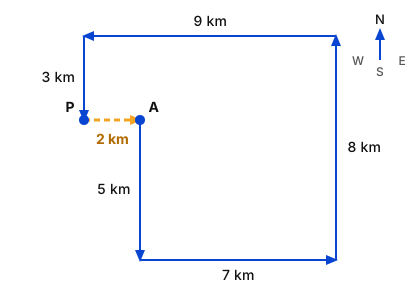
Kiran starts from Point A and drives 5 km towards south. He then takes a left turn, drives 7 km, turns left and drives 8 km. He then takes a left turn and drives 9 km. He takes a final left turn, drives 3 km and stops at Point P. How far (shortest distance) and towards which direction should he drive in order to reach Point A again? (All turns are 90° turns only unless specified.)
किरण बिंदु A से चलना शुरू करता है और दक्षिण की ओर 5 km गाड़ी चलाता है। फिर वह बाएँ मुड़ता है, 7 km गाड़ी चलाता है, बाएँ मुड़ता है और 8 km गाड़ी चलाता है। फिर वह बाएँ मुड़ता है और 9 km गाड़ी चलाता है। वह अंतिम बार बाएँ मुड़ता है, 3 km गाड़ी चलाता है और बिंदु P पर रुक जाता है। बिंदु A पर फिर से पहुँचने के लिए उसे कितनी दूरी (न्यूनतम दूरी) तक और किस दिशा में गाड़ी चलानी चाहिए? (जब तक निर्दिष्ट न किया गया हो, सभी मोड़ केवल 90° के मोड़ हैं।)
  1. A4 km to eastपूर्व की ओर 4 km
  2. B2 km to eastपूर्व की ओर 2 km
  3. C3 km to eastपूर्व की ओर 3 km
  4. D1 km to eastपूर्व की ओर 1 km
Show answer

Concept: Track the coordinates; with A at origin, east +x and north +y.

  1. S 5 → (0,−5); left (east) 7 → (7,−5).
  2. Left (north) 8 → (7,3); left (west) 9 → (−2,3).
  3. Left (south) 3 → P (−2,0): P is 2 km west of A, so drive 2 km east.

Trick: Net E–W: 7−9=−2; net N–S: −5+8−3=0.

Answer: (B) 2 km to east

अवधारणा: A को मूल बिंदु मानें; पूर्व +x, उत्तर +y।

  1. दक्षिण 5 → (0,−5); बाएँ (पूर्व) 7 → (7,−5)।
  2. बाएँ (उत्तर) 8 → (7,3); बाएँ (पश्चिम) 9 → (−2,3)।
  3. बाएँ (दक्षिण) 3 → P (−2,0); A तक 2 km पूर्व।

ट्रिक: शुद्ध पूर्व–पश्चिम: 7−9=−2; उत्तर–दक्षिण: 0।

उत्तर: (B) 2 km पूर्व की ओर

RRB NTPC Undergraduate CBT 1General Intelligence and ReasoningDirection and DistanceRRB NTPC Undergraduate CBT 1 2024 · 3 Sep Shift 2 →
Q4867.
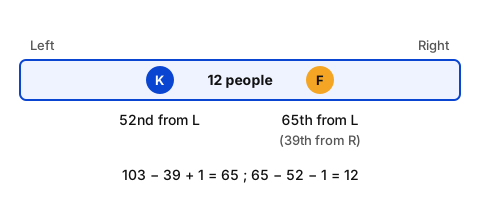
All 103 students in a class are standing in a row facing north. Farah is 39th from the right end while Kanak is 52nd from the left end. How many people stand between Farah and Kanak?
एक कक्षा के सभी 103 विद्यार्थी उत्तर की ओर मुख करके एक पंक्ति में खड़े हैं। फराह दाएँ छोर से 39वें स्थान पर है जबकि कनक बाएँ छोर से 52वें स्थान पर है। फराह और कनक के बीच कितने व्यक्ति खड़े हैं?
  1. A11
  2. B13
  3. C12
  4. D10
Show answer

Concept: Position from left = Total − position from right + 1.

  1. Farah from left =103−39+1=65.
  2. Kanak is 52nd from left.
  3. Persons between =65−52−1=12.

Trick: Between two ranks counted from the same end = difference − 1.

Answer: (C) 12

अवधारणा: बाएँ से स्थान = कुल − दाएँ से स्थान + 1।

  1. फ़राह बाएँ से =103−39+1=65वाँ।
  2. कनक बाएँ से 52वाँ।
  3. बीच में =65−52−1=12।

ट्रिक: एक ही छोर से गिने स्थानों के बीच = अंतर − 1।

उत्तर: (C) 12

RRB NTPC Undergraduate CBT 1General Intelligence and ReasoningRanking and OrderRRB NTPC Undergraduate CBT 1 2024 · 3 Sep Shift 2 →
Q4868.
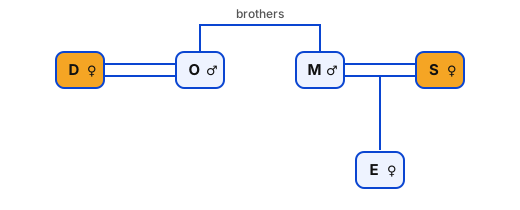
D is the wife of O. O is the brother of M. M is the father of E. E is the daughter of S. How is D related to S?
D, O की पत्नी है। O, M का भाई है। M, E का पिता है। E, S की पुत्री है। D का S से क्या संबंध है?
  1. AFather's brother's motherपिता के भाई की माता
  2. BHusband's brother's wifeपति के भाई की पत्नी
  3. CFather's brother's sonपिता के भाई का पुत्र
  4. DFather's brother's daughterपिता के भाई की पुत्री
Show answer

Concept: Draw the family tree step by step.

  1. O and M are brothers; D is O's wife.
  2. E is daughter of both M and S, so S is M's wife.
  3. For S: husband (M) → his brother (O) → his wife (D).

Trick: Wife of husband's brother = sister-in-law (devrani/jethani).

Answer: (B) Husband's brother's wife

अवधारणा: चरणबद्ध परिवार वृक्ष बनाएँ।

  1. O और M भाई हैं; D, O की पत्नी है।
  2. E, M और S दोनों की पुत्री है → S, M की पत्नी।
  3. S के लिए: पति (M) → उसका भाई (O) → उसकी पत्नी (D)।

ट्रिक: पति के भाई की पत्नी = देवरानी/जेठानी।

उत्तर: (B) Husband's brother's wife (पति के भाई की पत्नी)

RRB NTPC Undergraduate CBT 1General Intelligence and ReasoningBlood RelationsRRB NTPC Undergraduate CBT 1 2024 · 3 Sep Shift 2 →
Q4869.
In the following triads, each group of letters is related to the subsequent one following a certain logic. Select from the given options, the one which follows the same logic. APES - EAPS - SEPA
FROM - OFRM - MORF
निम्नलिखित त्रिकों में, अक्षरों का प्रत्येक समूह एक निश्चित तर्क का अनुसरण करते हुए अगले समूह से संबंधित है। दिए गए विकल्पों में से उस विकल्प का चयन कीजिए जो उसी तर्क का अनुसरण करता है। APES - EAPS - SEPA
FROM - OFRM - MORF
  1. ASANK - SNAK - KNAS
  2. BRING - IRNG - GINR
  3. CFIRM - RFIM - MRIF
  4. DMEAL - AMEL - EALM
Show answer

Concept: Write letter positions 1 2 3 4 and see how they are rearranged.

  1. APES → EAPS = order 3-1-2-4; SEPA = 4-3-2-1 (reverse).
  2. FROM → OFRM (3-1-2-4), MORF (reverse) ✔.
  3. FIRM → RFIM (3-1-2-4), MRIF (reverse) ✔. Others fail, e.g. MEAL reversed is LAEM, not EALM.

Trick: Check the easy reverse step first to eliminate options.

Answer: (C) FIRM - RFIM - MRIF

अवधारणा: अक्षरों के स्थान 1 2 3 4 लिखकर पुनर्व्यवस्था देखें।

  1. APES → EAPS = 3-1-2-4; SEPA = उल्टा क्रम।
  2. FROM → OFRM, MORF ✔।
  3. FIRM → RFIM (3-1-2-4), MRIF (उल्टा) ✔; MEAL का उल्टा LAEM है, EALM नहीं।

ट्रिक: पहले आसान "उल्टा" चरण जाँचें।

उत्तर: (C) FIRM - RFIM - MRIF

RRB NTPC Undergraduate CBT 1General Intelligence and ReasoningLetter Arrangement AnalogyRRB NTPC Undergraduate CBT 1 2024 · 3 Sep Shift 2 →
Q4870.
Based on the English alphabetical order, three of the following four letter-clusters are alike in a certain way and thus form a group. Which letter-cluster DOES NOT belong to that group?
(Note: The odd one out is not based on the number of consonants/vowels or their position in the letter-cluster.)
अंग्रेज़ी वर्णमाला क्रम के आधार पर, निम्नलिखित चार अक्षर-समूहों में से तीन किसी निश्चित प्रकार से एकसमान हैं और इस प्रकार एक समूह बनाते हैं। कौन-सा अक्षर-समूह उस समूह से संबंधित नहीं है?
(ध्यान दें: असंगत अक्षर-समूह, उस अक्षर-समूह में व्यंजनों/स्वरों की संख्या या उनके स्थान पर आधारित नहीं है।)
  1. AXZD
  2. BHJN
  3. CEGL
  4. DSUY
Show answer

Concept: Find the gaps between letter positions (A = 1 … Z = 26, cyclic).

  1. XZD: 24→26→4 = +2, +4.
  2. HJN: +2, +4; SUY: +2, +4.
  3. EGL: 5→7→12 = +2, +5 → odd.

Trick: EJOTY: E5, J10, O15, T20, Y25 helps count fast.

Answer: (C) EGL

अवधारणा: अक्षर स्थानों के अंतर देखें (A = 1 … Z = 26, चक्रीय)।

  1. XZD: +2, +4।
  2. HJN: +2, +4; SUY: +2, +4।
  3. EGL: +2, +5 → भिन्न।

ट्रिक: EJOTY: 5, 10, 15, 20, 25 याद रखें।

उत्तर: (C) EGL

RRB NTPC Undergraduate CBT 1General Intelligence and ReasoningOdd One Out – LettersRRB NTPC Undergraduate CBT 1 2024 · 3 Sep Shift 2 →
Q4871.
What should come in place of the question mark (?) in the given series based on the English alphabetical order?
RFG THI VJK XLM ?
अंग्रेज़ी वर्णमाला क्रम के आधार पर दी गई श्रृंखला में प्रश्न चिह्न (?) के स्थान पर क्या आना चाहिए?
RFG THI VJK XLM ?
  1. AZNO
  2. BZNP
  3. CYNO
  4. DZMO
Show answer

Concept: Each position follows its own pattern.

  1. First letters: R, T, V, X → next Z (+2).
  2. Last two letters are consecutive pairs: FG, HI, JK, LM → NO.
  3. Next term = ZNO.

Trick: 2nd and 3rd letters together run through the alphabet F, G, H, I, … continuously.

Answer: (A) ZNO

अवधारणा: प्रत्येक स्थान का अलग पैटर्न है।

  1. पहला अक्षर: R, T, V, X → Z (+2)।
  2. अंतिम दो: FG, HI, JK, LM → NO।
  3. अगला पद = ZNO।

ट्रिक: दूसरे-तीसरे अक्षर F, G, H, I … लगातार चलते हैं।

उत्तर: (A) ZNO

RRB NTPC Undergraduate CBT 1General Intelligence and ReasoningLetter SeriesRRB NTPC Undergraduate CBT 1 2024 · 3 Sep Shift 2 →
Q4872.
Each of the digits in the number 513946287 is arranged in ascending order from left to right. What will be the sum of the digits which are second from the left and third from the right in the new number thus formed?
संख्या 513946287 के प्रत्येक अंक को बाएँ से दाएँ आरोही क्रम में व्यवस्थित किया जाता है। इस प्रकार बनी नई संख्या में बाएँ से दूसरे और दाएँ से तीसरे अंकों का योग क्या होगा?
  1. A11
  2. B13
  3. C9
  4. D5
Show answer

Concept: Sort the digits and read positions.

  1. Digits 5,1,3,9,4,6,2,8,7 in ascending order → 123456789.
  2. Second from left = 2; third from right = 7.
  3. Sum =2+7=9.

Trick: All digits 1–9 appear once, so the sorted number is simply 123456789.

Answer: (C) 9

अवधारणा: अंकों को आरोही क्रम में लगाकर स्थान पढ़ें।

  1. आरोही क्रम → 123456789।
  2. बाएँ से दूसरा = 2; दाएँ से तीसरा = 7।
  3. योग =9।

ट्रिक: 1–9 सभी अंक एक बार हैं → 123456789।

उत्तर: (C) 9

RRB NTPC Undergraduate CBT 1General Intelligence and ReasoningDigit ArrangementRRB NTPC Undergraduate CBT 1 2024 · 3 Sep Shift 2 →
Q4873.
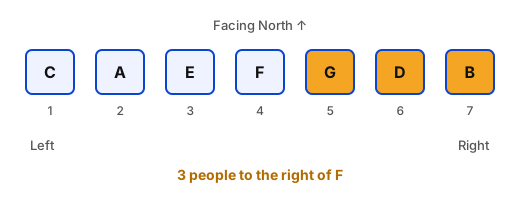
Seven people A, B, C, D, E, F and G are sitting in a row, facing north.
Only three people sit to the left of F. Only B sits to the right of D. Only three people sit between D and A. E sits at some place to the left of G but at some place to the right of C. How many people sit to the right of F?
सात व्यक्ति A, B, C, D, E, F और G उत्तर की ओर मुख करके एक पंक्ति में बैठे हैं।
F के बाईं ओर केवल तीन व्यक्ति बैठे हैं। D के दाईं ओर केवल B बैठा है। D और A के बीच केवल तीन व्यक्ति बैठे हैं। E, G के बाईं ओर किसी स्थान पर, किंतु C के दाईं ओर किसी स्थान पर बैठा है। F के दाईं ओर कितने व्यक्ति बैठे हैं?
  1. A1
  2. B4
  3. C3
  4. D2
Show answer

Concept: Fix definite positions first (7 seats, 1 = left end).

  1. Three to the left of F → F at 4. Only B right of D → D 6, B 7.
  2. Three between D and A → A at 2.
  3. C, E, G fill 1, 3, 5 with C left of E left of G → C1, E3, G5. Right of F: G, D, B = 3.

Trick: Seats right of F = 7−4=3 directly once F is at 4.

Answer: (C) 3

अवधारणा: पहले निश्चित स्थान तय करें (7 स्थान, 1 = बायाँ छोर)।

  1. F के बाएँ तीन → F स्थान 4। D के दाएँ केवल B → D 6, B 7।
  2. D और A के बीच तीन → A स्थान 2।
  3. C1, E3, G5। F के दाएँ: G, D, B = 3।

ट्रिक: F स्थान 4 पर है तो दाएँ 7−4=3।

उत्तर: (C) 3

RRB NTPC Undergraduate CBT 1General Intelligence and ReasoningLinear Seating ArrangementRRB NTPC Undergraduate CBT 1 2024 · 3 Sep Shift 2 →
Q4874.
Based on the English alphabetical order, three of the following four letter-cluster pairs are alike in a certain way and thus form a group. Which is the letter-cluster pair that DOES NOT belong to that group?
(Note: The odd one out is not based on the number of consonants/vowels or their position in the letter-cluster.)
अंग्रेज़ी वर्णमाला क्रम के आधार पर, निम्नलिखित चार अक्षर-समूह युग्मों में से तीन किसी निश्चित प्रकार से एकसमान हैं और इस प्रकार एक समूह बनाते हैं। वह कौन-सा अक्षर-समूह युग्म है जो उस समूह से संबंधित नहीं है?
(ध्यान दें: असंगत अक्षर-समूह, उस अक्षर-समूह में व्यंजनों/स्वरों की संख्या या उनके स्थान पर आधारित नहीं है।)
  1. AWD-BK
  2. BGN-LU
  3. CFN-KT
  4. DJQ-OX
Show answer

Concept: Compare position shifts of corresponding letters.

  1. WD-BK: W→B +5, D→K +7.
  2. GN-LU: +5, +7; JQ-OX: +5, +7.
  3. FN-KT: F→K +5, N→T +6 → odd.

Trick: Check only the 2nd letters: +7, +7, +6, +7.

Answer: (C) FN-KT

अवधारणा: संगत अक्षरों का स्थान-अंतर देखें।

  1. WD-BK: +5, +7।
  2. GN-LU: +5, +7; JQ-OX: +5, +7।
  3. FN-KT: +5, +6 → भिन्न।

ट्रिक: केवल दूसरे अक्षर देखें: +7, +7, +6, +7।

उत्तर: (C) FN-KT

RRB NTPC Undergraduate CBT 1General Intelligence and ReasoningOdd One Out – Letter PairsRRB NTPC Undergraduate CBT 1 2024 · 3 Sep Shift 2 →
Q4875.
If + means −, − means ×, × means ÷ and ÷ means +, then what will come in place of the question mark (?) in the following equation?
19 + 17 − 2 ÷ 84 × 3 = ?
यदि + का अर्थ −, − का अर्थ ×, × का अर्थ ÷ और ÷ का अर्थ + है, तो निम्नलिखित समीकरण में प्रश्न चिह्न (?) के स्थान पर क्या आएगा?
19 + 17 − 2 ÷ 84 × 3 = ?
  1. A32
  2. B24
  3. C18
  4. D13
Show answer

Concept: Replace symbols, then apply BODMAS.

  1. 19+17−2÷84×3 becomes 19−17×2+84÷3.
  2. =19−34+28.
  3. =13.

Trick: Write the swap table (+→−, −→×, ×→÷, ÷→+) before converting.

Answer: (D) 13

अवधारणा: चिह्न बदलकर BODMAS लगाएँ।

  1. व्यंजक बनता है 19−17×2+84÷3।
  2. =19−34+28=13।

ट्रिक: पहले बदलाव तालिका लिखें (+→−, −→×, ×→÷, ÷→+)।

उत्तर: (D) 13

RRB NTPC Undergraduate CBT 1General Intelligence and ReasoningMathematical OperationsRRB NTPC Undergraduate CBT 1 2024 · 3 Sep Shift 2 →
Q4876.
In a certain code language, ‘MOST’ is coded as ‘2457’ and ‘BEAM’ is coded as ‘4136’. What is the code for ‘M’ in that language?
एक निश्चित कूट भाषा में, ‘MOST’ को ‘2457’ लिखा जाता है और ‘BEAM’ को ‘4136’ लिखा जाता है। उस भाषा में ‘M’ के लिए कूट क्या है?
  1. A4
  2. B6
  3. C2
  4. D1
Show answer

Concept: The letter common to both words takes the digit common to both codes.

  1. MOST → 2457; BEAM → 4136.
  2. Common letter: M. Common digit: 4.
  3. So M = 4.

Trick: Common letter ↔ common digit (order does not matter).

Answer: (A) 4

अवधारणा: दोनों शब्दों का साझा अक्षर = दोनों कोडों का साझा अंक।

  1. MOST → 2457; BEAM → 4136।
  2. साझा अक्षर M, साझा अंक 4।
  3. M = 4।

ट्रिक: साझा अक्षर ↔ साझा अंक।

उत्तर: (A) 4

RRB NTPC Undergraduate CBT 1General Intelligence and ReasoningCoding-DecodingRRB NTPC Undergraduate CBT 1 2024 · 3 Sep Shift 2 →
Q4877.
Based on the English alphabetical order, three of the following four letter-cluster pairs are alike in a certain way and thus form a group. Which letter-cluster pair DOES NOT belong to that group?
(Note: The odd one out is not based on the number of consonants/vowels or their position in the letter-cluster.)
अंग्रेज़ी वर्णमाला क्रम के आधार पर, निम्नलिखित चार अक्षर-समूह युग्मों में से तीन किसी निश्चित प्रकार से एकसमान हैं और इस प्रकार एक समूह बनाते हैं। कौन-सा अक्षर-समूह युग्म उस समूह से संबंधित नहीं है?
(ध्यान दें: असंगत अक्षर-समूह, उस अक्षर-समूह में व्यंजनों/स्वरों की संख्या या उनके स्थान पर आधारित नहीं है।)
  1. ANE-IL
  2. BUL-PS
  3. CPG-KM
  4. DRI-MP
Show answer

Concept: Compare position shifts of corresponding letters.

  1. NE-IL: N→I −5, E→L +7.
  2. UL-PS: −5, +7; RI-MP: −5, +7.
  3. PG-KM: P→K −5, G→M +6 → odd.

Trick: Look at 2nd letters only: +7, +7, +6, +7.

Answer: (C) PG-KM

अवधारणा: संगत अक्षरों का स्थान-अंतर देखें।

  1. NE-IL: −5, +7।
  2. UL-PS: −5, +7; RI-MP: −5, +7।
  3. PG-KM: −5, +6 → भिन्न।

ट्रिक: केवल दूसरे अक्षर: +7, +7, +6, +7।

उत्तर: (C) PG-KM

RRB NTPC Undergraduate CBT 1General Intelligence and ReasoningOdd One Out – Letter PairsRRB NTPC Undergraduate CBT 1 2024 · 3 Sep Shift 2 →
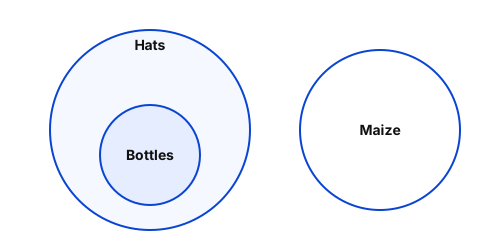
Q4878.
Read the given statement(s) and conclusions carefully. Assuming that the information given in the statements is true, even if it appears to be at variance with commonly known facts, decide which of the given conclusions logically follow(s) from the statement(s).
Statements:
All bottles are hats.
No hat is a maize.
Conclusions:
(I): No bottle is a maize.
(II): Some maizes are hats.
दिए गए कथन(नों) और निष्कर्षों को ध्यानपूर्वक पढ़िए। यह मानते हुए कि कथनों में दी गई जानकारी सत्य है, भले ही वह सामान्य रूप से ज्ञात तथ्यों से भिन्न प्रतीत होती हो, निर्णय लीजिए कि दिए गए निष्कर्षों में से कौन-सा/से निष्कर्ष तार्किक रूप से कथन(नों) का अनुसरण करता है/करते हैं।
कथन:
सभी बोतलें, टोपियाँ हैं।
कोई टोपी, मक्का नहीं है।
निष्कर्ष:
(I): कोई बोतल, मक्का नहीं है।
(II): कुछ मक्का, टोपियाँ हैं।
  1. AOnly conclusion (I) follows.केवल निष्कर्ष (I) अनुसरण करता है।
  2. BBoth conclusions (I) and (II) follow.निष्कर्ष (I) और (II) दोनों अनुसरण करते हैं।
  3. CNeither conclusion (I) nor (II) follows.न तो निष्कर्ष (I) और न ही (II) अनुसरण करता है।
  4. DOnly conclusion (II) followsकेवल निष्कर्ष (II) अनुसरण करता है
Show answer

Concept: Draw the least-overlap Venn diagram.

  1. Bottles lie inside Hats; Maize is fully outside Hats.
  2. So no bottle can be maize → (I) follows.
  3. "No hat is maize" means no maize is a hat, so (II) "Some maizes are hats" is false.

Yaad rakhein: All A are B + No B is C ⇒ No A is C.

Answer: (A) Only conclusion (I) follows.

अवधारणा: न्यूनतम ओवरलैप वाला वेन आरेख बनाएँ।

  1. Bottles, Hats के अंदर; Maize, Hats से पूरी तरह बाहर।
  2. अतः कोई bottle, maize नहीं → (I) सही।
  3. "कोई hat maize नहीं" → (II) गलत।

याद रखें: सभी A, B हैं + कोई B, C नहीं ⇒ कोई A, C नहीं।

उत्तर: (A) केवल निष्कर्ष (I) अनुसरण करता है।

RRB NTPC Undergraduate CBT 1General Intelligence and ReasoningSyllogismRRB NTPC Undergraduate CBT 1 2024 · 3 Sep Shift 2 →
Q4879.
What should come in place of the question mark (?) in the given series?
53 69 87 107 129 ?
दी गई श्रृंखला में प्रश्न चिह्न (?) के स्थान पर क्या आना चाहिए?
53 69 87 107 129 ?
  1. A163
  2. B158
  3. C168
  4. D153
Show answer

Concept: Look at differences between terms.

  1. Differences: 16, 18, 20, 22 → increase by 2.
  2. Next difference = 24.
  3. 129+24=153.

Trick: Second differences constant (= 2) → quadratic-type series.

Answer: (D) 153

अवधारणा: पदों के अंतर देखें।

  1. अंतर: 16, 18, 20, 22 → हर बार +2।
  2. अगला अंतर 24।
  3. 129+24=153।

ट्रिक: द्वितीय अंतर स्थिर (= 2)।

उत्तर: (D) 153

RRB NTPC Undergraduate CBT 1General Intelligence and ReasoningNumber SeriesRRB NTPC Undergraduate CBT 1 2024 · 3 Sep Shift 2 →
Q4880.
In a certain code language, ‘AMID’ is coded as ‘4257’ and ‘INKS’ is coded as ‘1346’. What is the code for ‘I’ in the given code language?
एक निश्चित कूट भाषा में, ‘AMID’ को ‘4257’ लिखा जाता है और ‘INKS’ को ‘1346’ लिखा जाता है। दी गई कूट भाषा में ‘I’ के लिए कूट क्या है?
  1. A6
  2. B1
  3. C4
  4. D7
Show answer

Concept: The letter common to both words takes the digit common to both codes.

  1. AMID → 4257; INKS → 1346.
  2. Common letter: I. Common digit: 4.
  3. So I = 4.

Trick: Common letter ↔ common digit.

Answer: (C) 4

अवधारणा: दोनों शब्दों का साझा अक्षर = साझा अंक।

  1. AMID → 4257; INKS → 1346।
  2. साझा अक्षर I, साझा अंक 4।
  3. I = 4।

ट्रिक: साझा अक्षर ↔ साझा अंक।

उत्तर: (C) 4

RRB NTPC Undergraduate CBT 1General Intelligence and ReasoningCoding-DecodingRRB NTPC Undergraduate CBT 1 2024 · 3 Sep Shift 2 →