Question bank

Q&A: practice questions with answers

Search questions on any topic. Filter by exam category, exam, subject and topic, try the question, then open the answer and explanation.

Courses – airGurukul

8,495 questions found.

Q4941.
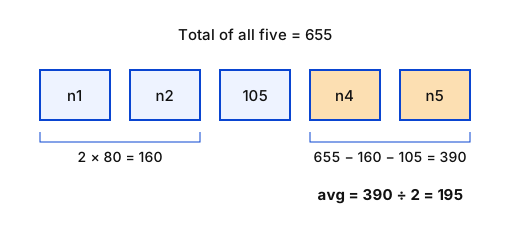
The sum of five numbers is 655. The average of the first two numbers is 80 and the third number is 105. Find the average of the remaining two numbers.
पाँच संख्याओं का योग 655 है। पहली दो संख्याओं का औसत 80 है और तीसरी संख्या 105 है। शेष दो संख्याओं का औसत ज्ञात कीजिए।
  1. A185
  2. B196
  3. C186
  4. D195
Show answer

Concept: Sum=Average×count.

  1. Sum of first two =2×80=160; third =105.
  2. Remaining two =655−160−105=390.
  3. Average =3902=195

Trick: Subtract the known parts from the total, then divide by the count left.

Answer: (D) 195

अवधारणा: योग=औसत×संख्या।

  1. पहली दो का योग =2×80=160; तीसरी =105।
  2. शेष दो का योग =655−160−105=390।
  3. औसत =3902=195

ट्रिक: कुल में से ज्ञात भाग घटाएँ, फिर शेष संख्या से भाग दें।

उत्तर: (D) 195
RRB NTPC Undergraduate CBT 1MathematicsAverageRRB NTPC Undergraduate CBT 1 2024 · 3 Sep Shift 1 →
Q4942.
David bought some sharpeners at the rate of ₹150 a dozen. He sold them for ₹43 each. His profit percentage is ______%.
डेविड ने ₹150 प्रति दर्जन की दर से कुछ शार्पनर खरीदे। उसने उन्हें ₹43 प्रति नग की दर से बेच दिया। उसका लाभ प्रतिशत ______% है।
  1. A242
  2. B244
  3. C248
  4. D246
Show answer

Concept: Profit%=SP−CPCP×100 (compare per piece).

  1. CP of 1 sharpener =15012=12.5 (₹).
  2. SP =43 → profit =43−12.5=30.5.
  3. Profit%=30.512.5×100=244%

Trick: Per dozen: CP 150, SP 43×12=516; profit =366150×100=244%.

Answer: (B) 244

अवधारणा: लाभ%=SP−CPCP×100 (प्रति नग तुलना)।

  1. 1 शार्पनर का CP =15012=12.5 (₹)।
  2. SP =43 → लाभ =43−12.5=30.5।
  3. लाभ%=30.512.5×100=244%

ट्रिक: प्रति दर्जन: CP 150, SP 43×12=516; लाभ =366150×100=244%।

उत्तर: (B) 244

RRB NTPC Undergraduate CBT 1MathematicsProfit PercentageRRB NTPC Undergraduate CBT 1 2024 · 3 Sep Shift 1 →
Q4943.
Simplify: x(3x - 8) + 3(x2 -5) + 11
सरल कीजिए: x(3x - 8) + 3(x2 -5) + 11
  1. A-6x2 -8x -4
  2. B6x2 - 8x + 4
  3. C-6x2 -8x + 4
  4. D6x2 - 8x - 4
Show answer

Concept: Expand the brackets, then combine like terms.

  1. x(3x−8)=3x2−8x
  2. 3(x2−5)=3x2−15
  3. Sum: 3x2−8x+3x2−15+11=6x2−8x−4

Trick: Constant: −15+11=−4 and x2 coefficient +6 → only option (D) fits.

Answer: (D) 6x2−8x−4

अवधारणा: कोष्ठक खोलें, फिर समान पदों को जोड़ें।

  1. x(3x−8)=3x2−8x
  2. 3(x2−5)=3x2−15
  3. योग: 3x2−8x+3x2−15+11=6x2−8x−4

ट्रिक: अचर पद: −15+11=−4 तथा x2 का गुणांक +6 → केवल (D)।

उत्तर: (D) 6x2−8x−4

RRB NTPC Undergraduate CBT 1MathematicsAlgebra – SimplificationRRB NTPC Undergraduate CBT 1 2024 · 3 Sep Shift 1 →
Q4944.
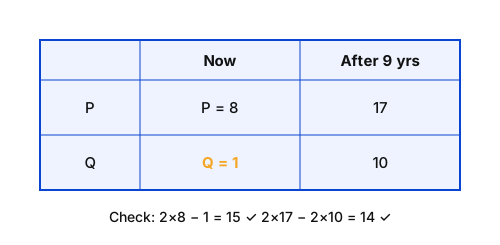
Two times the present age of P exceeds the present age of Q by 15 years. After 9 years, twice Q’s age will be 14 years less than twice P’s age at that time. What is the present age (in years) of Q?
P की वर्तमान आयु का दोगुना, Q की वर्तमान आयु से 15 वर्ष अधिक है। 9 वर्ष बाद, Q की आयु का दोगुना, उस समय P की आयु के दोगुने से 14 वर्ष कम होगा। Q की वर्तमान आयु (वर्षों में) क्या है?
  1. A3
  2. B8
  3. C1
  4. D6
Show answer

Concept: Form two equations from the two conditions and solve.

  1. Now: 2P−Q=15 … (i)
  2. After 9 years: 2(Q+9)=2(P+9)−14⇒2P−2Q=14 … (ii)
  3. (i) − (ii): Q=1; then P=8.

Trick: Subtracting the equations removes 2P directly and gives Q.

Answer: (C) 1

अवधारणा: दोनों शर्तों से दो समीकरण बनाकर हल करें।

  1. वर्तमान: 2P−Q=15 … (i)
  2. 9 वर्ष बाद: 2(Q+9)=2(P+9)−14⇒2P−2Q=14 … (ii)
  3. (i) − (ii): Q=1; तब P=8।

ट्रिक: समीकरण घटाने पर 2P हट जाता है और सीधे Q मिलता है।

उत्तर: (C) 1

RRB NTPC Undergraduate CBT 1MathematicsProblems on AgesRRB NTPC Undergraduate CBT 1 2024 · 3 Sep Shift 1 →
Q4945.
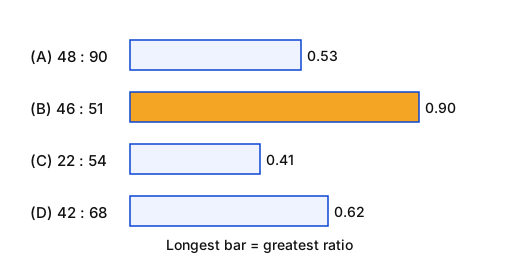
Which of the following ratios is the greatest?
निम्नलिखित में से कौन-सा अनुपात सबसे बड़ा है?
  1. A48 : 90
  2. B46 : 51
  3. C22 : 54
  4. D42 : 68
Show answer

Concept: Convert each ratio to a decimal (or compare how close the two terms are).

  1. 4890≈0.53, 4651≈0.90
  2. 2254≈0.41, 4268≈0.62
  3. Greatest: 46:51

Trick: When the antecedent is closest to the consequent, the ratio is nearest to 1 – here 46 is just 5 less than 51.

Answer: (B) 46:51

अवधारणा: हर अनुपात को दशमलव में बदलें (या देखें कि दोनों पद कितने पास हैं)।

  1. 4890≈0.53, 4651≈0.90
  2. 2254≈0.41, 4268≈0.62
  3. सबसे बड़ा: 46:51

ट्रिक: जब पूर्वपद उत्तरपद के सबसे पास हो, अनुपात 1 के सबसे निकट होता है – 46 और 51 में अंतर केवल 5।

उत्तर: (B) 46:51

RRB NTPC Undergraduate CBT 1MathematicsRatio ComparisonRRB NTPC Undergraduate CBT 1 2024 · 3 Sep Shift 1 →
Q4946.
Anshuman and Kunal together invested ₹70,400 in a business. At the end of the year, out of a total profit of ₹12,000, Kunal's share was ₹1,800. What was the difference between their investments?
अंशुमान और कुणाल ने मिलकर एक व्यवसाय में ₹70,400 का निवेश किया। वर्ष के अंत में, ₹12,000 के कुल लाभ में से कुणाल का हिस्सा ₹1,800 था। उनके निवेशों के बीच अंतर कितना था?
  1. A₹48,614
  2. B₹50,554
  3. C₹49,280
  4. D₹47,329
Show answer

Concept: When the time is the same, profit is shared in the ratio of investments.

  1. Kunal's share of profit =180012000=320.
  2. Kunal's investment =320×70400=10560 (₹).
  3. Anshuman's investment =70400−10560=59840 (₹).
  4. Difference =59840−10560=49280 (₹).

Trick: Difference =70400×12000−2×180012000=70400×0.7=49280.

Answer: (C) ₹49,280

अवधारणा: समय समान हो तो लाभ निवेश के अनुपात में बँटता है।

  1. कुणाल का लाभ भाग =180012000=320।
  2. कुणाल का निवेश =320×70400=10560 (₹)।
  3. अंशुमान का निवेश =70400−10560=59840 (₹)।
  4. अंतर =59840−10560=49280 (₹)।

ट्रिक: अंतर =70400×12000−2×180012000=70400×0.7=49280।

उत्तर: (C) ₹49,280

RRB NTPC Undergraduate CBT 1MathematicsPartnershipRRB NTPC Undergraduate CBT 1 2024 · 3 Sep Shift 1 →
Q4947.
The LCM of the numbers 2.9 and 0.031 is:
संख्याओं 2.9 और 0.031 का ल.स. (LCM) है:
  1. A899
  2. B8.99
  3. C0.899
  4. D89.9
Show answer

Concept: Write the decimals with the same number of decimal places, find the LCM of the whole numbers, then put the decimal back.

  1. 2.9=2.900=29001000 and 0.031=311000.
  2. 2900=22×52×29 and 31 is prime, so LCM(2900,31)=2900×31=89900.
  3. LCM =899001000=89.9.

Trick: LCM of decimals = LCM of numbers without decimal, with decimal places equal to the larger count (here 3).

Answer: (D) 89.9

अवधारणा: दशमलव स्थान बराबर करें, पूर्ण संख्याओं का LCM लें और फिर दशमलव वापस लगाएँ।

  1. 2.9=2.900=29001000 तथा 0.031=311000।
  2. 2900=22×52×29 और 31 अभाज्य है, अतः LCM(2900,31)=2900×31=89900।
  3. LCM =899001000=89.9।

ट्रिक: दशमलव का LCM = बिना दशमलव संख्याओं का LCM, फिर अधिकतम दशमलव स्थान (यहाँ 3) लगाएँ।

उत्तर: (D) 89.9

RRB NTPC Undergraduate CBT 1MathematicsLCM of decimalsRRB NTPC Undergraduate CBT 1 2024 · 3 Sep Shift 1 →
Q4948.
The number of prime numbers lying between 397 and 407, both included, is:
397 और 407 के बीच स्थित अभाज्य संख्याओं की संख्या (दोनों को सम्मिलित करते हुए) है:
  1. A1
  2. B4
  3. C6
  4. D2
Show answer

Concept: Test each odd number for divisibility by primes up to its square root (407<21).

  1. Odd numbers: 397, 399, 401, 403, 405, 407.
  2. 399=3×133, 405=5×81, 403=13×31, 407=11×37 – not prime.
  3. 397 and 401 are not divisible by 2, 3, 5, 7, 11, 13, 17, 19 → prime.
  4. So there are 2 primes.

Trick: Check only primes up to 19 here; use the 11-rule for 407 (4−0+7=11) and 13×31=403.

Answer: (D) 2

अवधारणा: हर विषम संख्या को उसके वर्गमूल (407<21) तक के अभाज्यों से जाँचें।

  1. विषम संख्याएँ: 397, 399, 401, 403, 405, 407।
  2. 399=3×133, 405=5×81, 403=13×31, 407=11×37 – अभाज्य नहीं।
  3. 397 और 401 किसी भी 2, 3, 5, 7, 11, 13, 17, 19 से विभाज्य नहीं → अभाज्य।
  4. अतः 2 अभाज्य संख्याएँ।

ट्रिक: यहाँ 19 तक के अभाज्य ही जाँचें; 407 के लिए 11 का नियम (4−0+7=11) और 13×31=403 याद रखें।

उत्तर: (D) 2

RRB NTPC Undergraduate CBT 1MathematicsPrime numbersRRB NTPC Undergraduate CBT 1 2024 · 3 Sep Shift 1 →
Q4949.
In an election between two candidates 96 % of the registered voters cast their vote and 10 % of the votes polled were found invalid. Winning candidate got 57 % of the valid votes and won the election by a margin of 378 votes. How many voters were registered?
दो उम्मीदवारों के बीच हुए एक चुनाव में 96 % पंजीकृत मतदाताओं ने अपना मत डाला और डाले गए मतों में से 10 % मत अवैध पाए गए। विजयी उम्मीदवार को 57 % वैध मत प्राप्त हुए और वह 378 मतों के अंतर से चुनाव जीत गया। कितने मतदाता पंजीकृत थे?
  1. A3123
  2. B3122
  3. C21872
  4. D3125
Show answer

Concept: Margin of victory = (winner% − loser%) of valid votes.

  1. Let registered voters =N. Votes polled =0.96N.
  2. Valid votes =0.9×0.96N=0.864N.
  3. Winner 57%, loser 43% → margin =14% of valid =0.14×0.864N=0.12096N.
  4. 0.12096N=378⇒N=3125.

Trick: Check options: 3125×0.96×0.9×0.14=378 ✓ – only a round answer fits.

Answer: (D) 3125

अवधारणा: जीत का अंतर = वैध मतों का (विजेता% − पराजित%)।

  1. पंजीकृत मतदाता =N। डाले गए मत =0.96N।
  2. वैध मत =0.9×0.96N=0.864N।
  3. विजेता 57%, पराजित 43% → अंतर =14% वैध मत =0.12096N।
  4. 0.12096N=378⇒N=3125।

ट्रिक: विकल्प जाँचें: 3125×0.96×0.9×0.14=378 ✓।

उत्तर: (D) 3125

RRB NTPC Undergraduate CBT 1MathematicsElections (percentage)RRB NTPC Undergraduate CBT 1 2024 · 3 Sep Shift 1 →
Q4950.
A piece of furniture is marked at 35% above its cost price. The shopkeeper gives a discount of 18% on the marked price and still earns ₹1,498 profit. What is the cost price of the furniture?
फ़र्नीचर के एक सामान पर उसके क्रय मूल्य से 35% अधिक मूल्य अंकित किया गया है। दुकानदार अंकित मूल्य पर 18% की छूट देता है और फिर भी ₹1,498 का लाभ अर्जित करता है। फ़र्नीचर का क्रय मूल्य क्या है?
  1. A₹16,000
  2. B₹12,000
  3. C₹14,000
  4. D₹15,000
Show answer

Concept: SP=CP×(1+markup)×(1−discount).

  1. Let CP=100. MP =135.
  2. SP =135×0.82=110.7 → profit =10.7% of CP.
  3. 10.7% of CP =1498⇒CP=1498×10010.7=14000.

Trick: Net effect of +35% and −18%: 35−18−35×18100=10.7%.

Answer: (C) ₹14,000

अवधारणा: SP=CP×(1+markup)×(1−छूट)।

  1. मान लें CP=100। अंकित मूल्य =135।
  2. SP =135×0.82=110.7 → लाभ =10.7%।
  3. 10.7% CP =1498⇒CP=1498×10010.7=14000।

ट्रिक: +35% और −18% का शुद्ध प्रभाव: 35−18−35×18100=10.7%।

उत्तर: (C) ₹14,000

RRB NTPC Undergraduate CBT 1MathematicsProfit & discountRRB NTPC Undergraduate CBT 1 2024 · 3 Sep Shift 1 →
Q4951.
The simple interest on a certain sum for 812 years at the rate of 3.2% per annum is ₹2,550. What will be the amount payable on the same sum at the rate of 9.6% per annum simple interest in 545 years?
किसी निश्चित राशि पर 812 वर्ष के लिए 3.2% वार्षिक दर से साधारण ब्याज ₹2,550 है। उसी राशि पर 9.6% वार्षिक साधारण ब्याज की दर से 545 वर्ष में देय मिश्रधन कितना होगा?
  1. A₹14,613
  2. B₹14,609
  3. C₹14,583
  4. D₹14,595
Show answer

Concept: SI=P×R×T100, Amount =P+SI.

  1. 2550=P×3.2×8.5100=0.272P⇒P=9375 (₹).
  2. New SI =9375×9.6×5.8100=5220 (₹).
  3. Amount =9375+5220=14595 (₹).

Trick: Rate × time: old =27.2, new =55.68; new SI =2550×55.6827.2=5220.

Answer: (D) ₹14,595

अवधारणा: SI=P×R×T100, मिश्रधन =P+SI।

  1. 2550=P×3.2×8.5100=0.272P⇒P=9375 (₹)।
  2. नया SI =9375×9.6×5.8100=5220 (₹)।
  3. मिश्रधन =9375+5220=14595 (₹)।

ट्रिक: दर × समय: पुराना =27.2, नया =55.68; नया SI =2550×55.6827.2=5220।

उत्तर: (D) ₹14,595

RRB NTPC Undergraduate CBT 1MathematicsSimple interestRRB NTPC Undergraduate CBT 1 2024 · 3 Sep Shift 1 →
Q4952.
Evaluate 242.
242 का मान ज्ञात कीजिए।
  1. A576
  2. B546
  3. C626
  4. D536
Show answer

Concept: Use (a−b)2=a2−2ab+b2 with a round base.

  1. 242=(25−1)2=625−50+1.
  2. =576.

Trick: Squares ending in 4 end in 6; 242=576 (since 252=625, subtract 25+24=49).

Answer: (A) 576

अवधारणा: गोल आधार के साथ (a−b)2=a2−2ab+b2 का प्रयोग करें।

  1. 242=(25−1)2=625−50+1।
  2. =576।

ट्रिक: 4 पर समाप्त संख्या का वर्ग 6 पर समाप्त होता है; 252=625 में से 25+24=49 घटाएँ = 576।

उत्तर: (A) 576

RRB NTPC Undergraduate CBT 1MathematicsSquaresRRB NTPC Undergraduate CBT 1 2024 · 3 Sep Shift 1 →
Q4953.
Ishaan and Meghna have to travel from Delhi to Kanpur in their respective cars. Ishaan is driving at 147 km/hr while Meghna is driving at 42 km/hr. Find the time taken by Meghna to reach Kanpur if Ishaan takes 8 hours.
ईशान और मेघना को अपनी-अपनी कारों से दिल्ली से कानपुर की यात्रा करनी है। ईशान 147 km/hr की चाल से गाड़ी चला रहा है जबकि मेघना 42 km/hr की चाल से गाड़ी चला रही है। यदि ईशान को 8 घंटे लगते हैं, तो मेघना द्वारा कानपुर पहुँचने में लिया गया समय ज्ञात कीजिए।
  1. A32 hours32 घंटे
  2. B19 hours19 घंटे
  3. C33 hours33 घंटे
  4. D28 hours28 घंटे
Show answer

Concept: For the same distance, time is inversely proportional to speed.

  1. Distance =147×8=1176km.
  2. Meghna's time =117642=28 hours.

Trick: T2=T1×S1S2=8×14742=8×3.5=28.

Answer: (D) 28 hours

अवधारणा: समान दूरी के लिए समय चाल के व्युत्क्रमानुपाती होता है।

  1. दूरी =147×8=1176km।
  2. मेघना का समय =117642=28 घंटे।

ट्रिक: T2=T1×S1S2=8×14742=28।

उत्तर: (D) 28 घंटे

RRB NTPC Undergraduate CBT 1MathematicsSpeed and timeRRB NTPC Undergraduate CBT 1 2024 · 3 Sep Shift 1 →
Q4954.
The marked price of a vehicle is ₹6,48,200. It is sold after allowing three successive discounts of 6%, 5% and 4%. Find its selling price. (Rounded off to nearest rupee)
एक वाहन का अंकित मूल्य ₹6,48,200 है। इसे 6%, 5% और 4% की तीन क्रमिक छूट देने के बाद बेचा जाता है। इसका विक्रय मूल्य ज्ञात कीजिए। (निकटतम रुपये तक पूर्णांकित)
  1. A₹5,55,689
  2. B₹5,70,650
  3. C₹5,60,789
  4. D₹5,48,600
Show answer

Concept: Successive discounts multiply: SP =MP×(1−d1)(1−d2)(1−d3).

  1. 648200×0.94=609308.
  2. 609308×0.95=578842.6.
  3. 578842.6×0.96=555688.9≈555689 (₹).

Trick: 0.94×0.95×0.96=0.85728 → net discount 14.272%; SP =648200×0.85728.

Answer: (A) ₹5,55,689

अवधारणा: क्रमिक छूट गुणा होती हैं: SP =MP×(1−d1)(1−d2)(1−d3)।

  1. 648200×0.94=609308।
  2. 609308×0.95=578842.6।
  3. 578842.6×0.96=555688.9≈555689 (₹)।

ट्रिक: 0.94×0.95×0.96=0.85728 → शुद्ध छूट 14.272%।

उत्तर: (A) ₹5,55,689

RRB NTPC Undergraduate CBT 1MathematicsSuccessive discountsRRB NTPC Undergraduate CBT 1 2024 · 3 Sep Shift 1 →
Q4955.
The exterior angle of a regular polygon is one-seventh of its interior angle. How many sides does the polygon have?
एक सम बहुभुज का बाह्य कोण उसके अंतः कोण का सातवाँ भाग है। बहुभुज की कितनी भुजाएँ हैं?
  1. A18
  2. B24
  3. C12
  4. D16
Show answer

Concept: Interior + exterior angle =180∘; number of sides n=360∘exterior.

  1. Exterior =17 interior → ratio 1:7.
  2. Exterior =180∘8=22.5∘.
  3. n=360∘22.5∘=16.

Trick: If exterior =1k interior, then n=2(k+1)=2×8=16.

Answer: (D) 16

अवधारणा: अंतः कोण + बाह्य कोण =180∘; भुजाएँ n=360∘बाह्य।

  1. बाह्य =17 अंतः → अनुपात 1:7।
  2. बाह्य =180∘8=22.5∘।
  3. n=360∘22.5∘=16।

ट्रिक: यदि बाह्य =1k अंतः, तो n=2(k+1)=16।

उत्तर: (D) 16

RRB NTPC Undergraduate CBT 1MathematicsPolygonsRRB NTPC Undergraduate CBT 1 2024 · 3 Sep Shift 1 →
Q4956.
The product of two positive numbers is 2645. If the first number is five times the second number, then the sum of the two numbers is:
दो धनात्मक संख्याओं का गुणनफल 2645 है। यदि पहली संख्या दूसरी संख्या की पाँच गुनी है, तो दोनों संख्याओं का योग है:
  1. A138
  2. B149
  3. C146
  4. D155
Show answer

Concept: Express both numbers in one variable and use the product.

  1. Second =x, first =5x.
  2. 5x2=2645⇒x2=529⇒x=23.
  3. Sum =6x=138.

Trick: 2645÷5=529=232; sum =6×23.

Answer: (A) 138

अवधारणा: दोनों संख्याओं को एक चर में लिखें और गुणनफल का प्रयोग करें।

  1. दूसरी =x, पहली =5x।
  2. 5x2=2645⇒x2=529⇒x=23।
  3. योग =6x=138।

ट्रिक: 2645÷5=529=232; योग =6×23।

उत्तर: (A) 138

RRB NTPC Undergraduate CBT 1MathematicsNumbersRRB NTPC Undergraduate CBT 1 2024 · 3 Sep Shift 1 →
Q4957.
The average runs scored by a batsman in 23 matches is 43. In the next 10 matches, the batsman scored an average of 15 runs. Find his average runs scored (rounded off to two decimal places) in all the 33 matches.
एक बल्लेबाज़ द्वारा 23 मैचों में बनाए गए रनों का औसत 43 है। अगले 10 मैचों में, बल्लेबाज़ ने औसतन 15 रन बनाए। सभी 33 मैचों में उसके द्वारा बनाए गए रनों का औसत (दो दशमलव स्थानों तक पूर्णांकित) ज्ञात कीजिए।
  1. A33.52
  2. B35.52
  3. C34.52
  4. D36.52
Show answer

Concept: Overall average = total runs ÷ total matches.

  1. Runs in 23 matches =23×43=989.
  2. Runs in next 10 =10×15=150.
  3. Average =113933=34.515≈34.52.

Trick: Deviation method: 43−10×(43−15)33=43−8.48=34.52.

Answer: (C) 34.52

अवधारणा: कुल औसत = कुल रन ÷ कुल मैच।

  1. 23 मैचों के रन =23×43=989।
  2. अगले 10 मैच =10×15=150।
  3. औसत =113933=34.515≈34.52।

ट्रिक: विचलन विधि: 43−10×2833=43−8.48=34.52।

उत्तर: (C) 34.52

RRB NTPC Undergraduate CBT 1MathematicsAverageRRB NTPC Undergraduate CBT 1 2024 · 3 Sep Shift 1 →
Q4958.
The number 938315 is divisible by which of the following?
संख्या 938315 निम्नलिखित में से किससे विभाज्य है?
  1. A12
  2. B13
  3. C5
  4. D9
Show answer

Concept: A number is divisible by 5 if its last digit is 0 or 5.

  1. 938315 ends in 5 → divisible by 5.
  2. Not by 12 or 9: it is odd and digit sum =29 (not a multiple of 3 or 9).
  3. 938315=13×72178+1 → not by 13.

Trick: Look at the last digit first – it settles 2, 4, 5, 10 instantly.

Answer: (C) 5

अवधारणा: जिस संख्या का अंतिम अंक 0 या 5 हो वह 5 से विभाज्य होती है।

  1. 938315 का अंतिम अंक 5 → 5 से विभाज्य।
  2. 12 या 9 से नहीं: संख्या विषम है और अंकों का योग =29 (3 या 9 का गुणज नहीं)।
  3. 938315=13×72178+1 → 13 से नहीं।

ट्रिक: पहले अंतिम अंक देखें – 2, 4, 5, 10 तुरंत तय हो जाते हैं।

उत्तर: (C) 5

RRB NTPC Undergraduate CBT 1MathematicsDivisibilityRRB NTPC Undergraduate CBT 1 2024 · 3 Sep Shift 1 →
Q4959.
An amount of ₹785 is divided among three persons in the ratio of 19 : 3 : 18. The difference between the largest and the smallest shares (in ₹) in the distribution is:
₹785 की एक राशि को तीन व्यक्तियों के बीच 19 : 3 : 18 के अनुपात में बाँटा जाता है। इस वितरण में सबसे बड़े और सबसे छोटे हिस्सों के बीच का अंतर (₹ में) है:
  1. A387
  2. B315
  3. C314
  4. D369
Show answer

Concept: Value of 1 part =totalsum of ratio terms.

  1. Sum of ratio =19+3+18=40; 1 part =78540=19.625.
  2. Largest − smallest =19−3=16 parts.
  3. 16×19.625=314 (₹).

Trick: Difference =785×1640=785×0.4=314.

Answer: (C) 314

अवधारणा: 1 भाग =कुलअनुपात पदों का योग।

  1. अनुपात योग =19+3+18=40; 1 भाग =78540=19.625।
  2. सबसे बड़ा − सबसे छोटा =19−3=16 भाग।
  3. 16×19.625=314 (₹)।

ट्रिक: अंतर =785×1640=785×0.4=314।

उत्तर: (C) 314

RRB NTPC Undergraduate CBT 1MathematicsRatio & proportionRRB NTPC Undergraduate CBT 1 2024 · 3 Sep Shift 1 →
Q4960.
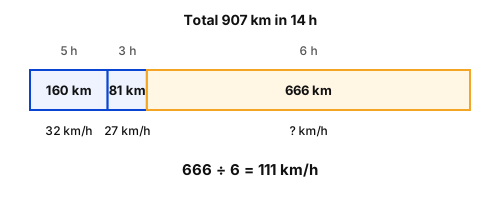
Aarohi has to reach Lucknow which is 907 km away in 14 hours. His starting speed for 5 hours was 32 km/hr. For the next 81 km his speed was 27 km/hr. By what speed he must travel now so as to reach Lucknow in the decided time of 14 hours?
आरोही को 907 km दूर स्थित लखनऊ 14 घंटे में पहुँचना है। पहले 5 घंटे तक उसकी प्रारंभिक चाल 32 km/hr थी। अगले 81 km तक उसकी चाल 27 km/hr थी। निर्धारित 14 घंटे के समय में लखनऊ पहुँचने के लिए उसे अब किस चाल से यात्रा करनी होगी?
  1. A108 km/hr
  2. B117 km/hr
  3. C107 km/hr
  4. D111 km/hr
Show answer

Concept: Required speed = remaining distance ÷ remaining time.

  1. First 5 h: 5×32=160km.
  2. Next 81km at 27km/h takes 3 h.
  3. Remaining distance =907−241=666km; remaining time =14−8=6 h.
  4. Speed =6666=111km/h.

Trick: Keep a running total of distance and time; the last leg gives the answer directly.

Answer: (D) 111 km/hr

अवधारणा: आवश्यक चाल = शेष दूरी ÷ शेष समय।

  1. पहले 5 घंटे: 5×32=160km।
  2. अगले 81km, 27km/h पर 3 घंटे।
  3. शेष दूरी =907−241=666km; शेष समय =14−8=6 घंटे।
  4. चाल =6666=111km/h।

ट्रिक: दूरी और समय का चालू योग रखें; अंतिम हिस्सा सीधे उत्तर देता है।

उत्तर: (D) 111 km/hr

RRB NTPC Undergraduate CBT 1MathematicsSpeed, distance & timeRRB NTPC Undergraduate CBT 1 2024 · 3 Sep Shift 1 →