Question bank

Q&A: practice questions with answers

Search questions on any topic. Filter by exam category, exam, subject and topic, try the question, then open the answer and explanation.

Courses – airGurukul

8,495 questions found.

Q5241.
If the third proportional of 9 and 30 be x, then what is the value of x?
यदि 9 और 30 का तृतीयानुपाती x है, तो x का मान क्या है?
  1. A101
  2. B102
  3. C99
  4. D100
Show answer

Concept: Third proportional of a and b is x where a:b=b:x, i.e. x=b2a.

  1. 9:30=30:x
  2. x=3029=9009=100

Trick: Third proportional =(second)2first.

Answer: (D) 100

अवधारणा: a और b का तृतीयानुपाती x हो तो a:b=b:x, अर्थात x=b2a।

  1. 9:30=30:x
  2. x=3029=9009=100

ट्रिक: तृतीयानुपाती =(दूसरा)2पहला।

उत्तर: (D) 100

RRB NTPC Undergraduate CBT 1MathematicsProportion – third proportionalRRB NTPC Undergraduate CBT 1 2024 · 2 Sep Shift 1 →
Q5242.
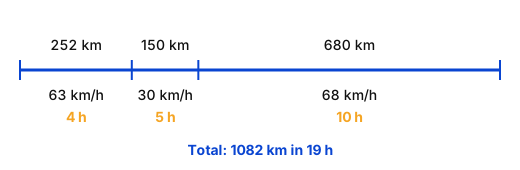
Zeeshan travels 252 km at 63 km/hr, the next 150 km at 30 km/hr and the next 680 km at 68 km/hr. What is his average speed (in km/hr, rounded off to two decimal places) for the whole journey?
ज़ीशान 252 km की दूरी 63 km/hr की चाल से, अगली 150 km की दूरी 30 km/hr की चाल से और अगली 680 km की दूरी 68 km/hr की चाल से तय करता है। पूरी यात्रा के लिए उसकी औसत चाल (km/hr में, दशमलव के दो स्थानों तक पूर्णांकित) कितनी है?
  1. A58.05
  2. B62.09
  3. C54.95
  4. D56.95
Show answer

Concept: Average speed=Total distanceTotal time (not the average of speeds).

  1. Times: 25263=4h, 15030=5h, 68068=10h
  2. Total distance =252+150+680=1082km; total time =19h
  3. Average speed =108219≈56.95km/h

Trick: 19×57=1083, so the answer is just below 57 → 56.95.

Answer: (D) 56.95

अवधारणा: औसत चाल=कुल दूरीकुल समय (चालों का औसत नहीं)।

  1. समय: 25263=4h, 15030=5h, 68068=10h
  2. कुल दूरी =252+150+680=1082km; कुल समय =19h
  3. औसत चाल =108219≈56.95km/h

ट्रिक: 19×57=1083, अतः उत्तर 57 से थोड़ा कम → 56.95।

उत्तर: (D) 56.95

RRB NTPC Undergraduate CBT 1MathematicsSpeed – average speedRRB NTPC Undergraduate CBT 1 2024 · 2 Sep Shift 1 →
Q5243.
What is the difference between a single discount of 48% on ₹1,450 and two successive discounts of 10% and 40% on the same amount?
₹1,450 पर 48% की एकल छूट और उसी राशि पर 10% और 40% की दो क्रमिक छूटों के बीच का अंतर कितना है?
  1. A₹28
  2. B₹29
  3. C₹32
  4. D₹31
Show answer

Concept: Two successive discounts a% and b% equal a single discount of (a+b−ab100)%.

  1. Equivalent of 10% and 40%: 10+40−10×40100=46%
  2. Single discount 48% vs 46%: gap =2%
  3. 2% of 1450=2×1450100=29

Trick: Find only the % gap and apply it to the price – no need to compute both selling prices (754 and 667).

Answer: (B) ₹29

अवधारणा: क्रमिक छूट a% व b% = एकल छूट (a+b−ab100)%।

  1. 10% व 40% का समतुल्य: 10+40−10×40100=46%
  2. एकल छूट 48% बनाम 46%: अंतर =2%
  3. 1450 का 2%=2×1450100=29

ट्रिक: केवल % अंतर निकालें और मूल्य पर लगाएँ – दोनों विक्रय मूल्य (754 और 667) निकालने की ज़रूरत नहीं।

उत्तर: (B) ₹29

RRB NTPC Undergraduate CBT 1MathematicsDiscount – single vs successiveRRB NTPC Undergraduate CBT 1 2024 · 2 Sep Shift 1 →
Q5244.
Simplify: 4(34x2−25x+17)−3(x2+8x−13)
सरल कीजिए: 4(34x2−25x+17)−3(x2+8x−13)
  1. A124x − 107
  2. B124x + 107
  3. C−124x − 107
  4. D−124x + 107
Show answer

Concept: Open brackets by distributing, then combine like terms.

  1. 4(34x2−25x+17)=3x2−100x+68
  2. −3(x2+8x−13)=−3x2−24x+39
  3. Add: (3x2−3x2)+(−100x−24x)+(68+39)=−124x+107

Trick: The x2 terms cancel (4×34=3), so only the x and constant terms need checking: sign of x is −, constant is +.

Answer: (D) −124x+107

अवधारणा: कोष्ठक खोलकर (वितरण नियम) समान पदों को जोड़ें।

  1. 4(34x2−25x+17)=3x2−100x+68
  2. −3(x2+8x−13)=−3x2−24x+39
  3. जोड़ें: (3x2−3x2)+(−100x−24x)+(68+39)=−124x+107

ट्रिक: x2 पद कट जाते हैं (4×34=3); x का चिह्न −, अचर +।

उत्तर: (D) −124x+107

RRB NTPC Undergraduate CBT 1MathematicsAlgebra – simplificationRRB NTPC Undergraduate CBT 1 2024 · 2 Sep Shift 1 →
Q5245.
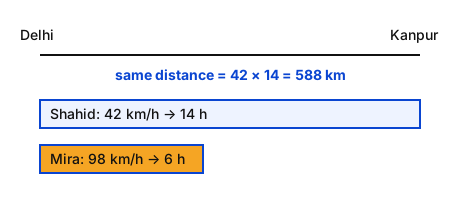
Shahid and Mira have to travel from Delhi to Kanpur in their respective cars. Shahid is driving at 42 km/hr while Mira is driving at 98 km/hr. Find the time taken by Mira to reach Kanpur if Shahid takes 14 hours.
शाहिद और मीरा को अपनी-अपनी कारों से दिल्ली से कानपुर तक यात्रा करनी है। शाहिद 42 km/hr की चाल से गाड़ी चला रहा है, जबकि मीरा 98 km/hr की चाल से गाड़ी चला रही है। यदि शाहिद को 14 घंटे लगते हैं, तो मीरा द्वारा कानपुर पहुँचने में लिया गया समय ज्ञात कीजिए।
  1. A5 hours5 घंटे
  2. B2 hours2 घंटे
  3. C6 hours6 घंटे
  4. D12 hours12 घंटे
Show answer

Concept: For the same distance, time is inversely proportional to speed: t1t2=s2s1.

  1. Distance =42×14=588km
  2. Mira’s time =58898=6h
  3. Check: tM14=4298=37⇒tM=6

Trick: Speed ratio 42:98=3:7, so time ratio =7:3; 14→6.

Answer: (C) 6 hours

अवधारणा: समान दूरी के लिए समय, चाल के व्युत्क्रमानुपाती होता है: t1t2=s2s1।

  1. दूरी =42×14=588km
  2. मीरा का समय =58898=6h
  3. जाँच: tM14=4298=37⇒tM=6

ट्रिक: चाल अनुपात 42:98=3:7, अतः समय अनुपात =7:3; 14→6।

उत्तर: (C) 6 hours (6 घंटे)

RRB NTPC Undergraduate CBT 1MathematicsSpeed, time and distanceRRB NTPC Undergraduate CBT 1 2024 · 2 Sep Shift 1 →
Q5246.
A sum of ₹400 amounts to ₹529 in 2 years at a certain rate of interest per annum, compounded annually. The rate of interest per annum is:
₹400 की एक राशि वार्षिक रूप से संयोजित होने वाली एक निश्चित वार्षिक ब्याज दर पर 2 वर्षों में ₹529 हो जाती है। वार्षिक ब्याज दर कितनी है?
  1. A11%
  2. B15%
  3. C18%
  4. D16%
Show answer

Concept: For CI compounded annually, A=P(1+r100)n.

  1. AP=529400=(1+r100)2
  2. 529400=2320=1+r100
  3. r100=320⇒r=15%

Trick: 529 and 400 are perfect squares (232,202): rate =23−2020×100=15%.

Answer: (B) 15%

अवधारणा: वार्षिक चक्रवृद्धि में A=P(1+r100)n।

  1. AP=529400=(1+r100)2
  2. 529400=2320=1+r100
  3. r100=320⇒r=15%

ट्रिक: 529 और 400 पूर्ण वर्ग हैं (232,202): दर =23−2020×100=15%।

उत्तर: (B) 15%

RRB NTPC Undergraduate CBT 1MathematicsCompound InterestRRB NTPC Undergraduate CBT 1 2024 · 2 Sep Shift 1 →
Q5247.
A trader claims to sell flour at a profit of 58%, but also dishonestly uses a weight which is 8% less than what is mentioned on it. Find the total percentage of profit earned by the trader. (Round off the answer to the nearest whole number.)
एक व्यापारी 58% के लाभ पर आटा बेचने का दावा करता है, लेकिन बेईमानी से ऐसे बाट का भी उपयोग करता है जो उस पर अंकित भार से 8% कम है। व्यापारी द्वारा अर्जित कुल लाभ प्रतिशत ज्ञात कीजिए। (उत्तर को निकटतम पूर्ण संख्या तक पूर्णांकित कीजिए।)
  1. A71%
  2. B76%
  3. C72%
  4. D74%
Show answer

Concept: With a false weight, Selling price per real unit rises; Profit%=(SPCP of goods actually given−1)×100.

  1. Let CP of 1 kg = ₹100; claimed SP = ₹158.
  2. He actually gives only 0.92kg, costing ₹92.
  3. Profit%=158−9292×100=660092≈71.74%
  4. Rounded: 72%.

Trick: Overall gain =100+gain100−error×100−100=15892×100−100.

Answer: (C) 72%

अवधारणा: गलत बाट से वास्तविक दिया गया माल कम होता है; लाभ%=(विक्रय मूल्यदिए गए माल का क्रय मूल्य−1)×100।

  1. मान लें 1 kg का क्रय मूल्य ₹100; दावा किया विक्रय मूल्य ₹158।
  2. वास्तव में वह केवल 0.92kg देता है, जिसकी लागत ₹92।
  3. लाभ%=158−9292×100≈71.74%
  4. निकटतम पूर्णांक: 72%।

ट्रिक: कुल लाभ =15892×100−100 (यानी 100+लाभ100−कमी)।

उत्तर: (C) 72%

RRB NTPC Undergraduate CBT 1MathematicsProfit and Loss – False WeightRRB NTPC Undergraduate CBT 1 2024 · 2 Sep Shift 1 →
Q5248.
The product of two positive numbers is 80. If the first number is five times of the second number, then the sum of the two numbers is:
दो धनात्मक संख्याओं का गुणनफल 80 है। यदि पहली संख्या, दूसरी संख्या की पाँच गुनी है, तो दोनों संख्याओं का योग कितना है?
  1. A29
  2. B24
  3. C33
  4. D27
Show answer

Concept: Write both numbers in one variable and use the product.

  1. Let second number =x, first =5x.
  2. 5x×x=80⇒x2=16⇒x=4
  3. Numbers: 20 and 4; sum =24.

Trick: Check options: 20×4=80 and 20=5×4 ✓.

Answer: (B) 24

अवधारणा: दोनों संख्याओं को एक चर में लिखकर गुणनफल का प्रयोग करें।

  1. दूसरी संख्या =x, पहली =5x।
  2. 5x×x=80⇒x2=16⇒x=4
  3. संख्याएँ 20 और 4; योग =24।

ट्रिक: जाँच: 20×4=80 और 20=5×4 ✓।

उत्तर: (B) 24

RRB NTPC Undergraduate CBT 1MathematicsNumbers – Product and SumRRB NTPC Undergraduate CBT 1 2024 · 2 Sep Shift 1 →
Q5249.
The LCM of the numbers 15.4 and 0.006 is:
संख्याओं 15.4 और 0.006 का LCM (लघुत्तम समापवर्त्य) कितना है?
  1. A4.62
  2. B46.2
  3. C462
  4. D0.462
Show answer

Concept: Make decimal places equal, find LCM of the whole numbers, then put back the decimal places.

  1. 15.4=15.400=154001000, 0.006=61000
  2. LCM(15400,6): 15400=23×52×7×11, 6=2×3 → LCM =46200
  3. Put back 3 decimal places: 46.200=46.2

Trick: LCM of decimals = LCM of numerators ÷ common denominator.

Answer: (B) 46.2

अवधारणा: दशमलव स्थान बराबर करें, पूर्ण संख्याओं का LCM निकालें, फिर दशमलव वापस लगाएँ।

  1. 15.4=154001000, 0.006=61000
  2. LCM(15400,6): 15400=23×52×7×11, 6=2×3 → LCM =46200
  3. 3 दशमलव स्थान: 46.200=46.2

ट्रिक: दशमलव का LCM = अंशों का LCM ÷ समान हर।

उत्तर: (B) 46.2

RRB NTPC Undergraduate CBT 1MathematicsLCM of DecimalsRRB NTPC Undergraduate CBT 1 2024 · 2 Sep Shift 1 →
Q5250.
Find the simple interest (in ₹) if a sum of ₹400 is borrowed for 3.5 years at 16% per annum rate of interest.
यदि ₹400 की राशि 16% वार्षिक ब्याज दर पर 3.5 वर्ष के लिए उधार ली जाती है, तो साधारण ब्याज (₹ में) ज्ञात कीजिए।
  1. A324
  2. B274
  3. C224
  4. D204
Show answer

Concept: SI=P×R×T100.

  1. P=400,R=16,T=3.5
  2. SI=400×16×3.5100=4×56=224

Trick: 16×3.5=56% of ₹400 = ₹224.

Answer: (C) 224

अवधारणा: साधारण ब्याज=P×R×T100।

  1. P=400,R=16,T=3.5
  2. SI=400×16×3.5100=4×56=224

ट्रिक: कुल दर 16×3.5=56%; ₹400 का 56% = ₹224।

उत्तर: (C) 224

RRB NTPC Undergraduate CBT 1MathematicsSimple InterestRRB NTPC Undergraduate CBT 1 2024 · 2 Sep Shift 1 →
Q5251.
Find the value of: [480 ÷ {12 + 2 × ( 4 − 9 )}].
इसका मान ज्ञात कीजिए: [480 ÷ {12 + 2 × ( 4 − 9 )}]
  1. A241
  2. B240
  3. C242
  4. D243
Show answer

Concept: Solve innermost bracket first: ( ) → { } → [ ].

  1. (4−9)=−5
  2. {12+2×(−5)}=12−10=2
  3. [480÷2]=240

Trick: Bracket order: small → curly → square.

Answer: (B) 240

अवधारणा: सबसे अंदर का कोष्ठक पहले: ( ) → { } → [ ]।

  1. (4−9)=−5
  2. {12+2×(−5)}=12−10=2
  3. [480÷2]=240

ट्रिक: कोष्ठक क्रम: छोटा → मझला → बड़ा।

उत्तर: (B) 240

RRB NTPC Undergraduate CBT 1MathematicsSimplification (BODMAS)RRB NTPC Undergraduate CBT 1 2024 · 2 Sep Shift 1 →
Q5252.
3 years ago, the age of a father was 18 years more than twice his son's age. After how many years, from now, will he be twice his son's age?
3 वर्ष पहले, एक पिता की आयु उसके पुत्र की आयु के दोगुने से 18 वर्ष अधिक थी। अब से कितने वर्ष बाद, वह अपने पुत्र की आयु का दोगुना होगा?
  1. A17
  2. B11
  3. C13
  4. D15
Show answer

Concept: Form equations from present ages F and S.

  1. 3 years ago: F−3=2(S−3)+18⇒F=2S+15
  2. After n years: F+n=2(S+n)⇒F=2S+n
  3. Compare: n=15 years.

Trick: If F−a=2(S−a)+k, then father becomes twice the son after exactly k−a years: 18−3=15.

Answer: (D) 15

अवधारणा: वर्तमान आयु F (पिता) और S (पुत्र) लेकर समीकरण बनाएँ।

  1. 3 वर्ष पहले: F−3=2(S−3)+18⇒F=2S+15
  2. n वर्ष बाद: F+n=2(S+n)⇒F=2S+n
  3. तुलना: n=15 वर्ष।

ट्रिक: यदि F−a=2(S−a)+k हो, तो पिता k−a वर्ष बाद दोगुना होगा: 18−3=15।

उत्तर: (D) 15

RRB NTPC Undergraduate CBT 1MathematicsProblems on AgesRRB NTPC Undergraduate CBT 1 2024 · 2 Sep Shift 1 →
Q5253.
Evaluate: (-9) - (-60) ÷ (-10) + (-4) × 6
मान ज्ञात कीजिए: (-9) - (-60) ÷ (-10) + (-4) × 6
  1. A-39
  2. B-38
  3. C-42
  4. D-41
Show answer

Concept: BODMAS: division and multiplication before addition/subtraction; watch signs.

  1. (−60)÷(−10)=6
  2. (−4)×6=−24
  3. (−9)−6+(−24)=−39

Trick: Negative ÷ negative = positive.

Answer: (A) −39

अवधारणा: BODMAS: पहले भाग व गुणा, फिर जोड़/घटाव; चिह्नों का ध्यान रखें।

  1. (−60)÷(−10)=6
  2. (−4)×6=−24
  3. (−9)−6+(−24)=−39

ट्रिक: ऋणात्मक ÷ ऋणात्मक = धनात्मक।

उत्तर: (A) −39

RRB NTPC Undergraduate CBT 1MathematicsSimplification with IntegersRRB NTPC Undergraduate CBT 1 2024 · 2 Sep Shift 1 →
Q5254.
A can lay railway track between two given stations in 19 days and B can do the same job in 11 days. With the help of C, they did the job in 3 days only. Then, C alone can do the job in
A दो दिए गए स्टेशनों के बीच रेलवे ट्रैक 19 दिनों में बिछा सकता है और B वही कार्य 11 दिनों में कर सकता है। C की सहायता से, उन्होंने यह कार्य केवल 3 दिनों में पूरा किया। तो, C अकेले यह कार्य कितने दिनों में कर सकता है?
  1. A332119 days332119 दिन
  2. B832119 days832119 दिन
  3. C532119 days532119 दिन
  4. D632119 days632119 दिन
Show answer

Concept: One-day work adds up: 1A+1B+1C=1together.

  1. 1C=13−119−111
  2. LCM =627: 209−33−57627=119627
  3. C=627119=532119 days

Trick: 627=3×19×11; integer part must be just over 5 since 119627≈0.19.

Answer: (C) 532119 days

अवधारणा: एक दिन का काम जुड़ता है: 1A+1B+1C=1साथ।

  1. 1C=13−119−111
  2. LCM =627: 209−33−57627=119627
  3. C=627119=532119 दिन

ट्रिक: 627=3×19×11; 119627≈0.19, अतः उत्तर 5 से थोड़ा अधिक।

उत्तर: (C) 532119 दिन

RRB NTPC Undergraduate CBT 1MathematicsTime and WorkRRB NTPC Undergraduate CBT 1 2024 · 2 Sep Shift 1 →
Q5255.
The current population of a town is 12,800. It increases by 25% and 35% in two successive years but decreases by 5% in the third year. What is the population of the town at the end of the third year?
एक कस्बे की वर्तमान जनसंख्या 12,800 है। यह दो क्रमिक वर्षों में 25% और 35% बढ़ती है, लेकिन तीसरे वर्ष में 5% घट जाती है। तीसरे वर्ष के अंत में कस्बे की जनसंख्या कितनी है?
  1. A20,520
  2. B20,525
  3. C20,515
  4. D20,517
Show answer

Concept: Successive % changes multiply: P×(1+r1)(1+r2)(1−r3).

  1. 12800×1.25=16000
  2. 16000×1.35=21600
  3. 21600×0.95=20520

Trick: Use fractions: 12800×54×2720×1920=20520.

Answer: (A) 20,520

अवधारणा: क्रमिक प्रतिशत परिवर्तन गुणा होते हैं: P×(1+r1)(1+r2)(1−r3)।

  1. 12800×1.25=16000
  2. 16000×1.35=21600
  3. 21600×0.95=20520

ट्रिक: भिन्न में: 12800×54×2720×1920=20520।

उत्तर: (A) 20,520

RRB NTPC Undergraduate CBT 1MathematicsPopulation – Successive ChangeRRB NTPC Undergraduate CBT 1 2024 · 2 Sep Shift 1 →
Q5256.
The HCF and the LCM of two numbers are 11 and 330, respectively. If one of the numbers is 66, find the other one.
दो संख्याओं का HCF और LCM क्रमशः 11 और 330 है। यदि उनमें से एक संख्या 66 है, तो दूसरी संख्या ज्ञात कीजिए।
  1. A44
  2. B55
  3. C66
  4. D121
Show answer

Concept: HCF×LCM=product of the two numbers.

  1. 11×330=66×x
  2. x=363066=55

Trick: Other number must be a multiple of HCF 11 dividing 330 → 55.

Answer: (B) 55

अवधारणा: HCF×LCM=दोनों संख्याओं का गुणनफल।

  1. 11×330=66×x
  2. x=363066=55

ट्रिक: दूसरी संख्या 11 का गुणज और 330 का भाजक होगी → 55।

उत्तर: (B) 55

RRB NTPC Undergraduate CBT 1MathematicsHCF and LCMRRB NTPC Undergraduate CBT 1 2024 · 2 Sep Shift 1 →
Q5257.
Pipe P can fill 38 part of a tank in 21 hours and pipe Q can fill 27 part of the same tank in 16 hours. Both P and Q were kept open for 2 hours, then both were closed. Pipe R alone was then opened and it emptied the water in the tank in 3 hours. Pipes P, Q and R together can fill the empty tank in:
पाइप P एक टंकी का 38 भाग 21 घंटे में भर सकता है और पाइप Q उसी टंकी का 27 भाग 16 घंटे में भर सकता है। P और Q दोनों को 2 घंटे के लिए खुला रखा गया, फिर दोनों को बंद कर दिया गया। इसके बाद केवल पाइप R को खोला गया और उसने टंकी का पानी 3 घंटे में खाली कर दिया। पाइप P, Q और R एक साथ खाली टंकी को कितने समय में भर सकते हैं?
  1. A94 hours94 घंटे
  2. B89 hours89 घंटे
  3. C67 hours67 घंटे
  4. D84 hours84 घंटे
Show answer

Concept: Find each pipe's full-tank time, then add rates (emptying pipe negative).

  1. P: 38 in 21 h → full in 21×83=56 h; Q: 27 in 16 h → 56 h.
  2. In 2 h: 2(156+156)=114 tank filled.
  3. R empties 114 in 3 h → empties full tank in 42 h.
  4. Together: 156+156−142=3+3−4168=184 → 84 h.

Trick: Take tank =168 units: P = 3, Q = 3, R = −4 per hour → net 2 → 1682=84 h.

Answer: (D) 84 hours

अवधारणा: हर पाइप का पूरा टैंक भरने का समय निकालें, फिर दरें जोड़ें (खाली करने वाला ऋणात्मक)।

  1. P: 21 घंटे में 38 → पूरा 56 घंटे; Q: 16 घंटे में 27 → 56 घंटे।
  2. 2 घंटे में: 2(156+156)=114 भाग भरा।
  3. R 3 घंटे में 114 खाली करता है → पूरा 42 घंटे में।
  4. साथ में: 156+156−142=184 → 84 घंटे।

ट्रिक: टैंक =168 इकाई: P = 3, Q = 3, R = −4 प्रति घंटा → शुद्ध 2 → 1682=84 घंटे।

उत्तर: (D) 84 घंटे

RRB NTPC Undergraduate CBT 1MathematicsPipes and CisternsRRB NTPC Undergraduate CBT 1 2024 · 2 Sep Shift 1 →
Q5258.
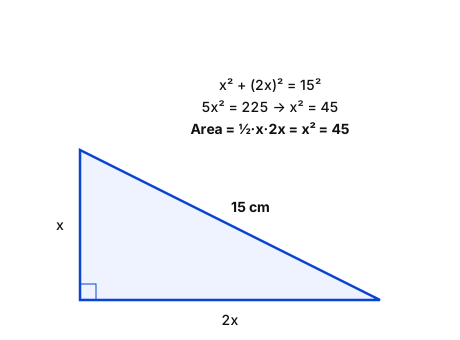
One side of a right-angled triangle is twice the other and the hypotenuse is 15 cm. Find the area (in cm2) of the triangle.
एक समकोण त्रिभुज की एक भुजा दूसरी भुजा की दोगुनी है और कर्ण 15 cm है। त्रिभुज का क्षेत्रफल (cm2 में) ज्ञात कीजिए।
  1. A70
  2. B60
  3. C45
  4. D80
Show answer

Concept: Pythagoras: base2+height2=hypotenuse2; area =12×base×height.

  1. Sides x and 2x: x2+4x2=152
  2. 5x2=225⇒x2=45
  3. Area =12×x×2x=x2=45cm2

Trick: No need to find x – area equals x2 directly.

Answer: (C) 45

अवधारणा: पाइथागोरस: आधार2+लंब2=कर्ण2; क्षेत्रफल =12×आधार×लंब।

  1. भुजाएँ x और 2x: x2+4x2=152
  2. 5x2=225⇒x2=45
  3. क्षेत्रफल =12×x×2x=x2=45cm2

ट्रिक: x निकालने की जरूरत नहीं – क्षेत्रफल सीधे x2 है।

उत्तर: (C) 45

RRB NTPC Undergraduate CBT 1MathematicsMensuration – Right TriangleRRB NTPC Undergraduate CBT 1 2024 · 2 Sep Shift 1 →
Q5259.
The value of 53+(11+56)−53 is
53+(11+56)−53 का मान कितना है?
  1. A713
  2. B611
  3. C518
  4. D1118
Show answer

Concept: Equal terms with opposite signs cancel; then simplify the complex fraction.

  1. 53 and −53 cancel.
  2. 1+56=116
  3. 1116=611

Trick: Spot cancellations before computing.

Answer: (B) 611

अवधारणा: समान पद विपरीत चिह्न के साथ कट जाते हैं; फिर जटिल भिन्न सरल करें।

  1. 53 और −53 कट जाते हैं।
  2. 1+56=116
  3. 1116=611

ट्रिक: गणना से पहले कटने वाले पद देखें।

उत्तर: (B) 611

RRB NTPC Undergraduate CBT 1MathematicsSimplification – FractionsRRB NTPC Undergraduate CBT 1 2024 · 2 Sep Shift 1 →
Q5260.
The average weight (in kg) of a family of five members whose weights are 40 kg, 49 kg, 56 kg, 76 kg and 38 kg is:
पाँच सदस्यों वाले एक परिवार, जिनके भार 40 kg, 49 kg, 56 kg, 76 kg और 38 kg हैं, का औसत भार (kg में) कितना है?
  1. A52.8
  2. B50.8
  3. C53.8
  4. D51.8
Show answer

Concept: Average=sumcount.

  1. Sum =40+49+56+76+38=259
  2. Average =2595=51.8kg

Trick: Assume 50: deviations −10,−1,+6,+26,−12 sum =9 → 50+95=51.8.

Answer: (D) 51.8

अवधारणा: औसत=योगसंख्या।

  1. योग =40+49+56+76+38=259
  2. औसत =2595=51.8kg

ट्रिक: 50 मानें: विचलन −10,−1,+6,+26,−12 का योग =9 → 50+95=51.8।

उत्तर: (D) 51.8

RRB NTPC Undergraduate CBT 1MathematicsAverageRRB NTPC Undergraduate CBT 1 2024 · 2 Sep Shift 1 →