Question bank

Q&A: practice questions with answers

Search questions on any topic. Filter by exam category, exam, subject and topic, try the question, then open the answer and explanation.

Courses – airGurukul

8,495 questions found.

Q5261.
M and N started a business. M invested ₹50,000 more than N for 3 months, while N invested for 7 months. M's share is ₹328 more than that of N, out of a total profit of ₹4,920. Find the capital contributed by M.
M और N ने एक व्यवसाय शुरू किया। M ने N से ₹50,000 अधिक 3 महीने के लिए निवेश किया, जबकि N ने 7 महीने के लिए निवेश किया। ₹4,920 के कुल लाभ में से M का हिस्सा N के हिस्से से ₹328 अधिक है। M द्वारा लगाई गई पूँजी ज्ञात कीजिए।
  1. A₹1,20,000
  2. B₹1,00,000
  3. C₹80,000
  4. D₹60,000
Show answer

Concept: Profit ratio = capital × time ratio.

  1. M+N=4920,M−N=328⇒M=2624,N=2296 → ratio 8:7
  2. 3m7n=87⇒3m=8n (capitals m,n)
  3. m=n+50000⇒3n+150000=8n⇒n=30000
  4. m=80000

Trick: 2624:2296 — divide both by 328 → 8:7.

Answer: (C) ₹80,000

अवधारणा: लाभ का अनुपात = पूँजी × समय का अनुपात।

  1. M+N=4920,M−N=328⇒M=2624,N=2296 → अनुपात 8:7
  2. 3m7n=87⇒3m=8n (पूँजी m,n)
  3. m=n+50000⇒3n+150000=8n⇒n=30000
  4. m=80000

ट्रिक: 2624:2296 — दोनों को 328 से भाग दें → 8:7।

उत्तर: (C) ₹80,000

RRB NTPC Undergraduate CBT 1MathematicsPartnershipRRB NTPC Undergraduate CBT 1 2024 · 2 Sep Shift 1 →
Q5262.
50 glass bottles were purchased for ₹50, and 28 glass bottles broke in transit. The trader sold the remaining glass bottles at ₹5.80 each. Find his profit.
₹50 में 50 काँच की बोतलें खरीदी गईं, और परिवहन के दौरान 28 काँच की बोतलें टूट गईं। व्यापारी ने शेष काँच की बोतलों को ₹5.80 प्रति बोतल की दर से बेचा। उसका लाभ ज्ञात कीजिए।
  1. A₹68.50
  2. B₹76.60
  3. C₹75.30
  4. D₹77.60
Show answer

Concept: Profit = total SP − total CP (broken items give no revenue).

  1. Bottles left =50−28=22
  2. SP =22×5.80=127.60
  3. Profit =127.60−50=77.60

Trick: Cost stays ₹50 even though bottles broke.

Answer: (D) ₹77.60

अवधारणा: लाभ = कुल विक्रय मूल्य − कुल क्रय मूल्य (टूटी बोतलों से कोई आय नहीं)।

  1. बची बोतलें =50−28=22
  2. विक्रय मूल्य =22×5.80=127.60
  3. लाभ =127.60−50=77.60

ट्रिक: बोतलें टूटने पर भी लागत ₹50 ही रहती है।

उत्तर: (D) ₹77.60

RRB NTPC Undergraduate CBT 1MathematicsProfit and LossRRB NTPC Undergraduate CBT 1 2024 · 2 Sep Shift 1 →
Q5263.
The average runs scored by a batsman in 23 matches is 42. In the next 10 matches, the batsman scored an average of 13 runs. Find his average runs scored (rounded off to two decimals) in all the 33 matches.
एक बल्लेबाज़ द्वारा 23 मैचों में बनाए गए औसत रन 42 हैं। अगले 10 मैचों में, बल्लेबाज़ ने 13 रन का औसत बनाया। सभी 33 मैचों में उसके द्वारा बनाए गए औसत रन (दशमलव के दो स्थानों तक पूर्णांकित) ज्ञात कीजिए।
  1. A35.21
  2. B34.21
  3. C33.21
  4. D32.21
Show answer

Concept: Combined average =total runstotal matches.

  1. Runs in 23 matches =23×42=966
  2. Runs in 10 matches =130
  3. Average =109633≈33.21

Trick: Answer must lie between 13 and 42, nearer 42 (more matches) → only 33.21 fits the exact division.

Answer: (C) 33.21

अवधारणा: संयुक्त औसत =कुल रनकुल मैच।

  1. 23 मैचों के रन =23×42=966
  2. 10 मैचों के रन =130
  3. औसत =109633≈33.21

ट्रिक: उत्तर 13 और 42 के बीच, 42 के निकट होगा।

उत्तर: (C) 33.21

RRB NTPC Undergraduate CBT 1MathematicsAverageRRB NTPC Undergraduate CBT 1 2024 · 2 Sep Shift 1 →
Q5264.
The value of 45+(11+56)−25 is
45+(11+56)−25 का मान कितना है?
  1. A5255
  2. B5749
  3. C5161
  4. D4353
Show answer

Concept: Simplify the complex fraction and combine like fractions.

  1. 11+56=611
  2. 45−25=25
  3. 25+611=22+3055=5255

Trick: Group same-denominator fractions first.

Answer: (A) 5255

अवधारणा: जटिल भिन्न सरल करें और समान हर वाली भिन्नें पहले जोड़ें।

  1. 11+56=611
  2. 45−25=25
  3. 25+611=22+3055=5255

ट्रिक: समान हर वाली भिन्नों को पहले मिलाएँ।

उत्तर: (A) 5255

RRB NTPC Undergraduate CBT 1MathematicsSimplification – FractionsRRB NTPC Undergraduate CBT 1 2024 · 2 Sep Shift 1 →
Q5265.
The difference between an interior angle and exterior angle of a regular polygon is 120°. Find the number of sides of the polygon.
एक समबहुभुज के अंतः कोण और बाह्य कोण के बीच का अंतर 120° है। बहुभुज की भुजाओं की संख्या ज्ञात कीजिए।
  1. A15
  2. B12
  3. C14
  4. D10
Show answer

Concept: Interior + exterior =180∘; number of sides n=360∘exterior.

  1. I+E=180∘,I−E=120∘
  2. 2E=60∘⇒E=30∘
  3. n=36030=12

Trick: Exterior =180−difference2.

Answer: (B) 12

अवधारणा: अंतः कोण + बाह्य कोण =180∘; भुजाएँ n=360∘बाह्य कोण।

  1. I+E=180∘,I−E=120∘
  2. 2E=60∘⇒E=30∘
  3. n=36030=12

ट्रिक: बाह्य कोण =180−अंतर2।

उत्तर: (B) 12

RRB NTPC Undergraduate CBT 1MathematicsPolygons – AnglesRRB NTPC Undergraduate CBT 1 2024 · 2 Sep Shift 1 →
Q5266.
FKPX is related to IPSC in a certain way based on the English alphabetical order. In the same way, REBR is related to UJEW. To which of the following options is ATKG related, following the same logic?
अंग्रेज़ी वर्णमाला क्रम के आधार पर FKPX एक निश्चित प्रकार से IPSC से संबंधित है। उसी प्रकार REBR, UJEW से संबंधित है। समान तर्क का अनुसरण करते हुए, ATKG निम्नलिखित में से किस विकल्प से संबंधित है?
  1. ADFRT
  2. BDYLN
  3. CDLNY
  4. DDYNL
Show answer

Concept: Find the position shift of each letter (A=1 … Z=26).

  1. F→I (+3), K→P (+5), P→S (+3), X→C (+5)
  2. REBR→UJEW: +3, +5, +3, +5 ✓
  3. ATKG: A+3=D, T+5=Y, K+3=N, G+5=L → DYNL

Trick: Alternate pattern +3, +5; wrap after Z (X+5 = C).

Answer: (D) DYNL

अवधारणा: हर अक्षर का स्थान-अंतर देखें (A=1 … Z=26)।

  1. F→I (+3), K→P (+5), P→S (+3), X→C (+5)
  2. REBR→UJEW: +3, +5, +3, +5 ✓
  3. ATKG: A+3=D, T+5=Y, K+3=N, G+5=L → DYNL

ट्रिक: एकांतर पैटर्न +3, +5; Z के बाद फिर A से गिनें।

उत्तर: (D) DYNL

RRB NTPC Undergraduate CBT 1General Intelligence and ReasoningLetter AnalogyRRB NTPC Undergraduate CBT 1 2024 · 2 Sep Shift 1 →
Q5267.
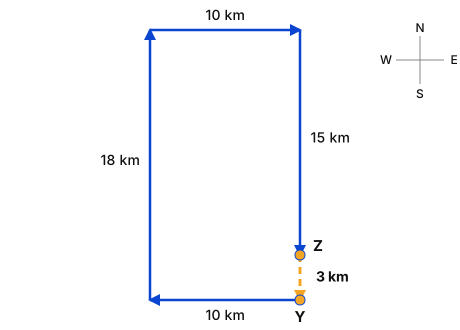
Navneet starts from Point Y and drives 10 km towards west. He then takes a right turn, drives 18 km. He then turns right and drives 10 km. He takes a final right turn, drives 15 km and stops at Point Z. How far (shortest distance) and towards which direction should he drive in order to reach Point Y again? (All turns are 90-degree turns only unless specified)
नवनीत बिंदु Y से चलना शुरू करता है और पश्चिम की ओर 10 km गाड़ी चलाता है। फिर वह दाएँ मुड़ता है और 18 km गाड़ी चलाता है। फिर वह दाएँ मुड़ता है और 10 km गाड़ी चलाता है। वह अंतिम बार दाएँ मुड़ता है, 15 km गाड़ी चलाता है और बिंदु Z पर रुक जाता है। बिंदु Y पर फिर से पहुँचने के लिए उसे कितनी दूर (न्यूनतम दूरी) और किस दिशा में गाड़ी चलानी चाहिए? (जब तक निर्दिष्ट न हो, सभी मोड़ केवल 90 डिग्री के मोड़ हैं)
  1. A3 km towards southदक्षिण की ओर 3 km
  2. B10 km towards northउत्तर की ओर 10 km
  3. C4 km towards eastपूर्व की ओर 4 km
  4. D6 km towards westपश्चिम की ओर 6 km
Show answer

Concept: Trace the path on a grid; a right turn from West is North, from North is East, from East is South.

  1. Y → 10 km West → 18 km North → 10 km East: now 18 km north of Y.
  2. Then 15 km South: Z is 18−15=3km north of Y.
  3. To return: 3 km towards South.

Trick: The two 10 km legs cancel; only 18−15 matters.

Answer: (A) 3 km towards south

अवधारणा: रास्ता ग्रिड पर बनाएँ; पश्चिम से दाएँ मुड़ने पर उत्तर, उत्तर से दाएँ पूर्व, पूर्व से दाएँ दक्षिण।

  1. Y → 10 km पश्चिम → 18 km उत्तर → 10 km पूर्व: अब Y से 18 km उत्तर।
  2. फिर 15 km दक्षिण: Z, Y से 18−15=3km उत्तर में है।
  3. वापस जाने के लिए: 3 km दक्षिण की ओर।

ट्रिक: दोनों 10 km कट जाते हैं; केवल 18−15 देखें।

उत्तर: (A) 3 km दक्षिण की ओर

RRB NTPC Undergraduate CBT 1General Intelligence and ReasoningDirection and DistanceRRB NTPC Undergraduate CBT 1 2024 · 2 Sep Shift 1 →
Q5268.
In a certain code language, ‘CLAM’ is coded as ‘1587’ and ‘LOAM’ is coded as ‘4875’. What is the code for ‘O’ in that language?
एक निश्चित कूट भाषा में, 'CLAM' को '1587' के रूप में कूटबद्ध किया जाता है और 'LOAM' को '4875' के रूप में कूटबद्ध किया जाता है। उस भाषा में 'O' के लिए कूट क्या है?
  1. A4
  2. B5
  3. C7
  4. D8
Show answer

Concept: Common letters of two words share the common digits (order of digits may be jumbled).

  1. CLAM = {1,5,8,7}, LOAM = {4,8,7,5}
  2. Common letters L, A, M ↔ common digits 5, 8, 7
  3. Left over: C = 1 and O = 4

Trick: Remove common letters and digits — the leftovers pair up.

Answer: (A) 4

अवधारणा: दोनों शब्दों के समान अक्षरों के कोड भी समान अंक होते हैं (क्रम बदला हो सकता है)।

  1. CLAM = {1,5,8,7}, LOAM = {4,8,7,5}
  2. समान अक्षर L, A, M ↔ समान अंक 5, 8, 7
  3. बचे: C = 1 और O = 4

ट्रिक: समान अक्षर व अंक हटाएँ — बचे हुए आपस में जुड़ते हैं।

उत्तर: (A) 4

RRB NTPC Undergraduate CBT 1General Intelligence and ReasoningCoding-DecodingRRB NTPC Undergraduate CBT 1 2024 · 2 Sep Shift 1 →
Q5269.
Based on the English alphabetical order, three of the following four letter-clusters are alike in a certain way and thus form a group. Which letter-cluster DOES NOT belong to that group?
(Note: The odd one out is not based on the number of consonants/vowels or their position in the letter-cluster.)
अंग्रेज़ी वर्णमाला क्रम के आधार पर, निम्नलिखित चार अक्षर-समूहों में से तीन किसी निश्चित प्रकार से एकसमान हैं और इस प्रकार एक समूह बनाते हैं। कौन-सा अक्षर-समूह उस समूह से संबंधित नहीं है?
(ध्यान दें: असंगत का निर्धारण व्यंजनों/स्वरों की संख्या या अक्षर-समूह में उनके स्थान के आधार पर नहीं है।)
  1. AHKO
  2. BDGK
  3. CORW
  4. DBEI
Show answer

Concept: Check the gaps between consecutive letters.

  1. HKO: H+3=K, K+4=O
  2. DGK: +3, +4; BEI: +3, +4
  3. ORW: O+3=R, R+5=W → different

Trick: Write positions: O15 R18 W23 → gaps 3, 5.

Answer: (C) ORW

अवधारणा: क्रमागत अक्षरों के बीच का अंतर देखें।

  1. HKO: H+3=K, K+4=O
  2. DGK: +3, +4; BEI: +3, +4
  3. ORW: O+3=R, R+5=W → भिन्न

ट्रिक: स्थान लिखें: O15 R18 W23 → अंतर 3, 5।

उत्तर: (C) ORW

RRB NTPC Undergraduate CBT 1General Intelligence and ReasoningOdd One Out – Letter ClustersRRB NTPC Undergraduate CBT 1 2024 · 2 Sep Shift 1 →
Q5270.
If + means −, − means ×, × means ÷ and ÷ means +, then what will come in place of the question mark (?) in the following equation?
12 − 2 + 49 × 7 ÷ 5 = ?
यदि + का अर्थ −, − का अर्थ ×, × का अर्थ ÷ और ÷ का अर्थ + है, तो निम्नलिखित समीकरण में प्रश्न चिह्न (?) के स्थान पर क्या आएगा?
12 − 2 + 49 × 7 ÷ 5 = ?
  1. A22
  2. B27
  3. C12
  4. D17
Show answer

Concept: Replace symbols first, then apply BODMAS.

  1. 12−2+49×7÷5 becomes 12×2−49÷7+5
  2. =24−7+5=22

Trick: Swap all signs in one go before calculating.

Answer: (A) 22

अवधारणा: पहले चिह्न बदलें, फिर BODMAS लगाएँ।

  1. 12−2+49×7÷5 बनता है 12×2−49÷7+5
  2. =24−7+5=22

ट्रिक: गणना से पहले सारे चिह्न एक साथ बदलें।

उत्तर: (A) 22

RRB NTPC Undergraduate CBT 1General Intelligence and ReasoningMathematical OperationsRRB NTPC Undergraduate CBT 1 2024 · 2 Sep Shift 1 →
Q5271.
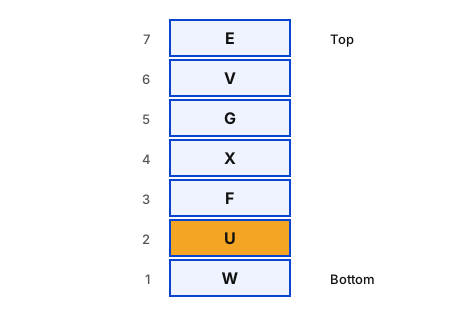
Seven boxes U, V, W, X, E, F and G are kept one over the other but not necessarily in the same order.
Only three boxes are kept below X. Only two boxes are kept between X and W. Only E is kept above V. H is kept at some place below G and at some place above U.
Which box is kept at second position from the bottom?
सात बक्से U, V, W, X, E, F और G एक के ऊपर एक रखे गए हैं, लेकिन आवश्यक नहीं कि इसी क्रम में हों।
X के नीचे केवल तीन बक्से रखे गए हैं। X और W के बीच केवल दो बक्से रखे गए हैं। V के ऊपर केवल E रखा गया है। H को G के नीचे किसी स्थान पर और U के ऊपर किसी स्थान पर रखा गया है।
नीचे से दूसरे स्थान पर कौन-सा बक्सा रखा गया है?
  1. AX
  2. BG
  3. CU
  4. DW
Show answer

Concept: Number positions 1 (bottom) to 7 (top) and fix the definite clues first.

  1. Only E above V → E = 7, V = 6. Three boxes below X → X = 4.
  2. Two boxes between X and W → W = 1 (7 is taken).
  3. The box below G and above U (named H in the statement; the only remaining box is F) → U = 2, F = 3, G = 5.
  4. Second from bottom = U.

Trick: Fill extreme positions (top/bottom) first — they leave fewest choices.

Answer: (C) U

अवधारणा: स्थान 1 (नीचे) से 7 (ऊपर) तक संख्या दें और पहले निश्चित संकेत लगाएँ।

  1. केवल E, V के ऊपर → E = 7, V = 6। X के नीचे तीन बॉक्स → X = 4।
  2. X और W के बीच दो बॉक्स → W = 1 (7 भरा है)।
  3. G के नीचे और U के ऊपर वाला बॉक्स (कथन में H; बचा हुआ बॉक्स F) → U = 2, F = 3, G = 5।
  4. नीचे से दूसरा = U।

ट्रिक: पहले सबसे ऊपर/नीचे के स्थान भरें — विकल्प कम रहते हैं।

उत्तर: (C) U

RRB NTPC Undergraduate CBT 1General Intelligence and ReasoningBox ArrangementRRB NTPC Undergraduate CBT 1 2024 · 2 Sep Shift 1 →
Q5272.
FRUZ is related to JUYC in a certain way based on the English alphabetical order. In the same way, VDKL is related to ZGOO. To which of the given options is HMWU related, following the same logic?
अंग्रेज़ी वर्णमाला क्रम के आधार पर FRUZ एक निश्चित प्रकार से JUYC से संबंधित है। उसी प्रकार VDKL, ZGOO से संबंधित है। समान तर्क का अनुसरण करते हुए, HMWU दिए गए विकल्पों में से किससे संबंधित है?
  1. ALPAX
  2. BXPLA
  3. CLPXA
  4. DXAPL
Show answer

Concept: Find the position shift of each letter.

  1. F+4=J, R+3=U, U+4=Y, Z+3=C
  2. VDKL→ZGOO: +4, +3, +4, +3 ✓
  3. HMWU: H+4=L, M+3=P, W+4=A, U+3=X → LPAX

Trick: Pattern +4, +3, +4, +3 with wrap-around (W+4 = A).

Answer: (A) LPAX

अवधारणा: हर अक्षर का स्थान-अंतर देखें।

  1. F+4=J, R+3=U, U+4=Y, Z+3=C
  2. VDKL→ZGOO: +4, +3, +4, +3 ✓
  3. HMWU: H+4=L, M+3=P, W+4=A, U+3=X → LPAX

ट्रिक: पैटर्न +4, +3, +4, +3; Z के बाद A (W+4 = A)।

उत्तर: (A) LPAX

RRB NTPC Undergraduate CBT 1General Intelligence and ReasoningLetter AnalogyRRB NTPC Undergraduate CBT 1 2024 · 2 Sep Shift 1 →
Q5273.
What should come in place of the question mark (?) in the given series based on the English alphabetical order?
JUO UFZ FQK QBV ?
अंग्रेज़ी वर्णमाला क्रम के आधार पर दी गई शृंखला में प्रश्न चिह्न (?) के स्थान पर क्या आना चाहिए?
JUO UFZ FQK QBV ?
  1. ABGM
  2. BBMG
  3. CBYG
  4. DBGY
Show answer

Concept: Each letter moves +11 positions to the corresponding letter of the next cluster (cyclic).

  1. J+11=U, U+11=F, O+11=Z → JUO→UFZ
  2. Same for UFZ→FQK→QBV
  3. QBV: Q+11=B, B+11=M, V+11=G → BMG

Trick: Here the next cluster also starts with the previous 2nd letter: J U → U F → F Q → Q B → B M.

Answer: (B) BMG

अवधारणा: हर अक्षर अगले समूह के संगत अक्षर तक +11 चलता है (Z के बाद A से)।

  1. J+11=U, U+11=F, O+11=Z → JUO→UFZ
  2. UFZ→FQK→QBV में भी यही
  3. QBV: Q+11=B, B+11=M, V+11=G → BMG

ट्रिक: अगला समूह पिछले के दूसरे अक्षर से शुरू होता है: J U → U F → F Q → Q B → B M।

उत्तर: (B) BMG

RRB NTPC Undergraduate CBT 1General Intelligence and ReasoningLetter SeriesRRB NTPC Undergraduate CBT 1 2024 · 2 Sep Shift 1 →
Q5274.
If ‘A’ stands for ‘÷’, ‘B’ stands for ‘×’, ‘C’ stands for ‘+’ and ‘D’ stands for ‘−’, what will come in place of the question mark (?) in the following equation?
11 B 3 C 20 D 93 A 3 = ?
यदि 'A' का अर्थ '÷', 'B' का अर्थ '×', 'C' का अर्थ '+' और 'D' का अर्थ '−' है, तो निम्नलिखित समीकरण में प्रश्न चिह्न (?) के स्थान पर क्या आएगा?
11 B 3 C 20 D 93 A 3 = ?
  1. A2
  2. B9
  3. C15
  4. D22
Show answer

Concept: Replace letters by signs, then use BODMAS.

  1. 11×3+20−93÷3
  2. =33+20−31=22

Trick: Do ÷ and × first: 93÷3=31.

Answer: (D) 22

अवधारणा: अक्षरों के स्थान पर चिह्न रखें, फिर BODMAS लगाएँ।

  1. 11×3+20−93÷3
  2. =33+20−31=22

ट्रिक: पहले ÷ और ×: 93÷3=31।

उत्तर: (D) 22

RRB NTPC Undergraduate CBT 1General Intelligence and ReasoningMathematical OperationsRRB NTPC Undergraduate CBT 1 2024 · 2 Sep Shift 1 →
Q5275.
What should come in place of the question mark (?) in the given series?
510 511 519 546 610 ?
दी गई शृंखला में प्रश्न चिह्न (?) के स्थान पर क्या आना चाहिए?
510 511 519 546 610 ?
  1. A735
  2. B695
  3. C755
  4. D715
Show answer

Concept: Look at differences between consecutive terms.

  1. Differences: 1, 8, 27, 64 = 13,23,33,43
  2. Next difference 53=125
  3. 610+125=735

Trick: Differences as cubes: 1,8,27,64,125.

Answer: (A) 735

अवधारणा: क्रमागत पदों के अंतर देखें।

  1. अंतर: 1, 8, 27, 64 = 13,23,33,43
  2. अगला अंतर 53=125
  3. 610+125=735

ट्रिक: अंतर घन संख्याएँ हैं: 1,8,27,64,125।

उत्तर: (A) 735

RRB NTPC Undergraduate CBT 1General Intelligence and ReasoningNumber SeriesRRB NTPC Undergraduate CBT 1 2024 · 2 Sep Shift 1 →
Q5276.
Read the given statement(s) and conclusions carefully. Assuming that the information given in the statements is true, even if it appears to be at variance with commonly known facts, decide which of the given conclusions logically follow(s) from the statement(s).
Statements:
All candles are waxes.
No candle is a tubelight.
Conclusions:
(I) Some tubelights are waxes.
(II) All waxes are tubelights.
दिए गए कथन(नों) और निष्कर्षों को ध्यानपूर्वक पढ़िए। यह मानते हुए कि कथनों में दी गई जानकारी सत्य है, भले ही वह सामान्यतः ज्ञात तथ्यों से भिन्न प्रतीत होती हो, निर्णय लीजिए कि दिए गए निष्कर्षों में से कौन-सा/से निष्कर्ष तार्किक रूप से कथन(नों) का अनुसरण करता है/करते हैं।
कथन:
सभी मोमबत्तियाँ, मोम हैं।
कोई भी मोमबत्ती, ट्यूबलाइट नहीं है।
निष्कर्ष:
(I) कुछ ट्यूबलाइट, मोम हैं।
(II) सभी मोम, ट्यूबलाइट हैं।
  1. ABoth conclusions (I) and (II) follow.निष्कर्ष (I) और (II) दोनों अनुसरण करते हैं।
  2. BOnly conclusion (I) follows.केवल निष्कर्ष (I) अनुसरण करता है।
  3. COnly conclusion (II) follows.केवल निष्कर्ष (II) अनुसरण करता है।
  4. DNeither conclusion (I) nor (II) follows.न तो निष्कर्ष (I) और न ही (II) अनुसरण करता है।
Show answer

Concept: Draw the least-overlap Venn diagram allowed by the statements.

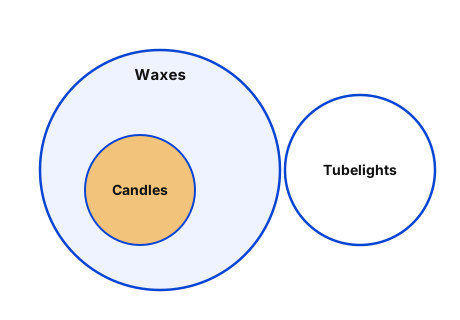
  1. Candles lie inside Waxes; Tubelights are kept away from Candles.
  2. Tubelights may stay completely outside Waxes, so (I) 'Some tubelights are waxes' is not certain.
  3. (II) 'All waxes are tubelights' is impossible (candles are waxes but not tubelights).

Trick: 'No A is B' tells nothing about how B relates to the bigger set containing A.

Answer: (D) Neither conclusion (I) nor (II) follows.

अवधारणा: कथनों के अनुसार न्यूनतम ओवरलैप वाला वेन आरेख बनाएँ।

  1. Candles, Waxes के अंदर; Tubelights, Candles से अलग।
  2. Tubelights पूरी तरह Waxes से बाहर भी हो सकते हैं, अतः (I) निश्चित नहीं।
  3. (II) असंभव है (candles, waxes हैं पर tubelights नहीं)।

ट्रिक: 'कोई A, B नहीं' से B और A के बड़े समूह का संबंध तय नहीं होता।

उत्तर: (D) न तो (I) और न ही (II) अनुसरण करता है।

RRB NTPC Undergraduate CBT 1General Intelligence and ReasoningSyllogismRRB NTPC Undergraduate CBT 1 2024 · 2 Sep Shift 1 →
Q5277.
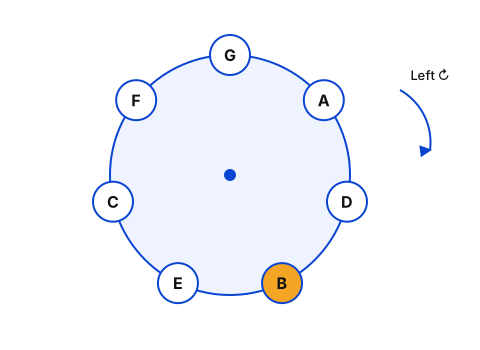
A, B, C, D, E, F and G are sitting around a circular table facing the centre. F sits to the immediate right of G. B sits third to the left of G. A is the immediate neighbour of D and G. C sits second to the left of B. How many people sit between E and D when counted from the left of D?
A, B, C, D, E, F और G एक वृत्ताकार मेज़ के चारों ओर केंद्र की ओर मुख करके बैठे हैं। F, G के ठीक दाएँ बैठा है। B, G के बाएँ से तीसरे स्थान पर बैठा है। A, D और G का निकटतम पड़ोसी है। C, B के बाएँ से दूसरे स्थान पर बैठा है। D के बाएँ से गिनने पर E और D के बीच कितने लोग बैठे हैं?
  1. AOneएक
  2. BFourचार
  3. CTwoदो
  4. DThreeतीन
Show answer

Concept: Facing the centre, 'left' means clockwise and 'right' means anticlockwise.

  1. Fix G; F is immediate right of G; B is third to the left of G.
  2. A sits between G and D → order clockwise: G, A, D, B.
  3. C is second to the left of B → E fills the remaining seat between B and C.
  4. From D moving left (clockwise): D → B → E, so one person (B) sits between.

Trick: Always start with the person mentioned most often (G).

Answer: (A) One

अवधारणा: केंद्र की ओर मुख होने पर 'बाएँ' = दक्षिणावर्त (clockwise), 'दाएँ' = वामावर्त।

  1. G को स्थिर करें; F, G के ठीक दाएँ; B, G के बाएँ तीसरे स्थान पर।
  2. A, G और D के बीच → दक्षिणावर्त क्रम: G, A, D, B।
  3. C, B के बाएँ दूसरा → E, B और C के बीच बचे स्थान पर।
  4. D से बाएँ (दक्षिणावर्त): D → B → E, अतः बीच में एक व्यक्ति (B)।

ट्रिक: सबसे अधिक बार आए व्यक्ति (G) से शुरू करें।

उत्तर: (A) एक

RRB NTPC Undergraduate CBT 1General Intelligence and ReasoningCircular Seating ArrangementRRB NTPC Undergraduate CBT 1 2024 · 2 Sep Shift 1 →
Q5278.
This question is based on the five, three-digit numbers given below.
(Left) 984 673 543 126 341 (Right)
(Example- 697 – First digit = 6, second digit = 9 and third digit = 7)
(NOTE: All operations to be done from left to right.)
If all the numbers are arranged in descending order, the position(s) of how many numbers will remain unchanged?
यह प्रश्न नीचे दी गई पाँच, तीन-अंकीय संख्याओं पर आधारित है।
(बाएँ) 984 673 543 126 341 (दाएँ)
(उदाहरण- 697 – पहला अंक = 6, दूसरा अंक = 9 और तीसरा अंक = 7)
(ध्यान दें: सभी संक्रियाएँ बाएँ से दाएँ की जानी हैं।)
यदि सभी संख्याओं को अवरोही क्रम में व्यवस्थित किया जाए, तो कितनी संख्याओं का/के स्थान अपरिवर्तित रहेगा/रहेंगे?
  1. A4
  2. B1
  3. C3
  4. D2
Show answer

Concept: Write the new order under the old order and compare position by position.

  1. Original: 984, 673, 543, 126, 341
  2. Descending: 984, 673, 543, 341, 126
  3. Same position: 984, 673, 543 → 3 numbers

Trick: Only the last two swap places.

Answer: (C) 3

अवधारणा: नया क्रम पुराने के नीचे लिखकर हर स्थान की तुलना करें।

  1. मूल: 984, 673, 543, 126, 341
  2. अवरोही: 984, 673, 543, 341, 126
  3. स्थान अपरिवर्तित: 984, 673, 543 → 3 संख्याएँ

ट्रिक: केवल अंतिम दो संख्याएँ स्थान बदलती हैं।

उत्तर: (C) 3

RRB NTPC Undergraduate CBT 1General Intelligence and ReasoningNumber ArrangementRRB NTPC Undergraduate CBT 1 2024 · 2 Sep Shift 1 →
Q5279.
Kishori ranked 15th from the bottom and 26th from the top in her class. How many students are there in her class?
किशोरी अपनी कक्षा में नीचे से 15वें और ऊपर से 26वें स्थान पर है। उसकी कक्षा में कितने विद्यार्थी हैं?
  1. A40
  2. B38
  3. C39
  4. D37
Show answer

Concept: Total = rank from top + rank from bottom − 1.

  1. 26+15−1=40

Yaad rakhein: Subtract 1 because Kishori is counted twice.

Answer: (A) 40

अवधारणा: कुल = ऊपर से रैंक + नीचे से रैंक − 1।

  1. 26+15−1=40

याद रखें: 1 घटाएँ क्योंकि किशोरी दो बार गिनी गई है।

उत्तर: (A) 40

RRB NTPC Undergraduate CBT 1General Intelligence and ReasoningRankingRRB NTPC Undergraduate CBT 1 2024 · 2 Sep Shift 1 →
Q5280.
Which of the following letter-number clusters will replace the question mark (?) in the given series to make it logically complete?
JCV 13, MFY 25, PIB 49, SLE 97, VOH 193, ?
निम्नलिखित में से कौन-सा अक्षर-संख्या समूह दी गई शृंखला में प्रश्न चिह्न (?) का स्थान लेकर उसे तार्किक रूप से पूर्ण करेगा?
JCV 13, MFY 25, PIB 49, SLE 97, VOH 193, ?
  1. AYRK 385
  2. BURK 385
  3. CYOK 385
  4. DYRK 383
Show answer

Concept: Treat letters and numbers separately.

  1. Each letter moves +3: J→M→P→S→V→Y, C→F→I→L→O→R, V→Y→B→E→H→K → YRK
  2. Numbers: 13×2−1=25, 25×2−1=49, … 193×2−1=385

Trick: Number rule: double and subtract 1.

Answer: (A) YRK 385

अवधारणा: अक्षर और संख्याएँ अलग-अलग देखें।

  1. हर अक्षर +3: J→M→P→S→V→Y, C→F→I→L→O→R, V→Y→B→E→H→K → YRK
  2. संख्याएँ: 13×2−1=25, 25×2−1=49, … 193×2−1=385

ट्रिक: संख्या नियम: दोगुना करके 1 घटाएँ।

उत्तर: (A) YRK 385

RRB NTPC Undergraduate CBT 1General Intelligence and ReasoningAlphanumeric SeriesRRB NTPC Undergraduate CBT 1 2024 · 2 Sep Shift 1 →