Question bank

Q&A: practice questions with answers

Search questions on any topic. Filter by exam category, exam, subject and topic, try the question, then open the answer and explanation.

Courses – airGurukul

8,495 questions found.

Q5361.
The value of 53+(11+27)−23 is
53+(11+27)−23 का मान है
  1. A169
  2. B2617
  3. C127
  4. D813
Show answer

Concept: Simplify the complex fraction first, then combine.

  1. 1+27=97, so 19/7=79.
  2. 53−23=1.
  3. Value =1+79=169.

Trick: Group like denominators (53−23) before anything else.

Answer: (A) 169

अवधारणा: पहले जटिल भिन्न को सरल करें, फिर जोड़ें।

  1. 1+27=97, अतः 19/7=79.
  2. 53−23=1.
  3. मान =1+79=169.

ट्रिक: समान हर वाली भिन्नें (53−23) पहले मिला लें।

उत्तर: (A) 169

RRB NTPC Undergraduate CBT 1MathematicsSimplification – FractionsRRB NTPC Undergraduate CBT 1 2024 · 1 Sep Shift 3 →
Q5362.
The number 481355 is divisible by which of the following?
संख्या 481355 निम्नलिखित में से किससे विभाज्य है?
  1. A3
  2. B15
  3. C6
  4. D5
Show answer

Concept: Divisible by 5 ⇔ last digit 0 or 5; by 3 ⇔ digit sum divisible by 3.

  1. Last digit is 5 ⇒ divisible by 5.
  2. Digit sum =4+8+1+3+5+5=26, not divisible by 3 ⇒ not by 3, 6 or 15.
  3. It is odd, so not by 6 either.

Yaad rakhein: 15 needs both 3 and 5; 6 needs both 2 and 3.

Answer: (D) 5

अवधारणा: 5 से विभाज्य ⇔ अंतिम अंक 0 या 5; 3 से ⇔ अंकों का योग 3 से विभाज्य।

  1. अंतिम अंक 5 ⇒ 5 से विभाज्य।
  2. अंकों का योग =4+8+1+3+5+5=26, 3 से विभाज्य नहीं ⇒ 3, 6, 15 से भी नहीं।
  3. संख्या विषम है, इसलिए 6 से भी नहीं।

याद रखें: 15 के लिए 3 और 5 दोनों; 6 के लिए 2 और 3 दोनों ज़रूरी।

उत्तर: (D) 5

RRB NTPC Undergraduate CBT 1MathematicsDivisibility RulesRRB NTPC Undergraduate CBT 1 2024 · 1 Sep Shift 3 →
Q5363.
Find the simple interest (in ₹) if a sum of ₹400 is borrowed for 4.5 years at 16% per annum rate of interest.
यदि ₹400 की धनराशि 16% वार्षिक ब्याज दर पर 4.5 वर्ष के लिए उधार ली जाती है, तो साधारण ब्याज (₹ में) ज्ञात कीजिए।
  1. A338
  2. B268
  3. C388
  4. D288
Show answer

Concept: SI=P×R×T100.

  1. SI=400×16×4.5100=4×16×4.5.
  2. =64×4.5=288.

Trick: P=400 ⇒ SI =4×R×T directly.

Answer: (D) 288

अवधारणा: साधारण ब्याज=P×R×T100.

  1. SI=400×16×4.5100=4×16×4.5.
  2. =64×4.5=288.

ट्रिक: P=400 हो तो SI =4×R×T सीधे।

उत्तर: (D) 288

RRB NTPC Undergraduate CBT 1MathematicsSimple InterestRRB NTPC Undergraduate CBT 1 2024 · 1 Sep Shift 3 →
Q5364.
The average weight (in kg) of a family of five members whose weights are 40 kg, 49 kg, 56 kg, 74 kg and 38 kg is:
पाँच सदस्यों वाले एक परिवार, जिनके भार 40 kg, 49 kg, 56 kg, 74 kg और 38 kg हैं, का औसत भार (kg में) है:
  1. A52.4
  2. B50.4
  3. C51.4
  4. D53.4
Show answer

Concept: Average =sumcount.

  1. Sum =40+49+56+74+38=257.
  2. Average =2575=51.4kg.

Trick: Deviation from 50: −10−1+6+24−12=7; 50+75=51.4.

Answer: (C) 51.4

अवधारणा: औसत =योगसंख्या.

  1. योग =40+49+56+74+38=257.
  2. औसत =2575=51.4kg.

ट्रिक: 50 से विचलन: −10−1+6+24−12=7; 50+75=51.4.

उत्तर: (C) 51.4

RRB NTPC Undergraduate CBT 1MathematicsAverageRRB NTPC Undergraduate CBT 1 2024 · 1 Sep Shift 3 →
Q5365.
By how much is 65% of 65 greater than 15 of 55?
65 का 65%, 55 के 15 से कितना अधिक है?
  1. A29.25
  2. B25.25
  3. C31.25
  4. D28.25
Show answer

Concept: Compute each quantity and subtract.

  1. 65% of 65=65×65100=42.25.
  2. 15 of 55=11.
  3. Difference =42.25−11=31.25.

Trick: 652=4225 (numbers ending in 5: 6×7=42, then 25).

Answer: (C) 31.25

अवधारणा: दोनों मान निकालकर घटाएँ।

  1. 65 का 65%=65×65100=42.25.
  2. 55 का 15=11.
  3. अंतर =42.25−11=31.25.

ट्रिक: 652=4225 (5 पर ख़त्म होने वाली संख्या: 6×7=42, फिर 25)।

उत्तर: (C) 31.25

RRB NTPC Undergraduate CBT 1MathematicsPercentageRRB NTPC Undergraduate CBT 1 2024 · 1 Sep Shift 3 →
Q5366.
In a certain code language, ‘DRAG’ is coded as ‘5824’ and ‘GRAM’ is coded as ‘4592’. What is the code for ‘M’ in the given code language?
एक निश्चित कूट भाषा में, 'DRAG' को '5824' लिखा जाता है और 'GRAM' को '4592' लिखा जाता है। उस कूट भाषा में 'M' के लिए क्या कूट है?
  1. A4
  2. B9
  3. C2
  4. D5
Show answer

Concept: Letters common to both words share the common digits; the leftover letter takes the leftover digit.

  1. DRAG → {5, 8, 2, 4}; GRAM → {4, 5, 9, 2}.
  2. Common letters R, A, G ↔ common digits 5, 2, 4.
  3. Left in GRAM: M ↔ 9 (and D ↔ 8).

Trick: Strike out common letters and common digits — what remains pairs up.

Answer: (B) 9

अवधारणा: दोनों शब्दों के समान अक्षरों के कोड समान अंक होते हैं; बचा अक्षर बचा अंक लेता है।

  1. DRAG → {5, 8, 2, 4}; GRAM → {4, 5, 9, 2}.
  2. समान अक्षर R, A, G ↔ समान अंक 5, 2, 4.
  3. GRAM में बचा: M ↔ 9 (और D ↔ 8)।

ट्रिक: समान अक्षर और समान अंक काट दें — जो बचे वे जोड़ी हैं।

उत्तर: (B) 9

RRB NTPC Undergraduate CBT 1General Intelligence and ReasoningCoding-DecodingRRB NTPC Undergraduate CBT 1 2024 · 1 Sep Shift 3 →
Q5367.
In a certain code language, ‘EARS’ is coded as ‘1357’ and ‘SOUP’ is coded as ‘2146’. What is the code for ‘S’ in that language?
एक निश्चित कूट भाषा में, 'EARS' को '1357' लिखा जाता है और 'SOUP' को '2146' लिखा जाता है। उस भाषा में 'S' के लिए क्या कूट है?
  1. A6
  2. B2
  3. C1
  4. D7
Show answer

Concept: The only letter common to both words must take the only digit common to both codes.

  1. EARS → {1, 3, 5, 7}; SOUP → {2, 1, 4, 6}.
  2. Common letter: S; common digit: 1.
  3. So S = 1.

Trick: One common letter ↔ one common digit.

Answer: (C) 1

अवधारणा: दोनों शब्दों में एकमात्र समान अक्षर का कोड दोनों कोडों का एकमात्र समान अंक होगा।

  1. EARS → {1, 3, 5, 7}; SOUP → {2, 1, 4, 6}.
  2. समान अक्षर: S; समान अंक: 1.
  3. अतः S = 1.

ट्रिक: एक समान अक्षर ↔ एक समान अंक।

उत्तर: (C) 1

RRB NTPC Undergraduate CBT 1General Intelligence and ReasoningCoding-DecodingRRB NTPC Undergraduate CBT 1 2024 · 1 Sep Shift 3 →
Q5368.
What should come in place of the question mark (?) in the given series based on the English alphabetical order?
TAW VCY XEA ZGC ?
अंग्रेज़ी वर्णमाला क्रम के आधार पर दी गई श्रृंखला में प्रश्न चिह्न (?) के स्थान पर क्या आना चाहिए?
TAW VCY XEA ZGC ?
  1. ABIQ
  2. BBIX
  3. CBIE
  4. DBIP
Show answer

Concept: Track each letter position separately.

  1. 1st letters: T, V, X, Z, B (+2, wrapping Z → B).
  2. 2nd letters: A, C, E, G, I (+2).
  3. 3rd letters: W, Y, A, C, E (+2).

Trick: All three positions move +2; after Z comes A, so Z+2=B, C+2=E.

Answer: (C) BIE

अवधारणा: हर स्थान के अक्षर को अलग-अलग देखें।

  1. पहला अक्षर: T, V, X, Z, B (+2, Z के बाद फिर A से)।
  2. दूसरा अक्षर: A, C, E, G, I (+2)।
  3. तीसरा अक्षर: W, Y, A, C, E (+2)।

ट्रिक: तीनों स्थान +2; Z के बाद A आता है, अतः Z+2=B, C+2=E.

उत्तर: (C) BIE

RRB NTPC Undergraduate CBT 1General Intelligence and ReasoningAlphabet SeriesRRB NTPC Undergraduate CBT 1 2024 · 1 Sep Shift 3 →
Q5369.
This question is based on the five, three-digit numbers given below.
(Left) 625 247 156 289 362 (Right)
(Example: 697 – First digit = 6, second digit = 9 and third digit = 7)
(NOTE: All operations to be done from left to right.)
What will be the resultant if the third digit of the highest number is added to the second digit of the lowest number?
यह प्रश्न नीचे दी गई तीन अंकों वाली पाँच संख्याओं पर आधारित है।
(बाएँ) 625 247 156 289 362 (दाएँ)
(उदाहरण: 697 – पहला अंक = 6, दूसरा अंक = 9 और तीसरा अंक = 7)
(नोट: सभी संक्रियाएँ बाएँ से दाएँ की जानी हैं।)
यदि सबसे बड़ी संख्या के तीसरे अंक को सबसे छोटी संख्या के दूसरे अंक में जोड़ा जाए, तो परिणाम क्या होगा?
  1. A8
  2. B7
  3. C10
  4. D12
Show answer

Concept: Pick the highest and lowest numbers, then the required digits.

  1. Highest =625 → third digit =5.
  2. Lowest =156 → second digit =5.
  3. Sum =5+5=10.

Trick: Compare first digits only: 6 (625) is largest, 1 (156) smallest.

Answer: (C) 10

अवधारणा: सबसे बड़ी और सबसे छोटी संख्या चुनें, फिर माँगे गए अंक लें।

  1. सबसे बड़ी =625 → तीसरा अंक =5.
  2. सबसे छोटी =156 → दूसरा अंक =5.
  3. योग =5+5=10.

ट्रिक: केवल पहले अंक देखें: 625 में 6 सबसे बड़ा, 156 में 1 सबसे छोटा।

उत्तर: (C) 10

RRB NTPC Undergraduate CBT 1General Intelligence and ReasoningNumber ArrangementRRB NTPC Undergraduate CBT 1 2024 · 1 Sep Shift 3 →
Q5370.
What will come in place of the question mark (?) in the following equation if ‘−’ and ‘÷’ are interchanged and ‘×’ and ‘+’ are interchanged?
19 + 40 − 8 × 2 ÷ 1 = ?
यदि '−' और '÷' को आपस में बदल दिया जाए तथा '×' और '+' को आपस में बदल दिया जाए, तो निम्नलिखित समीकरण में प्रश्न चिह्न (?) के स्थान पर क्या आएगा?
19 + 40 − 8 × 2 ÷ 1 = ?
  1. A96
  2. B98
  3. C99
  4. D97
Show answer

Concept: Interchange the signs first, then apply BODMAS.

  1. 19+40−8×2÷1 becomes 19×40÷8+2−1.
  2. 19×40=760; 760÷8=95.
  3. 95+2−1=96.

Trick: Rewrite the full expression with new signs before calculating.

Answer: (A) 96

अवधारणा: पहले चिह्न बदलें, फिर BODMAS लगाएँ।

  1. 19+40−8×2÷1 बन जाता है 19×40÷8+2−1.
  2. 19×40=760; 760÷8=95.
  3. 95+2−1=96.

ट्रिक: गणना से पहले नए चिह्नों के साथ पूरा व्यंजक दोबारा लिखें।

उत्तर: (A) 96

RRB NTPC Undergraduate CBT 1General Intelligence and ReasoningMathematical OperationsRRB NTPC Undergraduate CBT 1 2024 · 1 Sep Shift 3 →
Q5371.
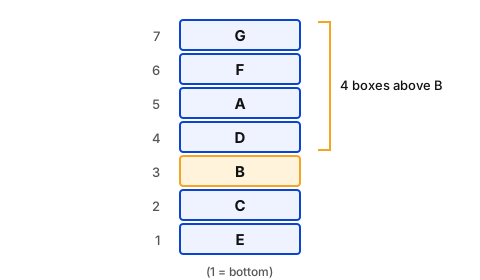
Seven boxes A, B, C, D, E, F and G are kept one over the other but not necessarily in the same order. No box is kept above G. Only three boxes are kept between G and B. Only one box is kept between F and D. D is kept immediately above B. Only four boxes are kept between F and E. A is kept at some place above C. How many boxes are kept above B?
सात बक्से A, B, C, D, E, F और G एक के ऊपर एक रखे गए हैं, परंतु आवश्यक नहीं कि इसी क्रम में हों। G के ऊपर कोई बक्सा नहीं रखा गया है। G और B के बीच केवल तीन बक्से रखे गए हैं। F और D के बीच केवल एक बक्सा रखा गया है। D, B के ठीक ऊपर रखा गया है। F और E के बीच केवल चार बक्से रखे गए हैं। A, C के ऊपर किसी स्थान पर रखा गया है। B के ऊपर कितने बक्से रखे गए हैं?
  1. A4
  2. B3
  3. C2
  4. D1
Show answer

Concept: Number positions 1 (bottom) to 7 (top) and place fixed clues first.

  1. No box above G ⇒ G = 7. Three between G and B ⇒ B = 3; D just above B ⇒ D = 4.
  2. One between F and D ⇒ F = 2 or 6. Four between F and E: F = 2 needs E = 7 (taken) ⇒ F = 6, E = 1.
  3. A above C in slots 5, 2 ⇒ A = 5, C = 2. Top to bottom: G, F, A, D, B, C, E.
  4. Boxes above B: G, F, A, D = 4.

Trick: Start from the extreme box (G at top) — it fixes the rest quickly.

Answer: (A) 4

अवधारणा: स्थान 1 (नीचे) से 7 (ऊपर) मानें, पहले निश्चित सूचनाएँ लगाएँ।

  1. G के ऊपर कोई नहीं ⇒ G = 7. G और B के बीच तीन ⇒ B = 3; D ठीक B के ऊपर ⇒ D = 4.
  2. F और D के बीच एक ⇒ F = 2 या 6. F और E के बीच चार: F = 2 पर E = 7 (भरा) ⇒ F = 6, E = 1.
  3. A, C के लिए 5 और 2; A ऊपर ⇒ A = 5, C = 2. ऊपर से: G, F, A, D, B, C, E.
  4. B के ऊपर: G, F, A, D = 4.

ट्रिक: सबसे ऊपर/नीचे वाले बॉक्स (G) से शुरू करें — बाकी जल्दी तय होते हैं।

उत्तर: (A) 4

RRB NTPC Undergraduate CBT 1General Intelligence and ReasoningBox ArrangementRRB NTPC Undergraduate CBT 1 2024 · 1 Sep Shift 3 →
Q5372.
Based on the English alphabetical order, three of the following four letter-cluster pairs are alike in a certain way and thus form a group. Which letter-cluster pair DOES NOT belong to that group?
(Note: The odd one out is not based on the number of consonants/vowels or their position in the letter-cluster.)
अंग्रेज़ी वर्णमाला क्रम के आधार पर, निम्नलिखित चार अक्षर-समूह युग्मों में से तीन किसी निश्चित प्रकार से एकसमान हैं और इस प्रकार एक समूह बनाते हैं। कौन-सा अक्षर-समूह युग्म उस समूह से संबंधित नहीं है?
(नोट: असंगत अक्षर-समूह युग्म, व्यंजनों/स्वरों की संख्या या अक्षर-समूह में उनके स्थान पर आधारित नहीं है।)
  1. AUX-ZS
  2. BOR-TM
  3. CLO-QI
  4. DRU-WP
Show answer

Concept: Compare each letter of the first cluster with the matching letter of the second.

  1. UX-ZS: U→Z +5, X→S −5. OR-TM: +5, −5. RU-WP: +5, −5.
  2. LO-QI: L→Q +5 but O→I −6.

Trick: Write positions: L=12, O=15, Q=17, I=9 — the second gap breaks the pattern.

Answer: (C) LO-QI

अवधारणा: पहले क्लस्टर के हर अक्षर की तुलना दूसरे क्लस्टर के संगत अक्षर से करें।

  1. UX-ZS: U→Z +5, X→S −5. OR-TM: +5, −5. RU-WP: +5, −5.
  2. LO-QI: L→Q +5 पर O→I −6.

ट्रिक: स्थान लिखें: L=12, O=15, Q=17, I=9 — दूसरा अंतर पैटर्न तोड़ता है।

उत्तर: (C) LO-QI

RRB NTPC Undergraduate CBT 1General Intelligence and ReasoningLetter Analogy – Odd One OutRRB NTPC Undergraduate CBT 1 2024 · 1 Sep Shift 3 →
Q5373.
What should come in place of the question mark (?) in the given series?
121 117.9 114.8 111.7 108.6 ?
दी गई श्रृंखला में प्रश्न चिह्न (?) के स्थान पर क्या आना चाहिए?
121 117.9 114.8 111.7 108.6 ?
  1. A105.5
  2. B107.6
  3. C108.2
  4. D106
Show answer

Concept: Each term decreases by a constant amount.

  1. 121−117.9=3.1, 117.9−114.8=3.1, … common difference −3.1.
  2. Next =108.6−3.1=105.5.

Trick: Constant difference ⇒ arithmetic progression.

Answer: (A) 105.5

अवधारणा: हर पद एक निश्चित मान से घटता है।

  1. 121−117.9=3.1, 117.9−114.8=3.1, … सार्व अंतर −3.1.
  2. अगला =108.6−3.1=105.5.

ट्रिक: अंतर स्थिर ⇒ समांतर श्रेढ़ी (AP)।

उत्तर: (A) 105.5

RRB NTPC Undergraduate CBT 1General Intelligence and ReasoningNumber SeriesRRB NTPC Undergraduate CBT 1 2024 · 1 Sep Shift 3 →
Q5374.
Which of the following letter-number clusters will replace the question mark (?) in the given series to make it logically complete?
PKE 17 RIH 10 TGK 1 ? XCQ -23
निम्नलिखित में से कौन-सा अक्षर-संख्या समूह दी गई श्रृंखला में प्रश्न चिह्न (?) को प्रतिस्थापित करके उसे तार्किक रूप से पूर्ण करेगा?
PKE 17 RIH 10 TGK 1 ? XCQ -23
  1. AVFN -8
  2. BVEN -10
  3. CVEM -10
  4. DEFM -8
Show answer

Concept: Track each letter position and the number separately.

  1. 1st letters P, R, T, V, X (+2); 2nd K, I, G, E, C (−2); 3rd E, H, K, N, Q (+3).
  2. Numbers 17, 10, 1, ?, −23: differences −7, −9, −11, −13 ⇒ 1−11=−10.
  3. Check: −10−13=−23 ✓.

Trick: Differences of the numbers themselves form an AP (−7, −9, −11…).

Answer: (B) VEN −10

अवधारणा: हर अक्षर स्थान और संख्या को अलग-अलग देखें।

  1. पहला अक्षर P, R, T, V, X (+2); दूसरा K, I, G, E, C (−2); तीसरा E, H, K, N, Q (+3)।
  2. संख्याएँ 17, 10, 1, ?, −23: अंतर −7, −9, −11, −13 ⇒ 1−11=−10.
  3. जाँच: −10−13=−23 ✓.

ट्रिक: संख्याओं के अंतर स्वयं एक AP (−7, −9, −11…) बनाते हैं।

उत्तर: (B) VEN −10

RRB NTPC Undergraduate CBT 1General Intelligence and ReasoningLetter-Number SeriesRRB NTPC Undergraduate CBT 1 2024 · 1 Sep Shift 3 →
Q5375.
Each of the digits in the number 4512689 is arranged in ascending order from left to right. The position(s) of how many digits will remain unchanged as compared to that in the original number?
संख्या 4512689 के प्रत्येक अंक को बाएँ से दाएँ आरोही क्रम में व्यवस्थित किया जाता है। मूल संख्या की तुलना में कितने अंकों का/के स्थान अपरिवर्तित रहेगा/रहेंगे?
  1. AThreeतीन
  2. BTwoदो
  3. COneएक
  4. DNoneकोई नहीं
Show answer

Concept: Write the digits in ascending order and compare place by place.

  1. Original: 4 5 1 2 6 8 9; Ascending: 1 2 4 5 6 8 9.
  2. Matching places: 6, 8, 9 (5th, 6th, 7th).
  3. So 3 digits keep their position.

Trick: Write both numbers one under the other and tick matching columns.

Answer: (A) Three

अवधारणा: अंकों को आरोही क्रम में लिखकर स्थान-दर-स्थान तुलना करें।

  1. मूल: 4 5 1 2 6 8 9; आरोही: 1 2 4 5 6 8 9.
  2. समान स्थान: 6, 8, 9 (5वाँ, 6वाँ, 7वाँ)।
  3. अतः 3 अंकों का स्थान नहीं बदलता।

ट्रिक: दोनों संख्याएँ एक के नीचे एक लिखें और मिलते कॉलम गिनें।

उत्तर: (A) तीन

RRB NTPC Undergraduate CBT 1General Intelligence and ReasoningDigit ArrangementRRB NTPC Undergraduate CBT 1 2024 · 1 Sep Shift 3 →
Q5376.
Refer to the following number and symbol series and answer the question that follows. Counting to be done from left to right only.
(Left) % € 9 2 5 * $ € © @ % % 1 7 $ * @ 6 7 3 & * (Right)
How many such symbols are there, each of which is immediately preceded by a number and also immediately followed by a symbol?
निम्नलिखित संख्या और प्रतीक श्रृंखला को देखिए और उसके बाद दिए गए प्रश्न का उत्तर दीजिए। गिनती केवल बाएँ से दाएँ की जानी है।
(बाएँ) % € 9 2 5 * $ € © @ % % 1 7 $ * @ 6 7 3 & * (दाएँ)
ऐसे कितने प्रतीक हैं, जिनमें से प्रत्येक के ठीक पहले एक संख्या है और ठीक बाद एक प्रतीक भी है?
  1. A5
  2. B4
  3. C3
  4. D2
Show answer

Concept: Find every pattern: number – symbol – symbol, and count the middle symbols.

  1. 5 * $ → * qualifies (preceded by 5, followed by $).
  2. 7 $ * → $ qualifies (preceded by 7, followed by *).
  3. 3 & * → & qualifies. Others (e.g. 6 after @, 1 after %) fail.
  4. Total = 3.

Trick: Scan only the places where a number is followed by a symbol, then check the next item.

Answer: (C) 3

अवधारणा: पैटर्न खोजें: संख्या – प्रतीक – प्रतीक, और बीच वाले प्रतीक गिनें।

  1. 5 * $ → * मान्य (पहले 5, बाद में $)।
  2. 7 $ * → $ मान्य (पहले 7, बाद में *)।
  3. 3 & * → & मान्य। अन्य (जैसे @ के बाद 6) मान्य नहीं।
  4. कुल = 3.

ट्रिक: केवल वे स्थान देखें जहाँ संख्या के बाद प्रतीक है, फिर उसके अगले पद को जाँचें।

उत्तर: (C) 3

RRB NTPC Undergraduate CBT 1General Intelligence and ReasoningSymbol-Number SeriesRRB NTPC Undergraduate CBT 1 2024 · 1 Sep Shift 3 →
Q5377.
Seven boxes U, V, W, X, E, F and G are kept one over the other but not necessarily in the same order.
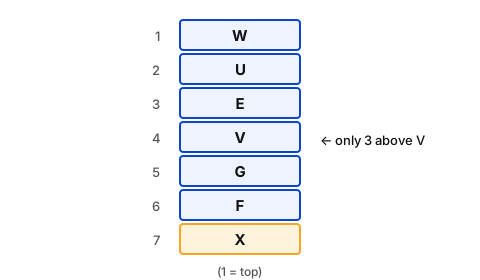
Only three boxes are kept above V. Only one box is kept between F and V. Only three boxes are kept between F and U. U is kept at some place above V. E is kept immediately below U. G is kept at one of the places above X. W is not kept immediately above or below F. Which box is kept at the lowermost position?
सात बक्से U, V, W, X, E, F और G एक के ऊपर एक रखे गए हैं, परंतु आवश्यक नहीं कि इसी क्रम में हों।
V के ऊपर केवल तीन बक्से रखे गए हैं। F और V के बीच केवल एक बक्सा रखा गया है। F और U के बीच केवल तीन बक्से रखे गए हैं। U, V के ऊपर किसी स्थान पर रखा गया है। E, U के ठीक नीचे रखा गया है। G, X के ऊपर के किसी एक स्थान पर रखा गया है। W, F के ठीक ऊपर या ठीक नीचे नहीं रखा गया है। सबसे नीचे के स्थान पर कौन-सा बक्सा रखा गया है?
  1. AW
  2. BU
  3. CX
  4. DF
Show answer

Concept: Number positions 1 (top) to 7 (bottom).

  1. Three above V ⇒ V = 4. One between F and V ⇒ F = 2 or 6.
  2. Three between F and U with U above V: F = 2 gives U = 6 (below V ✗) ⇒ F = 6, U = 2; E just below U ⇒ E = 3.
  3. W, G, X go to 1, 5, 7. W not next to F ⇒ W = 1; G above X ⇒ G = 5, X = 7.
  4. Lowermost box = X.

Trick: Use the "U above V" condition to reject one case immediately.

Answer: (C) X

अवधारणा: स्थान 1 (ऊपर) से 7 (नीचे) मानें।

  1. V के ऊपर तीन ⇒ V = 4. F और V के बीच एक ⇒ F = 2 या 6.
  2. F और U के बीच तीन, U, V के ऊपर: F = 2 पर U = 6 (V के नीचे ✗) ⇒ F = 6, U = 2; E ठीक U के नीचे ⇒ E = 3.
  3. W, G, X के लिए 1, 5, 7. W, F के पास नहीं ⇒ W = 1; G, X के ऊपर ⇒ G = 5, X = 7.
  4. सबसे नीचे = X.

ट्रिक: "U, V के ऊपर" शर्त से एक केस तुरंत हट जाता है।

उत्तर: (C) X

RRB NTPC Undergraduate CBT 1General Intelligence and ReasoningBox ArrangementRRB NTPC Undergraduate CBT 1 2024 · 1 Sep Shift 3 →
Q5378.
Read the given statements and conclusions carefully. Assuming that the information given in the statements is true, even if it appears to be at variance with commonly known facts, decide which of the given conclusion(s) logically follow(s) from the statements.
Statements:
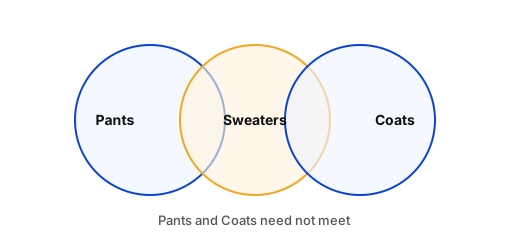
Some pants are sweaters.
Some sweaters are coats.
Conclusions:
(I) Some pants are coats.
(II) Some sweaters are pants.
दिए गए कथनों और निष्कर्षों को ध्यानपूर्वक पढ़िए। यह मानते हुए कि कथनों में दी गई जानकारी सत्य है, भले ही वह सामान्य रूप से ज्ञात तथ्यों से भिन्न प्रतीत होती हो, निर्णय कीजिए कि दिए गए निष्कर्षों में से कौन-सा/से निष्कर्ष कथनों का तार्किक रूप से अनुसरण करता है/करते हैं।
कथन:
कुछ पैंट, स्वेटर हैं।
कुछ स्वेटर, कोट हैं।
निष्कर्ष:
(I) कुछ पैंट, कोट हैं।
(II) कुछ स्वेटर, पैंट हैं।
  1. AOnly conclusion (I) follows.केवल निष्कर्ष (I) अनुसरण करता है।
  2. BNeither conclusion (I) nor (II) follows.न तो निष्कर्ष (I) और न ही (II) अनुसरण करता है।
  3. COnly conclusion (II) follows.केवल निष्कर्ष (II) अनुसरण करता है।
  4. DBoth conclusions (I) and (II) follow.निष्कर्ष (I) और (II) दोनों अनुसरण करते हैं।
Show answer

Concept: "Some A are B" can be converted to "Some B are A"; two "some" statements give no link between the outer terms.

  1. II: "Some pants are sweaters" ⇒ "Some sweaters are pants" (conversion) ✓.
  2. I: Pants and coats are linked only through some sweaters, which may be different ones ⇒ not definite ✗.

Yaad rakhein: Some + Some ⇒ no conclusion between the end terms.

Answer: (C) Only conclusion (II) follows.

अवधारणा: "कुछ A, B हैं" को "कुछ B, A हैं" में बदला जा सकता है; दो "कुछ" कथनों से बाहरी पदों में संबंध नहीं बनता।

  1. II: "कुछ पैंट स्वेटर हैं" ⇒ "कुछ स्वेटर पैंट हैं" (रूपांतरण) ✓.
  2. I: पैंट और कोट केवल स्वेटर से जुड़े हैं, जो अलग-अलग हो सकते हैं ⇒ निश्चित नहीं ✗.

याद रखें: कुछ + कुछ ⇒ अंतिम पदों में कोई निष्कर्ष नहीं।

उत्तर: (C) केवल निष्कर्ष (II) अनुसरण करता है।

RRB NTPC Undergraduate CBT 1General Intelligence and ReasoningSyllogismRRB NTPC Undergraduate CBT 1 2024 · 1 Sep Shift 3 →
Q5379.
Based on the English alphabetical order, three of the following four letter-cluster pairs are alike in a certain way and thus form a group. Which letter-cluster pair DOES NOT belong to that group?
(Note: The odd one out is not based on the number of consonants/vowels or their position in the letter-cluster.)
अंग्रेज़ी वर्णमाला क्रम के आधार पर, निम्नलिखित चार अक्षर-समूह युग्मों में से तीन किसी निश्चित प्रकार से एकसमान हैं और इस प्रकार एक समूह बनाते हैं। कौन-सा अक्षर-समूह युग्म उस समूह से संबंधित नहीं है?
(नोट: असंगत अक्षर-समूह युग्म, व्यंजनों/स्वरों की संख्या या अक्षर-समूह में उनके स्थान पर आधारित नहीं है।)
  1. ALO-HJ
  2. BFI-BC
  3. CPS-LN
  4. DIL-EG
Show answer

Concept: Compare each letter of the first cluster with the matching letter of the second.

  1. LO-HJ: L→H −4, O→J −5. PS-LN: −4, −5. IL-EG: −4, −5.
  2. FI-BC: F→B −4 but I→C −6.

Trick: Positions: I=9, C=3 — a gap of 6, not 5.

Answer: (B) FI-BC

अवधारणा: पहले क्लस्टर के हर अक्षर की तुलना दूसरे क्लस्टर के संगत अक्षर से करें।

  1. LO-HJ: L→H −4, O→J −5. PS-LN: −4, −5. IL-EG: −4, −5.
  2. FI-BC: F→B −4 पर I→C −6.

ट्रिक: स्थान: I=9, C=3 — अंतर 6 है, 5 नहीं।

उत्तर: (B) FI-BC

RRB NTPC Undergraduate CBT 1General Intelligence and ReasoningLetter Analogy – Odd One OutRRB NTPC Undergraduate CBT 1 2024 · 1 Sep Shift 3 →
Q5380.
Based on the English alphabetical order, three of the following four letter-cluster pairs are alike in a certain way and thus form a group. Which letter-cluster pair DOES NOT belong to that group?
(Note: The odd one out is not based on the number of consonants/vowels or their position in the letter-cluster.)
अंग्रेज़ी वर्णमाला क्रम के आधार पर, निम्नलिखित चार अक्षर-समूह युग्मों में से तीन किसी निश्चित प्रकार से एकसमान हैं और इस प्रकार एक समूह बनाते हैं। कौन-सा अक्षर-समूह युग्म उस समूह से संबंधित नहीं है?
(नोट: असंगत अक्षर-समूह युग्म, व्यंजनों/स्वरों की संख्या या अक्षर-समूह में उनके स्थान पर आधारित नहीं है।)
  1. ATW-VY
  2. BRU-TW
  3. CAD-CF
  4. DEH-GK
Show answer

Concept: Compare each letter of the first cluster with the matching letter of the second.

  1. TW-VY: +2, +2. RU-TW: +2, +2. AD-CF: +2, +2.
  2. EH-GK: E→G +2 but H→K +3.

Trick: In the three alike pairs, the second cluster is also a "+3" pair like the first (V→Y); G→K is +4.

Answer: (D) EH-GK

अवधारणा: पहले क्लस्टर के हर अक्षर की तुलना दूसरे क्लस्टर के संगत अक्षर से करें।

  1. TW-VY: +2, +2. RU-TW: +2, +2. AD-CF: +2, +2.
  2. EH-GK: E→G +2 पर H→K +3.

ट्रिक: तीन समान जोड़ियों में दूसरा क्लस्टर भी "+3" वाला है (V→Y); G→K में +4 है।

उत्तर: (D) EH-GK

RRB NTPC Undergraduate CBT 1General Intelligence and ReasoningLetter Analogy – Odd One OutRRB NTPC Undergraduate CBT 1 2024 · 1 Sep Shift 3 →