Question bank

Q&A: practice questions with answers

Search questions on any topic. Filter by exam category, exam, subject and topic, try the question, then open the answer and explanation.

Courses – airGurukul

8,495 questions found.

Q5461.
The LCM of the numbers 2.6 and 0.084 is:
संख्याओं 2.6 और 0.084 का LCM है:
  1. A546
  2. B0.546
  3. C5.46
  4. D54.6
Show answer

Concept: Make decimal places equal, find LCM of the integers, then put back the decimal places.

  1. 2.600 and 0.084 → 2600 and 84 (3 decimal places).
  2. 2600=23×52×13, 84=22×3×7.
  3. LCM =23×3×52×7×13=54600 → 54.600=54.6.

Trick: LCM of decimals must be a multiple of the bigger number 2.6: 54.6=2.6×21 ✓.

Answer: (D) 54.6

अवधारणा: दशमलव स्थान बराबर करें, पूर्णांकों का LCM लें, फिर दशमलव लगाएँ।

  1. 2.600 और 0.084 → 2600 और 84.
  2. 2600=23×52×13, 84=22×3×7.
  3. LCM =54600 → 54.6.

ट्रिक: उत्तर 2.6 का गुणज होना चाहिए: 2.6×21=54.6.

उत्तर: (D) 54.6

RRB NTPC Undergraduate CBT 1MathematicsLCM of DecimalsRRB NTPC Undergraduate CBT 1 2024 · 1 Sep Shift 2 →
Q5462.
Amit, Neha, and Kiran invest ₹1,220, ₹1,370, and ₹1,110, respectively, to start a business. If the profit at the end of the year is ₹1,160, then what is the share of Kiran in the profit?
अमित, नेहा और किरण एक व्यवसाय शुरू करने के लिए क्रमशः ₹1,220, ₹1,370 और ₹1,110 का निवेश करते हैं। यदि वर्ष के अंत में लाभ ₹1,160 है, तो लाभ में किरण का हिस्सा कितना है?
  1. A₹345
  2. B₹347
  3. C₹351
  4. D₹348
Show answer

Concept: For the same time period, profit is shared in the ratio of investments.

  1. Total investment =1220+1370+1110=3700.
  2. Kiran's share =11103700×1160=0.3×1160=348.

Trick: 11103700=310 exactly — 30% of 1160.

Answer: (D) ₹348

अवधारणा: समान अवधि में लाभ निवेश के अनुपात में बँटता है।

  1. कुल निवेश =3700.
  2. किरण का भाग =11103700×1160=348.

ट्रिक: 11103700=310, अर्थात् 1160 का 30%।

उत्तर: (D) ₹348

RRB NTPC Undergraduate CBT 1MathematicsPartnershipRRB NTPC Undergraduate CBT 1 2024 · 1 Sep Shift 2 →
Q5463.
The average runs scored by a batsman in 23 matches is 43. In the next 10 matches, the batsman scored an average of 13 runs. Find his average runs scored (rounded off to two decimal places) in all the 33 matches.
एक बल्लेबाज़ द्वारा 23 मैचों में बनाए गए रनों का औसत 43 है। अगले 10 मैचों में, बल्लेबाज़ ने 13 रनों का औसत बनाया। सभी 33 मैचों में उसके द्वारा बनाए गए रनों का औसत (दो दशमलव स्थानों तक पूर्णांकित) ज्ञात कीजिए।
  1. A32.91
  2. B34.91
  3. C35.91
  4. D33.91
Show answer

Concept: Overall average = total runs ÷ total matches.

  1. Runs in 23 matches =23×43=989.
  2. Runs in 10 matches =10×13=130.
  3. Average =989+13033=111933≈33.91.

Trick: Deviation method: 43−10×3033=43−9.09=33.91.

Answer: (D) 33.91

अवधारणा: कुल औसत = कुल रन ÷ कुल मैच।

  1. 23 मैचों के रन =989.
  2. 10 मैचों के रन =130.
  3. औसत =111933≈33.91.

ट्रिक: 43−10×3033=33.91.

उत्तर: (D) 33.91

RRB NTPC Undergraduate CBT 1MathematicsAverageRRB NTPC Undergraduate CBT 1 2024 · 1 Sep Shift 2 →
Q5464.
Pallavi bought a toy for ₹670, decorated it at a cost of ₹10 and sold the toy for ₹290. Find the loss or profit percentage.
पल्लवी ने एक खिलौना ₹670 में खरीदा, ₹10 की लागत से उसे सजाया और खिलौने को ₹290 में बेच दिया। हानि या लाभ प्रतिशत ज्ञात कीजिए।
  1. A97517% profit97517% लाभ
  2. B975% loss975% हानि
  3. C98517% profit98517% लाभ
  4. D97517% loss97517% हानि
Show answer

Concept: Overhead (decoration) is added to cost price. Loss%=LossCP×100.

  1. CP =670+10=680.
  2. SP =290 → loss =680−290=390.
  3. Loss%=390680×100=97517% (≈ 57.35%).

Trick: SP is less than CP → only the 'loss' options; then divide 39000 by 680.

Answer: (D) 97517% loss

अवधारणा: सजावट का खर्च क्रय मूल्य में जुड़ता है। हानि%=हानिक्रय मूल्य×100.

  1. CP =680.
  2. हानि =680−290=390.
  3. हानि%=390680×100=97517%.

ट्रिक: SP कम है → केवल हानि वाले विकल्प देखें।

उत्तर: (D) 97517% हानि

RRB NTPC Undergraduate CBT 1MathematicsProfit and LossRRB NTPC Undergraduate CBT 1 2024 · 1 Sep Shift 2 →
Q5465.
Pipe A can fill a tank in 16 hours, pipe B can fill the same tank in 21 hours and pipe C can fill the same tank in 11 hours. The time taken by them to fill the same tank if they operate together is::
पाइप A एक टंकी को 16 घंटे में भर सकता है, पाइप B उसी टंकी को 21 घंटे में भर सकता है और पाइप C उसी टंकी को 11 घंटे में भर सकता है। यदि वे एक साथ कार्य करें, तो उसी टंकी को भरने में उनके द्वारा लिया गया समय है:
  1. A5724743 hours5724743 घंटे
  2. B1724743 hours1724743 घंटे
  3. C4724743 hours4724743 घंटे
  4. D2724743 hours2724743 घंटे
Show answer

Concept: Together, rates add: 1T=116+121+111.

  1. LCM =16×21×11=3696.
  2. 231+176+3363696=7433696 tank per hour.
  3. T=3696743=4724743 hours.

Trick: All options share the fraction 724743; only the whole part 3696÷743=4 is needed.

Answer: (C) 4724743 hours

अवधारणा: साथ में दरें जुड़ती हैं: 1T=116+121+111.

  1. LCM =3696.
  2. 231+176+3363696=7433696.
  3. T=3696743=4724743 घंटे।

ट्रिक: भिन्न भाग सभी विकल्पों में समान है; पूर्ण भाग 3696÷743=4 निकालें।

उत्तर: (C) 4724743 घंटे

RRB NTPC Undergraduate CBT 1MathematicsPipes and CisternsRRB NTPC Undergraduate CBT 1 2024 · 1 Sep Shift 2 →
Q5466.
In a certain code language,
A + B means ‘A is the husband of B’,
A – B means ‘A is the mother of B’,
A x B means ‘A is the daughter of B’ and
A ÷ B means ‘A is the brother of B’.
How is G related to P if ‘G ÷ I x L + N – P’?
एक निश्चित कूट भाषा में,
A + B का अर्थ है ‘A, B का पति है’,
A – B का अर्थ है ‘A, B की माँ है’,
A x B का अर्थ है ‘A, B की बेटी है’ और
A ÷ B का अर्थ है ‘A, B का भाई है’।
यदि ‘G ÷ I x L + N – P’ है, तो G का P से क्या संबंध है?
  1. AMother's fatherमाँ के पिता
  2. BFather's brotherपिता के भाई
  3. CBrotherभाई
  4. DMother's brotherमाँ के भाई
Show answer

Concept: Decode each symbol and build the family tree.

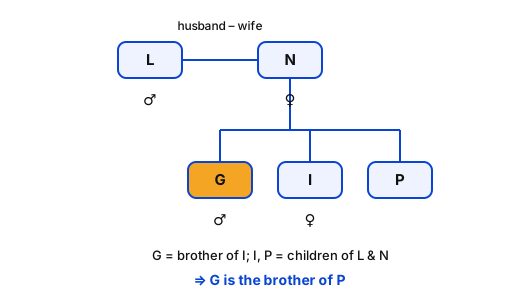
  1. G ÷ I: G is the brother of I.
  2. I × L: I is the daughter of L.
  3. L + N: L is the husband of N; N − P: N is the mother of P.
  4. So I and P are children of L and N, and G (male) is their brother → G is P's brother.

Trick: Brother of P's sibling (same parents) is P's brother.

Answer: (C) Brother

अवधारणा: प्रत्येक चिह्न का अर्थ लिखकर वंश-वृक्ष बनाएँ।

  1. G ÷ I: G, I का भाई है।
  2. I × L: I, L की बेटी है।
  3. L + N: L, N का पति; N − P: N, P की माँ है।
  4. I और P, L व N की संतान हैं; G (पुरुष) उनका भाई है।

ट्रिक: P के भाई-बहन का भाई = P का भाई।

उत्तर: (C) Brother (भाई)

RRB NTPC Undergraduate CBT 1General Intelligence and ReasoningCoded Blood RelationsRRB NTPC Undergraduate CBT 1 2024 · 1 Sep Shift 2 →
Q5467.
Read the given statements and conclusions carefully. Assuming that the information given in the statements is true, even if it appears to be at variance with commonly known facts, decide which of the given conclusions logically follow(s) from the statements.
Statements:
Some cloth are handkerchief.
All towel are handkerchief.
Conclusion:
(I): Some cloth are towel.
(II): All handkerchief are towel.
दिए गए कथनों और निष्कर्षों को ध्यानपूर्वक पढ़िए। यह मानते हुए कि कथनों में दी गई जानकारी सत्य है, भले ही वह सामान्यतः ज्ञात तथ्यों से भिन्न प्रतीत होती हो, निर्णय कीजिए कि दिए गए निष्कर्षों में से कौन-सा/से निष्कर्ष कथनों का तार्किक रूप से अनुसरण करता है/करते हैं।
कथन:
कुछ कपड़े, रूमाल हैं।
सभी तौलिए, रूमाल हैं।
निष्कर्ष:
(I): कुछ कपड़े, तौलिए हैं।
(II): सभी रूमाल, तौलिए हैं।
  1. ABoth conclusions (I) and (II) follow.निष्कर्ष (I) और (II) दोनों अनुसरण करते हैं।
  2. BNeither conclusion (I) nor (II) follows.न तो निष्कर्ष (I) और न ही (II) अनुसरण करता है।
  3. COnly conclusion (II) follows.केवल निष्कर्ष (II) अनुसरण करता है।
  4. DOnly conclusion (I) follows.केवल निष्कर्ष (I) अनुसरण करता है।
Show answer

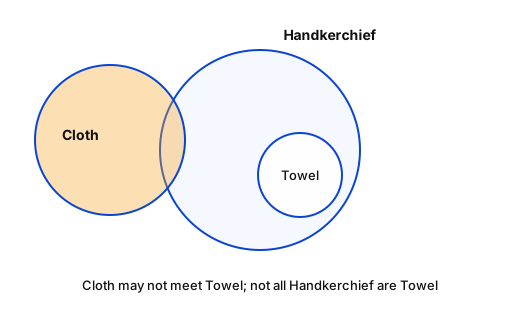
Concept: Draw the least-overlap Venn diagram; a conclusion follows only if it is true in every possible diagram.

  1. All towel are handkerchief → Towel inside Handkerchief.
  2. Some cloth are handkerchief → Cloth overlaps Handkerchief, but may avoid Towel → (I) does not follow.
  3. Towel is inside Handkerchief, not the reverse → (II) does not follow.

Yaad rakhein: 'All A are B' never gives 'All B are A'.

Answer: (B) Neither conclusion (I) nor (II) follows.

अवधारणा: न्यूनतम-संभव वेन आरेख बनाएँ; निष्कर्ष तभी सही जब हर संभावित आरेख में सत्य हो।

  1. सभी towel, handkerchief हैं → Towel, Handkerchief के अंदर।
  2. Cloth, Handkerchief को काटता है पर Towel से अलग रह सकता है → (I) नहीं।
  3. उल्टा 'सभी handkerchief, towel हैं' निश्चित नहीं → (II) नहीं।

याद रखें: 'सभी A, B हैं' से 'सभी B, A हैं' कभी नहीं निकलता।

उत्तर: (B) न तो (I) और न (II) अनुसरण करता है।

RRB NTPC Undergraduate CBT 1General Intelligence and ReasoningSyllogismRRB NTPC Undergraduate CBT 1 2024 · 1 Sep Shift 2 →
Q5468.
Refer to the following number and symbol series and answer the question that follows. Counting to be done from left to right only.
(Left) 2 4 & # $ 4 7 6 6 & 1 * $ 2 © 9 4 8 € $ * 4 (Right)
How many such numbers are there each of which is immediately preceded by a symbol and also immediately followed by a symbol?
निम्नलिखित संख्या और प्रतीक श्रृंखला को देखिए और उसके बाद पूछे गए प्रश्न का उत्तर दीजिए। गिनती केवल बाएँ से दाएँ की जानी है।
(बाएँ) 2 4 & # $ 4 7 6 6 & 1 * $ 2 © 9 4 8 € $ * 4 (दाएँ)
ऐसी कितनी संख्याएँ हैं जिनमें से प्रत्येक के ठीक पहले एक प्रतीक है और ठीक बाद भी एक प्रतीक है?
  1. A2
  2. B1
  3. C4
  4. D3
Show answer

Concept: Scan for the pattern Symbol – Number – Symbol.

  1. Series: 2 4 & # $ 4 7 6 6 & 1 * $ 2 © 9 4 8 € $ * 4.
  2. & 1 * ✓
  3. $ 2 © ✓
  4. No other number has symbols on both sides; total = 2.

Trick: Look only at numbers standing alone between symbols — runs like 4 7 6 6 can never qualify.

Answer: (A) 2

अवधारणा: प्रतीक – संख्या – प्रतीक का क्रम खोजें।

  1. शृंखला: 2 4 & # $ 4 7 6 6 & 1 * $ 2 © 9 4 8 € $ * 4.
  2. & 1 * ✓
  3. $ 2 © ✓
  4. अन्य कोई नहीं; कुल 2.

ट्रिक: केवल अकेली संख्याएँ देखें जो दोनों ओर प्रतीकों से घिरी हों।

उत्तर: (A) 2

RRB NTPC Undergraduate CBT 1General Intelligence and ReasoningNumber–Symbol SeriesRRB NTPC Undergraduate CBT 1 2024 · 1 Sep Shift 2 →
Q5469.
126 people are standing in a row facing north. Mr. Into is 11th from the right end while Mr. Toni is 12th from the left end. How many people are there between Mr. Into and Mr. Toni?
126 लोग उत्तर की ओर मुख करके एक पंक्ति में खड़े हैं। Mr. Into दाएँ छोर से 11वें स्थान पर है जबकि Mr. Toni बाएँ छोर से 12वें स्थान पर है। Mr. Into और Mr. Toni के बीच कितने लोग हैं?
  1. A104
  2. B101
  3. C102
  4. D103
Show answer

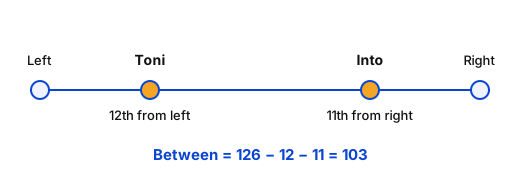
Concept: When positions are counted from opposite ends and do not overlap: persons between = Total − (left rank + right rank).

  1. Toni is 12th from left; Into is 11th from right = 126−11+1=116th from left.
  2. Between them =116−12−1=103.

Trick: 126−(12+11)=103 directly.

Answer: (D) 103

अवधारणा: विपरीत सिरों से स्थान दिए हों और ओवरलैप न हो: बीच में = कुल − (बाएँ से स्थान + दाएँ से स्थान)।

  1. Toni बाएँ से 12वाँ; Into दाएँ से 11वाँ = बाएँ से 116वाँ।
  2. बीच में =116−12−1=103.

ट्रिक: सीधे 126−23=103.

उत्तर: (D) 103

RRB NTPC Undergraduate CBT 1General Intelligence and ReasoningRanking in a RowRRB NTPC Undergraduate CBT 1 2024 · 1 Sep Shift 2 →
Q5470.
Ram starts his journey from Point A. He then drives 4 km towards the west, turns left and drives 7 km. He then turns right and drives 5 km, again turns left and drives for 3 km. After that he turns left and drives for 12 km. He takes a final left turn, drives for 10 km and stops. How far (shortest distance) and in which direction should he drive in order to reach Point A again? (All turns are 90-degree turns only unless specified.)
राम बिंदु A से अपनी यात्रा शुरू करता है। फिर वह पश्चिम की ओर 4 km ड्राइव करता है, बाएँ मुड़ता है और 7 km ड्राइव करता है। फिर वह दाएँ मुड़ता है और 5 km ड्राइव करता है, फिर से बाएँ मुड़ता है और 3 km ड्राइव करता है। उसके बाद वह बाएँ मुड़ता है और 12 km ड्राइव करता है। वह अंतिम बार बाएँ मुड़ता है, 10 km ड्राइव करता है और रुक जाता है। पुनः बिंदु A पर पहुँचने के लिए उसे कितनी दूरी (न्यूनतम दूरी) तक और किस दिशा में ड्राइव करना चाहिए? (जब तक निर्दिष्ट न हो, सभी मोड़ केवल 90 डिग्री के मोड़ हैं।)
  1. A5 km towards the eastपूर्व की ओर 5 km
  2. B3 km towards the northउत्तर की ओर 3 km
  3. C3 km towards the westपश्चिम की ओर 3 km
  4. D8 km towards the southदक्षिण की ओर 8 km
Show answer

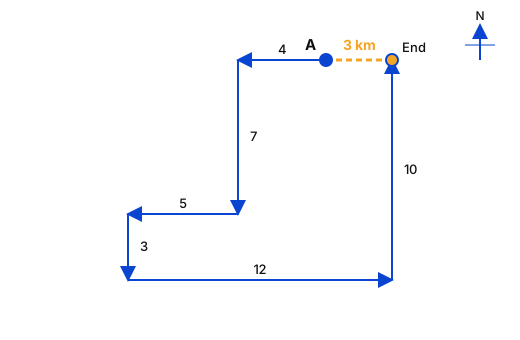
Concept: Plot each move on axes (East +x, North +y) and compare the final point with A.

  1. A(0, 0) → 4 W → (−4, 0) → left = South 7 → (−4, −7).
  2. Right = West 5 → (−9, −7) → left = South 3 → (−9, −10).
  3. Left = East 12 → (3, −10) → left = North 10 → (3, 0).
  4. End point is 3 km east of A → drive 3 km towards the west.

Trick: Net E–W: −4−5+12=3 (east); net N–S: −7−3+10=0.

Answer: (C) 3 km towards the west

अवधारणा: हर चाल को अक्षों पर लिखें (पूर्व +x, उत्तर +y) और अंतिम बिंदु की A से तुलना करें।

  1. A(0, 0) → 4 पश्चिम → (−4, 0) → बाएँ = दक्षिण 7 → (−4, −7).
  2. दाएँ = पश्चिम 5 → (−9, −7) → बाएँ = दक्षिण 3 → (−9, −10).
  3. बाएँ = पूर्व 12 → (3, −10) → बाएँ = उत्तर 10 → (3, 0).
  4. अंतिम बिंदु A से 3 km पूर्व → 3 km पश्चिम जाना होगा।

ट्रिक: पूर्व-पश्चिम: −4−5+12=3; उत्तर-दक्षिण: −7−3+10=0.

उत्तर: (C) 3 km पश्चिम की ओर

RRB NTPC Undergraduate CBT 1General Intelligence and ReasoningDirection and DistanceRRB NTPC Undergraduate CBT 1 2024 · 1 Sep Shift 2 →
Q5471.
What will come in the place of the question mark (?) in the following equation, ‘÷’ and ‘×’ are interchanged and ‘−‘ and ‘+’ are interchanged?
13 − 5 ÷ 5 × 5 + 13 × 13 − 9 × 3 ÷ 3 − 108 = ?
यदि ‘÷’ और ‘×’ को आपस में बदल दिया जाए तथा ‘−‘ और ‘+’ को आपस में बदल दिया जाए, तो निम्नलिखित समीकरण में प्रश्न चिह्न (?) के स्थान पर क्या आएगा?
13 − 5 ÷ 5 × 5 + 13 × 13 − 9 × 3 ÷ 3 − 108 = ?
  1. A90
  2. B129
  3. C110
  4. D134
Show answer

Concept: Swap the signs first, then apply BODMAS.

  1. After swapping: 13+5×5÷5−13÷13+9÷3×3+108.
  2. 5×5÷5=5, 13÷13=1, 9÷3×3=9.
  3. 13+5−1+9+108=134.

Trick: Rewrite the whole expression once with new signs before calculating — avoids mixing old and new signs.

Answer: (D) 134

अवधारणा: पहले चिह्न बदलें, फिर BODMAS लगाएँ।

  1. बदलने के बाद: 13+5×5÷5−13÷13+9÷3×3+108.
  2. 5×5÷5=5, 13÷13=1, 9÷3×3=9.
  3. 13+5−1+9+108=134.

ट्रिक: पूरा व्यंजक नए चिह्नों के साथ एक बार दोबारा लिखें।

उत्तर: (D) 134

RRB NTPC Undergraduate CBT 1General Intelligence and ReasoningSymbol InterchangeRRB NTPC Undergraduate CBT 1 2024 · 1 Sep Shift 2 →
Q5472.
In a certain code language, ‘VAST’ is coded as ‘7892’ and ‘SAVE’ is coded as ‘8629’. What is the code for ‘E’ in the given code language?
एक निश्चित कूट भाषा में, ‘VAST’ को ‘7892’ के रूप में कूटबद्ध किया जाता है और ‘SAVE’ को ‘8629’ के रूप में कूटबद्ध किया जाता है। दी गई कूट भाषा में ‘E’ का कूट क्या है?
  1. A2
  2. B9
  3. C6
  4. D8
Show answer

Concept: Letters common to both words take the digits common to both codes.

  1. VAST = 7892, SAVE = 8629.
  2. Common letters V, A, S ↔ common digits 8, 9, 2.
  3. Leftover: T = 7 in VAST, E = 6 in SAVE.

Trick: Uncommon letter ↔ uncommon digit.

Answer: (C) 6

अवधारणा: दोनों शब्दों के समान अक्षरों को दोनों कूटों के समान अंक मिलते हैं।

  1. VAST = 7892, SAVE = 8629.
  2. समान अक्षर V, A, S ↔ समान अंक 8, 9, 2.
  3. बचे: VAST में T = 7, SAVE में E = 6.

ट्रिक: असमान अक्षर ↔ असमान अंक।

उत्तर: (C) 6

RRB NTPC Undergraduate CBT 1General Intelligence and ReasoningCoding–Decoding (Common Letters)RRB NTPC Undergraduate CBT 1 2024 · 1 Sep Shift 2 →
Q5473.
Based on the English alphabetical order, three of the following four letter-clusters are alike in a certain way and thus form a group. Which letter-cluster DOES NOT belong to that group?
(Note: The odd one out is not based on the number of consonants/vowels or their position in the letter-cluster.)
अंग्रेज़ी वर्णमाला क्रम के आधार पर, निम्नलिखित चार अक्षर-समूहों में से तीन किसी निश्चित प्रकार से एकसमान हैं और इस प्रकार एक समूह बनाते हैं। कौन-सा अक्षर-समूह उस समूह से संबंधित नहीं है?
(ध्यान दें: असंगत अक्षर-समूह, उस अक्षर-समूह में व्यंजनों/स्वरों की संख्या या उनके स्थान पर आधारित नहीं है।)
  1. ALNH
  2. BKNZ
  3. COQK
  4. DTVP
Show answer

Concept: Find the gaps between letter positions (A = 1 … Z = 26).

  1. LNH: 12, 14, 8 → +2, −6.
  2. OQK: 15, 17, 11 → +2, −6; TVP: 20, 22, 16 → +2, −6.
  3. KNZ: 11, 14, 26 → +3, +12 → odd one.

Trick: Skip one letter forward, then six back — KNZ breaks it at the first step.

Answer: (B) KNZ

अवधारणा: अक्षरों की स्थिति (A = 1 … Z = 26) के अंतर देखें।

  1. LNH: +2, −6.
  2. OQK और TVP: +2, −6.
  3. KNZ: +3, +12 → भिन्न।

ट्रिक: पहला कदम ही +2 नहीं है — KNZ अलग।

उत्तर: (B) KNZ

RRB NTPC Undergraduate CBT 1General Intelligence and ReasoningOdd One Out – Letter ClustersRRB NTPC Undergraduate CBT 1 2024 · 1 Sep Shift 2 →
Q5474.
In a certain code language, ‘WAVE’ is coded as ‘3257’ and ‘VOLT’ is coded as ‘1346’. What is the code for ‘V’ in the given code language?
एक निश्चित कूट भाषा में, ‘WAVE’ को ‘3257’ के रूप में कूटबद्ध किया जाता है और ‘VOLT’ को ‘1346’ के रूप में कूटबद्ध किया जाता है। दी गई कूट भाषा में ‘V’ का कूट क्या है?
  1. A1
  2. B7
  3. C3
  4. D5
Show answer

Concept: The only letter common to both words gets the only digit common to both codes.

  1. WAVE = 3257, VOLT = 1346.
  2. Common letter: V; common digit: 3.
  3. So V = 3.

Trick: One common letter ↔ one common digit.

Answer: (C) 3

अवधारणा: दोनों शब्दों का एकमात्र समान अक्षर, दोनों कूटों का एकमात्र समान अंक पाता है।

  1. WAVE = 3257, VOLT = 1346.
  2. समान अक्षर V; समान अंक 3.
  3. अतः V = 3.

ट्रिक: एक समान अक्षर ↔ एक समान अंक।

उत्तर: (C) 3

RRB NTPC Undergraduate CBT 1General Intelligence and ReasoningCoding–Decoding (Common Letters)RRB NTPC Undergraduate CBT 1 2024 · 1 Sep Shift 2 →
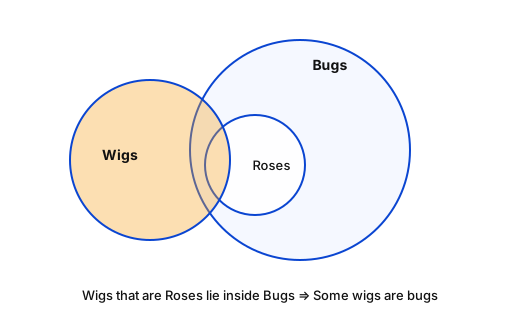
Q5475.
Read the given statements and conclusions carefully. You have to take the given statements to be true even if they seem to be at variance from commonly known facts. You have to decide which conclusion(s) logically follow/s from the given statements. Statements:
Some wigs are roses.
All roses are bugs.
Conclusions (I): Some wigs are bugs.
Conclusions (II): All bugs are roses.
दिए गए कथनों और निष्कर्षों को ध्यानपूर्वक पढ़िए। आपको दिए गए कथनों को सत्य मानना है, भले ही वे सामान्यतः ज्ञात तथ्यों से भिन्न प्रतीत होते हों। आपको निर्णय करना है कि कौन-सा/से निष्कर्ष दिए गए कथनों का तार्किक रूप से अनुसरण करता है/करते हैं। कथन:
कुछ विग, गुलाब हैं।
सभी गुलाब, कीड़े हैं।
निष्कर्ष (I): कुछ विग, कीड़े हैं।
निष्कर्ष (II): सभी कीड़े, गुलाब हैं।
  1. ABoth conclusions (I) and (II) follow.निष्कर्ष (I) और (II) दोनों अनुसरण करते हैं।
  2. BNeither conclusion (I) nor (II) follows.न तो निष्कर्ष (I) और न ही (II) अनुसरण करता है।
  3. COnly conclusion (I) follows.केवल निष्कर्ष (I) अनुसरण करता है।
  4. DOnly conclusion (II) follows.केवल निष्कर्ष (II) अनुसरण करता है।
Show answer

Concept: Some A are B + All B are C ⇒ Some A are C (definite).

  1. Some wigs are roses, and every rose is a bug → those wigs are bugs → (I) follows.
  2. All roses are bugs does not mean all bugs are roses → (II) does not follow.

Yaad rakhein: Some + All = Some (with the first term of 'Some').

Answer: (C) Only conclusion (I) follows.

अवधारणा: कुछ A, B हैं + सभी B, C हैं ⇒ कुछ A, C हैं (निश्चित)।

  1. कुछ wigs, roses हैं और सभी roses, bugs हैं → वे wigs, bugs हैं → (I) सही।
  2. 'सभी roses, bugs' का उल्टा निश्चित नहीं → (II) नहीं।

याद रखें: कुछ + सभी = कुछ।

उत्तर: (C) केवल निष्कर्ष (I) अनुसरण करता है।

RRB NTPC Undergraduate CBT 1General Intelligence and ReasoningSyllogismRRB NTPC Undergraduate CBT 1 2024 · 1 Sep Shift 2 →
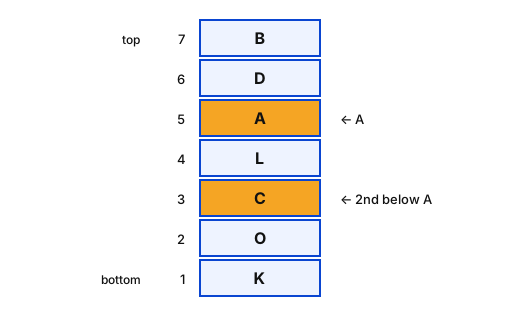
Q5476.
Seven boxes A, B, C, D, K, L and O are kept one over the other but not necessarily in the same order. No box is kept above B. Only three boxes are kept between B and C. Only one box is kept between D and L. L is kept immediately above C. Only four boxes are kept between D and K. A is kept at some place above O.
Which box is kept second below A?
सात बक्से A, B, C, D, K, L और O एक के ऊपर एक रखे गए हैं, लेकिन आवश्यक नहीं कि इसी क्रम में हों। B के ऊपर कोई बक्सा नहीं रखा गया है। B और C के बीच केवल तीन बक्से रखे गए हैं। D और L के बीच केवल एक बक्सा रखा गया है। L, C के ठीक ऊपर रखा गया है। D और K के बीच केवल चार बक्से रखे गए हैं। A, O के ऊपर किसी स्थान पर रखा गया है।
A के नीचे दूसरे स्थान पर कौन-सा बक्सा रखा गया है?
  1. AC
  2. BD
  3. CO
  4. DB
Show answer

Concept: Number positions 1 (bottom) to 7 (top) and fix definite clues first.

  1. Nothing above B → B = 7; three between B and C → C = 3; L immediately above C → L = 4.
  2. One between D and L → D = 2 or 6; four between D and K: D = 2 would need K = 7 (taken), so D = 6, K = 1.
  3. A above O among 2 and 5 → A = 5, O = 2.
  4. Second below A (5) is position 3 = C.

Trick: 'k boxes between' means positions differ by k+1.

Answer: (A) C

अवधारणा: स्थान 1 (नीचे) से 7 (ऊपर) मानें; पहले निश्चित सूचनाएँ लगाएँ।

  1. B के ऊपर कोई नहीं → B = 7; B और C के बीच तीन → C = 3; L, C के ठीक ऊपर → L = 4.
  2. D और L के बीच एक → D = 2 या 6; D और K के बीच चार: D = 6, K = 1.
  3. A, O से ऊपर → A = 5, O = 2.
  4. A (5) से दूसरा नीचे = स्थान 3 = C.

ट्रिक: 'बीच में k डिब्बे' = स्थानों का अंतर k+1.

उत्तर: (A) C

RRB NTPC Undergraduate CBT 1General Intelligence and ReasoningBox Stacking PuzzleRRB NTPC Undergraduate CBT 1 2024 · 1 Sep Shift 2 →
Q5477.
If + means −, − means ×, × means ÷ and ÷ means +, then what will come in place of the question mark (?) in the following equation?
20 ÷ 55 × 5 + 7 − 4 = ?
यदि + का अर्थ −, − का अर्थ ×, × का अर्थ ÷ और ÷ का अर्थ + है, तो निम्नलिखित समीकरण में प्रश्न चिह्न (?) के स्थान पर क्या आएगा?
20 ÷ 55 × 5 + 7 − 4 = ?
  1. A3
  2. B13
  3. C8
  4. D17
Show answer

Concept: Replace each sign as per the given meaning, then use BODMAS.

  1. 20÷55×5+7−4 becomes 20+55÷5−7×4.
  2. =20+11−28=3.

Trick: Do division and multiplication first: 11 and 28.

Answer: (A) 3

अवधारणा: दिए अर्थ के अनुसार चिह्न बदलें, फिर BODMAS लगाएँ।

  1. व्यंजक बनता है 20+55÷5−7×4.
  2. =20+11−28=3.

ट्रिक: पहले भाग और गुणा: 11 और 28.

उत्तर: (A) 3

RRB NTPC Undergraduate CBT 1General Intelligence and ReasoningSymbol SubstitutionRRB NTPC Undergraduate CBT 1 2024 · 1 Sep Shift 2 →
Q5478.
UP 16 is related to TK 4 in a certain way. In the same way, YT 23 is related to XO 11. To which of the following is KG 13 related, following the same logic?
UP 16 एक निश्चित प्रकार से TK 4 से संबंधित है। उसी प्रकार, YT 23, XO 11 से संबंधित है। उसी तर्क का अनुसरण करते हुए, KG 13 निम्नलिखित में से किससे संबंधित है?
  1. AIB 3
  2. BJA 3
  3. CIA 1
  4. DJB 1
Show answer

Concept: Check the change in each part separately.

  1. U → T (−1), P → K (−5), 16→4 (−12).
  2. Y → X (−1), T → O (−5), 23→11 (−12).
  3. K → J, G → B, 13−12=1 → JB 1.

Trick: Same three steps for every pair: −1, −5, −12.

Answer: (D) JB 1

अवधारणा: हर भाग का परिवर्तन अलग-अलग देखें।

  1. U → T (−1), P → K (−5), 16 → 4 (−12).
  2. Y → X (−1), T → O (−5), 23 → 11 (−12).
  3. K → J, G → B, 13−12=1 → JB 1.

ट्रिक: हर युग्म में −1, −5, −12.

उत्तर: (D) JB 1

RRB NTPC Undergraduate CBT 1General Intelligence and ReasoningLetter–Number AnalogyRRB NTPC Undergraduate CBT 1 2024 · 1 Sep Shift 2 →
Q5479.
In the following triad, each group of letters is related to the subsequent one following a certain logic. Select from the given options, the one which follows the same logic. WISE - EWSI - WEIS
PLUS - SPUL - PSLU
निम्नलिखित त्रिक में, अक्षरों का प्रत्येक समूह एक निश्चित तर्क का अनुसरण करते हुए अगले समूह से संबंधित है। दिए गए विकल्पों में से उस विकल्प का चयन कीजिए जो समान तर्क का अनुसरण करता है। WISE - EWSI - WEIS
PLUS - SPUL - PSLU
  1. APAWN - NPWA - PANW
  2. BPAGE - EPAG - AGEP
  3. CDOSE - ODSE - EOSD
  4. DBORN - NBRO - BNOR
Show answer

Concept: Track letter positions 1-2-3-4 through each step.

  1. WISE → EWSI: order 4-1-3-2. PLUS → SPUL ✓.
  2. EWSI → WEIS: swap 1st–2nd and 3rd–4th. SPUL → PSLU ✓.
  3. BORN → NBRO (4-1-3-2) → BNOR (swap pairs) ✓.

Trick: Step 2 just swaps letters in pairs — check that first, it is quick.

Answer: (D) BORN - NBRO - BNOR

अवधारणा: हर चरण में अक्षरों की स्थिति 1-2-3-4 देखें।

  1. WISE → EWSI: क्रम 4-1-3-2; PLUS → SPUL ✓.
  2. EWSI → WEIS: जोड़ों की अदला-बदली; SPUL → PSLU ✓.
  3. BORN → NBRO → BNOR ✓.

ट्रिक: दूसरा चरण सिर्फ़ जोड़ों की अदला-बदली है — पहले वही जाँचें।

उत्तर: (D) BORN - NBRO - BNOR

RRB NTPC Undergraduate CBT 1General Intelligence and ReasoningLetter Rearrangement TriadsRRB NTPC Undergraduate CBT 1 2024 · 1 Sep Shift 2 →
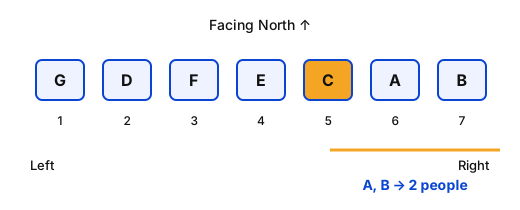
Q5480.
Seven people A, B, C, D, E, F and G are sitting in a row, facing north.
No one sits to the left of G. Only four people sit between G and A. Only three people sit to the right of E. D sits to the immediate left of F. B is not an immediate neighbour of E. How many people sit to the right of C?
सात व्यक्ति A, B, C, D, E, F और G उत्तर की ओर मुख करके एक पंक्ति में बैठे हैं।
G के बाईं ओर कोई नहीं बैठा है। G और A के बीच केवल चार व्यक्ति बैठे हैं। E के दाईं ओर केवल तीन व्यक्ति बैठे हैं। D, F के ठीक बाईं ओर बैठा है। B, E का निकटतम पड़ोसी नहीं है। C के दाईं ओर कितने व्यक्ति बैठे हैं?
  1. A2
  2. B1
  3. C3
  4. D4
Show answer

Concept: Facing north, left end is position 1; place fixed people first.

  1. No one left of G → G = 1; four between G and A → A = 6.
  2. Three to the right of E → E = 4.
  3. D immediately left of F: only free pair is 2-3 → D = 2, F = 3.
  4. B not next to E → B = 7, C = 5; right of C: A and B = 2.

Trick: 'Only k to the right' in a row of 7 → position 7−k.

Answer: (A) 2

अवधारणा: उत्तर की ओर मुख: बायाँ सिरा स्थान 1; पहले निश्चित व्यक्ति रखें।

  1. G के बाएँ कोई नहीं → G = 1; G और A के बीच चार → A = 6.
  2. E के दाएँ तीन → E = 4.
  3. D, F के ठीक बाएँ: खाली जोड़ी 2-3 → D = 2, F = 3.
  4. B, E का पड़ोसी नहीं → B = 7, C = 5; C के दाएँ A, B = 2.

ट्रिक: 7 की पंक्ति में 'दाएँ केवल k' → स्थान 7−k.

उत्तर: (A) 2

RRB NTPC Undergraduate CBT 1General Intelligence and ReasoningLinear Seating ArrangementRRB NTPC Undergraduate CBT 1 2024 · 1 Sep Shift 2 →