Question bank

Q&A: practice questions with answers

Search questions on any topic. Filter by exam category, exam, subject and topic, try the question, then open the answer and explanation.

Courses – airGurukul

8,495 questions found.

Q5761.
Priya lent ₹920 to her friend at 5% per annum simple interest for 3 years. How much simple interest does she earn in this period?
प्रिया ने अपनी मित्र को 3 वर्षों के लिए 5% वार्षिक साधारण ब्याज पर ₹920 उधार दिए। इस अवधि में उसे कितना साधारण ब्याज प्राप्त होता है?
  1. A₹145
  2. B₹127
  3. C₹150
  4. D₹138
Show answer

Concept: SI=P×R×T100.

  1. P=920, R=5, T=3.
  2. SI =920×5×3100=13800100.
  3. SI =₹138.

Trick: 5%×3=15%; 10% of 920=92, 5%=46 → 138.

Answer: (D) ₹138

अवधारणा: साधारण ब्याज=P×R×T100।

  1. P=920, R=5, T=3।
  2. ब्याज =920×5×3100=13800100।
  3. ब्याज =₹138।

ट्रिक: 5%×3=15%; 920 का 10%=92, 5%=46 → 138।

उत्तर: (D) ₹138

RRB NTPC Undergraduate CBT 1MathematicsSimple interestRRB NTPC Undergraduate CBT 1 2025 · 20 Jun Shift 2 →
Q5762.
Which single digit should replace the blank in the number 1_36 so that the number is divisible by 9?
संख्या 1_36 में रिक्त स्थान पर कौन-सा एकल अंक रखा जाना चाहिए ताकि संख्या 9 से विभाज्य हो?
  1. A3
  2. B8
  3. C1
  4. D5
Show answer

Concept: A number is divisible by 9 if the sum of its digits is divisible by 9.

  1. Digit sum =1+x+3+6=10+x.
  2. Next multiple of 9 after 10 is 18 → x=8.
  3. Number =1836=9×204.

Trick: Digit-sum remainder: 10 leaves 1, so add 8 to reach 18.

Answer: (B) 8

अवधारणा: कोई संख्या 9 से विभाज्य है यदि उसके अंकों का योग 9 से विभाज्य हो।

  1. अंकों का योग =1+x+3+6=10+x।
  2. 10 के बाद 9 का अगला गुणज 18 → x=8।
  3. संख्या =1836=9×204।

ट्रिक: अंक-योग 10 है, 18 तक पहुँचने के लिए 8 जोड़ें।

उत्तर: (B) 8

RRB NTPC Undergraduate CBT 1MathematicsDivisibility by 9RRB NTPC Undergraduate CBT 1 2025 · 20 Jun Shift 2 →
Q5763.
The population of a town decreased from 8,000 to 7,200 in one year. What is the percentage decrease?
एक कस्बे की जनसंख्या एक वर्ष में 8,000 से घटकर 7,200 हो गई। प्रतिशत कमी कितनी है?
  1. A10%
  2. B12%
  3. C15%
  4. D8%
Show answer

Concept: % decrease=decreaseoriginal×100.

  1. Decrease =8000−7200=800.
  2. 8008000×100=10%.

Trick: Always divide by the original (old) value, not the new one.

Answer: (A) 10%

अवधारणा: % कमी=कमीमूल मान×100।

  1. कमी =8000−7200=800।
  2. 8008000×100=10%।

ट्रिक: हमेशा मूल (पुराने) मान से भाग दें, नए से नहीं।

उत्तर: (A) 10%

RRB NTPC Undergraduate CBT 1MathematicsPercentage changeRRB NTPC Undergraduate CBT 1 2025 · 20 Jun Shift 2 →
Q5764.
X can finish a job in 20 days. Y can complete the same job in 15 days. If X and Y work together for 5 days and X leaves, how long will Y take to finish the remaining work?
X एक कार्य को 20 दिनों में पूरा कर सकता है। Y उसी कार्य को 15 दिनों में पूरा कर सकता है। यदि X और Y 5 दिनों तक एक साथ कार्य करते हैं और फिर X कार्य छोड़ देता है, तो शेष कार्य को पूरा करने में Y को कितना समय लगेगा?
  1. A6.25 days6.25 दिन
  2. B7 days7 दिन
  3. C4.5 days4.5 दिन
  4. D5 days5 दिन
Show answer

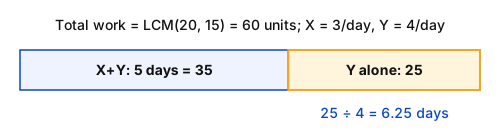
Concept: Take total work as LCM of the days and find per-day efficiency.

  1. Work =LCM(20,15)=60 units; X =3/day, Y =4/day.
  2. Together 5 days: 5×7=35 units.
  3. Remaining =60−35=25 units.
  4. Y alone: 254=6.25 days.

Trick: LCM method avoids fractions – work in whole units.

Answer: (A) 6.25 days

अवधारणा: कुल कार्य को दिनों का LCM मानें और प्रति दिन क्षमता निकालें।

  1. कार्य =LCM(20,15)=60 इकाई; X =3/दिन, Y =4/दिन।
  2. 5 दिन साथ: 5×7=35 इकाई।
  3. शेष =60−35=25 इकाई।
  4. Y अकेले: 254=6.25 दिन।

ट्रिक: LCM विधि से भिन्नें नहीं आतीं – पूर्ण इकाइयों में काम करें।

उत्तर: (A) 6.25 दिन

RRB NTPC Undergraduate CBT 1MathematicsTime and workRRB NTPC Undergraduate CBT 1 2025 · 20 Jun Shift 2 →
Q5765.
A vendor uses a 50 g stone in place of a 60 g weight while selling salt. If he sells the salt at the cost price per kilogram, what is his profit percentage on the transaction?
एक विक्रेता नमक बेचते समय 60 g के बाट के स्थान पर 50 g के पत्थर का उपयोग करता है। यदि वह नमक को प्रति किलोग्राम क्रय मूल्य पर बेचता है, तो इस लेन-देन पर उसका लाभ प्रतिशत क्या है?
  1. A20%
  2. B18%
  3. C15%
  4. D16.67%
Show answer

Concept: Gain%=true weight−false weightfalse weight×100.

  1. He charges for 60 g but gives only 50 g.
  2. Gain =10 g on 50 g actually given.
  3. Gain %=1050×100=20%.

Trick: Divide by what the customer actually receives (50), not by 60 – 16.67% is the trap.

Answer: (A) 20%

अवधारणा: लाभ%=सही वजन−गलत वजनगलत वजन×100।

  1. वह 60 g का पैसा लेता है पर देता केवल 50 g है।
  2. वास्तव में दिए गए 50 g पर लाभ =10 g।
  3. लाभ %=1050×100=20%।

ट्रिक: ग्राहक को वास्तव में मिली मात्रा (50) से भाग दें, 60 से नहीं – 16.67% जाल है।

उत्तर: (A) 20%

RRB NTPC Undergraduate CBT 1MathematicsFaulty weightsRRB NTPC Undergraduate CBT 1 2025 · 20 Jun Shift 2 →
Q5766.
Select the pair which follows the same pattern as that followed by the two pairs given below. Both pairs follow the same pattern.
DCF−GFI
YXA−BAD
उस युग्म का चयन कीजिए जो उसी पैटर्न का अनुसरण करता है जिसका अनुसरण नीचे दिए गए दो युग्मों द्वारा किया जाता है। दोनों युग्म एक ही पैटर्न का अनुसरण करते हैं।
DCF−GFI
YXA−BAD
  1. ATRT−WVY
  2. BRQT−UTW
  3. CTSV−VVX
  4. DTRT−VUX
Show answer

Concept: Compare letters position-wise between the two clusters.

  1. DCF → GFI: D+3 = G, C+3 = F, F+3 = I.
  2. YXA → BAD: Y+3 = B, X+3 = A, A+3 = D (wrapping after Z).
  3. RQT → UTW: R+3 = U, Q+3 = T, T+3 = W ✓.
  4. TRT → WVY fails (R+3 = U, not V); TSV → VVX and TRT → VUX fail at the first letter.

Trick: Check only the first letter of each option first – T+3 = W, T+2 = V – it eliminates fast.

Answer: (B) RQT − UTW

अवधारणा: दोनों समूहों के अक्षरों की स्थिति के अनुसार तुलना करें।

  1. DCF → GFI: D+3 = G, C+3 = F, F+3 = I।
  2. YXA → BAD: Y+3 = B, X+3 = A, A+3 = D (Z के बाद फिर A)।
  3. RQT → UTW: R+3 = U, Q+3 = T, T+3 = W ✓।
  4. TRT → WVY में R+3 = U होना चाहिए, V नहीं; TSV → VVX और TRT → VUX पहले अक्षर पर ही गलत।

Trick: पहले हर विकल्प का पहला अक्षर जाँचें – जल्दी छँटाई होती है।

उत्तर: (B) RQT − UTW

RRB NTPC Undergraduate CBT 1General Intelligence and ReasoningLetter AnalogyRRB NTPC Undergraduate CBT 1 2025 · 20 Jun Shift 2 →
Q5767.
What should come in place of the ‘?’ in the given series?
8 15 28 53 ? 199
दी गई शृंखला में ‘?’ के स्थान पर क्या आना चाहिए?
8 15 28 53 ? 199
  1. A102
  2. B103
  3. C104
  4. D101
Show answer

Concept: Each term = previous term ×2 minus an increasing number.

  1. 8×2−1=15, 15×2−2=28, 28×2−3=53
  2. 53×2−4=102
  3. Check: 102×2−5=199 ✓

Trick: Terms roughly double each time → test ×2 and look at the small leftover.

Answer: (A) 102

अवधारणा: हर पद = पिछला पद ×2 में से बढ़ती संख्या घटाएँ।

  1. 8×2−1=15, 15×2−2=28, 28×2−3=53
  2. 53×2−4=102
  3. जाँच: 102×2−5=199 ✓

Trick: पद लगभग दोगुने हो रहे हों तो ×2 आज़माएँ और बचा अंतर देखें।

उत्तर: (A) 102

RRB NTPC Undergraduate CBT 1General Intelligence and ReasoningNumber SeriesRRB NTPC Undergraduate CBT 1 2025 · 20 Jun Shift 2 →
Q5768.
Based on the English alphabetical order, three of the following four letter-clusters are alike in a certain way and thus form a group. Which is the one that does not belong to that group?
(Note: The odd one out is not based on the number of consonants/vowels or their position in the letter-cluster.)
अंग्रेज़ी वर्णमाला क्रम के आधार पर, निम्नलिखित चार अक्षर-समूहों में से तीन किसी निश्चित प्रकार से एकसमान हैं और इस प्रकार एक समूह बनाते हैं। वह कौन-सा अक्षर-समूह है जो उस समूह से संबंधित नहीं है?
(ध्यान दें: असंगत अक्षर-समूह, उस अक्षर-समूह में व्यंजनों/स्वरों की संख्या या उनके स्थान पर आधारित नहीं है।)
  1. AFZO
  2. BICW
  3. CNHB
  4. DGAU
Show answer

Concept: Find the alphabet-position gap between consecutive letters (A = 1 … Z = 26, wrapping around).

  1. ICW: I(9) − 6 = C(3); C(3) − 6 → W(23).
  2. NHB: N(14) − 6 = H(8); H(8) − 6 = B(2).
  3. GAU: G(7) − 6 = A(1); A(1) − 6 → U(21).
  4. FZO: F(6) − 6 → Z(26), but Z − 6 = T, not O. So FZO is odd.

Trick: Backward −6 with wrap: from A go to U, from C go to W.

Answer: (A) FZO

अवधारणा: क्रमागत अक्षरों की स्थिति का अंतर देखें (A = 1 … Z = 26, चक्रीय)।

  1. ICW: I(9) − 6 = C(3); C(3) − 6 → W(23)।
  2. NHB: N(14) − 6 = H(8); H(8) − 6 = B(2)।
  3. GAU: G(7) − 6 = A(1); A(1) − 6 → U(21)।
  4. FZO: F(6) − 6 → Z(26), पर Z − 6 = T, O नहीं। अतः FZO विषम है।

Trick: चक्रीय −6: A से U, C से W।

उत्तर: (A) FZO

RRB NTPC Undergraduate CBT 1General Intelligence and ReasoningOdd One Out – LettersRRB NTPC Undergraduate CBT 1 2025 · 20 Jun Shift 2 →
Q5769.
Select the triad that follows the same pattern as that followed by the two triads given below. Both triads follow the same pattern.
FORK – ORKF – RKFO
TUCK – UCKT – CKTU
उस त्रिक का चयन कीजिए जो उसी पैटर्न का अनुसरण करता है जिसका अनुसरण नीचे दिए गए दो त्रिकों द्वारा किया जाता है। दोनों त्रिक एक ही पैटर्न का अनुसरण करते हैं।
FORK – ORKF – RKFO
TUCK – UCKT – CKTU
  1. ABAKE - AKEB - KEBA
  2. BTHEM - MTHE - EMTH
  3. CFUND - UNFD - NFUD
  4. DCLOT - CTLO - COTL
Show answer

Concept: Each step moves the first letter of the word to the end.

  1. FORK → ORKF (F to end) → RKFO (O to end).
  2. TUCK → UCKT → CKTU – same rule.
  3. BAKE → AKEB → KEBA ✓.
  4. THEM → MTHE moves the last letter to the front – opposite rule; (C) and (D) break the order.

Trick: Read the 2nd word: it should start with the 2nd letter of the 1st word.

Answer: (A) BAKE - AKEB - KEBA

अवधारणा: हर चरण में शब्द का पहला अक्षर अंत में चला जाता है।

  1. FORK → ORKF (F अंत में) → RKFO (O अंत में)।
  2. TUCK → UCKT → CKTU – वही नियम।
  3. BAKE → AKEB → KEBA ✓।
  4. THEM → MTHE में अंतिम अक्षर आगे आया – उल्टा नियम; (C) और (D) में क्रम टूटता है।

Trick: दूसरा शब्द पहले शब्द के दूसरे अक्षर से शुरू होना चाहिए।

उत्तर: (A) BAKE - AKEB - KEBA

RRB NTPC Undergraduate CBT 1General Intelligence and ReasoningLetter Triad – RotationRRB NTPC Undergraduate CBT 1 2025 · 20 Jun Shift 2 →
Q5770.
Refer to the given number series and answer the question that follows. All numbers are single-digit numbers only. Counting to be done from left to right only.
(Left) 3 9 5 3 8 4 4 2 9 8 9 4 6 6 5 7 7 2 4 1 3 6 3 (Right)
How many such even digits are there, each of which is immediately preceded by an odd digit and also immediately followed by an even digit?
दी गई संख्या शृंखला को देखिए और उसके बाद दिए गए प्रश्न का उत्तर दीजिए। सभी संख्याएँ केवल एक-अंकीय संख्याएँ हैं। गिनती केवल बाएँ से दाएँ की जानी है।
(बाएँ) 3 9 5 3 8 4 4 2 9 8 9 4 6 6 5 7 7 2 4 1 3 6 3 (दाएँ)
ऐसे कितने सम अंक हैं, जिनमें से प्रत्येक के ठीक पहले एक विषम अंक है और ठीक बाद में भी एक सम अंक है?
  1. AOneएक
  2. BFourचार
  3. CThreeतीन
  4. DTwoदो
Show answer

Concept: Look for the pattern Odd – Even – Even and count the middle digit.

  1. Scan: 3 8 4 ✓ (3 odd, 4 even).
  2. 9 4 6 ✓ (9 odd, 6 even).
  3. 7 2 4 ✓ (7 odd, 4 even).
  4. Others fail: 9 8 9 (followed by odd), 3 6 3 (followed by odd). Total = 3.

Trick: First mark every odd digit, then check the next two digits are both even.

Answer: (C) Three

अवधारणा: ढाँचा विषम – सम – सम खोजें और बीच वाला अंक गिनें।

  1. 3 8 4 ✓ (3 विषम, 4 सम)।
  2. 9 4 6 ✓ (9 विषम, 6 सम)।
  3. 7 2 4 ✓ (7 विषम, 4 सम)।
  4. बाकी असफल: 9 8 9 (बाद में विषम), 3 6 3 (बाद में विषम)। कुल = 3।

Trick: पहले हर विषम अंक चिह्नित करें, फिर उसके बाद के दो अंक सम हैं या नहीं देखें।

उत्तर: (C) तीन

RRB NTPC Undergraduate CBT 1General Intelligence and ReasoningNumber Series – CountingRRB NTPC Undergraduate CBT 1 2025 · 20 Jun Shift 2 →
Q5771.
In a certain code language,
A ÷ B means ‘A is the son of B’,
A # B means ‘A is the wife of B’,
A + B means ‘A is the brother of B’ and
A & B means ‘A is the father of B’.
How is S related to H if ‘S + D & R # Y ÷ H’?
एक निश्चित कूट भाषा में,
A ÷ B का अर्थ है ‘A, B का पुत्र है’,
A # B का अर्थ है ‘A, B की पत्नी है’,
A + B का अर्थ है ‘A, B का भाई है’ और
A & B का अर्थ है ‘A, B का पिता है’।
यदि ‘S + D & R # Y ÷ H’ है, तो S का H से क्या संबंध है?
  1. ASon's wife's brother's sonपुत्र की पत्नी के भाई का पुत्र
  2. BWife's father's brotherपत्नी के पिता का भाई
  3. CSon's wife's father's brotherपुत्र की पत्नी के पिता का भाई
  4. DSon's wife's father's sisterपुत्र की पत्नी के पिता की बहन
Show answer

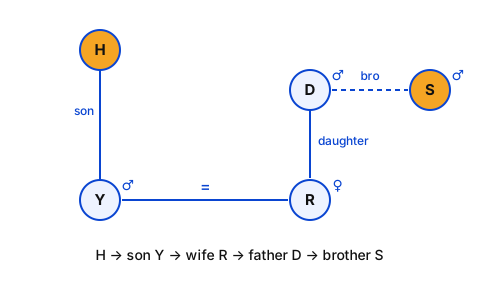
Concept: Decode each symbol and build the tree from H.

  1. Y ÷ H: Y is the son of H.
  2. R # Y: R is the wife of Y (H's son's wife).
  3. D & R: D is the father of R; S + D: S is the brother of D.
  4. So S is H's son's wife's father's brother.

Trick: Read the chain backwards from H: son → wife → father → brother.

Answer: (C) Son's wife's father's brother

अवधारणा: हर चिह्न को डिकोड कर H से वंश-वृक्ष बनाएँ।

  1. Y ÷ H: Y, H का पुत्र है।
  2. R # Y: R, Y की पत्नी है (H के पुत्र की पत्नी)।
  3. D & R: D, R का पिता है; S + D: S, D का भाई है।
  4. अतः S, H के पुत्र की पत्नी के पिता का भाई है।

Trick: H से उल्टा पढ़ें: पुत्र → पत्नी → पिता → भाई।

उत्तर: (C) पुत्र की पत्नी के पिता का भाई

RRB NTPC Undergraduate CBT 1General Intelligence and ReasoningBlood Relation – CodedRRB NTPC Undergraduate CBT 1 2025 · 20 Jun Shift 2 →
Q5772.
Seven boxes, G, H, I, L, M, N and O, are kept one over the other, but not necessarily in the same order.
No box is kept below L. Only four boxes are kept between M and L. H is kept above M. Only two boxes are kept between O and N. I is kept immediately above G. N is not kept immediately above I.
Which box is kept fourth from the bottom?
सात बक्से, G, H, I, L, M, N और O, एक के ऊपर एक रखे गए हैं, लेकिन जरूरी नहीं कि इसी क्रम में हों।
L के नीचे कोई बक्सा नहीं रखा गया है। M और L के बीच केवल चार बक्से रखे गए हैं। H को M के ऊपर रखा गया है। O और N के बीच केवल दो बक्से रखे गए हैं। I को G के ठीक ऊपर रखा गया है। N को I के ठीक ऊपर नहीं रखा गया है।
नीचे से चौथे स्थान पर कौन-सा बक्सा रखा गया है?
  1. AO
  2. BM
  3. CN
  4. DI
Show answer

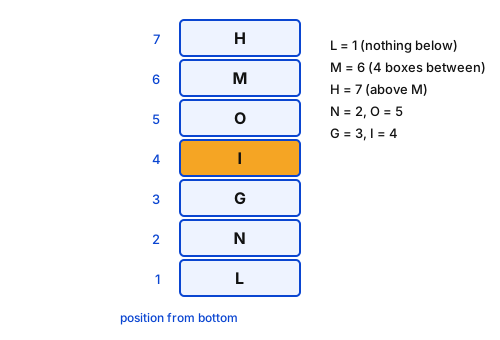
Concept: Number positions 1 (bottom) to 7 (top) and fix the definite clues first.

  1. No box below L → L = 1. Four boxes between M and L → M = 6. H above M → H = 7.
  2. Left: positions 2–5 for G, I, N, O. O and N need two boxes between them → 2 and 5.
  3. I immediately above G → G = 3, I = 4.
  4. N not immediately above I → N ≠ 5, so N = 2, O = 5. Fourth from bottom = I.

Trick: Start with words like 'no box below' – they fix an exact position.

Answer: (D) I

अवधारणा: स्थान 1 (नीचे) से 7 (ऊपर) मानें और पहले निश्चित संकेत लगाएँ।

  1. L के नीचे कोई नहीं → L = 1। M और L के बीच चार → M = 6। H, M के ऊपर → H = 7।
  2. बचे स्थान 2–5 में G, I, N, O। O और N के बीच दो बॉक्स → स्थान 2 और 5।
  3. I, G के ठीक ऊपर → G = 3, I = 4।
  4. N, I के ठीक ऊपर नहीं → N ≠ 5, अतः N = 2, O = 5। नीचे से चौथा = I।

Trick: 'नीचे कोई नहीं' जैसे संकेत सीधे स्थान तय करते हैं।

उत्तर: (D) I

RRB NTPC Undergraduate CBT 1General Intelligence and ReasoningBox ArrangementRRB NTPC Undergraduate CBT 1 2025 · 20 Jun Shift 2 →
Q5773.
Anamika starts from Point A and drives 2 km towards the north. She then takes a right turn, drives 5 km, turns right and drives 7 km. She then takes a right turn and drives 8 km. She takes a final right turn, drives 5 km and stops at Point P. How far (shortest distance) and towards which direction should she drive in order to reach Point A again? (All turns are 90-degree turns only unless specified.)
अनामिका बिंदु A से शुरू करती है और उत्तर की ओर 2 km गाड़ी चलाती है। फिर वह दाएँ मुड़ती है, 5 km गाड़ी चलाती है, दाएँ मुड़ती है और 7 km गाड़ी चलाती है। फिर वह दाएँ मुड़ती है और 8 km गाड़ी चलाती है। वह अंतिम बार दाएँ मुड़ती है, 5 km गाड़ी चलाती है और बिंदु P पर रुक जाती है। फिर से बिंदु A तक पहुँचने के लिए उसे कितनी दूर (न्यूनतम दूरी) और किस दिशा में गाड़ी चलानी चाहिए? (जब तक निर्दिष्ट न किया जाए, सभी मोड़ केवल 90 डिग्री के मोड़ हैं।)
  1. A3 km to the eastपूर्व की ओर 3 km
  2. B2 km to the westपश्चिम की ओर 2 km
  3. C1 km to the eastपूर्व की ओर 1 km
  4. D4 km to the eastपूर्व की ओर 4 km
Show answer

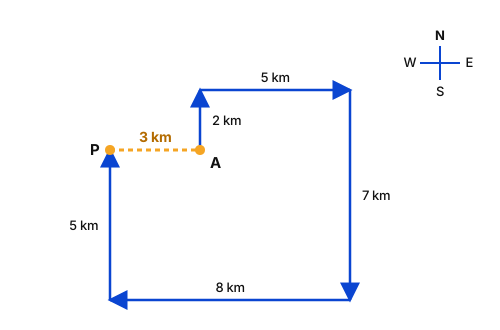
Concept: Take A as origin; east and north positive.

  1. North 2 → (0, 2); right = east 5 → (5, 2).
  2. Right = south 7 → (5, −5); right = west 8 → (−3, −5).
  3. Right = north 5 → (−3, 0) = P.
  4. P is 3 km west of A, so she must drive 3 km to the east.

Trick: Net east-west: 5−8=−3 (3 km west); net north-south: 2−7+5=0.

Answer: (A) 3 km to the east

अवधारणा: A को मूल बिंदु मानें; पूर्व और उत्तर धनात्मक।

  1. उत्तर 2 → (0, 2); दाएँ = पूर्व 5 → (5, 2)।
  2. दाएँ = दक्षिण 7 → (5, −5); दाएँ = पश्चिम 8 → (−3, −5)।
  3. दाएँ = उत्तर 5 → (−3, 0) = P।
  4. P, A से 3 km पश्चिम है, अतः उसे 3 km पूर्व जाना होगा।

Trick: शुद्ध पूर्व-पश्चिम: 5−8=−3 (3 km पश्चिम); उत्तर-दक्षिण: 2−7+5=0।

उत्तर: (A) 3 km पूर्व की ओर

RRB NTPC Undergraduate CBT 1General Intelligence and ReasoningDirection & DistanceRRB NTPC Undergraduate CBT 1 2025 · 20 Jun Shift 2 →
Q5774.
Each vowel in the word CONTACT is changed to the letter immediately following it in the English alphabetical order and each consonant is changed to the letter immediately preceding it in the English alphabetical order. Which of the following letters will be first from the right in the new group of letters thus formed?
शब्द CONTACT के प्रत्येक स्वर को अंग्रेज़ी वर्णमाला क्रम में उसके ठीक बाद वाले अक्षर में बदल दिया जाता है और प्रत्येक व्यंजन को अंग्रेज़ी वर्णमाला क्रम में उसके ठीक पहले वाले अक्षर में बदल दिया जाता है। इस प्रकार बने अक्षरों के नए समूह में दाएँ से पहला अक्षर निम्नलिखित में से कौन-सा होगा?
  1. AT
  2. BR
  3. CS
  4. DU
Show answer

Concept: Vowel → next letter; consonant → previous letter.

  1. C→B, O→P, N→M, T→S, A→B, C→B, T→S.
  2. New group: B P M S B B S.
  3. First from the right = S.

Trick: Only the last letter matters: T is a consonant → S.

Answer: (C) S

अवधारणा: स्वर → अगला अक्षर; व्यंजन → पिछला अक्षर।

  1. C→B, O→P, N→M, T→S, A→B, C→B, T→S।
  2. नया समूह: B P M S B B S।
  3. दाएँ से पहला = S।

Trick: सिर्फ़ अंतिम अक्षर बदलें: T व्यंजन है → S।

उत्तर: (C) S

RRB NTPC Undergraduate CBT 1General Intelligence and ReasoningLetter CodingRRB NTPC Undergraduate CBT 1 2025 · 20 Jun Shift 2 →
Q5775.
Based on the English alphabetical order, three of the following four letter-cluster pairs are alike in a certain way and thus form a group. Which letter-cluster pair DOES NOT belong to that group?
(Note: The odd one out is not based on the number of consonants/vowels or their position in the letter-cluster.)
अंग्रेज़ी वर्णमाला क्रम के आधार पर, निम्नलिखित चार अक्षर-समूह युग्मों में से तीन किसी निश्चित प्रकार से एकसमान हैं और इस प्रकार एक समूह बनाते हैं। कौन-सा अक्षर-समूह युग्म उस समूह से संबंधित नहीं है?
(ध्यान दें: असंगत अक्षर-समूह, उस अक्षर-समूह में व्यंजनों/स्वरों की संख्या या उनके स्थान पर आधारित नहीं है।)
  1. AQM – XJ
  2. BHP – OM
  3. CRD – YA
  4. DLG – SC
Show answer

Concept: Compare the first letters (+7) and the second letters of the two clusters.

  1. QM – XJ: Q+7 = X, M−3 = J.
  2. HP – OM: H+7 = O, P−3 = M.
  3. RD – YA: R+7 = Y, D−3 = A.
  4. LG – SC: L+7 = S but G−4 = C (not −3). Odd one.

Trick: When all first letters fit, the odd one hides in the second letters.

Answer: (D) LG – SC

अवधारणा: दोनों समूहों के पहले अक्षर (+7) और दूसरे अक्षर की तुलना करें।

  1. QM – XJ: Q+7 = X, M−3 = J।
  2. HP – OM: H+7 = O, P−3 = M।
  3. RD – YA: R+7 = Y, D−3 = A।
  4. LG – SC: L+7 = S पर G−4 = C (−3 नहीं)। यही विषम है।

Trick: जब सभी पहले अक्षर सही हों, अंतर दूसरे अक्षरों में छिपा होता है।

उत्तर: (D) LG – SC

RRB NTPC Undergraduate CBT 1General Intelligence and ReasoningOdd Pair – LettersRRB NTPC Undergraduate CBT 1 2025 · 20 Jun Shift 2 →
Q5776.
Select the pair which follows the same pattern as that followed by the two sets of pairs given below. Both pairs follow the same pattern.
DKW : HEV
EGK : IAJ
उस युग्म का चयन कीजिए जो उसी पैटर्न का अनुसरण करता है जिसका अनुसरण नीचे दिए गए युग्मों के दो समुच्चयों द्वारा किया जाता है। दोनों युग्म एक ही पैटर्न का अनुसरण करते हैं।
DKW : HEV
EGK : IAJ
  1. ASOT : WJS
  2. BLRD : PLC
  3. CFQK : JKL
  4. DJGX : NAV
Show answer

Concept: Apply the letter-wise change: 1st +4, 2nd −6, 3rd −1.

  1. DKW : HEV → D+4 = H, K−6 = E, W−1 = V.
  2. EGK : IAJ → E+4 = I, G−6 = A, K−1 = J.
  3. LRD : PLC → L+4 = P, R−6 = L, D−1 = C ✓.
  4. SOT : WJS fails (O−6 = I, not J); FQK : JKL and JGX : NAV fail at the 3rd letter.

Trick: The '−1' on the last letter alone removes (C) and (D).

Answer: (B) LRD : PLC

अवधारणा: अक्षरवार बदलाव: पहला +4, दूसरा −6, तीसरा −1।

  1. DKW : HEV → D+4 = H, K−6 = E, W−1 = V।
  2. EGK : IAJ → E+4 = I, G−6 = A, K−1 = J।
  3. LRD : PLC → L+4 = P, R−6 = L, D−1 = C ✓।
  4. SOT : WJS में O−6 = I होना चाहिए, J नहीं; FQK : JKL और JGX : NAV तीसरे अक्षर पर गलत।

Trick: केवल अंतिम अक्षर का '−1' ही (C) और (D) को हटा देता है।

उत्तर: (B) LRD : PLC

RRB NTPC Undergraduate CBT 1General Intelligence and ReasoningLetter AnalogyRRB NTPC Undergraduate CBT 1 2025 · 20 Jun Shift 2 →
Q5777.
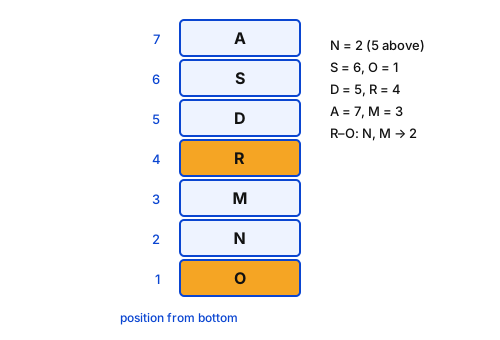
Seven boxes R, A, N, D, O, M and S are kept one over the other but not necessarily in the same order. Only five boxes are kept above N. Only three boxes are kept between N and S. O is kept at one of the positions below N. Only D is kept between S and R. A is kept at one of the positions above S. How many boxes are kept between R and O?
सात बक्से R, A, N, D, O, M और S एक के ऊपर एक रखे गए हैं, लेकिन जरूरी नहीं कि इसी क्रम में हों। N के ऊपर केवल पाँच बक्से रखे गए हैं। N और S के बीच केवल तीन बक्से रखे गए हैं। O को N के नीचे के किसी एक स्थान पर रखा गया है। S और R के बीच केवल D रखा गया है। A को S के ऊपर के किसी एक स्थान पर रखा गया है। R और O के बीच कितने बक्से रखे गए हैं?
  1. AThreeतीन
  2. BOneएक
  3. CFourचार
  4. DTwoदो
Show answer

Concept: Number positions 1 (bottom) to 7 (top).

  1. Five boxes above N → N = 2. Three boxes between N and S → S = 6.
  2. O below N → O = 1. Only D between S and R → D = 5, R = 4.
  3. A above S → A = 7; the remaining box M = 3.
  4. Between R (4) and O (1): N and M → two boxes.

Trick: Boxes between = difference of positions − 1 = 4−1−1=2.

Answer: (D) Two

अवधारणा: स्थान 1 (नीचे) से 7 (ऊपर) मानें।

  1. N के ऊपर पाँच → N = 2। N और S के बीच तीन → S = 6।
  2. O, N के नीचे → O = 1। S और R के बीच केवल D → D = 5, R = 4।
  3. A, S के ऊपर → A = 7; बचा M = 3।
  4. R (4) और O (1) के बीच: N और M → दो बॉक्स।

Trick: बीच के बॉक्स = स्थानों का अंतर − 1 = 4−1−1=2।

उत्तर: (D) दो

RRB NTPC Undergraduate CBT 1General Intelligence and ReasoningBox ArrangementRRB NTPC Undergraduate CBT 1 2025 · 20 Jun Shift 2 →
Q5778.
Based on the English alphabetical order, three of the following four letter-cluster pairs are alike in a certain way and thus form a group. Which is the one that does not belong to that group?
(Note: The odd one out is not based on the number of consonants/vowels or their position in the letter-cluster.)
अंग्रेज़ी वर्णमाला क्रम के आधार पर, निम्नलिखित चार अक्षर-समूह युग्मों में से तीन किसी निश्चित प्रकार से एकसमान हैं और इस प्रकार एक समूह बनाते हैं। वह कौन-सा युग्म है जो उस समूह से संबंधित नहीं है?
(ध्यान दें: असंगत अक्षर-समूह, उस अक्षर-समूह में व्यंजनों/स्वरों की संख्या या उनके स्थान पर आधारित नहीं है।)
  1. AKH - MJ
  2. BIF - KH
  3. CNK - PM
  4. DPM - NM
Show answer

Concept: In each cluster the second letter is 3 before the first, and the second cluster is +2 of the first.

  1. KH – MJ: K−3 = H, M−3 = J, K+2 = M.
  2. IF – KH: I−3 = F, K−3 = H, I+2 = K.
  3. NK – PM: N−3 = K, P−3 = M, N+2 = P.
  4. PM – NM: N−1 = M (not −3) and P−2 = N. Odd one.

Trick: Check the gap inside each cluster first – −3 everywhere except NM.

Answer: (D) PM - NM

अवधारणा: हर समूह में दूसरा अक्षर पहले से 3 पीछे है, और दूसरा समूह पहले से +2 है।

  1. KH – MJ: K−3 = H, M−3 = J, K+2 = M।
  2. IF – KH: I−3 = F, K−3 = H, I+2 = K।
  3. NK – PM: N−3 = K, P−3 = M, N+2 = P।
  4. PM – NM: N−1 = M (−3 नहीं) और P−2 = N। यही विषम है।

Trick: पहले हर समूह के अंदर का अंतर देखें – NM को छोड़ सब जगह −3।

उत्तर: (D) PM - NM

RRB NTPC Undergraduate CBT 1General Intelligence and ReasoningOdd Pair – LettersRRB NTPC Undergraduate CBT 1 2025 · 20 Jun Shift 2 →
Q5779.
If 3 is added to each odd digit and 2 is subtracted from each even digit in the number 8254316, then what will be the sum of the digits that are third from the left and third from the right in the new number thus formed?
यदि संख्या 8254316 के प्रत्येक विषम अंक में 3 जोड़ दिया जाए और प्रत्येक सम अंक में से 2 घटा दिया जाए, तो इस प्रकार बनी नई संख्या में बाएँ से तीसरे और दाएँ से तीसरे अंकों का योग क्या होगा?
  1. A14
  2. B13
  3. C15
  4. D12
Show answer

Concept: Odd digit +3, even digit −2, then pick positions.

  1. 8→6, 2→0, 5→8, 4→2, 3→6, 1→4, 6→4.
  2. New number: 6 0 8 2 6 4 4.
  3. Third from left = 8; third from right = 6.
  4. Sum =8+6=14.

Trick: Change only the needed digits: 3rd from left is 5 → 8, 3rd from right is 3 → 6.

Answer: (A) 14

अवधारणा: विषम अंक +3, सम अंक −2, फिर स्थान चुनें।

  1. 8→6, 2→0, 5→8, 4→2, 3→6, 1→4, 6→4।
  2. नई संख्या: 6 0 8 2 6 4 4।
  3. बाएँ से तीसरा = 8; दाएँ से तीसरा = 6।
  4. योग =8+6=14।

Trick: केवल ज़रूरी अंक बदलें: बाएँ से तीसरा 5 → 8, दाएँ से तीसरा 3 → 6।

उत्तर: (A) 14

RRB NTPC Undergraduate CBT 1General Intelligence and ReasoningDigit OperationsRRB NTPC Undergraduate CBT 1 2025 · 20 Jun Shift 2 →
Q5780.
In a certain code language, "JCPV" is coded as "51" and "DYSF" is coded as "48". What is the code for "HTOB" in that given language?
एक निश्चित कूट भाषा में, "JCPV" को "51" के रूप में और "DYSF" को "48" के रूप में कूटबद्ध किया जाता है। उसी भाषा में "HTOB" का कूट क्या है?
  1. A50
  2. B53
  3. C49
  4. D57
Show answer

Concept: Use reverse alphabet values (Z = 1, Y = 2 … A = 26), add them and subtract 6.

  1. JCPV: 17+24+11+5=57, 57−6=51 ✓.
  2. DYSF: 23+2+8+21=54, 54−6=48 ✓.
  3. HTOB: 19+7+12+25=63.
  4. Code =63−6=57.

Trick: Reverse value =27−forward value.

Answer: (D) 57

अवधारणा: उल्टे वर्णमाला मान (Z = 1, Y = 2 … A = 26) जोड़ें और 6 घटाएँ।

  1. JCPV: 17+24+11+5=57, 57−6=51 ✓।
  2. DYSF: 23+2+8+21=54, 54−6=48 ✓।
  3. HTOB: 19+7+12+25=63।
  4. कोड =63−6=57।

Trick: उल्टा मान =27−सीधा मान।

उत्तर: (D) 57

RRB NTPC Undergraduate CBT 1General Intelligence and ReasoningCoding–Decoding (Letter Values)RRB NTPC Undergraduate CBT 1 2025 · 20 Jun Shift 2 →