Question bank

Q&A: practice questions with answers

Search questions on any topic. Filter by exam category, exam, subject and topic, try the question, then open the answer and explanation.

Courses – airGurukul

8,495 questions found.

Q5841.
Evaluate 223 + (-6)3 + (-16)3
223 + (-6)3 + (-16)3 का मान ज्ञात कीजिए।
  1. A6127
  2. B6147
  3. C6336
  4. D6099
Show answer

Concept: If a+b+c=0, then a3+b3+c3=3abc.

  1. 22+(−6)+(−16)=0
  2. So value =3×22×(−6)×(−16)
  3. =3×2112=6336

Trick: Always check whether the bases add to zero before cubing.

Answer: (C) 6336

अवधारणा: यदि a+b+c=0 हो, तो a3+b3+c3=3abc।

  1. 22+(−6)+(−16)=0
  2. अतः मान =3×22×(−6)×(−16)
  3. =3×2112=6336

ट्रिक: घन निकालने से पहले देखें कि आधारों का योग शून्य तो नहीं।

उत्तर: (C) 6336
RRB NTPC Undergraduate CBT 1MathematicsAlgebraic IdentitiesRRB NTPC Undergraduate CBT 1 2025 · 20 Jun Shift 1 →
Q5842.
A club received an income of ₹7,643 from membership fees and ₹2,198 from selling old sports equipment during the year. At the start of the year, ₹1,105 in membership fees was outstanding, and at the end of the year, ₹916 was still outstanding. If the club incurred expenditures of ₹5,287 on sports material and ₹3,120 on maintenance, what is the club's surplus or deficit for the year?
एक क्लब को वर्ष के दौरान सदस्यता शुल्क से ₹7,643 और पुराने खेल उपकरण बेचने से ₹2,198 की आय प्राप्त हुई। वर्ष की शुरुआत में ₹1,105 सदस्यता शुल्क बकाया था, और वर्ष के अंत में ₹916 अभी भी बकाया था। यदि क्लब ने खेल सामग्री पर ₹5,287 और रखरखाव पर ₹3,120 का व्यय किया, तो वर्ष के लिए क्लब का अधिशेष या घाटा कितना है?
  1. A₹2,613 deficit₹2,613 घाटा
  2. B₹2,613 surplus₹2,613 अधिशेष
  3. C₹1,975 deficit₹1,975 घाटा
  4. D₹1,245 surplus₹1,245 अधिशेष
Show answer

Concept: Fee income for the year = fees received − outstanding at start (belongs to last year) + outstanding at end.

  1. Fees for the year =7643−1105+916=7454
  2. Total income =7454+2198=9652
  3. Expenditure =5287+3120=8407
  4. Surplus =9652−8407=1245

Trick: Opening outstanding → subtract; closing outstanding → add.

Answer: (D) ₹1,245 surplus

अवधारणा: वर्ष की शुल्क आय = प्राप्त शुल्क − वर्ष की शुरुआत का बकाया (पिछले वर्ष का) + वर्ष के अंत का बकाया।

  1. वर्ष का शुल्क =7643−1105+916=7454
  2. कुल आय =7454+2198=9652
  3. व्यय =5287+3120=8407
  4. अधिशेष (surplus) =9652−8407=1245

ट्रिक: शुरुआती बकाया घटाएँ, अंतिम बकाया जोड़ें।

उत्तर: (D) ₹1,245 अधिशेष (surplus)

RRB NTPC Undergraduate CBT 1MathematicsIncome and ExpenditureRRB NTPC Undergraduate CBT 1 2025 · 20 Jun Shift 1 →
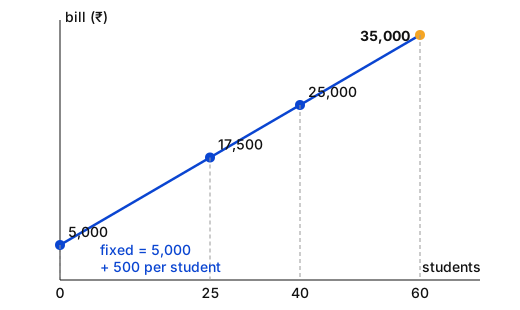
Q5843.
The monthly charges of a hostel consist of a fixed part and a variable part depending on the number of students. For 25 students, the total bill is ₹17,500. For 40 students, the total bill is ₹25,000. What is the total bill for 60 students?
एक छात्रावास के मासिक शुल्क में एक नियत भाग और छात्रों की संख्या पर निर्भर एक परिवर्ती भाग होता है। 25 छात्रों के लिए कुल बिल ₹17,500 है। 40 छात्रों के लिए कुल बिल ₹25,000 है। 60 छात्रों के लिए कुल बिल कितना होगा?
  1. A₹32,500
  2. B₹35,000
  3. C₹37,500
  4. D₹30,000
Show answer

Concept: Bill = fixed part F + v×(number of students).

  1. 15 extra students add 25000−17500=7500, so v=500.
  2. F=17500−25×500=5000
  3. For 60: 5000+60×500=35000

Trick: From 40 to 60 is 20 more students: 25000+20×500=35000.

Answer: (B) ₹35,000

अवधारणा: बिल = स्थिर भाग F + v×(छात्रों की संख्या)।

  1. 15 अतिरिक्त छात्रों से 25000−17500=7500 बढ़ा, तो v=500।
  2. F=17500−25×500=5000
  3. 60 के लिए: 5000+60×500=35000

ट्रिक: 40 से 60 = 20 और छात्र: 25000+20×500=35000।

उत्तर: (B) ₹35,000

RRB NTPC Undergraduate CBT 1MathematicsLinear VariationRRB NTPC Undergraduate CBT 1 2025 · 20 Jun Shift 1 →
Q5844.
A five-digit number 7549A is divisible by 4 and 3. If it is divided by 12, what will be the remainder?
पाँच अंकों की एक संख्या 7549A, 4 और 3 से विभाज्य है। यदि इसे 12 से विभाजित किया जाए, तो शेषफल क्या होगा?
  1. A4
  2. B1
  3. C2
  4. D0
Show answer

Concept: 3 and 4 are co-prime, so a number divisible by both is divisible by 3×4=12.

  1. Divisible by 4 and 3 → divisible by 12.
  2. Hence remainder on division by 12 is 0.
  3. Check: A=2 gives 75492 (last two digits 92, digit sum 27) =12×6291.

Trick: Divisible by co-prime factors ⇒ divisible by their product.

Answer: (D) 0

अवधारणा: 3 और 4 सह-अभाज्य (co-prime) हैं, अतः दोनों से विभाज्य संख्या 3×4=12 से भी विभाज्य है।

  1. 4 और 3 से विभाज्य → 12 से विभाज्य।
  2. इसलिए 12 से भाग देने पर शेषफल 0।
  3. जाँच: A=2 से 75492 (अंतिम दो अंक 92, अंकों का योग 27) =12×6291।

ट्रिक: सह-अभाज्य गुणनखंडों से विभाज्य ⇒ उनके गुणनफल से विभाज्य।

उत्तर: (D) 0

RRB NTPC Undergraduate CBT 1MathematicsDivisibilityRRB NTPC Undergraduate CBT 1 2025 · 20 Jun Shift 1 →
Q5845.
A company has three branches. Branch A has 40 employees with average monthly sales of ₹1,20,000, Branch B has 30 employees with average monthly sales of ₹1,80,000, and Branch C has 30 employees with average monthly sales of ₹1,50,000. What is the average monthly sales per employee of the company (in ₹)?
एक कंपनी की तीन शाखाएँ हैं। शाखा A में 40 कर्मचारी हैं जिनकी औसत मासिक बिक्री ₹1,20,000 है, शाखा B में 30 कर्मचारी हैं जिनकी औसत मासिक बिक्री ₹1,80,000 है, और शाखा C में 30 कर्मचारी हैं जिनकी औसत मासिक बिक्री ₹1,50,000 है। कंपनी की प्रति कर्मचारी औसत मासिक बिक्री (₹ में) कितनी है?
  1. A1,60,000
  2. B1,20,000
  3. C1,50,000
  4. D1,47,000
Show answer

Concept: Overall average = total sales ÷ total employees.

  1. Total =40×120000+30×180000+30×150000
  2. =4800000+5400000+4500000=14700000
  3. Employees =100, average =14700000100=147000

Trick: Work in thousands: 40×120+30×180+30×150100=147 thousand.

Answer: (D) ₹1,47,000

अवधारणा: कुल औसत = कुल बिक्री ÷ कुल कर्मचारी।

  1. कुल =40×120000+30×180000+30×150000
  2. =4800000+5400000+4500000=14700000
  3. कर्मचारी =100, औसत =14700000100=147000

ट्रिक: हज़ार में गणना: 40×120+30×180+30×150100=147 हज़ार।

उत्तर: (D) ₹1,47,000

RRB NTPC Undergraduate CBT 1MathematicsWeighted AverageRRB NTPC Undergraduate CBT 1 2025 · 20 Jun Shift 1 →
Q5846.
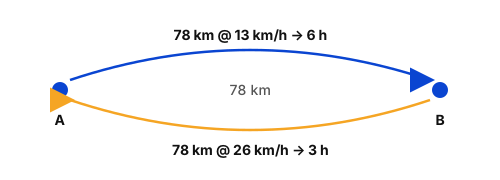
A cyclist travels from Town A to Town B, a distance of 78 km, at a speed of 13 km/h. He returns from Town B to Town A at a speed of 26 km/h. What is the total time taken for the round trip, in hours?
एक साइकिल चालक 13 km/h की चाल से कस्बे A से कस्बे B तक 78 km की दूरी तय करता है। वह 26 km/h की चाल से कस्बे B से कस्बे A तक वापस लौटता है। पूरी आने-जाने की यात्रा में लगा कुल समय (घंटों में) कितना है?
  1. A7
  2. B9
  3. C8
  4. D10
Show answer

Concept: Time=DistanceSpeed for each leg.

  1. A → B: 7813=6 h
  2. B → A: 7826=3 h
  3. Total =6+3=9 h

Trick: Do not average the speeds; add the times.

Answer: (B) 9

अवधारणा: समय=दूरीचाल, हर भाग के लिए अलग।

  1. A → B: 7813=6 घंटे
  2. B → A: 7826=3 घंटे
  3. कुल =6+3=9 घंटे

ट्रिक: चालों का औसत न लें; समय जोड़ें।

उत्तर: (B) 9

RRB NTPC Undergraduate CBT 1MathematicsTime and DistanceRRB NTPC Undergraduate CBT 1 2025 · 20 Jun Shift 1 →
Q5847.
Of three numbers, the first number is 25 and the third number is 100. If the second number is the mean proportional between the first and the third numbers, find the value of the second number.
तीन संख्याओं में से पहली संख्या 25 है और तीसरी संख्या 100 है। यदि दूसरी संख्या पहली और तीसरी संख्या के बीच मध्यानुपाती है, तो दूसरी संख्या का मान ज्ञात कीजिए।
  1. A75
  2. B50
  3. C45
  4. D40
Show answer

Concept: Mean proportional of a and c is b=ac (since a:b=b:c).

  1. b=25×100
  2. =2500=50

Trick: Check: 25:50=50:100=1:2.

Answer: (B) 50

अवधारणा: a और c का मध्यानुपाती b=ac (क्योंकि a:b=b:c)।

  1. b=25×100
  2. =2500=50

ट्रिक: जाँच: 25:50=50:100=1:2।

उत्तर: (B) 50

RRB NTPC Undergraduate CBT 1MathematicsMean ProportionalRRB NTPC Undergraduate CBT 1 2025 · 20 Jun Shift 1 →
Q5848.
A shopkeeper offers the following schemes on toys of the same marked price. (A) Successive discounts of 6% and 39% on any number of toys bought.
(B) Successive discounts of 48%, 16% and 11% on any number of toys bought. (C) 37% discount on the first 2 toys and 29% discount on each toy thereon.
(D) 2 toys free of cost on buying 4 toys.
A customer wants to buy 4 toys. Which of the above schemes is the least beneficial to her?
एक दुकानदार समान अंकित मूल्य वाले खिलौनों पर निम्नलिखित योजनाएँ प्रदान करता है। (A) कितने भी खिलौने खरीदने पर 6% और 39% की क्रमिक छूट।
(B) कितने भी खिलौने खरीदने पर 48%, 16% और 11% की क्रमिक छूट। (C) पहले 2 खिलौनों पर 37% छूट और उसके बाद प्रत्येक खिलौने पर 29% छूट।
(D) 4 खिलौने खरीदने पर 2 खिलौने निःशुल्क।
एक ग्राहक 4 खिलौने खरीदना चाहती है। उपर्युक्त में से कौन-सी योजना उसके लिए सबसे कम लाभदायक है?
  1. AB
  2. BD
  3. CC
  4. DA
Show answer

Concept: Compare the price paid per toy as a % of marked price; the highest % is the least beneficial.

  1. A: 0.94×0.61=0.5734 → 57.34%
  2. B: 0.52×0.84×0.89≈0.3888 → 38.88%
  3. C: 2×63+2×714=67%
  4. D: 6 toys for the price of 4 → 46≈66.67%
  5. Highest cost per toy is C.

Trick: Turn every offer into "% paid per toy" and compare.

Answer: (C) C

अवधारणा: प्रति खिलौना चुकाई गई कीमत को अंकित मूल्य के % में तुलना करें; सबसे अधिक % वाली योजना सबसे कम लाभकारी।

  1. A: 0.94×0.61=0.5734 → 57.34%
  2. B: 0.52×0.84×0.89≈0.3888 → 38.88%
  3. C: 2×63+2×714=67%
  4. D: 4 के दाम में 6 खिलौने → 46≈66.67%
  5. प्रति खिलौना सबसे महँगा C है।

ट्रिक: हर ऑफर को "प्रति खिलौना चुकाया %" में बदलें।

उत्तर: (C) C

RRB NTPC Undergraduate CBT 1MathematicsDiscount – Comparing SchemesRRB NTPC Undergraduate CBT 1 2025 · 20 Jun Shift 1 →
Q5849.
A shopkeeper offers a single discount of 30% on a shirt priced at ₹800. Alternatively, he offers two successive discounts of 25% and 5% on the same shirt. What is the difference in the total discount amount between the two offers?
एक दुकानदार ₹800 मूल्य की एक कमीज़ पर 30% की एकल छूट प्रदान करता है। वैकल्पिक रूप से, वह उसी कमीज़ पर 25% और 5% की दो क्रमिक छूट प्रदान करता है। दोनों प्रस्तावों के बीच कुल छूट राशि में कितना अंतर है?
  1. A₹16
  2. B₹10
  3. C₹14
  4. D₹20
Show answer

Concept: Single equivalent of a% and b% is a+b−ab100.

  1. Single offer: 30% of 800 =240
  2. Successive: 25+5−125100=28.75% → 0.2875×800=230
  3. Difference =240−230=10

Trick: Difference =1.25% of 800 =10.

Answer: (B) ₹10

अवधारणा: a% और b% की एकल समतुल्य छूट =a+b−ab100।

  1. एकल छूट: 800 का 30% =240
  2. क्रमिक: 25+5−125100=28.75% → 0.2875×800=230
  3. अंतर =240−230=10

ट्रिक: अंतर = 800 का 1.25% =10।

उत्तर: (B) ₹10

RRB NTPC Undergraduate CBT 1MathematicsSuccessive DiscountRRB NTPC Undergraduate CBT 1 2025 · 20 Jun Shift 1 →
Q5850.
Two sisters, Anika and Riya, have a combined present age of 34 years. Five years ago from now, Anika was twice as old as Riya was then. What is Anika's current age in years?
दो बहनों, अनिका और रिया, की वर्तमान आयु का योग 34 वर्ष है। अब से पाँच वर्ष पहले, अनिका की आयु रिया की तत्कालीन आयु की दोगुनी थी। अनिका की वर्तमान आयु (वर्षों में) कितनी है?
  1. A20
  2. B23
  3. C21
  4. D18
Show answer

Concept: Form two equations from the present sum and the past ratio.

  1. A+R=34
  2. A−5=2(R−5) ⇒ A=2R−5
  3. 3R−5=34 ⇒ R=13, A=21

Trick: Option check: A=21, R=13; 5 years ago 16=2×8 ✓.

Answer: (C) 21

अवधारणा: वर्तमान योग और पिछले अनुपात से दो समीकरण बनाएँ।

  1. A+R=34
  2. A−5=2(R−5) ⇒ A=2R−5
  3. 3R−5=34 ⇒ R=13, A=21

ट्रिक: विकल्प जाँच: A=21, R=13; 5 वर्ष पहले 16=2×8 ✓।

उत्तर: (C) 21

RRB NTPC Undergraduate CBT 1MathematicsProblems on AgesRRB NTPC Undergraduate CBT 1 2025 · 20 Jun Shift 1 →
Q5851.
A tank is full. Pipes A and B can drain the tank in 10 hours and 15 hours, respectively, while pipe C can fill the tank in 12 hours. Pipes A and B run for 2 hours, after which pipe C is also turned on. How many hours will it take to empty the tank completely?
एक टंकी पूरी भरी हुई है। पाइप A और B टंकी को क्रमशः 10 घंटे और 15 घंटे में खाली कर सकते हैं, जबकि पाइप C टंकी को 12 घंटे में भर सकता है। पाइप A और B 2 घंटे तक चलते हैं, जिसके बाद पाइप C को भी खोल दिया जाता है। टंकी को पूरी तरह खाली होने में कितने घंटे लगेंगे?
  1. A10 hours10 घंटे
  2. B4 hours4 घंटे
  3. C8 hours8 घंटे
  4. D6 hours6 घंटे
Show answer

Concept: Rates add: draining pipes +, filling pipe − (taking tank = 1).

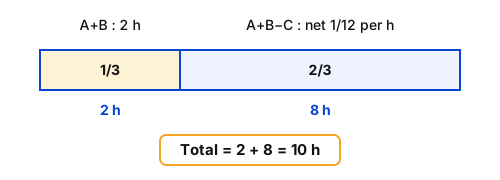
  1. A + B drain 110+115=16 per h; in 2 h → 13 drained, 23 left.
  2. With C: net 16−112=112 per h.
  3. Time =23÷112=8 h; total from start =2+8=10 h.

Trick: LCM 60 units: A = 6, B = 4, C = −5; first 2 h drain 20, then 40 at 5 per h = 8 h.

Answer: (A) 10 hours

अवधारणा: दर जोड़ें: खाली करने वाले पाइप +, भरने वाला पाइप − (टंकी = 1)।

  1. A + B: 110+115=16 प्रति घंटा; 2 घंटे में 13 खाली, 23 शेष।
  2. C के साथ शुद्ध दर 16−112=112 प्रति घंटा।
  3. समय =23÷112=8 घंटे; शुरुआत से कुल =2+8=10 घंटे।

ट्रिक: LCM 60 इकाई: A = 6, B = 4, C = −5; पहले 2 घंटे में 20, फिर 40 इकाई 5 प्रति घंटा = 8 घंटे।

उत्तर: (A) 10 घंटे

RRB NTPC Undergraduate CBT 1MathematicsPipes and CisternRRB NTPC Undergraduate CBT 1 2025 · 20 Jun Shift 1 →
Q5852.
Simplify: {1227÷122}÷(111×223+59)+29÷3322 of 229
सरल कीजिए: {1227÷122}÷(111×223+59)+29÷3322 of 229
  1. A1441
  2. B433
  3. C−18
  4. D923
Show answer

Concept: BODMAS: brackets first, and "of" is done before ÷.

  1. 1227÷122=1227×212=227
  2. 111×223+59=23+59=119
  3. 227÷119=233
  4. 3322 of 229=339, so 29÷339=233
  5. Sum =233+233=433

Trick: "of" means multiply and has higher priority than ÷.

Answer: (B) 433

अवधारणा: BODMAS: पहले कोष्ठक, और "of" (का) ÷ से पहले।

  1. 1227÷122=1227×212=227
  2. 111×223+59=23+59=119
  3. 227÷119=233
  4. 3322 of 229=339, अतः 29÷339=233
  5. योग =233+233=433

ट्रिक: "of" = गुणा, और इसकी प्राथमिकता ÷ से अधिक है।

उत्तर: (B) 433

RRB NTPC Undergraduate CBT 1MathematicsSimplification (BODMAS)RRB NTPC Undergraduate CBT 1 2025 · 20 Jun Shift 1 →
Q5853.
20 note books, 100 pens and 50 pencils were bought for ₹3,500. If the average cost of a note book is ₹50 and that of a pencil is ₹10, find the average cost of a pen.
20 नोटबुक, 100 पेन और 50 पेंसिलें ₹3,500 में खरीदी गईं। यदि एक नोटबुक की औसत लागत ₹50 और एक पेंसिल की औसत लागत ₹10 है, तो एक पेन की औसत लागत ज्ञात कीजिए।
  1. A₹20
  2. B₹25
  3. C₹15
  4. D₹16
Show answer

Concept: Total cost = sum of (number × average cost) of each item.

  1. Notebooks: 20×50=1000; pencils: 50×10=500
  2. Pens: 3500−1000−500=2000
  3. Average per pen =2000100=20

Trick: Subtract the known totals first, then divide.

Answer: (A) ₹20

अवधारणा: कुल लागत = हर वस्तु की (संख्या × औसत लागत) का योग।

  1. नोटबुक: 20×50=1000; पेंसिल: 50×10=500
  2. पेन: 3500−1000−500=2000
  3. प्रति पेन औसत =2000100=20

ट्रिक: पहले ज्ञात कुल घटाएँ, फिर भाग दें।

उत्तर: (A) ₹20

RRB NTPC Undergraduate CBT 1MathematicsAverageRRB NTPC Undergraduate CBT 1 2025 · 20 Jun Shift 1 →
Q5854.
A and B can do a piece of work in 12 days and 24 days, respectively. Both work for 4 days and then A leaves. How long (in days) will B take to complete the remaining work?
A और B किसी कार्य को क्रमशः 12 दिनों और 24 दिनों में कर सकते हैं। दोनों 4 दिनों तक कार्य करते हैं और फिर A कार्य छोड़ देता है। शेष कार्य को पूरा करने में B को कितना समय (दिनों में) लगेगा?
  1. A14
  2. B13
  3. C11
  4. D12
Show answer

Concept: Take total work = LCM of days; one-day work = units per day.

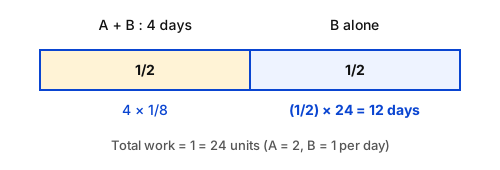
  1. Work =24 units; A =2, B =1 unit/day.
  2. In 4 days together: 4×3=12 units.
  3. Remaining 12 units by B: 121=12 days.

Trick: Together they finish half in 4 days; B alone does half in 242=12 days.

Answer: (D) 12

अवधारणा: कुल कार्य = दिनों का LCM; एक दिन का कार्य = इकाइयाँ प्रति दिन।

  1. कार्य =24 इकाई; A =2, B =1 इकाई/दिन।
  2. 4 दिन साथ में: 4×3=12 इकाई।
  3. शेष 12 इकाई B: 121=12 दिन।

ट्रिक: दोनों 4 दिन में आधा काम करते हैं; B अकेला आधा 242=12 दिन में।

उत्तर: (D) 12

RRB NTPC Undergraduate CBT 1MathematicsTime and WorkRRB NTPC Undergraduate CBT 1 2025 · 20 Jun Shift 1 →
Q5855.
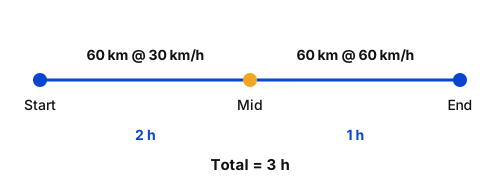
A person travels half of a total distance at 30 km/h and the remaining half at 60 km/h. If the total distance is 120 km, how much time does the person take to complete the entire journey?
एक व्यक्ति कुल दूरी का आधा भाग 30 km/h की चाल से और शेष आधा भाग 60 km/h की चाल से तय करता है। यदि कुल दूरी 120 km है, तो व्यक्ति को पूरी यात्रा पूरी करने में कितना समय लगता है?
  1. A3 hours3 घंटे
  2. B5 hours5 घंटे
  3. C4 hours4 घंटे
  4. D2.5 hours2.5 घंटे
Show answer

Concept: Find time for each half separately: Time=DistanceSpeed.

  1. Each half =60 km.
  2. 6030=2 h and 6060=1 h
  3. Total =3 h

Trick: Average speed =2×30×6090=40 km/h → 12040=3 h.

Answer: (A) 3 hours

अवधारणा: हर आधे भाग का समय अलग निकालें: समय=दूरीचाल।

  1. हर आधा =60 km।
  2. 6030=2 घंटे और 6060=1 घंटा
  3. कुल =3 घंटे

ट्रिक: औसत चाल =2×30×6090=40 km/h → 12040=3 घंटे।

उत्तर: (A) 3 घंटे

RRB NTPC Undergraduate CBT 1MathematicsTime and DistanceRRB NTPC Undergraduate CBT 1 2025 · 20 Jun Shift 1 →
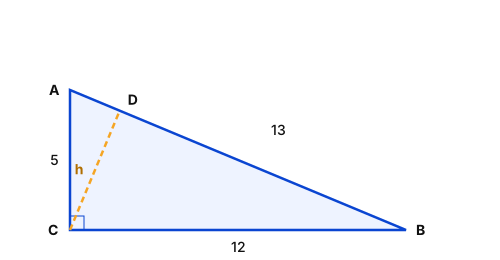
Q5856.
A triangle has sides of lengths 5 cm, 12 cm, and 13 cm. If a perpendicular is drawn from the vertex opposite the longest side to the longest side, what is the length of the perpendicular? (Rounded off to two decimal places)
एक त्रिभुज की भुजाओं की लंबाइयाँ 5 cm, 12 cm और 13 cm हैं। यदि सबसे लंबी भुजा के सम्मुख शीर्ष से सबसे लंबी भुजा पर एक लंब डाला जाए, तो लंब की लंबाई कितनी है? (दशमलव के दो स्थानों तक पूर्णांकित)
  1. A6.51 cm
  2. B5.37 cm
  3. C5.08 cm
  4. D4.62 cm
Show answer

Concept: 52+122=132, so the triangle is right-angled. Altitude to the hypotenuse =product of legshypotenuse.

  1. Area =12×5×12=30
  2. Also area =12×13×h
  3. h=6013≈4.615≈4.62 cm

Trick: Altitude on hypotenuse =abc; it is always less than the shorter leg (5).

Answer: (D) 4.62 cm

अवधारणा: 52+122=132, अतः त्रिभुज समकोण है। कर्ण पर लंब =भुजाओं का गुणनफलकर्ण।

  1. क्षेत्रफल =12×5×12=30
  2. साथ ही क्षेत्रफल =12×13×h
  3. h=6013≈4.615≈4.62 cm

ट्रिक: कर्ण पर लंब =abc; यह छोटी भुजा (5) से हमेशा कम होता है।

उत्तर: (D) 4.62 cm

RRB NTPC Undergraduate CBT 1MathematicsGeometry – Right TriangleRRB NTPC Undergraduate CBT 1 2025 · 20 Jun Shift 1 →
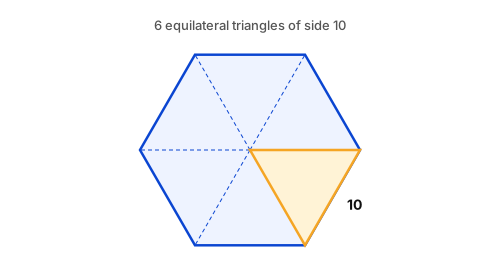
Q5857.
A city is planning a new park in the shape of a regular hexagon with each side measuring 10 meters. Which of the following is closest to the area of the park?
एक शहर एक समषट्भुज के आकार के एक नए पार्क की योजना बना रहा है, जिसकी प्रत्येक भुजा 10 मीटर है। निम्नलिखित में से कौन-सा पार्क के क्षेत्रफल के सबसे निकट है?
  1. A173.2 square meters173.2 वर्ग मीटर
  2. B259.8 square meters259.8 वर्ग मीटर
  3. C150 square meters150 वर्ग मीटर
  4. D600 square meters600 वर्ग मीटर
Show answer

Concept: A regular hexagon = 6 equilateral triangles: Area =332a2.

  1. a=10, a2=100
  2. Area =3×1.7322×100=2.598×100
  3. ≈259.8 m²

Trick: 173.2 is the area of just 4 such triangles — a common trap.

Answer: (B) 259.8 square meters

अवधारणा: समषट्भुज = 6 समबाहु त्रिभुज: क्षेत्रफल =332a2।

  1. a=10, a2=100
  2. क्षेत्रफल =3×1.7322×100=2.598×100
  3. ≈259.8 वर्ग मीटर

ट्रिक: 173.2 केवल 4 त्रिभुजों का क्षेत्रफल है — आम जाल।

उत्तर: (B) 259.8 वर्ग मीटर

RRB NTPC Undergraduate CBT 1MathematicsMensuration – Regular HexagonRRB NTPC Undergraduate CBT 1 2025 · 20 Jun Shift 1 →
Q5858.
A shopkeeper buys an article for ₹500 and sells it for ₹575. What is the percentage profit?
एक दुकानदार एक वस्तु ₹500 में खरीदता है और उसे ₹575 में बेचता है। प्रतिशत लाभ कितना है?
  1. A20%
  2. B15%
  3. C12.5%
  4. D10%
Show answer

Concept: Profit%=ProfitCP×100.

  1. Profit =575−500=75
  2. 75500×100=15%

Trick: Profit % is always on cost price, not selling price.

Answer: (B) 15%

अवधारणा: लाभ%=लाभक्रय मूल्य×100।

  1. लाभ =575−500=75
  2. 75500×100=15%

ट्रिक: लाभ % हमेशा क्रय मूल्य (CP) पर।

उत्तर: (B) 15%

RRB NTPC Undergraduate CBT 1MathematicsProfit PercentageRRB NTPC Undergraduate CBT 1 2025 · 20 Jun Shift 1 →
Q5859.
Priya invested ₹3200 in a bank at a simple interest rate of 12% per annum. If she kept her money in the bank for 5 years, what will be the total interest earned?
प्रिया ने 12% वार्षिक साधारण ब्याज दर पर एक बैंक में ₹3200 का निवेश किया। यदि उसने अपना धन 5 वर्षों तक बैंक में रखा, तो अर्जित कुल ब्याज कितना होगा?
  1. A₹1910
  2. B₹1930
  3. C₹1920
  4. D₹1940
Show answer

Concept: SI=P×R×T100.

  1. SI=3200×12×5100
  2. =32×60=1920

Trick: Total rate =12×5=60%; 60% of 3200 =1920.

Answer: (C) ₹1920

अवधारणा: SI=P×R×T100।

  1. SI=3200×12×5100
  2. =32×60=1920

ट्रिक: कुल दर =12×5=60%; 3200 का 60% =1920।

उत्तर: (C) ₹1920

RRB NTPC Undergraduate CBT 1MathematicsSimple InterestRRB NTPC Undergraduate CBT 1 2025 · 20 Jun Shift 1 →
Q5860.
Which of the following numbers are not divisible by 68?
( i ) 17350
( ii ) 23800
( iii ) 28560
( iv ) 35350
निम्नलिखित में से कौन-सी संख्याएँ 68 से विभाज्य नहीं हैं?
( i ) 17350
( ii ) 23800
( iii ) 28560
( iv ) 35350
  1. A( iii ) and ( iv )( iii ) और ( iv )
  2. B( ii ) and ( iii )( ii ) और ( iii )
  3. C( i ) and ( iv )( i ) और ( iv )
  4. D( i ) and ( ii )( i ) और ( ii )
Show answer

Concept: 68=4×17; a number must be divisible by both 4 and 17.

  1. Test by 4 (last two digits): 17350 → 50 ✗; 35350 → 50 ✗.
  2. 23800 =68×350 ✓; 28560 =68×420 ✓.
  3. Not divisible: (i) and (iv).

Trick: The quick test by 4 eliminates (i) and (iv) at once.

Answer: (C) ( i ) and ( iv )

अवधारणा: 68=4×17; संख्या 4 और 17 दोनों से विभाज्य होनी चाहिए।

  1. 4 की जाँच (अंतिम दो अंक): 17350 → 50 ✗; 35350 → 50 ✗।
  2. 23800 =68×350 ✓; 28560 =68×420 ✓।
  3. विभाज्य नहीं: (i) और (iv)।

ट्रिक: 4 का त्वरित परीक्षण ही (i) और (iv) को हटा देता है।

उत्तर: (C) ( i ) और ( iv )

RRB NTPC Undergraduate CBT 1MathematicsDivisibilityRRB NTPC Undergraduate CBT 1 2025 · 20 Jun Shift 1 →