Question bank

Q&A: practice questions with answers

Search questions on any topic. Filter by exam category, exam, subject and topic, try the question, then open the answer and explanation.

Courses – airGurukul

8,495 questions found.

Q5881.
BEGH is related to HKMN in a certain way based on the English alphabetical order. In the same way, FIKM is related to LOQS. To which of the following is LNPS related, following the same logic?
अंग्रेज़ी वर्णमाला क्रम के आधार पर BEGH एक निश्चित प्रकार से HKMN से संबंधित है। उसी प्रकार, FIKM, LOQS से संबंधित है। समान तर्क का अनुसरण करते हुए, LNPS निम्नलिखित में से किससे संबंधित है?
  1. AKMOR
  2. BRTVY
  3. CQSUX
  4. DMOQT
Show answer

Concept: Find the shift between corresponding letters.

  1. B → H, E → K, G → M, H → N: each +6. Check F → L, I → O, K → Q, M → S: each +6.
  2. LNPS: L+6 = R, N+6 = T, P+6 = V, S+6 = Y → RTVY.

Trick: Check just the first letter of each option: only R = L +6 among {K, R, Q, M}.

Answer: (B) RTVY

अवधारणा: संगत अक्षरों में खिसकाव (shift) देखें।

  1. B → H, E → K, G → M, H → N: हर एक +6। जाँच: F → L, I → O, K → Q, M → S: हर एक +6।
  2. LNPS: L+6 = R, N+6 = T, P+6 = V, S+6 = Y → RTVY।

ट्रिक: विकल्पों का केवल पहला अक्षर देखें: {K, R, Q, M} में केवल R = L +6।

उत्तर: (B) RTVY

RRB NTPC Undergraduate CBT 1General Intelligence and ReasoningLetter analogyRRB NTPC Undergraduate CBT 1 2025 · 20 Jun Shift 1 →
Q5882.
ZACY is related to VWYU in a certain way based on the English alphabetical order. In the same way, QRTP is related to MNPL. To which of the following is CDFB related, following the same logic?
अंग्रेज़ी वर्णमाला क्रम के आधार पर ZACY एक निश्चित प्रकार से VWYU से संबंधित है। उसी प्रकार, QRTP, MNPL से संबंधित है। समान तर्क का अनुसरण करते हुए, CDFB निम्नलिखित में से किससे संबंधित है?
  1. AYAAI
  2. BYZBX
  3. CYYAX
  4. DYZAX
Show answer

Concept: Find the shift between corresponding letters.

  1. Z → V, A → W, C → Y, Y → U: each −4 (wrapping around). Check Q → M, R → N, T → P, P → L: each −4.
  2. CDFB: C−4 = Y, D−4 = Z, F−4 = B, B−4 = X → YZBX.

Trick: Backward wrap: 3−4=−1→26−1=25= Y.

Answer: (B) YZBX

अवधारणा: संगत अक्षरों में खिसकाव देखें।

  1. Z → V, A → W, C → Y, Y → U: हर एक −4 (चक्र में घूमकर)। जाँच: Q → M, R → N, T → P, P → L: हर एक −4।
  2. CDFB: C−4 = Y, D−4 = Z, F−4 = B, B−4 = X → YZBX।

ट्रिक: पीछे की ओर चक्र: 3−4=−1→26−1=25= Y।

उत्तर: (B) YZBX

RRB NTPC Undergraduate CBT 1General Intelligence and ReasoningLetter analogyRRB NTPC Undergraduate CBT 1 2025 · 20 Jun Shift 1 →
Q5883.
Which of the following letter-number clusters will replace the question mark (?) in the given series to make it logically complete?
VRX 1, TPV 4, RNT 9, PLR 16, ?
निम्नलिखित में से कौन-सा अक्षर-संख्या समूह दी गई श्रृंखला में प्रश्नचिह्न (?) का स्थान लेकर उसे तार्किक रूप से पूर्ण बनाएगा?
VRX 1, TPV 4, RNT 9, PLR 16, ?
  1. ADOP 36
  2. BKPR 36
  3. CGSP 49
  4. DNJP 25
Show answer

Concept: Treat the letter part and the number part separately.

  1. Letters: V R X → T P V → R N T → P L R: every letter moves −2, so next = N J P.
  2. Numbers: 1,4,9,16 are 12,22,32,42, so next =52=25.

Trick: Only one option has 25 – the number part alone settles it.

Answer: (D) NJP 25

अवधारणा: अक्षर भाग और संख्या भाग अलग-अलग देखें।

  1. अक्षर: V R X → T P V → R N T → P L R: हर अक्षर −2, अतः अगला = N J P।
  2. संख्याएँ: 1,4,9,16 यानी 12,22,32,42, अतः अगला =52=25।

ट्रिक: केवल एक विकल्प में 25 है – संख्या से ही उत्तर मिल जाता है।

उत्तर: (D) NJP 25

RRB NTPC Undergraduate CBT 1General Intelligence and ReasoningLetter-number seriesRRB NTPC Undergraduate CBT 1 2025 · 20 Jun Shift 1 →
Q5884.
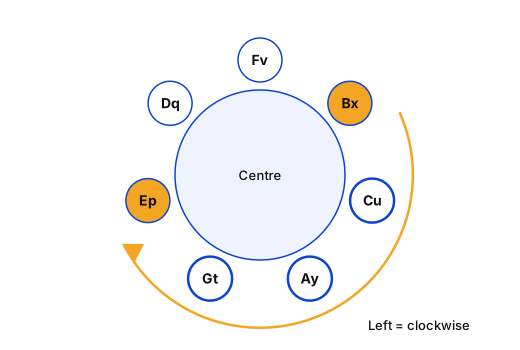
Ay, Bx, Cu, Dq, Ep, Fv and Gt are sitting around a circular table, facing the centre. Cu sits second to the left of Fv. Gt sits second to the left of Cu. Dq sits to the immediate left of Ep. Ay sits second to the right of Ep.
How many people sit between Bx and Ep when counted from the left of Bx?
Ay, Bx, Cu, Dq, Ep, Fv और Gt एक वृत्ताकार मेज़ के चारों ओर केंद्र की ओर मुख करके बैठे हैं। Cu, Fv के बाईं ओर दूसरे स्थान पर बैठा है। Gt, Cu के बाईं ओर दूसरे स्थान पर बैठा है। Dq, Ep के ठीक बाईं ओर बैठा है। Ay, Ep के दाईं ओर दूसरे स्थान पर बैठा है।
Bx के बाईं ओर से गिनने पर Bx और Ep के बीच कितने व्यक्ति बैठे हैं?
  1. AFourचार
  2. BOneएक
  3. CTwoदो
  4. DThreeतीन
Show answer

Concept: Facing the centre, 'left' means clockwise. Place Fv first.

  1. Cu is 2nd to the left of Fv; Gt is 2nd to the left of Cu.
  2. Of the free seats only one adjacent pair remains for Dq and Ep (Dq on Ep's immediate left). Ay is 2nd to the right of Ep, and Bx takes the last seat, immediately left of Fv.
  3. Clockwise order: Fv, Bx, Cu, Ay, Gt, Ep, Dq.
  4. Going left (clockwise) from Bx to Ep: Cu, Ay, Gt → three people.

Trick: Facing centre: left = clockwise, right = anticlockwise.

Answer: (D) Three

अवधारणा: केंद्र की ओर मुख होने पर 'बाएँ' = दक्षिणावर्त (clockwise)। पहले Fv बिठाएँ।

  1. Cu, Fv के बाएँ दूसरा; Gt, Cu के बाएँ दूसरा।
  2. खाली स्थानों में Dq-Ep के लिए केवल एक सटा जोड़ा बचता है (Dq, Ep के ठीक बाएँ)। Ay, Ep के दाएँ दूसरा, और Bx बची सीट पर, Fv के ठीक बाएँ।
  3. दक्षिणावर्त क्रम: Fv, Bx, Cu, Ay, Gt, Ep, Dq।
  4. Bx से बाएँ (दक्षिणावर्त) Ep तक: Cu, Ay, Gt → तीन व्यक्ति।

ट्रिक: केंद्र की ओर मुख: बाएँ = दक्षिणावर्त, दाएँ = वामावर्त।

उत्तर: (D) तीन

RRB NTPC Undergraduate CBT 1General Intelligence and ReasoningCircular seating arrangementRRB NTPC Undergraduate CBT 1 2025 · 20 Jun Shift 1 →
Q5885.
Based on the alphabetical order, three of the following four are alike in a certain way and thus form a group. Which is the one that does not belong to that group?
(Note: The odd one out is not based on the number of consonants/vowels or their position in the letter cluster.)
वर्णमाला क्रम के आधार पर, निम्नलिखित चार में से तीन किसी निश्चित प्रकार से एकसमान हैं और इस प्रकार एक समूह बनाते हैं। वह कौन-सा है जो उस समूह से संबंधित नहीं है?
(ध्यान दें: असंगत का चयन व्यंजनों/स्वरों की संख्या या अक्षर-समूह में उनके स्थान पर आधारित नहीं है।)
  1. AQMJ
  2. BSOP
  3. CVRO
  4. DKGD
Show answer

Concept: Find the steps between letters (A = 1 … Z = 26).

  1. QMJ: Q(17) → M(13) → J(10): −4,−3.
  2. VRO: 22→18→15: −4,−3. KGD: 11→7→4: −4,−3.
  3. SOP: 19→15→16: −4,+1 → different.

Trick: Same first gap in all? Then compare the second gap.

Answer: (B) SOP

अवधारणा: अक्षरों के बीच अंतर देखें (A = 1 … Z = 26)।

  1. QMJ: Q(17) → M(13) → J(10): −4,−3।
  2. VRO: 22→18→15: −4,−3। KGD: 11→7→4: −4,−3।
  3. SOP: 19→15→16: −4,+1 → भिन्न।

ट्रिक: सबमें पहला अंतर समान हो तो दूसरा अंतर देखें।

उत्तर: (B) SOP

RRB NTPC Undergraduate CBT 1General Intelligence and ReasoningOdd one out – lettersRRB NTPC Undergraduate CBT 1 2025 · 20 Jun Shift 1 →
Q5886.
What should come in place of ? in the given series based on the English alphabetical order?
MQS QUW UYA YCE ?
अंग्रेज़ी वर्णमाला क्रम के आधार पर दी गई श्रृंखला में ? के स्थान पर क्या आना चाहिए?
MQS QUW UYA YCE ?
  1. ACGI
  2. BCFH
  3. CCHH
  4. DCDF
Show answer

Concept: Each letter moves forward by 4 in every term.

  1. 1st letters: M → Q → U → Y → C.
  2. 2nd letters: Q → U → Y → C → G.
  3. 3rd letters: S → W → A → E → I.

Trick: Y +4: 25+4=29→29−26=3= C.

Answer: (A) CGI

अवधारणा: हर पद में प्रत्येक अक्षर 4 आगे बढ़ता है।

  1. पहले अक्षर: M → Q → U → Y → C।
  2. दूसरे: Q → U → Y → C → G।
  3. तीसरे: S → W → A → E → I।

ट्रिक: Y +4: 25+4=29→29−26=3= C।

उत्तर: (A) CGI

RRB NTPC Undergraduate CBT 1General Intelligence and ReasoningAlphabet seriesRRB NTPC Undergraduate CBT 1 2025 · 20 Jun Shift 1 →
Q5887.
Read the given statement(s) and conclusions carefully. Assuming that the information given in the statements is true, even if it appears to be at variance with commonly known facts, decide which of the given conclusions logically follow(s) from the statement(s).
Statements:
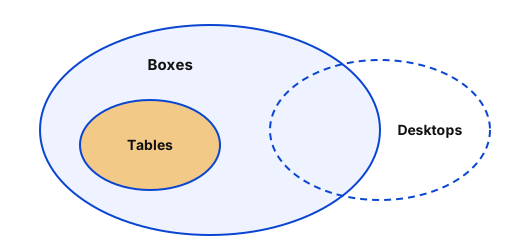
All tables are boxes.
Some boxes are desktops.
Conclusions:
(I) Some tables are desktops.
(II) Some boxes are tables.
दिए गए कथन(नों) और निष्कर्षों को ध्यानपूर्वक पढ़िए। यह मानते हुए कि कथनों में दी गई जानकारी सत्य है, भले ही वह सामान्यतः ज्ञात तथ्यों से भिन्न प्रतीत होती हो, निर्णय कीजिए कि दिए गए निष्कर्षों में से कौन-सा/से निष्कर्ष तार्किक रूप से कथन(नों) का अनुसरण करता है/करते हैं।
कथन:
सभी मेज़ें बक्से हैं।
कुछ बक्से डेस्कटॉप हैं।
निष्कर्ष:
(I) कुछ मेज़ें डेस्कटॉप हैं।
(II) कुछ बक्से मेज़ें हैं।
  1. ABoth conclusions (I) and (II) followनिष्कर्ष (I) और (II) दोनों अनुसरण करते हैं
  2. BOnly conclusion (I) followsकेवल निष्कर्ष (I) अनुसरण करता है
  3. COnly conclusion (II) followsकेवल निष्कर्ष (II) अनुसरण करता है
  4. DNeither conclusion (I) nor (II) followsन तो निष्कर्ष (I) और न ही (II) अनुसरण करता है
Show answer

Concept: Draw Tables inside Boxes; Desktops overlap Boxes but need not touch Tables.

  1. (I) Desktops may meet Boxes outside the Tables region, so 'Some tables are desktops' is not certain → does not follow.
  2. (II) All tables are boxes ⇒ some boxes are tables (conversion) → follows.

Trick: 'All A are B' always gives 'Some B are A'.

Answer: (C) Only conclusion (II) follows

अवधारणा: Tables को Boxes के अंदर बनाएँ; Desktops, Boxes से मिलते हैं पर Tables को छूना ज़रूरी नहीं।

  1. (I) Desktops, Tables के बाहर वाले Boxes भाग से मिल सकते हैं, इसलिए 'कुछ tables, desktops हैं' निश्चित नहीं → अनुसरण नहीं करता।
  2. (II) सभी tables, boxes हैं ⇒ कुछ boxes, tables हैं (परिवर्तन) → अनुसरण करता है।

ट्रिक: 'सभी A, B हैं' से हमेशा 'कुछ B, A हैं' मिलता है।

उत्तर: (C) केवल निष्कर्ष (II) अनुसरण करता है

RRB NTPC Undergraduate CBT 1General Intelligence and ReasoningSyllogismRRB NTPC Undergraduate CBT 1 2025 · 20 Jun Shift 1 →
Q5888.
SMAL is related to PIVF in a certain way based on the English alphabetical order. In the same way, GWGN is related to DSBH. To which of the following options is XKRV related, following the same logic?
अंग्रेज़ी वर्णमाला क्रम के आधार पर SMAL एक निश्चित प्रकार से PIVF से संबंधित है। उसी प्रकार, GWGN, DSBH से संबंधित है। समान तर्क का अनुसरण करते हुए, XKRV निम्नलिखित में से किस विकल्प से संबंधित है?
  1. AUGPM
  2. BUPLO
  3. CUGMP
  4. DUMPG
Show answer

Concept: Find the backward shift of each letter.

  1. S → P (−3), M → I (−4), A → V (−5), L → F (−6). Check G → D, W → S, G → B, N → H: −3,−4,−5,−6 ✓.
  2. XKRV: X−3 = U, K−4 = G, R−5 = M, V−6 = P → UGMP.

Trick: Increasing backward steps −3,−4,−5,−6.

Answer: (C) UGMP

अवधारणा: हर अक्षर का पीछे की ओर खिसकाव देखें।

  1. S → P (−3), M → I (−4), A → V (−5), L → F (−6)। जाँच: G → D, W → S, G → B, N → H: −3,−4,−5,−6 ✓।
  2. XKRV: X−3 = U, K−4 = G, R−5 = M, V−6 = P → UGMP।

ट्रिक: पीछे के कदम बढ़ते हैं: −3,−4,−5,−6।

उत्तर: (C) UGMP

RRB NTPC Undergraduate CBT 1General Intelligence and ReasoningLetter analogyRRB NTPC Undergraduate CBT 1 2025 · 20 Jun Shift 1 →
Q5889.
Based on the English alphabetical order, three of the following four letter-cluster pairs are alike in a certain way and thus form a group. Which is the one that does not belong to that group?
(Note: The odd one out is not based on the number of consonants/vowels or their position in the letter cluster.)
अंग्रेज़ी वर्णमाला क्रम के आधार पर, निम्नलिखित चार अक्षर-समूह युग्मों में से तीन किसी निश्चित प्रकार से एकसमान हैं और इस प्रकार एक समूह बनाते हैं। वह कौन-सा युग्म है जो उस समूह से संबंधित नहीं है?
(ध्यान दें: असंगत का चयन व्यंजनों/स्वरों की संख्या या अक्षर-समूह में उनके स्थान पर आधारित नहीं है।)
  1. AWE - ZJ
  2. BSZ - VD
  3. CBM - EQ
  4. DOA - RE
Show answer

Concept: Compare the shift of the 1st and 2nd letters from left cluster to right cluster.

  1. SZ – VD: S+3 = V, Z+4 = D (wrap). BM – EQ: B+3 = E, M+4 = Q. OA – RE: O+3 = R, A+4 = E.
  2. WE – ZJ: W+3 = Z, but E+5 = J → different.

Trick: Pattern (+3,+4); the pair breaking it is the odd one.

Answer: (A) WE - ZJ

अवधारणा: बाएँ समूह से दाएँ समूह तक पहले और दूसरे अक्षर का खिसकाव देखें।

  1. SZ – VD: S+3 = V, Z+4 = D (चक्र)। BM – EQ: B+3 = E, M+4 = Q। OA – RE: O+3 = R, A+4 = E।
  2. WE – ZJ: W+3 = Z, पर E+5 = J → भिन्न।

ट्रिक: क्रम (+3,+4); जो जोड़ा इसे तोड़े वही विषम।

उत्तर: (A) WE - ZJ

RRB NTPC Undergraduate CBT 1General Intelligence and ReasoningOdd one out – letter pairsRRB NTPC Undergraduate CBT 1 2025 · 20 Jun Shift 1 →
Q5890.
Refer to the following letter series and answer the question that follows. Counting to be done from left to right only.
(Left) D E I V D I J Y T Z A K F Z S M U I Y E Q (Right)
How many such vowels are there, each of which is immediately preceded by a consonant and also immediately followed by a vowel?
निम्नलिखित अक्षर श्रृंखला को देखिए और उसके बाद दिए गए प्रश्न का उत्तर दीजिए। गिनती केवल बाएँ से दाएँ की जानी है।
(बाएँ) D E I V D I J Y T Z A K F Z S M U I Y E Q (दाएँ)
ऐसे कितने स्वर हैं, जिनमें से प्रत्येक के ठीक पहले एक व्यंजन है और ठीक बाद एक स्वर है?
  1. AFourचार
  2. BOneएक
  3. CTwoदो
  4. DThreeतीन
Show answer

Concept: Need the pattern Consonant–Vowel–Vowel. Vowels in the series: E, I, I, A, U, I, E.

  1. D E I → E is preceded by consonant D and followed by vowel I ✓.
  2. M U I → U is preceded by M and followed by I ✓.
  3. Others fail: I (after E), D I J, Z A K, U I Y, Y E Q.

Trick: Look for two vowels together, then check the letter before the first one.

Answer: (C) Two

अवधारणा: व्यंजन–स्वर–स्वर का क्रम चाहिए। श्रृंखला में स्वर: E, I, I, A, U, I, E।

  1. D E I → E से पहले व्यंजन D और बाद में स्वर I ✓।
  2. M U I → U से पहले M और बाद में I ✓।
  3. बाकी असफल: I (E के बाद), D I J, Z A K, U I Y, Y E Q।

ट्रिक: दो साथ-साथ स्वर ढूँढें, फिर पहले स्वर से पहले का अक्षर जाँचें।

उत्तर: (C) दो

RRB NTPC Undergraduate CBT 1General Intelligence and ReasoningLetter series – positionsRRB NTPC Undergraduate CBT 1 2025 · 20 Jun Shift 1 →
Q5891.
In a certain code language,
A = B means ‘A is the sister of B’,
A $ B means ‘A is the brother of B’,
A @ B means ‘A is the wife of B’ and
A * B means ‘A is the father of B’.
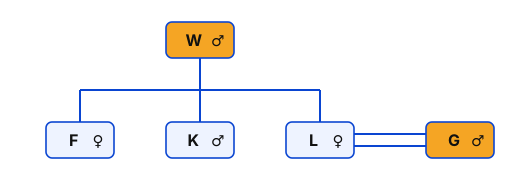
How is W related to G if ‘W * F = K $ L @ G’?
एक निश्चित कूट भाषा में,
A = B का अर्थ है ‘A, B की बहन है’,
A $ B का अर्थ है ‘A, B का भाई है’,
A @ B का अर्थ है ‘A, B की पत्नी है’ और
A * B का अर्थ है ‘A, B का पिता है’।
यदि ‘W * F = K $ L @ G’ है, तो W का G से क्या संबंध है?
  1. AWife's brotherपत्नी का भाई
  2. BFatherपिता
  3. CBrotherभाई
  4. DWife's fatherपत्नी का पिता
Show answer

Concept: Decode: = sister, $ brother, @ wife, * father.

  1. W * F: W is the father of F. F = K: F is K's sister.
  2. K $ L: K is L's brother → F, K, L are siblings, all children of W.
  3. L @ G: L is G's wife → W is the father of G's wife.

Trick: Father of wife = father-in-law.

Answer: (D) Wife's father

अवधारणा: अर्थ: = बहन, $ भाई, @ पत्नी, * पिता।

  1. W * F: W, F का पिता है। F = K: F, K की बहन है।
  2. K $ L: K, L का भाई है → F, K, L भाई-बहन हैं, सभी W की संतान।
  3. L @ G: L, G की पत्नी है → W, G की पत्नी का पिता है।

ट्रिक: पत्नी के पिता = ससुर।

उत्तर: (D) Wife's father (पत्नी के पिता)

RRB NTPC Undergraduate CBT 1General Intelligence and ReasoningBlood relations (coded)RRB NTPC Undergraduate CBT 1 2025 · 20 Jun Shift 1 →
Q5892.
Which of the following two numbers should be interchanged to make the given equation correct?
(12 × 8) ÷ 6 + 4 × 13 − (36 ÷ 9) × 15 + 25 = 49
दिए गए समीकरण को सही बनाने के लिए निम्नलिखित में से किन दो संख्याओं को आपस में बदला जाना चाहिए?
(12 × 8) ÷ 6 + 4 × 13 − (36 ÷ 9) × 15 + 25 = 49
  1. A12 and 3612 और 36
  2. B13 and 1513 और 15
  3. C4 and 64 और 6
  4. D4 and 84 और 8
Show answer

Concept: Try the option swaps and evaluate using BODMAS.

  1. As given: 16+52−60+25=33≠49.
  2. Swap 13 and 15: (12×8)÷6+4×15−(36÷9)×13+25
  3. =16+60−52+25=49 ✓

Trick: Needed change =49−33=16; swapping 13 and 15 changes +52−60 into +60−52, a gain of 16.

Answer: (B) 13 and 15

अवधारणा: विकल्पों की अदला-बदली करके BODMAS से जाँचें।

  1. दिया गया: 16+52−60+25=33≠49।
  2. 13 और 15 बदलें: (12×8)÷6+4×15−(36÷9)×13+25
  3. =16+60−52+25=49 ✓

ट्रिक: आवश्यक बदलाव =49−33=16; 13 और 15 बदलने से +52−60, +60−52 बनता है – 16 की बढ़त।

उत्तर: (B) 13 और 15

RRB NTPC Undergraduate CBT 1General Intelligence and ReasoningInterchanging numbersRRB NTPC Undergraduate CBT 1 2025 · 20 Jun Shift 1 →
Q5893.
Based on the English alphabetical order, three of the following four letter-cluster pairs are alike in a certain way and thus form a group. Which is the one that does not belong to that group?
(Note: The odd one out is not based on the number of consonants/vowels or their position in the letter-cluster.)
अंग्रेज़ी वर्णमाला क्रम के आधार पर, निम्नलिखित चार अक्षर-समूह युग्मों में से तीन किसी निश्चित प्रकार से एकसमान हैं और इस प्रकार एक समूह बनाते हैं। वह कौन-सा युग्म है जो उस समूह से संबंधित नहीं है?
(ध्यान दें: असंगत का चयन व्यंजनों/स्वरों की संख्या या अक्षर-समूह में उनके स्थान पर आधारित नहीं है।)
  1. ABD - HJ
  2. BEH - KM
  3. CLN - RT
  4. DHJ - NP
Show answer

Concept: Check the gap inside each cluster and between the clusters.

  1. BD – HJ: B+2 = D, H+2 = J, B+6 = H.
  2. LN – RT and HJ – NP: same (+2,+2,+6).
  3. EH – KM: E+3 = H but K+2 = M → different.

Trick: First spot the inner gap – only EH has a gap of 3.

Answer: (B) EH - KM

अवधारणा: हर समूह के अंदर और समूहों के बीच का अंतर देखें।

  1. BD – HJ: B+2 = D, H+2 = J, B+6 = H।
  2. LN – RT और HJ – NP: वही (+2,+2,+6)।
  3. EH – KM: E+3 = H पर K+2 = M → भिन्न।

ट्रिक: पहले अंदर का अंतर देखें – केवल EH में अंतर 3 है।

उत्तर: (B) EH - KM

RRB NTPC Undergraduate CBT 1General Intelligence and ReasoningOdd one out – letter pairsRRB NTPC Undergraduate CBT 1 2025 · 20 Jun Shift 1 →
Q5894.
In a certain code language, ‘yak lock zip’ is coded as ' je tc ly' and ‘zip shirt cake’ is coded as ‘rl jg tc’. How is ‘zip’ coded in the given language?
एक निश्चित कूट भाषा में, ‘yak lock zip’ को ' je tc ly' लिखा जाता है और ‘zip shirt cake’ को ‘rl jg tc’ लिखा जाता है। दी गई भाषा में ‘zip’ को कैसे लिखा जाता है?
  1. Arl
  2. Bje
  3. Ctc
  4. Dly
Show answer

Concept: A word common to two sentences has the code common to both coded sentences.

  1. 'yak lock zip' → je tc ly; 'zip shirt cake' → rl jg tc.
  2. Common word: zip; common code: tc → zip = tc.

Trick: Common word ↔ common code.

Answer: (C) tc

अवधारणा: दो वाक्यों में समान शब्द का कोड दोनों कोडित वाक्यों में समान होता है।

  1. 'yak lock zip' → je tc ly; 'zip shirt cake' → rl jg tc।
  2. समान शब्द: zip; समान कोड: tc → zip = tc।

ट्रिक: समान शब्द ↔ समान कोड।

उत्तर: (C) tc

RRB NTPC Undergraduate CBT 1General Intelligence and ReasoningCoding-decoding (words)RRB NTPC Undergraduate CBT 1 2025 · 20 Jun Shift 1 →
Q5895.
What should come in place of the ‘?’ in the given series?
3 ? 90 360 1080 2160 2160
दी गई श्रृंखला में ‘?’ के स्थान पर क्या आना चाहिए?
3 ? 90 360 1080 2160 2160
  1. A18
  2. B21
  3. C36
  4. D15
Show answer

Concept: Look at the ratio of consecutive terms.

  1. 36090=4,1080360=3,21601080=2,21602160=1
  2. So the multipliers go ×6,×5,×4,×3,×2,×1.
  3. ?=3×6=18; check 18×5=90 ✓.

Trick: Same number repeated at the end (2160,2160) hints at ×1 – a falling multiplier.

Answer: (A) 18

अवधारणा: क्रमागत पदों का अनुपात देखें।

  1. 36090=4,1080360=3,21601080=2,21602160=1
  2. अतः गुणक ×6,×5,×4,×3,×2,×1 हैं।
  3. ?=3×6=18; जाँच 18×5=90 ✓।

ट्रिक: अंत में एक ही संख्या दोहराना (2160,2160) ×1 का संकेत – घटता गुणक।

उत्तर: (A) 18

RRB NTPC Undergraduate CBT 1General Intelligence and ReasoningNumber seriesRRB NTPC Undergraduate CBT 1 2025 · 20 Jun Shift 1 →
Q5896.
Who among the following was the most famous Indo-Greek king in ancient India?
निम्नलिखित में से कौन प्राचीन भारत का सबसे प्रसिद्ध हिंद-यवन (Indo-Greek) राजा था?
  1. APushyamitraपुष्यमित्र
  2. BRudradamanरुद्रदामन
  3. CAlexanderसिकंदर
  4. DMenanderमिनांडर
Show answer

Concept: Menander (Milinda) was the most famous Indo-Greek king.

  1. He ruled from Sakala (Sialkot) in the 2nd century BCE.
  2. His dialogue with monk Nagasena is recorded in the Pali text Milindapanho; he is said to have embraced Buddhism.
  3. Alexander was Macedonian (not Indo-Greek), Pushyamitra was a Shunga and Rudradaman a Shaka ruler.

Yaad rakhein: Milinda = Menander → Milindapanho → Nagasena.

Answer: (D) Menander

अवधारणा: मिनांडर (मिलिंद) सबसे प्रसिद्ध इंडो-ग्रीक राजा था।

  1. उसकी राजधानी साकल (सियालकोट) थी, दूसरी शताब्दी ईसा पूर्व।
  2. भिक्षु नागसेन से उसका संवाद पाली ग्रंथ मिलिंदपन्हो में है; उसने बौद्ध धर्म अपनाया माना जाता है।
  3. सिकंदर मैसेडोनियन था, पुष्यमित्र शुंग और रुद्रदामन शक शासक थे।

याद रखें: मिलिंद = मिनांडर → मिलिंदपन्हो → नागसेन।

उत्तर: (D) मिनांडर

RRB NTPC Undergraduate CBT 1General AwarenessAncient India – Indo-GreeksRRB NTPC Undergraduate CBT 1 2025 · 19 Jun Shift 3 →
Q5897.
The Damodar valley of the Indian subcontinent is mainly rich in which mineral deposit?
भारतीय उपमहाद्वीप की दामोदर घाटी मुख्य रूप से किस खनिज निक्षेप में समृद्ध है?
  1. ALimestoneचूना पत्थर
  2. BIronलोहा
  3. CMagnesiumमैग्नीशियम
  4. DCoalकोयला
Show answer

Concept: The Damodar valley is India's richest coal-bearing region (Gondwana coalfields).

  1. It contains Jharia (largest coking-coal field), Raniganj, Bokaro and Karanpura coalfields.
  2. It is therefore the base of the iron-steel and thermal power belt of Jharkhand–West Bengal.

Yaad rakhein: Damodar = 'Ruhr of India' because of coal.

Answer: (D) Coal

अवधारणा: दामोदर घाटी भारत का सबसे समृद्ध कोयला क्षेत्र (गोंडवाना कोयला क्षेत्र) है।

  1. यहाँ झरिया (सबसे बड़ा कोकिंग कोयला क्षेत्र), रानीगंज, बोकारो, करनपुरा कोयला क्षेत्र हैं।
  2. इसलिए यह झारखंड–पश्चिम बंगाल के लौह-इस्पात व ताप विद्युत क्षेत्र का आधार है।

याद रखें: दामोदर = 'भारत का रूर' – कोयले के कारण।

उत्तर: (D) कोयला

RRB NTPC Undergraduate CBT 1General AwarenessIndian Geography – MineralsRRB NTPC Undergraduate CBT 1 2025 · 19 Jun Shift 3 →
Q5898.
Hydrogen ions cannot exist alone; they are found associated with water molecules. Hence they must always be shown as H3O+, which is called the:
हाइड्रोजन आयन अकेले विद्यमान नहीं रह सकते; ये जल के अणुओं के साथ संयुक्त रूप में पाए जाते हैं। अतः इन्हें सदैव H3O+ के रूप में दर्शाया जाना चाहिए, जिसे ______ कहा जाता है:
  1. AHydronium ionहाइड्रोनियम आयन
  2. BHydroxide ionहाइड्रॉक्साइड आयन
  3. CHydrogen gasहाइड्रोजन गैस
  4. DOxide ionऑक्साइड आयन
Show answer

Concept: An H+ ion cannot exist alone in water; it bonds with a water molecule.

  1. H++H2O→H3O+, the hydronium ion.
  2. Hydroxide is OH− and oxide is O2− – different species.

Yaad rakhein: Acid in water → H3O+ (hydronium); base in water → OH−.

Answer: (A) Hydronium ion

अवधारणा: H+ आयन पानी में अकेला नहीं रह सकता; यह जल अणु से जुड़ जाता है।

  1. H++H2O→H3O+, हाइड्रोनियम आयन।
  2. हाइड्रॉक्साइड OH− और ऑक्साइड O2− अलग आयन हैं।

याद रखें: अम्ल जल में → H3O+ (हाइड्रोनियम); क्षार जल में → OH−।

उत्तर: (A) हाइड्रोनियम आयन

RRB NTPC Undergraduate CBT 1General AwarenessChemistry – AcidsRRB NTPC Undergraduate CBT 1 2025 · 19 Jun Shift 3 →
Q5899.
According to the Union Budget 2025-26, the government announced the setting up of a Maritime Development Fund with what corpus?
केंद्रीय बजट 2025-26 के अनुसार, सरकार ने कितनी निधि (corpus) के साथ समुद्री विकास निधि (Maritime Development Fund) की स्थापना की घोषणा की?
  1. A₹20,000 crore₹20,000 करोड़
  2. B₹25,000 crore₹25,000 करोड़
  3. C₹30,000 crore₹30,000 करोड़
  4. D₹35,000 crore₹35,000 करोड़
Show answer

Concept: Union Budget 2025-26 announced a Maritime Development Fund with a corpus of ₹25,000 crore.

  1. It provides long-term financing for the shipbuilding and maritime sector.
  2. Up to 49% is to be contributed by the Government; the rest mobilised from ports and the private sector.

Yaad rakhein: Maritime Development Fund → ₹25,000 crore (Budget 2025-26).

Answer: (B) ₹25,000 crore

अवधारणा: केंद्रीय बजट 2025-26 में ₹25,000 करोड़ के कोष वाला समुद्री विकास कोष (Maritime Development Fund) घोषित हुआ।

  1. यह जहाज़ निर्माण और समुद्री क्षेत्र के लिए दीर्घकालिक वित्त देगा।
  2. 49% तक योगदान सरकार का, शेष बंदरगाहों और निजी क्षेत्र से।

याद रखें: समुद्री विकास कोष → ₹25,000 करोड़ (बजट 2025-26)।

उत्तर: (B) ₹25,000 करोड़

RRB NTPC Undergraduate CBT 1General AwarenessUnion Budget 2025-26RRB NTPC Undergraduate CBT 1 2025 · 19 Jun Shift 3 →
Q5900.
What was the main objective of the exercise 'Samanvay Shakti', launched by the Indian Army in August 2025 at Laipuli in Tinsukia district of Assam along with the authorities of Assam and Manipur?
अगस्त 2025 में भारतीय सेना द्वारा असम और मणिपुर के प्राधिकरणों के साथ मिलकर असम के तिनसुकिया जिले के लाइपुली में शुरू किए गए अभ्यास 'समन्वय शक्ति' का मुख्य उद्देश्य क्या था?
  1. AMilitary-civil integration to foster coordination among the security forces, government departments and civil institutionsसुरक्षा बलों, सरकारी विभागों और नागरिक संस्थाओं के बीच समन्वय को बढ़ावा देने हेतु सैन्य-नागरिक एकीकरण
  2. BJoint military exercise between India and friendly foreign countries for counter-terrorism operationsआतंकवाद-रोधी अभियानों के लिए भारत और मित्र विदेशी देशों के बीच संयुक्त सैन्य अभ्यास
  3. CBorder security exercise aimed at strengthening India–Myanmar military cooperationभारत-म्यांमार सैन्य सहयोग को सुदृढ़ करने के उद्देश्य से सीमा सुरक्षा अभ्यास
  4. DLarge-scale disaster management drill with main focus on earthquake and flood preparednessभूकंप और बाढ़ की तैयारी पर मुख्य ध्यान केंद्रित करने वाला बड़े पैमाने का आपदा प्रबंधन अभ्यास
Show answer

Concept: Exercise 'Samanvay Shakti' (August 2025, Laipuli, Tinsukia, Assam) was a military-civil fusion exercise.

  1. It was conducted by the Indian Army with the civil administrations of Assam and Manipur.
  2. Aim: build synergy among the armed forces, government departments and civil bodies – not a foreign joint exercise or a pure disaster drill.

Yaad rakhein: 'Samanvay' = coordination → military-civil integration.

Answer: (A) Military-civil integration to foster coordination among security forces, government departments and civil institutions

अवधारणा: अभ्यास 'समन्वय शक्ति' (अगस्त 2025, लाइपुली, तिनसुकिया, असम) एक सैन्य-नागरिक समन्वय अभ्यास था।

  1. इसे भारतीय सेना ने असम और मणिपुर के नागरिक प्रशासन के साथ किया।
  2. उद्देश्य: सशस्त्र बलों, सरकारी विभागों और नागरिक संस्थाओं में तालमेल – यह विदेशी संयुक्त अभ्यास या केवल आपदा ड्रिल नहीं था।

याद रखें: 'समन्वय' = तालमेल → सैन्य-नागरिक एकीकरण।

उत्तर: (A) सुरक्षा बलों, सरकारी विभागों व नागरिक संस्थाओं में समन्वय हेतु सैन्य-नागरिक एकीकरण

RRB NTPC Undergraduate CBT 1General AwarenessDefence – Exercises 2025RRB NTPC Undergraduate CBT 1 2025 · 19 Jun Shift 3 →