Question bank

Q&A: practice questions with answers

Search questions on any topic. Filter by exam category, exam, subject and topic, try the question, then open the answer and explanation.

Courses – airGurukul

8,495 questions found.

Q6061.
The mode of the numbers 7, 8, 7, 9, 10 is:
संख्याओं 7, 8, 7, 9, 10 का बहुलक (mode) कितना है?
  1. A7
  2. B9
  3. C10
  4. D8
Show answer

Concept: Mode is the value that occurs most often.

  1. 7 occurs twice; 8, 9, 10 occur once each.
  2. Mode =7.

Yaad rakhein: Mode = most frequent, median = middle value, mean = average.

Answer: (A) 7

अवधारणा: बहुलक (mode) वह मान है जो सबसे अधिक बार आता है।

  1. 7 दो बार; 8, 9, 10 एक-एक बार।
  2. बहुलक =7।

याद रखें: Mode = सबसे अधिक बार, Median = बीच का मान, Mean = औसत।

उत्तर: (A) 7
RRB NTPC Undergraduate CBT 1MathematicsModeRRB NTPC Undergraduate CBT 1 2025 · 19 Jun Shift 2 →
Q6062.
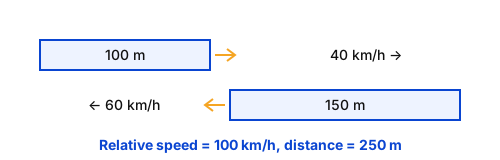
Two trains of lengths 100 m and 150 m are moving in opposite directions at 40 km/h and 60 km/h, respectively. Find the time taken by the trains (in seconds) to cross each other other.
100 m और 150 m लंबाई वाली दो रेलगाड़ियाँ क्रमशः 40 km/h और 60 km/h की चाल से विपरीत दिशाओं में चल रही हैं। रेलगाड़ियों द्वारा एक-दूसरे को पार करने में लगा समय (सेकंड में) ज्ञात कीजिए।
  1. A8 seconds8 सेकंड
  2. B9.5 seconds9.5 सेकंड
  3. C9 seconds9 सेकंड
  4. D8.9 seconds8.9 सेकंड
Show answer

Concept: Opposite directions: relative speed = sum; distance = sum of lengths.

  1. Relative speed =40+60=100km/h=100×518=2509m/s.
  2. Distance =100+150=250m.
  3. Time =250÷2509=9s.

Trick: Time (s) =total length (m)×18speed (km/h)×5=250×18500=9.

Answer: (C) 9 seconds

अवधारणा: विपरीत दिशा: सापेक्ष चाल = योग; दूरी = लंबाइयों का योग।

  1. सापेक्ष चाल =40+60=100km/h=100×518=2509m/s।
  2. दूरी =100+150=250m।
  3. समय =250÷2509=9s।

ट्रिक: समय (s) =कुल लंबाई (m)×18चाल (km/h)×5=250×18500=9।

उत्तर: (C) 9 सेकंड

RRB NTPC Undergraduate CBT 1MathematicsTrains – Opposite DirectionsRRB NTPC Undergraduate CBT 1 2025 · 19 Jun Shift 2 →
Q6063.
The present ages of A and B are in the ratio 5 : 7. After 6 years, the sum of their ages will be 60 years. What is A’s present age?
A और B की वर्तमान आयु का अनुपात 5 : 7 है। 6 वर्ष बाद, उनकी आयु का योग 60 वर्ष होगा। A की वर्तमान आयु क्या है?
  1. A40 years40 वर्ष
  2. B20 years20 वर्ष
  3. C25 years25 वर्ष
  4. D30 years30 वर्ष
Show answer

Concept: After n years, the sum of two ages increases by 2n.

  1. Present sum =60−2×6=48.
  2. 5x+7x=12x=48⇒x=4.
  3. A =5×4=20 years.

Trick: A =512×48=20.

Answer: (B) 20 years

अवधारणा: n वर्ष बाद दोनों की आयु का योग 2n बढ़ता है।

  1. वर्तमान योग =60−2×6=48।
  2. 5x+7x=12x=48⇒x=4।
  3. A =5×4=20 वर्ष।

ट्रिक: A =512×48=20।

उत्तर: (B) 20 वर्ष

RRB NTPC Undergraduate CBT 1MathematicsProblems on AgesRRB NTPC Undergraduate CBT 1 2025 · 19 Jun Shift 2 →
Q6064.
A wholesaler allows a scheme discount of 25% on an article whose marked price is ₹2,400. The retailer is required to pay the remaining amount in full. What is the net price paid by the retailer?
एक थोक विक्रेता ₹2,400 अंकित मूल्य वाली एक वस्तु पर 25% की योजना छूट (scheme discount) देता है। खुदरा विक्रेता को शेष राशि का पूरा भुगतान करना होता है। खुदरा विक्रेता द्वारा भुगतान किया गया शुद्ध मूल्य कितना है?
  1. A₹1,700
  2. B₹1,750
  3. C₹1,900
  4. D₹1,800
Show answer

Concept: Net price =MP×100−d100.

  1. 2400×75100=1800.

Trick: 25%=14: 2400−600=1800.

Answer: (D) ₹1,800

अवधारणा: शुद्ध मूल्य =MP×100−d100।

  1. 2400×75100=1800।

ट्रिक: 25%=14: 2400−600=1800।

उत्तर: (D) ₹1,800

RRB NTPC Undergraduate CBT 1MathematicsDiscountRRB NTPC Undergraduate CBT 1 2025 · 19 Jun Shift 2 →
Q6065.
A sum, when invested at 20% simple interest per annum, amounts to ₹5,040 after 3 years. What is the simple interest (in ₹) on the same sum at the same rate in 2 years?
एक राशि, 20% वार्षिक साधारण ब्याज पर निवेश करने पर, 3 वर्ष बाद ₹5,040 हो जाती है। उसी राशि पर उसी दर से 2 वर्ष में साधारण ब्याज (₹ में) कितना होगा?
  1. A630
  2. B2,520
  3. C5,040
  4. D1,260
Show answer

Concept: A=P(1+RT100), SI=PRT100.

  1. 5040=P(1+0.6)=1.6P⇒P=3150.
  2. SI for 2 years =3150×20×2100=1260.

Trick: 3 years' SI =60% of P, amount =160%; 2 years =40%: 40160×5040=1260.

Answer: (D) 1,260

अवधारणा: A=P(1+RT100), SI=PRT100।

  1. 5040=P(1+0.6)=1.6P⇒P=3150।
  2. 2 वर्ष का SI =3150×20×2100=1260।

ट्रिक: मिश्रधन =160%, 2 वर्ष का ब्याज =40%: 40160×5040=1260।

उत्तर: (D) 1,260

RRB NTPC Undergraduate CBT 1MathematicsSimple InterestRRB NTPC Undergraduate CBT 1 2025 · 19 Jun Shift 2 →
Q6066.
Based on the English alphabetical order, three of the following four are alike in a certain way and thus form a group. Which is the one that does not belong to that group? (Note: The odd man out is not based on the number of consonants/vowels or their position in the letter cluster.)
अंग्रेज़ी वर्णमाला क्रम के आधार पर, निम्नलिखित चार में से तीन किसी निश्चित प्रकार से एकसमान हैं और इस प्रकार एक समूह बनाते हैं। वह कौन-सा विकल्प है जो उस समूह से संबंधित नहीं है? (ध्यान दें: असंगत, अक्षर-समूह में व्यंजनों/स्वरों की संख्या या उनके स्थान पर आधारित नहीं है।)
  1. ABCDF
  2. BUVWX
  3. CHIJL
  4. DOPQS
Show answer

Concept: Check the gaps between consecutive letters of each cluster.

  1. BCDF: +1,+1,+2
  2. HIJL: +1,+1,+2; OPQS: +1,+1,+2
  3. UVWX: +1,+1,+1 – different pattern.

Trick: Three clusters skip one letter at the end (E, K, R missing); UVWX skips nothing.

Answer: (B) UVWX

अवधारणा: हर समूह के क्रमागत अक्षरों का अंतर देखें।

  1. BCDF: +1,+1,+2
  2. HIJL: +1,+1,+2; OPQS: +1,+1,+2
  3. UVWX: +1,+1,+1 – पैटर्न अलग।

ट्रिक: तीन समूहों में अंत में एक अक्षर छूटता है (E, K, R); UVWX में कोई नहीं।

उत्तर: (B) UVWX

RRB NTPC Undergraduate CBT 1General Intelligence and ReasoningOdd one out – letter clustersRRB NTPC Undergraduate CBT 1 2025 · 19 Jun Shift 2 →
Q6067.
What should come in place of the question mark (?) in the given series based on the English alphabetical order?
FJI JNM NRQ RVU ?
अंग्रेज़ी वर्णमाला क्रम के आधार पर दी गई श्रृंखला में प्रश्न चिह्न (?) के स्थान पर क्या आना चाहिए?
FJI JNM NRQ RVU ?
  1. AVWY
  2. BVZY
  3. CVAX
  4. DVYX
Show answer

Concept: Look at the first letters and at the link inside each term.

  1. First letters: F, J, N, R → each +4, so next is V.
  2. Inside each term: 2nd = 1st +4, 3rd = 2nd −1 (F→J→I, J→N→M, R→V→U).
  3. V +4 = Z, Z −1 = Y → VZY.

Trick: Every letter of each term moves +4: FJI → JNM → NRQ → RVU → VZY.

Answer: (B) VZY

अवधारणा: पहले अक्षर और हर पद के भीतर का संबंध देखें।

  1. पहले अक्षर: F, J, N, R → हर बार +4, अतः अगला V।
  2. हर पद में: दूसरा = पहला +4, तीसरा = दूसरा −1 (F→J→I, R→V→U)।
  3. V +4 = Z, Z −1 = Y → VZY।

ट्रिक: हर पद का हर अक्षर +4 खिसकता है: RVU → VZY।

उत्तर: (B) VZY

RRB NTPC Undergraduate CBT 1General Intelligence and ReasoningLetter seriesRRB NTPC Undergraduate CBT 1 2025 · 19 Jun Shift 2 →
Q6068.
In a certain code language, ‘CONE’ is coded as ‘1536’ and ‘NOTE’ is coded as ‘3146’. What is the code for ‘T’ in the given code language?
एक निश्चित कूट भाषा में, ‘CONE’ को ‘1536’ लिखा जाता है और ‘NOTE’ को ‘3146’ लिखा जाता है। उसी कूट भाषा में ‘T’ के लिए कूट क्या है?
  1. A6
  2. B1
  3. C3
  4. D4
Show answer

Concept: Letters common to both words take the digits common to both codes.

  1. CONE = 1536, NOTE = 3146.
  2. Common letters: O, N, E ↔ common digits: 1, 3, 6.
  3. Left over: CONE has C ↔ 5; NOTE has T ↔ 4.

Trick: Remove the common part; the unmatched letter gets the unmatched digit.

Answer: (D) 4

अवधारणा: दोनों शब्दों के उभयनिष्ठ अक्षरों को दोनों कोडों के उभयनिष्ठ अंक मिलते हैं।

  1. CONE = 1536, NOTE = 3146।
  2. उभयनिष्ठ अक्षर: O, N, E ↔ उभयनिष्ठ अंक: 1, 3, 6।
  3. शेष: CONE में C ↔ 5; NOTE में T ↔ 4।

ट्रिक: उभयनिष्ठ भाग हटाएँ; बचे अक्षर को बचा अंक मिलेगा।

उत्तर: (D) 4

RRB NTPC Undergraduate CBT 1General Intelligence and ReasoningCoding-decoding – common lettersRRB NTPC Undergraduate CBT 1 2025 · 19 Jun Shift 2 →
Q6069.
If ‘A’ stands for ‘÷’, ‘B’ stands for ‘×’, ‘C’ stands for ‘+’ and ‘D’ stands for ‘−’, then what will come in place of the question mark (?) in the following equation?
43 D 28 C 35 A 7 B 11 = ?
यदि ‘A’ का अर्थ ‘÷’, ‘B’ का अर्थ ‘×’, ‘C’ का अर्थ ‘+’ और ‘D’ का अर्थ ‘−’ है, तो निम्नलिखित समीकरण में प्रश्न चिह्न (?) के स्थान पर क्या आएगा?
43 D 28 C 35 A 7 B 11 = ?
  1. A73
  2. B74
  3. C70
  4. D71
Show answer

Concept: Replace the letters with signs, then apply BODMAS.

  1. A = ÷, B = ×, C = +, D = −.
  2. 43−28+35÷7×11
  3. =43−28+5×11=43−28+55
  4. =70

Trick: Do ÷ and × left to right first: 35÷7×11=55.

Answer: (C) 70

अवधारणा: अक्षरों को चिह्नों से बदलें, फिर BODMAS लगाएँ।

  1. A = ÷, B = ×, C = +, D = −।
  2. 43−28+35÷7×11
  3. =43−28+5×11=43−28+55
  4. =70

ट्रिक: पहले ÷ और × बाएँ से दाएँ: 35÷7×11=55।

उत्तर: (C) 70

RRB NTPC Undergraduate CBT 1General Intelligence and ReasoningMathematical operationsRRB NTPC Undergraduate CBT 1 2025 · 19 Jun Shift 2 →
Q6070.
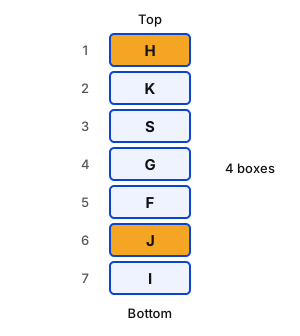
Seven boxes F,G,H,I,J,K and S are kept one over the other but not necessarily in the same order. Only three boxes are kept above G. Only one box is kept between J and G. Only three boxes are kept between J and K. K is kept at some place above G. S is kept immediately below K. F is kept at one of the places above I. H is not kept immediately above or below J. How many boxes are kept between H and J?
सात बक्से F,G,H,I,J,K और S एक के ऊपर एक रखे गए हैं, लेकिन जरूरी नहीं कि इसी क्रम में हों। G के ऊपर केवल तीन बक्से रखे हैं। J और G के बीच केवल एक बक्सा रखा है। J और K के बीच केवल तीन बक्से रखे हैं। K, G के ऊपर किसी स्थान पर रखा है। S, K के ठीक नीचे रखा है। F, I के ऊपर के स्थानों में से किसी एक पर रखा है। H, J के ठीक ऊपर या ठीक नीचे नहीं रखा है। H और J के बीच कितने बक्से रखे हैं?
  1. AOneएक
  2. BFourचार
  3. CTwoदो
  4. DThreeतीन
Show answer

Concept: Number positions 1 (top) to 7 (bottom) and fix the definite clues first.

  1. Three boxes above G → G = 4. One box between J and G → J = 2 or 6.
  2. Three between J and K, with K above G: J = 6, K = 2 (J = 2 would put K at 6, below G). S just below K → S = 3.
  3. F, H, I take 1, 5, 7. H is not next to J (5, 7) → H = 1; F above I → F = 5, I = 7.
  4. Order: H, K, S, G, F, J, I. Between H(1) and J(6): K, S, G, F = 4.

Trick: Boxes between = 6−1−1=4.

Answer: (B) Four

अवधारणा: स्थान 1 (ऊपर) से 7 (नीचे) तक लें और पहले निश्चित सूचनाएँ लगाएँ।

  1. G के ऊपर तीन बॉक्स → G = 4। J और G के बीच एक → J = 2 या 6।
  2. J और K के बीच तीन, K, G के ऊपर: J = 6, K = 2। S, K के ठीक नीचे → S = 3।
  3. F, H, I के लिए 1, 5, 7। H, J के पास (5, 7) नहीं → H = 1; F, I के ऊपर → F = 5, I = 7।
  4. क्रम: H, K, S, G, F, J, I। H(1) और J(6) के बीच: K, S, G, F = 4।

ट्रिक: बीच के बॉक्स = 6−1−1=4।

उत्तर: (B) चार

RRB NTPC Undergraduate CBT 1General Intelligence and ReasoningBox arrangementRRB NTPC Undergraduate CBT 1 2025 · 19 Jun Shift 2 →
Q6071.
In a certain code language,
A ÷ B means ‘A is the son of B’,
A # B means ‘A is the wife of B’,
A + B means ‘A is the brother of B’ and
A & B means ‘A is the father of B’.
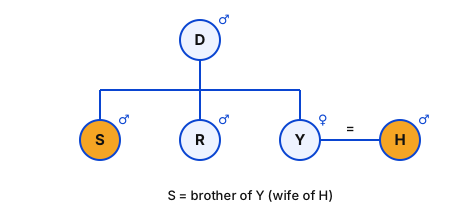
How is S related to H if ‘S ÷ D & R + Y # H’?
एक निश्चित कूट भाषा में,
A ÷ B का अर्थ है ‘A, B का पुत्र है’,
A # B का अर्थ है ‘A, B की पत्नी है’,
A + B का अर्थ है ‘A, B का भाई है’ और
A & B का अर्थ है ‘A, B का पिता है’।
यदि ‘S ÷ D & R + Y # H’ है, तो S का H से क्या संबंध है?
  1. ABrotherभाई
  2. BWife's fatherपत्नी का पिता
  3. CFatherपिता
  4. DWife's brotherपत्नी का भाई
Show answer

Concept: Decode each symbol one link at a time and draw the tree.

  1. S ÷ D: S is the son of D (S is male).
  2. D & R: D is the father of R. R + Y: R is the brother of Y, so S, R, Y are siblings.
  3. Y # H: Y is the wife of H.
  4. S is the brother of Y, i.e. brother of H's wife.

Trick: Brother of wife = brother-in-law (wife's brother).

Answer: (D) Wife's brother

अवधारणा: हर चिह्न को क्रम से डिकोड करें और वंश-वृक्ष बनाएँ।

  1. S ÷ D: S, D का पुत्र है (S पुरुष)।
  2. D & R: D, R का पिता है। R + Y: R, Y का भाई है, अतः S, R, Y भाई-बहन हैं।
  3. Y # H: Y, H की पत्नी है।
  4. S, Y का भाई है अर्थात H की पत्नी का भाई।

ट्रिक: पत्नी का भाई = साला।

उत्तर: (D) पत्नी का भाई (साला)

RRB NTPC Undergraduate CBT 1General Intelligence and ReasoningCoded blood relationsRRB NTPC Undergraduate CBT 1 2025 · 19 Jun Shift 2 →
Q6072.
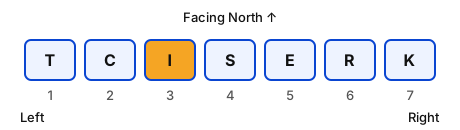
Seven people, S, T, I, C, K, E and R, are sitting in a row, facing north. Only two people sit to the right of E. Only two people sit between E and C. Only two people sit between T and S. S sits to the immediate left of E. K sits to the immediate right of R. Who sits at the third position from the left end of the line?
सात व्यक्ति, S, T, I, C, K, E और R, एक पंक्ति में उत्तर की ओर मुख करके बैठे हैं। E के दाईं ओर केवल दो व्यक्ति बैठे हैं। E और C के बीच केवल दो व्यक्ति बैठे हैं। T और S के बीच केवल दो व्यक्ति बैठे हैं। S, E के ठीक बाईं ओर बैठा है। K, R के ठीक दाईं ओर बैठा है। पंक्ति के बाएँ छोर से तीसरे स्थान पर कौन बैठा है?
  1. AS
  2. BE
  3. CI
  4. DK
Show answer

Concept: Number seats 1–7 from the left (all face north, so their right = our right).

  1. Two people right of E → E = 5; S immediately left of E → S = 4.
  2. Two between E and C → C = 2. Two between T and S → T = 1 or 7.
  3. R, K must be adjacent (K right of R). If T = 7, seats 1, 3, 6 are left – no adjacent pair. So T = 1, R = 6, K = 7, I = 3.
  4. Row: T C I S E R K → 3rd from left is I.

Trick: Test the two cases of T; the one that leaves a free adjacent pair for R–K wins.

Answer: (C) I

अवधारणा: बाएँ से सीटें 1–7 लें (सभी उत्तरमुखी, अतः उनका दायाँ = हमारा दायाँ)।

  1. E के दाएँ दो लोग → E = 5; S, E के ठीक बाएँ → S = 4।
  2. E और C के बीच दो → C = 2। T और S के बीच दो → T = 1 या 7।
  3. R, K पास-पास (K, R के दाएँ)। T = 7 पर 1, 3, 6 बचते हैं – कोई जोड़ा नहीं। अतः T = 1, R = 6, K = 7, I = 3।
  4. पंक्ति: T C I S E R K → बाएँ से तीसरा I।

ट्रिक: T के दोनों विकल्प जाँचें; जिसमें R–K के लिए पास-पास सीट बचे वही सही।

उत्तर: (C) I

RRB NTPC Undergraduate CBT 1General Intelligence and ReasoningLinear seating arrangementRRB NTPC Undergraduate CBT 1 2025 · 19 Jun Shift 2 →
Q6073.
Based on the English alphabetical order, three of the following four are alike in a certain way and thus form a group. Which is the one that does not belong to that group?
(Note: The odd man out is not based on the number of consonants/vowels or their position in the letter cluster.)
अंग्रेज़ी वर्णमाला क्रम के आधार पर, निम्नलिखित चार में से तीन किसी निश्चित प्रकार से एकसमान हैं और इस प्रकार एक समूह बनाते हैं। वह कौन-सा विकल्प है जो उस समूह से संबंधित नहीं है?
(ध्यान दें: असंगत, अक्षर-समूह में व्यंजनों/स्वरों की संख्या या उनके स्थान पर आधारित नहीं है।)
  1. AYBX
  2. BNQM
  3. CUYT
  4. DJMI
Show answer

Concept: Find the moves from 1st→2nd and 2nd→3rd letter.

  1. YBX: Y +3 = B (Z, A, B), B −4 = X.
  2. NQM: N +3 = Q, Q −4 = M; JMI: J +3 = M, M −4 = I.
  3. UYT: U +4 = Y, Y −5 = T – different.

Trick: In the group, 3rd letter = 1st letter −1 (Y→X, N→M, J→I); U→T also, so check the middle: only UYT has +4.

Answer: (C) UYT

अवधारणा: पहले→दूसरे और दूसरे→तीसरे अक्षर की चाल देखें।

  1. YBX: Y +3 = B (Z, A, B), B −4 = X।
  2. NQM: N +3 = Q, Q −4 = M; JMI: J +3 = M, M −4 = I।
  3. UYT: U +4 = Y, Y −5 = T – अलग।

ट्रिक: बीच का अक्षर देखें: केवल UYT में +4 है, बाकी में +3।

उत्तर: (C) UYT

RRB NTPC Undergraduate CBT 1General Intelligence and ReasoningOdd one out – letter clustersRRB NTPC Undergraduate CBT 1 2025 · 19 Jun Shift 2 →
Q6074.
What should come in place of the ‘?’ in the given series?
4 12 36 108 ? 972
दी गई श्रृंखला में ‘?’ के स्थान पर क्या आना चाहिए?
4 12 36 108 ? 972
  1. A324
  2. B323
  3. C322
  4. D321
Show answer

Concept: Each term is the previous term multiplied by a fixed number.

  1. 4×3=12, 12×3=36, 36×3=108
  2. 108×3=324
  3. Check: 324×3=972 ✓

Trick: 972108=9=3×3, so the missing term is 108×3.

Answer: (A) 324

अवधारणा: हर पद पिछले पद को एक निश्चित संख्या से गुणा करके बनता है।

  1. 4×3=12, 12×3=36, 36×3=108
  2. 108×3=324
  3. जाँच: 324×3=972 ✓

ट्रिक: 972108=9=3×3, अतः लुप्त पद 108×3।

उत्तर: (A) 324

RRB NTPC Undergraduate CBT 1General Intelligence and ReasoningNumber series – geometricRRB NTPC Undergraduate CBT 1 2025 · 19 Jun Shift 2 →
Q6075.
The position(s) of how many letters will remain unchanged if each letter in the word DEPARTS is arranged in the English alphabetical order?
यदि शब्द DEPARTS के प्रत्येक अक्षर को अंग्रेज़ी वर्णमाला क्रम में व्यवस्थित किया जाए, तो कितने अक्षरों का/के स्थान अपरिवर्तित रहेगा/रहेंगे?
  1. A0
  2. B3
  3. C1
  4. D2
Show answer

Concept: Write the word and its alphabetical rearrangement one below the other and compare position by position.

  1. Original: D E P A R T S
  2. Sorted: A D E P R S T
  3. Positions 1–7: D/A, E/D, P/E, A/P, R/R, T/S, S/T → only R (5th) is unchanged.

Trick: R is the 5th smallest letter and is already 5th in the word.

Answer: (C) 1

अवधारणा: शब्द और उसकी वर्णानुक्रम व्यवस्था एक के नीचे एक लिखकर स्थान-दर-स्थान मिलाएँ।

  1. मूल: D E P A R T S
  2. क्रमबद्ध: A D E P R S T
  3. स्थान 1–7: D/A, E/D, P/E, A/P, R/R, T/S, S/T → केवल R (5वाँ) अपरिवर्तित।

ट्रिक: R पाँचवाँ सबसे छोटा अक्षर है और शब्द में भी 5वें स्थान पर है।

उत्तर: (C) 1

RRB NTPC Undergraduate CBT 1General Intelligence and ReasoningAlphabetical arrangement of lettersRRB NTPC Undergraduate CBT 1 2025 · 19 Jun Shift 2 →
Q6076.
If ‘+’ means ‘−’, ‘−’ means ‘×’, ‘×’ means ‘÷’, and ‘÷’ means ‘+’, then what will come in place of the question mark (?) in the following equation?
54 − 2 ÷ 120 × 2 + 85 = ?
यदि ‘+’ का अर्थ ‘−’, ‘−’ का अर्थ ‘×’, ‘×’ का अर्थ ‘÷’ और ‘÷’ का अर्थ ‘+’ है, तो निम्नलिखित समीकरण में प्रश्न चिह्न (?) के स्थान पर क्या आएगा?
54 − 2 ÷ 120 × 2 + 85 = ?
  1. A85
  2. B83
  3. C86
  4. D88
Show answer

Concept: Replace each sign as given, then use BODMAS.

  1. '+' → −, '−' → ×, '×' → ÷, '÷' → +.
  2. 54×2+120÷2−85
  3. =108+60−85
  4. =83

Trick: Rewrite the whole expression first, then calculate – never mix the old and new signs.

Answer: (B) 83

अवधारणा: दिए अनुसार चिह्न बदलें, फिर BODMAS लगाएँ।

  1. '+' → −, '−' → ×, '×' → ÷, '÷' → +।
  2. 54×2+120÷2−85
  3. =108+60−85
  4. =83

ट्रिक: पहले पूरा व्यंजक नए चिह्नों में लिखें, फिर गणना करें।

उत्तर: (B) 83

RRB NTPC Undergraduate CBT 1General Intelligence and ReasoningMathematical operations – sign interchangeRRB NTPC Undergraduate CBT 1 2025 · 19 Jun Shift 2 →
Q6077.
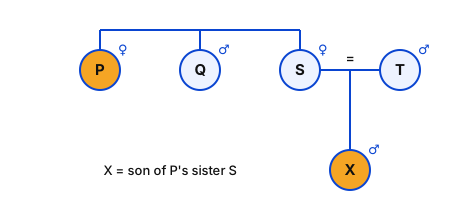
P is the sister of Q. Q is the brother of S. T is the father of X. X is the son of S. How is X related to P?
P, Q की बहन है। Q, S का भाई है। T, X का पिता है। X, S का पुत्र है। X का P से क्या संबंध है?
  1. ABrother's sonभाई का पुत्र
  2. BDaughter's sonपुत्री का पुत्र
  3. CSonपुत्र
  4. DSister's sonबहन का पुत्र
Show answer

Concept: Fix genders from the clues and draw the family tree.

  1. P is the sister of Q; Q is the brother of S → P, Q, S are siblings.
  2. X is the son of S and T is the father of X → S is X's mother (female), T her husband.
  3. So X is the son of P's sister S.

Trick: When the father is named separately, the other parent (S) must be the mother.

Answer: (D) Sister's son

अवधारणा: सूचनाओं से लिंग तय करें और वंश-वृक्ष बनाएँ।

  1. P, Q की बहन है; Q, S का भाई है → P, Q, S भाई-बहन हैं।
  2. X, S का पुत्र है और T, X का पिता है → S, X की माता (स्त्री) है, T उसका पति।
  3. अतः X, P की बहन S का पुत्र है।

ट्रिक: पिता अलग बताया हो तो दूसरा अभिभावक (S) माता ही होगा।

उत्तर: (D) बहन का पुत्र (भांजा)

RRB NTPC Undergraduate CBT 1General Intelligence and ReasoningBlood relationsRRB NTPC Undergraduate CBT 1 2025 · 19 Jun Shift 2 →
Q6078.
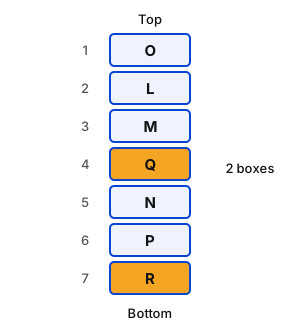
Seven boxes L, M, N, O, P, Q and R are kept one over the other but not necessarily in the same order. Box Q is kept immediately above N. Exactly two boxes are kept between L and N. L is kept on one of the positions above N. O is placed at the topmost position. Exactly two boxes are kept between M and P. Only one box is kept below P. R is kept on one of the positions below N. How many boxes are kept between Q and R?
सात बक्से L, M, N, O, P, Q और R एक के ऊपर एक रखे गए हैं, लेकिन जरूरी नहीं कि इसी क्रम में हों। बक्सा Q, N के ठीक ऊपर रखा है। L और N के बीच ठीक दो बक्से रखे हैं। L, N के ऊपर के स्थानों में से किसी एक पर रखा है। O सबसे ऊपर के स्थान पर रखा है। M और P के बीच ठीक दो बक्से रखे हैं। P के नीचे केवल एक बक्सा रखा है। R, N के नीचे के स्थानों में से किसी एक पर रखा है। Q और R के बीच कितने बक्से रखे हैं?
  1. AThreeतीन
  2. BNoneकोई नहीं
  3. CTwoदो
  4. DOneएक
Show answer

Concept: Number positions 1 (top) to 7 (bottom) and place the fixed boxes first.

  1. O = 1. Only one box below P → P = 6. Two boxes between M and P → M = 3.
  2. Left: 2, 4, 5, 7 for L, N, Q, R. Q just above N, L three places above N, R below N.
  3. Only N = 5 works: Q = 4, L = 2, R = 7.
  4. Order: O, L, M, Q, N, P, R. Between Q(4) and R(7): N, P = 2.

Trick: Boxes between = 7−4−1=2.

Answer: (C) Two

अवधारणा: स्थान 1 (ऊपर) से 7 (नीचे) लें और पहले निश्चित बॉक्स रखें।

  1. O = 1। P के नीचे केवल एक → P = 6। M और P के बीच दो → M = 3।
  2. शेष 2, 4, 5, 7 में L, N, Q, R। Q, N के ठीक ऊपर; L, N से तीन स्थान ऊपर; R, N के नीचे।
  3. केवल N = 5 संभव: Q = 4, L = 2, R = 7।
  4. क्रम: O, L, M, Q, N, P, R। Q(4) और R(7) के बीच: N, P = 2।

ट्रिक: बीच के बॉक्स = 7−4−1=2।

उत्तर: (C) दो

RRB NTPC Undergraduate CBT 1General Intelligence and ReasoningBox arrangementRRB NTPC Undergraduate CBT 1 2025 · 19 Jun Shift 2 →
Q6079.
Select the set in which the numbers are related in the same way as are the numbers of the following sets.
(NOTE: Operations should be performed on the whole numbers, without breaking down the numbers into their constituent digits. E.g. 13 – Operations on 13 such as
adding/subtracting/multiplying etc. to 13 can be performed. Breaking down 13 into 1 and 3 and then performing mathematical operations on 1 and 3 is not allowed.) (27, 12, 322)
(24, 13, 310)
उस समुच्चय का चयन कीजिए जिसमें संख्याएँ उसी प्रकार संबंधित हैं जिस प्रकार निम्नलिखित समुच्चयों की संख्याएँ संबंधित हैं।
(ध्यान दें: संख्याओं को उनके घटक अंकों में विभाजित किए बिना, पूर्ण संख्याओं पर संक्रियाएँ की जानी चाहिए। उदाहरण के लिए 13 – 13 पर संक्रियाएँ जैसे 13 में
जोड़ना/घटाना/गुणा करना आदि किया जा सकता है। 13 को 1 और 3 में विभाजित करना और फिर 1 और 3 पर गणितीय संक्रियाएँ करना वर्जित है।) (27, 12, 322)
(24, 13, 310)
  1. A(31, 8, 246)
  2. B(29, 10, 292)
  3. C(34, 9, 308)
  4. D(32, 7, 224)
Show answer

Concept: Find how the third number is made from the first two.

  1. (27,12,322): 27×12=324, 324−2=322 ✓
  2. (24,13,310): 24×13=312, 312−2=310 ✓
  3. (A) 31×8=248, 248−2=246 ✓; (B) 290−2=288≠292; (C) 306−2=304≠308; (D) 224−2=222≠224.

Trick: Rule: third = first × second −2.

Answer: (A) (31,8,246)

अवधारणा: पहली दो संख्याओं से तीसरी कैसे बनी, यह खोजें।

  1. (27,12,322): 27×12=324, 324−2=322 ✓
  2. (24,13,310): 24×13=312, 312−2=310 ✓
  3. (A) 31×8=248, 248−2=246 ✓; (B) 290−2=288≠292; (C) 306−2=304≠308; (D) 224−2=222≠224।

ट्रिक: नियम: तीसरी = पहली × दूसरी −2।

उत्तर: (A) (31,8,246)

RRB NTPC Undergraduate CBT 1General Intelligence and ReasoningNumber analogy – setsRRB NTPC Undergraduate CBT 1 2025 · 19 Jun Shift 2 →
Q6080.
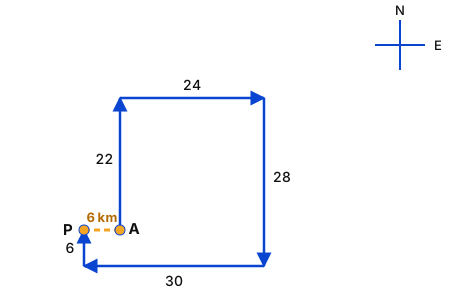
Shreya starts from Point A and drives 22 km towards the north. He then takes a right turn, drives 24 km, turns right and drives 28 km. He then takes a right turn and drives 30 km. He takes a final right turn, drives 6 km and stops at Point P. How far (shortest distance) and towards which direction should he drive in order to reach Point A again? (All turns are 90-degree turns only unless specified.)
श्रेया बिंदु A से शुरू करती है और उत्तर की ओर 22 km गाड़ी चलाती है। फिर वह दाएँ मुड़ती है, 24 km गाड़ी चलाती है, दाएँ मुड़ती है और 28 km गाड़ी चलाती है। फिर वह दाएँ मुड़ती है और 30 km गाड़ी चलाती है। वह अंतिम बार दाएँ मुड़ती है, 6 km गाड़ी चलाती है और बिंदु P पर रुक जाती है। पुनः बिंदु A पर पहुँचने के लिए उसे कितनी दूरी (न्यूनतम दूरी) तक और किस दिशा में गाड़ी चलानी चाहिए? (जब तक निर्दिष्ट न हो, सभी मोड़ केवल 90 डिग्री के मोड़ हैं।)
  1. A5 km to the eastपूर्व की ओर 5 km
  2. B6 km to the eastपूर्व की ओर 6 km
  3. C7 km to the westपश्चिम की ओर 7 km
  4. D3 km to the eastपूर्व की ओर 3 km
Show answer

Concept: Track the east–west and north–south displacements separately.

  1. North 22, right → East 24, right → South 28, right → West 30, right → North 6.
  2. North–south: 22−28+6=0 → P is on the same level as A.
  3. East–west: 24−30=−6 → P is 6 km west of A.
  4. So to return, drive 6 km towards the east.

Trick: Net vertical =0, so the answer is just the net horizontal gap: 30−24=6.

Answer: (B) 6 km to the east

अवधारणा: पूर्व–पश्चिम और उत्तर–दक्षिण विस्थापन अलग-अलग जोड़ें।

  1. उत्तर 22, दाएँ → पूर्व 24, दाएँ → दक्षिण 28, दाएँ → पश्चिम 30, दाएँ → उत्तर 6।
  2. उत्तर–दक्षिण: 22−28+6=0 → P, A की सीध में है।
  3. पूर्व–पश्चिम: 24−30=−6 → P, A से 6 km पश्चिम में है।
  4. अतः वापस पहुँचने के लिए 6 km पूर्व की ओर चलना होगा।

ट्रिक: शुद्ध ऊर्ध्वाधर =0, अतः उत्तर केवल क्षैतिज अंतर: 30−24=6।

उत्तर: (B) 6 km पूर्व की ओर

RRB NTPC Undergraduate CBT 1General Intelligence and ReasoningDirection and distanceRRB NTPC Undergraduate CBT 1 2025 · 19 Jun Shift 2 →