Question bank

Q&A: practice questions with answers

Search questions on any topic. Filter by exam category, exam, subject and topic, try the question, then open the answer and explanation.

Courses – airGurukul

8,495 questions found.

Q6141.
Pipes, A and B, can fill a tank in 10 hours. Pipes, B and C, can fill the same tank in 20 hours. If pipe B alone can fill the same tank in 30 hours, how much time will the pipes A and C take together to fill the same tank.
पाइप A और B मिलकर एक टंकी को 10 घंटे में भर सकते हैं। पाइप B और C मिलकर उसी टंकी को 20 घंटे में भर सकते हैं। यदि अकेला पाइप B उसी टंकी को 30 घंटे में भर सकता है, तो पाइप A और C मिलकर उसी टंकी को भरने में कितना समय लेंगे?
  1. A13 hours13 घंटे
  2. B14 hours14 घंटे
  3. C12 hours12 घंटे
  4. D16 hours16 घंटे
Show answer

Concept: Work per hour of each pipe is the reciprocal of its time; take LCM capacity.

  1. Tank =LCM(10,20,30)=60 units. A+B =6, B+C =3, B =2 units/h.
  2. A =6−2=4, C =3−2=1 unit/h.
  3. A+C =5 units/h → time =605=12 hours.

Trick: A+C =(A+B)+(B+C)−2B=6+3−4=5 units/h.

Answer: (C) 12 hours

अवधारणा: प्रत्येक पाइप का प्रति घंटा कार्य = समय का व्युत्क्रम; LCM को टंकी की क्षमता मानें।

  1. टंकी =LCM(10,20,30)=60 इकाई। A+B =6, B+C =3, B =2 इकाई/घंटा।
  2. A =4, C =1 इकाई/घंटा।
  3. A+C =5 इकाई/घंटा → समय =605=12 घंटे।

ट्रिक: A+C =(A+B)+(B+C)−2B=6+3−4=5.

उत्तर: (C) 12 घंटे

RRB NTPC Undergraduate CBT 1MathematicsPipes and CisternsRRB NTPC Undergraduate CBT 1 2025 · 19 Jun Shift 1 →
Q6142.
Chetan’s salary is ₹16000 per month. He spends ₹6000 on house rent, ₹1500 on bills and the rest of the amount is his monthly savings. Find his savings(in ₹) in a year, if in the month of his birthday he spent his complete monthly saving for birthday
celebration.
चेतन का वेतन ₹16000 प्रति माह है। वह ₹6000 मकान किराए पर, ₹1500 बिलों पर खर्च करता है और शेष राशि उसकी मासिक बचत है। एक वर्ष में उसकी बचत (₹ में) ज्ञात कीजिए, यदि अपने जन्मदिन वाले महीने में उसने अपनी पूरी मासिक बचत जन्मदिन
समारोह पर खर्च कर दी।
  1. A85000
  2. B76500
  3. C102000
  4. D93500
Show answer

Concept: Monthly saving = salary − expenses; in the birthday month saving becomes zero.

  1. Saving per month =16000−6000−1500=8500.
  2. Saved in only 11 months: 11×8500=93500.

Trick: Year saving =12×8500−8500=93500.

Answer: (D) ₹93500

अवधारणा: मासिक बचत = वेतन − खर्च; जन्मदिन वाले महीने में बचत शून्य।

  1. प्रति माह बचत =16000−6000−1500=8500.
  2. केवल 11 महीनों की बचत: 11×8500=93500.

ट्रिक: वार्षिक बचत =12×8500−8500=93500.

उत्तर: (D) ₹93500

RRB NTPC Undergraduate CBT 1MathematicsIncome and SavingsRRB NTPC Undergraduate CBT 1 2025 · 19 Jun Shift 1 →
Q6143.
Simplify: (1321)(1310)÷(59×1815+57)+106÷2915 of 156
सरल कीजिए: (1321)(1310)÷(59×1815+57)+106÷2915 of 156
  1. A1336
  2. B1027
  3. C2029
  4. D2637
Show answer

Concept: Follow VBODMAS: brackets first, then ‘of’, then division, multiplication, addition.

  1. 13/2113/10=1021.
  2. Bracket: 59×1815+57=23+57=2921; so 1021÷2921=1029.
  3. ‘of’ first: 2915 of 156=296; so 106÷296=1029.
  4. Total =1029+1029=2029.

Trick: ‘of’ is solved before ÷ – doing ÷ first gives a wrong answer.

Answer: (C) 2029

अवधारणा: VBODMAS नियम: पहले कोष्ठक, फिर ‘of’ (का), फिर भाग, गुणा, जोड़।

  1. 13/2113/10=1021.
  2. कोष्ठक: 23+57=2921; अतः 1021÷2921=1029.
  3. पहले ‘of’: 2915×156=296; अतः 106÷296=1029.
  4. कुल =2029.

ट्रिक: ‘of’ को ÷ से पहले हल करें।

उत्तर: (C) 2029

RRB NTPC Undergraduate CBT 1MathematicsSimplification (BODMAS)RRB NTPC Undergraduate CBT 1 2025 · 19 Jun Shift 1 →
Q6144.
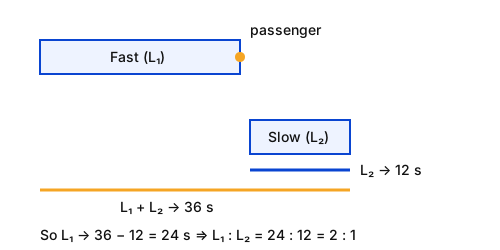
A faster train overtakes a slower train, both moving in the same direction. The faster train takes 36 seconds to completely pass the slower train. A passenger sitting in the faster train observes that he passes the slower train in 12 seconds. Find the ratio of the length of the faster train to the length of the slower train.
एक तेज़ गति वाली रेलगाड़ी, एक धीमी गति वाली रेलगाड़ी से आगे निकलती है, दोनों एक ही दिशा में चल रही हैं। तेज़ रेलगाड़ी को धीमी रेलगाड़ी को पूरी तरह पार करने में 36 सेकंड लगते हैं। तेज़ रेलगाड़ी में बैठा एक यात्री देखता है कि वह धीमी रेलगाड़ी को 12 सेकंड में पार कर लेता है। तेज़ रेलगाड़ी की लंबाई और धीमी रेलगाड़ी की लंबाई का अनुपात ज्ञात कीजिए।
  1. A3 : 2
  2. B3 : 1
  3. C1 : 1
  4. D2 : 1
Show answer

Concept: At the same relative speed v, the time taken is proportional to the length covered.

  1. Faster train fully passing slower: L1+L2=36v.
  2. Passenger (a point) passing slower train: L2=12v.
  3. L1=36v−12v=24v, so L1:L2=24:12=2:1.

Trick: Ratio =(36−12):12=2:1.

Answer: (D) 2:1

अवधारणा: समान सापेक्ष चाल v पर समय ∝ तय की गई लंबाई।

  1. तेज़ गाड़ी द्वारा धीमी को पूरा पार करना: L1+L2=36v.
  2. यात्री (एक बिंदु) द्वारा धीमी गाड़ी पार करना: L2=12v.
  3. L1=24v, अतः L1:L2=2:1.

ट्रिक: अनुपात =(36−12):12=2:1.

उत्तर: (D) 2:1

RRB NTPC Undergraduate CBT 1MathematicsTrains – Relative SpeedRRB NTPC Undergraduate CBT 1 2025 · 19 Jun Shift 1 →
Q6145.
Two trains, 130 meters and 120 meters long, are running in parallel tracks in the same direction at speeds of 62 km/hr and 44 km/hr, respectively. How much time will the faster train take to completely cross the slower one?
130 मीटर और 120 मीटर लंबी दो रेलगाड़ियाँ समांतर पटरियों पर एक ही दिशा में क्रमशः 62 km/hr और 44 km/hr की चाल से चल रही हैं। तेज़ रेलगाड़ी को धीमी रेलगाड़ी को पूरी तरह पार करने में कितना समय लगेगा?
  1. A45 seconds45 सेकंड
  2. B50 seconds50 सेकंड
  3. C60 seconds60 सेकंड
  4. D55 seconds55 सेकंड
Show answer

Concept: Same direction: relative speed = difference; distance = sum of lengths.

  1. Relative speed =62−44=18km/h=18×518=5 m/s.
  2. Distance =130+120=250 m.
  3. Time =2505=50 s.

Trick: 18km/h=5 m/s – remember this pair.

Answer: (B) 50 seconds

अवधारणा: एक ही दिशा: सापेक्ष चाल = अंतर; दूरी = दोनों लंबाइयों का योग।

  1. सापेक्ष चाल =18km/h=5 m/s.
  2. दूरी =250 m.
  3. समय =2505=50 सेकंड।

ट्रिक: 18km/h=5 m/s याद रखें।

उत्तर: (B) 50 सेकंड

RRB NTPC Undergraduate CBT 1MathematicsTrains – Same DirectionRRB NTPC Undergraduate CBT 1 2025 · 19 Jun Shift 1 →
Q6146.
If the average of four numbers is 15, and three of the numbers are 10, 20, and 25, what is the fourth number?
यदि चार संख्याओं का औसत 15 है, और उनमें से तीन संख्याएँ 10, 20 और 25 हैं, तो चौथी संख्या क्या है?
  1. A5
  2. B10
  3. C15
  4. D20
Show answer

Concept: Sum = average × count.

  1. Sum of 4 numbers =4×15=60.
  2. Fourth =60−(10+20+25)=5.

Trick: Deviation method: −5+5+10=10 above 15, so fourth =15−10=5.

Answer: (A) 5

अवधारणा: योग = औसत × संख्या।

  1. चार संख्याओं का योग =60.
  2. चौथी =60−55=5.

ट्रिक: विचलन: −5+5+10=10, अतः चौथी =15−10=5.

उत्तर: (A) 5

RRB NTPC Undergraduate CBT 1MathematicsAverageRRB NTPC Undergraduate CBT 1 2025 · 19 Jun Shift 1 →
Q6147.
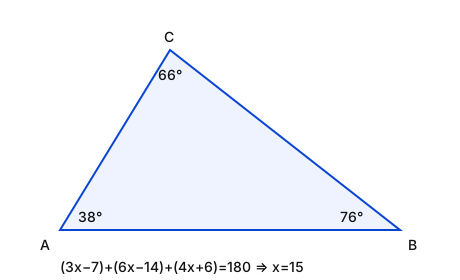
In △ABC, ∠A=(3x−7)∘, ∠B=2∠A and ∠C=(4x+6)∘. Find the value of ∠A+∠C.
△ABC में, ∠A=(3x−7)∘, ∠B=2∠A और ∠C=(4x+6)∘ है। ∠A+∠C का मान ज्ञात कीजिए।
  1. A115∘
  2. B148∘
  3. C135∘
  4. D104∘
Show answer

Concept: Sum of the three angles of a triangle is 180∘.

  1. ∠B=2∠A=6x−14.
  2. (3x−7)+(6x−14)+(4x+6)=180⇒13x=195⇒x=15.
  3. ∠A=38∘, ∠C=66∘; ∠A+∠C=104∘.

Trick: Check: 38+76+66=180 ✓.

Answer: (D) 104∘

अवधारणा: त्रिभुज के तीनों कोणों का योग 180∘ होता है।

  1. ∠B=2∠A=6x−14.
  2. 13x−15=180⇒x=15.
  3. ∠A=38∘, ∠C=66∘; योग =104∘.

ट्रिक: जाँच: 38+76+66=180 ✓.

उत्तर: (D) 104∘

RRB NTPC Undergraduate CBT 1MathematicsAngle Sum of TriangleRRB NTPC Undergraduate CBT 1 2025 · 19 Jun Shift 1 →
Q6148.
The simple interest on a certain sum for 4 years at 10% interest per annum is ₹3,200. What will be the amount payable after 6 years at the same rate?
किसी निश्चित राशि पर 10% वार्षिक ब्याज दर से 4 वर्षों का साधारण ब्याज ₹3,200 है। उसी दर पर 6 वर्षों के बाद देय मिश्रधन कितना होगा?
  1. A₹12,800
  2. B₹12,400
  3. C₹11,800
  4. D₹11,400
Show answer

Concept: SI=P×R×T100; amount =P+SI.

  1. 3200=P×10×4100⇒P=8000.
  2. SI for 6 years =8000×10×6100=4800.
  3. Amount =8000+4800=12800.

Trick: SI per year =32004=800 = 10% of P → P=8000.

Answer: (A) ₹12,800

अवधारणा: SI=P×R×T100; मिश्रधन =P+SI.

  1. 3200=P×40100⇒P=8000.
  2. 6 वर्ष का ब्याज =4800.
  3. मिश्रधन =12800.

ट्रिक: प्रति वर्ष ब्याज =800 = P का 10% → P=8000.

उत्तर: (A) ₹12,800

RRB NTPC Undergraduate CBT 1MathematicsSimple InterestRRB NTPC Undergraduate CBT 1 2025 · 19 Jun Shift 1 →
Q6149.
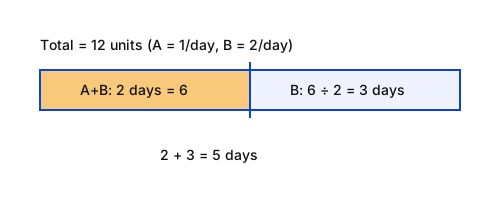
A and B can complete a piece of work in 12 days and 6 days, respectively. Both work together for 2 days and then A leaves. B completes the remaining work alone. In how many days is the whole work completed?
A और B किसी कार्य को क्रमशः 12 दिन और 6 दिन में पूरा कर सकते हैं। दोनों 2 दिन तक साथ मिलकर कार्य करते हैं और फिर A कार्य छोड़ देता है। B शेष कार्य अकेले पूरा करता है। पूरा कार्य कितने दिनों में पूरा होता है?
  1. A6
  2. B4
  3. C5
  4. D3
Show answer

Concept: Take total work = LCM of days and find daily units.

  1. Work =LCM(12,6)=12 units; A =1, B =2 units/day.
  2. Together for 2 days: 2×3=6 units.
  3. Remaining 6 units by B: 62=3 days.
  4. Total =2+3=5 days.

Trick: Half the work is done in 2 days; B alone does half in 62=3 days.

Answer: (C) 5

अवधारणा: कुल कार्य = दिनों का LCM; प्रतिदिन की इकाइयाँ निकालें।

  1. कार्य =12 इकाई; A =1, B =2 इकाई/दिन।
  2. 2 दिन साथ में: 6 इकाई।
  3. शेष 6 इकाई B: 3 दिन।
  4. कुल =5 दिन।

ट्रिक: 2 दिन में आधा कार्य; B अकेले बाकी आधा 3 दिन में।

उत्तर: (C) 5

RRB NTPC Undergraduate CBT 1MathematicsTime and WorkRRB NTPC Undergraduate CBT 1 2025 · 19 Jun Shift 1 →
Q6150.
₹5,278 is divided among X, Y, and Z in such a way that if ₹67, ₹61, and ₹68 are deducted from their respective shares, they have money in the ratio 8 : 20 : 5. Find X’s share after deduction.
₹5,278 को X, Y और Z के बीच इस प्रकार विभाजित किया जाता है कि यदि उनके संबंधित हिस्सों में से क्रमशः ₹67, ₹61 और ₹68 घटा दिए जाएँ, तो उनके पास धनराशि 8 : 20 : 5 के अनुपात में रहती है। कटौती के बाद X का हिस्सा ज्ञात कीजिए।
  1. A₹1,132
  2. B₹1,082
  3. C₹1,232
  4. D₹1,332
Show answer

Concept: Subtract the deductions from the total, then divide in the given ratio.

  1. Total after deduction =5278−(67+61+68)=5278−196=5082.
  2. Ratio parts =8+20+5=33; one part =508233=154.
  3. X after deduction =8×154=1232.

Trick: Question asks share after deduction – don't add 67 back (that would give ₹1,299).

Answer: (C) ₹1,232

अवधारणा: कुल राशि से कटौतियाँ घटाएँ, फिर दिए अनुपात में बाँटें।

  1. कटौती के बाद कुल =5278−196=5082.
  2. 8+20+5=33 भाग; एक भाग =508233=154.
  3. कटौती के बाद X =8×154=1232.

ट्रिक: प्रश्न कटौती के बाद का हिस्सा पूछता है – 67 वापस न जोड़ें।

उत्तर: (C) ₹1,232

RRB NTPC Undergraduate CBT 1MathematicsRatio and ProportionRRB NTPC Undergraduate CBT 1 2025 · 19 Jun Shift 1 →
Q6151.
Surjeet buys 20 kg of sugar for ₹900. He sells 18 kg of sugar for ₹918. What is the percentage profit made by Surjeet?
सुरजीत ₹900 में 20 kg चीनी खरीदता है। वह 18 kg चीनी ₹918 में बेचता है। सुरजीत द्वारा अर्जित प्रतिशत लाभ कितना है?
  1. A1319%
  2. B1119%
  3. C1313%
  4. D1113%
Show answer

Concept: Compare cost price and selling price per kg.

  1. CP per kg =90020=45.
  2. SP per kg =91818=51.
  3. Profit %=645×100=403=1313%.

Trick: 645=215 and 115=623%, so 215=1313%.

Answer: (C) 1313%

अवधारणा: प्रति kg क्रय मूल्य और विक्रय मूल्य की तुलना करें।

  1. प्रति kg क्रय मूल्य =45.
  2. प्रति kg विक्रय मूल्य =51.
  3. लाभ%=645×100=1313%.

ट्रिक: 115=623%, अतः 215=1313%.

उत्तर: (C) 1313%

RRB NTPC Undergraduate CBT 1MathematicsProfit and LossRRB NTPC Undergraduate CBT 1 2025 · 19 Jun Shift 1 →
Q6152.
A trader buys a mobile phone for ₹8000, spends ₹500 on repairs, and sells it at a profit of 20% on the total cost. Later, the buyer resells it at a loss of 25%. What price does the final buyer pay for the mobile phone?
एक व्यापारी ₹8000 में एक मोबाइल फ़ोन खरीदता है, ₹500 मरम्मत पर खर्च करता है, और इसे कुल लागत पर 20% लाभ पर बेच देता है। बाद में, क्रेता इसे 25% हानि पर पुनः बेच देता है। अंतिम क्रेता मोबाइल फ़ोन के लिए कितना मूल्य चुकाता है?
  1. A₹7000
  2. B₹7650
  3. C₹10500
  4. D₹9600
Show answer

Concept: Total cost includes repairs; apply profit and loss one after another.

  1. Total cost =8000+500=8500.
  2. Trader sells at 8500×1.2=10200.
  3. Buyer resells at 25% loss: 10200×0.75=7650.

Trick: Net factor =1.2×0.75=0.9 → 8500×0.9=7650.

Answer: (B) ₹7650

अवधारणा: कुल लागत में मरम्मत खर्च जोड़ें; फिर लाभ और हानि क्रम से लगाएँ।

  1. कुल लागत =8500.
  2. व्यापारी का विक्रय मूल्य =10200.
  3. 25% हानि पर: 10200×0.75=7650.

ट्रिक: शुद्ध गुणक =1.2×0.75=0.9 → 7650.

उत्तर: (B) ₹7650

RRB NTPC Undergraduate CBT 1MathematicsProfit and Loss – SuccessiveRRB NTPC Undergraduate CBT 1 2025 · 19 Jun Shift 1 →
Q6153.
Simplify: 82+82−49−6
सरल कीजिए: 82+82−49−6
  1. A53
  2. B59
  3. C50
  4. D66
Show answer

Concept: a2=a for positive a.

  1. 82=64, 82=8, 49=7.
  2. 64+8−7−6=59.

Trick: Add positives, subtract negatives: 72−13=59.

Answer: (B) 59

अवधारणा: धनात्मक a के लिए a2=a.

  1. 82=64, 82=8, 49=7.
  2. 64+8−7−6=59.

ट्रिक: धन वाले जोड़ें, ऋण वाले घटाएँ: 72−13=59.

उत्तर: (B) 59

RRB NTPC Undergraduate CBT 1MathematicsSimplification – Squares and RootsRRB NTPC Undergraduate CBT 1 2025 · 19 Jun Shift 1 →
Q6154.
Ravi buys an article with a discount of 25% on its marked price. He makes a profit of 10% by selling it at ₹1,320. The marked price of the article was:
रवि एक वस्तु को उसके अंकित मूल्य पर 25% की छूट पर खरीदता है। वह इसे ₹1,320 में बेचकर 10% लाभ अर्जित करता है। वस्तु का अंकित मूल्य कितना था?
  1. A₹1,400
  2. B₹1,650
  3. C₹1,600
  4. D₹1,550
Show answer

Concept: Find CP from SP and profit; with 25% discount, CP paid =75% of MP.

  1. CP =13201.1=1200.
  2. 0.75×MP=1200⇒MP=1600.

Trick: MP=13201.1×0.75=1600.

Answer: (C) ₹1,600

अवधारणा: विक्रय मूल्य व लाभ से क्रय मूल्य निकालें; 25% छूट पर क्रय मूल्य = MP का 75%।

  1. क्रय मूल्य =13201.1=1200.
  2. 0.75×MP=1200⇒MP=1600.

ट्रिक: MP=13201.1×0.75=1600.

उत्तर: (C) ₹1,600

RRB NTPC Undergraduate CBT 1MathematicsDiscount and Marked PriceRRB NTPC Undergraduate CBT 1 2025 · 19 Jun Shift 1 →
Q6155.
Three numbers are in the ratio 3 : 7 : 2, and their LCM is 5376. Their HCF is:
तीन संख्याएँ 3 : 7 : 2 के अनुपात में हैं, और उनका LCM 5376 है। उनका HCF कितना है?
  1. A128
  2. B161
  3. C140
  4. D162
Show answer

Concept: Numbers 3k,7k,2k with co-prime ratio terms: HCF =k, LCM =3×7×2×k.

  1. LCM =42k=5376.
  2. k=537642=128 = HCF.

Trick: HCF =LCMLCM of ratio terms=537642.

Answer: (A) 128

अवधारणा: संख्याएँ 3k,7k,2k (अनुपात के पद सहअभाज्य): HCF =k, LCM =42k.

  1. 42k=5376.
  2. k=128 = HCF.

ट्रिक: HCF =LCM42.

उत्तर: (A) 128

RRB NTPC Undergraduate CBT 1MathematicsHCF and LCMRRB NTPC Undergraduate CBT 1 2025 · 19 Jun Shift 1 →
Q6156.
What sum (in ₹) will earn a simple interest of ₹1,320 in 4 years at 8% per year rate of interest?
कितनी राशि (₹ में) 8% वार्षिक ब्याज दर पर 4 वर्षों में ₹1,320 का साधारण ब्याज अर्जित करेगी?
  1. A4,125
  2. B8,250
  3. C422.4
  4. D2,062.5
Show answer

Concept: P=SI×100R×T.

  1. P=1320×1008×4=13200032=4125.

Trick: 4 years at 8% = 32% of P; 1320÷0.32=4125.

Answer: (A) 4,125

अवधारणा: P=SI×100R×T.

  1. P=1320×10032=4125.

ट्रिक: 4 वर्ष × 8% = P का 32%; 1320÷0.32=4125.

उत्तर: (A) 4,125

RRB NTPC Undergraduate CBT 1MathematicsSimple Interest – PrincipalRRB NTPC Undergraduate CBT 1 2025 · 19 Jun Shift 1 →
Q6157.
A store offers a 10% festival discount on the marked price of ₹900. Later, to clear the stock, it offers an additional 5% off on the already discounted price. What is the total amount paid by the customer?
एक स्टोर ₹900 के अंकित मूल्य पर 10% त्योहारी छूट प्रदान करता है। बाद में, स्टॉक खाली करने के लिए, वह पहले से छूट वाले मूल्य पर 5% की अतिरिक्त छूट देता है। ग्राहक द्वारा भुगतान की गई कुल राशि कितनी है?
  1. A₹785.50
  2. B₹790
  3. C₹769.50
  4. D₹775
Show answer

Concept: Successive discounts multiply: pay (1−d1)(1−d2) of MP.

  1. After 10%: 900×0.9=810.
  2. After 5% more: 810×0.95=769.50.

Trick: Net discount =10+5−50100=14.5%; 900×0.855=769.5.

Answer: (C) ₹769.50

अवधारणा: क्रमागत छूट गुणा होती है: भुगतान =(1−d1)(1−d2)× MP.

  1. 10% के बाद: 810.
  2. 5% और: 810×0.95=769.50.

ट्रिक: शुद्ध छूट =14.5%; 900×0.855=769.5.

उत्तर: (C) ₹769.50

RRB NTPC Undergraduate CBT 1MathematicsSuccessive DiscountRRB NTPC Undergraduate CBT 1 2025 · 19 Jun Shift 1 →
Q6158.
The ratio of the radii of two spheres is 2 : 3. If the radius of the first sphere is increased by 50% and the radius of the second sphere is increased by 20%, find the ratio of their new volumes.
दो गोलों की त्रिज्याओं का अनुपात 2 : 3 है। यदि पहले गोले की त्रिज्या में 50% और दूसरे गोले की त्रिज्या में 20% की वृद्धि की जाती है, तो उनके नए आयतनों का अनुपात ज्ञात कीजिए।
  1. A216 : 343
  2. B144 : 125
  3. C125 : 169
  4. D125 : 216
Show answer

Concept: Volume of a sphere ∝r3.

  1. Take radii 2 and 3.
  2. New radii: 2×1.5=3 and 3×1.2=3.6; ratio 3:3.6=5:6.
  3. Volumes: 53:63=125:216.

Trick: Cube the radius ratio after the change.

Answer: (D) 125:216

अवधारणा: गोले का आयतन ∝r3.

  1. त्रिज्याएँ 2 और 3 मानें।
  2. नई त्रिज्याएँ: 3 और 3.6; अनुपात 5:6.
  3. आयतन: 125:216.

ट्रिक: बदली हुई त्रिज्याओं के अनुपात का घन लें।

उत्तर: (D) 125:216

RRB NTPC Undergraduate CBT 1MathematicsVolume of SphereRRB NTPC Undergraduate CBT 1 2025 · 19 Jun Shift 1 →
Q6159.
Evaluate 253 + (-7)3 + (-18)3
253 + (-7)3 + (-18)3 का मान ज्ञात कीजिए।
  1. A9450
  2. B9490
  3. C9173
  4. D9350
Show answer

Concept: If a+b+c=0 then a3+b3+c3=3abc.

  1. 25+(−7)+(−18)=0.
  2. Value =3×25×(−7)×(−18)=3×3150=9450.

Trick: Always check if the bases add to zero before cubing.

Answer: (A) 9450

अवधारणा: यदि a+b+c=0 तो a3+b3+c3=3abc.

  1. 25−7−18=0.
  2. मान =3×25×7×18=9450.

ट्रिक: घन निकालने से पहले देखें कि आधारों का योग शून्य तो नहीं।

उत्तर: (A) 9450

RRB NTPC Undergraduate CBT 1MathematicsAlgebraic Identity – CubesRRB NTPC Undergraduate CBT 1 2025 · 19 Jun Shift 1 →
Q6160.
The numerator of a fraction is 8 less than the denominator. If the denominator is increased by 5 and the numerator is increased by 3, we get the fraction 34. Find the original fraction.
एक भिन्न का अंश उसके हर से 8 कम है। यदि हर में 5 की वृद्धि की जाए और अंश में 3 की वृद्धि की जाए, तो हमें भिन्न 34 प्राप्त होती है। मूल भिन्न ज्ञात कीजिए।
  1. A35
  2. B1923
  3. C2735
  4. D1114
Show answer

Concept: Let numerator =x, denominator =x+8 and form the equation.

  1. x+3x+8+5=34.
  2. 4x+12=3x+39⇒x=27.
  3. Fraction =2735.

Trick: Option check: 27+335+5=3040=34 ✓.

Answer: (C) 2735

अवधारणा: अंश =x, हर =x+8 मानकर समीकरण बनाएँ।

  1. x+3x+13=34.
  2. 4x+12=3x+39⇒x=27.
  3. भिन्न =2735.

ट्रिक: विकल्प जाँच: 3040=34 ✓.

उत्तर: (C) 2735

RRB NTPC Undergraduate CBT 1MathematicsFractions – Linear EquationRRB NTPC Undergraduate CBT 1 2025 · 19 Jun Shift 1 →