Question bank

Q&A: practice questions with answers

Search questions on any topic. Filter by exam category, exam, subject and topic, try the question, then open the answer and explanation.

Courses – airGurukul

8,495 questions found.

Q6161.
In a class, the average weight of the boys is 65 kg and the average weight of the girls is 45 kg. The average weight of the whole class is 57 kg. What is the ratio of the number of girls to the number of boys in the class?
एक कक्षा में, लड़कों का औसत भार 65 kg है और लड़कियों का औसत भार 45 kg है। पूरी कक्षा का औसत भार 57 kg है। कक्षा में लड़कियों की संख्या और लड़कों की संख्या का अनुपात क्या है?
  1. A4:3
  2. B3:2
  3. C2:3
  4. D3:4
Show answer

Concept: Alligation: ratio of quantities = opposite differences from the mean.
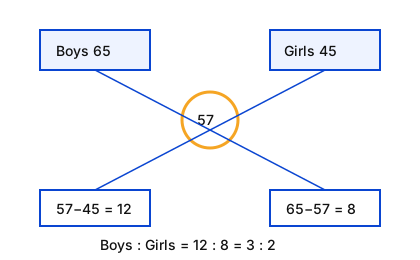
  1. Boys : Girls =(57−45):(65−57)=12:8=3:2.
  2. Girls : Boys =2:3.

Trick: Read carefully – question asks girls to boys, so reverse 3:2.

Answer: (C) 2:3

अवधारणा: एलिगेशन: मात्राओं का अनुपात = औसत से विपरीत अंतर।

  1. लड़के : लड़कियाँ =12:8=3:2.
  2. लड़कियाँ : लड़के =2:3.

ट्रिक: प्रश्न लड़कियाँ : लड़के पूछता है – अनुपात उलटें।

उत्तर: (C) 2:3
RRB NTPC Undergraduate CBT 1MathematicsAlligation – Average WeightRRB NTPC Undergraduate CBT 1 2025 · 19 Jun Shift 1 →
Q6162.
Find the third proportional to 8 and 48.2.
8 और 48.2 का तृतीयानुपाती ज्ञात कीजिए।
  1. A290.405
  2. B292.805
  3. C296.605
  4. D294.205
Show answer

Concept: Third proportional to a and b is b2a.

  1. 48.22=2323.24.
  2. 2323.248=290.405.

Trick: a:b=b:c⇒c=b2a.

Answer: (A) 290.405

अवधारणा: a और b का तृतीयानुपाती =b2a.

  1. 48.22=2323.24.
  2. 2323.248=290.405.

ट्रिक: a:b=b:c⇒c=b2a.

उत्तर: (A) 290.405

RRB NTPC Undergraduate CBT 1MathematicsThird ProportionalRRB NTPC Undergraduate CBT 1 2025 · 19 Jun Shift 1 →
Q6163.
Two friends, P and Q, started a business by investing ₹3,000 and ₹600, respectively. At the end of one year, the business earned a total profit of ₹54,846. What is the share (in ₹) of P in the profit?
दो मित्रों, P और Q ने क्रमशः ₹3,000 और ₹600 का निवेश करके एक व्यवसाय शुरू किया। एक वर्ष के अंत में, व्यवसाय ने कुल ₹54,846 का लाभ अर्जित किया। लाभ में P का हिस्सा (₹ में) कितना है?
  1. A45,705
  2. B45,555
  3. C45,855
  4. D45,605
Show answer

Concept: Same time period → profit shared in ratio of investments.

  1. 3000:600=5:1.
  2. P's share =56×54846=45705.

Trick: 54846÷6=9141; ×5=45705.

Answer: (A) 45,705

अवधारणा: समान समय → लाभ निवेश के अनुपात में।

  1. 3000:600=5:1.
  2. P का हिस्सा =56×54846=45705.

ट्रिक: 54846÷6=9141; ×5=45705.

उत्तर: (A) 45,705

RRB NTPC Undergraduate CBT 1MathematicsPartnershipRRB NTPC Undergraduate CBT 1 2025 · 19 Jun Shift 1 →
Q6164.
Two positive numbers are in the ratio 2:3. If the product of their LCM and HCF is 294, then find the sum of the two numbers.
दो धनात्मक संख्याएँ 2:3 के अनुपात में हैं। यदि उनके LCM और HCF का गुणनफल 294 है, तो दोनों संख्याओं का योग ज्ञात कीजिए।
  1. A20
  2. B35
  3. C15
  4. D30
Show answer

Concept: For two numbers, HCF×LCM= product of the numbers.

  1. Numbers 2x,3x: 6x2=294⇒x2=49⇒x=7.
  2. Numbers 14, 21; sum =35.

Trick: Sum =5x – must be a multiple of 5 and 6x2=294 → 35.

Answer: (B) 35

अवधारणा: दो संख्याओं के लिए HCF×LCM= उनका गुणनफल।

  1. 2x×3x=294⇒x=7.
  2. संख्याएँ 14, 21; योग =35.

ट्रिक: योग =5x=35.

उत्तर: (B) 35

RRB NTPC Undergraduate CBT 1MathematicsHCF × LCM = ProductRRB NTPC Undergraduate CBT 1 2025 · 19 Jun Shift 1 →
Q6165.
324 × 24 = 7776. What will 7.776 ÷ 2.4 be equal to?
324 × 24 = 7776 है। 7.776 ÷ 2.4 किसके बराबर होगा?
  1. A0.0324
  2. B32.4
  3. C3.24
  4. D0.324
Show answer

Concept: Shift decimals: compare the given division with the known one.

  1. 7776÷24=324.
  2. 7.776÷2.4=7776×10−324×10−1=324×10−2=3.24.

Trick: Rough check: 7.8÷2.4≈3.2.

Answer: (C) 3.24

अवधारणा: दशमलव खिसकाकर दिए गए भाग से तुलना करें।

  1. 7776÷24=324.
  2. 7.776÷2.4=324×10−2=3.24.

ट्रिक: अनुमान: 7.8÷2.4≈3.2.

उत्तर: (C) 3.24

RRB NTPC Undergraduate CBT 1MathematicsDecimalsRRB NTPC Undergraduate CBT 1 2025 · 19 Jun Shift 1 →
Q6166.
What should come in place of the question mark (?) in the given series based on the English alphabetical order?
FIN KNS PSX UXC ?
अंग्रेज़ी वर्णमाला क्रम के आधार पर दी गई शृंखला में प्रश्न चिह्न (?) के स्थान पर क्या आना चाहिए?
FIN KNS PSX UXC ?
  1. AZCH
  2. BYSK
  3. CJKP
  4. DKLM
Show answer

Concept: Track each letter position separately (A=1 … Z=26).

  1. 1st letters: F, K, P, U → each +5 → next U+5=Z.
  2. 2nd letters: I, N, S, X → +5 → X+5=C (after Z, start again at A).
  3. 3rd letters: N, S, X, C → +5 → C+5=H.

Trick: All three positions move +5; just add 5 to UXC.

Answer: (A) ZCH

अवधारणा: प्रत्येक स्थान के अक्षर को अलग देखें (A=1 … Z=26)।

  1. पहले अक्षर: F, K, P, U → हर बार +5 → U+5=Z।
  2. दूसरे अक्षर: I, N, S, X → +5 → X+5=C (Z के बाद फिर A से)।
  3. तीसरे अक्षर: N, S, X, C → +5 → C+5=H।

ट्रिक: तीनों स्थान +5; UXC में 5 जोड़ दें।

उत्तर: (A) ZCH

RRB NTPC Undergraduate CBT 1General Intelligence and ReasoningLetter seriesRRB NTPC Undergraduate CBT 1 2025 · 19 Jun Shift 1 →
Q6167.
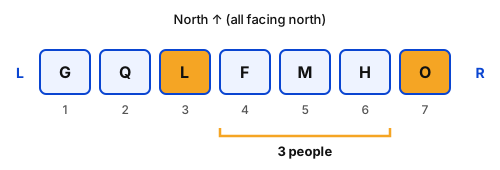
Seven people F, G, H, L, M, O and Q are sitting in a row facing north. Only five people sit between G and O. H sits to the immediate left of O. Only one person sits between H and F. Q sits immediately to the left of L. How many people sit between L and O?
सात व्यक्ति F, G, H, L, M, O और Q एक पंक्ति में उत्तर की ओर मुख करके बैठे हैं। G और O के बीच केवल पाँच व्यक्ति बैठे हैं। H, O के ठीक बाईं ओर बैठा है। H और F के बीच केवल एक व्यक्ति बैठा है। Q, L के ठीक बाईं ओर बैठा है। L और O के बीच कितने व्यक्ति बैठे हैं?
  1. ATwoदो
  2. BFourचार
  3. COneएक
  4. DThreeतीन
Show answer

Concept: 7 seats in a row facing north: left is position 1, right is position 7.

  1. Five people between G and O ⇒ they occupy the two ends (1 and 7).
  2. H is immediately left of O, so O cannot be at 1 ⇒ O = 7, G = 1, H = 6.
  3. One person between H and F ⇒ F = 4. Q immediately left of L among seats 2, 3, 5 ⇒ Q = 2, L = 3, M = 5.
  4. Between L (3) and O (7): F, M, H = 3 people.

Trick: Between seats a and b = |a−b|−1=7−3−1=3.

Answer: (D) Three

अवधारणा: पंक्ति में 7 सीटें, सभी उत्तरमुखी: बायाँ = स्थान 1, दायाँ = स्थान 7।

  1. G और O के बीच पाँच लोग ⇒ दोनों सिरों (1 और 7) पर।
  2. H, O के ठीक बाएँ है, अतः O स्थान 1 पर नहीं ⇒ O = 7, G = 1, H = 6।
  3. H और F के बीच एक व्यक्ति ⇒ F = 4। Q, L के ठीक बाएँ (सीट 2, 3, 5 में) ⇒ Q = 2, L = 3, M = 5।
  4. L (3) और O (7) के बीच: F, M, H = 3 व्यक्ति।

ट्रिक: सीट a और b के बीच = |a−b|−1=7−3−1=3।

उत्तर: (D) तीन

RRB NTPC Undergraduate CBT 1General Intelligence and ReasoningSeating arrangement – linearRRB NTPC Undergraduate CBT 1 2025 · 19 Jun Shift 1 →
Q6168.
In a certain code language, ‘BIKE’ is coded as ‘4821’ and ‘KITE’ is coded as ‘2146’. What is the code for ‘B’ in the given code language?
एक निश्चित कूट भाषा में, ‘BIKE’ को ‘4821’ के रूप में और ‘KITE’ को ‘2146’ के रूप में कूटबद्ध किया जाता है। दी गई कूट भाषा में ‘B’ का कूट क्या है?
  1. A8
  2. B1
  3. C2
  4. D4
Show answer

Concept: Letters common to both words share the common digits; the leftover letter gets the leftover digit.

  1. BIKE → {4, 8, 2, 1}; KITE → {2, 1, 4, 6}.
  2. Common letters I, K, E ↔ common digits 4, 2, 1.
  3. Remaining letter of BIKE is B and remaining digit is 8 ⇒ B = 8 (and T = 6).

Trick: Strike out the common part; what remains matches.

Answer: (A) 8

अवधारणा: दोनों शब्दों में समान अक्षरों के कोड भी समान अंक होते हैं; बचा हुआ अक्षर बचे हुए अंक से मेल खाता है।

  1. BIKE → {4, 8, 2, 1}; KITE → {2, 1, 4, 6}।
  2. समान अक्षर I, K, E ↔ समान अंक 4, 2, 1।
  3. BIKE में बचा अक्षर B और बचा अंक 8 ⇒ B = 8 (और T = 6)।

ट्रिक: समान भाग काट दें; बचे हुए आपस में मेल खाते हैं।

उत्तर: (A) 8

RRB NTPC Undergraduate CBT 1General Intelligence and ReasoningCoding-decodingRRB NTPC Undergraduate CBT 1 2025 · 19 Jun Shift 1 →
Q6169.
Based on the alphabetical order, three of the following four are alike in a certain way and thus form a group. Which is the one that does not belong to that group?
(Note: The odd man out is not based on the number of consonants/vowels or their position in the letter cluster.)
वर्णमाला क्रम के आधार पर, निम्नलिखित चार में से तीन किसी निश्चित प्रकार से एकसमान हैं और इस प्रकार एक समूह बनाते हैं। वह कौन-सा है जो उस समूह से संबंधित नहीं है?
(नोट: असंगत, अक्षर-समूह में व्यंजनों/स्वरों की संख्या या उनके स्थान पर आधारित नहीं है।)
  1. ATTV
  2. BZYB
  3. CKJM
  4. DFEH
Show answer

Concept: Find the step from 1st to 2nd and 2nd to 3rd letter (A=1 … Z=26).

  1. ZYB: Z→−1Y→+3B; KJM: K→−1J→+3M; FEH: F→−1E→+3H.
  2. TTV: T→0T→+2V – a different pattern.

Trick: Three follow −1,+3; the one that does not is odd.

Answer: (A) TTV

अवधारणा: पहले से दूसरे और दूसरे से तीसरे अक्षर का अंतर देखें (A=1 … Z=26)।

  1. ZYB: Z→−1Y→+3B; KJM: K→−1J→+3M; FEH: F→−1E→+3H।
  2. TTV: T→0T→+2V – अलग पैटर्न।

ट्रिक: तीन में −1,+3 है; जो नहीं मानता वही विषम।

उत्तर: (A) TTV

RRB NTPC Undergraduate CBT 1General Intelligence and ReasoningOdd one out – lettersRRB NTPC Undergraduate CBT 1 2025 · 19 Jun Shift 1 →
Q6170.
Refer to the following letter series and answer the question. (Counting to be done from left to right only)
(Left) R C X Z H M E D F T B S I K A Q Y O W G U (Right)
How many such consonants are there, each of which is immediately preceded by a consonant and also immediately followed by a consonant?
निम्नलिखित अक्षर शृंखला को देखिए और प्रश्न का उत्तर दीजिए। (गिनती केवल बाएँ से दाएँ की जानी है)
(बाएँ) R C X Z H M E D F T B S I K A Q Y O W G U (दाएँ)
ऐसे कितने व्यंजन हैं, जिनमें से प्रत्येक के ठीक पहले एक व्यंजन है और ठीक बाद भी एक व्यंजन है?
  1. A9
  2. B7
  3. C8
  4. D10
Show answer

Concept: Mark vowels (A, E, I, O, U); check each consonant's left and right neighbours.

  1. Series: R C X Z H M E D F T B S I K A Q Y O W G U.
  2. Block R C X Z H M: C, X, Z, H have consonants on both sides → 4.
  3. Block D F T B S: F, T, B qualify → 3.
  4. Q Y, W G blocks are too short (each letter touches a vowel). Total =4+3=7.

Trick: In a consonant block of length n, the inner n−2 letters qualify: (6−2)+(5−2)=7.

Answer: (B) 7

अवधारणा: स्वर (A, E, I, O, U) चिह्नित करें; हर व्यंजन के दोनों पड़ोसी देखें।

  1. श्रृंखला: R C X Z H M E D F T B S I K A Q Y O W G U।
  2. समूह R C X Z H M: C, X, Z, H के दोनों ओर व्यंजन → 4।
  3. समूह D F T B S: F, T, B → 3।
  4. Q Y और W G समूह छोटे हैं (हर अक्षर स्वर से सटा)। कुल =4+3=7।

ट्रिक: n लंबाई के व्यंजन-समूह में भीतरी n−2 अक्षर गिने जाते हैं: (6−2)+(5−2)=7।

उत्तर: (B) 7

RRB NTPC Undergraduate CBT 1General Intelligence and ReasoningLetter series – countingRRB NTPC Undergraduate CBT 1 2025 · 19 Jun Shift 1 →
Q6171.
Read the given statement(s) and conclusions carefully. Assuming that the information given in the statements is true, even if it appears to be at variance with commonly known facts, decide which of the given conclusions logically follow(s) from the statement(s).
Statements:
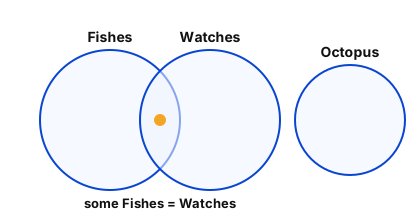
Some fishes are watches.
No watch is an octopus.
Conclusions:
(I) Some fishes are octopus.
(II) Some watches are fishes.
दिए गए कथन/कथनों और निष्कर्षों को ध्यानपूर्वक पढ़िए। यह मानते हुए कि कथनों में दी गई जानकारी सत्य है, भले ही वह सामान्यतः ज्ञात तथ्यों से भिन्न प्रतीत होती हो, निर्णय कीजिए कि दिए गए निष्कर्षों में से कौन-सा/कौन-से निष्कर्ष तार्किक रूप से कथन/कथनों का अनुसरण करता है/करते हैं।
कथन:
कुछ मछलियाँ, घड़ियाँ हैं।
कोई घड़ी, ऑक्टोपस नहीं है।
निष्कर्ष:
(I) कुछ मछलियाँ, ऑक्टोपस हैं।
(II) कुछ घड़ियाँ, मछलियाँ हैं।
  1. ANeither conclusion (I) nor (II) followsन तो निष्कर्ष (I) और न ही (II) अनुसरण करता है
  2. BOnly conclusion (II) followsकेवल निष्कर्ष (II) अनुसरण करता है
  3. COnly conclusion (I) followsकेवल निष्कर्ष (I) अनुसरण करता है
  4. DBoth conclusions (I) and (II) followनिष्कर्ष (I) और (II) दोनों अनुसरण करते हैं
Show answer

Concept: Draw the least-overlap Venn diagram that satisfies both statements.

  1. Some fishes are watches → Fishes and Watches overlap.
  2. No watch is an octopus → Octopus is separate from Watches, but may or may not touch Fishes ⇒ (I) is not certain.
  3. 'Some fishes are watches' converts to 'Some watches are fishes' ⇒ (II) follows.

Trick: 'Some A are B' always ⇔ 'Some B are A'.

Answer: (B) Only conclusion (II) follows

अवधारणा: दोनों कथनों को संतुष्ट करने वाला न्यूनतम Venn चित्र बनाएँ।

  1. कुछ मछलियाँ घड़ियाँ हैं → Fishes और Watches आपस में मिलते हैं।
  2. कोई घड़ी ऑक्टोपस नहीं → Octopus, Watches से अलग; Fishes से मिले या न मिले, निश्चित नहीं ⇒ (I) नहीं।
  3. 'कुछ मछलियाँ घड़ियाँ हैं' का उलटा 'कुछ घड़ियाँ मछलियाँ हैं' ⇒ (II) सही।

ट्रिक: 'कुछ A, B हैं' ⇔ 'कुछ B, A हैं' – हमेशा।

उत्तर: (B) केवल निष्कर्ष (II) अनुसरण करता है

RRB NTPC Undergraduate CBT 1General Intelligence and ReasoningSyllogismRRB NTPC Undergraduate CBT 1 2025 · 19 Jun Shift 1 →
Q6172.
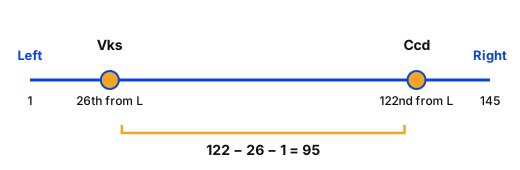
All 145 people are standing in a row facing north. Ccd is 24th from the right end while Vks is 26th from the left end. How many people are there between Ccd and Vks?
सभी 145 व्यक्ति एक पंक्ति में उत्तर की ओर मुख करके खड़े हैं। Ccd दाएँ छोर से 24वें स्थान पर है जबकि Vks बाएँ छोर से 26वें स्थान पर है। Ccd और Vks के बीच कितने व्यक्ति हैं?
  1. A92
  2. B94
  3. C95
  4. D98
Show answer

Concept: Position from left =Total−position from right+1.

  1. Ccd from left =145−24+1=122.
  2. Vks is 26th from left.
  3. People between =122−26−1=95.

Trick: Direct: Total−(L+R)=145−(26+24)=95 when no overlap.

Answer: (C) 95

अवधारणा: बाएँ से स्थान =कुल−दाएँ से स्थान+1।

  1. Ccd बाएँ से =145−24+1=122वाँ।
  2. Vks बाएँ से 26वाँ।
  3. बीच में व्यक्ति =122−26−1=95।

ट्रिक: सीधा: कुल−(बायाँ+दायाँ)=145−(26+24)=95 (जब overlap न हो)।

उत्तर: (C) 95

RRB NTPC Undergraduate CBT 1General Intelligence and ReasoningRanking – rowRRB NTPC Undergraduate CBT 1 2025 · 19 Jun Shift 1 →
Q6173.
The position(s) of how many letters will remain unchanged if each letter in the word SERVANT is arranged in the alphabetical order?
यदि शब्द SERVANT के प्रत्येक अक्षर को वर्णमाला क्रम में व्यवस्थित किया जाए, तो कितने अक्षरों का/के स्थान अपरिवर्तित रहेगा/रहेंगे?
  1. A3
  2. B2
  3. C1
  4. D0
Show answer

Concept: Write the word and its alphabetical arrangement one below the other and compare position by position.

  1. SERVANT: S E R V A N T
  2. Sorted: A E N R S T V
  3. Only position 2 (E) is the same in both ⇒ 1 letter unchanged.

Trick: Compare column by column – don't count letters, count matching positions.

Answer: (C) 1

अवधारणा: शब्द और उसका वर्णानुक्रम एक के नीचे एक लिखकर स्थान-दर-स्थान मिलाएँ।

  1. SERVANT: S E R V A N T
  2. वर्णानुक्रम: A E N R S T V
  3. केवल स्थान 2 (E) दोनों में समान ⇒ 1 अक्षर अपरिवर्तित।

ट्रिक: स्तंभ-दर-स्तंभ मिलाएँ – समान स्थान गिनें।

उत्तर: (C) 1

RRB NTPC Undergraduate CBT 1General Intelligence and ReasoningAlphabetical arrangementRRB NTPC Undergraduate CBT 1 2025 · 19 Jun Shift 1 →
Q6174.
Based on the English alphabetical order, three of the following four letter-cluster pairs are alike in a certain way and thus form a group. Which is the one that does not belong to that group?
(Note: The odd one out is not based on the number of consonants/vowels or their position in the letter-cluster pairs.)
अंग्रेज़ी वर्णमाला क्रम के आधार पर, निम्नलिखित चार अक्षर-समूह युग्मों में से तीन किसी निश्चित प्रकार से एकसमान हैं और इस प्रकार एक समूह बनाते हैं। वह कौन-सा है जो उस समूह से संबंधित नहीं है?
(नोट: असंगत, अक्षर-समूह युग्मों में व्यंजनों/स्वरों की संख्या या उनके स्थान पर आधारित नहीं है।)
  1. AFJ-LP
  2. BHL-NR
  3. CDH-JN
  4. DJO-QU
Show answer

Concept: Compare letter gaps within and between the clusters (A=1 … Z=26).

  1. FJ-LP: 6,10,12,16 → gaps +4,+2,+4.
  2. HL-NR: 8,12,14,18 → +4,+2,+4; DH-JN: 4,8,10,14 → +4,+2,+4.
  3. JO-QU: 10,15,17,21 → +5,+2,+4 – different.

Trick: Check the first gap only: three have +4, JO has +5.

Answer: (D) JO-QU

अवधारणा: समूह के भीतर और बीच में अक्षरों का अंतर देखें (A=1 … Z=26)।

  1. FJ-LP: 6,10,12,16 → अंतर +4,+2,+4।
  2. HL-NR: 8,12,14,18 → +4,+2,+4; DH-JN: 4,8,10,14 → +4,+2,+4।
  3. JO-QU: 10,15,17,21 → +5,+2,+4 – अलग।

ट्रिक: केवल पहला अंतर देखें: तीन में +4, JO में +5।

उत्तर: (D) JO-QU

RRB NTPC Undergraduate CBT 1General Intelligence and ReasoningOdd one out – letter pairsRRB NTPC Undergraduate CBT 1 2025 · 19 Jun Shift 1 →
Q6175.
What should come in place of '?' in the given series based on the English alphabetical order?
COV ERX GUZ IXB ?
अंग्रेज़ी वर्णमाला क्रम के आधार पर दी गई शृंखला में '?' के स्थान पर क्या आना चाहिए?
COV ERX GUZ IXB ?
  1. ALBE
  2. BKAD
  3. CLAC
  4. DMAD
Show answer

Concept: Track each letter position separately.

  1. 1st letters: C, E, G, I → +2 → K.
  2. 2nd letters: O, R, U, X → +3 → A (after Z).
  3. 3rd letters: V, X, Z, B → +2 → D.

Trick: Positions: +2,+3,+2 on IXB gives KAD.

Answer: (B) KAD

अवधारणा: हर स्थान के अक्षर अलग देखें।

  1. पहले अक्षर: C, E, G, I → +2 → K।
  2. दूसरे अक्षर: O, R, U, X → +3 → A (Z के बाद)।
  3. तीसरे अक्षर: V, X, Z, B → +2 → D।

ट्रिक: IXB पर +2,+3,+2 → KAD।

उत्तर: (B) KAD

RRB NTPC Undergraduate CBT 1General Intelligence and ReasoningLetter seriesRRB NTPC Undergraduate CBT 1 2025 · 19 Jun Shift 1 →
Q6176.
Select the triad that follows the same pattern as that followed by the two sets of triads given below. Both triads follow the same pattern.
BATH –HBAT –THBA
TOYS –STOY -YSTO
उस त्रिक का चयन कीजिए जो उसी पैटर्न का अनुसरण करता है जिसका अनुसरण नीचे दिए गए त्रिकों के दो समुच्चय करते हैं। दोनों त्रिक एक ही पैटर्न का अनुसरण करते हैं।
BATH –HBAT –THBA
TOYS –STOY -YSTO
  1. ATOMB -OMTB -MTOB
  2. BCART - ACTR - CTAR
  3. CABLE-EABL-LEAB
  4. DLOVE- OVEL -VELO
Show answer

Concept: Each next word is formed by moving the last letter to the front.

  1. BATH → HBAT (H to front) → THBA (T to front).
  2. TOYS → STOY → YSTO – same rule.
  3. ABLE → EABL → LEAB ✓. LOVE → OVEL uses first-to-end, so it fails.

Trick: Rule = rotate right by one letter each time.

Answer: (C) ABLE-EABL-LEAB

अवधारणा: हर अगला शब्द पिछले शब्द के अंतिम अक्षर को आगे लाकर बनता है।

  1. BATH → HBAT (H आगे) → THBA (T आगे)।
  2. TOYS → STOY → YSTO – वही नियम।
  3. ABLE → EABL → LEAB ✓। LOVE → OVEL में पहला अक्षर पीछे गया है, अतः गलत।

ट्रिक: नियम = हर बार एक अक्षर दाएँ घुमाएँ।

उत्तर: (C) ABLE-EABL-LEAB

RRB NTPC Undergraduate CBT 1General Intelligence and ReasoningLetter triads – patternRRB NTPC Undergraduate CBT 1 2025 · 19 Jun Shift 1 →
Q6177.
Select the triad which follows the same pattern as that followed by the two triads given below. Both triads follow the same pattern.
DF – HJ – LN
GI – KM –OQ
उस त्रिक का चयन कीजिए जो उसी पैटर्न का अनुसरण करता है जिसका अनुसरण नीचे दिए गए दो त्रिक करते हैं। दोनों त्रिक एक ही पैटर्न का अनुसरण करते हैं।
DF – HJ – LN
GI – KM –OQ
  1. AAC – EG – IK
  2. BEB – IG – NL
  3. CME – QK – XQ
  4. DHI – MP – SU
Show answer

Concept: Convert letters to numbers (A=1 … Z=26).

  1. DF–HJ–LN: (4,6),(8,10),(12,14) → within pair +2, pair to pair +4.
  2. GI–KM–OQ: (7,9),(11,13),(15,17) → same.
  3. AC–EG–IK: (1,3),(5,7),(9,11) → +2 within, +4 between ✓.

Trick: Skip one letter inside a pair, skip three between pairs.

Answer: (A) AC – EG – IK

अवधारणा: अक्षरों को संख्या में बदलें (A=1 … Z=26)।

  1. DF–HJ–LN: (4,6),(8,10),(12,14) → युग्म के भीतर +2, युग्म से युग्म +4।
  2. GI–KM–OQ: (7,9),(11,13),(15,17) → वही।
  3. AC–EG–IK: (1,3),(5,7),(9,11) → भीतर +2, बीच +4 ✓।

ट्रिक: युग्म के भीतर एक अक्षर छोड़ें, युग्मों के बीच तीन।

उत्तर: (A) AC – EG – IK

RRB NTPC Undergraduate CBT 1General Intelligence and ReasoningLetter triads – patternRRB NTPC Undergraduate CBT 1 2025 · 19 Jun Shift 1 →
Q6178.
What will come in place of the question mark (?) in the following equation, if ‘+’ and ‘−’ are interchanged and ‘×’ and ‘÷’ are interchanged?
558 × 31 − 18 ÷ 17 + 321 = ?
यदि ‘+’ और ‘−’ को आपस में बदल दिया जाए तथा ‘×’ और ‘÷’ को आपस में बदल दिया जाए, तो निम्नलिखित समीकरण में प्रश्न चिह्न (?) के स्थान पर क्या आएगा?
558 × 31 − 18 ÷ 17 + 321 = ?
  1. A3
  2. B33
  3. C24
  4. D16
Show answer

Concept: Swap the signs first, then solve using BODMAS.

  1. After swapping: 558÷31+18×17−321.
  2. 558÷31=18, 18×17=306.
  3. 18+306−321=3.

Trick: Rewrite the whole expression before calculating – never swap mentally.

Answer: (A) 3

अवधारणा: पहले चिह्न बदलें, फिर BODMAS से हल करें।

  1. बदलने के बाद: 558÷31+18×17−321।
  2. 558÷31=18, 18×17=306।
  3. 18+306−321=3।

ट्रिक: गणना से पहले पूरा व्यंजक नया लिखें।

उत्तर: (A) 3

RRB NTPC Undergraduate CBT 1General Intelligence and ReasoningMathematical operations – interchangeRRB NTPC Undergraduate CBT 1 2025 · 19 Jun Shift 1 →
Q6179.
Pqr ranked 71st from the bottom and 39th from the top in his class. How many students are there in his class?
Pqr अपनी कक्षा में नीचे से 71वें और ऊपर से 39वें स्थान पर है। उसकी कक्षा में कितने विद्यार्थी हैं?
  1. A109
  2. B113
  3. C107
  4. D108
Show answer

Concept: Total = rank from top + rank from bottom −1.

  1. Total =39+71−1.
  2. =109 students.

Trick: The person is counted twice, so subtract 1.

Answer: (A) 109

अवधारणा: कुल = ऊपर से रैंक + नीचे से रैंक −1।

  1. कुल =39+71−1।
  2. =109 छात्र।

ट्रिक: व्यक्ति दो बार गिना जाता है, अतः 1 घटाएँ।

उत्तर: (A) 109

RRB NTPC Undergraduate CBT 1General Intelligence and ReasoningRankingRRB NTPC Undergraduate CBT 1 2025 · 19 Jun Shift 1 →
Q6180.
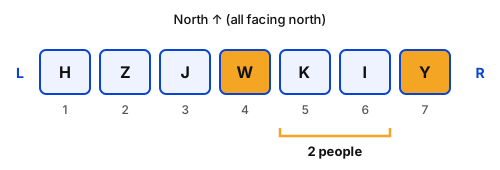
Seven people H, I, J, K, W, Y and Z are sitting in a row facing north. No one sits to the left of H. Only four people sit between H and I. Only three people sit to the right of W. Z sits to the immediate left of J. Y is not an immediate neighbor of W. How many people sit between Y and W?
सात व्यक्ति H, I, J, K, W, Y और Z एक पंक्ति में उत्तर की ओर मुख करके बैठे हैं। H के बाईं ओर कोई नहीं बैठा है। H और I के बीच केवल चार व्यक्ति बैठे हैं। W के दाईं ओर केवल तीन व्यक्ति बैठे हैं। Z, J के ठीक बाईं ओर बैठा है। Y, W का निकटतम पड़ोसी नहीं है। Y और W के बीच कितने व्यक्ति बैठे हैं?
  1. AThreeतीन
  2. BOneएक
  3. CFourचार
  4. DTwoदो
Show answer

Concept: 7 seats facing north; position 1 = extreme left.

  1. No one left of H ⇒ H = 1. Four between H and I ⇒ I = 6.
  2. Three to the right of W ⇒ W = 4.
  3. Z immediately left of J – free consecutive seats only 2, 3 ⇒ Z = 2, J = 3.
  4. Seats 5 and 7 left for Y and K; Y is not next to W ⇒ Y = 7, K = 5. Between Y and W: K, I = 2.

Trick: Between =7−4−1=2.

Answer: (D) Two

अवधारणा: 7 सीटें, सभी उत्तरमुखी; स्थान 1 = सबसे बायाँ।

  1. H के बाएँ कोई नहीं ⇒ H = 1। H और I के बीच चार ⇒ I = 6।
  2. W के दाएँ तीन ⇒ W = 4।
  3. Z, J के ठीक बाएँ – लगातार खाली सीटें केवल 2, 3 ⇒ Z = 2, J = 3।
  4. सीट 5 और 7 पर Y, K; Y, W का पड़ोसी नहीं ⇒ Y = 7, K = 5। Y और W के बीच: K, I = 2।

ट्रिक: बीच में =7−4−1=2।

उत्तर: (D) दो

RRB NTPC Undergraduate CBT 1General Intelligence and ReasoningSeating arrangement – linearRRB NTPC Undergraduate CBT 1 2025 · 19 Jun Shift 1 →