Question bank

Q&A: practice questions with answers

Search questions on any topic. Filter by exam category, exam, subject and topic, try the question, then open the answer and explanation.

Courses – airGurukul

8,495 questions found.

Q6241.
Find the positive integral value of x if the fourth proportional of x, x + 1, 2x + 3 is y and y = 3x + 3.
यदि x, x + 1, 2x + 3 का चतुर्थानुपाती y है और y = 3x + 3 है, तो x का धनात्मक पूर्णांक मान ज्ञात कीजिए।
  1. A4
  2. B3
  3. C2
  4. D5
Show answer

Concept: Fourth proportional y of a,b,c: a:b=c:y⇒y=bca.

  1. y=(x+1)(2x+3)x=3x+3=3(x+1)
  2. Cancel (x+1): 2x+3x=3
  3. 2x+3=3x⇒x=3

Trick: Option check: x=3 gives 3:4=9:12 and y=12=3×3+3. ✔

Answer: (B) 3

अवधारणा: a,b,c का चतुर्थानुपाती y: a:b=c:y⇒y=bca.

  1. y=(x+1)(2x+3)x=3x+3=3(x+1)
  2. (x+1) काटें: 2x+3x=3
  3. 2x+3=3x⇒x=3

ट्रिक: विकल्प जाँच: x=3 से 3:4=9:12 और y=12=3×3+3. ✔

उत्तर: (B) 3

RRB NTPC Undergraduate CBT 1MathematicsFourth ProportionalRRB NTPC Undergraduate CBT 1 2025 · 18 Jun Shift 3 →
Q6242.
A jacket has a marked price of ₹5,000. The shopkeeper offers two successive discounts of 20% and 30%. What is the final selling price?
एक जैकेट का अंकित मूल्य ₹5,000 है। दुकानदार 20% और 30% की दो क्रमिक छूट देता है। अंतिम विक्रय मूल्य क्या है?
  1. A₹2,600
  2. B₹2,800
  3. C₹2,850
  4. D₹2,650
Show answer

Concept: Successive discounts multiply: SP=MP×(1−d1)(1−d2).

  1. SP=5000×80100×70100
  2. =5000×0.56=2800

Trick: Net discount of 20% and 30% =20+30−20×30100=44%; 56% of ₹5,000 = ₹2,800.

Answer: (B) ₹2,800

अवधारणा: क्रमागत छूट गुणा होती हैं: SP=MP×(1−d1)(1−d2).

  1. SP=5000×80100×70100
  2. =5000×0.56=2800

ट्रिक: 20% व 30% की कुल छूट =20+30−20×30100=44%; ₹5,000 का 56% = ₹2,800.

उत्तर: (B) ₹2,800

RRB NTPC Undergraduate CBT 1MathematicsSuccessive DiscountsRRB NTPC Undergraduate CBT 1 2025 · 18 Jun Shift 3 →
Q6243.
Find the value of 1.4×1.4×1.4−1.2×1.2×1.21.4×1.4+1.4×1.2+1.2×1.2.
1.4×1.4×1.4−1.2×1.2×1.21.4×1.4+1.4×1.2+1.2×1.2 का मान ज्ञात कीजिए।
  1. A0.52
  2. B0.2
  3. C0.46
  4. D2.6
Show answer

Concept: a3−b3=(a−b)(a2+ab+b2), so a3−b3a2+ab+b2=a−b.

  1. Here a=1.4, b=1.2
  2. Value =a−b=1.4−1.2=0.2

Trick: Numerator cubes with minus, denominator a2+ab+b2 → answer is simply a−b.

Answer: (B) 0.2

अवधारणा: a3−b3=(a−b)(a2+ab+b2), अतः a3−b3a2+ab+b2=a−b.

  1. यहाँ a=1.4, b=1.2
  2. मान =a−b=1.4−1.2=0.2

ट्रिक: अंश में घनों का अंतर, हर में a2+ab+b2 → उत्तर सीधे a−b.

उत्तर: (B) 0.2

RRB NTPC Undergraduate CBT 1MathematicsAlgebraic IdentitiesRRB NTPC Undergraduate CBT 1 2025 · 18 Jun Shift 3 →
Q6244.
The mean proportional of 0.15 and 0.000135 is ______.
0.15 और 0.000135 का मध्यानुपाती ______ है।
  1. A0.00045
  2. B0.045
  3. C0.0045
  4. D0.000045
Show answer

Concept: Mean proportional of a and b =ab.

  1. ab=0.15×0.000135=0.00002025
  2. 0.00002025=0.0045 (since 452=2025)

Trick: Count decimals: 8 decimal places under the root → 4 decimal places in the answer.

Answer: (C) 0.0045

अवधारणा: a और b का मध्यानुपाती =ab.

  1. ab=0.15×0.000135=0.00002025
  2. 0.00002025=0.0045 (क्योंकि 452=2025)

ट्रिक: दशमलव गिनें: मूल के अंदर 8 दशमलव स्थान → उत्तर में 4.

उत्तर: (C) 0.0045

RRB NTPC Undergraduate CBT 1MathematicsMean ProportionalRRB NTPC Undergraduate CBT 1 2025 · 18 Jun Shift 3 →
Q6245.
Priyal is 5 years younger than her brother. After 4 years, the sum of their ages will be 39 years. What is Priyal's current age?
प्रियल अपने भाई से 5 वर्ष छोटी है। 4 वर्ष बाद, उनकी आयु का योग 39 वर्ष होगा। प्रियल की वर्तमान आयु क्या है?
  1. A16 years16 वर्ष
  2. B13 years13 वर्ष
  3. C14 years14 वर्ष
  4. D15 years15 वर्ष
Show answer

Concept: Form equations from present ages; each person gains the same years.

  1. Let Priyal =x, brother =x+5
  2. After 4 years: (x+4)+(x+9)=39
  3. 2x+13=39⇒x=13

Trick: Present sum =39−8=31; with difference 5, smaller age =31−52=13.

Answer: (B) 13 years

अवधारणा: वर्तमान आयु से समीकरण बनाएँ; दोनों की आयु समान वर्षों से बढ़ती है।

  1. प्रियल =x, भाई =x+5
  2. 4 वर्ष बाद: (x+4)+(x+9)=39
  3. 2x+13=39⇒x=13

ट्रिक: वर्तमान योग =39−8=31; अंतर 5, छोटी आयु =31−52=13.

उत्तर: (B) 13 वर्ष

RRB NTPC Undergraduate CBT 1MathematicsProblems on AgesRRB NTPC Undergraduate CBT 1 2025 · 18 Jun Shift 3 →
Q6246.
Simplify: 156 ÷ [12 + {7 × (15 – 9) – 28}]
सरल कीजिए: 156 ÷ [12 + {7 × (15 – 9) – 28}]
  1. A8
  2. B6
  3. C12
  4. D10
Show answer

Concept: Solve brackets innermost first: ( ) → { } → [ ], then division.

  1. 15−9=6, 7×6=42
  2. {42−28}=14
  3. [12+14]=26
  4. 156÷26=6

Trick: Inside-out order of brackets avoids sign mistakes.

Answer: (B) 6

अवधारणा: सबसे अंदर का कोष्ठक पहले: ( ) → { } → [ ], फिर भाग।

  1. 15−9=6, 7×6=42
  2. {42−28}=14
  3. [12+14]=26
  4. 156÷26=6

ट्रिक: कोष्ठक अंदर से बाहर हल करें — चिह्न की गलती नहीं होगी।

उत्तर: (B) 6

RRB NTPC Undergraduate CBT 1MathematicsSimplification (BODMAS)RRB NTPC Undergraduate CBT 1 2025 · 18 Jun Shift 3 →
Q6247.
Rohit walks at a speed of 6 km/hr. How much time will he take to cover 12 km?
रोहित 6 km/hr की चाल से चलता है। 12 km की दूरी तय करने में उसे कितना समय लगेगा?
  1. A2.5 hours2.5 घंटे
  2. B2 hours2 घंटे
  3. C1.5 hours1.5 घंटे
  4. D1 hour1 घंटा
Show answer

Concept: Time=DistanceSpeed.

  1. Time =126=2 hours

Trick: Every hour he covers 6 km, so 12 km needs 2 such hours.

Answer: (B) 2 hours

अवधारणा: समय=दूरीचाल.

  1. समय =126=2 घंटे

ट्रिक: हर घंटे 6 km, तो 12 km के लिए 2 घंटे।

उत्तर: (B) 2 घंटे

RRB NTPC Undergraduate CBT 1MathematicsSpeed, Time and DistanceRRB NTPC Undergraduate CBT 1 2025 · 18 Jun Shift 3 →
Q6248.
An article is marked for ₹2,000. A 25% discount is offered on the marked price, followed by a second discount of 10% on the new price. What is the final selling price of the article?
एक वस्तु पर ₹2,000 मूल्य अंकित है। अंकित मूल्य पर 25% की छूट दी जाती है, जिसके बाद नए मूल्य पर 10% की दूसरी छूट दी जाती है। वस्तु का अंतिम विक्रय मूल्य क्या है?
  1. A₹1,350
  2. B₹1,720
  3. C₹1,450
  4. D₹1,520
Show answer

Concept: SP=MP×(1−d1)(1−d2).

  1. After 25%: 2000×0.75=1500
  2. After 10%: 1500×0.90=1350

Trick: Net discount =25+10−25×10100=32.5%; 67.5% of 2000 = 1350.

Answer: (A) ₹1,350

अवधारणा: SP=MP×(1−d1)(1−d2).

  1. 25% के बाद: 2000×0.75=1500
  2. 10% के बाद: 1500×0.90=1350

ट्रिक: कुल छूट =25+10−25×10100=32.5%; 2000 का 67.5% = 1350.

उत्तर: (A) ₹1,350

RRB NTPC Undergraduate CBT 1MathematicsSuccessive DiscountsRRB NTPC Undergraduate CBT 1 2025 · 18 Jun Shift 3 →
Q6249.
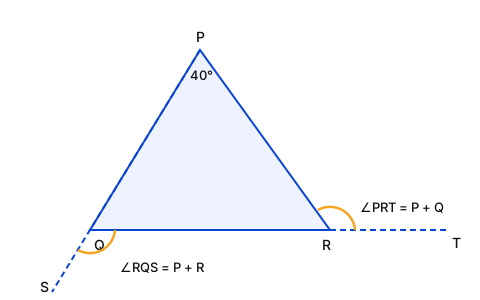
Sides PQ and QR of a ∆PQR are produced to points S and T. If ∠PRT > ∠RQS > 50o and ∠PRT + ∠RQS = 220o, which of the following statements is true?
∆PQR की भुजाओं PQ और QR को क्रमशः बिंदुओं S और T तक बढ़ाया गया है। यदि ∠PRT > ∠RQS > 50o और ∠PRT + ∠RQS = 220o है, तो निम्नलिखित में से कौन-सा कथन सत्य है?
  1. APR < PQ < QR
  2. BQR < PR < PQ
  3. CPQ < PR < QR
  4. DQR < PQ < PR
Show answer

Concept: Exterior angle = sum of the two interior opposite angles; in a triangle the larger angle faces the larger side.

  1. ∠PRT=P+Q, ∠RQS=P+R
  2. Sum: 2P+Q+R=180∘+P=220∘⇒P=40∘, Q+R=140∘
  3. ∠PRT>∠RQS⇒Q>R, so Q>70∘: Q is the largest angle → PR is the largest side
  4. Only option (D) has PR largest; it holds with P<R<Q, giving QR<PQ<PR

Trick: Side opposite an angle carries the other two letters: angle Q ↔ side PR.

Answer: (D) QR<PQ<PR

अवधारणा: बहिष्कोण = दो अंतः सम्मुख कोणों का योग; त्रिभुज में बड़े कोण के सामने बड़ी भुजा होती है।

  1. ∠PRT=P+Q, ∠RQS=P+R
  2. योग: 2P+Q+R=180∘+P=220∘⇒P=40∘, Q+R=140∘
  3. ∠PRT>∠RQS⇒Q>R, अतः Q>70∘: Q सबसे बड़ा कोण → PR सबसे बड़ी भुजा
  4. केवल विकल्प (D) में PR सबसे बड़ी है; P<R<Q से QR<PQ<PR

ट्रिक: कोण के सामने वाली भुजा में बाकी दो अक्षर होते हैं: कोण Q ↔ भुजा PR.

उत्तर: (D) QR<PQ<PR

RRB NTPC Undergraduate CBT 1MathematicsExterior Angles & Side–Angle RelationRRB NTPC Undergraduate CBT 1 2025 · 18 Jun Shift 3 →
Q6250.
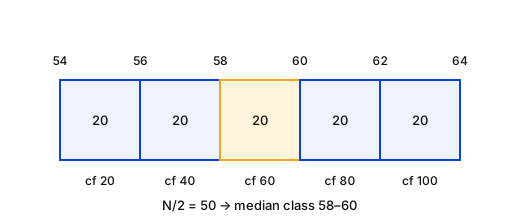
The frequency distribution of the hourly wage rates of 100 employees of a paper mill is as follows. Find the median wage rate (in ₹).
Wage rate (in ₹)54–5656–5858–6060–6262–64
Number of workers2020202020
एक पेपर मिल के 100 कर्मचारियों की प्रति घंटा मज़दूरी दरों का बारंबारता बंटन निम्नानुसार है। माध्यिका मज़दूरी दर (₹ में) ज्ञात कीजिए।
मज़दूरी दर (₹ में)54–5656–5858–6060–6262–64
श्रमिकों की संख्या2020202020
  1. A56.3
  2. B58.9
  3. C59
  4. D56.8
Show answer

Concept: Median =l+N2−cff×h.

  1. N=100, N2=50; cumulative frequencies 20, 40, 60, … → median class 58–60
  2. l=58, cf=40, f=20, h=2
  3. Median =58+50−4020×2=58+1=59

Trick: Equal frequencies in equal classes → median is simply the middle of the whole range: 54+642=59.

Answer: (C) 59

अवधारणा: माध्यिका =l+N2−cff×h.

  1. N=100, N2=50; संचयी बारंबारता 20, 40, 60, … → माध्यिका वर्ग 58–60
  2. l=58, cf=40, f=20, h=2
  3. माध्यिका =58+50−4020×2=58+1=59

ट्रिक: सभी वर्गों की बारंबारता समान हो तो माध्यिका पूरे परिसर का मध्य: 54+642=59.

उत्तर: (C) 59

RRB NTPC Undergraduate CBT 1MathematicsMedian of Grouped DataRRB NTPC Undergraduate CBT 1 2025 · 18 Jun Shift 3 →
Q6251.
Two taps can fill a cistern in 4 hours and 15 hours, respectively. A third tap can empty it in 15 hours. How long (in hours) will it take to fill one-fourth of the empty cistern if all the taps are opened together?
दो नल एक टंकी को क्रमशः 4 घंटे और 15 घंटे में भर सकते हैं। एक तीसरा नल इसे 15 घंटे में खाली कर सकता है। यदि सभी नल एक साथ खोल दिए जाएँ, तो खाली टंकी के एक-चौथाई भाग को भरने में कितना समय (घंटों में) लगेगा?
  1. A1
  2. B3
  3. C4
  4. D2
Show answer

Concept: Net work per hour = sum of filling rates − emptying rate.

  1. Net rate =14+115−115=14 per hour
  2. Time for 14 cistern =14÷14=1 hour

Trick: Second and third taps have equal rates and cancel — only the 4-hour tap matters.

Answer: (A) 1

अवधारणा: प्रति घंटा शुद्ध कार्य = भरने की दरों का योग − खाली करने की दर।

  1. शुद्ध दर =14+115−115=14 प्रति घंटा
  2. 14 टंकी का समय =14÷14=1 घंटा

ट्रिक: दूसरा और तीसरा नल बराबर दर से एक-दूसरे को काट देते हैं — केवल 4 घंटे वाला नल बचता है।

उत्तर: (A) 1

RRB NTPC Undergraduate CBT 1MathematicsPipes and CisternsRRB NTPC Undergraduate CBT 1 2025 · 18 Jun Shift 3 →
Q6252.
A stationery shop sells notebooks and pens. The cost of 4 notebooks and 6 pens is ₹228. The cost of 7 notebooks and 6 pens is ₹333. Find the cost of one notebook.
एक स्टेशनरी की दुकान नोटबुक और पेन बेचती है। 4 नोटबुक और 6 पेन का मूल्य ₹228 है। 7 नोटबुक और 6 पेन का मूल्य ₹333 है। एक नोटबुक का मूल्य ज्ञात कीजिए।
  1. A₹ 35
  2. B₹ 37.50
  3. C₹ 32
  4. D₹ 39
Show answer

Concept: Subtract equations having the same pen term to eliminate it.

  1. 4n+6p=228 and 7n+6p=333
  2. Subtract: 3n=105⇒n=35

Trick: Same number of pens in both → extra 3 notebooks cost 333−228=105.

Answer: (A) ₹ 35

अवधारणा: जिन समीकरणों में पेन का पद समान है उन्हें घटाकर उसे हटाएँ।

  1. 4n+6p=228 तथा 7n+6p=333
  2. घटाने पर: 3n=105⇒n=35

ट्रिक: दोनों में पेन बराबर → 3 अतिरिक्त नोटबुक का मूल्य 333−228=105.

उत्तर: (A) ₹ 35

RRB NTPC Undergraduate CBT 1MathematicsLinear EquationsRRB NTPC Undergraduate CBT 1 2025 · 18 Jun Shift 3 →
Q6253.
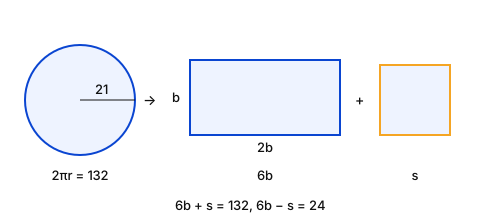
A string initially in the shape of a circle with a radius of 21 cm is cut into two distinct pieces. The first piece is reshaped into a rectangle where the length is twice its breadth, while the second piece is formed into a square. If the perimeter of the rectangle is 24 cm greater than the perimeter of the square, find the breadth of the rectangle. [Use π = 22/7]
एक डोरी, जो प्रारंभ में 21 cm त्रिज्या वाले वृत्त के आकार में है, को दो भिन्न टुकड़ों में काटा जाता है। पहले टुकड़े को एक ऐसे आयत का आकार दिया जाता है जिसकी लंबाई उसकी चौड़ाई की दोगुनी है, जबकि दूसरे टुकड़े से एक वर्ग बनाया जाता है। यदि आयत का परिमाप वर्ग के परिमाप से 24 cm अधिक है, तो आयत की चौड़ाई ज्ञात कीजिए। [π = 22/7 का प्रयोग कीजिए]
  1. A26 cm
  2. B13 cm
  3. C4 cm
  4. D4.25 cm
Show answer

Concept: Total string length = circumference; it is shared by the rectangle and square perimeters.

  1. Length =2πr=2×227×21=132cm
  2. Rectangle: l=2b⇒ perimeter =2(2b+b)=6b; square perimeter =s
  3. 6b+s=132 and 6b−s=24⇒12b=156⇒b=13cm

Trick: Sum and difference given → bigger part =132+242=78=6b, so b=13.

Answer: (B) 13 cm

अवधारणा: धागे की कुल लंबाई = वृत्त की परिधि; यही आयत और वर्ग के परिमापों में बँटती है।

  1. लंबाई =2πr=2×227×21=132cm
  2. आयत: l=2b⇒ परिमाप =2(2b+b)=6b; वर्ग का परिमाप =s
  3. 6b+s=132 और 6b−s=24⇒12b=156⇒b=13cm

ट्रिक: योग और अंतर दिए हों → बड़ा भाग =132+242=78=6b, अतः b=13.

उत्तर: (B) 13 cm

RRB NTPC Undergraduate CBT 1MathematicsPerimeter (Circle, Rectangle, Square)RRB NTPC Undergraduate CBT 1 2025 · 18 Jun Shift 3 →
Q6254.
What is the mean proportional between 0.16 and 0.49?
0.16 और 0.49 के बीच मध्यानुपाती क्या है?
  1. A0.24
  2. B0.26
  3. C0.28
  4. D0.21
Show answer

Concept: Mean proportional of a,b =ab.

  1. 0.16×0.49=0.16×0.49
  2. =0.4×0.7=0.28

Trick: Both are perfect squares — take roots separately and multiply.

Answer: (C) 0.28

अवधारणा: a,b का मध्यानुपाती =ab.

  1. 0.16×0.49=0.16×0.49
  2. =0.4×0.7=0.28

ट्रिक: दोनों पूर्ण वर्ग हैं — अलग-अलग मूल लेकर गुणा करें।

उत्तर: (C) 0.28

RRB NTPC Undergraduate CBT 1MathematicsMean ProportionalRRB NTPC Undergraduate CBT 1 2025 · 18 Jun Shift 3 →
Q6255.
A trader sells goods at a 15% profit but uses a weight of 950 grams for a kilogram. What is his total profit percentage? (Correct to two decimal places.)
एक व्यापारी 15% लाभ पर सामान बेचता है, लेकिन एक किलोग्राम के लिए 950 ग्राम के बाट का उपयोग करता है। उसका कुल लाभ प्रतिशत क्या है? (दो दशमलव स्थानों तक सही।)
  1. A18.95%
  2. B20%
  3. C21.05%
  4. D25%
Show answer

Concept: Effective SP/CP ratio =(1+profit)×true weightfalse weight.

  1. He charges for 1000 g at 115% but gives only 950 g
  2. Ratio =1.15×1000950=1150950=1.2105
  3. Profit ≈21.05%

Trick: Use 1000×(100+15)950−100=21.05% directly.

Answer: (C) 21.05%

अवधारणा: प्रभावी विक्रय/क्रय अनुपात =(1+लाभ)×सही भारगलत भार.

  1. वह 1000 g का 115% लेता है पर देता केवल 950 g
  2. अनुपात =1.15×1000950=1150950=1.2105
  3. लाभ ≈21.05%

ट्रिक: सीधे 1000×(100+15)950−100=21.05%.

उत्तर: (C) 21.05%

RRB NTPC Undergraduate CBT 1MathematicsProfit with False WeightRRB NTPC Undergraduate CBT 1 2025 · 18 Jun Shift 3 →
Q6256.
The cost of an article is increased by 20% in the first year. In the second year the increased cost is decreased by 24%. If the final cost of the article is ₹1,938, find the original cost of the article.
किसी वस्तु के मूल्य में पहले वर्ष 20% की वृद्धि की जाती है। दूसरे वर्ष में बढ़े हुए मूल्य में 24% की कमी की जाती है। यदि वस्तु का अंतिम मूल्य ₹1,938 है, तो वस्तु का मूल मूल्य ज्ञात कीजिए।
  1. A₹2,160
  2. B₹2,196
  3. C₹2,125
  4. D₹2,148
Show answer

Concept: Final = Original ×(1+r1)(1−r2).

  1. Factor =1.20×0.76=0.912
  2. Original =19380.912=2125

Trick: Check option: 2125×1.2=2550, 2550×0.76=1938. ✔

Answer: (C) ₹2,125

अवधारणा: अंतिम = मूल ×(1+r1)(1−r2).

  1. गुणक =1.20×0.76=0.912
  2. मूल =19380.912=2125

ट्रिक: विकल्प जाँचें: 2125×1.2=2550, 2550×0.76=1938. ✔

उत्तर: (C) ₹2,125

RRB NTPC Undergraduate CBT 1MathematicsSuccessive Percentage ChangeRRB NTPC Undergraduate CBT 1 2025 · 18 Jun Shift 3 →
Q6257.
The HCF and LCM of two numbers are 27 and 324, respectively. If one number is 81, find the other number.
दो संख्याओं का HCF और LCM क्रमशः 27 और 324 है। यदि एक संख्या 81 है, तो दूसरी संख्या ज्ञात कीजिए।
  1. A108
  2. B96
  3. C120
  4. D84
Show answer

Concept: Product of two numbers = HCF × LCM.

  1. Other number =27×32481
  2. =874881=108

Trick: Check: HCF(81, 108) =27 and LCM =324. ✔

Answer: (A) 108

अवधारणा: दो संख्याओं का गुणनफल = म.स. × ल.स.

  1. दूसरी संख्या =27×32481
  2. =874881=108

ट्रिक: जाँच: म.स.(81, 108) =27, ल.स. =324. ✔

उत्तर: (A) 108

RRB NTPC Undergraduate CBT 1MathematicsHCF and LCMRRB NTPC Undergraduate CBT 1 2025 · 18 Jun Shift 3 →
Q6258.
Rajiv invested a certain sum of money at 10% per annum. After 2 years, he received ₹199.5 as compound interest, compounded annually. Find the corresponding simple interest (in ₹) for 2 years at the same rate.
राजीव ने एक निश्चित धनराशि 10% वार्षिक दर पर निवेश की। 2 वर्ष बाद, उसे वार्षिक रूप से संयोजित चक्रवृद्धि ब्याज के रूप में ₹199.5 प्राप्त हुए। समान दर पर 2 वर्ष के लिए संगत साधारण ब्याज (₹ में) ज्ञात कीजिए।
  1. A200
  2. B190
  3. C205
  4. D185
Show answer

Concept: For 2 years at r%: CI = SI + interest on interest; at 10%, CI =21% of P, SI =20% of P.

  1. 0.21P=199.5⇒P=950
  2. SI =950×10×2100=190

Trick: SI : CI for 2 years at 10% =20:21 → SI =199.5×2021=190.

Answer: (B) 190

अवधारणा: 2 वर्ष, r% पर: CI = SI + ब्याज पर ब्याज; 10% पर CI = P का 21%, SI = P का 20%.

  1. 0.21P=199.5⇒P=950
  2. SI =950×10×2100=190

ट्रिक: 10% पर 2 वर्ष का SI : CI =20:21 → SI =199.5×2021=190.

उत्तर: (B) 190

RRB NTPC Undergraduate CBT 1MathematicsCompound vs Simple InterestRRB NTPC Undergraduate CBT 1 2025 · 18 Jun Shift 3 →
Q6259.
A teacher records the number of books read by each student in a month: 3, 5, 2, 3, 4, 5, 3, 2, 5, 5. What is the mode of this data set?
एक शिक्षक एक महीने में प्रत्येक छात्र द्वारा पढ़ी गई पुस्तकों की संख्या दर्ज करता है: 3, 5, 2, 3, 4, 5, 3, 2, 5, 5। इस आँकड़ा समुच्चय का बहुलक क्या है?
  1. A3
  2. B2
  3. C5
  4. D4
Show answer

Concept: Mode is the value that occurs most often.

  1. Counts: 2 → 2 times, 3 → 3 times, 4 → 1 time, 5 → 4 times
  2. Highest frequency is for 5

Trick: Tally quickly; the most repeated value wins.

Answer: (C) 5

अवधारणा: बहुलक वह मान है जो सबसे अधिक बार आता है।

  1. गिनती: 2 → 2 बार, 3 → 3 बार, 4 → 1 बार, 5 → 4 बार
  2. सर्वाधिक बारंबारता 5 की है

ट्रिक: मिलान चिह्न लगाएँ; सबसे अधिक दोहराया मान बहुलक।

उत्तर: (C) 5

RRB NTPC Undergraduate CBT 1MathematicsModeRRB NTPC Undergraduate CBT 1 2025 · 18 Jun Shift 3 →
Q6260.
If xx+1+x+1x=52, then find x.
यदि xx+1+x+1x=52 है, तो x ज्ञात कीजिए।
  1. A0 or -10 या -1
  2. B-1 or 2-1 या 2
  3. C0 or 10 या 1
  4. D1 or -21 या -2
Show answer

Concept: Put t=xx+1; then t+1t=52⇒t=2 or t=12.

  1. xx+1=2⇒x=2x+2⇒x=−2
  2. xx+1=12⇒2x=x+1⇒x=1

Trick: t+1t=52=2+12 — read the two values of t directly.

Answer: (D) 1 or −2

अवधारणा: t=xx+1 रखें; तब t+1t=52⇒t=2 या t=12.

  1. xx+1=2⇒x=2x+2⇒x=−2
  2. xx+1=12⇒2x=x+1⇒x=1

ट्रिक: t+1t=52=2+12 — t के दोनों मान सीधे पढ़ें।

उत्तर: (D) 1 या −2

RRB NTPC Undergraduate CBT 1MathematicsEquations (Reciprocal Form)RRB NTPC Undergraduate CBT 1 2025 · 18 Jun Shift 3 →