Question bank

Q&A: practice questions with answers

Search questions on any topic. Filter by exam category, exam, subject and topic, try the question, then open the answer and explanation.

Courses – airGurukul

8,495 questions found.

Q6261.
Harish bought an article for ₹347 and sold it to Renu at a loss of 6%. With this amount, Harish bought another article and sold it at a gain of 65%. What is Harish's overall gain percentage?
हरीश ने एक वस्तु ₹347 में खरीदी और उसे 6% की हानि पर रेणु को बेच दिया। इस राशि से हरीश ने एक अन्य वस्तु खरीदी और उसे 65% के लाभ पर बेच दिया। हरीश का कुल लाभ प्रतिशत क्या है?
  1. A53.1%
  2. B50.9%
  3. C51.8%
  4. D55.1%
Show answer

Concept: Overall factor = product of individual factors.

  1. After 6% loss: factor 0.94; after 65% gain: factor 1.65
  2. Overall =0.94×1.65=1.551
  3. Gain =55.1% (₹347 → ₹538.20)

Trick: −6+65−6×65100=59−3.9=55.1%.

Answer: (D) 55.1%

अवधारणा: कुल गुणक = अलग-अलग गुणकों का गुणनफल।

  1. 6% हानि: गुणक 0.94; 65% लाभ: गुणक 1.65
  2. कुल =0.94×1.65=1.551
  3. लाभ =55.1% (₹347 → ₹538.20)

ट्रिक: −6+65−6×65100=59−3.9=55.1%.

उत्तर: (D) 55.1%

RRB NTPC Undergraduate CBT 1MathematicsSuccessive Profit and LossRRB NTPC Undergraduate CBT 1 2025 · 18 Jun Shift 3 →
Q6262.
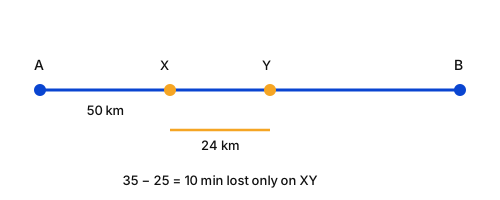
A train met with an accident 50 km away from station A. It completed the remaining journey at three-fourth of its original speed and reached station B 35 minutes late. Had the accident occurred 24 km further down the line, it would have been only 25 minutes late. What is the original speed of the train?
एक ट्रेन स्टेशन A से 50 km दूर दुर्घटनाग्रस्त हो गई। उसने शेष यात्रा अपनी मूल चाल की तीन-चौथाई चाल से पूरी की और स्टेशन B पर 35 मिनट देरी से पहुँची। यदि दुर्घटना लाइन पर 24 km और आगे हुई होती, तो वह केवल 25 मिनट देरी से पहुँचती। ट्रेन की मूल चाल क्या है?
  1. A60 km/hr
  2. B40 km/hr
  3. C45 km/hr
  4. D48 km/hr
Show answer

Concept: The two cases differ only on the extra 24 km, which is run at full speed in case 2 instead of 34 speed.

  1. Time saved =35−25=10 min =16 h
  2. 2434v−24v=32v−24v=8v
  3. 8v=16⇒v=48km/h

Trick: At 34 speed time becomes 43, i.e. extra 13 of normal time: 13×24v=16.

Answer: (D) 48 km/hr

अवधारणा: दोनों स्थितियों में अंतर केवल अतिरिक्त 24 km का है, जो दूसरी स्थिति में पूरी चाल से चलती है, 34 चाल से नहीं।

  1. बचा समय =35−25=10 मिनट =16 घंटा
  2. 2434v−24v=32v−24v=8v
  3. 8v=16⇒v=48km/h

ट्रिक: 34 चाल पर समय 43 गुना, यानी सामान्य समय का 13 अधिक: 13×24v=16.

उत्तर: (D) 48 km/hr

RRB NTPC Undergraduate CBT 1MathematicsTrain Delay ProblemsRRB NTPC Undergraduate CBT 1 2025 · 18 Jun Shift 3 →
Q6263.
The price of fuel decreases by 45%, 50% and 25% in three successive months, but increases by 65% in the fourth month. What is the percentage decrease in the price of fuel in the fourth month as compared to its original price? (Round off to 2 decimal places.)
ईंधन के मूल्य में तीन क्रमिक महीनों में 45%, 50% और 25% की कमी होती है, लेकिन चौथे महीने में 65% की वृद्धि होती है। मूल मूल्य की तुलना में चौथे महीने में ईंधन के मूल्य में कितने प्रतिशत की कमी हुई है? (2 दशमलव स्थानों तक पूर्णांकित कीजिए।)
  1. A69.13%
  2. B65.97%
  3. C67.46%
  4. D70.35%
Show answer

Concept: Multiply the factors of all changes.

  1. Factor =0.55×0.50×0.75×1.65
  2. =0.275×0.75×1.65=0.20625×1.65=0.3403
  3. Decrease =100−34.03=65.97%

Trick: Take original = 100: 55 → 27.5 → 20.625 → 34.03.

Answer: (B) 65.97%

अवधारणा: सभी परिवर्तनों के गुणक गुणा करें।

  1. गुणक =0.55×0.50×0.75×1.65
  2. =0.275×0.75×1.65=0.20625×1.65=0.3403
  3. कमी =100−34.03=65.97%

ट्रिक: मूल = 100 लें: 55 → 27.5 → 20.625 → 34.03.

उत्तर: (B) 65.97%

RRB NTPC Undergraduate CBT 1MathematicsSuccessive Percentage ChangeRRB NTPC Undergraduate CBT 1 2025 · 18 Jun Shift 3 →
Q6264.
Pipe X can fill a reservoir in 15 hours and pipe Y can empty it in 20 hours. If both pipes are opened simultaneously and pipe Y is closed after 10 hours, find the total time to fill the reservoir.
पाइप X एक जलाशय को 15 घंटे में भर सकता है और पाइप Y इसे 20 घंटे में खाली कर सकता है। यदि दोनों पाइप एक साथ खोले जाते हैं और पाइप Y को 10 घंटे बाद बंद कर दिया जाता है, तो जलाशय को भरने में लगा कुल समय ज्ञात कीजिए।
  1. A23 hours23 घंटे
  2. B23.5 hours23.5 घंटे
  3. C24 hours24 घंटे
  4. D22.5 hours22.5 घंटे
Show answer

Concept: Work done = rate × time; filling pipe positive, emptying pipe negative.

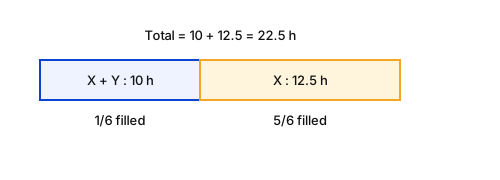
  1. Both for 10 h: 10(115−120)=10×160=16
  2. Remaining 56 by X: 56×15=12.5 h
  3. Total =10+12.5=22.5 h

Trick: LCM capacity 60 units: X =+4, Y =−3; 10 h → 10 units; remaining 50 units ÷4=12.5 h.

Answer: (D) 22.5 hours

अवधारणा: कार्य = दर × समय; भरने वाला पाइप धनात्मक, खाली करने वाला ऋणात्मक।

  1. दोनों 10 घंटे: 10(115−120)=10×160=16
  2. शेष 56 X से: 56×15=12.5 घंटे
  3. कुल =10+12.5=22.5 घंटे

ट्रिक: ल.स. क्षमता 60 इकाई: X =+4, Y =−3; 10 घंटे → 10 इकाई; शेष 50 इकाई ÷4=12.5 घंटे।

उत्तर: (D) 22.5 घंटे

RRB NTPC Undergraduate CBT 1MathematicsPipes and CisternsRRB NTPC Undergraduate CBT 1 2025 · 18 Jun Shift 3 →
Q6265.
If the ratio of two numbers is 4 : 1, and their HCF is 47, then their LCM is:
यदि दो संख्याओं का अनुपात 4 : 1 है, और उनका HCF 47 है, तो उनका LCM क्या है?
  1. A376
  2. B188
  3. C412
  4. D406
Show answer

Concept: Numbers in ratio a:b (co-prime) with HCF h are ha,hb; LCM =h×a×b.

  1. Numbers: 47×4=188 and 47×1=47
  2. LCM =47×4×1=188

Trick: When one number divides the other, LCM is the bigger number.

Answer: (B) 188

अवधारणा: अनुपात a:b (सहअभाज्य) व म.स. h हो तो संख्याएँ ha,hb; ल.स. =h×a×b.

  1. संख्याएँ: 47×4=188 और 47×1=47
  2. ल.स. =47×4×1=188

ट्रिक: जब एक संख्या दूसरी को विभाजित करे, ल.स. बड़ी संख्या होती है।

उत्तर: (B) 188

RRB NTPC Undergraduate CBT 1MathematicsHCF and LCMRRB NTPC Undergraduate CBT 1 2025 · 18 Jun Shift 3 →
Q6266.
In a certain code language, ‘CHIN’ is coded as ‘9413’ and ‘NICE’ is coded as ‘2319’. What is the code for ‘E’ in that language?
एक निश्चित कूट भाषा में, ‘CHIN’ को ‘9413’ और ‘NICE’ को ‘2319’ के रूप में कूटबद्ध किया जाता है। उस भाषा में ‘E’ का कूट क्या है?
  1. A1
  2. B9
  3. C3
  4. D2
Show answer

Concept: Letters common to two words share the common codes (order is jumbled).

  1. CHIN → {9, 4, 1, 3}; NICE → {2, 3, 1, 9}.
  2. Common letters C, I, N ↔ common codes 9, 1, 3.
  3. Left-over in NICE: E ↔ 2 (and H ↔ 4).

Trick: Remove common codes; the leftover code belongs to the leftover letter.

Answer: (D) 2

अवधारणा: दो शब्दों के उभयनिष्ठ अक्षरों के कोड भी उभयनिष्ठ होते हैं (क्रम बदला हुआ)।

  1. CHIN → {9, 4, 1, 3}; NICE → {2, 3, 1, 9}।
  2. उभयनिष्ठ अक्षर C, I, N ↔ उभयनिष्ठ कोड 9, 1, 3।
  3. NICE में बचा E ↔ 2 (और H ↔ 4)।

ट्रिक: उभयनिष्ठ कोड हटाइए; बचा कोड बचे अक्षर का है।

उत्तर: (D) 2

RRB NTPC Undergraduate CBT 1General Intelligence and ReasoningCoding–decodingRRB NTPC Undergraduate CBT 1 2025 · 18 Jun Shift 3 →
Q6267.
What should come in place of the question mark (?) in the given series based on the English alphabetical order?
ZEK UZF PUA KPV ?
अंग्रेज़ी वर्णमाला क्रम के आधार पर दी गई शृंखला में प्रश्न चिह्न (?) के स्थान पर क्या आना चाहिए?
ZEK UZF PUA KPV ?
  1. ADKR
  2. BPFY
  3. CFKQ
  4. DEGP
Show answer

Concept: Check each letter position separately across the terms.

  1. 1st letters: Z, U, P, K, F (each −5).
  2. 2nd letters: E, Z, U, P, K (each −5).
  3. 3rd letters: K, F, A, V, Q (each −5, wrapping A → V).

Trick: Each term's 1st letter = previous term's 2nd letter, so the answer starts F, K.

Answer: (C) FKQ

अवधारणा: हर स्थान के अक्षर को अलग-अलग जाँचें।

  1. पहले अक्षर: Z, U, P, K, F (हर बार −5)।
  2. दूसरे अक्षर: E, Z, U, P, K (हर बार −5)।
  3. तीसरे अक्षर: K, F, A, V, Q (हर बार −5, A के बाद V पर लौटकर)।

ट्रिक: हर पद का पहला अक्षर = पिछले पद का दूसरा अक्षर, अतः उत्तर F, K से शुरू।

उत्तर: (C) FKQ

RRB NTPC Undergraduate CBT 1General Intelligence and ReasoningLetter seriesRRB NTPC Undergraduate CBT 1 2025 · 18 Jun Shift 3 →
Q6268.
If ‘A’ stands for ‘÷’, ‘B’ stands for ‘x’, ‘C’ stands for ‘+’ and ‘D’ stands for ‘−’, then the resultant of which of the following would be 4?
यदि ‘A’ का अर्थ ‘÷’, ‘B’ का अर्थ ‘x’, ‘C’ का अर्थ ‘+’ और ‘D’ का अर्थ ‘−’ है, तो निम्नलिखित में से किसका परिणाम 4 होगा?
  1. A85 B 5 D 7 C 5 A 22
  2. B85 C 5 D 7 A 5 B 22
  3. C85 A 5 D 7 B 5 C 22
  4. D85 D 5 A 7 B 5 C 22
Show answer

Concept: Replace letters with signs (A ÷, B ×, C +, D −) and apply BODMAS.

  1. (C): 85÷5−7×5+22
  2. =17−35+22=4 ✓
  3. (A) =425−7+522≠4; (B) =85+5−75×22≠4; (D) =85−57×5+22≠4.

Trick: Look for an option where division gives a whole number (85÷5=17).

Answer: (C) 85÷5−7×5+22=4

अवधारणा: अक्षरों को चिह्नों से बदलें (A ÷, B ×, C +, D −) और BODMAS लगाएँ।

  1. (C): 85÷5−7×5+22
  2. =17−35+22=4 ✓
  3. (A) =425−7+522≠4; (B) =85+5−75×22≠4; (D) =85−57×5+22≠4।

ट्रिक: ऐसा विकल्प देखें जिसमें भाग पूर्णांक दे (85÷5=17)।

उत्तर: (C) 85÷5−7×5+22=4

RRB NTPC Undergraduate CBT 1General Intelligence and ReasoningMathematical operationsRRB NTPC Undergraduate CBT 1 2025 · 18 Jun Shift 3 →
Q6269.
Based on the English alphabetical order, three of the following four letter-cluster pairs are alike in a certain way and thus form a group. Which is the one that does not belong to that group?
(Note: The odd one out is not based on the number of consonants/vowels or their position in the letter-cluster.)
अंग्रेज़ी वर्णमाला क्रम के आधार पर, निम्नलिखित चार अक्षर-समूह युग्मों में से तीन किसी निश्चित प्रकार से एकसमान हैं और इस प्रकार एक समूह बनाते हैं। कौन-सा युग्म उस समूह से संबंधित नहीं है?
(ध्यान दें: असंगत युग्म, व्यंजनों/स्वरों की संख्या या अक्षर-समूह में उनके स्थान पर आधारित नहीं है।)
  1. AGJ - FI
  2. BKN - HU
  3. CPS - OR
  4. DOR - NQ
Show answer

Concept: Compare letter positions within and between the clusters.

  1. GJ – FI: G+3=J, F+3=I, and G−1=F ✓
  2. PS – OR and OR – NQ follow the same +3 / −1 pattern ✓
  3. KN – HU: K+3=N but H+13=U (and K−3=H) ✗

Trick: Check the gap inside the second cluster first – only HU breaks the +3 gap.

Answer: (B) KN - HU

अवधारणा: क्लस्टर के अंदर और दोनों क्लस्टरों के बीच अक्षरों की स्थिति की तुलना करें।

  1. GJ – FI: G+3=J, F+3=I, तथा G−1=F ✓
  2. PS – OR और OR – NQ में भी वही +3 / −1 पैटर्न ✓
  3. KN – HU: K+3=N पर H+13=U (और K−3=H) ✗

ट्रिक: पहले दूसरे क्लस्टर का अंतर देखें – केवल HU में +3 नहीं है।

उत्तर: (B) KN - HU

RRB NTPC Undergraduate CBT 1General Intelligence and ReasoningOdd one out – letter pairsRRB NTPC Undergraduate CBT 1 2025 · 18 Jun Shift 3 →
Q6270.
In a certain code language, ‘uncle steak gum’ is coded as 'xl wc iv' and ‘sir gum barn’ is coded as ‘wc mn ut’. How is ‘gum’ coded in the given language?
एक निश्चित कूट भाषा में, ‘uncle steak gum’ को 'xl wc iv' और ‘sir gum barn’ को ‘wc mn ut’ के रूप में कूटबद्ध किया जाता है। दी गई भाषा में ‘gum’ को किस प्रकार कूटबद्ध किया जाता है?
  1. Amn
  2. Biv
  3. Cxl
  4. Dwc
Show answer

Concept: A word common to two sentences takes the code common to both.

  1. ‘uncle steak gum’ → xl wc iv; ‘sir gum barn’ → wc mn ut.
  2. Common word: gum; common code: wc.
  3. So gum = wc.

Trick: Common word ↔ common code.

Answer: (D) wc

अवधारणा: दो वाक्यों में उभयनिष्ठ शब्द का कोड दोनों में उभयनिष्ठ होता है।

  1. ‘uncle steak gum’ → xl wc iv; ‘sir gum barn’ → wc mn ut।
  2. उभयनिष्ठ शब्द: gum; उभयनिष्ठ कोड: wc।
  3. अतः gum = wc।

ट्रिक: उभयनिष्ठ शब्द ↔ उभयनिष्ठ कोड।

उत्तर: (D) wc

RRB NTPC Undergraduate CBT 1General Intelligence and ReasoningCoding–decoding – wordsRRB NTPC Undergraduate CBT 1 2025 · 18 Jun Shift 3 →
Q6271.
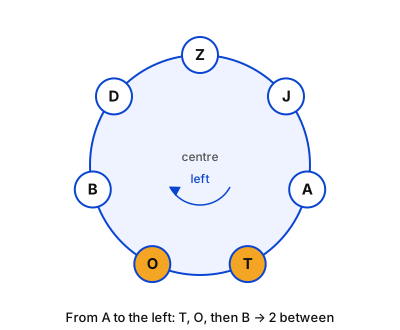
A, B, D, J, O, T and Z are sitting around a circular table facing the center. Exactly three people sit between Z and T when counted from the right of Z. B sits second to the left of T. A sits immediately to the left of J. D is not an immediate neighbor of T. How many people sit between B and A when counted from the left of A?
A, B, D, J, O, T और Z एक वृत्ताकार मेज़ के चारों ओर केंद्र की ओर मुख करके बैठे हैं। Z के दाईं ओर से गिनने पर Z और T के बीच ठीक तीन व्यक्ति बैठे हैं। B, T के बाईं ओर दूसरे स्थान पर बैठा है। A, J के ठीक बाईं ओर बैठा है। D, T का निकटतम पड़ोसी नहीं है। A के बाईं ओर से गिनने पर B और A के बीच कितने व्यक्ति बैठे हैं?
  1. AFourचार
  2. BTwoदो
  3. COneएक
  4. DThreeतीन
Show answer

Concept: Facing the centre, a person's left is the clockwise direction.

  1. Fix Z; three people between Z and T counting from Z's right → T is fourth to the right of Z (third to the left).
  2. B is second to the left of T.
  3. Empty seats: two between Z and T (on Z's left), one between T and B, one between B and Z. A immediately left of J needs two adjacent seats → J, A sit between Z and T.
  4. D cannot be next to T → D is beside Z on the right; O sits between T and B.
  5. From A going left: T, O, then B → 2 people.

Trick: In a circle of 7, “3 between on one side” means 2 between on the other side.

Answer: (B) Two

अवधारणा: केंद्र की ओर मुख होने पर व्यक्ति का बायाँ = दक्षिणावर्त (clockwise) दिशा।

  1. Z को स्थिर करें; Z के दाएँ से गिनने पर Z और T के बीच तीन व्यक्ति → T, Z के दाएँ चौथे (बाएँ तीसरे) स्थान पर।
  2. B, T के बाएँ दूसरे स्थान पर।
  3. A, J के ठीक बाएँ – यह जोड़ी केवल Z के बाईं ओर के दो स्थानों में बैठती है: J, फिर A।
  4. D, T का पड़ोसी नहीं → D, Z के दाएँ; O, T और B के बीच।
  5. A से बाईं ओर: T, O, फिर B → 2 व्यक्ति।

ट्रिक: 7 के वृत्त में एक ओर “3 बीच में” = दूसरी ओर 2 बीच में।

उत्तर: (B) दो (Two)

RRB NTPC Undergraduate CBT 1General Intelligence and ReasoningCircular seating arrangementRRB NTPC Undergraduate CBT 1 2025 · 18 Jun Shift 3 →
Q6272.
CZAZ is related to VSTS in a certain way based on the English alphabetical order. In the same way, EBCB is related to XUVU. To which of the following is GDED related, following the same logic?
अंग्रेज़ी वर्णमाला क्रम के आधार पर CZAZ एक निश्चित प्रकार से VSTS से संबंधित है। उसी प्रकार, EBCB, XUVU से संबंधित है। समान तर्क का अनुसरण करते हुए, GDED निम्नलिखित में से किससे संबंधित है?
  1. AZWWW
  2. BZXWA
  3. CZVWW
  4. DZWXW
Show answer

Concept: Find the shift applied to each letter.

  1. CZAZ → VSTS: C−7=V, Z−7=S, A−7=T, Z−7=S.
  2. EBCB → XUVU: every letter −7 again ✓
  3. GDED: G−7=Z, D−7=W, E−7=X, D−7=W → ZWXW.

Trick: Same letter in the word (Z, B, D) → same letter in the code; only ZWXW keeps 2nd = 4th with a different 3rd.

Answer: (D) ZWXW

अवधारणा: हर अक्षर पर लगा खिसकाव (shift) निकालें।

  1. CZAZ → VSTS: C−7=V, Z−7=S, A−7=T, Z−7=S।
  2. EBCB → XUVU: फिर हर अक्षर −7 ✓
  3. GDED: G−7=Z, D−7=W, E−7=X, D−7=W → ZWXW।

ट्रिक: शब्द में समान अक्षर (Z, B, D) → कोड में समान अक्षर; केवल ZWXW में दूसरा = चौथा और तीसरा अलग।

उत्तर: (D) ZWXW

RRB NTPC Undergraduate CBT 1General Intelligence and ReasoningLetter analogyRRB NTPC Undergraduate CBT 1 2025 · 18 Jun Shift 3 →
Q6273.
Select the set in which the numbers are related in the same way as are the numbers of the following sets.
(NOTE: Operations should be performed on the whole numbers, without breaking down the numbers into their constituent digits. E.g. 13 – Operations on 13 such as
adding/subtracting/multiplying etc. to 13 can be performed. Breaking down 13 into 1 and 3 and then performing mathematical operations on 1 and 3 is not allowed.) (17, 4, 204)
(19, 5, 285)
उस समुच्चय का चयन कीजिए जिसमें संख्याएँ उसी प्रकार संबंधित हैं, जिस प्रकार निम्नलिखित समुच्चयों की संख्याएँ संबंधित हैं।
(ध्यान दें: संख्याओं को उनके घटक अंकों में विभाजित किए बिना, पूर्ण संख्याओं पर संक्रियाएँ की जानी चाहिए। उदाहरण के लिए, 13 – 13 पर संक्रियाएँ जैसे
13 में जोड़ना/घटाना/गुणा करना आदि किया जा सकता है। 13 को 1 और 3 में विभाजित करके फिर 1 और 3 पर गणितीय संक्रियाएँ करने की अनुमति नहीं है।) (17, 4, 204)
(19, 5, 285)
  1. A(16, 8, 384)
  2. B(21, 4, 256)
  3. C(15, 7, 316)
  4. D(18, 6, 328)
Show answer

Concept: Test the product of the first two numbers against the third.

  1. 17×4×3=204 ✓; 19×5×3=285 ✓ → third = first × second ×3.
  2. (A) 16×8×3=384 ✓
  3. (B) 21×4×3=252, (C) 15×7×3=315, (D) 18×6×3=324 ✗

Trick: Third ÷ (first × second) is constant: 20468=28595=3.

Answer: (A) (16, 8, 384)

अवधारणा: पहली दो संख्याओं के गुणनफल को तीसरी से जाँचें।

  1. 17×4×3=204 ✓; 19×5×3=285 ✓ → तीसरी = पहली × दूसरी ×3।
  2. (A) 16×8×3=384 ✓
  3. (B) 21×4×3=252, (C) 15×7×3=315, (D) 18×6×3=324 ✗

ट्रिक: तीसरी ÷ (पहली × दूसरी) स्थिर है: 20468=28595=3।

उत्तर: (A) (16, 8, 384)

RRB NTPC Undergraduate CBT 1General Intelligence and ReasoningNumber analogy – tripletsRRB NTPC Undergraduate CBT 1 2025 · 18 Jun Shift 3 →
Q6274.
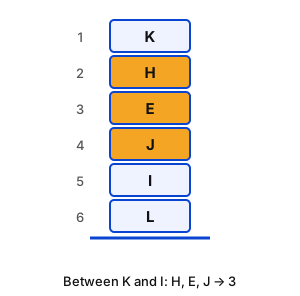
Six boxes H,I,J,K,L and E are kept one over the other but not necessarily in the same order. E is kept immediately above J. I is kept immediately above L. Only K is kept above H. Only two boxes are kept above E. How many boxes are kept between I and K?
छह बक्से H, I, J, K, L और E एक के ऊपर एक रखे गए हैं, लेकिन आवश्यक नहीं कि इसी क्रम में हों। E को J के ठीक ऊपर रखा गया है। I को L के ठीक ऊपर रखा गया है। केवल K को H के ऊपर रखा गया है। E के ऊपर केवल दो बक्से रखे गए हैं। I और K के बीच कितने बक्से रखे गए हैं?
  1. AFourचार
  2. BTwoदो
  3. COneएक
  4. DThreeतीन
Show answer

Concept: Start with the clues that fix exact positions (count from the top).

  1. Only K above H → K = 1, H = 2.
  2. Only two boxes above E → E = 3; E immediately above J → J = 4.
  3. I immediately above L → I = 5, L = 6.
  4. Between K (1) and I (5): H, E, J → 3 boxes.

Trick: Boxes between positions p and q =|p−q|−1=5−1−1=3.

Answer: (D) Three

अवधारणा: जिन सुरागों से सटीक स्थान तय हो, उनसे शुरू करें (ऊपर से गिनती)।

  1. केवल K, H के ऊपर → K = 1, H = 2।
  2. E के ऊपर केवल दो डिब्बे → E = 3; E, J के ठीक ऊपर → J = 4।
  3. I, L के ठीक ऊपर → I = 5, L = 6।
  4. K (1) और I (5) के बीच: H, E, J → 3 डिब्बे।

ट्रिक: स्थान p और q के बीच डिब्बे =|p−q|−1=5−1−1=3।

उत्तर: (D) तीन (Three)

RRB NTPC Undergraduate CBT 1General Intelligence and ReasoningBox stacking puzzleRRB NTPC Undergraduate CBT 1 2025 · 18 Jun Shift 3 →
Q6275.
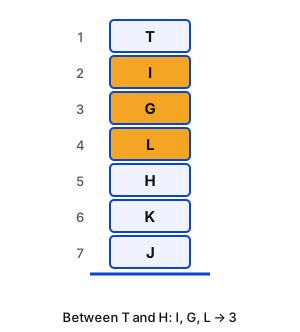
Seven boxes G, H, I, J, K, L and T are kept one over the other but not necessarily in the same order. Only two boxes are kept between L and J. Only T is kept above I. No box is kept below J. H is kept at some place below G but at some place above K. How many boxes are kept between T and H?
सात बक्से G, H, I, J, K, L और T एक के ऊपर एक रखे गए हैं, लेकिन आवश्यक नहीं कि इसी क्रम में हों। L और J के बीच केवल दो बक्से रखे गए हैं। I के ऊपर केवल T रखा गया है। J के नीचे कोई बक्सा नहीं रखा गया है। H को G के नीचे किसी स्थान पर, लेकिन K के ऊपर किसी स्थान पर रखा गया है। T और H के बीच कितने बक्से रखे गए हैं?
  1. ATwoदो
  2. BFourचार
  3. CThreeतीन
  4. DOneएक
Show answer

Concept: Fix top and bottom first, then place the rest by the order clues.

  1. Only T above I → T = 1, I = 2. No box below J → J = 7.
  2. Two boxes between L and J → L = 4.
  3. G above H above K in the free places 3, 5, 6 → G = 3, H = 5, K = 6.
  4. Between T (1) and H (5): I, G, L → 3.

Trick: Count gap: 5−1−1=3.

Answer: (C) Three

अवधारणा: पहले सबसे ऊपर और सबसे नीचे का डिब्बा तय करें, फिर क्रम वाले सुराग लगाएँ।

  1. केवल T, I के ऊपर → T = 1, I = 2। J के नीचे कोई नहीं → J = 7।
  2. L और J के बीच दो डिब्बे → L = 4।
  3. खाली स्थान 3, 5, 6 में G ऊपर, H बीच, K नीचे → G = 3, H = 5, K = 6।
  4. T (1) और H (5) के बीच: I, G, L → 3।

ट्रिक: अंतर: 5−1−1=3।

उत्तर: (C) तीन (Three)

RRB NTPC Undergraduate CBT 1General Intelligence and ReasoningBox stacking puzzleRRB NTPC Undergraduate CBT 1 2025 · 18 Jun Shift 3 →
Q6276.
Read the given statement(s) and conclusions carefully. Assuming that the information given in the statements is true, even if it appears to be at variance with commonly known facts, decide which of the given conclusions logically follow(s) from the statement(s).
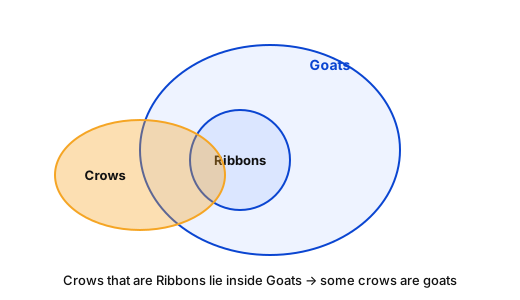
Statements: All ribbons are goats. Some crows are ribbons.
Conclusion (I): Some crows are goats.
Conclusion (II): All goats are crows.
दिए गए कथन(नों) और निष्कर्षों को ध्यानपूर्वक पढ़िए। यह मानते हुए कि कथनों में दी गई जानकारी सत्य है, भले ही वह सामान्य रूप से ज्ञात तथ्यों से भिन्न प्रतीत होती हो, निर्णय कीजिए कि दिए गए निष्कर्षों में से कौन-सा/से निष्कर्ष कथन(नों) का तार्किक रूप से अनुसरण करता है/करते हैं।
कथन: सभी रिबन, बकरियाँ हैं। कुछ कौवे, रिबन हैं।
निष्कर्ष (I): कुछ कौवे, बकरियाँ हैं।
निष्कर्ष (II): सभी बकरियाँ, कौवे हैं।
  1. AOnly conclusion (II) followsकेवल निष्कर्ष (II) अनुसरण करता है
  2. BOnly conclusion (I) followsकेवल निष्कर्ष (I) अनुसरण करता है
  3. CNeither conclusion (I) nor (II) followsन तो निष्कर्ष (I) और न ही (II) अनुसरण करता है
  4. DBoth conclusions (I) and (II) followनिष्कर्ष (I) और (II) दोनों अनुसरण करते हैं
Show answer

Concept: Draw the least-overlap Venn diagram satisfying the statements.

  1. All ribbons are goats → Ribbons circle inside Goats.
  2. Some crows are ribbons → those crows are inside Goats too → Some crows are goats: (I) follows.
  3. Goats may have members that are not crows → (II) ‘All goats are crows’ does not follow.

Trick: “Some A are B” + “All B are C” ⇒ “Some A are C” always.

Answer: (B) Only conclusion (I) follows

अवधारणा: कथनों को संतुष्ट करने वाला न्यूनतम-ओवरलैप वेन आरेख बनाइए।

  1. सभी ribbons goats हैं → Ribbons वृत्त Goats के अंदर।
  2. कुछ crows ribbons हैं → वे crows भी Goats के अंदर → कुछ crows goats हैं: (I) अनुसरण करता है।
  3. Goats में ऐसे सदस्य हो सकते हैं जो crows नहीं → (II) ‘सभी goats crows हैं’ अनुसरण नहीं करता।

ट्रिक: “कुछ A, B हैं” + “सभी B, C हैं” ⇒ “कुछ A, C हैं” हमेशा।

उत्तर: (B) केवल निष्कर्ष (I) अनुसरण करता है

RRB NTPC Undergraduate CBT 1General Intelligence and ReasoningSyllogismRRB NTPC Undergraduate CBT 1 2025 · 18 Jun Shift 3 →
Q6277.
Refer to the given series and answer the question that follows. All numbers are single- digit numbers only.
(Left) 8 5 2 8 8 2 3 1 8 8 9 6 6 4 8 6 2 9 9 2 4 6 9 (Right)
How many such odd digits are there, each of which is immediately preceded by an odd digit and also immediately followed by an odd digit?
दी गई शृंखला को देखिए और उसके बाद आने वाले प्रश्न का उत्तर दीजिए। सभी संख्याएँ केवल एक-अंकीय संख्याएँ हैं।
(बाएँ) 8 5 2 8 8 2 3 1 8 8 9 6 6 4 8 6 2 9 9 2 4 6 9 (दाएँ)
ऐसे कितने विषम अंक हैं, जिनमें से प्रत्येक के ठीक पहले एक विषम अंक है और ठीक बाद भी एक विषम अंक है?
  1. ATwoदो
  2. BOneएक
  3. CNoneकोई नहीं
  4. DThreeतीन
Show answer

Concept: Find odd digits whose both neighbours are odd: pattern odd–odd–odd.

  1. Odd digits: 5, 3, 1, 9, 9, 9, 9 (positions 2, 7, 8, 11, 18, 19, 23).
  2. Only two places have adjacent odd digits: ‘3 1’ (preceded by 2, followed by 8) and ‘9 9’ (preceded by 2, followed by 2).
  3. No odd digit has odd digits on both sides → none.

Trick: You need three odd digits in a row; scan for that block – there is none.

Answer: (C) None

अवधारणा: ऐसे विषम अंक खोजें जिनके दोनों पड़ोसी विषम हों: क्रम विषम–विषम–विषम।

  1. विषम अंक: 5, 3, 1, 9, 9, 9, 9 (स्थान 2, 7, 8, 11, 18, 19, 23)।
  2. केवल दो जगह विषम अंक साथ हैं: ‘3 1’ (पहले 2, बाद में 8) और ‘9 9’ (पहले 2, बाद में 2)।
  3. किसी विषम अंक के दोनों ओर विषम नहीं → कोई नहीं।

ट्रिक: लगातार तीन विषम अंक चाहिए; ऐसा कोई समूह नहीं है।

उत्तर: (C) कोई नहीं (None)

RRB NTPC Undergraduate CBT 1General Intelligence and ReasoningNumber sequence – digit conditionsRRB NTPC Undergraduate CBT 1 2025 · 18 Jun Shift 3 →
Q6278.
Refer to the following letter series and answer the question.
(Left) T Y E V B I W F X A P D G H M K R Z O L M S (Right)
How many letters are there in the English alphabetical series between the letter which is sixth from the right end and fourth from the left end of the series?
निम्नलिखित अक्षर शृंखला को देखिए और प्रश्न का उत्तर दीजिए।
(बाएँ) T Y E V B I W F X A P D G H M K R Z O L M S (दाएँ)
शृंखला के दाएँ छोर से छठे अक्षर और बाएँ छोर से चौथे अक्षर के बीच अंग्रेज़ी वर्णमाला शृंखला में कितने अक्षर हैं?
  1. AThreeतीन
  2. BTwoदो
  3. CFiveपाँच
  4. DFourचार
Show answer

Concept: Find both letters by counting from the stated ends, then count the alphabet gap.

  1. 4th from left: T, Y, E, V.
  2. 6th from right: S, M, L, O, Z, R.
  3. Between R (18) and V (22) in the alphabet: S, T, U → 22−18−1=3.

Trick: Letters between positions p and q =|p−q|−1.

Answer: (A) Three

अवधारणा: बताए गए सिरों से गिनकर दोनों अक्षर निकालें, फिर वर्णमाला में अंतर गिनें।

  1. बाएँ से चौथा: T, Y, E, V।
  2. दाएँ से छठा: S, M, L, O, Z, R।
  3. वर्णमाला में R (18) और V (22) के बीच: S, T, U → 22−18−1=3।

ट्रिक: स्थान p और q के बीच अक्षर =|p−q|−1।

उत्तर: (A) तीन (Three)

RRB NTPC Undergraduate CBT 1General Intelligence and ReasoningLetter series – positionRRB NTPC Undergraduate CBT 1 2025 · 18 Jun Shift 3 →
Q6279.
If ‘A’ stands for ‘+’, ‘B’ stands for ‘–’, ‘C’ stands for ‘×’ and ‘D’ stands for ‘÷’, then what will come in place of the question mark (?) in the following equation?
126 B 13 A 42 D 7 C 15 = ?
यदि ‘A’ का अर्थ ‘+’, ‘B’ का अर्थ ‘–’, ‘C’ का अर्थ ‘×’ और ‘D’ का अर्थ ‘÷’ है, तो निम्नलिखित समीकरण में प्रश्न चिह्न (?) के स्थान पर क्या आएगा?
126 B 13 A 42 D 7 C 15 = ?
  1. A203
  2. B330
  3. C620
  4. D480
Show answer

Concept: Replace letters (A +, B −, C ×, D ÷) and use BODMAS.

  1. 126−13+42÷7×15
  2. 42÷7=6, 6×15=90
  3. 126−13+90=203

Trick: Do ÷ and × first, then + and − from left to right.

Answer: (A) 203

अवधारणा: अक्षर बदलें (A +, B −, C ×, D ÷) और BODMAS लगाएँ।

  1. 126−13+42÷7×15
  2. 42÷7=6, 6×15=90
  3. 126−13+90=203

ट्रिक: पहले ÷ और ×, फिर बाएँ से दाएँ + और −।

उत्तर: (A) 203

RRB NTPC Undergraduate CBT 1General Intelligence and ReasoningMathematical operationsRRB NTPC Undergraduate CBT 1 2025 · 18 Jun Shift 3 →
Q6280.
Select the pair that follows the same pattern as that followed by the two pairs given below. Both pairs follow the same pattern.
UQL : QMH
CAT : YWP
उस युग्म का चयन कीजिए जो उसी पैटर्न का अनुसरण करता है जिसका अनुसरण नीचे दिए गए दो युग्म करते हैं। दोनों युग्म समान पैटर्न का अनुसरण करते हैं।
UQL : QMH
CAT : YWP
  1. ANOP : OPQ
  2. BZBM : VXI
  3. CUTW : RQT
  4. DLJH : NLJ
Show answer

Concept: Find the shift of each letter from the first cluster to the second.

  1. UQL → QMH: each letter −4. CAT → YWP: each letter −4 (C → Y wraps).
  2. ZBM → VXI: Z−4=V, B−4=X, M−4=I ✓
  3. NOP → OPQ is +1; UTW → RQT is −3; LJH → NLJ is +2 ✗

Trick: Check only the first letter of each option: −4 from Z gives V – unique.

Answer: (B) ZBM : VXI

अवधारणा: पहले क्लस्टर से दूसरे तक हर अक्षर का खिसकाव निकालें।

  1. UQL → QMH: हर अक्षर −4। CAT → YWP: हर अक्षर −4 (C → Y घूमकर)।
  2. ZBM → VXI: Z−4=V, B−4=X, M−4=I ✓
  3. NOP → OPQ +1; UTW → RQT −3; LJH → NLJ +2 ✗

ट्रिक: हर विकल्प का केवल पहला अक्षर देखें: Z से −4 = V – केवल यही।

उत्तर: (B) ZBM : VXI

RRB NTPC Undergraduate CBT 1General Intelligence and ReasoningLetter analogy – pairsRRB NTPC Undergraduate CBT 1 2025 · 18 Jun Shift 3 →