Question bank

Q&A: practice questions with answers

Search questions on any topic. Filter by exam category, exam, subject and topic, try the question, then open the answer and explanation.

Courses – airGurukul

8,495 questions found.

Q6341.
Three positive numbers are in proportion such that the ratio of the first number to the second number is the same as the ratio of the second number to the third number. If the first number is 16 and the second number is 24, find the value of the third number.
तीन धनात्मक संख्याएँ इस प्रकार समानुपात में हैं कि पहली संख्या और दूसरी संख्या का अनुपात, दूसरी संख्या और तीसरी संख्या के अनुपात के समान है। यदि पहली संख्या 16 और दूसरी संख्या 24 है, तो तीसरी संख्या का मान ज्ञात कीजिए।
  1. A64
  2. B32
  3. C36
  4. D48
Show answer

Concept: If a:b=b:c (continued proportion), then b2=ac, so c=b2a.

  1. 16:24=24:c
  2. c=24216=57616=36

Trick: Third proportional =(second)2first.

Answer: (C) 36

अवधारणा: यदि a:b=b:c (क्रमागत अनुपात), तो b2=ac, अतः c=b2a।

  1. 16:24=24:c
  2. c=24216=57616=36

ट्रिक: तृतीयानुपाती =(दूसरी)2पहली।

उत्तर: (C) 36

RRB NTPC Undergraduate CBT 1MathematicsContinued proportionRRB NTPC Undergraduate CBT 1 2025 · 18 Jun Shift 2 →
Q6342.
The price of an article is increased by 20%. In the next step, it is decreased by x% of the new price. Finally, the price is increased by 10% of the original price. If the final price becomes exactly equal to the original price, the value of x is:
एक वस्तु के मूल्य में 20% की वृद्धि की जाती है। अगले चरण में, नए मूल्य में x% की कमी की जाती है। अंत में, मूल्य में मूल मूल्य के 10% की वृद्धि की जाती है। यदि अंतिम मूल्य ठीक मूल मूल्य के बराबर हो जाता है, तो x का मान है:
  1. A22.75
  2. B12.25
  3. C25
  4. D17.5
Show answer

Concept: Take original price =100 and follow each step carefully — the last increase is on the original price.

  1. After 20% increase: 120
  2. Decrease of x% of 120: 120−1.2x
  3. Add 10% of original =10: 130−1.2x=100
  4. 1.2x=30⇒x=25

Trick: Base 100 makes every % a plain number.

Answer: (C) 25

अवधारणा: मूल मूल्य =100 लें और हर चरण देखें — अंतिम वृद्धि मूल मूल्य पर है।

  1. 20% वृद्धि के बाद: 120
  2. 120 का x% घटाने पर: 120−1.2x
  3. मूल का 10%=10 जोड़ें: 130−1.2x=100
  4. 1.2x=30⇒x=25

ट्रिक: आधार 100 लेने से हर % सीधी संख्या बन जाता है।

उत्तर: (C) 25

RRB NTPC Undergraduate CBT 1MathematicsPercentage changeRRB NTPC Undergraduate CBT 1 2025 · 18 Jun Shift 2 →
Q6343.
A four-digit number 3P2Q is divisible by both 2 and 3. Find the smallest value of P + Q.
चार अंकों की एक संख्या 3P2Q, 2 और 3 दोनों से विभाज्य है। P + Q का न्यूनतम मान ज्ञात कीजिए।
  1. A4
  2. B7
  3. C2
  4. D1
Show answer

Concept: Divisible by 2 → last digit even; divisible by 3 → digit sum divisible by 3.

  1. Digit sum =3+P+2+Q=5+P+Q must be a multiple of 3
  2. Smallest P+Q with 5+P+Q a multiple of 3 is 1 (sum =6)
  3. P=1, Q=0 (even) works: 3120=2×1560=3×1040

Trick: Check smallest option first: P+Q=1 makes digit sum 6 ✓.

Answer: (D) 1

अवधारणा: 2 से विभाज्य → अंतिम अंक सम; 3 से विभाज्य → अंकों का योग 3 से विभाज्य।

  1. अंकों का योग =5+P+Q, 3 का गुणज होना चाहिए
  2. सबसे छोटा P+Q=1 (योग =6)
  3. P=1, Q=0 (सम): 3120 दोनों से विभाज्य

ट्रिक: सबसे छोटा विकल्प पहले जाँचें: P+Q=1 से योग 6 ✓।

उत्तर: (D) 1

RRB NTPC Undergraduate CBT 1MathematicsDivisibility rulesRRB NTPC Undergraduate CBT 1 2025 · 18 Jun Shift 2 →
Q6344.
If the mean proportional between x and 36 is 12, find x.
यदि x और 36 का मध्यानुपाती 12 है, तो x ज्ञात कीजिए।
  1. A7
  2. B5
  3. C4
  4. D6
Show answer

Concept: Mean proportional of a and b is ab.

  1. 36x=12
  2. 36x=144⇒x=4

Trick: x=(mean)236=14436.

Answer: (C) 4

अवधारणा: a और b का मध्यानुपाती =ab।

  1. 36x=12
  2. 36x=144⇒x=4

ट्रिक: x=(मध्यानुपाती)236=14436।

उत्तर: (C) 4

RRB NTPC Undergraduate CBT 1MathematicsMean proportionalRRB NTPC Undergraduate CBT 1 2025 · 18 Jun Shift 2 →
Q6345.
The price of an article is first increased by 20% and then decreased by 20%. If the original price of the article is ₹500, what is the net percentage change in the price?
एक वस्तु के मूल्य में पहले 20% की वृद्धि की जाती है और फिर 20% की कमी की जाती है। यदि वस्तु का मूल मूल्य ₹500 है, तो मूल्य में निवल प्रतिशत परिवर्तन कितना है?
  1. A2% increase2% वृद्धि
  2. BNo changeकोई परिवर्तन नहीं
  3. C4% decrease4% कमी
  4. D5% decrease5% कमी
Show answer

Concept: Net change for +a% then −b%: a−b−ab100. The original price does not matter.

  1. 20−20−20×20100=−4%
  2. Check: 500→600→480, fall =20 = 4% of 500

Trick: Equal % up then down always gives a loss of x2100%.

Answer: (C) 4% decrease

अवधारणा: +a% फिर −b% का शुद्ध परिवर्तन: a−b−ab100। मूल मूल्य से फर्क नहीं पड़ता।

  1. 20−20−20×20100=−4%
  2. जाँच: 500→600→480, कमी =20 = 500 का 4%

ट्रिक: समान % बढ़ाकर फिर घटाने पर हमेशा x2100% की कमी।

उत्तर: (C) 4% कमी (decrease)

RRB NTPC Undergraduate CBT 1MathematicsSuccessive percentage changeRRB NTPC Undergraduate CBT 1 2025 · 18 Jun Shift 2 →
Q6346.
A man bought an article and sold it at a profit of 15%. If he had bought it at 25% less cost price and sold it for ₹294 less than the original selling price, he would have made a profit of 30%. Find the cost price of the article.
एक व्यक्ति ने एक वस्तु खरीदी और उसे 15% लाभ पर बेच दिया। यदि उसने इसे 25% कम क्रय मूल्य पर खरीदा होता और मूल विक्रय मूल्य से ₹294 कम में बेचा होता, तो उसे 30% लाभ होता। वस्तु का क्रय मूल्य ज्ञात कीजिए।
  1. A₹1,630
  2. B₹1,540
  3. C₹1,590
  4. D₹1,680
Show answer

Concept: Write both selling prices in terms of CP x and equate the ₹294 gap.

  1. Original SP =1.15x
  2. New CP =0.75x, new SP =1.30×0.75x=0.975x
  3. 1.15x−0.975x=294⇒0.175x=294
  4. x=2940.175=1680

Trick: Gap in SP =17.5% of CP =294 → CP =294×10017.5.

Answer: (D) ₹1,680

अवधारणा: दोनों विक्रय मूल्य क्रय मूल्य x में लिखें और ₹294 के अंतर को बराबर करें।

  1. मूल SP =1.15x
  2. नया CP =0.75x, नया SP =1.30×0.75x=0.975x
  3. 1.15x−0.975x=294⇒0.175x=294
  4. x=2940.175=1680

ट्रिक: SP का अंतर = CP का 17.5% =294 → CP =294×10017.5।

उत्तर: (D) ₹1,680

RRB NTPC Undergraduate CBT 1MathematicsProfit and lossRRB NTPC Undergraduate CBT 1 2025 · 18 Jun Shift 2 →
Q6347.
A bus travels 90 km at 45 km/h, 120 km at 60 km/h, and 150 km at 75 km/h. What is the average speed of the bus for the entire journey?
एक बस 90 km की दूरी 45 km/h की चाल से, 120 km की दूरी 60 km/h की चाल से और 150 km की दूरी 75 km/h की चाल से तय करती है। पूरी यात्रा के लिए बस की औसत चाल कितनी है?
  1. A66 km/h
  2. B70 km/h
  3. C55 km/h
  4. D60 km/h
Show answer

Concept: Average speed =total distancetotal time (not the mean of speeds).

  1. Times: 9045=2, 12060=2, 15075=2 hours
  2. Total distance =360km, total time =6h
  3. Average =3606=60km/h

Trick: Equal times on each part → average speed = simple mean 45+60+753=60.

Answer: (D) 60km/h

अवधारणा: औसत चाल =कुल दूरीकुल समय (चालों का साधारण औसत नहीं)।

  1. समय: 9045=2, 12060=2, 15075=2 घंटे
  2. कुल दूरी =360km, कुल समय =6h
  3. औसत =3606=60km/h

ट्रिक: हर भाग में समय बराबर → औसत चाल = साधारण औसत 45+60+753=60।

उत्तर: (D) 60km/h

RRB NTPC Undergraduate CBT 1MathematicsAverage speedRRB NTPC Undergraduate CBT 1 2025 · 18 Jun Shift 2 →
Q6348.
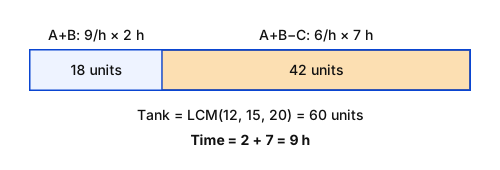
Pipes A and B can fill a tank in 12 hours and 15 hours, respectively. A third pipe C can empty the full tank in 20 hours. If A and B are opened together for 2 hours and then C is also opened, what is the total time taken to fill the tank?
पाइप A और B किसी टंकी को क्रमशः 12 घंटे और 15 घंटे में भर सकते हैं। एक तीसरा पाइप C भरी हुई टंकी को 20 घंटे में खाली कर सकता है। यदि A और B को एक साथ 2 घंटे के लिए खोला जाता है और फिर C को भी खोल दिया जाता है, तो टंकी को भरने में लगने वाला कुल समय कितना है?
  1. A10 hours10 घंटे
  2. B8 hours8 घंटे
  3. C9.5 hours9.5 घंटे
  4. D9 hours9 घंटे
Show answer

Concept: Take tank =LCM(12,15,20)=60 units; filling pipes add, emptying pipe subtracts.

  1. Rates: A =5, B =4, C =−3 units/h
  2. First 2 h (A+B): 9×2=18 units
  3. Remaining 42 units at 5+4−3=6 units/h → 7 h
  4. Total =2+7=9 hours

Trick: LCM-unit method avoids fractions completely.

Answer: (D) 9 hours

अवधारणा: टंकी =LCM(12,15,20)=60 इकाई लें; भरने वाले पाइप जोड़ें, खाली करने वाला घटाएँ।

  1. दरें: A =5, B =4, C =−3 इकाई/घंटा
  2. पहले 2 घंटे (A+B): 9×2=18 इकाई
  3. शेष 42 इकाई, दर 5+4−3=6 → 7 घंटे
  4. कुल =2+7=9 घंटे

ट्रिक: LCM-इकाई विधि से भिन्न नहीं आतीं।

उत्तर: (D) 9 घंटे

RRB NTPC Undergraduate CBT 1MathematicsPipes and cisternsRRB NTPC Undergraduate CBT 1 2025 · 18 Jun Shift 2 →
Q6349.
Arun sold an article for ₹1,786.40 and incurred a loss of 12%. At what price should he sell the article to earn a profit of 14%?
अरुण ने एक वस्तु ₹1,786.40 में बेची और उसे 12% की हानि हुई। 14% का लाभ अर्जित करने के लिए उसे वस्तु किस मूल्य पर बेचनी चाहिए?
  1. A₹2,268.70
  2. B₹2,112.20
  3. C₹2,485.70
  4. D₹2,314.20
Show answer

Concept: SP=CP×100±%100. Find CP from the loss, then apply the profit.

  1. CP=1786.400.88=2030
  2. Required SP =2030×1.14=2314.20

Trick: Directly: new SP =1786.40×11488.

Answer: (D) ₹2,314.20

अवधारणा: SP=CP×100±%100। हानि से CP निकालें, फिर लाभ लगाएँ।

  1. CP=1786.400.88=2030
  2. अभीष्ट SP =2030×1.14=2314.20

ट्रिक: सीधे: नया SP =1786.40×11488।

उत्तर: (D) ₹2,314.20

RRB NTPC Undergraduate CBT 1MathematicsProfit and lossRRB NTPC Undergraduate CBT 1 2025 · 18 Jun Shift 2 →
Q6350.
Two taps can fill a cistern in 4 hours and 8 hours, respectively. A third tap can empty it in 8 hours. How long (in hours) will it take to fill one-fourth of the empty cistern if all the taps are opened together?
दो नल किसी टंकी को क्रमशः 4 घंटे और 8 घंटे में भर सकते हैं। एक तीसरा नल इसे 8 घंटे में खाली कर सकता है। यदि सभी नल एक साथ खोल दिए जाएँ, तो खाली टंकी का एक-चौथाई भाग भरने में कितना समय (घंटों में) लगेगा?
  1. A1
  2. B4
  3. C2
  4. D3
Show answer

Concept: Net work per hour = sum of filling rates − emptying rate.

  1. Net rate =14+18−18=14 per hour
  2. Time for 14 tank =1/41/4=1 hour

Trick: The 8-hour filler and 8-hour emptier cancel each other — only the 4-hour tap works.

Answer: (A) 1

अवधारणा: प्रति घंटा शुद्ध कार्य = भरने की दरों का योग − खाली करने की दर।

  1. शुद्ध दर =14+18−18=14 प्रति घंटा
  2. 14 टंकी का समय =1 घंटा

ट्रिक: 8 घंटे वाला भरने और 8 घंटे वाला खाली करने वाला नल एक-दूसरे को रद्द करते हैं।

उत्तर: (A) 1

RRB NTPC Undergraduate CBT 1MathematicsPipes and cisternsRRB NTPC Undergraduate CBT 1 2025 · 18 Jun Shift 2 →
Q6351.
The cost of 5 chairs and 3 tables is ₹12,500, while the cost of 3 chairs and 5 tables is ₹15,500. Find the cost of 2 chairs and 2 tables.
5 कुर्सियों और 3 मेज़ों का मूल्य ₹12,500 है, जबकि 3 कुर्सियों और 5 मेज़ों का मूल्य ₹15,500 है। 2 कुर्सियों और 2 मेज़ों का मूल्य ज्ञात कीजिए।
  1. A₹7,000
  2. B₹6,000
  3. C₹6,500
  4. D₹7,500
Show answer

Concept: When coefficients are swapped, add the two equations.

  1. (5c+3t)+(3c+5t)=12500+15500
  2. 8c+8t=28000⇒c+t=3500
  3. 2c+2t=7000

Trick: Add equations → c+t directly; no need to find each price.

Answer: (A) ₹7,000

अवधारणा: जब गुणांक आपस में बदले हों, दोनों समीकरण जोड़ें।

  1. (5c+3t)+(3c+5t)=12500+15500
  2. 8c+8t=28000⇒c+t=3500
  3. 2c+2t=7000

ट्रिक: समीकरण जोड़कर सीधे c+t मिल जाता है।

उत्तर: (A) ₹7,000

RRB NTPC Undergraduate CBT 1MathematicsLinear equationsRRB NTPC Undergraduate CBT 1 2025 · 18 Jun Shift 2 →
Q6352.
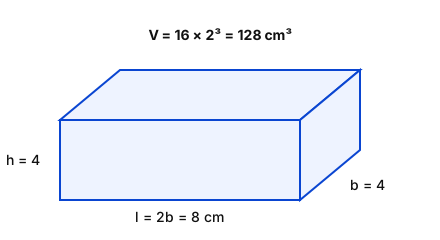
Sixteen identical solid cubes, each of side 2 cm, are melted and recast into a cuboid whose length is twice its breadth and height equals its breadth. Find the volume of the cuboid.
2 cm भुजा वाले सोलह सर्वसम ठोस घनों को पिघलाकर एक घनाभ में ढाला जाता है, जिसकी लंबाई उसकी चौड़ाई की दोगुनी है और ऊँचाई उसकी चौड़ाई के बराबर है। घनाभ का आयतन ज्ञात कीजिए।
  1. A64cm3
  2. B128cm3
  3. C96cm3
  4. D100cm3
Show answer

Concept: When solids are melted and recast, the volume stays the same.

  1. Volume of one cube =23=8cm3
  2. Cuboid volume =16×8=128cm3
  3. Check: 2b×b×b=2b3=128⇒b=4, so 8×4×4

Trick: The shape details are not needed for the volume — just add the volumes.

Answer: (B) 128cm3

अवधारणा: ठोसों को पिघलाकर नया ठोस बनाने पर आयतन वही रहता है।

  1. एक घन का आयतन =23=8cm3
  2. घनाभ का आयतन =16×8=128cm3
  3. जाँच: 2b×b×b=2b3=128⇒b=4, अर्थात 8×4×4

ट्रिक: आयतन के लिए आकार की जानकारी की ज़रूरत नहीं — बस आयतन जोड़ें।

उत्तर: (B) 128cm3

RRB NTPC Undergraduate CBT 1MathematicsMensuration – recasting solidsRRB NTPC Undergraduate CBT 1 2025 · 18 Jun Shift 2 →
Q6353.
The combined present age of P and Q is 46 years. 2 years ago from now, P was twice as old as Q. What is the present age of P?
P और Q की वर्तमान आयु का योग 46 वर्ष है। अब से 2 वर्ष पहले, P की आयु Q की आयु की दोगुनी थी। P की वर्तमान आयु कितनी है?
  1. A16 years16 वर्ष
  2. B30 years30 वर्ष
  3. C20 years20 वर्ष
  4. D28 years28 वर्ष
Show answer

Concept: Form two equations: one for the present sum, one for 2 years ago.

  1. P+Q=46
  2. P−2=2(Q−2)⇒P=2Q−2
  3. 3Q−2=46⇒Q=16, P=30

Trick: Check options: P=30, Q=16 → 2 years ago 28 and 14 ✓.

Answer: (B) 30 years

अवधारणा: दो समीकरण बनाएँ: वर्तमान योग और 2 वर्ष पहले की स्थिति।

  1. P+Q=46
  2. P−2=2(Q−2)⇒P=2Q−2
  3. 3Q−2=46⇒Q=16, P=30

ट्रिक: विकल्प जाँचें: P=30, Q=16 → 2 वर्ष पहले 28 और 14 ✓।

उत्तर: (B) 30 वर्ष

RRB NTPC Undergraduate CBT 1MathematicsProblems on agesRRB NTPC Undergraduate CBT 1 2025 · 18 Jun Shift 2 →
Q6354.
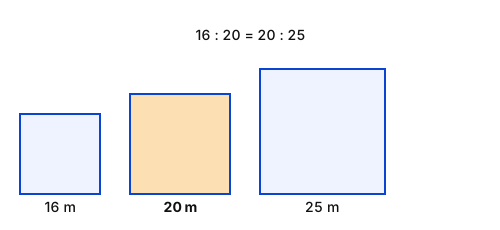
The sides of two square gardens are 16 m and 25 m, respectively. A third square garden is to be constructed such that the length of its side is the mean proportional between the sides of the given two gardens. What will be the length of the side of the new square garden?
दो वर्गाकार बगीचों की भुजाएँ क्रमशः 16 m और 25 m हैं। एक तीसरा वर्गाकार बगीचा इस प्रकार बनाया जाना है कि उसकी भुजा की लंबाई दिए गए दोनों बगीचों की भुजाओं की मध्यानुपाती हो। नए वर्गाकार बगीचे की भुजा की लंबाई कितनी होगी?
  1. A18 m
  2. B21 m
  3. C19 m
  4. D20 m
Show answer

Concept: Mean proportional of a and b =ab.

  1. Side =16×25=400=20m
  2. Check: 16:20=20:25 ✓

Trick: 16×25=4×5.

Answer: (D) 20 m

अवधारणा: a और b का मध्यानुपाती =ab।

  1. भुजा =16×25=400=20m
  2. जाँच: 16:20=20:25 ✓

ट्रिक: 16×25=4×5।

उत्तर: (D) 20 m

RRB NTPC Undergraduate CBT 1MathematicsMean proportionalRRB NTPC Undergraduate CBT 1 2025 · 18 Jun Shift 2 →
Q6355.
A specialized printing machine can print 2400 pages in 1 hour and 20 minutes. At this steady rate, how many pages can the machine print in 45 minutes?
एक विशेष मुद्रण मशीन 1 घंटे 20 मिनट में 2400 पृष्ठ मुद्रित कर सकती है। इसी स्थिर दर से, मशीन 45 मिनट में कितने पृष्ठ मुद्रित कर सकती है?
  1. A1500
  2. B1350
  3. C1250
  4. D1450
Show answer

Concept: Convert time to minutes and find pages per minute.

  1. 1 h 20 min =80 min; rate =240080=30 pages/min
  2. In 45 min: 30×45=1350

Trick: 2400×4580=2400×916=1350.

Answer: (B) 1350

अवधारणा: समय को मिनट में बदलें और प्रति मिनट पेज निकालें।

  1. 1 घंटा 20 मिनट =80 मिनट; दर =240080=30 पेज/मिनट
  2. 45 मिनट में: 30×45=1350

ट्रिक: 2400×4580=2400×916=1350।

उत्तर: (B) 1350

RRB NTPC Undergraduate CBT 1MathematicsUnitary method (rate)RRB NTPC Undergraduate CBT 1 2025 · 18 Jun Shift 2 →
Q6356.
Three numbers are in the ratio 9 : 7 : 5, and their LCM is 2205. Their HCF is:
तीन संख्याएँ 9 : 7 : 5 के अनुपात में हैं, और उनका LCM 2205 है। उनका HCF है:
  1. A7
  2. B29
  3. C34
  4. D24
Show answer

Concept: Numbers in ratio 9:7:5 are 9k,7k,5k with HCF k (ratio terms are co-prime).

  1. LCM=9×7×5×k=315k
  2. 315k=2205⇒k=7

Trick: HCF =LCMLCM of ratio terms=2205315.

Answer: (A) 7

अवधारणा: 9:7:5 अनुपात वाली संख्याएँ 9k,7k,5k; HCF =k (अनुपात के पद सह-अभाज्य हैं)।

  1. LCM=9×7×5×k=315k
  2. 315k=2205⇒k=7

ट्रिक: HCF =LCMअनुपात पदों का LCM=2205315।

उत्तर: (A) 7

RRB NTPC Undergraduate CBT 1MathematicsHCF and LCMRRB NTPC Undergraduate CBT 1 2025 · 18 Jun Shift 2 →
Q6357.
Simplify: 5518+5538+5558+5578
सरल कीजिए: 5518+5538+5558+5578
  1. A224
  2. B222
  3. C226
  4. D220
Show answer

Concept: Add whole parts and fractional parts separately.

  1. Whole parts: 55×4=220
  2. Fractions: 1+3+5+78=168=2
  3. Total =220+2=222

Trick: Sum of first n odd numbers =n2: 1+3+5+7=16.

Answer: (B) 222

अवधारणा: पूर्णांक भाग और भिन्न भाग अलग-अलग जोड़ें।

  1. पूर्णांक: 55×4=220
  2. भिन्न: 1+3+5+78=168=2
  3. कुल =220+2=222

ट्रिक: पहली n विषम संख्याओं का योग =n2: 1+3+5+7=16।

उत्तर: (B) 222

RRB NTPC Undergraduate CBT 1MathematicsMixed fractionsRRB NTPC Undergraduate CBT 1 2025 · 18 Jun Shift 2 →
Q6358.
The sum of two positive numbers is 32 and their product is 220. The positive difference between them is:
दो धनात्मक संख्याओं का योग 32 है और उनका गुणनफल 220 है। उनके बीच धनात्मक अंतर है:
  1. A17
  2. B12
  3. C16
  4. D11
Show answer

Concept: (a−b)2=(a+b)2−4ab.

  1. (a−b)2=322−4×220=1024−880=144
  2. a−b=12 (numbers 22 and 10)

Trick: Find two numbers with sum 32, product 220: 22×10 → difference 12.

Answer: (B) 12

अवधारणा: (a−b)2=(a+b)2−4ab।

  1. (a−b)2=322−4×220=1024−880=144
  2. a−b=12 (संख्याएँ 22 और 10)

ट्रिक: योग 32, गुणनफल 220 वाली संख्याएँ: 22×10 → अंतर 12।

उत्तर: (B) 12

RRB NTPC Undergraduate CBT 1MathematicsAlgebraic identitiesRRB NTPC Undergraduate CBT 1 2025 · 18 Jun Shift 2 →
Q6359.
What sum (in ₹) will earn a simple interest of ₹1,440 in 2 years at 16% per year rate of interest?
कितनी राशि (₹ में) पर 16% वार्षिक ब्याज दर से 2 वर्ष में ₹1,440 का साधारण ब्याज प्राप्त होगा?
  1. A460.8
  2. B2,250
  3. C4,500
  4. D9,000
Show answer

Concept: P=SI×100R×T.

  1. P=1440×10016×2=14400032=4500

Trick: Total rate =16×2=32%; 32% of P=1440.

Answer: (C) 4,500

अवधारणा: P=SI×100R×T।

  1. P=1440×10016×2=14400032=4500

ट्रिक: कुल दर =16×2=32%; P का 32%=1440।

उत्तर: (C) 4,500

RRB NTPC Undergraduate CBT 1MathematicsSimple interestRRB NTPC Undergraduate CBT 1 2025 · 18 Jun Shift 2 →
Q6360.
If the mean of the following data is 40, find the missing frequency.
x102030405060
frequency2314f4
यदि निम्नलिखित आँकड़ों का माध्य 40 है, तो लुप्त बारंबारता ज्ञात कीजिए।
x102030405060
बारंबारता2314f4
  1. A1
  2. B7
  3. C5
  4. D4
Show answer

Concept: Mean =∑fx∑f.

  1. ∑f=2+3+1+4+f+4=14+f
  2. ∑fx=20+60+30+160+50f+240=510+50f
  3. 510+50f14+f=40⇒510+50f=560+40f
  4. 10f=50⇒f=5

Trick: Deviation method: ∑f(x−40)=0 → −60−60−10+0+10f+80=0 → f=5.

Answer: (C) 5

अवधारणा: माध्य =∑fx∑f।

  1. ∑f=14+f
  2. ∑fx=20+60+30+160+50f+240=510+50f
  3. 510+50f14+f=40⇒510+50f=560+40f
  4. 10f=50⇒f=5

ट्रिक: विचलन विधि: ∑f(x−40)=0 → −60−60−10+10f+80=0 → f=5।

उत्तर: (C) 5

RRB NTPC Undergraduate CBT 1MathematicsMean of grouped dataRRB NTPC Undergraduate CBT 1 2025 · 18 Jun Shift 2 →