Question bank

Q&A: practice questions with answers

Search questions on any topic. Filter by exam category, exam, subject and topic, try the question, then open the answer and explanation.

Courses – airGurukul

8,495 questions found.

Q6361.
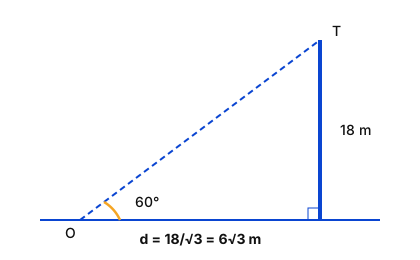
A person standing on level ground looks up at the top of a vertical tower. The angle of elevation formed at the observer’s eye is 60°. If the tower is 18 m high, determine the horizontal distance (in meters) between the person and the base of the tower.
समतल भूमि पर खड़ा एक व्यक्ति एक ऊर्ध्वाधर मीनार के शीर्ष की ओर देखता है। प्रेक्षक की आँख पर बनने वाला उन्नयन कोण 60° है। यदि मीनार 18 m ऊँची है, तो व्यक्ति और मीनार के आधार के बीच की क्षैतिज दूरी (मीटर में) ज्ञात कीजिए।
  1. A63
  2. B73
  3. C53
  4. D43
Show answer

Concept: tanθ=heightbase.

  1. tan60∘=18d⇒3=18d
  2. d=183=1833=63m

Trick: At 60∘, base =height3; at 30∘, base =height×3.

Answer: (A) 63

अवधारणा: tanθ=ऊँचाईआधार।

  1. tan60∘=18d⇒3=18d
  2. d=183=63m

ट्रिक: 60∘ पर आधार =ऊँचाई3; 30∘ पर आधार =ऊँचाई×3।

उत्तर: (A) 63

RRB NTPC Undergraduate CBT 1MathematicsHeights and distancesRRB NTPC Undergraduate CBT 1 2025 · 18 Jun Shift 2 →
Q6362.
Find the sum of the surface areas of three spheres of radii 2 cm, 3 cm and 6 cm. (Take π=227)
2 cm, 3 cm और 6 cm त्रिज्या वाले तीन गोलों के पृष्ठीय क्षेत्रफलों का योग ज्ञात कीजिए। (π=227 लीजिए)
  1. A616 cm2
  2. B620 cm2
  3. C608 cm2
  4. D612 cm2
Show answer

Concept: Surface area of a sphere =4πr2.

  1. Sum =4π(22+32+62)=4π×49
  2. =4×227×49=616cm2

Trick: r2 sum =49 cancels the 7 in π=227 neatly.

Answer: (A) 616cm2

अवधारणा: गोले का पृष्ठीय क्षेत्रफल =4πr2।

  1. योग =4π(22+32+62)=4π×49
  2. =4×227×49=616cm2

ट्रिक: r2 का योग 49 है, जो π=227 के 7 से कट जाता है।

उत्तर: (A) 616cm2

RRB NTPC Undergraduate CBT 1MathematicsSurface area of sphereRRB NTPC Undergraduate CBT 1 2025 · 18 Jun Shift 2 →
Q6363.
A shopkeeper offers the following schemes on toys of the same marked price. (A) Successive discounts of 24% and 33% on any number of toys bought.
(B) Successive discounts of 39%, 37% and 23% on any number of toys bought. (C) 24% discount on the first 2 toys and 12% discount on each toy thereon.
(D) 2 toys free of cost on buying 5 toys.
A customer wants to buy 5 toys. Which of the above schemes is the least beneficial to her?
एक दुकानदार समान अंकित मूल्य वाले खिलौनों पर निम्नलिखित योजनाएँ प्रदान करता है। (A) कितने भी खिलौने खरीदने पर 24% और 33% की क्रमिक छूट।
(B) कितने भी खिलौने खरीदने पर 39%, 37% और 23% की क्रमिक छूट। (C) पहले 2 खिलौनों पर 24% छूट और उसके बाद प्रत्येक खिलौने पर 12% छूट।
(D) 5 खिलौने खरीदने पर 2 खिलौने निःशुल्क।
एक ग्राहक 5 खिलौने खरीदना चाहती है। उपर्युक्त में से कौन-सी योजना उसके लिए सबसे कम लाभदायक है?
  1. AA
  2. BC
  3. CB
  4. DD
Show answer

Concept: Convert each scheme into an effective % discount on 5 toys; least beneficial = smallest discount.

  1. (A) 1−0.76×0.67=1−0.5092⇒49.08%
  2. (B) 1−0.61×0.63×0.77=1−0.2959⇒70.4%
  3. (C) 2×24+3×125=845=16.8%
  4. (D) pays for 5, gets 7 → 27≈28.6%
  5. Smallest discount is scheme C

Trick: Successive discounts multiply the remaining fractions, they never simply add.

Answer: (B) C

अवधारणा: हर योजना को 5 खिलौनों पर प्रभावी % छूट में बदलें; सबसे कम लाभ = सबसे कम छूट।

  1. (A) 1−0.76×0.67⇒49.08%
  2. (B) 1−0.61×0.63×0.77⇒70.4%
  3. (C) 2×24+3×125=16.8%
  4. (D) 5 का मूल्य देकर 7 → 27≈28.6%
  5. सबसे कम छूट योजना C में

ट्रिक: क्रमिक छूटों में शेष भाग गुणा होते हैं, सीधे नहीं जुड़ते।

उत्तर: (B) C

RRB NTPC Undergraduate CBT 1MathematicsDiscount schemesRRB NTPC Undergraduate CBT 1 2025 · 18 Jun Shift 2 →
Q6364.
An article is marked at ₹3,000. The shopkeeper offers successive discounts of 10% and 20%. What is the final selling price of the article?
एक वस्तु का अंकित मूल्य ₹3,000 है। दुकानदार 10% और 20% की क्रमिक छूट प्रदान करता है। वस्तु का अंतिम विक्रय मूल्य क्या है?
  1. A₹2,250
  2. B₹2,100
  3. C₹2,200
  4. D₹2,160
Show answer

Concept: Selling price after successive discounts =MP×(1−d1)(1−d2).

  1. 3000×0.9=2700
  2. 2700×0.8=2160

Trick: Single equivalent discount =10+20−10×20100=28%; 72% of 3000=2160.

Answer: (D) ₹2,160

अवधारणा: क्रमिक छूट के बाद विक्रय मूल्य =MP×(1−d1)(1−d2)।

  1. 3000×0.9=2700
  2. 2700×0.8=2160

ट्रिक: समतुल्य एकल छूट =10+20−10×20100=28%; 3000 का 72%=2160।

उत्तर: (D) ₹2,160

RRB NTPC Undergraduate CBT 1MathematicsSuccessive discountsRRB NTPC Undergraduate CBT 1 2025 · 18 Jun Shift 2 →
Q6365.
Find the mode for the following distribution.
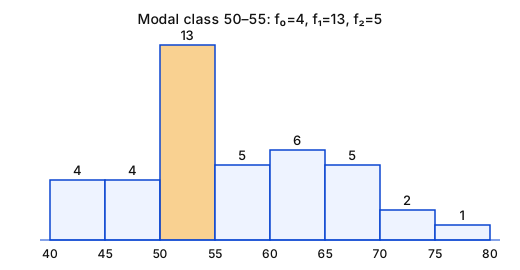
CL40-4545-5050-5555-6060-6565-7070-7575-80
Frequency441356521
निम्नलिखित बंटन का बहुलक ज्ञात कीजिए।
वर्ग अंतराल (CL)40-4545-5050-5555-6060-6565-7070-7575-80
बारंबारता441356521
  1. A54.60
  2. B51.34
  3. C52.65
  4. D48.57
Show answer

Concept: Mode=l+f1−f02f1−f0−f2×h, using the class with the highest frequency.

  1. Modal class 50−55: l=50, f1=13, f0=4, f2=5, h=5
  2. Mode=50+13−426−4−5×5=50+4517
  3. =50+2.647=52.65

Trick: Mode must lie inside the modal class (50–55) — only 51.34 and 52.65 qualify; formula picks 52.65.

Answer: (C) 52.65

अवधारणा: बहुलक=l+f1−f02f1−f0−f2×h, सबसे अधिक बारंबारता वाले वर्ग से।

  1. बहुलक वर्ग 50−55: l=50, f1=13, f0=4, f2=5, h=5
  2. बहुलक=50+917×5=50+4517
  3. =50+2.647=52.65

ट्रिक: बहुलक, बहुलक वर्ग (50–55) के अंदर ही होगा — केवल 51.34 और 52.65 बचते हैं।

उत्तर: (C) 52.65

RRB NTPC Undergraduate CBT 1MathematicsMode of grouped dataRRB NTPC Undergraduate CBT 1 2025 · 18 Jun Shift 2 →
Q6366.
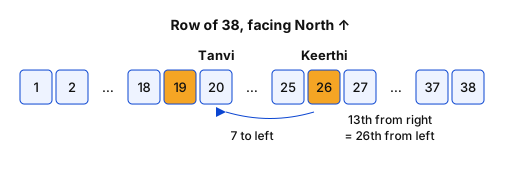
In a row of 38 people facing the north, Keerthi is 13th from the right end. If Tanvi sits 7th to the left of Keerthi, what is Tanvi’s position from the left end of the row?
उत्तर की ओर मुख करके बैठे 38 व्यक्तियों की एक पंक्ति में, कीर्ति दाएँ छोर से 13th स्थान पर है। यदि तन्वी, कीर्ति के बाईं ओर 7th स्थान पर बैठी है, तो पंक्ति के बाएँ छोर से तन्वी का स्थान क्या है?
  1. A19th
  2. B20th
  3. C17th
  4. D18th
Show answer

Concept: Position from left = Total − Position from right +1. Facing north, left of a person is towards the left end.

  1. Keerthi from left =38−13+1=26th.
  2. Tanvi is 7 places to the left of Keerthi: 26−7=19th from the left.

Trick: Moving left reduces the position from the left end – just subtract.

Answer: (A) 19th

अवधारणा: बाएँ से स्थान = कुल − दाएँ से स्थान +1। उत्तर की ओर मुख होने पर व्यक्ति का बायाँ, पंक्ति का बायाँ सिरा है।

  1. कीर्ति बाएँ से =38−13+1=26वाँ।
  2. तन्वी, कीर्ति के 7 स्थान बाएँ है: 26−7=19वाँ बाएँ से।

ट्रिक: बाईं ओर खिसकने पर बाएँ से स्थान घटता है – सीधा घटाइए।

उत्तर: (A) 19वाँ

RRB NTPC Undergraduate CBT 1General Intelligence and ReasoningRanking & PositionRRB NTPC Undergraduate CBT 1 2025 · 18 Jun Shift 2 →
Q6367.
Based on the English alphabetical order, three of the following four are alike in a certain way and thus form a group. Which is the one that does not belong to that group? (Note: The odd man out is not based on the number of consonants/vowels or their position in the letter cluster.)
अंग्रेज़ी वर्णमाला क्रम के आधार पर, निम्नलिखित चार में से तीन किसी निश्चित प्रकार से समान हैं और इस प्रकार एक समूह बनाते हैं। वह कौन-सा है जो उस समूह से संबंधित नहीं है? (ध्यान दें: असंगत का निर्धारण व्यंजनों/स्वरों की संख्या या अक्षर-समूह में उनके स्थान पर आधारित नहीं है।)
  1. ACDB
  2. BGHE
  3. CLMJ
  4. DSTQ
Show answer

Concept: Compare each letter with the first letter using alphabet positions.

  1. GHE: G(7), H(8) =+1, E(5) =−2.
  2. LMJ: L(12), M =+1, J(10) =−2. STQ: S(19), T =+1, Q(17) =−2.
  3. CDB: C(3), D =+1, but B(2) =−1 – pattern breaks.

Trick: Write the pattern as “+1, −2” from the first letter; the option that does not fit is odd.

Answer: (A) CDB

अवधारणा: वर्णमाला स्थान लेकर हर अक्षर की तुलना पहले अक्षर से करें।

  1. GHE: G(7), H(8) =+1, E(5) =−2।
  2. LMJ: L(12), M =+1, J(10) =−2। STQ: S(19), T =+1, Q(17) =−2।
  3. CDB: C(3), D =+1, पर B(2) =−1 – पैटर्न टूटता है।

ट्रिक: पहले अक्षर से पैटर्न “+1, −2” लिखें; जो विकल्प न बैठे वही विषम है।

उत्तर: (A) CDB

RRB NTPC Undergraduate CBT 1General Intelligence and ReasoningOdd One Out (Letter Clusters)RRB NTPC Undergraduate CBT 1 2025 · 18 Jun Shift 2 →
Q6368.
Which letter cluster will replace the question mark (?) to complete the given series? CDX DFU EHR ? GLL
दी गई श्रृंखला को पूर्ण करने के लिए कौन-सा अक्षर-समूह प्रश्न चिह्न (?) का स्थान लेगा? CDX DFU EHR ? GLL
  1. AFTR
  2. BFGY
  3. CFDR
  4. DFJO
Show answer

Concept: Treat the 1st, 2nd and 3rd letters of the clusters as three separate series.

  1. 1st letters: C, D, E, ?, G → +1 → F.
  2. 2nd letters: D, F, H, ?, L → +2 → J.
  3. 3rd letters: X, U, R, ?, L → −3 → O.

Trick: Check only the letter that differs among options: here the 2nd letter J alone decides.

Answer: (D) FJO

अवधारणा: समूहों के पहले, दूसरे और तीसरे अक्षर को तीन अलग श्रेणियाँ मानें।

  1. पहले अक्षर: C, D, E, ?, G → +1 → F।
  2. दूसरे अक्षर: D, F, H, ?, L → +2 → J।
  3. तीसरे अक्षर: X, U, R, ?, L → −3 → O।

ट्रिक: विकल्पों में जो अक्षर अलग है केवल उसे जाँचें: यहाँ दूसरा अक्षर J ही निर्णय कर देता है।

उत्तर: (D) FJO

RRB NTPC Undergraduate CBT 1General Intelligence and ReasoningLetter SeriesRRB NTPC Undergraduate CBT 1 2025 · 18 Jun Shift 2 →
Q6369.
Refer to the following letter series and answer the question that follows.
(Left) H U N V Y M L N D M Q M B E M N Z W M J I N F Q N (Right)
How many letters are there in the English alphabetical series between the letter which is fifth from the right end and eighth from the left end of the series?
निम्नलिखित अक्षर श्रृंखला को देखिए और नीचे दिए गए प्रश्न का उत्तर दीजिए।
(बाएँ) H U N V Y M L N D M Q M B E M N Z W M J I N F Q N (दाएँ)
श्रृंखला के दाएँ छोर से पाँचवें और बाएँ छोर से आठवें अक्षर के बीच अंग्रेज़ी वर्णमाला क्रम में कितने अक्षर हैं?
  1. AThreeतीन
  2. BFiveपाँच
  3. CTwoदो
  4. DFourचार
Show answer

Concept: Count the letters from the given end, then count letters between them in the alphabet.

  1. The series has 25 letters. 8th from the left: H U N V Y M L N → N.
  2. 5th from the right = 25−5+1=21st from left: …N Z W M J I N F Q N → I.
  3. Between I(9) and N(14) in the alphabet: J, K, L, M → 14−9−1=4 letters.

Trick: Letters between two letters = difference of positions −1.

Answer: (D) Four

अवधारणा: दिए गए सिरे से अक्षर गिनें, फिर वर्णमाला में उनके बीच के अक्षर गिनें।

  1. श्रेणी में 25 अक्षर हैं। बाएँ से 8वाँ: H U N V Y M L N → N।
  2. दाएँ से 5वाँ = बाएँ से 25−5+1=21वाँ: …N Z W M J I N F Q N → I।
  3. वर्णमाला में I(9) और N(14) के बीच: J, K, L, M → 14−9−1=4 अक्षर।

ट्रिक: दो अक्षरों के बीच के अक्षर = स्थानों का अंतर −1।

उत्तर: (D) चार

RRB NTPC Undergraduate CBT 1General Intelligence and ReasoningLetter Position SeriesRRB NTPC Undergraduate CBT 1 2025 · 18 Jun Shift 2 →
Q6370.
Seven boxes, G, H, I, J, Q, R and S, are kept one over the other, but not necessarily in the same order.
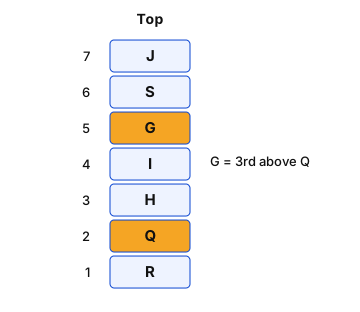
Only two boxes are kept between I and R. Only J is kept above S. Only three boxes are kept below I. H is kept at some place below G but at some place above Q.
Which box is kept third above Q?
सात बक्से, G, H, I, J, Q, R और S, एक के ऊपर एक रखे गए हैं, लेकिन आवश्यक नहीं कि इसी क्रम में हों।
I और R के बीच केवल दो बक्से रखे गए हैं। S के ऊपर केवल J रखा गया है। I के नीचे केवल तीन बक्से रखे गए हैं। H, G के नीचे किसी स्थान पर, लेकिन Q के ऊपर किसी स्थान पर रखा गया है।
Q के ठीक तीसरे ऊपर कौन-सा बक्सा रखा गया है?
  1. AJ
  2. BR
  3. CS
  4. DG
Show answer

Concept: Number positions 1 (bottom) to 7 (top) and fix the definite clues first.

  1. Only J above S → J = 7, S = 6. Only three boxes below I → I = 4.
  2. Two boxes between I and R → R = 1 (7 is taken).
  3. G, H, Q fill 2, 3, 5 with G above H above Q → Q = 2, H = 3, G = 5.
  4. Third above Q (2) is position 5 = G.

Trick: “Only X above Y” instantly fixes the top two places.

Answer: (D) G

अवधारणा: स्थान 1 (नीचे) से 7 (ऊपर) तक संख्या दें और पहले निश्चित संकेत लगाएँ।

  1. केवल J, S के ऊपर → J = 7, S = 6। I के नीचे केवल तीन बॉक्स → I = 4।
  2. I और R के बीच दो बॉक्स → R = 1 (7 भरा है)।
  3. G, H, Q स्थान 2, 3, 5 में, G के नीचे H और H के नीचे Q → Q = 2, H = 3, G = 5।
  4. Q (2) से तीसरा ऊपर स्थान 5 = G।

ट्रिक: “केवल X, Y के ऊपर” से ऊपर के दो स्थान तुरंत तय हो जाते हैं।

उत्तर: (D) G

RRB NTPC Undergraduate CBT 1General Intelligence and ReasoningBox ArrangementRRB NTPC Undergraduate CBT 1 2025 · 18 Jun Shift 2 →
Q6371.
Which of the following letter-number clusters will replace the question mark (?) in the given series to make it logically complete?
RHE 53, WMC 61, BRA 69, GWY 77, ?
निम्नलिखित में से कौन-सा अक्षर-संख्या समूह दी गई श्रृंखला में प्रश्न चिह्न (?) का स्थान लेकर उसे तार्किक रूप से पूर्ण करेगा?
RHE 53, WMC 61, BRA 69, GWY 77, ?
  1. AKBV 83
  2. BMAX 85
  3. CLBW 85
  4. DKCU 83
Show answer

Concept: Check each letter position and the number separately.

  1. 1st letter: R, W, B, G → +5 → L.
  2. 2nd letter: H, M, R, W → +5 → B.
  3. 3rd letter: E, C, A, Y → −2 → W.
  4. Number: 53, 61, 69, 77 → +8 → 85.

Trick: Numbers end in 85 for two options; the first letter L settles it.

Answer: (C) LBW 85

अवधारणा: हर अक्षर स्थान और संख्या को अलग-अलग जाँचें।

  1. पहला अक्षर: R, W, B, G → +5 → L।
  2. दूसरा अक्षर: H, M, R, W → +5 → B।
  3. तीसरा अक्षर: E, C, A, Y → −2 → W।
  4. संख्या: 53, 61, 69, 77 → +8 → 85।

ट्रिक: दो विकल्पों में 85 है; पहला अक्षर L निर्णय कर देता है।

उत्तर: (C) LBW 85

RRB NTPC Undergraduate CBT 1General Intelligence and ReasoningAlphanumeric SeriesRRB NTPC Undergraduate CBT 1 2025 · 18 Jun Shift 2 →
Q6372.
What should come in place of ‘?’ in the given series?
135 146 168 201 245 ?
दी गई श्रृंखला में ‘?’ के स्थान पर क्या आना चाहिए?
135 146 168 201 245 ?
  1. A300
  2. B310
  3. C290
  4. D280
Show answer

Concept: Look at the differences between consecutive terms.

  1. Differences: 146−135=11, 168−146=22, 201−168=33, 245−201=44.
  2. Next difference =55: 245+55=300.

Trick: Differences are multiples of 11 (11×1,11×2,…).

Answer: (A) 300

अवधारणा: लगातार पदों के अंतर देखें।

  1. अंतर: 146−135=11, 168−146=22, 201−168=33, 245−201=44।
  2. अगला अंतर =55: 245+55=300।

ट्रिक: अंतर 11 के गुणज हैं (11×1,11×2,…)।

उत्तर: (A) 300

RRB NTPC Undergraduate CBT 1General Intelligence and ReasoningNumber SeriesRRB NTPC Undergraduate CBT 1 2025 · 18 Jun Shift 2 →
Q6373.
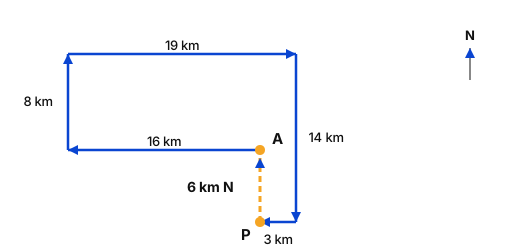
Abhinav starts from Point A and drives 16 km towards the west. He then takes a right turn, drives 8 km, turns right and drives 19 km. He then takes a right turn and drives 14 km. He takes a final right turn, drives 3 km and stops at Point P. How far (shortest distance) and towards which direction should he drive in order to reach Point A again? (All turns are 90-degree turns only unless specified.)
अभिनव बिंदु A से आरंभ करता है और पश्चिम की ओर 16 km गाड़ी चलाता है। फिर वह दाएँ मुड़ता है, 8 km गाड़ी चलाता है, दाएँ मुड़ता है और 19 km गाड़ी चलाता है। फिर वह दाएँ मुड़ता है और 14 km गाड़ी चलाता है। वह अंतिम बार दाएँ मुड़ता है, 3 km गाड़ी चलाता है और बिंदु P पर रुक जाता है। पुनः बिंदु A तक पहुँचने के लिए उसे कितनी दूरी (न्यूनतम दूरी) और किस दिशा में गाड़ी चलानी चाहिए? (जब तक निर्दिष्ट न हो, सभी मोड़ केवल 90 डिग्री के हैं।)
  1. A5 km to the southदक्षिण की ओर 5 km
  2. B6 km to the northउत्तर की ओर 6 km
  3. C5 km to the northउत्तर की ओर 5 km
  4. D6 km to the southदक्षिण की ओर 6 km
Show answer

Concept: Take A as origin (0, 0); east and north positive. Right turns go W → N → E → S → W.

  1. West 16 → (−16,0); right (north) 8 → (−16,8).
  2. Right (east) 19 → (3,8); right (south) 14 → (3,−6).
  3. Right (west) 3 → P=(0,−6).
  4. P is 6 km directly south of A, so he must drive 6 km towards the north.

Trick: Net E–W: −16+19−3=0; net N–S: 8−14=−6 → straight back 6 km north.

Answer: (B) 6 km to the north

अवधारणा: A को मूल बिंदु (0, 0) लें; पूर्व और उत्तर धनात्मक। दाएँ मुड़ने का क्रम: पश्चिम → उत्तर → पूर्व → दक्षिण → पश्चिम।

  1. पश्चिम 16 → (−16,0); दाएँ (उत्तर) 8 → (−16,8)।
  2. दाएँ (पूर्व) 19 → (3,8); दाएँ (दक्षिण) 14 → (3,−6)।
  3. दाएँ (पश्चिम) 3 → P=(0,−6)।
  4. P, A से ठीक 6 km दक्षिण है, इसलिए उसे 6 km उत्तर की ओर जाना होगा।

ट्रिक: कुल पूर्व–पश्चिम: −16+19−3=0; कुल उत्तर–दक्षिण: 8−14=−6 → सीधे 6 km उत्तर।

उत्तर: (B) 6 km उत्तर की ओर

RRB NTPC Undergraduate CBT 1General Intelligence and ReasoningDirection & DistanceRRB NTPC Undergraduate CBT 1 2025 · 18 Jun Shift 2 →
Q6374.
Each of the digits in the number 7632198 is arranged in ascending order from left to right. The position(s) of how many digits will remain unchanged as compared to that in the original number?
संख्या 7632198 के प्रत्येक अंक को बाएँ से दाएँ आरोही क्रम में व्यवस्थित किया जाता है। मूल संख्या की तुलना में कितने अंकों का/के स्थान अपरिवर्तित रहेगा/रहेंगे?
  1. AONEएक
  2. BNONEकोई नहीं
  3. CTHREEतीन
  4. DTWOदो
Show answer

Concept: Write the original and rearranged numbers one below the other and compare place by place.

  1. Original: 7 6 3 2 1 9 8.
  2. Ascending: 1 2 3 6 7 8 9.
  3. Compare: 7–1, 6–2, 3–3, 2–6, 1–7, 9–8, 8–9 → only the 3rd digit (3) is unchanged.

Trick: In ascending order a digit stays only if exactly (its rank −1) digits are smaller and all of them lie to its left.

Answer: (A) ONE

अवधारणा: मूल और पुनर्व्यवस्थित संख्याओं को एक के नीचे एक लिखकर स्थानवार तुलना करें।

  1. मूल: 7 6 3 2 1 9 8।
  2. आरोही: 1 2 3 6 7 8 9।
  3. तुलना: 7–1, 6–2, 3–3, 2–6, 1–7, 9–8, 8–9 → केवल तीसरा अंक (3) अपरिवर्तित।

ट्रिक: आरोही क्रम में कोई अंक तभी अपनी जगह रहता है जब उससे छोटे सभी अंक उसके बाईं ओर हों और संख्या ठीक उसकी जगह के अनुसार हो।

उत्तर: (A) एक

RRB NTPC Undergraduate CBT 1General Intelligence and ReasoningDigit RearrangementRRB NTPC Undergraduate CBT 1 2025 · 18 Jun Shift 2 →
Q6375.
Based on the English alphabetical order, three of the following four letter-cluster pairs are alike in a certain way and thus form a group. Which is the one that does not belong to that group?
(Note: The odd one out is not based on the number of consonants/vowels or their position in the letter-cluster pairs.)
अंग्रेज़ी वर्णमाला क्रम के आधार पर, निम्नलिखित चार अक्षर-समूह युग्मों में से तीन किसी निश्चित प्रकार से समान हैं और इस प्रकार एक समूह बनाते हैं। वह कौन-सा है जो उस समूह से संबंधित नहीं है?
(ध्यान दें: असंगत का निर्धारण व्यंजनों/स्वरों की संख्या या अक्षर-समूह युग्मों में उनके स्थान पर आधारित नहीं है।)
  1. AKJ-PZ
  2. BHG – NW
  3. CFE-KU
  4. DPO – UE
Show answer

Concept: Find the relation between the letters of each pair using alphabet positions.

  1. KJ-PZ: K→J −1, K(11)→P(16) +5, J(10)→Z(26) +16.
  2. FE-KU: −1, +5, E(5)→U(21) +16. PO-UE: −1, P→U +5, O(15)→E +16 (looping past Z).
  3. HG-NW: −1, but H(8)→N(14) =+6 – pattern breaks.

Trick: Check the first letters of the two clusters: only H→N is +6, all others +5.

Answer: (B) HG – NW

अवधारणा: वर्णमाला स्थानों से हर युग्म के अक्षरों का संबंध खोजें।

  1. KJ-PZ: K→J −1, K(11)→P(16) +5, J(10)→Z(26) +16।
  2. FE-KU: −1, +5, E(5)→U(21) +16। PO-UE: −1, P→U +5, O(15)→E +16 (Z के बाद फिर A से)।
  3. HG-NW: −1, पर H(8)→N(14) =+6 – पैटर्न टूटता है।

ट्रिक: दोनों समूहों के पहले अक्षर देखें: केवल H→N में +6 है, बाकी सब में +5।

उत्तर: (B) HG – NW

RRB NTPC Undergraduate CBT 1General Intelligence and ReasoningOdd One Out (Letter Pairs)RRB NTPC Undergraduate CBT 1 2025 · 18 Jun Shift 2 →
Q6376.
Based on the alphabetical order, three of the following four are alike in a certain way and thus form a group. Which is the one that does not belong to that group?
(Note: The odd one out is not based on the number of consonants/vowels or their position in the letter cluster.)
वर्णमाला क्रम के आधार पर, निम्नलिखित चार में से तीन किसी निश्चित प्रकार से समान हैं और इस प्रकार एक समूह बनाते हैं। वह कौन-सा है जो उस समूह से संबंधित नहीं है?
(ध्यान दें: असंगत का निर्धारण व्यंजनों/स्वरों की संख्या या अक्षर-समूह में उनके स्थान पर आधारित नहीं है।)
  1. AJKO
  2. BROS
  3. CMJN
  4. DLIM
Show answer

Concept: Relate the 2nd and 3rd letters to the 1st letter.

  1. ROS: R(18) → O(15) =−3, S(19) =+1.
  2. MJN: M(13) → J −3, N +1. LIM: L(12) → I −3, M +1.
  3. JKO: J(10) → K +1, O +5 – does not follow.

Trick: Pattern “−3, +1” from the first letter; JKO breaks it.

Answer: (A) JKO

अवधारणा: दूसरे और तीसरे अक्षर का संबंध पहले अक्षर से देखें।

  1. ROS: R(18) → O(15) =−3, S(19) =+1।
  2. MJN: M(13) → J −3, N +1। LIM: L(12) → I −3, M +1।
  3. JKO: J(10) → K +1, O +5 – पैटर्न नहीं मानता।

ट्रिक: पहले अक्षर से पैटर्न “−3, +1”; JKO इसे तोड़ता है।

उत्तर: (A) JKO

RRB NTPC Undergraduate CBT 1General Intelligence and ReasoningOdd One Out (Letter Clusters)RRB NTPC Undergraduate CBT 1 2025 · 18 Jun Shift 2 →
Q6377.
What should come in place of the question mark (?) in the given series based on the English alphabetical order?
PCO QGL RKI SOF ?
अंग्रेज़ी वर्णमाला क्रम के आधार पर दी गई श्रृंखला में प्रश्न चिह्न (?) के स्थान पर क्या आना चाहिए?
PCO QGL RKI SOF ?
  1. ASKM
  2. BCAP
  3. CSDF
  4. DTSC
Show answer

Concept: Split each cluster into 1st, 2nd and 3rd letters.

  1. 1st: P, Q, R, S → +1 → T.
  2. 2nd: C, G, K, O → +4 → S.
  3. 3rd: O, L, I, F → −3 → C.

Trick: The first letter must be T – only one option starts with T.

Answer: (D) TSC

अवधारणा: हर समूह को पहले, दूसरे और तीसरे अक्षर में बाँटें।

  1. पहला: P, Q, R, S → +1 → T।
  2. दूसरा: C, G, K, O → +4 → S।
  3. तीसरा: O, L, I, F → −3 → C।

ट्रिक: पहला अक्षर T होना चाहिए – केवल एक विकल्प T से शुरू होता है।

उत्तर: (D) TSC

RRB NTPC Undergraduate CBT 1General Intelligence and ReasoningLetter SeriesRRB NTPC Undergraduate CBT 1 2025 · 18 Jun Shift 2 →
Q6378.
In a certain code language,
A + B means ‘A is the sister of B’,
A - B means ‘A is the daughter of B’,
A × B means ‘A is the son of B’, and
A ÷ B means ‘A is the husband of B’.
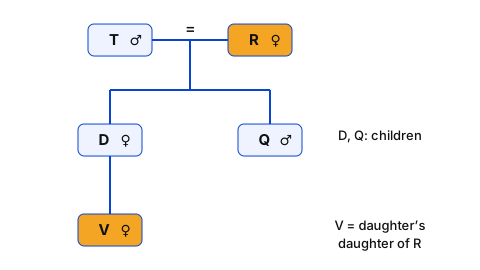
Based on the above, how is V related to R if ‘V - D + Q × T ÷ R’?
एक निश्चित कूट भाषा में,
A + B का अर्थ है ‘A, B की बहन है’,
A - B का अर्थ है ‘A, B की पुत्री है’,
A × B का अर्थ है ‘A, B का पुत्र है’, और
A ÷ B का अर्थ है ‘A, B का पति है’।
उपर्युक्त के आधार पर, यदि ‘V - D + Q × T ÷ R’ है, तो V का R से क्या संबंध है?
  1. ADaughterपुत्री
  2. BSon’s wifeपुत्र की पत्नी
  3. CSister’s daughterबहन की पुत्री
  4. DDaughter’s daughterपुत्री की पुत्री
Show answer

Concept: Decode each symbol from left to right and draw the family tree.

  1. V − D: V is the daughter of D. D + Q: D is the sister of Q (D is female).
  2. Q × T: Q is the son of T. T ÷ R: T is the husband of R, so R is the mother of Q and D.
  3. V is the daughter of D, and D is R’s daughter → V is R’s daughter’s daughter.

Trick: A sister of someone shares the same parents – put D beside Q under T–R.

Answer: (D) Daughter’s daughter

अवधारणा: हर चिह्न को बाएँ से दाएँ डिकोड करें और वंश-वृक्ष बनाएँ।

  1. V − D: V, D की पुत्री है। D + Q: D, Q की बहन है (D स्त्री)।
  2. Q × T: Q, T का पुत्र है। T ÷ R: T, R का पति है, अतः R, Q और D की माँ है।
  3. V, D की पुत्री है और D, R की पुत्री है → V, R की पुत्री की पुत्री है।

ट्रिक: किसी की बहन के माता-पिता वही होते हैं – D को T–R के नीचे Q के साथ रखें।

उत्तर: (D) पुत्री की पुत्री (नातिन)

RRB NTPC Undergraduate CBT 1General Intelligence and ReasoningCoded Blood RelationsRRB NTPC Undergraduate CBT 1 2025 · 18 Jun Shift 2 →
Q6379.
DI 12 is related to JE 3 in a certain way. In the same way, EW 11 is related to KS 2. To which of the following is KN 19 related, following the same logic?
DI 12 एक निश्चित प्रकार से JE 3 से संबंधित है। उसी प्रकार, EW 11, KS 2 से संबंधित है। उसी तर्क का अनुसरण करते हुए, KN 19 निम्नलिखित में से किससे संबंधित है?
  1. ATR 11
  2. BHY 14
  3. CQJ 10
  4. DLP 9
Show answer

Concept: Find the change in each letter and in the number separately.

  1. DI 12 → JE 3: D(4)→J(10) +6, I(9)→E(5) −4, 12−9=3.
  2. EW 11 → KS 2: E→K +6, W(23)→S(19) −4, 11−9=2 ✓.
  3. KN 19: K(11)→Q(17), N(14)→J(10), 19−9=10 → QJ 10.

Trick: Apply “+6, −4, −9” directly; the number 10 alone matches only one option.

Answer: (C) QJ 10

अवधारणा: हर अक्षर और संख्या में बदलाव अलग-अलग देखें।

  1. DI 12 → JE 3: D(4)→J(10) +6, I(9)→E(5) −4, 12−9=3।
  2. EW 11 → KS 2: E→K +6, W(23)→S(19) −4, 11−9=2 ✓।
  3. KN 19: K(11)→Q(17), N(14)→J(10), 19−9=10 → QJ 10।

ट्रिक: सीधे “+6, −4, −9” लगाएँ; संख्या 10 केवल एक विकल्प में है।

उत्तर: (C) QJ 10

RRB NTPC Undergraduate CBT 1General Intelligence and ReasoningAlphanumeric AnalogyRRB NTPC Undergraduate CBT 1 2025 · 18 Jun Shift 2 →
Q6380.
Refer to the given number series and answer the question that follows. Counting to be done from left to right only. All numbers are single-digit numbers only.
(Left) 3 8 7 5 3 2 1 9 6 4 8 7 5 2 1 4 6 3 2 9 8 7 5 4 1 5 2 6 9 8 7 5 6 3 2 1 5 4 7 8 5 1 2 5 9 6 3 9 8 7 5 1 4 5 2 (Right)
How many such even digits are there, each of which is immediately preceded by a perfect square and immediately followed by an odd digit? (NOTE: 1 is also a perfect square.)
दी गई संख्या श्रृंखला को देखिए और नीचे दिए गए प्रश्न का उत्तर दीजिए। गणना केवल बाएँ से दाएँ की जानी है। सभी संख्याएँ केवल एक अंक वाली संख्याएँ हैं।
(बाएँ) 3 8 7 5 3 2 1 9 6 4 8 7 5 2 1 4 6 3 2 9 8 7 5 4 1 5 2 6 9 8 7 5 6 3 2 1 5 4 7 8 5 1 2 5 9 6 3 9 8 7 5 1 4 5 2 (दाएँ)
ऐसे कितने सम अंक हैं, जिनमें से प्रत्येक के ठीक पहले एक पूर्ण वर्ग है और ठीक बाद एक विषम अंक है? (ध्यान दें: 1 भी एक पूर्ण वर्ग है।)
  1. A2
  2. B4
  3. C8
  4. D6
Show answer

Concept: Find even digits with a perfect square (1, 4 or 9) just before and an odd digit just after.

  1. Scan for patterns (1, 4 or 9) – even – odd.
  2. Found: 4 8 7, 4 6 3, 9 8 7, 9 8 7, 1 2 5, 9 6 3, 9 8 7, 1 4 5.
  3. Total =8.

Trick: Search around every 1, 4 and 9 only – each is a possible “preceding” digit.

Answer: (C) 8

अवधारणा: वे सम अंक खोजें जिनके ठीक पहले पूर्ण वर्ग (1, 4 या 9) और ठीक बाद विषम अंक हो।

  1. ढाँचा खोजें: (1, 4 या 9) – सम – विषम।
  2. मिले: 4 8 7, 4 6 3, 9 8 7, 9 8 7, 1 2 5, 9 6 3, 9 8 7, 1 4 5।
  3. कुल =8।

ट्रिक: केवल हर 1, 4 और 9 के ठीक बाद वाले अंक जाँचें।

उत्तर: (C) 8

RRB NTPC Undergraduate CBT 1General Intelligence and ReasoningNumber Series CountingRRB NTPC Undergraduate CBT 1 2025 · 18 Jun Shift 2 →