Question bank

Q&A: practice questions with answers

Search questions on any topic. Filter by exam category, exam, subject and topic, try the question, then open the answer and explanation.

Courses – airGurukul

8,495 questions found.

Q6441.
Two taps can fill a cistern in 4 hours and 19 hours, respectively. A third tap can empty it in 19 hours. How long (in hours) will it take to fill one-fourth of the empty cistern if all the taps are opened together?
दो नल एक टंकी को क्रमशः 4 घंटे और 19 घंटे में भर सकते हैं। एक तीसरा नल इसे 19 घंटे में खाली कर सकता है। यदि सभी नल एक साथ खोल दिए जाएँ, तो खाली टंकी का एक-चौथाई भाग भरने में कितना समय (घंटों में) लगेगा?
  1. A3
  2. B1
  3. C2
  4. D4
Show answer

Concept: Net filling rate = sum of filling rates − emptying rate.

  1. Rates: 14+119−119=14 per hour
  2. The 19-hour filler and 19-hour emptier cancel out
  3. Time for 14 tank =1/41/4=1 hour

Trick: Equal fill and empty times cancel — only the 4-hour tap matters.

Answer: (B) 1 hour

अवधारणा: शुद्ध भरने की दर = भरने वाले नलों की दर − खाली करने वाले की दर।

  1. दर: 14+119−119=14 प्रति घंटा
  2. 19 घंटे वाला भरने और खाली करने वाला नल एक-दूसरे को रद्द करते हैं
  3. 14 टंकी का समय =1 घंटा

ट्रिक: बराबर समय वाले भरने व खाली करने वाले नल कट जाते हैं — सिर्फ 4 घंटे वाला नल बचता है।

उत्तर: (B) 1 घंटा

RRB NTPC Undergraduate CBT 1MathematicsPipes and cisternsRRB NTPC Undergraduate CBT 1 2025 · 18 Jun Shift 1 →
Q6442.
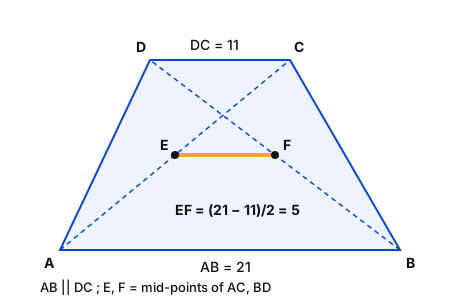
ABCD is a quadrilateral in which AB ∥ DC, and E and F are the mid points of the diagonals AC and BD, respectively. If AB = 21 cm, BC = 33 cm, DC = 11 cm, and AD = 52 cm, then what is the length (in cm) of EF?
ABCD एक चतुर्भुज है, जिसमें AB ∥ DC है, और E तथा F क्रमशः विकर्णों AC और BD के मध्य-बिंदु हैं। यदि AB = 21 cm, BC = 33 cm, DC = 11 cm, और AD = 52 cm है, तो EF की लंबाई (cm में) कितनी है?
  1. A3
  2. B4
  3. C6
  4. D5
Show answer

Concept: In a trapezium, the segment joining mid-points of the diagonals is parallel to the bases and EF=AB−DC2.

  1. Parallel sides: AB=21, DC=11
  2. EF=21−112=5cm
  3. BC and AD are extra data (not needed)

Yaad rakhein: Mid-points of diagonals → half the difference of parallel sides; mid-points of legs → half the sum.

Answer: (D) 5

अवधारणा: समलंब में विकर्णों के मध्य-बिंदुओं को मिलाने वाला रेखाखंड समांतर भुजाओं के समांतर होता है और EF=AB−DC2।

  1. समांतर भुजाएँ: AB=21, DC=11
  2. EF=21−112=5cm
  3. BC और AD अतिरिक्त आँकड़े हैं

याद रखें: विकर्णों के मध्य-बिंदु → समांतर भुजाओं के अंतर का आधा; तिर्यक भुजाओं के मध्य-बिंदु → योग का आधा।

उत्तर: (D) 5

RRB NTPC Undergraduate CBT 1MathematicsTrapezium (mid-points of diagonals)RRB NTPC Undergraduate CBT 1 2025 · 18 Jun Shift 1 →
Q6443.
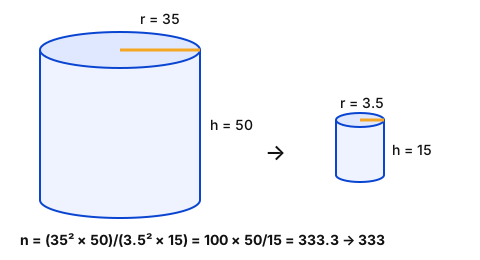
A solid cylinder of radius 35 cm and height 50 cm is melted and recast into smaller identical cylinders, each having radius 3.5 cm and height 15 cm. How many complete such smaller cylinders are formed?
35 cm त्रिज्या और 50 cm ऊँचाई वाले एक ठोस बेलन को पिघलाकर छोटे सर्वसम बेलनों में ढाला जाता है, जिनमें से प्रत्येक की त्रिज्या 3.5 cm और ऊँचाई 15 cm है। ऐसे कितने पूर्ण छोटे बेलन बनेंगे?
  1. A121
  2. B222
  3. C333
  4. D260
Show answer

Concept: Number of small solids =volume of bigvolume of one small.

  1. n=π×352×50π×3.52×15
  2. 3523.52=100, so n=100×5015=333.33
  3. Complete cylinders =333

Trick: Radius ratio 10⇒ area ratio 100; then multiply by height ratio 5015.

Answer: (C) 333

अवधारणा: छोटे ठोसों की संख्या =बड़े का आयतनएक छोटे का आयतन।

  1. n=π×352×50π×3.52×15
  2. 3523.52=100, अतः n=100×5015=333.33
  3. पूरे बेलन =333

ट्रिक: त्रिज्या अनुपात 10⇒ क्षेत्रफल अनुपात 100; फिर ऊँचाई अनुपात 5015 से गुणा करें।

उत्तर: (C) 333

RRB NTPC Undergraduate CBT 1MathematicsMelting and recasting (cylinder)RRB NTPC Undergraduate CBT 1 2025 · 18 Jun Shift 1 →
Q6444.
Amit and Raghav invest in a business in the ratio 5 : 7. If the total profit is ₹48,000, what is Raghav’s share?
अमित और राघव एक व्यवसाय में 5 : 7 के अनुपात में निवेश करते हैं। यदि कुल लाभ ₹48,000 है, तो राघव का हिस्सा कितना है?
  1. A₹26,000
  2. B₹28,000
  3. C₹30,000
  4. D₹32,000
Show answer

Concept: Profit is shared in the ratio of investments.

  1. Total parts =5+7=12
  2. Raghav's share =712×48000=28000

Trick: One part =4800012=4000; Raghav =7×4000.

Answer: (B) ₹28,000

अवधारणा: लाभ निवेश के अनुपात में बँटता है।

  1. कुल भाग =5+7=12
  2. राघव का हिस्सा =712×48000=28000

ट्रिक: एक भाग =4800012=4000; राघव =7×4000।

उत्तर: (B) ₹28,000

RRB NTPC Undergraduate CBT 1MathematicsPartnershipRRB NTPC Undergraduate CBT 1 2025 · 18 Jun Shift 1 →
Q6445.
A sum of money is invested at a simple interest rate of 8% per annum. After 3 years, the simple interest earned is ₹1,920. What is the principal invested?
एक धनराशि 8% वार्षिक साधारण ब्याज दर पर निवेश की जाती है। 3 वर्ष बाद, अर्जित साधारण ब्याज ₹1,920 है। निवेश किया गया मूलधन कितना है?
  1. A₹8,000
  2. B₹6,000
  3. C₹7,500
  4. D₹9,000
Show answer

Concept: SI=P×R×T100.

  1. 1920=P×8×3100
  2. P=1920×10024=8000

Trick: 3 years at 8% =24% of P =1920⇒P=8000.

Answer: (A) ₹8,000

अवधारणा: SI=P×R×T100।

  1. 1920=P×8×3100
  2. P=1920×10024=8000

ट्रिक: 3 वर्ष में 8% = P का 24%=1920⇒P=8000।

उत्तर: (A) ₹8,000

RRB NTPC Undergraduate CBT 1MathematicsSimple interestRRB NTPC Undergraduate CBT 1 2025 · 18 Jun Shift 1 →
Q6446.
A dishonest shopkeeper claims to sell 1 kg of rice at the cost price per kg. He actually uses a weight of 1200 g while purchasing rice, and a weight of 840 g while selling rice. What is the overall percentage profit made by the shopkeeper?
(Round off the result to two decimal places.)
एक बेईमान दुकानदार 1 kg चावल को प्रति kg क्रय मूल्य पर बेचने का दावा करता है। वह वास्तव में चावल खरीदते समय 1200 g के बाट का और चावल बेचते समय 840 g के बाट का उपयोग करता है। दुकानदार द्वारा अर्जित कुल प्रतिशत लाभ कितना है?
(परिणाम को दो दशमलव स्थानों तक पूर्णांकित कीजिए।)
  1. A42.86%
  2. B43.44%
  3. C41.78%
  4. D40.33%
Show answer

Concept: He gets 1200 g for the price of 1000 g and gives 840 g for the price of 1000 g.

  1. Let price of 1 kg = ₹1000. He buys 1200 g for ₹1000 and sells 840 g for ₹1000.
  2. Goods bought for ₹1000 (1200 g) are sold as 1200840 lots of ₹1000
  3. Profit%=1200−840840×100=360840×100=42.86%

Trick: Profit%=goods taken−goods givengoods given×100.

Answer: (A) 42.86%

अवधारणा: वह 1000 g के दाम में 1200 g लेता है और 1000 g के दाम में 840 g देता है।

  1. माना 1 kg का दाम ₹1000; खरीद: 1200 g = ₹1000, बिक्री: 840 g = ₹1000
  2. ₹1000 में खरीदा 1200 g माल 1200840 गुना दाम पर बिकता है
  3. लाभ%=1200−840840×100=360840×100=42.86%

ट्रिक: लाभ%=लिया माल−दिया मालदिया माल×100।

उत्तर: (A) 42.86%

RRB NTPC Undergraduate CBT 1MathematicsFaulty weightsRRB NTPC Undergraduate CBT 1 2025 · 18 Jun Shift 1 →
Q6447.
In an educational institute, the ratio of male students to female students is 4 : 3. The ratio of the same female students to teaching staff is 8 : 1. Find the ratio of total students (male + female) to teaching staff.
एक शैक्षणिक संस्थान में, पुरुष छात्रों और महिला छात्रों का अनुपात 4 : 3 है। उन्हीं महिला छात्रों और शिक्षण कर्मचारियों का अनुपात 8 : 1 है। कुल छात्रों (पुरुष + महिला) और शिक्षण कर्मचारियों का अनुपात ज्ञात कीजिए।
  1. A66 : 7
  2. B27 : 1
  3. C21 : 2
  4. D56 : 3
Show answer

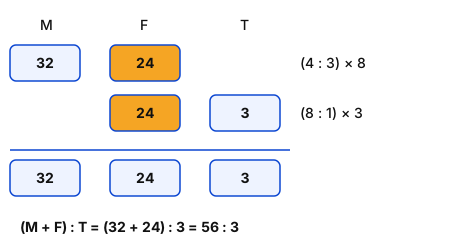
Concept: Make the common term (female students) equal in both ratios.

  1. M:F=4:3=32:24 (×8)
  2. F:T=8:1=24:3 (×3)
  3. M:F:T=32:24:3, so (M+F):T=56:3

Trick: Common term: LCM of 3 and 8 is 24.

Answer: (D) 56:3

अवधारणा: दोनों अनुपातों में साझा पद (छात्राएँ) बराबर करें।

  1. M:F=4:3=32:24 (×8)
  2. F:T=8:1=24:3 (×3)
  3. M:F:T=32:24:3, अतः (M+F):T=56:3

ट्रिक: साझा पद: 3 और 8 का LCM 24।

उत्तर: (D) 56:3

RRB NTPC Undergraduate CBT 1MathematicsRatio (combining ratios)RRB NTPC Undergraduate CBT 1 2025 · 18 Jun Shift 1 →
Q6448.
Three classes have 60, 40, and 50 students respectively. Their average marks are 65, 72, and 60. What is the average mark of all 150 students combined?
तीन कक्षाओं में क्रमशः 60, 40 और 50 छात्र हैं। उनके औसत अंक 65, 72 और 60 हैं। सभी 150 छात्रों के संयुक्त औसत अंक कितने हैं?
  1. A70
  2. B65.2
  3. C60
  4. D67
Show answer

Concept: Combined average =∑nix¯i∑ni.

  1. Totals: 60×65=3900, 40×72=2880, 50×60=3000
  2. Sum =9780
  3. Average =9780150=65.2

Trick: Deviation from 65: 0+40×7−50×5=30; 65+30150=65.2.

Answer: (B) 65.2

अवधारणा: संयुक्त औसत =∑nix¯i∑ni।

  1. योग: 60×65=3900, 40×72=2880, 50×60=3000
  2. कुल =9780
  3. औसत =9780150=65.2

ट्रिक: 65 से विचलन: 0+40×7−50×5=30; 65+30150=65.2।

उत्तर: (B) 65.2

RRB NTPC Undergraduate CBT 1MathematicsWeighted averageRRB NTPC Undergraduate CBT 1 2025 · 18 Jun Shift 1 →
Q6449.
What is the mode of the following data?
53, 46, 55, 53, 40, 48, 53, 47, 41, 54, 43, 55, 54, 51, 43, 42, 44, 47
निम्नलिखित आँकड़ों का बहुलक (mode) क्या है?
53, 46, 55, 53, 40, 48, 53, 47, 41, 54, 43, 55, 54, 51, 43, 42, 44, 47
  1. A46
  2. B48
  3. C53
  4. D55
Show answer

Concept: Mode is the value that occurs most often.

  1. 53 occurs 3 times
  2. 43, 47, 54, 55 occur 2 times each; all others once
  3. Highest frequency → 53

Trick: Sort or tally quickly; only one value repeats 3 times.

Answer: (C) 53

अवधारणा: बहुलक (Mode) वह मान है जो सबसे अधिक बार आता है।

  1. 53 तीन बार आता है
  2. 43, 47, 54, 55 दो-दो बार; बाकी एक बार
  3. सर्वाधिक बारंबारता → 53

ट्रिक: जल्दी से गिनती करें; केवल एक मान 3 बार आता है।

उत्तर: (C) 53

RRB NTPC Undergraduate CBT 1MathematicsModeRRB NTPC Undergraduate CBT 1 2025 · 18 Jun Shift 1 →
Q6450.
The difference between two numbers is 8. If twice the larger number is 4 more than three times the smaller number, what is the larger number?
दो संख्याओं का अंतर 8 है। यदि बड़ी संख्या का दोगुना, छोटी संख्या के तिगुने से 4 अधिक है, तो बड़ी संख्या कौन-सी है?
  1. A18
  2. B16
  3. C20
  4. D14
Show answer

Concept: Let larger =x, smaller =y and form two equations.

  1. x−y=8 and 2x=3y+4
  2. 2(y+8)=3y+4⇒y=12
  3. x=12+8=20

Trick: Option check: x=20,y=12: 40=36+4 ✓.

Answer: (C) 20

अवधारणा: माना बड़ी संख्या =x, छोटी =y; दो समीकरण बनाइए।

  1. x−y=8 और 2x=3y+4
  2. 2(y+8)=3y+4⇒y=12
  3. x=12+8=20

ट्रिक: विकल्प जाँच: x=20,y=12: 40=36+4 ✓।

उत्तर: (C) 20

RRB NTPC Undergraduate CBT 1MathematicsLinear equationsRRB NTPC Undergraduate CBT 1 2025 · 18 Jun Shift 1 →
Q6451.
The price of a book is increased from ₹200 to ₹220. What is the percentage increase in the price?
एक पुस्तक का मूल्य ₹200 से बढ़ाकर ₹220 कर दिया जाता है। मूल्य में प्रतिशत वृद्धि कितनी है?
  1. A8%
  2. B10%
  3. C12%
  4. D5%
Show answer

Concept: Increase%=increaseoriginal×100.

  1. Increase =220−200=20
  2. 20200×100=10%

Yaad rakhein: Always divide by the original (old) value.

Answer: (B) 10%

अवधारणा: वृद्धि%=वृद्धिमूल×100।

  1. वृद्धि =220−200=20
  2. 20200×100=10%

याद रखें: हमेशा मूल (पुराने) मान से भाग दें।

उत्तर: (B) 10%

RRB NTPC Undergraduate CBT 1MathematicsPercentage changeRRB NTPC Undergraduate CBT 1 2025 · 18 Jun Shift 1 →
Q6452.
If (3−22+3−19+3−17+3−16)=k(3−24), then find the value of k.
यदि (3−22+3−19+3−17+3−16)=k(3−24) है, तो k का मान ज्ञात कीजिए।
  1. A9000
  2. B900
  3. C1000
  4. D3000
Show answer

Concept: Divide both sides by 3−24: am÷an=am−n.

  1. k=3−22+24+3−19+24+3−17+24+3−16+24
  2. k=32+35+37+38
  3. k=9+243+2187+6561=9000

Trick: Multiply each power by 324 — just add 24 to every exponent.

Answer: (A) 9000

अवधारणा: दोनों पक्षों को 3−24 से भाग दें: am÷an=am−n।

  1. k=3−22+24+3−19+24+3−17+24+3−16+24
  2. k=32+35+37+38
  3. k=9+243+2187+6561=9000

ट्रिक: हर घातांक में 24 जोड़ दें।

उत्तर: (A) 9000

RRB NTPC Undergraduate CBT 1MathematicsIndices (exponents)RRB NTPC Undergraduate CBT 1 2025 · 18 Jun Shift 1 →
Q6453.
Two pipes, A and B, can fill a tank in 20 minutes and 30 minutes, respectively. A waste pipe C can empty it in 60 minutes. All three are opened together. After 10 minutes, pipe C is closed. How much total time will it take to fill the tank?
दो पाइप, A और B, एक टंकी को क्रमशः 20 मिनट और 30 मिनट में भर सकते हैं। एक निकास पाइप C इसे 60 मिनट में खाली कर सकता है। तीनों को एक साथ खोला जाता है। 10 मिनट बाद, पाइप C को बंद कर दिया जाता है। टंकी को भरने में कुल कितना समय लगेगा?
  1. A14 minutes14 मिनट
  2. B15 minutes15 मिनट
  3. C17 minutes17 मिनट
  4. D12 minutes12 मिनट
Show answer

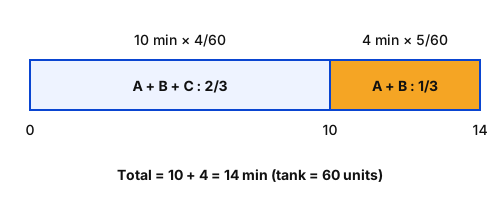
Concept: Take tank =60 units (LCM of 20, 30, 60).

  1. Rates: A =3, B =2, C =−1 unit/min; together =4
  2. In 10 min: 40 units filled
  3. Left 20 units at 3+2=5 per min → 4 min
  4. Total =10+4=14 min

Trick: LCM-units method avoids fractions.

Answer: (A) 14 minutes

अवधारणा: टंकी =60 इकाई मानें (20, 30, 60 का LCM)।

  1. दर: A =3, B =2, C =−1 इकाई/मिनट; साथ में =4
  2. 10 मिनट में 40 इकाई भरी
  3. बची 20 इकाई, दर 3+2=5 → 4 मिनट
  4. कुल =10+4=14 मिनट

ट्रिक: LCM-इकाई विधि से भिन्न नहीं आते।

उत्तर: (A) 14 मिनट

RRB NTPC Undergraduate CBT 1MathematicsPipes and cisternsRRB NTPC Undergraduate CBT 1 2025 · 18 Jun Shift 1 →
Q6454.
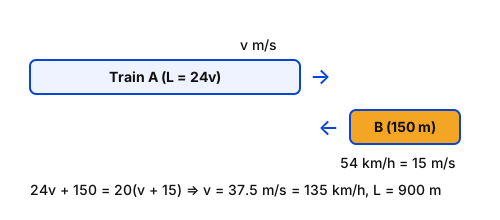
A train A passes a fixed pole in 24 seconds. The same train completely crosses another train B of length 150 m coming from the opposite direction in 20 seconds. Train B’s speed is 54 km/h. Find the length and the speed of train A.
एक रेलगाड़ी A एक स्थिर खंभे को 24 सेकंड में पार करती है। वही रेलगाड़ी विपरीत दिशा से आ रही 150 m लंबी एक अन्य रेलगाड़ी B को 20 सेकंड में पूरी तरह पार कर लेती है। रेलगाड़ी B की चाल 54 km/h है। रेलगाड़ी A की लंबाई और चाल ज्ञात कीजिए।
  1. A900 m and 134 km/h900 m और 134 km/h
  2. B600 m and 135 km/h600 m और 135 km/h
  3. C500 m and 135 km/h500 m और 135 km/h
  4. D900 m and 135 km/h900 m और 135 km/h
Show answer

Concept: Crossing a pole: length =vt; opposite trains: LA+LB=(vA+vB)t.

  1. vB=54×518=15m/s; LA=24v
  2. 24v+150=20(v+15)⇒4v=150⇒v=37.5m/s
  3. v=37.5×185=135km/h, LA=24×37.5=900m

Trick: Only option (D) has 135 km/h with L=24×37.5=900.

Answer: (D) 900 m and 135 km/h

अवधारणा: खंभा पार करने पर लंबाई =vt; विपरीत दिशा में LA+LB=(vA+vB)t।

  1. vB=54×518=15m/s; LA=24v
  2. 24v+150=20(v+15)⇒4v=150⇒v=37.5m/s
  3. v=37.5×185=135km/h, LA=24×37.5=900m

ट्रिक: 135 km/h के साथ L=24×37.5=900 केवल (D) में है।

उत्तर: (D) 900 m और 135 km/h

RRB NTPC Undergraduate CBT 1MathematicsTrains (opposite direction)RRB NTPC Undergraduate CBT 1 2025 · 18 Jun Shift 1 →
Q6455.
A pen is priced at ₹47. A scheme offers “Buy 4, Get 1 at 50% off”. What is the effective price per pen?
एक पेन का मूल्य ₹47 है। एक योजना में “4 खरीदें, 1 पर 50% छूट पाएँ” का प्रस्ताव है। प्रति पेन प्रभावी मूल्य क्या है?
  1. A₹42.30
  2. B₹40.30
  3. C₹38.30
  4. D₹39.30
Show answer

Concept: Effective price per item =total paiditems received.

  1. Pay for 4 full: 4×47=188
  2. 5th pen at 50% off: 23.50
  3. Total =211.50 for 5 pens → 211.55=42.30

Trick: Discount =0.55=10%; 47×0.9=42.30.

Answer: (A) ₹42.30

अवधारणा: प्रति वस्तु प्रभावी मूल्य =कुल भुगतानमिली वस्तुएँ।

  1. 4 पेन पूरे दाम: 4×47=188
  2. 5वाँ पेन 50% छूट पर: 23.50
  3. कुल =211.50, 5 पेन → 211.55=42.30

ट्रिक: छूट =0.55=10%; 47×0.9=42.30।

उत्तर: (A) ₹42.30

RRB NTPC Undergraduate CBT 1MathematicsDiscount schemesRRB NTPC Undergraduate CBT 1 2025 · 18 Jun Shift 1 →
Q6456.
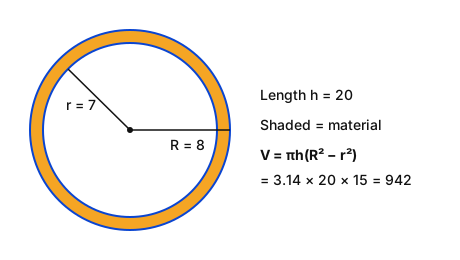
A cylindrical pipe has an external radius of 8 cm and an internal radius of 7 cm. If its length is 20 cm, what is the volume of material used in the pipe? (Use π = 3.14)
एक बेलनाकार पाइप की बाहरी त्रिज्या 8 cm और आंतरिक त्रिज्या 7 cm है। यदि इसकी लंबाई 20 cm है, तो पाइप में प्रयुक्त सामग्री का आयतन कितना है? (π = 3.14 लीजिए)
  1. A192 cubic cm192 घन cm
  2. B201 cubic cm201 घन cm
  3. C320 cubic cm320 घन cm
  4. D942 cubic cm942 घन cm
Show answer

Concept: Volume of material =πh(R2−r2).

  1. R2−r2=64−49=15
  2. V=3.14×20×15=942cm3

Trick: R2−r2=(R+r)(R−r)=15×1.

Answer: (D) 942 cubic cm

अवधारणा: पदार्थ का आयतन =πh(R2−r2)।

  1. R2−r2=64−49=15
  2. V=3.14×20×15=942cm3

ट्रिक: R2−r2=(R+r)(R−r)=15×1।

उत्तर: (D) 942 घन cm

RRB NTPC Undergraduate CBT 1MathematicsHollow cylinderRRB NTPC Undergraduate CBT 1 2025 · 18 Jun Shift 1 →
Q6457.
If x is the fourth proportional of 37, 25 and 888, what is the value of x?
यदि x, 37, 25 और 888 का चतुर्थानुपाती है, तो x का मान क्या है?
  1. A400
  2. B800
  3. C500
  4. D600
Show answer

Concept: Fourth proportional x of a,b,c: a:b=c:x⇒x=bca.

  1. x=25×88837
  2. 88837=24, so x=25×24=600

Yaad rakhein: 888=37×24 — spot the factor first.

Answer: (D) 600

अवधारणा: a,b,c का चतुर्थानुपाती x: a:b=c:x⇒x=bca।

  1. x=25×88837
  2. 88837=24, अतः x=25×24=600

याद रखें: 888=37×24 — पहले गुणनखंड पहचानें।

उत्तर: (D) 600

RRB NTPC Undergraduate CBT 1MathematicsProportionRRB NTPC Undergraduate CBT 1 2025 · 18 Jun Shift 1 →
Q6458.
A daily commuter usually reaches his office on time by driving at a speed of 40 km/hr. One day, due to traffic, he drives at 30 km/hr and reaches 20 minutes late. What is the distance to his office?
एक दैनिक यात्री सामान्यतः 40 km/hr की चाल से गाड़ी चलाकर अपने कार्यालय समय पर पहुँचता है। एक दिन, यातायात के कारण, वह 30 km/hr की चाल से गाड़ी चलाता है और 20 मिनट देरी से पहुँचता है। उसके कार्यालय की दूरी कितनी है?
  1. A40 km
  2. B60 km
  3. C50 km
  4. D30 km
Show answer

Concept: Same distance: difference of times = delay.

  1. d30−d40=2060=13
  2. d120=13⇒d=40km

Trick: d=S1S2S1−S2×t=40×3010×13=40.

Answer: (A) 40km

अवधारणा: दूरी समान: समयों का अंतर = देरी।

  1. d30−d40=2060=13
  2. d120=13⇒d=40km

ट्रिक: d=S1S2S1−S2×t=40×3010×13=40।

उत्तर: (A) 40km

RRB NTPC Undergraduate CBT 1MathematicsSpeed, time and distanceRRB NTPC Undergraduate CBT 1 2025 · 18 Jun Shift 1 →
Q6459.
Which of the expressions given below has the same value as that of cos2(θ) + sin2(θ)?
नीचे दिए गए व्यंजकों में से किसका मान cos2(θ) + sin2(θ) के मान के समान है?
  1. A1 + tan²(θ) - (1- sec²(θ))
  2. Bcosec²(θ) + sec²(θ)
  3. Ccosec²(θ) + cot²(θ)
  4. D1 + tan²(θ) + (1- sec²(θ))
Show answer

Concept: cos2θ+sin2θ=1 and 1+tan2θ=sec2θ.

  1. (D): 1+tan2θ+1−sec2θ=sec2θ+1−sec2θ=1 ✓
  2. (A) gives 2sec2θ−1, not 1
  3. (B), (C) are always greater than 1

Yaad rakhein: sec2θ−tan2θ=1, csc2θ−cot2θ=1.

Answer: (D) 1+tan2θ+(1−sec2θ)

अवधारणा: cos2θ+sin2θ=1 तथा 1+tan2θ=sec2θ।

  1. (D): 1+tan2θ+1−sec2θ=sec2θ+1−sec2θ=1 ✓
  2. (A) से 2sec2θ−1 मिलता है, 1 नहीं
  3. (B), (C) सदैव 1 से बड़े हैं

याद रखें: sec2θ−tan2θ=1, csc2θ−cot2θ=1।

उत्तर: (D) 1+tan2θ+(1−sec2θ)

RRB NTPC Undergraduate CBT 1MathematicsTrigonometric identitiesRRB NTPC Undergraduate CBT 1 2025 · 18 Jun Shift 1 →
Q6460.
What sum (in ₹) will earn a simple interest of ₹1,320 in 4 years at 12% per year rate of interest?
12% वार्षिक ब्याज दर पर 4 वर्षों में कितनी राशि (₹ में) पर ₹1,320 का साधारण ब्याज प्राप्त होगा?
  1. A5,500
  2. B633.6
  3. C1,375
  4. D2,750
Show answer

Concept: P=SI×100R×T.

  1. R×T=12×4=48%
  2. P=1320×10048=2750

Trick: 48% of P =1320 → 1%=27.5 → P=2750.

Answer: (D) ₹2,750

अवधारणा: P=SI×100R×T।

  1. R×T=12×4=48%
  2. P=1320×10048=2750

ट्रिक: P का 48%=1320 → 1%=27.5 → P=2750।

उत्तर: (D) ₹2,750

RRB NTPC Undergraduate CBT 1MathematicsSimple interestRRB NTPC Undergraduate CBT 1 2025 · 18 Jun Shift 1 →