Question bank

Q&A: practice questions with answers

Search questions on any topic. Filter by exam category, exam, subject and topic, try the question, then open the answer and explanation.

Courses – airGurukul

8,495 questions found.

Q6461.
What least value must be given to n so that the number 5135n2 becomes divisible by 9?
n को कम से कम कौन-सा मान दिया जाना चाहिए ताकि संख्या 5135n2, 9 से विभाज्य हो जाए?
  1. A5
  2. B3
  3. C4
  4. D2
Show answer

Concept: A number is divisible by 9 if its digit sum is a multiple of 9.

  1. Digit sum =5+1+3+5+2+n=16+n
  2. Next multiple of 9 is 18 → n=2

Yaad rakhein: 9 test: digit sum ÷ 9; 3 test: digit sum ÷ 3.

Answer: (D) 2

अवधारणा: कोई संख्या 9 से विभाज्य होती है यदि अंकों का योग 9 का गुणज हो।

  1. अंकों का योग =5+1+3+5+2+n=16+n
  2. 9 का अगला गुणज 18 → n=2

याद रखें: 9 का नियम: अंकों का योग 9 से विभाज्य।

उत्तर: (D) 2
RRB NTPC Undergraduate CBT 1MathematicsDivisibility by 9RRB NTPC Undergraduate CBT 1 2025 · 18 Jun Shift 1 →
Q6462.
Five years ago, Rahul was twice as old as his brother. If Rahul is 10 years older than his brother, what is Rahul’s present age?
पाँच वर्ष पहले, राहुल की आयु उसके भाई की आयु की दोगुनी थी। यदि राहुल अपने भाई से 10 वर्ष बड़ा है, तो राहुल की वर्तमान आयु कितनी है?
  1. A15 years15 वर्ष
  2. B25 years25 वर्ष
  3. C30 years30 वर्ष
  4. D20 years20 वर्ष
Show answer

Concept: The age difference stays constant over time.

  1. Let brother =b, Rahul =b+10
  2. 5 years ago: b+5=2(b−5)⇒b=15
  3. Rahul =25 years

Trick: 5 years ago Rahul = 2 × brother and difference 10 → brother 10, Rahul 20 then; now 25.

Answer: (B) 25 years

अवधारणा: समय के साथ आयु का अंतर स्थिर रहता है।

  1. माना भाई =b, राहुल =b+10
  2. 5 वर्ष पहले: b+5=2(b−5)⇒b=15
  3. राहुल =25 वर्ष

ट्रिक: 5 वर्ष पहले राहुल = 2 × भाई और अंतर 10 → तब भाई 10, राहुल 20; अब 25।

उत्तर: (B) 25 वर्ष

RRB NTPC Undergraduate CBT 1MathematicsProblems on agesRRB NTPC Undergraduate CBT 1 2025 · 18 Jun Shift 1 →
Q6463.
A person spends 75% of his income. If his income increases by 20% and his
expenditure increases by 10%, what is the percentage change in his savings?
एक व्यक्ति अपनी आय का 75% व्यय करता है। यदि उसकी आय में 20% की वृद्धि होती है और उसके
व्यय में 10% की वृद्धि होती है, तो उसकी बचत में कितने प्रतिशत का परिवर्तन होगा?
  1. A60% increase60% वृद्धि
  2. B50% increase50% वृद्धि
  3. C40% increase40% वृद्धि
  4. D25% increase25% वृद्धि
Show answer

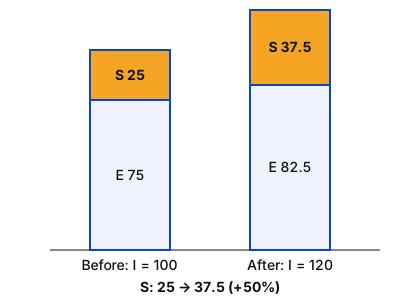
Concept: Savings=Income−Expenditure; take income =100.

  1. Before: I=100, E=75, S=25
  2. After: I=120, E=75×1.1=82.5, S=37.5
  3. Change =12.525×100=50% increase

Trick: Always assume income 100 in such questions.

Answer: (B) 50% increase

अवधारणा: बचत=आय−व्यय; आय =100 मानें।

  1. पहले: I=100, E=75, S=25
  2. बाद में: I=120, E=75×1.1=82.5, S=37.5
  3. परिवर्तन =12.525×100=50% वृद्धि

ट्रिक: ऐसे प्रश्नों में आय 100 मान लें।

उत्तर: (B) 50% वृद्धि

RRB NTPC Undergraduate CBT 1MathematicsIncome, expenditure and savingsRRB NTPC Undergraduate CBT 1 2025 · 18 Jun Shift 1 →
Q6464.
If 2x−2x−1=32, then the value of 2x−12x+3 is:
यदि 2x−2x−1=32 है, तो 2x−12x+3 का मान है:
  1. A1114
  2. B1115
  3. C1112
  4. D1113
Show answer

Concept: Take the common factor 2x−1.

  1. 2x−2x−1=2x−1(2−1)=2x−1
  2. 2x−1=32=25⇒x=6
  3. 2x−12x+3=1115

Yaad rakhein: ax−ax−1=ax−1(a−1).

Answer: (B) 1115

अवधारणा: उभयनिष्ठ गुणनखंड 2x−1 निकालें।

  1. 2x−2x−1=2x−1(2−1)=2x−1
  2. 2x−1=32=25⇒x=6
  3. 2x−12x+3=1115

याद रखें: ax−ax−1=ax−1(a−1)।

उत्तर: (B) 1115

RRB NTPC Undergraduate CBT 1MathematicsExponential equationsRRB NTPC Undergraduate CBT 1 2025 · 18 Jun Shift 1 →
Q6465.
The 7-digit number 77A444B is divisible by 24. What is the maximum value of (A + B)?
7-अंकीय संख्या 77A444B, 24 से विभाज्य है। (A + B) का अधिकतम मान क्या है?
  1. A13
  2. B12
  3. C15
  4. D16
Show answer

Concept: 24=3×8: last three digits divisible by 8 and digit sum divisible by 3.

  1. Last three digits 44B: 440 and 448 are multiples of 8 → B=0 or 8
  2. Digit sum =26+A+B must be a multiple of 3
  3. Take B=8: 34+A → A=2,5,8; max A=8
  4. Max A+B=8+8=16

Trick: Choose the largest B first, then the largest A that fits the 3-test.

Answer: (D) 16

अवधारणा: 24=3×8: अंतिम तीन अंक 8 से और अंकों का योग 3 से विभाज्य हो।

  1. अंतिम तीन अंक 44B: 440 व 448 ही 8 के गुणज → B=0 या 8
  2. अंकों का योग =26+A+B, 3 का गुणज हो
  3. B=8: 34+A → A=2,5,8; अधिकतम A=8
  4. अधिकतम A+B=8+8=16

ट्रिक: पहले सबसे बड़ा B, फिर 3 के नियम से सबसे बड़ा A चुनें।

उत्तर: (D) 16

RRB NTPC Undergraduate CBT 1MathematicsDivisibility by 24RRB NTPC Undergraduate CBT 1 2025 · 18 Jun Shift 1 →
Q6466.
Based on the English alphabetical order, three of the following four are alike in a certain way and thus form a group. Which is the one that does not belong to that group? (Note: The odd man out is not based on the number of consonants/vowels or their position in the letter cluster.)
अंग्रेज़ी वर्णमाला क्रम के आधार पर, निम्नलिखित चार में से तीन किसी निश्चित प्रकार से एकसमान हैं और इस प्रकार एक समूह बनाते हैं। वह कौन-सा है जो उस समूह से संबंधित नहीं है? (ध्यान दें: असंगत, अक्षर-समूह में व्यंजनों/स्वरों की संख्या या उनके स्थान पर आधारित नहीं है।)
  1. APNN
  2. BKHI
  3. CZWX
  4. DFCD
Show answer

Concept: Check the gap between consecutive letters of each cluster.

  1. KHI: K →−3 H →+1 I
  2. ZWX: Z →−3 W →+1 X; FCD: F →−3 C →+1 D
  3. PNN: P →−2 N →0 N – different pattern.

Trick: A repeated letter (NN) usually signals the odd cluster – verify quickly.

Answer: (A) PNN

अवधारणा: हर समूह के क्रमागत अक्षरों का अंतर देखें।

  1. KHI: K →−3 H →+1 I
  2. ZWX: Z →−3 W →+1 X; FCD: F →−3 C →+1 D
  3. PNN: P →−2 N →0 N – अलग पैटर्न।

ट्रिक: दोहराया गया अक्षर (NN) अक्सर विषम समूह का संकेत होता है – जल्दी जाँच लें।

उत्तर: (A) PNN

RRB NTPC Undergraduate CBT 1General Intelligence and ReasoningOdd one out – letter clustersRRB NTPC Undergraduate CBT 1 2025 · 18 Jun Shift 1 →
Q6467.
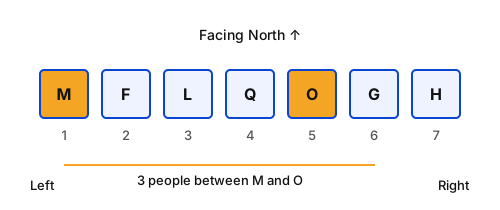
Seven people F, G, H, L, M, O and Q are sitting in a row facing north. Only two people sit between H and Q. Only H sits to the right of G. Only three people sit between G and F. L sits at some place to the left of O, but at some place to the right of M. How many people sit between M and O?
सात व्यक्ति F, G, H, L, M, O और Q एक पंक्ति में उत्तर की ओर मुख करके बैठे हैं। H और Q के बीच केवल दो व्यक्ति बैठे हैं। G के दाईं ओर केवल H बैठा है। G और F के बीच केवल तीन व्यक्ति बैठे हैं। L, O के बाईं ओर किसी स्थान पर, परंतु M के दाईं ओर किसी स्थान पर बैठा है। M और O के बीच कितने व्यक्ति बैठे हैं?
  1. ATwoदो
  2. BThreeतीन
  3. CFourचार
  4. DOneएक
Show answer

Concept: Facing north, “right” is the east end. Fix the person with a unique position first.

  1. Only H is to the right of G → H at the right end (7), G at 6.
  2. Two between H and Q → Q = 4. Three between G and F → F = 2.
  3. Positions 1, 3, 5 left for M, L, O with M < L < O (left to right) → M = 1, L = 3, O = 5.
  4. Between M (1) and O (5): F, L, Q = 3 people.

Trick: “Only X is to the right of Y” → Y is second from the right end.

Answer: (B) Three

अवधारणा: उत्तर की ओर मुख होने पर “दायाँ” = पूर्वी छोर। पहले निश्चित स्थान वाला व्यक्ति रखें।

  1. केवल H, G के दाईं ओर → H दाएँ छोर (7) पर, G 6 पर।
  2. H और Q के बीच दो → Q = 4। G और F के बीच तीन → F = 2।
  3. बचे स्थान 1, 3, 5 पर M, L, O (बाएँ से दाएँ M, L, O क्रम) → M = 1, L = 3, O = 5।
  4. M (1) और O (5) के बीच: F, L, Q = 3 व्यक्ति।

ट्रिक: “केवल X, Y के दाईं ओर” → Y दाएँ छोर से दूसरा।

उत्तर: (B) तीन

RRB NTPC Undergraduate CBT 1General Intelligence and ReasoningLinear seating arrangementRRB NTPC Undergraduate CBT 1 2025 · 18 Jun Shift 1 →
Q6468.
Select the pair which follows the same pattern as that followed by the two pairs given below. Both pairs follow the same pattern.
VXW−UWV
WYX−VXW
उस युग्म का चयन कीजिए जो उसी पैटर्न का अनुसरण करता है जिसका अनुसरण नीचे दिए गए दो युग्म करते हैं। दोनों युग्म एक ही पैटर्न का अनुसरण करते हैं।
VXW−UWV
WYX−VXW
  1. ABDC−ACB
  2. BBCA−ACB
  3. CBDC−ZCA
  4. DBCA−ZBA
Show answer

Concept: Compare each letter of the first cluster with the corresponding letter of the second.

  1. VXW → UWV: each letter −1. WYX → VXW: each letter −1.
  2. BDC → ACB: B→A, D→C, C→B, each −1 ✓.
  3. BCA → ACB, BDC → ZCA and BCA → ZBA break the −1 rule.

Trick: Check only the first letter of each option first (B → A); only (A) and (B) survive, then check the rest.

Answer: (A) BDC−ACB

अवधारणा: पहले समूह के प्रत्येक अक्षर की तुलना दूसरे समूह के संगत अक्षर से करें।

  1. VXW → UWV: हर अक्षर −1। WYX → VXW: हर अक्षर −1।
  2. BDC → ACB: B→A, D→C, C→B, सभी −1 ✓।
  3. BCA → ACB, BDC → ZCA, BCA → ZBA में −1 नियम टूटता है।

ट्रिक: पहले हर विकल्प का पहला अक्षर जाँचें (B → A); केवल (A), (B) बचते हैं, फिर बाकी देखें।

उत्तर: (A) BDC−ACB

RRB NTPC Undergraduate CBT 1General Intelligence and ReasoningLetter analogyRRB NTPC Undergraduate CBT 1 2025 · 18 Jun Shift 1 →
Q6469.
In a certain code language, ‘salt elbow care’ is coded as ' zh pv nf' and ‘night care jar’ is coded as ‘ab po zh’. How is ‘care’ coded in the given language?
एक निश्चित कूट भाषा में, ‘salt elbow care’ को ' zh pv nf' के रूप में कूटबद्ध किया जाता है और ‘night care jar’ को ‘ab po zh’ के रूप में कूटबद्ध किया जाता है। दी गई भाषा में ‘care’ को किस प्रकार कूटबद्ध किया जाता है?
  1. Azh
  2. Bab
  3. Cnf
  4. Dpv
Show answer

Concept: A word common to two sentences gets the code common to both coded sentences.

  1. salt elbow care → zh pv nf
  2. night care jar → ab po zh
  3. Only “care” and only “zh” are common → care = zh.

Trick: Common word ↔ common code – no need to decode other words.

Answer: (A) zh

अवधारणा: दो वाक्यों में उभयनिष्ठ शब्द का कोड दोनों कूट वाक्यों में उभयनिष्ठ कोड होता है।

  1. salt elbow care → zh pv nf
  2. night care jar → ab po zh
  3. केवल “care” और केवल “zh” उभयनिष्ठ → care = zh।

ट्रिक: उभयनिष्ठ शब्द ↔ उभयनिष्ठ कोड – बाकी शब्द डिकोड करने की ज़रूरत नहीं।

उत्तर: (A) zh

RRB NTPC Undergraduate CBT 1General Intelligence and ReasoningCoding–decoding (common word)RRB NTPC Undergraduate CBT 1 2025 · 18 Jun Shift 1 →
Q6470.
Each of the digits in the number 73912685 is arranged in ascending order from left to right. The position(s) of how many digits will remain unchanged as compared to that in the original number?
संख्या 73912685 के प्रत्येक अंक को बाएँ से दाएँ आरोही क्रम में व्यवस्थित किया जाता है। मूल संख्या की तुलना में कितने अंकों का/के स्थान अपरिवर्तित रहेगा/रहेंगे?
  1. ANoneकोई नहीं
  2. BTwoदो
  3. COneएक
  4. DThreeतीन
Show answer

Concept: Write the digits in ascending order and compare place by place with the original number.

  1. Original: 7 3 9 1 2 6 8 5
  2. Ascending: 1 2 3 5 6 7 8 9
  3. Only the 7th place has the same digit (8) in both.

Trick: A digit stays fixed only if exactly (its place − 1) digits are smaller than it: 8 has 6 smaller digits and sits 7th ✓.

Answer: (C) One

अवधारणा: अंकों को आरोही क्रम में लिखें और मूल संख्या से स्थान-दर-स्थान तुलना करें।

  1. मूल: 7 3 9 1 2 6 8 5
  2. आरोही: 1 2 3 5 6 7 8 9
  3. केवल 7वें स्थान पर दोनों में एक ही अंक (8) है।

ट्रिक: कोई अंक तभी अपनी जगह रहता है जब उससे छोटे अंक ठीक (स्थान − 1) हों: 8 से छोटे 6 अंक हैं और 8 सातवें स्थान पर है ✓।

उत्तर: (C) एक

RRB NTPC Undergraduate CBT 1General Intelligence and ReasoningNumber arrangementRRB NTPC Undergraduate CBT 1 2025 · 18 Jun Shift 1 →
Q6471.
What will come in place of the question mark (?) in the following equation, if ‘+’ and ‘−’ are interchanged and ‘×’ and ‘÷’ are interchanged?
39 – 15 ÷ 3 + 124 × 4 = ?
यदि ‘+’ और ‘−’ को आपस में बदल दिया जाए तथा ‘×’ और ‘÷’ को आपस में बदल दिया जाए, तो निम्नलिखित समीकरण में प्रश्न चिह्न (?) के स्थान पर क्या आएगा?
39 – 15 ÷ 3 + 124 × 4 = ?
  1. A59
  2. B52
  3. C53
  4. D50
Show answer

Concept: Swap the signs as directed, then solve using BODMAS.

  1. After interchange: 39+15×3−124÷4
  2. =39+45−31
  3. =53

Trick: Swap carefully in one pass (write the new expression fully) before calculating.

Answer: (C) 53

अवधारणा: निर्देशानुसार चिह्न बदलें, फिर BODMAS से हल करें।

  1. बदलने के बाद: 39+15×3−124÷4
  2. =39+45−31
  3. =53

ट्रिक: गणना से पहले पूरा नया व्यंजक एक बार में लिख लें।

उत्तर: (C) 53

RRB NTPC Undergraduate CBT 1General Intelligence and ReasoningMathematical operations (interchange)RRB NTPC Undergraduate CBT 1 2025 · 18 Jun Shift 1 →
Q6472.
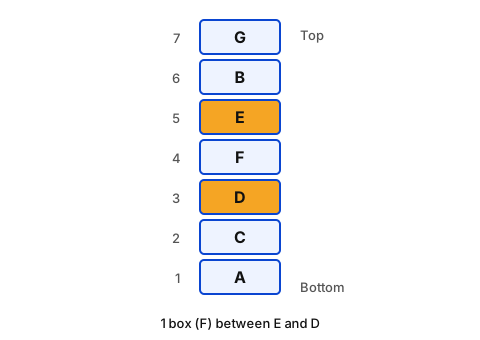
Seven boxes A, B, C, D, E, F and G are kept one over the other but not necessarily in the same order. D is kept third from the bottom. C is kept above A but below D. Only two boxes are kept between G and F. E is kept above F but below B. How many boxes are kept between E and D?
सात बक्से A, B, C, D, E, F और G एक के ऊपर एक रखे गए हैं, परंतु आवश्यक नहीं कि इसी क्रम में हों। D को नीचे से तीसरे स्थान पर रखा गया है। C को A के ऊपर परंतु D के नीचे रखा गया है। G और F के बीच केवल दो बक्से रखे गए हैं। E को F के ऊपर परंतु B के नीचे रखा गया है। E और D के बीच कितने बक्से रखे गए हैं?
  1. ATwoदो
  2. BOneएक
  3. CThreeतीन
  4. DNoneकोई नहीं
Show answer

Concept: Number positions 1 (bottom) to 7 (top) and place the fixed box first.

  1. D = 3. C above A but below D → A = 1, C = 2.
  2. Positions 4–7 left for B, E, F, G. E above F and below B → F is the lowest of them.
  3. Two between G and F → F = 4, G = 7; then E = 5, B = 6.
  4. Between E (5) and D (3): only F → one box.

Trick: When only one pair of slots fits “two between” inside a 4-slot block, it must be the two ends (4 and 7).

Answer: (B) One

अवधारणा: स्थान 1 (नीचे) से 7 (ऊपर) तक संख्या दें और पहले निश्चित बॉक्स रखें।

  1. D = 3। C, A के ऊपर पर D के नीचे → A = 1, C = 2।
  2. स्थान 4–7 पर B, E, F, G। E, F के ऊपर और B के नीचे → F इनमें सबसे नीचे।
  3. G और F के बीच दो → F = 4, G = 7; फिर E = 5, B = 6।
  4. E (5) और D (3) के बीच केवल F → एक बॉक्स।

ट्रिक: 4 स्थानों के खंड में “बीच में दो” केवल दोनों छोरों (4 और 7) पर संभव है।

उत्तर: (B) एक

RRB NTPC Undergraduate CBT 1General Intelligence and ReasoningBox arrangementRRB NTPC Undergraduate CBT 1 2025 · 18 Jun Shift 1 →
Q6473.
Select the set in which the numbers are related in the same way as are the numbers of the following sets.
(NOTE: Operations should be performed on the whole numbers, without breaking down the numbers into their constituent digits. E.g. 13 – Operations on 13 such as
adding/subtracting/multiplying etc. to 13 can be performed. Breaking down 13 into 1 and 3 and then performing mathematical operations on 1 and 3 is not allowed.) (15, 12, 37)
(25, 15, 50)
उस समुच्चय का चयन कीजिए जिसमें संख्याएँ उसी प्रकार संबंधित हैं, जिस प्रकार निम्नलिखित समुच्चयों की संख्याएँ संबंधित हैं।
(ध्यान दें: संक्रियाएँ पूर्ण संख्याओं पर की जानी चाहिए, संख्याओं को उनके घटक अंकों में विभाजित किए बिना। उदाहरण के लिए, 13 – 13 पर संक्रियाएँ जैसे
13 में जोड़ना/घटाना/गुणा करना आदि की जा सकती हैं। 13 को 1 और 3 में विभाजित करना और फिर 1 और 3 पर गणितीय संक्रियाएँ करना वर्जित है।) (15, 12, 37)
(25, 15, 50)
  1. A(2, 8, 20)
  2. B(23, 5, 40)
  3. C(24, 10, 40)
  4. D(18, 17, 42)
Show answer

Concept: Find a rule linking the three numbers of each set.

  1. (15,12,37): 15+12+10=37
  2. (25,15,50): 25+15+10=50
  3. (2,8,20): 2+8+10=20 ✓; others give 38≠40, 44≠40, 45≠42.

Trick: Third number − (first + second) is constant (10) – test that difference on each option.

Answer: (A) (2,8,20)

अवधारणा: हर समूह की तीनों संख्याओं को जोड़ने वाला नियम खोजें।

  1. (15,12,37): 15+12+10=37
  2. (25,15,50): 25+15+10=50
  3. (2,8,20): 2+8+10=20 ✓; बाकी में 38≠40, 44≠40, 45≠42।

ट्रिक: तीसरी संख्या − (पहली + दूसरी) स्थिर (10) है – हर विकल्प पर यही अंतर जाँचें।

उत्तर: (A) (2,8,20)

RRB NTPC Undergraduate CBT 1General Intelligence and ReasoningNumber set relationRRB NTPC Undergraduate CBT 1 2025 · 18 Jun Shift 1 →
Q6474.
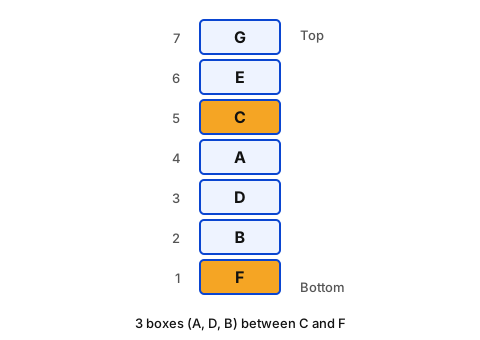
Seven boxes A, B, C, D, E, F and G are kept one over the other but not necessarily in the same order. Only G is kept above E. Only C is kept between E and A. Only F is kept below B. How many boxes are kept between C and F?
सात बक्से A, B, C, D, E, F और G एक के ऊपर एक रखे गए हैं, परंतु आवश्यक नहीं कि इसी क्रम में हों। E के ऊपर केवल G रखा गया है। E और A के बीच केवल C रखा गया है। B के नीचे केवल F रखा गया है। C और F के बीच कितने बक्से रखे गए हैं?
  1. A4
  2. B3
  3. C1
  4. D2
Show answer

Concept: Number positions 1 (bottom) to 7 (top); “only X above Y” fixes both at the top.

  1. Only G above E → G = 7, E = 6.
  2. Only C between E and A → C = 5, A = 4.
  3. Only F below B → F = 1, B = 2; remaining D = 3.
  4. Between C (5) and F (1): A, D, B → 3 boxes.

Trick: Boxes between positions p and q = |p−q|−1=5−1−1=3.

Answer: (B) 3

अवधारणा: स्थान 1 (नीचे) से 7 (ऊपर); “केवल X, Y के ऊपर” से दोनों शीर्ष पर तय हो जाते हैं।

  1. केवल G, E के ऊपर → G = 7, E = 6।
  2. E और A के बीच केवल C → C = 5, A = 4।
  3. केवल F, B के नीचे → F = 1, B = 2; बचा D = 3।
  4. C (5) और F (1) के बीच: A, D, B → 3 बॉक्स।

ट्रिक: स्थान p और q के बीच बॉक्स = |p−q|−1=5−1−1=3।

उत्तर: (B) 3

RRB NTPC Undergraduate CBT 1General Intelligence and ReasoningBox arrangementRRB NTPC Undergraduate CBT 1 2025 · 18 Jun Shift 1 →
Q6475.
What should come in place of '?' in the given series based on the English alphabetical order?
BMS EPV HSY KVB ?
अंग्रेज़ी वर्णमाला क्रम के आधार पर दी गई श्रृंखला में '?' के स्थान पर क्या आना चाहिए?
BMS EPV HSY KVB ?
  1. ANYD
  2. BNYE
  3. COYE
  4. DNXE
Show answer

Concept: Track each letter position of the clusters separately.

  1. 1st letters: B, E, H, K → +3 → N
  2. 2nd letters: M, P, S, V → +3 → Y
  3. 3rd letters: S, V, Y, B → +3 (Y → Z → A → B) → E

Trick: All three positions move +3; after Z, wrap around to A.

Answer: (B) NYE

अवधारणा: प्रत्येक स्थान के अक्षरों को अलग-अलग देखें।

  1. पहले अक्षर: B, E, H, K → +3 → N
  2. दूसरे अक्षर: M, P, S, V → +3 → Y
  3. तीसरे अक्षर: S, V, Y, B → +3 (Y → Z → A → B) → E

ट्रिक: तीनों स्थान +3 बढ़ते हैं; Z के बाद फिर A से गिनें।

उत्तर: (B) NYE

RRB NTPC Undergraduate CBT 1General Intelligence and ReasoningLetter seriesRRB NTPC Undergraduate CBT 1 2025 · 18 Jun Shift 1 →
Q6476.
What should come in place of the ‘?’ in the given series?
51 78 132 213 321 ?
दी गई श्रृंखला में ‘?’ के स्थान पर क्या आना चाहिए?
51 78 132 213 321 ?
  1. A456
  2. B462
  3. C448
  4. D450
Show answer

Concept: Look at the differences between consecutive terms.

  1. Differences: 27,54,81,108 = 27×1,27×2,27×3,27×4
  2. Next difference =27×5=135
  3. 321+135=456

Trick: Differences in a table of 27 – recognise multiples quickly.

Answer: (A) 456

अवधारणा: क्रमागत पदों का अंतर देखें।

  1. अंतर: 27,54,81,108 = 27×1,27×2,27×3,27×4
  2. अगला अंतर =27×5=135
  3. 321+135=456

ट्रिक: अंतर 27 का पहाड़ा है – गुणज जल्दी पहचानें।

उत्तर: (A) 456

RRB NTPC Undergraduate CBT 1General Intelligence and ReasoningNumber seriesRRB NTPC Undergraduate CBT 1 2025 · 18 Jun Shift 1 →
Q6477.
Which of the following letter-number clusters will replace the question mark (?) in the given series to make it logically complete?
GCH 10, DZE 21, AWB 32, XTY 43, ?
निम्नलिखित में से कौन-सा अक्षर-संख्या समूह दी गई श्रृंखला में प्रश्न चिह्न (?) को प्रतिस्थापित करके उसे तार्किक रूप से पूर्ण करेगा?
GCH 10, DZE 21, AWB 32, XTY 43, ?
  1. AUQB 56
  2. BUQV 54
  3. CKPT 56
  4. DLFY 58
Show answer

Concept: Treat each letter position and the number separately.

  1. Every letter moves −3: G→D→A→X→U, C→Z→W→T→Q, H→E→B→Y→V.
  2. Numbers: 10, 21, 32, 43 → +11 → 54.
  3. Next term: UQV 54.

Trick: Numbers alone (+11 → 54) cut options to (B); confirm letters.

Answer: (B) UQV 54

अवधारणा: हर अक्षर-स्थान और संख्या को अलग देखें।

  1. हर अक्षर −3: G→D→A→X→U, C→Z→W→T→Q, H→E→B→Y→V।
  2. संख्याएँ: 10, 21, 32, 43 → +11 → 54।
  3. अगला पद: UQV 54।

ट्रिक: केवल संख्या (+11 → 54) से ही विकल्प (B) बचता है; अक्षरों से पुष्टि करें।

उत्तर: (B) UQV 54

RRB NTPC Undergraduate CBT 1General Intelligence and ReasoningLetter-number seriesRRB NTPC Undergraduate CBT 1 2025 · 18 Jun Shift 1 →
Q6478.
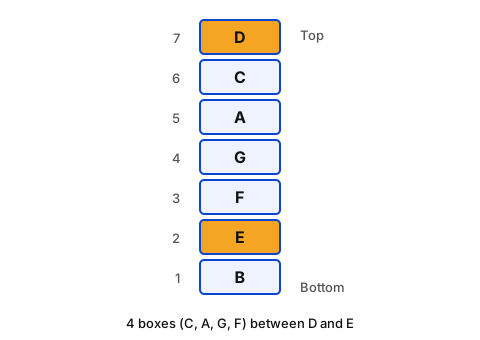
Seven boxes A, B, C, D, E, F and G are kept one over the other but not necessarily in the same order. Only two boxes are kept between G and B. Only D is kept above C. No box is kept below B. F is kept at some place below A but at some place above E. How many boxes are kept between D and E?
सात बक्से A, B, C, D, E, F और G एक के ऊपर एक रखे गए हैं, परंतु आवश्यक नहीं कि इसी क्रम में हों। G और B के बीच केवल दो बक्से रखे गए हैं। C के ऊपर केवल D रखा गया है। B के नीचे कोई बक्सा नहीं रखा गया है। F को A के नीचे किसी स्थान पर परंतु E के ऊपर किसी स्थान पर रखा गया है। D और E के बीच कितने बक्से रखे गए हैं?
  1. A2
  2. B1
  3. C4
  4. D3
Show answer

Concept: Number positions 1 (bottom) to 7 (top).

  1. No box below B → B = 1. Two between G and B → G = 4.
  2. Only D above C → D = 7, C = 6.
  3. Positions 2, 3, 5 for A, F, E with A above F above E → E = 2, F = 3, A = 5.
  4. Between D (7) and E (2): C, A, G, F → 4 boxes.

Trick: “No box below B” = B at the bottom; “only D above C” = D top, C second.

Answer: (C) 4

अवधारणा: स्थान 1 (नीचे) से 7 (ऊपर) तक संख्या दें।

  1. B के नीचे कोई नहीं → B = 1। G और B के बीच दो → G = 4।
  2. केवल D, C के ऊपर → D = 7, C = 6।
  3. स्थान 2, 3, 5 पर A, F, E; क्रम A > F > E → E = 2, F = 3, A = 5।
  4. D (7) और E (2) के बीच: C, A, G, F → 4 बॉक्स।

ट्रिक: “B के नीचे कोई नहीं” = B सबसे नीचे; “केवल D, C के ऊपर” = D सबसे ऊपर, C दूसरा।

उत्तर: (C) 4

RRB NTPC Undergraduate CBT 1General Intelligence and ReasoningBox arrangementRRB NTPC Undergraduate CBT 1 2025 · 18 Jun Shift 1 →
Q6479.
Based on the English alphabetical order, three of the following four letter-cluster pairs are alike in a certain way and thus form a group. Which is the one that does not belong to that group?
(Note: The odd one out is not based on the number of consonants/vowels or their position in the letter-cluster.)
अंग्रेज़ी वर्णमाला क्रम के आधार पर, निम्नलिखित चार अक्षर-समूह युग्मों में से तीन किसी निश्चित प्रकार से एकसमान हैं और इस प्रकार एक समूह बनाते हैं। वह कौन-सा युग्म है जो उस समूह से संबंधित नहीं है?
(ध्यान दें: असंगत, अक्षर-समूह में व्यंजनों/स्वरों की संख्या या उनके स्थान पर आधारित नहीं है।)
  1. APS - OR
  2. BFI - EH
  3. CKN - JL
  4. DLO - KN
Show answer

Concept: Compare the change from the first cluster to the second, letter by letter.

  1. PS → OR: −1,−1; FI → EH: −1,−1; LO → KN: −1,−1.
  2. KN → JL: K→J is −1 but N→L is −2.
  3. So KN − JL is the odd pair.

Trick: In the three alike pairs both clusters have the same internal gap (+3): PS/OR, FI/EH, LO/KN; JL has gap +2.

Answer: (C) KN - JL

अवधारणा: पहले समूह से दूसरे में अक्षर-दर-अक्षर बदलाव देखें।

  1. PS → OR: −1,−1; FI → EH: −1,−1; LO → KN: −1,−1।
  2. KN → JL: K→J −1 पर N→L −2।
  3. अतः KN − JL विषम है।

ट्रिक: समान युग्मों में दोनों समूहों का आंतरिक अंतर (+3) बराबर है; JL में अंतर +2 है।

उत्तर: (C) KN - JL

RRB NTPC Undergraduate CBT 1General Intelligence and ReasoningOdd one out – letter pairsRRB NTPC Undergraduate CBT 1 2025 · 18 Jun Shift 1 →
Q6480.
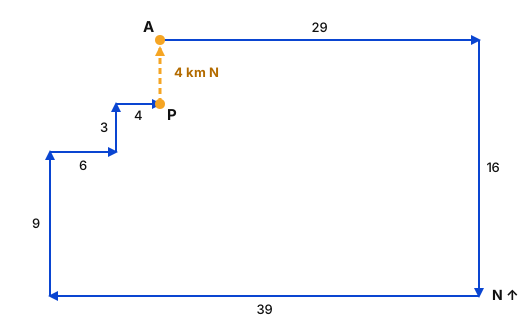
Mr. Yorly starts from Point A and drives 29 km towards East. He then takes a right turn, drives 16 km, turns right and drives 39 km. He then takes a right turn and drives 9 km. He then takes a right turn, drives 6 km, turns left and drives 3 km. He takes a final right turn, drives 4 km and stops at Point P. How far (shortest distance) and towards which direction should he drive in order to reach Point A again? (All turns are 90 degrees turns only unless specified.)
श्री Yorly बिंदु A से चलना शुरू करते हैं और पूर्व की ओर 29 km गाड़ी चलाते हैं। फिर वे दाएँ मुड़ते हैं, 16 km गाड़ी चलाते हैं, दाएँ मुड़ते हैं और 39 km गाड़ी चलाते हैं। फिर वे दाएँ मुड़ते हैं और 9 km गाड़ी चलाते हैं। फिर वे दाएँ मुड़ते हैं, 6 km गाड़ी चलाते हैं, बाएँ मुड़ते हैं और 3 km गाड़ी चलाते हैं। वे अंतिम बार दाएँ मुड़ते हैं, 4 km गाड़ी चलाते हैं और बिंदु P पर रुक जाते हैं। पुनः बिंदु A पर पहुँचने के लिए उन्हें कितनी दूर (न्यूनतम दूरी) और किस दिशा में गाड़ी चलानी चाहिए? (जब तक निर्दिष्ट न हो, सभी मोड़ केवल 90 डिग्री के मोड़ हैं।)
  1. A7 km to the Westपश्चिम की ओर 7 km
  2. B6 km to the Southदक्षिण की ओर 6 km
  3. C4 km to the Northउत्तर की ओर 4 km
  4. D8 km to the Eastपूर्व की ओर 8 km
Show answer

Concept: Take A as origin (0,0), East = +x, North = +y, and track each move.

  1. E 29 → (29,0); right → S 16 → (29,−16); right → W 39 → (−10,−16).
  2. Right → N 9 → (−10,−7); right → E 6 → (−4,−7); left → N 3 → (−4,−4).
  3. Right → E 4 → P =(0,−4).
  4. P is 4 km directly south of A, so he must drive 4 km towards North.

Trick: Net E–W: 29−39+6+4=0; net N–S: −16+9+3=−4 → P is 4 km south of A.

Answer: (C) 4 km to the North

अवधारणा: A को मूल बिंदु (0,0) लें, पूर्व = +x, उत्तर = +y, और हर चाल लिखें।

  1. पूर्व 29 → (29,0); दाएँ → दक्षिण 16 → (29,−16); दाएँ → पश्चिम 39 → (−10,−16)।
  2. दाएँ → उत्तर 9 → (−10,−7); दाएँ → पूर्व 6 → (−4,−7); बाएँ → उत्तर 3 → (−4,−4)।
  3. दाएँ → पूर्व 4 → P =(0,−4)।
  4. P, A से ठीक 4 km दक्षिण है, अतः उसे उत्तर की ओर 4 km चलना होगा।

ट्रिक: कुल पूर्व–पश्चिम: 29−39+6+4=0; कुल उत्तर–दक्षिण: −16+9+3=−4 → P, A से 4 km दक्षिण।

उत्तर: (C) उत्तर की ओर 4 km

RRB NTPC Undergraduate CBT 1General Intelligence and ReasoningDirection and distanceRRB NTPC Undergraduate CBT 1 2025 · 18 Jun Shift 1 →