Question bank

Q&A: practice questions with answers

Search questions on any topic. Filter by exam category, exam, subject and topic, try the question, then open the answer and explanation.

Courses – airGurukul

8,495 questions found.

Q6561.
Two trains of equal lengths cross a stationary pole in 12 seconds and 16 seconds, respectively. How long will it take for the trains to cross each other when running in opposite directions? (Write your answer rounded off to two decimal places.)
समान लंबाई की दो रेलगाड़ियाँ एक स्थिर खंभे को क्रमशः 12 सेकंड और 16 सेकंड में पार करती हैं। विपरीत दिशाओं में चलते हुए रेलगाड़ियों को एक-दूसरे को पार करने में कितना समय लगेगा? (अपना उत्तर दो दशमलव स्थानों तक पूर्णांकित करके लिखिए।)
  1. A14.53 seconds14.53 सेकंड
  2. B12.61 seconds12.61 सेकंड
  3. C15.43 seconds15.43 सेकंड
  4. D13.71 seconds13.71 सेकंड
Show answer

Concept: Opposite directions: relative speed = sum; distance = sum of lengths.
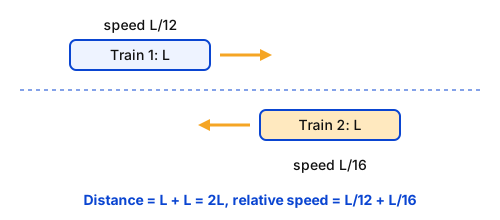
  1. Length L each; speeds L12 and L16.
  2. Relative speed =L12+L16=7L48
  3. Time =2L7L/48=967=13.71s

Trick: Equal lengths: t=2t1t2t1+t2=2×12×1628.

Answer: (D) 13.71 seconds

अवधारणा: विपरीत दिशा: सापेक्ष चाल = चालों का योग; दूरी = लंबाइयों का योग।

  1. प्रत्येक लंबाई L; चाल L12 और L16।
  2. सापेक्ष चाल =L12+L16=7L48
  3. समय =2L7L/48=967=13.71s

ट्रिक: समान लंबाई: t=2t1t2t1+t2=2×12×1628।

उत्तर: (D) 13.71 सेकंड

RRB NTPC Undergraduate CBT 1MathematicsTrains – Crossing Each OtherRRB NTPC Undergraduate CBT 1 2025 · 17 Jun Shift 3 →
Q6562.
The ratio between the speeds of two trains is 5:8. If the second train covers 300 km in 3 hours, then find the speed of the first train.
दो रेलगाड़ियों की चालों का अनुपात 5:8 है। यदि दूसरी रेलगाड़ी 3 घंटे में 300 km की दूरी तय करती है, तो पहली रेलगाड़ी की चाल ज्ञात कीजिए।
  1. A63.8 km/h
  2. B62.5 km/h
  3. C65.2 km/h
  4. D72.5 km/h
Show answer

Concept: Speed =DistanceTime; speeds follow the given ratio.

  1. Second train: 3003=100km/h
  2. First train =100×58=62.5km/h

Trick: 8 parts = 100 ⇒ 1 part = 12.5 ⇒ 5 parts = 62.5.

Answer: (B) 62.5km/h

अवधारणा: चाल =दूरीसमय; चालें दिए अनुपात में।

  1. दूसरी ट्रेन: 3003=100km/h
  2. पहली ट्रेन =100×58=62.5km/h

ट्रिक: 8 भाग = 100 ⇒ 1 भाग = 12.5 ⇒ 5 भाग = 62.5।

उत्तर: (B) 62.5km/h

RRB NTPC Undergraduate CBT 1MathematicsSpeed and RatioRRB NTPC Undergraduate CBT 1 2025 · 17 Jun Shift 3 →
Q6563.
Three ropes of lengths 54 m, 72 m and 90 m are to be cut into smaller pieces of equal lengths such that no rope is left over. What is the maximum possible length of each smaller piece?
54 m, 72 m और 90 m लंबाई की तीन रस्सियों को समान लंबाई के छोटे टुकड़ों में इस प्रकार काटा जाना है कि कोई भी रस्सी शेष न बचे। प्रत्येक छोटे टुकड़े की अधिकतम संभव लंबाई कितनी है?
  1. A24 m
  2. B18 m
  3. C36 m
  4. D12 m
Show answer

Concept: Largest equal piece that divides all lengths exactly = HCF.

  1. 54=2×33, 72=23×32, 90=2×32×5
  2. HCF =2×32=18m

Trick: “Maximum equal length / largest size” → HCF; “minimum common” → LCM.

Answer: (B) 18 m

अवधारणा: सभी लंबाइयों को पूरा-पूरा बाँटने वाला सबसे बड़ा टुकड़ा = HCF।

  1. 54=2×33, 72=23×32, 90=2×32×5
  2. HCF =2×32=18m

याद रखें: “अधिकतम समान लंबाई” → HCF; “न्यूनतम साझा” → LCM।

उत्तर: (B) 18 m

RRB NTPC Undergraduate CBT 1MathematicsHCF – ApplicationRRB NTPC Undergraduate CBT 1 2025 · 17 Jun Shift 3 →
Q6564.
A jacket with a marked price of ₹2,000 is sold for ₹1,530 after two successive discounts. If the first discount is 15%, what is the second discount percentage?
₹2,000 अंकित मूल्य वाली एक जैकेट दो क्रमिक छूटों के बाद ₹1,530 में बेची जाती है। यदि पहली छूट 15% है, तो दूसरी छूट का प्रतिशत क्या है?
  1. A8%
  2. B5%
  3. C12%
  4. D10%
Show answer

Concept: Apply discounts one after another on the reduced price.

  1. After 15%: 2000×0.85=1700
  2. Second discount =1700−1530=170
  3. 1701700×100=10%

Trick: 15301700=0.9 ⇒ second discount 10%.

Answer: (D) 10%

अवधारणा: छूट एक के बाद एक घटे हुए मूल्य पर लगती है।

  1. 15% के बाद: 2000×0.85=1700
  2. दूसरी छूट =1700−1530=170
  3. 1701700×100=10%

ट्रिक: 15301700=0.9 ⇒ दूसरी छूट 10%।

उत्तर: (D) 10%

RRB NTPC Undergraduate CBT 1MathematicsSuccessive DiscountsRRB NTPC Undergraduate CBT 1 2025 · 17 Jun Shift 3 →
Q6565.
If twice the smaller of two numbers is added to three times the larger number, the result is 55. If the larger is increased by 5, it becomes twice the smaller. What is the larger number?
यदि दो संख्याओं में से छोटी संख्या के दोगुने को बड़ी संख्या के तीन गुने में जोड़ा जाए, तो परिणाम 55 आता है। यदि बड़ी संख्या में 5 की वृद्धि की जाए, तो वह छोटी संख्या की दोगुनी हो जाती है। बड़ी संख्या क्या है?
  1. A10.5
  2. B12.75
  3. C10.75
  4. D12.5
Show answer

Concept: Form two equations and substitute.

  1. Let smaller =s, larger =L: 2s+3L=55 and L+5=2s.
  2. Substitute 2s: L+5+3L=55⇒4L=50
  3. L=12.5 (and s=8.75)

Trick: Replace “2s” directly — no need to find s first.

Answer: (D) 12.5

अवधारणा: दो समीकरण बनाकर प्रतिस्थापन करें।

  1. छोटी संख्या =s, बड़ी =L: 2s+3L=55 और L+5=2s।
  2. 2s रखने पर: L+5+3L=55⇒4L=50
  3. L=12.5 (और s=8.75)

ट्रिक: सीधे “2s” प्रतिस्थापित करें — पहले s निकालना ज़रूरी नहीं।

उत्तर: (D) 12.5

RRB NTPC Undergraduate CBT 1MathematicsLinear EquationsRRB NTPC Undergraduate CBT 1 2025 · 17 Jun Shift 3 →
Q6566.
What should come in place of ‘?’ in the given series?
4 4 8 12 16 28 32 ?
दी गई श्रृंखला में ‘?’ के स्थान पर क्या आना चाहिए?
4 4 8 12 16 28 32 ?
  1. A68
  2. B62
  3. C64
  4. D60
Show answer

Concept: Split the series into two alternate series.

  1. Odd positions: 4,8,16,32 – each ×2.
  2. Even positions: 4,12,28,? – differences 8,16, so next difference 32.
  3. ?=28+32=60

Trick: When numbers jump irregularly, check alternate terms first.

Answer: (D) 60

अवधारणा: श्रृंखला को दो एकांतर (alternate) श्रृंखलाओं में बाँटें।

  1. विषम स्थान: 4,8,16,32 – हर बार ×2।
  2. सम स्थान: 4,12,28,? – अंतर 8,16, अतः अगला अंतर 32।
  3. ?=28+32=60

ट्रिक: संख्याएँ अनियमित बढ़ें तो पहले एकांतर पद जाँचें।

उत्तर: (D) 60

RRB NTPC Undergraduate CBT 1General Intelligence and ReasoningNumber seriesRRB NTPC Undergraduate CBT 1 2025 · 17 Jun Shift 3 →
Q6567.
If ‘A’ stands for ‘÷’, ‘B’ stands for ‘×’, ‘C’ stands for ‘+’ and ‘D’ stands for ‘−’, then what will come in place of the question mark (?) in the following equation?
1 D 40 A 7 B 7 C 46 = ?
यदि ‘A’ का अर्थ ‘÷’, ‘B’ का अर्थ ‘×’, ‘C’ का अर्थ ‘+’ और ‘D’ का अर्थ ‘−’ है, तो निम्नलिखित समीकरण में प्रश्न चिह्न (?) के स्थान पर क्या आएगा?
1 D 40 A 7 B 7 C 46 = ?
  1. A9
  2. B8
  3. C5
  4. D7
Show answer

Concept: Replace letters by signs, then apply BODMAS.

  1. A = ÷, B = ×, C = +, D = −
  2. 1−40÷7×7+46
  3. 40÷7×7=40 (left to right), so 1−40+46=7

Trick: ÷7 and ×7 cancel each other – no fractions needed.

Answer: (D) 7

अवधारणा: अक्षरों को चिह्नों से बदलें, फिर BODMAS लगाएँ।

  1. A = ÷, B = ×, C = +, D = −
  2. 1−40÷7×7+46
  3. 40÷7×7=40 (बाएँ से दाएँ), अतः 1−40+46=7

ट्रिक: ÷7 और ×7 एक-दूसरे को काट देते हैं – भिन्न की ज़रूरत नहीं।

उत्तर: (D) 7

RRB NTPC Undergraduate CBT 1General Intelligence and ReasoningMathematical operationsRRB NTPC Undergraduate CBT 1 2025 · 17 Jun Shift 3 →
Q6568.
Based on the alphabetical order, three of the following four are alike in a certain way and thus form a group. Which is the one that does not belong to that group?
(Note: The odd one out is not based on the number of consonants/vowels or their position in the letter cluster.)
वर्णमाला क्रम के आधार पर, निम्नलिखित चार में से तीन किसी निश्चित प्रकार से समान हैं और इस प्रकार एक समूह बनाते हैं। वह कौन-सा है जो उस समूह से संबंधित नहीं है?
(ध्यान दें: असंगत अक्षर-समूह, उस अक्षर-समूह में व्यंजनों/स्वरों की संख्या या उनके स्थान पर आधारित नहीं है।)
  1. ANRT
  2. BJNP
  3. CSWY
  4. DQUO
Show answer

Concept: Write the position values of the letters and find the gaps.

  1. NRT: 14,18,20 → +4,+2; JNP: 10,14,16 → +4,+2
  2. SWY: 19,23,25 → +4,+2
  3. QUO: 17,21,15 → +4,−6 ✗

Trick: EJOTY: E5, J10, O15, T20, Y25 – reach any letter quickly.

Answer: (D) QUO

अवधारणा: अक्षरों के स्थानीय मान लिखकर अंतर देखें।

  1. NRT: 14,18,20 → +4,+2; JNP: 10,14,16 → +4,+2
  2. SWY: 19,23,25 → +4,+2
  3. QUO: 17,21,15 → +4,−6 ✗

ट्रिक: EJOTY: E5, J10, O15, T20, Y25 – किसी भी अक्षर तक जल्दी पहुँचें।

उत्तर: (D) QUO

RRB NTPC Undergraduate CBT 1General Intelligence and ReasoningOdd one out – lettersRRB NTPC Undergraduate CBT 1 2025 · 17 Jun Shift 3 →
Q6569.
Based on the English alphabetical order, three of the following four are alike in a certain way and thus form a group. Which is the one that does not belong to that group? (Note: The odd man out is not based on the number of consonants/vowels or their position in the letter cluster.)
अंग्रेज़ी वर्णमाला क्रम के आधार पर, निम्नलिखित चार में से तीन किसी निश्चित प्रकार से समान हैं और इस प्रकार एक समूह बनाते हैं। वह कौन-सा है जो उस समूह से संबंधित नहीं है? (ध्यान दें: असंगत अक्षर-समूह, उस अक्षर-समूह में व्यंजनों/स्वरों की संख्या या उनके स्थान पर आधारित नहीं है।)
  1. AMKI
  2. BQOM
  3. CCBY
  4. DBZX
Show answer

Concept: Check the gap between consecutive letters (wrapping Z → A).

  1. MKI: 13,11,9 → −2,−2; QOM: 17,15,13 → −2,−2
  2. BZX: B → Z → X is also −2,−2 (going back past A)
  3. CBY: 3,2,25 → −1,−3 ✗

Trick: In backward series, after A comes Z – B−2 = Z.

Answer: (C) CBY

अवधारणा: क्रमागत अक्षरों का अंतर देखें (Z → A चक्र मानें)।

  1. MKI: 13,11,9 → −2,−2; QOM: 17,15,13 → −2,−2
  2. BZX: B → Z → X भी −2,−2 (A के बाद पीछे Z)
  3. CBY: 3,2,25 → −1,−3 ✗

ट्रिक: उल्टी गिनती में A के बाद Z आता है – B−2 = Z।

उत्तर: (C) CBY

RRB NTPC Undergraduate CBT 1General Intelligence and ReasoningOdd one out – lettersRRB NTPC Undergraduate CBT 1 2025 · 17 Jun Shift 3 →
Q6570.
Which of the following letter-number clusters will replace the question mark (?) in the given series to make it logically complete?
OKH 41, GCZ 47, YUR 53, QMJ 59, ?
निम्नलिखित में से कौन-सा अक्षर-संख्या समूह दी गई श्रृंखला में प्रश्न चिह्न (?) को प्रतिस्थापित करके उसे तार्किक रूप से पूर्ण करेगा?
OKH 41, GCZ 47, YUR 53, QMJ 59, ?
  1. AIDA 64
  2. BIJL 64
  3. CIEB 65
  4. DIFA 65
Show answer

Concept: Treat each letter position and the number separately.

  1. 1st letter: O → G → Y → Q → I (each −8)
  2. 2nd letter: K → C → U → M → E (−8); 3rd letter: H → Z → R → J → B (−8)
  3. Numbers: 41,47,53,59,65 (each +6)

Trick: Moving back 8 = moving forward 18 (since 26−8=18).

Answer: (C) IEB 65

अवधारणा: हर अक्षर-स्थान और संख्या को अलग-अलग देखें।

  1. पहला अक्षर: O → G → Y → Q → I (हर बार −8)
  2. दूसरा: K → C → U → M → E (−8); तीसरा: H → Z → R → J → B (−8)
  3. संख्याएँ: 41,47,53,59,65 (हर बार +6)

ट्रिक: 8 पीछे जाना = 18 आगे जाना (26−8=18)।

उत्तर: (C) IEB 65

RRB NTPC Undergraduate CBT 1General Intelligence and ReasoningLetter-number seriesRRB NTPC Undergraduate CBT 1 2025 · 17 Jun Shift 3 →
Q6571.
What should come in place of ‘?’ in the given series?
10 19 36 58 88 123 ?
दी गई श्रृंखला में ‘?’ के स्थान पर क्या आना चाहिए?
10 19 36 58 88 123 ?
  1. A171
  2. B169
  3. C175
  4. D166
Show answer

Concept: Take first differences, then look for a pattern in them.

  1. Differences: 9,17,22,30,35
  2. Second differences: 8,5,8,5 → next is 8
  3. Next difference =35+8=43; ?=123+43=166

Trick: Alternating +8,+5 in the differences = two-level series.

Answer: (D) 166

अवधारणा: पहले अंतर निकालें, फिर उनमें पैटर्न देखें।

  1. अंतर: 9,17,22,30,35
  2. दूसरे अंतर: 8,5,8,5 → अगला 8
  3. अगला अंतर =35+8=43; ?=123+43=166

ट्रिक: अंतरों में +8,+5 बारी-बारी = दो-स्तरीय श्रृंखला।

उत्तर: (D) 166

RRB NTPC Undergraduate CBT 1General Intelligence and ReasoningNumber seriesRRB NTPC Undergraduate CBT 1 2025 · 17 Jun Shift 3 →
Q6572.
FACN is related to LFIS in a certain way based on the English alphabetical order. In the same way, DUAH is related to JZGM. To which of the following options is VJSW related, following the same logic?
अंग्रेज़ी वर्णमाला क्रम के आधार पर FACN एक निश्चित प्रकार से LFIS से संबंधित है। उसी प्रकार, DUAH, JZGM से संबंधित है। समान तर्क का अनुसरण करते हुए, VJSW निम्नलिखित में से किस विकल्प से संबंधित है?
  1. ABOBY
  2. BBYOB
  3. CBOYB
  4. DBBOY
Show answer

Concept: Find the shift for each letter of the first pair and verify it on the second pair.

  1. FACN → LFIS: F+6=L, A+5=F, C+6=I, N+5=S
  2. DUAH → JZGM: same +6,+5,+6,+5 ✓
  3. VJSW: V+6=B, J+5=O, S+6=Y, W+5=B → BOYB

Trick: Wrap round: V(22)+6=28−26=2 = B.

Answer: (C) BOYB

अवधारणा: पहले जोड़े में हर अक्षर का खिसकाव निकालें और दूसरे जोड़े से पुष्टि करें।

  1. FACN → LFIS: F+6=L, A+5=F, C+6=I, N+5=S
  2. DUAH → JZGM: वही +6,+5,+6,+5 ✓
  3. VJSW: V+6=B, J+5=O, S+6=Y, W+5=B → BOYB

ट्रिक: चक्र: V(22)+6=28−26=2 = B।

उत्तर: (C) BOYB

RRB NTPC Undergraduate CBT 1General Intelligence and ReasoningLetter analogyRRB NTPC Undergraduate CBT 1 2025 · 17 Jun Shift 3 →
Q6573.
If ‘P’ stands for ‘×’ , ‘Q’ stands for ‘÷’, ‘R’ stands for ‘-’ and ‘S’ stands for ‘+’, what will come in place of the question mark ‘?’ in the following equation?
(96 Q 12) P 5 S (42 Q 7) P 8 R 12 P 5 = ?
यदि ‘P’ का अर्थ ‘×’, ‘Q’ का अर्थ ‘÷’, ‘R’ का अर्थ ‘-’ और ‘S’ का अर्थ ‘+’ है, तो निम्नलिखित समीकरण में प्रश्न चिह्न ‘?’ के स्थान पर क्या आएगा?
(96 Q 12) P 5 S (42 Q 7) P 8 R 12 P 5 = ?
  1. A34
  2. B20
  3. C28
  4. D48
Show answer

Concept: Replace letters by signs and use BODMAS.

  1. P = ×, Q = ÷, R = −, S = +
  2. (96÷12)×5+(42÷7)×8−12×5
  3. =8×5+6×8−60=40+48−60=28

Trick: Solve brackets first, then all ×, then +/−.

Answer: (C) 28

अवधारणा: अक्षरों को चिह्नों से बदलें और BODMAS लगाएँ।

  1. P = ×, Q = ÷, R = −, S = +
  2. (96÷12)×5+(42÷7)×8−12×5
  3. =8×5+6×8−60=40+48−60=28

ट्रिक: पहले कोष्ठक, फिर सभी ×, फिर +/−।

उत्तर: (C) 28

RRB NTPC Undergraduate CBT 1General Intelligence and ReasoningMathematical operationsRRB NTPC Undergraduate CBT 1 2025 · 17 Jun Shift 3 →
Q6574.
Which of the following letter-number clusters will replace the question mark (?) in the given series to make it logically complete?
RTR 77 NPN 72 JLJ 67 FHF 62 ?
निम्नलिखित में से कौन-सा अक्षर-संख्या समूह दी गई श्रृंखला में प्रश्न चिह्न (?) को प्रतिस्थापित करके उसे तार्किक रूप से पूर्ण करेगा?
RTR 77 NPN 72 JLJ 67 FHF 62 ?
  1. ABDB 57
  2. BBFK 56
  3. CBEA 57
  4. DBCA 56
Show answer

Concept: Each cluster is of the form X Y X; track letters and numbers separately.

  1. Outer letters: R → N → J → F → B (each −4)
  2. Middle letter: T → P → L → H → D (each −4)
  3. Numbers: 77,72,67,62,57 (each −5)

Trick: Middle letter is always 2 ahead of the outer letter: B + 2 = D.

Answer: (A) BDB 57

अवधारणा: हर समूह X Y X रूप का है; अक्षर और संख्या अलग-अलग देखें।

  1. बाहरी अक्षर: R → N → J → F → B (हर बार −4)
  2. बीच का अक्षर: T → P → L → H → D (हर बार −4)
  3. संख्याएँ: 77,72,67,62,57 (हर बार −5)

ट्रिक: बीच का अक्षर हमेशा बाहरी अक्षर से 2 आगे: B + 2 = D।

उत्तर: (A) BDB 57

RRB NTPC Undergraduate CBT 1General Intelligence and ReasoningLetter-number seriesRRB NTPC Undergraduate CBT 1 2025 · 17 Jun Shift 3 →
Q6575.
Raman ranked 25th from the top and 67th from the bottom in his class. How many students are there in his class?
रमन अपनी कक्षा में ऊपर से 25वें और नीचे से 67वें स्थान पर था। उसकी कक्षा में कितने विद्यार्थी हैं?
  1. A90
  2. B93
  3. C92
  4. D91
Show answer

Concept: Total = rank from top + rank from bottom −1 (the person is counted twice).

  1. Rank from top =25, rank from bottom =67
  2. Total =25+67−1=91

Trick: Always subtract 1 – Raman is included in both counts.

Answer: (D) 91

अवधारणा: कुल = ऊपर से रैंक + नीचे से रैंक −1 (व्यक्ति दो बार गिना जाता है)।

  1. ऊपर से रैंक =25, नीचे से रैंक =67
  2. कुल =25+67−1=91

ट्रिक: हमेशा 1 घटाएँ – रमन दोनों गिनतियों में शामिल है।

उत्तर: (D) 91

RRB NTPC Undergraduate CBT 1General Intelligence and ReasoningRankingRRB NTPC Undergraduate CBT 1 2025 · 17 Jun Shift 3 →
Q6576.
Which two numbers should be interchanged to make the given equation correct? (21 × 2) ÷ 3 + 15 × 5 − 19 × 4 + 36 + 7 × 6 = 57
दिए गए समीकरण को सही बनाने के लिए किन दो संख्याओं को आपस में बदला जाना चाहिए? (21 × 2) ÷ 3 + 15 × 5 − 19 × 4 + 36 + 7 × 6 = 57
  1. A2 and 42 और 4
  2. B5 and 65 और 6
  3. C36 and 2136 और 21
  4. D4 and 54 और 5
Show answer

Concept: Interchange the numbers in each option and test the equation with BODMAS.

  1. Interchange 4 and 5: (21×2)÷3+15×4−19×5+36+7×6
  2. =14+60−95+36+42
  3. =152−95=57 ✓

Trick: Original value: 14+75−76+36+42=91; need 34 less – swapping 4, 5 changes +75−76 to +60−95 (34 less).

Answer: (D) 4 and 5

अवधारणा: हर विकल्प की संख्याओं को आपस में बदलकर BODMAS से जाँचें।

  1. 4 और 5 बदलने पर: (21×2)÷3+15×4−19×5+36+7×6
  2. =14+60−95+36+42
  3. =152−95=57 ✓

ट्रिक: मूल मान: 14+75−76+36+42=91; 34 कम चाहिए – 4, 5 बदलने से +75−76 बनता है +60−95 (34 कम)।

उत्तर: (D) 4 and 5

RRB NTPC Undergraduate CBT 1General Intelligence and ReasoningInterchange of numbersRRB NTPC Undergraduate CBT 1 2025 · 17 Jun Shift 3 →
Q6577.
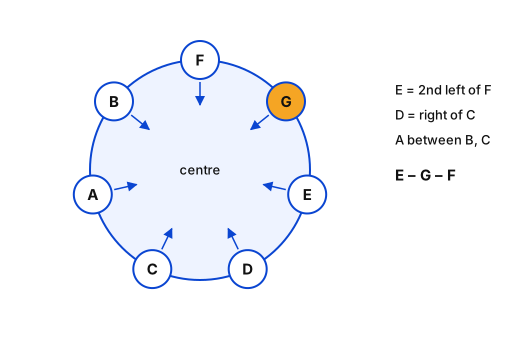
Seven people A, B, C, D, E, F and G are sitting around a circular table facing towards the centre of the table. E sits second to the left of F. A is sitting immediately between B and C. D sits to the immediate right of C. Who is sitting immediately between E and F?
सात व्यक्ति A, B, C, D, E, F और G एक वृत्ताकार मेज़ के चारों ओर मेज़ के केंद्र की ओर मुख करके बैठे हैं। E, F के बाएँ से दूसरे स्थान पर बैठा है। A, B और C के ठीक बीच में बैठा है। D, C के ठीक दाएँ बैठा है। E और F के ठीक बीच में कौन बैठा है?
  1. AB
  2. BD
  3. CG
  4. DC
Show answer

Concept: Facing the centre: left = clockwise, right = anticlockwise.

  1. E is second to the left of F → one seat lies between F and E.
  2. D is immediately right of C and A sits between B and C → D, C, A, B form a block of four consecutive seats.
  3. This block cannot fit in the single gap between F and E, so it takes the other four seats; the gap gets G.
  4. Order (clockwise): F, G, E, D, C, A, B.

Trick: Place the biggest block first – the leftover seat is the answer.

Answer: (C) G

अवधारणा: केंद्र की ओर मुख: बायाँ = दक्षिणावर्त (clockwise), दायाँ = वामावर्त।

  1. E, F के बाएँ से दूसरे स्थान पर → F और E के बीच एक सीट।
  2. D, C के ठीक दाएँ और A, B व C के बीच → D, C, A, B चार लगातार सीटों का ब्लॉक।
  3. यह ब्लॉक F और E के बीच की एक सीट में नहीं आ सकता, अतः बाकी चार सीटें लेता है; बीच की सीट पर G।
  4. क्रम (दक्षिणावर्त): F, G, E, D, C, A, B।

ट्रिक: पहले सबसे बड़ा ब्लॉक रखें – बची हुई सीट ही उत्तर है।

उत्तर: (C) G

RRB NTPC Undergraduate CBT 1General Intelligence and ReasoningCircular arrangementRRB NTPC Undergraduate CBT 1 2025 · 17 Jun Shift 3 →
Q6578.
In a certain code language, ‘SOAP’ is coded as ‘5279’ and ‘ATOP’ is coded as ‘4527’. What is the code for ‘T’ in the given code language?
एक निश्चित कूट भाषा में, ‘SOAP’ को ‘5279’ के रूप में और ‘ATOP’ को ‘4527’ के रूप में कूटबद्ध किया जाता है। दी गई कूट भाषा में ‘T’ के लिए कूट क्या है?
  1. A5
  2. B4
  3. C7
  4. D2
Show answer

Concept: Letters common to both words share the common digits.

  1. SOAP = 5279, ATOP = 4527
  2. Common letters O, A, P ↔ common digits 5, 2, 7
  3. Left over: S = 9 and T = 4

Trick: Cancel the common part – the unique letter gets the unique digit.

Answer: (B) 4

अवधारणा: दोनों शब्दों के समान अक्षरों के कोड भी समान अंक होंगे।

  1. SOAP = 5279, ATOP = 4527
  2. समान अक्षर O, A, P ↔ समान अंक 5, 2, 7
  3. शेष: S = 9 और T = 4

ट्रिक: समान भाग हटाएँ – अलग अक्षर को अलग अंक मिलेगा।

उत्तर: (B) 4

RRB NTPC Undergraduate CBT 1General Intelligence and ReasoningCoding-decodingRRB NTPC Undergraduate CBT 1 2025 · 17 Jun Shift 3 →
Q6579.
Refer to the following series and answer the question. (Counting to be done from left to right only.) (All numbers are single-digit numbers only.)
(Left) 9 3 1 2 6 8 4 5 3 9 7 2 4 5 1 8 2 3 5 9 8 5 7 3 5 6 (Right)
How many such odd digits are there, each of which is immediately preceded by an even digit and also immediately followed by an odd digit?
निम्नलिखित श्रृंखला को देखिए और प्रश्न का उत्तर दीजिए। (गिनती केवल बाएँ से दाएँ की जानी है।) (सभी संख्याएँ केवल एक अंक वाली संख्याएँ हैं।)
(बाएँ) 9 3 1 2 6 8 4 5 3 9 7 2 4 5 1 8 2 3 5 9 8 5 7 3 5 6 (दाएँ)
ऐसे कितने विषम अंक हैं, जिनमें से प्रत्येक के ठीक पहले एक सम अंक है और ठीक बाद भी एक विषम अंक है?
  1. AOneएक
  2. BNoneकोई नहीं
  3. CMore than twoदो से अधिक
  4. DTwoदो
Show answer

Concept: Look for the pattern Even – Odd – Odd and count the middle digits.

  1. … 4 5 3 … ✓
  2. … 4 5 1 … ✓
  3. … 2 3 5 … ✓
  4. … 8 5 7 … ✓ → total 4 such digits

Trick: First mark every even digit, then check only the next two digits.

Answer: (C) More than two

अवधारणा: सम – विषम – विषम पैटर्न खोजें और बीच वाले अंक गिनें।

  1. … 4 5 3 … ✓
  2. … 4 5 1 … ✓
  3. … 2 3 5 … ✓
  4. … 8 5 7 … ✓ → कुल 4 अंक

ट्रिक: पहले हर सम अंक पर निशान लगाएँ, फिर केवल अगले दो अंक जाँचें।

उत्तर: (C) More than two

RRB NTPC Undergraduate CBT 1General Intelligence and ReasoningNumber sequence analysisRRB NTPC Undergraduate CBT 1 2025 · 17 Jun Shift 3 →
Q6580.
Refer to the following letter series and answer the question that follows. Counting to be done from left to right only.
(Left) U N E H W Y B X P E L Q R C G R U A Z R U (Right)
How many such vowels are there, each of which is immediately preceded by a vowel and also immediately followed by a consonant?
निम्नलिखित अक्षर श्रृंखला को देखिए और उसके बाद आने वाले प्रश्न का उत्तर दीजिए। गिनती केवल बाएँ से दाएँ की जानी है।
(बाएँ) U N E H W Y B X P E L Q R C G R U A Z R U (दाएँ)
ऐसे कितने स्वर हैं, जिनमें से प्रत्येक के ठीक पहले एक स्वर है और ठीक बाद एक व्यंजन है?
  1. AThreeतीन
  2. BTwoदो
  3. CNoneकोई नहीं
  4. DOneएक
Show answer

Concept: Look for Vowel – Vowel – Consonant.

  1. Vowels in the series: U (1st), E, E, U, A, U (last).
  2. Only A has a vowel before it (U) and a consonant after it (Z): U A Z ✓
  3. Other vowels are preceded by consonants (N E, P E, R U, R U).

Trick: Find adjacent vowel pairs first – they are rare.

Answer: (D) One

अवधारणा: स्वर – स्वर – व्यंजन पैटर्न खोजें।

  1. श्रृंखला के स्वर: U (पहला), E, E, U, A, U (अंतिम)।
  2. केवल A से पहले स्वर (U) और बाद में व्यंजन (Z) है: U A Z ✓
  3. बाकी स्वरों से पहले व्यंजन हैं (N E, P E, R U, R U)।

ट्रिक: पहले लगातार दो स्वर खोजें – ऐसे जोड़े कम होते हैं।

उत्तर: (D) One

RRB NTPC Undergraduate CBT 1General Intelligence and ReasoningLetter sequence analysisRRB NTPC Undergraduate CBT 1 2025 · 17 Jun Shift 3 →