Question bank

Q&A: practice questions with answers

Search questions on any topic. Filter by exam category, exam, subject and topic, try the question, then open the answer and explanation.

Courses – airGurukul

8,495 questions found.

Q641.
4 times the present age of P exceeds the present age of Q by 19 years. After 5 years, 3 times the age of Q will be 27 years less than 9 the age of P. The present age of Q is (in years):
P की वर्तमान आयु का 4 गुना, Q की वर्तमान आयु से 19 वर्ष अधिक है। 5 वर्ष बाद, Q की आयु का 3 गुना, P की आयु के 9 गुने से 27 वर्ष कम होगा। Q की वर्तमान आयु (वर्षों में) कितनी है?
  1. A63
  2. B58
  3. C66
  4. D61
Show answer

Concept: Form two equations from the two statements and solve.

  1. 4P−Q=19 ...(i)
  2. After 5 years: 3(Q+5)=9(P+5)−27⇒3Q+15=9P+18⇒Q=3P+1 ...(ii)
  3. Put (ii) in (i): 4P−(3P+1)=19⇒P=20
  4. Q=3×20+1=61

Trick: Check options in (i): Q=61⇒P=61+194=20; then 3×66=198 and 9×25−27=198 ✓.

Answer: (D) 61 years

अवधारणा: दोनों कथनों से दो समीकरण बनाकर हल करें।

  1. 4P−Q=19 ...(i)
  2. 5 वर्ष बाद: 3(Q+5)=9(P+5)−27⇒3Q+15=9P+18⇒Q=3P+1 ...(ii)
  3. (ii) को (i) में रखें: 4P−(3P+1)=19⇒P=20
  4. Q=3×20+1=61

ट्रिक: विकल्प जाँचें: Q=61⇒P=61+194=20; फिर 3×66=198 और 9×25−27=198 ✓।

उत्तर: (D) 61 वर्ष

RRB NTPC Undergraduate CBT 1MathematicsProblems on AgesRRB NTPC Undergraduate CBT 1 2024 · 22 Aug Shift 3 →
Q642.
Simplify: (1+cot2A)+(1+1cot2A)
सरल कीजिए: (1+cot2A)+(1+1cot2A)
  1. Asin2Acos2A
  2. Btan2A
  3. Ccsc2Asec2A
  4. Dcot2A
Show answer

Concept: Use 1+cot2A=csc2A and 1+tan2A=sec2A.

  1. 1cot2A=tan2A, so the expression =(1+cot2A)+(1+tan2A)=csc2A+sec2A
  2. =1sin2A+1cos2A=cos2A+sin2Asin2Acos2A=1sin2Acos2A
  3. =csc2Asec2A

Trick: Put A=45∘: expression =2+2=4 and csc2Asec2A=2×2=4 ✓.

Answer: (C) csc2Asec2A

अवधारणा: 1+cot2A=csc2A और 1+tan2A=sec2A का प्रयोग करें।

  1. 1cot2A=tan2A, अतः व्यंजक =(1+cot2A)+(1+tan2A)=csc2A+sec2A
  2. =1sin2A+1cos2A=cos2A+sin2Asin2Acos2A=1sin2Acos2A
  3. =csc2Asec2A

ट्रिक: A=45∘ रखें: व्यंजक =2+2=4 और csc2Asec2A=2×2=4 ✓।

उत्तर: (C) csc2Asec2A

RRB NTPC Undergraduate CBT 1MathematicsTrigonometric IdentitiesRRB NTPC Undergraduate CBT 1 2024 · 22 Aug Shift 3 →
Q643.
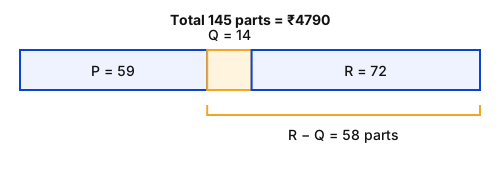
P, Q and R invest a sum in the ratio of 59 : 14 : 72, respectively. If they earned a total profit of ₹4,790 at the end of the year, what is the difference between the shares of Q and R?
P, Q और R क्रमशः 59 : 14 : 72 के अनुपात में एक राशि निवेश करते हैं। यदि वर्ष के अंत में उन्होंने कुल ₹4,790 का लाभ अर्जित किया, तो Q और R के हिस्सों में कितना अंतर है?
  1. A₹2,022
  2. B₹1,836
  3. C₹1,966
  4. D₹1,916
Show answer

Concept: Profit is shared in the ratio of investment.

  1. Total parts =59+14+72=145
  2. Difference of R and Q =72−14=58 parts
  3. Difference =58145×4790=25×4790=1916

Trick: 58145=25 – so just take 40% of ₹4,790.

Answer: (D) ₹1,916

अवधारणा: लाभ निवेश के अनुपात में बँटता है।

  1. कुल भाग =59+14+72=145
  2. R और Q का अंतर =72−14=58 भाग
  3. अंतर =58145×4790=25×4790=1916

ट्रिक: 58145=25 – यानी ₹4,790 का 40%।

उत्तर: (D) ₹1,916

RRB NTPC Undergraduate CBT 1MathematicsPartnershipRRB NTPC Undergraduate CBT 1 2024 · 22 Aug Shift 3 →
Q644.
The value of 121+0.0196−8.41 is _____.
121+0.0196−8.41 का मान _____ है।
  1. A6.03
  2. B15.54
  3. C8.24
  4. D8.55
Show answer

Concept: Take square roots of perfect squares, counting decimal places in pairs.

  1. 121=11
  2. 0.0196=0.14 (since 142=196, 4 decimal places → 2)
  3. 8.41=2.9 (since 292=841)
  4. 11+0.14−2.9=8.24

Trick: Decimal places in the root = half of those under the root.

Answer: (C) 8.24

अवधारणा: पूर्ण वर्गों का वर्गमूल लें, दशमलव स्थान जोड़े में गिनें।

  1. 121=11
  2. 0.0196=0.14 (क्योंकि 142=196, 4 दशमलव स्थान → 2)
  3. 8.41=2.9 (क्योंकि 292=841)
  4. 11+0.14−2.9=8.24

ट्रिक: वर्गमूल में दशमलव स्थान = अंदर वाले स्थानों का आधा।

उत्तर: (C) 8.24

RRB NTPC Undergraduate CBT 1MathematicsSquare RootsRRB NTPC Undergraduate CBT 1 2024 · 22 Aug Shift 3 →
Q645.
Find the perimeter of a semicircle with a radius of 7 cm. (Use π=227)
7 cm त्रिज्या वाले एक अर्धवृत्त का परिमाप ज्ञात कीजिए। (π=227 का प्रयोग कीजिए)
  1. A22 cm
  2. B25 cm
  3. C36 cm
  4. D28 cm
Show answer

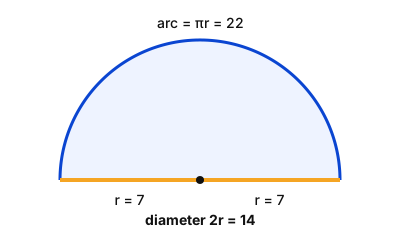
Concept: Perimeter of a semicircle = curved arc + diameter =πr+2r.

  1. Arc =227×7=22cm
  2. Diameter =2×7=14cm
  3. Perimeter =22+14=36cm

Trick: Perimeter =367r; with r=7 it is directly 36.

Answer: (C) 36cm

अवधारणा: अर्धवृत्त का परिमाप = वक्र चाप + व्यास =πr+2r।

  1. चाप =227×7=22cm
  2. व्यास =2×7=14cm
  3. परिमाप =22+14=36cm

ट्रिक: परिमाप =367r; r=7 पर सीधे 36।

उत्तर: (C) 36cm

RRB NTPC Undergraduate CBT 1MathematicsMensuration – SemicircleRRB NTPC Undergraduate CBT 1 2024 · 22 Aug Shift 3 →
Q646.
Anjani can do a certain piece of work in 30 days. Anjani and Khushbu can together do the same work in 10 days, and Anjani, Khushbu and Sushmita can do the same work together in 9 days. In how many days can Anjani and Sushmita do the same work together?
अंजनी किसी कार्य को 30 दिनों में पूरा कर सकती है। अंजनी और खुशबू मिलकर उसी कार्य को 10 दिनों में पूरा कर सकती हैं, और अंजनी, खुशबू और सुष्मिता मिलकर उसी कार्य को 9 दिनों में पूरा कर सकती हैं। अंजनी और सुष्मिता मिलकर उसी कार्य को कितने दिनों में पूरा कर सकती हैं?
  1. A442
  2. B494
  3. C452
  4. D383
Show answer

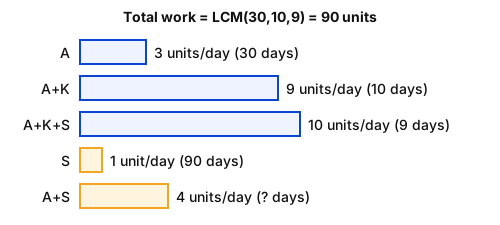
Concept: Take total work = LCM of days and find each person's daily units.

  1. LCM(30,10,9)=90 units. Anjani =9030=3, Anjani + Khushbu =9, all three =10 units/day
  2. Sushmita =10−9=1 unit/day
  3. Anjani + Sushmita =3+1=4 units/day
  4. Time =904=452 days

Trick: Sushmita = (A+K+S) − (A+K): 19−110=190.

Answer: (C) 452 days

अवधारणा: कुल कार्य = दिनों का LCM लें और प्रत्येक का प्रतिदिन कार्य निकालें।

  1. LCM(30,10,9)=90 इकाई। अंजनी =9030=3, अंजनी + ख़ुशबू =9, तीनों =10 इकाई/दिन
  2. सुष्मिता =10−9=1 इकाई/दिन
  3. अंजनी + सुष्मिता =3+1=4 इकाई/दिन
  4. समय =904=452 दिन

ट्रिक: सुष्मिता = (A+K+S) − (A+K): 19−110=190।

उत्तर: (C) 452 दिन

RRB NTPC Undergraduate CBT 1MathematicsTime and WorkRRB NTPC Undergraduate CBT 1 2024 · 22 Aug Shift 3 →
Q647.
The number of prime numbers lying between 488 and 494, both included, is:
488 और 494 के बीच स्थित (दोनों को सम्मिलित करते हुए) अभाज्य संख्याओं की संख्या कितनी है?
  1. A3
  2. B4
  3. C1
  4. D2
Show answer

Concept: Test each number for divisibility by primes up to 494≈22.

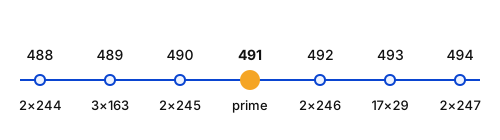
  1. 488, 490, 492, 494 are even – not prime.
  2. 489=3×163 (digit sum 21) and 493=17×29 – not prime.
  3. 491 is not divisible by 2, 3, 5, 7, 11, 13, 17, 19 – prime.
  4. So only one prime.

Trick: Remove evens first; only 489, 491, 493 need checking.

Answer: (C) 1

अवधारणा: 494≈22 तक के अभाज्यों से विभाज्यता जाँचें।

  1. 488, 490, 492, 494 सम हैं – अभाज्य नहीं।
  2. 489=3×163 (अंकों का योग 21) और 493=17×29 – अभाज्य नहीं।
  3. 491, 2, 3, 5, 7, 11, 13, 17, 19 से विभाज्य नहीं – अभाज्य।
  4. अतः केवल एक अभाज्य संख्या।

ट्रिक: पहले सम संख्याएँ हटाएँ; केवल 489, 491, 493 जाँचें।

उत्तर: (C) 1

RRB NTPC Undergraduate CBT 1MathematicsPrime NumbersRRB NTPC Undergraduate CBT 1 2024 · 22 Aug Shift 3 →
Q648.
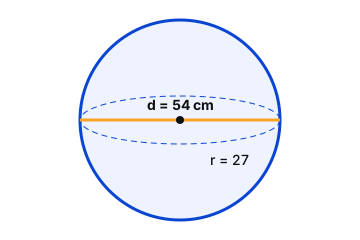
Find the surface area of a sphere whose diameter is equal to 54 cm.
उस गोले का पृष्ठीय क्षेत्रफल ज्ञात कीजिए जिसका व्यास 54 cm है।
  1. A3865π cm2
  2. B2386π cm2
  3. C3651π cm2
  4. D2916π cm2
Show answer

Concept: Surface area of a sphere =4πr2.

  1. r=542=27cm
  2. 4πr2=4π×272=4×729π
  3. =2916πcm2

Trick: 4πr2=πd2=542π=2916π directly.

Answer: (D) 2916πcm2

अवधारणा: गोले का पृष्ठीय क्षेत्रफल =4πr2।

  1. r=542=27cm
  2. 4πr2=4π×272=4×729π
  3. =2916πcm2

ट्रिक: 4πr2=πd2=542π=2916π सीधे।

उत्तर: (D) 2916πcm2

RRB NTPC Undergraduate CBT 1MathematicsMensuration – SphereRRB NTPC Undergraduate CBT 1 2024 · 22 Aug Shift 3 →
Q649.
The income of Raman is ₹86,400. He saves 22.5% of his income. If his income increases by 22% and expenditure increases by 25%, then his savings will:
रमन की आय ₹86,400 है। वह अपनी आय का 22.5% बचाता है। यदि उसकी आय में 22% की वृद्धि होती है और व्यय में 25% की वृद्धि होती है, तो उसकी बचत:
  1. Adecrease by ₹2,271₹2,271 कम हो जाएगी
  2. Bincrease by ₹2,268₹2,268 बढ़ जाएगी
  3. Cincrease by ₹2,273₹2,273 बढ़ जाएगी
  4. Ddecrease by ₹2,263₹2,263 कम हो जाएगी
Show answer

Concept: Savings=Income−Expenditure.

  1. Savings =22.5% of 86400 =19440; Expenditure =86400−19440=66960
  2. New income =86400×1.22=105408
  3. New expenditure =66960×1.25=83700
  4. New savings =105408−83700=21708; change =21708−19440=+2268

Trick: Change =22% of 86400−25% of 66960=19008−16740=2268.

Answer: (B) increase by ₹2,268

अवधारणा: बचत=आय−व्यय।

  1. बचत =86400 का 22.5%=19440; व्यय =86400−19440=66960
  2. नई आय =86400×1.22=105408
  3. नया व्यय =66960×1.25=83700
  4. नई बचत =105408−83700=21708; परिवर्तन =21708−19440=+2268

ट्रिक: परिवर्तन =86400 का 22%−66960 का 25%=19008−16740=2268।

उत्तर: (B) increase by ₹2,268

RRB NTPC Undergraduate CBT 1MathematicsIncome, Expenditure and SavingsRRB NTPC Undergraduate CBT 1 2024 · 22 Aug Shift 3 →
Q650.
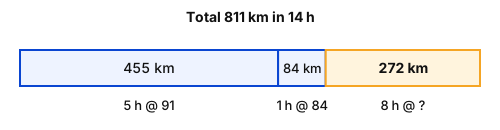
Diya has to reach Surat which is 811 km away in 14 hours. His starting speed for 5 hours was 91 km/hr. For the next 84 km his speed was 84 km/hr. By what speed he must travel now so as to reach Surat in the decided time of 14 hours?
दीया को 811 km दूर स्थित सूरत 14 घंटे में पहुँचना है। प्रारंभिक 5 घंटों के लिए उसकी चाल 91 km/hr थी। अगले 84 km के लिए उसकी चाल 84 km/hr थी। निर्धारित 14 घंटे में सूरत पहुँचने के लिए अब उसे किस चाल से यात्रा करनी होगी?
  1. A38 km/hr
  2. B39 km/hr
  3. C35 km/hr
  4. D34 km/hr
Show answer

Concept: Required speed =remaining distanceremaining time.

  1. First 5 h: 5×91=455km
  2. Next 84 km at 84km/h takes 1 h
  3. Covered =455+84=539km in 6 h; left =811−539=272km in 14−6=8 h
  4. Speed =2728=34km/h

Trick: Same number distance and speed (84 km at 84 km/h) = exactly 1 hour.

Answer: (D) 34km/h

अवधारणा: आवश्यक चाल =शेष दूरीशेष समय।

  1. पहले 5 घंटे: 5×91=455km
  2. अगले 84 km, 84km/h से = 1 घंटा
  3. तय दूरी =455+84=539km, समय 6 घंटे; शेष =811−539=272km, समय 14−6=8 घंटे
  4. चाल =2728=34km/h

ट्रिक: दूरी और चाल की संख्या समान (84 km, 84 km/h) = ठीक 1 घंटा।

उत्तर: (D) 34km/h

RRB NTPC Undergraduate CBT 1MathematicsSpeed, Time and DistanceRRB NTPC Undergraduate CBT 1 2024 · 22 Aug Shift 3 →
Q651.
Find the simple interest (in ₹) on ₹4,000 at 7.5% per annum rate of interest deposited on 5 February 2024 and withdrawn on 6 April 2024.
₹4,000 पर 7.5% वार्षिक ब्याज दर से साधारण ब्याज (₹ में) ज्ञात कीजिए, जो 5 फ़रवरी 2024 को जमा किया गया और 6 अप्रैल 2024 को निकाला गया।
  1. A49
  2. B51
  3. C50
  4. D48
Show answer

Concept: For a period in days, SI=P×R×days100×days in year. Count the day of deposit OR withdrawal, not both. 2024 is a leap year (366 days).

  1. Days: February 29−5=24, March 31, April 6 → 24+31+6=61 days.
  2. SI=4000×7.5×61100×366
  3. =183000036600=50

Trick: 61 days of 366 = 16 year → SI=4000×7.5%×16=300÷6=50.

Answer: (C) ₹50

अवधारणा: दिनों के लिए SI=P×R×days100×days in year। जमा या निकासी में से केवल एक दिन गिनें। 2024 लीप वर्ष है (366 दिन)।

  1. दिन: फरवरी 29−5=24, मार्च 31, अप्रैल 6 → कुल 61 दिन।
  2. SI=4000×7.5×61100×366
  3. =183000036600=50

ट्रिक: 61366=16 वर्ष → 4000×7.5%=300, 300÷6=50।

उत्तर: (C) ₹50

RRB NTPC Undergraduate CBT 1MathematicsSimple Interest (days)RRB NTPC Undergraduate CBT 1 2024 · 22 Aug Shift 3 →
Q652.
A number, when increased by 60%, gives 3600. The number is:
एक संख्या में 60% की वृद्धि करने पर 3600 प्राप्त होता है। वह संख्या है:
  1. A4500
  2. B6750
  3. C2250
  4. D1125
Show answer

Concept: Increasing a number by 60% means multiplying it by 1.6.

  1. Let the number be x. Then x×160100=3600.
  2. x=3600×100160=2250.

Trick: 160%→3600, so 1%→22.5 and 100%→2250.

Answer: (C) 2250

अवधारणा: किसी संख्या में 60% वृद्धि = संख्या ×1.6।

  1. माना संख्या x है: x×160100=3600।
  2. x=3600×100160=2250।

ट्रिक: 160%→3600, 1%→22.5, 100%→2250।

उत्तर: (C) 2250

RRB NTPC Undergraduate CBT 1MathematicsPercentage increaseRRB NTPC Undergraduate CBT 1 2024 · 22 Aug Shift 3 →
Q653.
The average of first 165 even numbers is
प्रथम 165 सम संख्याओं का औसत है
  1. A166
  2. B167
  3. C165.5
  4. D166.5
Show answer

Concept: Sum of first n even numbers =n(n+1), so their average =n+1.

  1. Here n=165.
  2. Average =165+1=166.
  3. Check: first and last even numbers are 2 and 330; average =2+3302=166.

Yaad rakhein: Average of first n even numbers =n+1; of first n odd numbers =n.

Answer: (A) 166

अवधारणा: पहली n सम संख्याओं का योग =n(n+1), अतः औसत =n+1।

  1. यहाँ n=165।
  2. औसत =165+1=166।
  3. जाँच: पहली व अंतिम सम संख्या 2 और 330; औसत =2+3302=166।

याद रखें: पहली n सम संख्याओं का औसत =n+1; पहली n विषम संख्याओं का औसत =n।

उत्तर: (A) 166

RRB NTPC Undergraduate CBT 1MathematicsAverage of even numbersRRB NTPC Undergraduate CBT 1 2024 · 22 Aug Shift 3 →
Q654.
An article is marked for ₹720. If two successive discounts of 10% and 15% are allowed for sale, then the selling price of the article is:
एक वस्तु का अंकित मूल्य ₹720 है। यदि बिक्री के लिए 10% और 15% की दो क्रमागत छूट दी जाती हैं, तो वस्तु का विक्रय मूल्य है:
  1. A₹597.60
  2. B₹550.80
  3. C₹468
  4. D₹489.60
Show answer

Concept: Successive discounts are applied one after another: SP=MP×(1−d1)(1−d2).

  1. After 10%: 720×0.9=648.
  2. After 15%: 648×0.85=550.80.

Trick: Net discount =10+15−10×15100=23.5% → 720×0.765=550.80.

Answer: (B) ₹550.80

अवधारणा: क्रमागत छूट एक के बाद एक लगती है: SP=MP×(1−d1)(1−d2)।

  1. 10% के बाद: 720×0.9=648।
  2. 15% के बाद: 648×0.85=550.80।

ट्रिक: शुद्ध छूट =10+15−10×15100=23.5% → 720×0.765=550.80।

उत्तर: (B) ₹550.80

RRB NTPC Undergraduate CBT 1MathematicsSuccessive discountsRRB NTPC Undergraduate CBT 1 2024 · 22 Aug Shift 3 →
Q655.
What sum of money (in ₹) will amount to ₹2,400 at 5% per annum simple interest in 4 years?
कितनी धनराशि (₹ में) 5% वार्षिक साधारण ब्याज की दर से 4 वर्ष में ₹2,400 हो जाएगी?
  1. A₹1,950
  2. B₹2,000
  3. C₹12,000
  4. D₹2,050
Show answer

Concept: Amount =P(1+RT100) for simple interest.

  1. Total interest rate =5×4=20%.
  2. P×120100=2400 → P=2000.

Trick: 120%→2400, so 100%→2000.

Answer: (B) ₹2,000

अवधारणा: साधारण ब्याज में मिश्रधन =P(1+RT100)।

  1. कुल ब्याज दर =5×4=20%।
  2. P×120100=2400 → P=2000।

ट्रिक: 120%→2400, तो 100%→2000।

उत्तर: (B) ₹2,000

RRB NTPC Undergraduate CBT 1MathematicsSimple InterestRRB NTPC Undergraduate CBT 1 2024 · 22 Aug Shift 3 →
Q656.
The average price of three items of furniture is ₹16,005. If their prices are in the ratio 3 : 5 : 7, the price of the cheapest item (in ₹) is:
फर्नीचर की तीन वस्तुओं का औसत मूल्य ₹16,005 है। यदि उनके मूल्य 3 : 5 : 7 के अनुपात में हैं, तो सबसे सस्ती वस्तु का मूल्य (₹ में) है:
  1. A9,603
  2. B5,335
  3. C3,201
  4. D7,469
Show answer

Concept: Total =average×number of items; then divide the total in the given ratio.

  1. Total price =16005×3=48015.
  2. Ratio parts =3+5+7=15 → 1 part =48015÷15=3201.
  3. Cheapest item =3×3201=9603.

Trick: Average of 3 items = middle share when ratio is in AP: 5 parts =16005 → 1 part =3201 → 3 parts =9603.

Answer: (A) 9,603

अवधारणा: कुल =औसत×वस्तुओं की संख्या, फिर कुल को अनुपात में बाँटें।

  1. कुल मूल्य =16005×3=48015।
  2. कुल भाग =3+5+7=15 → 1 भाग =48015÷15=3201।
  3. सबसे सस्ती वस्तु =3×3201=9603।

ट्रिक: अनुपात समांतर श्रेढ़ी (AP) में है, तो बीच वाला हिस्सा = औसत: 5 भाग =16005 → 1 भाग =3201 → 3 भाग =9603।

उत्तर: (A) 9,603

RRB NTPC Undergraduate CBT 1MathematicsAverage and ratioRRB NTPC Undergraduate CBT 1 2024 · 22 Aug Shift 3 →
Q657.
Anil bought some pens at the rate of ₹150 a dozen. He sold them for ₹45 each. His profit percentage is ______%.
अनिल ने ₹150 प्रति दर्जन की दर से कुछ पेन खरीदे। उसने उन्हें ₹45 प्रति पेन की दर से बेचा। उसका लाभ प्रतिशत ______% है।
  1. A258
  2. B260
  3. C262
  4. D264
Show answer

Concept: Profit%=SP−CPCP×100, compared per pen.

  1. CP of 1 pen =150÷12=12.5.
  2. SP of 1 pen =45; profit =45−12.5=32.5.
  3. Profit%=32.512.5×100=260%.

Trick: Compare a dozen: CP =150, SP =45×12=540; profit =390 → 390150×100=260%.

Answer: (B) 260

अवधारणा: लाभ%=SP−CPCP×100, एक पेन के आधार पर।

  1. 1 पेन का CP =150÷12=12.5।
  2. 1 पेन का SP =45; लाभ =45−12.5=32.5।
  3. लाभ%=32.512.5×100=260%।

ट्रिक: एक दर्जन पर: CP =150, SP =45×12=540; लाभ =390 → 390150×100=260%।

उत्तर: (B) 260

RRB NTPC Undergraduate CBT 1MathematicsProfit percentageRRB NTPC Undergraduate CBT 1 2024 · 22 Aug Shift 3 →
Q658.
Find the value of 83−2÷ 837× 83−10.
83−2÷ 837× 83−10 का मान ज्ञात कीजिए।
  1. A83−19
  2. B83−20
  3. C83−16
  4. D83−14
Show answer

Concept: am÷an=am−n and am×an=am+n; work left to right.

  1. 83−2÷837=83−2−7=83−9.
  2. 83−9×83−10=83−9−10=83−19.

Trick: Only the powers matter: −2−7+(−10)=−19.

Answer: (A) 83−19

अवधारणा: am÷an=am−n तथा am×an=am+n; बाएँ से दाएँ हल करें।

  1. 83−2÷837=83−2−7=83−9।
  2. 83−9×83−10=83−9−10=83−19।

ट्रिक: केवल घातों पर काम करें: −2−7+(−10)=−19।

उत्तर: (A) 83−19

RRB NTPC Undergraduate CBT 1MathematicsLaws of indicesRRB NTPC Undergraduate CBT 1 2024 · 22 Aug Shift 3 →
Q659.
The product of two consecutive positive natural numbers is 930. The greater of the two numbers is:
दो क्रमागत धनात्मक प्राकृत संख्याओं का गुणनफल 930 है। दोनों संख्याओं में से बड़ी संख्या है:
  1. A29
  2. B32
  3. C33
  4. D31
Show answer

Concept: For n(n+1)=930, n is just below 930.

  1. 930≈30.5, so try 30×31.
  2. 30×31=930 ✓.
  3. Greater number =31.

Trick: Unit digit 0 in 930 → one number ends in 0 or 5; 30×31 fits at once.

Answer: (D) 31

अवधारणा: n(n+1)=930 में n, 930 से थोड़ा कम होगा।

  1. 930≈30.5, अतः 30×31 आज़माएँ।
  2. 30×31=930 ✓।
  3. बड़ी संख्या =31।

ट्रिक: 930 का इकाई अंक 0 → एक संख्या 0 या 5 पर समाप्त; 30×31 तुरंत मिलता है।

उत्तर: (D) 31

RRB NTPC Undergraduate CBT 1MathematicsConsecutive numbersRRB NTPC Undergraduate CBT 1 2024 · 22 Aug Shift 3 →
Q660.
Simplify x(7x − 2) + 5(x2 − 3) + 13.
x(7x − 2) + 5(x2 − 3) + 13 को सरल कीजिए।
  1. A12x2 − 2x + 2
  2. B−12x2 − 2x − 2
  3. C12x2 − 2x − 2
  4. D−12x2 − 2x + 2
Show answer

Concept: Expand the brackets and combine like terms.

  1. x(7x−2)=7x2−2x.
  2. 5(x2−3)=5x2−15.
  3. Sum +13: 7x2+5x2−2x−15+13=12x2−2x−2.

Trick: Put x=0: expression =−15+13=−2 → constant term must be −2 with positive x2; only (C) fits.

Answer: (C) 12x2−2x−2

अवधारणा: कोष्ठक खोलें और समान पदों को जोड़ें।

  1. x(7x−2)=7x2−2x।
  2. 5(x2−3)=5x2−15।
  3. जोड़ +13: 7x2+5x2−2x−15+13=12x2−2x−2।

ट्रिक: x=0 रखें: मान =−15+13=−2 → अचर पद −2 और x2 धनात्मक; केवल (C)।

उत्तर: (C) 12x2−2x−2

RRB NTPC Undergraduate CBT 1MathematicsAlgebraic simplificationRRB NTPC Undergraduate CBT 1 2024 · 22 Aug Shift 3 →